Georgia State University Georgia State University
ScholarWorks @ Georgia State University
ScholarWorks @ Georgia State University
Computer Information Systems Dissertations Department of Computer Information Systems
Fall 12-18-2012
The Management of Distance in Distributed-work
The Management of Distance in Distributed-work
Chauvet Mathieu Georgia State University
Follow this and additional works at: https://scholarworks.gsu.edu/cis_diss
Recommended Citation Recommended Citation
Mathieu, Chauvet, "The Management of Distance in Distributed-work." Dissertation, Georgia State University, 2012.
https://scholarworks.gsu.edu/cis_diss/50
1
UNIVERSITE PARIS-DAUPHINE
ECOLE DOCTORALE DE DAUPHINE
&
GEORGIA STATE UNIVERSITY
J.MACK ROBINSON COLLEGE OF BUSINESS
THESE
Pour l’obtention du titre de
DOCTEUR EN SCIENCES DE GESTION
(Arrêté du 07 Août 2006)
CHAUVET Mathieu
The Management of Distance in
Distributed-work: A Deleuzian Approach to Control
Co-directeurs de thèse : Pr. Stéphanie DAMERON/Pr. Michael
GALLIVAN
Thèse présentée et soutenue publiquement le 13 Novembre 2012
Rapporteurs :
Pr. Jean-Pierre DUPUIS
Pr. Jacques THEVENOT
Suffragants :
Pr. Jean-François CHANLAT
Pr. Sébastien DAMART
2
L’université n’entend donner aucune
3 PERMISSION TO BORROW
In presenting this dissertation as a partial fulfillment of the requirements for an advanced degree from Georgia State University, I agree that the Library of the University shall make it available for inspection and circulation in accordance with its regulations governing materials of this type. I agree that permission to quote from, to copy from, or publish this dissertation may be granted by the author or, in his/her absence, the professor under whose direction it was written or, in his absence, by the Dean of the Robinson College of Business. Such
quoting, copying, or publishing must be solely for the scholarly purposes and does not involve potential financial gain. It is understood that any copying from or publication of this
dissertation which involves potential gain will not be allowed without written permission of the author.
4 NOTICE TO BORROWERS
All dissertations deposited in the Georgia State University Library must be used only in accordance with the stipulations prescribed by the author in the preceding statement.
The author of this dissertation is:
CHAUVET MATHIEU
46 Rue Manessier
94130 Nogent sur Marne
France
The directors of this dissertation are:
Pr. Michael GALLIVAN
CIS Department – Georgia State University
9th Floor, RCB Building, 35 Broad Street, Atlanta, 30302, Georgia, USA
Pr. Stéphanie DAMERON
GFR Management & Organisation - Université Paris Dauphine
5 THE MANAGEMENT OF DISTANCE IN DISTRIBUTED-WORK: A DELEUZIAN
APPROACH TO CONTROL
BY
Mathieu Julien CHAUVET
A Dissertation Submitted in Partial Fulfillment of the Requirements for the Degree
Of
Doctor of Philosophy
In the Robinson College of Business
Of
Georgia State University
GEORGIA STATE UNIVERSITY
ROBINSON COLLEGE OF BUSINESS
6 Copyright by
Mathieu Julien CHAUVET
7 ACCEPTANCE
This dissertation was prepared under the direction of the Mathieu CHAUVET Dissertation Committee. It has been approved and accepted by all members of that committee, and it has been accepted in partial fulfillment of the requirements for the degree of Doctoral of
Philosophy in Business Administration in the J. Mack Robinson College of Business of Georgia State University.
H. Fenwick Huss, Dean
DISSERTATION COMMITTEE
Pr. Michael GALLIVAN
Pr. Stéphanie DAMERON
Pr. Jean-Pierre DUPUIS
Pr. Jacques THEVENOT
Pr. Sébastien DAMART
Pr. Jean-François CHANLAT
Pr. Lars MATHIASSEN
8 ABSTRACT
THE MANAGEMENT OF DISTANCE IN DISTRIBUTED-WORK: A DELEUZIAN APPROACH TO CONTROL
BY
Mathieu Julien CHAUVET
13th of November 2012
Committee Co-Chair: Pr. Michael GALLIVAN and Pr. Stéphanie DAMERON
Major Academic Unit: Computer and Information Systems
Distributed-work has introduced challenges for both employees and managers alike.
Maintaining a form of supervision and discipline remains then necessary as control is the
ultimate means for the hierarchy to bridge the issue of distance. With regard to the
unprecedented changes generated by the significant development of ICTs in organizations, we
expressed the necessity to analyze how control is reconsidered within the managerial
challenges introduced by distributed-work.
Our theoretical reasoning finally led us to use the works of French philosopher Gilles Deleuze
as a basis for a more relevant conceptual framework. Data coming from 49 interviews and 7
days as non-participant observer enabled us to provide evidences for the disruption of
management practices due to the reconsideration of control in distributed-work. Both for
managers, evolving from a supervisory to a facilitator status, and distributed-workers
themselves, whose activities will mainly be directed by the management of their visibility,
responsiveness and modulation. Ultimately, this PhD dissertation provides concrete
9
ACKNOWLEDGEMENTS
At the end of this long research-work taking the form of this final document, and by looking
into the last few years, I can only consider how this dissertation process has been one of the
most significant challenges of my life. Sometimes painful, but always very rewarding, the
heavy work of reflection, analysis and synthesis remains an intense learning experience that it
will be hard to forget. In terms of cultural experience in particular, thanks to the many people
who have accompanied me throughout this journey.
My first thanks go to my French co-advisor, Professor Stephanie DAMERON, with whom I
will never be indebted enough for all her efforts developed in our research collaboration. It's
not lying to say that without her support and trust, I would never have conceived and - a
fortiori, reached the conclusion of such research-work based on managerial issues that really
mean to me. I can only thank her for her high availability, for the mentoring she proposed to
me throughout these many months of work, despite her own and multiple responsibilities. For
all her experience and knowledge she has shared with me, for the focus on reflection and
synthesis she always wanted me to develop during our exchanges, for her involvement in
activities that enabled me to conduct my PhD at best (field-research through the Chaire
“Management & Diversité”, various applications, renewing my ATER status), I want to
sincerely thank her. While this document is about to be evaluated in its entirety over the next
few weeks, my greatest pride would be that this research-work is recognized and valued up to
the consideration I have for my French co-advisor.
Then I want to express my deep gratitude to my other co-advisor, Professor Michael
GALLIVAN. Throughout this dual PhD, I have appreciated his great qualities of empathy,
listening and openness. Especially during the two semesters at Georgia State University where
he received and welcomed me very naturally, allowing me to live these semesters at best. By
collaborating with him, I had the tremendous opportunity to discover another aspect of the
academic world, which is the Anglo-Saxon one, and I am extremely grateful for the chance I
had to evolve under the responsibility of such a reputed person.
I then expressed my sincere thanks to all the members of my thesis committee. Professor
10 knowledge, his generosity and his contagious enthusiasm, and for his unfailing support in
recent years as Head of our dear CREPA laboratory. Professor Jean-Pierre DUPUIS and
Professor Jacques THEVENOT then, who kindly agreed to be my dissertation reviewers
(“rapporteurs”) and who devote their valuable time for analyzing my research. Professor Lars
MATHIASSEN and Professor Duane TRUEX, for their advice and the various exchanges we
had during my stays at GSU or my pre-defense. Pr.DAMART finally, for his extreme
availability and his responsiveness, as well as for his numerous comments and remarks n
particular during the very interesting CDEG seminar. I certainly do not consider enough how
fortunate I am to have all these different members participating in my dissertation committee,
but I really feel honored for their commitment
I would also like to thank Mr. Jacques MASSOT, with whom I have always enjoyed
exchanging, for his knowledge, his experience and his considerable contribution to the
development of my field-study through the company EADS. These acknowledgments have to
be sent to participants from the EADS group who helped me through their assistance in
making this research-work as well. In the same vein, I would like to emphasize the role of Mr.
Eric DEL'COTTO in the achievement of my research collaboration with the company he
manages, KCI MEDICAL. This is also for me the opportunity to thank all the members of this
organization for their availabilities and interests.
Among the many people who offered me their support during the realization of this
dissertation, I would like to especially thank Mrs. Adenike BREWINGTON for her
tremendous support in the management of administrative issues relative to the constitution of
this dual PhD program between distinctive universities. I am also extremely grateful to all the
teams - professors, administrative members, PhD students – of our CREPA laboratory who
accompanied me and have provided their significant advices through various conferences or
more informal exchanges. Thank you also to the “Service des Thèses” of Paris Dauphine
University for being complaisant and cordial during the discussions we had together. Apart
from this noble institution, I would also like to acknowledge the contribution of Anne-Sophie
FERNANDEZ, a young and recent professor for her collaboration on this dissertation and
other mutual research works.
11 for the hilarious moments we had together and allowed me to take some steps back when I
was confronted with some harsh realities of my doctoral activities. I would also like to take
this opportunity to especially thank Amandine - I never do it enough - for her encouragement,
her presence and patience; some of her qualities that have often been undermined by my daily
work on this dissertation but that she hardly ever complained about. Living every day by my
side might not certainly be an easy task, then I thank her for everything she brings into our
happy life together.
Finally, I would like to conclude these acknowledgments with those who have always been
there by my side, it means my beloved family, my parents, my sister, my grandfather, and my
“parrain”, for the trust and support they expressed not only during the development of this
PhD dissertation but also all along my studies.
12
REMERCIEMENTS
Au terme de ce long travail de recherche matérialisé ici par ce document, et en me penchant
sur ces dernières années, je ne peux que constater combien ce processus de thèse a constitué
pour moi l’un des challenges les plus significatifs de mon existence. Quelque fois douloureux, mais toujours très enrichissant, ce lourd travail de réflexion, d’analyse et de synthèse restera
pour moi une expérience formatrice intense et certainement inoubliable. Sur le plan humain
en particulier, et cela grâce aux nombreuses personnes qui m’ont accompagné tout au long de
ce parcours.
Mes premiers remerciements sont adressés à ma co-directrice de thèse, Pr. Stéphanie
DAMERON, auprès de laquelle je ne serai sûrement jamais assez redevable des efforts
fournis dans notre collaboration de recherche. Ce n’est pas mentir que de dire que sans son
soutien et sa confiance, je n’aurais jamais pu concevoir et – a fortiori- arriver au terme d’un
tel travail de recherche sur des problématiques de management qui me sont chères. Je ne peux
que la remercier pour sa très grande disponibilité, et le suivi qu’elle a pu promulguer tout au
long de ces nombreux mois de travail, et cela malgré ses activités propres et multiples. Pour
son expérience et ses connaissances qu’elle a su partager, pour le travail de réflexion et de synthèse qu’elle m’a toujours poussé à développer au cours de nos échanges, pour son
engagement dans des dossiers me permettant de mener au mieux mes activités de doctorant
(sollicitation de terrains par le biais de la Chaire Management & Diversité, candidatures
diverses, renouvellement de mon statut d’ATER), je tiens sincèrement à la remercier. Alors
que ce document de travail va finalement être évalué dans sa globalité au cours des semaines
à venir, ma plus grande fierté serait que celui-ci soit reconnu et apprécié à hauteur de l’estime
que je porte à ma co-directrice de thèse.
Je tiens ensuite à exprimer ma profonde gratitude à mon autre co-directeur de thèse,
13 anglo-saxonne, et suis reconnaissant de la chance d’avoir évolué sous la responsabilité d’une
personne si reconnue.
J’exprime ensuite mes sincères remerciements à l’ensemble des membres de mon comité de
thèse. Le Pr. Jean-François CHANLAT tout d’abord, à la fois pour son rôle prépondérant de
Président de jury, son savoir, sa générosité et son enthousiasme communicatif, ainsi que pour
son soutien sans failles au cours des dernières années en tant que responsable de notre cher
laboratoire CREPA. Pr. Jean-Pierre DUPUIS et Pr. Jacques THEVENOT ensuite, pour avoir
cordialement accepté d’être mes rapporteurs de thèse et de consacrer leur temps si précieux à l’analyse de mon travail de recherche. Pr. Lars MATHIASSEN et Pr. Duane TRUEX, pour
leurs nombreux conseils et échanges établis au cours de mes séjours à GSU ou de ma
pré-soutenance. Pr.DAMART enfin, pour son extrême disponibilité et sa réactivité, ainsi que pour
ses nombreux conseils et remarques lors du séminaire formateur CDEG notamment. Je ne
mesure certainement pas la chance d’avoir l’ensemble de ces différents membres dans mon jury de thèse, mais c’est véritablement un honneur pour moi que ces personnes acceptent de
participer à ce dernier.
Je tiens ensuite à remercier Mr. Jacques MASSOT, avec qui j’ai toujours pris plaisir à
échanger, pour ses connaissances, son expérience et son apport considérable dans la mise en
place de mon étude terrain auprès de l’entreprise EADS. Ces remerciements sont également à
adresser aux nombreux collaborateurs du groupe EADS qui m’ont aidé, à travers leur
concours, à concrétiser ce travail de recherche. Dans la même optique, je souhaiterai souligner
le rôle prépondérant de Mr. Eric DEL’COTTO dans l’aboutissement de ma collaboration de
recherche avec l’entreprise qu’il dirige, KCI MEDICAL, et par ce biais remercier l’ensemble
des équipes de son organisation pour leurs disponibilités et participations.
Parmi les nombreuses personnes qui m’ont proposé leur aide précieuse durant la réalisation de
cette thèse, je souhaiterais remercier tout particulièrement Mme Adenike BREWINGTON
pour son aide extrêmement précieuse dans le règlement des problématiques administratives
relatives à l’établissement de cette thèse en co-tutelle entre deux universités bien distinctes. Je
voudrais également saluer les équipes – enseignants-chercheurs, administratifs, doctorants -
du laboratoire CREPA qui m’ont accompagné et m’ont prodigué leurs conseils à travers de
14 l’Université Paris Dauphine pour avoir été complaisant et cordiaux lors des nombreux échanges que j’ai pu avoir avec eux. En dehors de cette noble institution, je souhaiterais également souligner l’apport d’Anne-Sophie FERNANDEZ, jeune docteur depuis peu, pour
sa collaboration autour de cette thèse et autres activités de recherche communes.
Comment ne pas remercier également mes amis de toujours, Eric, Franck, Michael ou Steve,
pour leurs franches parties de rigolade qui m’ont permis de souffler et prendre du recul lorsque j’étais parfois confronté aux dures réalités de toutes activités de doctorat. J’aimerais
aussi profiter de cette occasion pour remercier tout particulièrement Amandine – ce que je ne
fais jamais assez - pour ses encouragements, sa présence et sa patience ; des qualités qui ont
souvent été mises à mal par mon travail au quotidien sur cette thèse sans qu’elle ne m’en
tienne jamais vraiment rigueur. Vivre tous les jours à mes côtés ne doit surement pas être une
tâche aisée et je l’en remercie pour tout ce qu’elle m’apporte dans cette vie à deux.
Enfin, j’aimerais clôturer ces remerciements par ceux et celles qui ont depuis toujours été là à
mes côtés, à savoir ma tendre famille, mes parents, ma grande sœur, mon grand-père, ainsi
que mon parrain, pour leur soutien et leur confiance accordés, non seulement durant ces
années de recherche, mais également tout au long de mes études.
15
INDEX
ACKNOWLEDGEMENTS ... 9
REMERCIEMENTS ... 12
INDEX ... 15
FIGURE INDEX ... 18
TABLE INDEX ... ERREUR ! SIGNET NON DÉFINI.19 GENERAL INTRODUCTION ... 21
I) Distributed-work as our research object: presentation and organizational manifestations: ... 22
III) Our research work sequence : ... 29
PART I: THEORETICAL FOUNDATIONS OF CONTROL IN DISTRIBUTED-WORK ... 33
CHAPTER I:DISTRIBUTED-WORK: CHARACTERISTICS AND EFFECT ON MANAGEMENT ... 34
I) The emergence of a Temporal distance: ... 36
II) The impact of Geographical distance: ... 39
III) The significance of Cultural distance: ... 41
CHAPTER II:THE CONCEPT OF CONTROL: AN ANALYSIS THROUGH THE MANAGEMENT OF DISTRIBUTED-WORK ... 45
I) Definition of control : ... 46
II) Means and tools in control organizations : ... 49
1) Behavior control: ... 49
2) Outcome control: ... 51
3) Social control: ... 52
4) Self-Control: ... 54
5) Matrix of control forms: ... 55
6) Control Portfolios: ... 57
7) Expected control modes in work-at-distance environments: ... 59
III) A need for conceptual step forward in the general understanding of control: ... 62
1) Limits of approaches of control in organization theories: ... 62
2) Michel Foucault and the concept of disciplinary power: ... 68
3) Limitations of Foucault’s theory and contributions of Deleuze: ... 71
4) Relevancy of Deleuze’s works for our research perspective: ... 73
PART II: METHODOLOGY AND DESIGN OF THE CORE RESEARCH ... 78
CHAPTER III:METHODOLOGY OF RESEARCH ... 79
I) Research design: ... 80
1) Epistemological posture : ... 80
16
3) Research strategy for apprehending reality : the case study ... 90
4) Research Roadmap : ... 105
5) Research occupational hazards: ... 108
II) Data collection: ... 111
III) Modalities of data analysis: ... 123
1) Data analysis process: ... 123
2) Rigor and Relevancy of our research data : ... 128
IV) General description of cases: ... 133
1) FIRST CASE: functional team within the company EADS – Corporate Department: ... 133
2) SECOND CASE: functional and operational team within the company EADS – Cassidian division: ... 145
3) THIRD CASE: Operational team within the company EADS – Cassidian division: 150 4) FOURTH CASE: Functional team within the company KCI – KCI Medical France: ... 153
CHAPTER IV:RECONFIGURATION AND DESIGN OF OUR ANALYTICAL FRAMEWORK ... 159
I) Reconsideration of types of distance constitutive of remote-environments through Deleuze’s works: ... 159
1) The rhizome structure: ... 160
2) The actual/virtual dichotomy: ... 163
3) The deterritorialization:... 166
II) Global management of the three forms of distance using Deleuzian concepts: ... 169
1) The impact of the rhizome structure on forms of distance in distributed-work:.. 169
2) The impact of Deleuze’s work on the virtual/actual dichotomy over distance in distributed-work: ... 177
3) The influence of the phenomenon of deterritorialization over distances in distributed-work ... 185
III) Logic of control for managing the different forms of distance:... 194
1) Temporal distance: ... 195
2) Geographical distance: ... 200
3) Cultural distance: ... 202
4) Deleuzian perspective on logic of control for the management of distance: ... 205
PART III: EMPIRICAL EXAMINATION OF OUR FRAMEWORK THROUGH CASE STUDIES ... 218
CHAPTER V:CASE ANALYSES ... 219
I) Identification and consideration of temporal distance: ... 219
II) Perceptions of geographical distance: ... 225
III) The consideration of cultural distance : ... 231
IV) Global management of distance : ... 236
V) Control portfolio and societies of control: ... 238
17
I) Similarities with previous cases: ... 244
1) Temporal distance: manifestations of isolation, control-enactment processes and impact over visibility: ... 244
2) A common observation of perceived proximity and social control in the management of geographical distance: ... 249
3) The omnipresence of deterritorialization: ... 253
4) General management of distance and control: ... 254
II) Differences and original contributions: ... 256
1) Issue of distributed forms (telecommuting and nomadic work) with respect to perceptions of temporality : ... 256
2) A different understanding of cultural distance and effects of outcome control on cultural deterritorialization : ... 261
PART IV: GENERAL RESTITUTION OF THE EMPIRICAL RESEARCH: STEPPING BACK TOWARDS A BIGGER PICTURE ... 266
CHAPTER VII:THE RECONSIDERATION OF CONTROL IN THE MANAGERIAL CHALLENGES INTRODUCED BY DISTRIBUTED-WORK ... 267
I) The managerial challenges introduced by emergent forms of distance and necessitating the deployment of control practices: ... 268
II) Control modalities and reconsideration of control in distributed-work: ... 272
III) Societies of control and questioning of managerial motivations for distributed-work: ... 278
GENERAL CONCLUSION:INSIGHTS, LIMITATIONS AND PERSPECTIVES ... 287
1) Theoretical and methodological contributions: ... 287
2) Managerial contributions: ... 290
3) Limitations of our research work: ... 291
REFERENCES ... 293
18
FIGURE INDEX
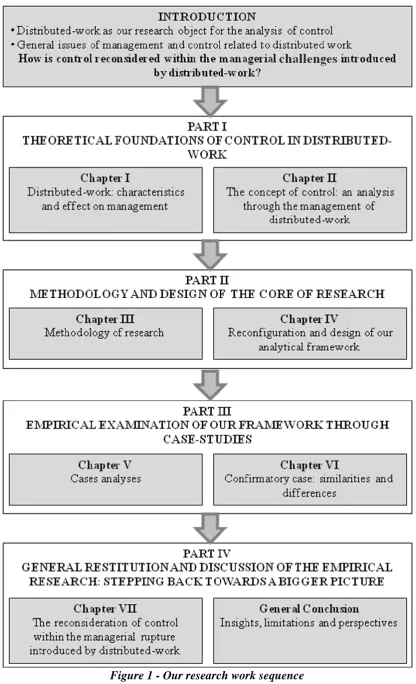
Figure 1 - Our research work sequence ... 31
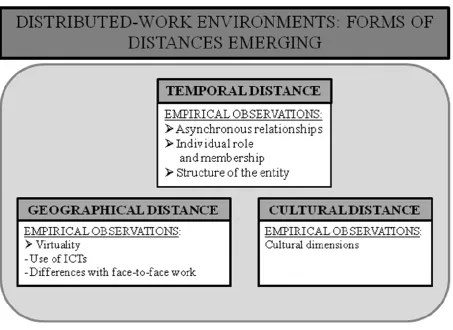
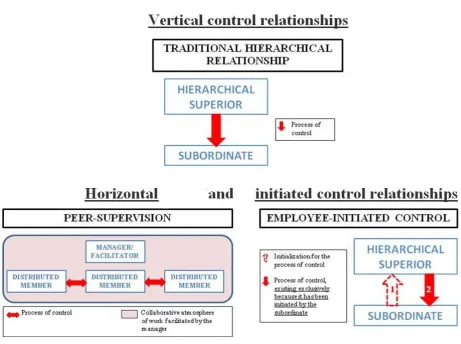
Figure 2 - The three forms of distance constitutive of distributed-work environments ... 44, 353 Figure 3 - Control relationships created by the development of distributed-work ... 66
Figure 4 - Our Case Study Method ... 91
Figure 5 - EADS Management Structure ... 136
Figure 6 - Organization chart of the HR/CD Department ... 140
Figure 7: A Deleuzian perspective of the management of distances in distributed-work environments ... 193
Figure 8 - Comparison and shift of control forms from approaches of control in organizational
theories to our analysis based on Deleuze’s work ... 208, 363
Figure 9 - Analytical framework: The management of distances in distributed-work
environments: a Deleuzian approach to control ... 210, 365
Figure 10 - The management of distances in distributed-work environments: A Deleuzian
19 FIGURE INDEX
Table 1 - Forms of control in Organizations ... 55
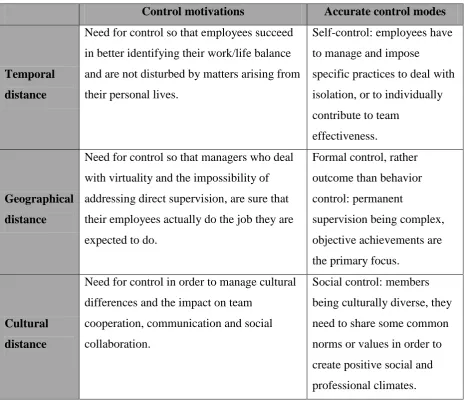
Table 2 - Expected control modes and motivations in work-at-distance environments according to approaches of control in organizational theories (own construction ... 61
Table 3 - Theoretical Grid, as a result of the literature review regarding the theme of managerial and control issues in remote-work universes ... 76
Table 4 - Variety of our case selection ... 99, 358 Table 5 - Criteria for theoretical sampling strategy, adapted from Hlady-Rispal (2002) ... 102
Table 6 - Details about our non-participating observation ... 114
Table 7 - The five phases of an interview (according to Wacheux, 2006) ... 115
Table 8 - Data collection grid of our research study ... 117
Table 9 - Original themes dictionary table ... 125
Table 10 - Adequacy with Mucchielli’s criteria of reliability and validity ... 130
Table 11 – Case-Study #1: participants ... 142
Table 12 – Case-Study #2: characteristics of participants ... 147, 368 Table 13 – Case-Study #3: characteristics of participants ... 151, 368 Table 14 – Case-Study #4: characteristics of participants ... 156
Table 15 - New and final themes dictionary table... 211
Table 16 - Synthesis of main similarities and differences observed in KCI Medical France
20 « On impose, à distance, plus de respect. »
21
GENERAL INTRODUCTION
The debate about distributed-work has become increasingly prominent in academic literature
as its development in our contemporary world has increased. Nevertheless, even though these
new ways of organizing are promising, distributed-work is still not the predominant form of
management in organizations. For example, telecommuting, which is a form of remote-work,
although not the most important one, is practiced by only 7% of the French working
population (Morel-a-Lhuissier, 2006).
The relatively low take-up by the French workforce might be due to the fact that
distributed-work introduces challenges that are difficult to overcome for both employees and
managers alike. The entirely unprecedented conditions created by advanced information
technology and its complex consequences generate contradictions which challenge
organizations in unanticipated ways. Clearly, the reconsideration of the traditional space-time
continuum brought on by the development of distributed-work disturbs the classical
representation of management that has been taught and practiced for generations.
In recent history, physical-office based work has been the norm for decades, and still
represents the traditional form of organization. This form of management is essentially based
on the concept of proximity - it means the physical distance between people measured in units
such as inches, meters, or miles (Kiesler and Cummings, 2002). Priority in management has
been placed for years on increasing proximity between individuals, not on reducing distance
which the recent development of our societies would seem to suggest. Organizations prefer to
place the emphasis on mobility because they do not accept working with colleagues at a
22 activities to employees, something that managers do not really want, although, paradoxically,
they keep on outsourcing or globalizing many activities.
This debate about encouraging mobility or reducing distance is particularly significant
for the development of distributed-work. While concepts of mobility and distance could easily
be brought together, they remain different conceptions in the representation of the
organizations that implement them. More precisely, mobility might even be interpreted as the
enemy of distance (De Mazenod & Maurin, 2008).
By favoring mobility, traditional organizations maintain their pyramidal and
centralized structure. Some employees become nomads, by necessity or not, and are equipped
with mobile tools. But clearly, the organization itself does not change much. Therefore,
despite its facade of modernity, mobility is rather the descendant representation of
management and traditional face-to-face organizations. Concretely, mobility at work is a
degraded form of office-work (De Mazenod & Maurin, 2008). The most significant element
constitutive of the evolution of organizations in our contemporary societies will then not be
mobility, but distance. In comparison to mobility, an approach through distance implies a
philosophy of remote collaboration, a radically different mode of organization.
We therefore suggest in this document that the key issue emerging from the evolution
of organizations should not be addressed by how we keep on working while being mobile, but
rather how we could work by being distributed, at a distance, without necessarily having to be
mobile.We will then particularly focus our attention with respect to distributed-work on the
issue of distance, even if we do not neglect questions of proximity and mobility that will come
back repeatedly in this document - if only because nomadic work, which is a concrete
illustration of mobility , is an important manifestation of distributed-work.
I) Distributed-work as our research object: presentation and organizational manifestations:
Distributed-work is a form of management that is the consequence of the evolution of our
society and the development of ICTs. The connection and networking of new technologies
within and between organizations has finally led to the development of what is called the
network organization (Miles and Snow 1986). This network organization, mainly illustrated
by distributed entities, is characterized by a vertical disintegration, the formation of
23 organization replaces rigid hierarchies with networks of formal and informal communication,
and information systems that permit connections between all parts of the organization. A
decrease in the number of hierarchical levels, flattening structures and a change in the
decision-making process result from the deployment of IS in organizations.
The reduction of intermediate hierarchies is a normal consequence of the introduction
of IS in the organization (Reix, 1990; Desreumaux, 1996) as it facilitates opportunities for
direct and vertical communication independently from intermediate levels. The recent
changes in organizational context lead to the emergence of new principles of management that
information systems are establishing and strengthening, and that are illustrated by
distributed-work.
Distributed-work, work-at-distance and remote-work are three notions that can be used
interchangeably1. They define any form of work organization that employs tele-mediated and
controlled methods of overseeing either isolated individuals (e.g., home-based or office-based
workers in the form of telecommuting) or collaborative work (virtual teams) (Huws &
O’Reagan, 2001).
In the preceding definition, we mention several forms of distributed-work that can be
adopted in organizations. The focus of our dissertation is related to distributed-work in its
entirety. It is then important to distinguish its constitutive forms: virtual teams, telecommuting
and nomadic work. Meanwhile, all these forms of distributed-work are included in the body
of knowledge for this thesis.
Powell et al. define virtual teams as “groups of geographically, organizationally and/or
time dispersed workers brought together by information and telecommunication technologies
to accomplish one or more organizational tasks” (2004, p.7). When comprised of members
that work and live in different countries and are culturally diversified, such teams are
qualified as global virtual teams, the term global implying a culturally diverse and
geographically dispersed entity (Jarvenpaa & Leidner 1999).
Nomadic work is included in the notion of work-in-movement, but is differentiated from
telecommuting: it can then be assimilated to a notion of mobile work. We can then
distinguish:
1 Distributed-work will still be our privileged denomination since it fits perfectly with the Deleuzian philosophy,
24 - Telecommuting, sharing work activity between the workplace and home, a form
which basically corresponds with extremely busy and hardworking employees whose work
goes far beyond their personal life.
- Fixed telecommuting, working exclusively, or almost exclusively, from home.
- Nomadic work, with individuals that often have a specific function (commercial or
technical) and who have to juggle their duties between several workplaces.
A commonly accepted assumption is that, in any case, it is a mistake to consider
telecommuting as a simple, rigid form of work (Baruch, 2001).
Finally, the best way to integrate such differentiation between home-based work and
nomadic work is to adopt the perspective that “teleworking occurs when employees perform
all or a substantial part of their work physically separated from the location of their employer,
using IT for operation and communication” (Baruch, 2001).
Forms of distributed-work might then sometimes represent ambiguous configurations,
whose effects in terms of management or social interactions within organizations are not
predetermined at all. Indeed, organizations have been structured for decades to facilitate
physical proximity with others, a proximity that was necessary to work, for the reproduction
of processes of authority and the exercise of control. In our contemporary international
context, distance is nevertheless inevitable.
Fortunately, technology now mostly allows overcoming distance. Information systems
provide means of coordination and control that reduce the hierarchical structures and exceed
the needs of physical proximity and synchronous relationships. The main obstacle for
organizations to develop distributed-work then still remains psychological. And while the
typical hierarchical functioning of face-to-face traditional organizations is supported by
technology, it is thus expected that the exercise of control will be at the heart of the
managerial disruption driven by the development of distributed-work.
Indeed while considering the numerous issues emerging from the development of
distributed-work, maintaining a form of surveillance and discipline at a distance remains
necessary. In such specific universes, control is the ultimate means for the hierarchy to bridge
the issue of distance. At a time when management practices are being reconsidered around
distance through a new approach to time and space, we definitely need to address issues
25 II) General issues of management and control related to distributed-work:
In remote-work environments, four variables are identified as being major attributes:
(1) the constitution and definition of the team, (2) the perception of virtuality; (3) the cultural
differences among members geographically dispersed, and (4) the forms of control that
managers use to oversee team members (Huws & O’Reagan, 2001; Powell et al., 2004;
Gibson & Gibbs, 2006). One of the fundamental differences in face-to-face and virtual
environments is the distinction between the immediacy of a physically present team member
and the remoteness of a virtual team member (Heuser, 2009). Remoteness and spatial
distribution complicate a manager’s ability to monitor participants and progress, increases
travel budgets, limits face-to-face interaction, and weakens social relations –Bell &
Kozlowski, 2002; Evaristo et al., 2004; Persson et al., 2009). However, remote entities can
have distinct levels of virtuality depending on the proportion of electronic communication and
face-to-face meetings they use to cooperate. The degree of virtuality is directly linked to the
geographical, physical distance existing between members (Brown 1995; Rallet & Torre,
1999; Kiesler & Cummings 2002).
In the meantime, this geographical dispersion also introduces temporal distance
(Carmel & Agerwal, 2001; Kayworth & Leidner, 2002; Espinosa & Carmel, 2003; Leonardi
et al., 2004; Nurmi et al., 2009). Indeed, even if Information and Communication
Technologies (ICTs) facilitate the exchange and cooperation of members located in
New-York, Paris and Beijing, for instance, these individuals will still be subject to time-zone
differences. Inexperienced members with limited familiarity with this type of work
environment may then sometimes experience anxiety or trust-decline due to negative
interpretations of silence or delays associated with time dispersion (Crampton, 2001;
Gudykunst & Nishida, 2001; Piccoli & Ives, 2003, Sarker & Sahay, 2004). Not everyone
“may feel at ease or quickly adapt to the “free-floating demands of the hyperflexible workplace” (Victor & Stephens 1994, quoted in Powell et al., 2004).
As a consequence, the work performed by such distributed teammates generally
cannot proceed in parallel and definitely needs to be re-sequenced to incorporate time lags.
Remote-entities are mainly directed by asynchronous relationships, which limit the ability to
engage in real-time collaboration. As such, they differ significantly from traditional (i.e.,
face-to-face) organizations for which synchronous interaction is the primary means of
26 By taking into account difficulties introduced by the shifting from a traditional
office-based to a virtual way of working, the analysis of control becomes absolutely obvious (Das &
Teng, 1998; Langevin, 2002; Wang, 2008). Indeed, organizational control is a key issue while
considering the management of remote-entities, if only because direct control, like
supervision, is no longer possible when members are physically distant. Moreover, the
economic cost for controlling such teams would be much greater than for traditional teams.
Furthermore, although the development of work-at-distance enables the collaboration
of members both geographically or/and time dispersed all around the world, their control
becomes even more difficult as another distance - cultural this time (e.g., Hofstede) - appears
with manifestations such as differences in languages, or in norms of communication, resulting
then in misinterpretations and un-conveyed information, differences in salience and
interpretation (Girin, in Chanlat 1990; Crampton, 2001; Dubé & Paré, 2001; Pauleen &
Yoong, 2001; Schiller & Mandviwalla, 2007; Wilson & O’Leary, 2008).
From a practical point of view, constraints resulting from these three types of distance
sometimes make the monitoring and the control of such teams impossible (O’Leary et al.,
2001). Managing these types of distance represents the most important issue and the greatest
challenge faced by a leader managing at a distance (Brunelle, 2009). In most academic
studies, either IS research has been implicitly based on the assumption that remote-entities
will be able to optimally organize their work-flow and manage internal processes, thereby
neglecting the potential impact of traditional managerial control mechanisms on team
effectiveness. Or, by focusing their study on control in remote-teams, the authors failed to
investigate the role of national culture (Piccoli et al., 2004). A research strategy has yet to be
determined to respond to both such practical and academic weaknesses.
Since the conceptualization of control in organizational theories is excessively related to
aspects of proximity rather than distance, we rather use in this PhD dissertation the works of
French Philosopher Gilles Deleuze as a distinct and original approach for globally analyzing
the concept of control in distributed-work, taking into account that he developed “a new set of
conceptual tools, which offer a basis for reassessing the ontological status of the organization
in the changing and virtually shaped environment of the twenty-first century” (Linstead &
Thanem, 2007). The choice of this author is motivated by numerous arguments in order to
question our traditional vision of space, and the use of concepts that can nowadays explain
27 of a world integrated capitalism (Deleuze & Guattari, 1980) succeeding to the classic
capitalism, and symbolized by a smooth space with disorganized and nomadic movements
that necessitates a reconsideration of elements such as control, perception of territories and
cultures.
The use of Deleuzian concepts pervaded several areas, not just philosophy, but also
theater, literature, contemporary painting, or architecture. Yet, Deleuze promoted the notion of
“pop philosophy” (Deleuze, 1990a) as a sort of toolbox that is accessible to everyone, and
where his ideas can be applied to a variety of domains – even those apparently remote from
philosophy. Nevertheless, with the exception of few studies or occasional references to few
specific concepts (Linstead & Thanem 2007), management and IS researchers have paid little
attention to his philosophical contributions. However, using such theory in the analysis of
control within remote universes can be of great interest.
By considering “societies of control”, Deleuze initially sought to characterize the
global crisis of our institutions, and the progressive and dispersed installation of a new system
of domination. But the emergence of societies of control can easily be related to the
increasing development of Information and Communication Technologies and
distributed-work over the last century. Societies of control do not lead to a physical confinement of
individuals anymore but rather exercise a continuous control through instantaneous
communication permitted by the numerous developments in Information and Communication
Technologies. Societies of control seem at first to offer new freedoms to individuals, but
“participate as well in mechanisms of control that are equal to the harshest of confinements”
(Deleuze, 1990b) by introducing a new system of domination. Distributed-work, by
promoting flexibility in time and space for employees, comes into correlation with this
description.
At a time when the nature of management is changing due to tele-mediated work, we
suggest that a Deleuzian perspective provides a useful interpretive lens for better
understanding the context of distributed-work, specifically regarding issues of distance and
control that his concept of “societies of control” can address globally. This original
conceptual framework will help us to address the following research issue:
How is control reconsidered within the managerial challenges introduced by
28 The development of our analytical framework enables us as well to emphasize three research
questions, which will act as guidelines for the realization of our field research study:
- What managerial changes necessitate the requirement of control practices in
remote-work environments?
- What will be the forms of control practices used?
- What do this reconsideration of control means to our global vision of management?
The purpose of this research document is to address how we can explain (research question
#1), support (research question #2), and understand (research question #3) the reconsideration
29 III) Our research work sequence :
In order to address the preceding research issues, our research work will be divided
into four parts:
First of all, we focus our attention on the development of the theoretical body of our
research (PART I). This part consists of two chapters of description of managerial results
specific to distributed-work (Chapter I), then the analysis of the concept of control through
this remote perspective of management (Chapter II). It is important in the first part of this
PhD dissertation to address the managerial challenges of distributed-work, illustrated by the
three forms of distance that our research object brings out: The temporal, geographical and
cultural forms of distance that emerge from the development of distributed-work introduce
issues in terms of communication and identification that are especially difficult to overcome
for both managers and employees. Analyzing the origins of managerial issues in such specific
universes remains critical for a better understanding of the theoretical foundations of
relationship between distributed-work and control. The definition of the concept of control
and the analysis of its sequencing within organizational theories is a preliminary step for
apprehending the particularities of these research issues. Although no consensus has been
reached on an accepted universal of control – this fascinating concept being largely
assimilated to other constructs of trust, power or even coordination, the numerous approaches
that have focused their analysis over organizational control in the literature can be summed up
by the seminal works of Ouchi. But the identification of various limitations finally leads us to
legitimate the need for a new concept of the general understanding of control. Approaches to
control in organizational – as well as economic – theories provide a conceptualization that is
excessively related to aspects of proximity, and over elaborate on ‘what’ control is exercised
on rather than on ‘whom’ and ‘how’ it is felt by the individuals who are the objects of it.
The second part of our research work (PART II) consists in the core of our PhD
dissertation. The methodology of our research is described first in this document (Chapter
III), so that we have the possibility of presenting the particularities of our research design and
of explaining the details of our chronological treatment of data. Our data gathering consisted
of the making a qualitative analysis of various case-studies. These descriptions are necessary
before the following chapter, where we propose to address the design of our analytical
framework that has been utilized for this research work (Chapter IV). Such reconfiguration of
30 led us to emphasize three Deleuzian concepts particularly relevant for the management of
distance in distributed-work universes: the rhizome structure, the prevalence of perceived
proximity coming from the actual/virtual dichotomy, and the phenomenon of
deterritorialization. These whole concepts are imbricated in a specific environment of control
that is defined by Deleuze as the “society of control,” consisting of a subtle form of isolation
and domination that is not detected by the individuals who live in it. Through this description
of societies of control, we obtain a global understanding of control that previous approaches
to the concept of control in organization theories were not able to provide. The
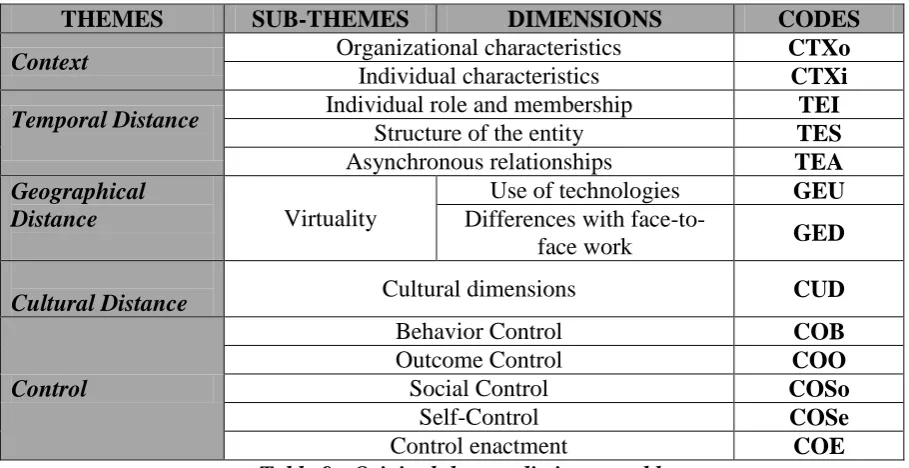
reconfiguration and modifications of our original themes dictionary through the introduction
of such Deleuzian concepts finally lead us to develop a complete analytical framework that
has been used for the following case-studies.
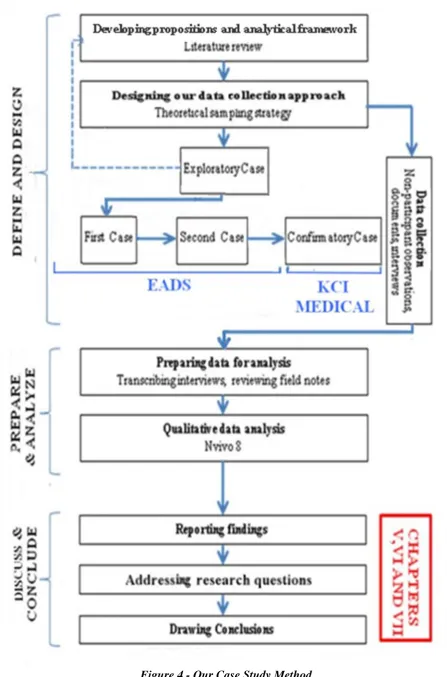
The examination of this original analytical framework has been conducted in
distinctive phases related in the third part of our research work (PART III). The description of
this data gathering is made chronologically in this PhD dissertation. We first conducted two
case-studies within the same organization – but at different organizational levels - than our
exploratory case. In a comprehensive and interpretative argument, the aim here was to
confront our conceptual model coming from the literature and our exploratory case to new
practical fields. Later, we conclude our concrete examination by the analysis of a completely
distinctive confirmatory case study, made within the medical sector rather than that of
aeronautics. The results of this ultimate case are presented in a way permitting cross-checking
and distinctions with previous cases. These two additional case-studies plus the final
confirmatory case study enabled us to better analyze the managerial forms developed in
distributed-work environments and to understand the way controls play a significant role for
individuals, organizations and technologies within them.
Finally, we provide in the ultimate part of this PhD dissertation a general discussion of
our empirical research (PART IV), which leads us to the analysis of the research questions
considered in this work (Chapter VII). Results from this empirical research are then compared
in order to provide a bigger picture of this analysis of control in distributed-work universes. A
final synthesis provided in Chapter VIII for allows us to conclude with the insights,
limitations and eventual future perspectives of our research work. The following figure
31
33
PART I: THEORETICAL FOUNDATIONS OF CONTROL IN
DISTRIBUTED-WORK
The first part of this work is devoted to the literature review. Our research lies at the
crossroads of several interrogations of distributed-work environments and their managerial
issues, particularly in terms of organizational control. Therefore, it is important to review the
academic literature devoted to these themes and to provide an overview of constitutive
theoretical elements. This part is divided into two chapters that provide insights about the
object of our research and the issues that it raises:
Chapter 1 focuses on the characteristics of distributed-work and its effect on
management. Through these sections, we will focus on the effect of distance within
these particular universes. This will allow us to describe the numerous managerial
results that emerge concretely from work-at-distance. The analysis of such elements
will finally lead us to justify the analysis of organizational control as the ultimate
means for the hierarchy to bridge distance in management.
Chapter 2 will allow us to focus our research on the issue of control within the
universes of distributed-work. After defining the main approaches of control in both
organizational and even in the economic theories, we will examine the relevance of
these approaches to remote management. These questions will lead us to ultimately
justify the necessity of reconsidering the current conceptualization of the issue of
34
Chapter I: Distributed-work:
characteristics and effect on management
In the previous sections, we had the opportunity of making general descriptions of
remote-work, especially defining it as corresponding to any form of work organization that employs
tele-mediated and controlled methods of overseeing either isolated individuals (e.g.,
home-based or office-home-based workers in the form of telecommuting) or collaborative work (virtual
teams) (Huws & O’Reagan, 2001). While distributed organizations could take different
shapes and configurations, these entities possess, and benefit from, similar characteristics.
In congruence with this observation, Parot (2003) expresses the fact that
remote-environments are subject to three different types of distance in their functioning: geographic
distance, cultural distance (i.e., the national culture here), and professional distance. These
diverse forms of distance are at the origin of the main characteristics constitutive of a
distributed organization, but one dimension is still missing, according to the current view: the
temporal dimension. While it is closely related to geographical distance, temporal distance is
a crucial element in the life of a work-at-distance entity, especially with respect to all the
issues it could effect in relation to the structure and the organization of the group. These
statements about the variety of distances present in remote-environments are supported by
Armstrong & Cole (2002) who claim that:
“Objective measures of distance include not just geographical distance but also
time difference (time zones), organizational distance (different departments,
functions, and levels), and cultural difference (both national culture and
organizational office site culture). Our findings suggest that national and
organizational cultures are experienced as dimensions of distance in
35 In such entities, virtual teams especially, the distinction between organizational and national
culture is somewhat complex (Vaara, 2000, Dameron & Joffre, 2007). This is why that, rather
than distinguishing them, we prefer to treat cultural distance considering both national and
organizational cultures (or professional distance, as depicted by Parot (2003)). Similarly,
universalist approaches to culture, which constitute the most significant part of cross-cultural
research made in management, treat culture as a concept that includes both national and
professional aspects - and define it as the collective programming of the mind which
distinguishes the members of one group or category of people from another (Hofstede, 1981)2.
Finally, it turns out that when dealing with work-at-distance, geographical distance
alone should not be exclusively investigated. Consequently, in this study, and in congruence
with Karjalainen & Soparnot (2010)3, we consider that virtual organizations are subject to the
influence of distance in three distinctive ways, the first two being at the origin of the last one4:
temporal distance, geographical distance5, and cultural distance. This is consistent with the
academic study of Leonardi et al. (2004) who urge a “reconceptualization of distance as a
multidimensional construct created and maintained through communication practices and not
only through physical location”. Similarly, Nurmi et al. (2009) defined distributed teams as
characterized by geographical distance, time separation and cultural diversity of team
members.
2 Organizational cultures operate within national cultures, although it happens that within few companies, the
influence of organizational culture could be assimilated to the one of national culture (Schein, 1992).
3 “The emergence of virtual teams in international organizations creates managerial challenges that are related to
geographical and temporal dispersions, and the multiculturalism of their members” (Karjalainen & Soparnot, 2010)
4 “Time, together with space, is eminently cultural” (Chanlat, 1990)
5 “Distance and time effects are often confounded in global software team studies because many geographically
36 I) The emergence of a Temporal distance:
Despite the lack of research on its effects6, temporal distance created by work-at-distance
practices has, however, many practical representations in contemporary organizations. In
particular, it creates challenges regarding collaboration in global teams spanning multiple
time-zones, as team members may be unavailable for simultaneous communication.
Nevertheless, time separation is more than just time-zone differences (Espinosa & Carmel,
2003) since other factors like non-overlapping weekend days and holidays, shifts, and
different working schedules can be identified. Multinational organizations are sometimes the
scenes of the dominant/hub sites that dictate meeting times convenient to their normal
workday, but never adjusting for the sake of the distant participants as well.
As a result, temporal distance limits the power of distributed leadership by creating
competing lines of authority, and by occulting visibility and awareness of team conditions
(Nurmi et al., 2009). These effects of temporal distance on issues of structures and
perceptions of role for distributed-workers will be one of the focuses of our research work.
In practice, remote meetings might have to combine diverse factors of
time-differences, with a massive time difference between individuals dispersed all over the world.
Communication between different sites across time differences often proved inappropriate as
information did not flow adequately between members (Nurmi, et al. 2009). As a
consequence, the work performed by such distributed teammates generally cannot proceed in
parallel and definitely needs to be re-sequenced in order to incorporate time lags.
Regarding another form of work-at-distance, as is the case with telecommuting
especially, temporal distance would emerge for employees who have difficulties in separating
professional and private times – i.e., work/life balance. Distributed-work constitutes a
disruption of one’s personal time and further confuses the boundaries between work and home
life (Espinosa & Carmel, 2003). Many home-based telecommuters for instance admit having
trouble staying focused on their daily work just by closing the door of the office located
within their home.
Issues behind observations of temporal distance are therefore much more general, and
consist of difficulties that distributed-workers experience in correctly identifying to or
recognizing the structure of their team. All these elements legitimize the need for
investigating the position of individuals in remote-entities, especially virtual teams, and
6
37 members’ perceptions about their team and its structure as we take into consideration that the
understanding and acceptance of personal roles and contributions is one of the main elements
for the effectiveness of the team (Millward & Kyriakidou, 2004).
To sum up, because of the inability to monitor them, virtual workers have to possess high
levels of organizational identification if they are to achieve sustained organizational benefits
(Crisp and Jarvenpaa, 2003). In this respect, the study of the temporal distance is central in
remote-work environments as it raises critical managerial issues:
- asynchronous relationships are more frequent than real-time collaborations as
opposed to traditional face-to-face ways of working, a factor that affects communication
between individuals
- boundaries between private and professional lives are less and less identifiable, a
factor which raises additional issues regarding the increase of feelings of isolation already
suffered by most distributed-workers
- more generally, temporal distance has a direct incidence on feelings of team
membership developed by distributed-workers, since these individuals have difficulties in
identifying the boundaries of the structure they are part of and their role within this structure.
This phenomenon is even stronger as remote-entities are mostly constituted temporarily and
are often modified.
Consequently, we see here that when determining whether individuals are affected by
temporal distribution or not, it is important to consider both the technology that these
individuals employ, and the structure they are part of.
While the focus on boundaries between ‘asynchronous/synchronous’ and
‘private/professional lives’ is relatively emphasized in past academic studies (Shamir &
Salomon, 1985; Habib & Cornford, 1996; Hill et al., 1998; Montoya-Weiss et al., 2002;
Espinosa & Carmel, 2003; Klein & Kleinhanns, 2003, Sarker & Sahay, 2004), less attention
has been paid to the general impact of temporal issues on feelings of membership and on the
identification of individuals roles and structures. Our research will focus significantly on this
latter element, since the identification of distributed-workers’ roles and the structures they are
part of, is a concrete and major managerial issue (Nurmi et al., 2009). This lack of clarity
regarding members’ identification or belonging to a specific group will sometimes be
38 2001; Gudykunst & Nishida, 2001; Piccoli & Ives, 2003, Sarker & Sahay, 2004).
Investigating the temporal distance in the context of work-at-distance should then not be
limited to an analysis of observable time dimensions (time-zones, temporal phases
(professional/private), etc…)7
.
39 II) The impact of Geographical distance:
While considering work-at-distance practices, anyone can understand that the word ‘distance’
correlates with the notion of geographical distance. With distributed-work, there is no longer a
need to worry about traditional concerns of whether or not members are located in reasonable
proximity to collaborate with one another, nor what it would cost to achieve that proximity
and collaboration between them (Townsend et al., 1998). Advances in communication
technologies have made it possible to draw upon expertise, regardless of where it resides, to
interdependently integrate individuals’ abilities and knowledge in order to solve problems
(Kirkman et al., 2004; Ben Naoui Jawadi, 2008)
The main challenges for distributed-workers from the emergence of geographical
distance consist of trying to succeed in communicating8, collaborating, cooperating with
people they cannot interact physically with, or sometimes, with whom they have not even met
once in person. Indeed, the distinctiveness of this specific way of working is constituted by
the fact that human physical interactions, including the body language, is substituted by
electronic interactions, using technologies such as email or telephone (Bell & Kozlowski,
2002). In distributed-work, social interactions are mostly impeded by low information
exchange and absence of informal communication (Herbsleb & Grinter 1999), and lack of
face-to-face interaction (Dubé & Paré 2001; Pauleen 2003). Geographical distance and
proximity between individuals not only affects the formation of a group, but also the extent to
which group members identify with one another. Finally, the management of geographical
distances necessarily implies the consideration of a key concept that has been used ad
infinitum in literature and day-to-day lives for the last few decades: virtuality, and its
perceptions by individuals.
Scholars working on communication in virtual organizations have unanimously
focused on the concept of distance as a by-product of specific technologies, emphasizing the
virtual aspect (Leonardi et al., 2004). In an attempt to explain how distant workers use
communication technologies, several theories have emerged in order to explain media
choices, especially highlighting the importance of contextuality (Rudy, 1996). These theories
assume that when individuals choose a medium for electronic communication, they
8
40 essentially look for technology that provides a medium as much like face-to-face
communication as possible, thereby reducing perceived distance (Wilson & O’Leary, 2008)
between them.
Social presence (Short et al., 1976) for instance asserts that communication medias
differ in their degree of social presence, and in this way, become a crucial element for
developing interaction. Secondly, media richness (Daft & Lengel, 1986) assumes that when
individuals have to communicate delicate or complex information, they will choose the richest
media possible: the greater social presence of a medium creates a greater immediacy and
warmth of the communication, because of the greater number of channels, the theory says. In
summary, the outcome of both approaches has largely positioned distance as an extremely
negative element that has to be overcome through the choice of rich media in order to restore
social presence (Leonardi et al., 2004): this observation is based on a particular and somehow
misleading conception of virtuality.
Although practitioners and academics all agree to say that virtuality is a primary
condition of geographic distance, defining and consequently measuring this concept of
virtuality is extremely difficult for them. It is obvious that there is “a need for more
sophisticated research to explore this phenomenon. Clearly, not enough emphasis has been
placed on “what it means to be dispersed from others” ” (Scott, 1999). The issue is important
when considering the question of well-known and developed “virtual teams,” for example:
Whereas the concept of virtuality has always characterized work distributed through time and
space (Townsend et al., 1998), such teams can have distinct levels of virtuality depending on
the proportion of electronic communication and face-to-face meetings they use to cooperate.
Identifying the virtual degree (Chudoba et al., 2005) of a team remains then extremely crucial
for a manager as it will give rise to the choices made for his/her management and it will
determine the dynamics that emerge from those choices. (Ben Naoui Jawadi, 2008). Such
observations emphasize the need for going back to the basics of the definition of virtuality, as
there is no current consensus at the level of organizational theories. The focus on a general
consideration of this notion would enhance a better understanding of issues related to the