Electromagnetic Lifshitz Formula for Small-Width
Mirrors from Functional Determinants
César D. Fosco, María L. Remaggi
Instituto Balseiro, Universidad Nacional de Cuyo, Centro Atómico Bariloche, Comisión Nacional de Energ a Atómica, Bariloche, Argentina
Email: [email protected]
Received May 30, 2013; revised June 30, 2013; accepted July 7, 2013
Copyright © 2013 César D. Fosco, María L. Remaggi. This is an open access article distributed under the Creative Commons Attri-bution License, which permits unrestricted use, distriAttri-bution, and reproduction in any medium, provided the original work is properly cited.
ABSTRACT
We extend a recently proposed Quantum Field Theory (QFT) approach to the Lifshitz formula, originally implemented for a real scalar field, to the case of a fluctuating vacuum Electromagnetic (EM) field, coupled to two flat, parallel mir- rors. The general result is presented in terms of the invariants of the vacuum polarization tensors due to the media on each mirror. We consider mirrors that have small widths, with the zero-width limit as a particular case. We apply the latter to models involving graphene sheets, obtaining results which are consistent with previous ones.
Keywords: Gelfand-Yaglom; Casimir; Vacuum
1. Introduction
Lifshitz’ formula [1], provides a quite useful tool for the evaluation of the Casimir force [2] between bodies with parallel planar interfaces, and rather arbitrary frequency- dependent dielectric functions. In its original version, two disjoint media-filled half-spaces with plane, parallel boundaries were considered; the calculation was per- formed at finite temperature, and the final result for the interaction force was presented in terms of the dielectric functions that described, macroscopically, the elec- tromagnetic properties of each media.
The successive refinements achieved in precision ex- periments measuring the Casimir force have provided a continuous stimulus to generalize the scope of the Lif- shitz formula, in order to encompass either new or more realistic situations [3]. One of those generalizations has been considered models where the fluctuating vacuum field, rather than being subject to ideal, “sharp and strong” boundary conditions, is instead in the presence of background potentials, localized on the mirrors [4,5]. These potentials are meant to implement smooth versions of the perfect boundary conditions. A possible way to justify them is by resorting to the microscopic point of view. Indeed, by taking into account the interaction of the internal degrees of freedom on the mirrors with the fluctuating field [5,6], one may derive an approximate effective action for the vacuum field, containing po-
tentials with support at the positions of the material slabs. Even assuming them, as we shall do throughout this paper, to have time independence and translation in- variant properties along the two “parallel” directions,
x x1, 2
x , the potentials are, in general, nonlocal
functions of time
x0 as well as of x and x3. Thenon locality in x
x x x0, ,1 2
can be dealt with by aFourier transformation in x, since this yields a potential
which is local in frequency as well as in the parallel components of the momentum. The resulting Fourier transformed potential will still carry a dependence on the
normal coordinate 3, the direction along which the
effect of the potential on the fluctuating field is strongest. The potential must be, then, necessarily non invariant under translations in
x
3
x . We shall nevertheless assume
that its dependence on x3 is local
1 .
In [8], a QFT approach was used to derive Lifshitz formula for a fluctuating real scalar field coupled to two material slabs, in a situation like the previously described one regarding both the geometry involved and the simplifying assumptions made. It is the aim of this article to adapt the approach of that reference to the case of a fluctuating Abelian gauge field. The derivation in [8] relied upon the application of the Gelfand-Yaglom (G-Y) formula for functional determinants [9] (for a modern
1Non localities along the normal coordinate can be incorporated, for
review, see [10]), objects which arise quite naturally within the path integral formulation, for example, when incorporating corrections due to fluctuations, in the pre- sence a nontrivial background.
Although we shall mostly deal with zero temperature calculations, it is convenient, for the sake of generality, to formulate the problem in terms of the Casimir free
energy per unit area, C
. This may, in turn, be ob-tained from the partition function
:
2
0
1 1
lim log ,
C
L L
(1)
where is a length that characterizes the size of the
plates.
L
can be written as an Euclidean functional
integral:
e A
A
, (2)
where
A is the Euclidean action for the gauge field,including its coupling to the mirrors. The integral over
the time-like Euclidean coordinate x0 is understood to
be taken over a finite interval of length , with periodic
boundary conditions for the field. The spatial coordinates
are assumed to be confined to a box of side length ,
with Dirichlet boundary conditions2.
L
Since we shall be interested in the Casimir force, we discard factors independent of , the distance between the mirrors. That is represented in (1) by the division by
0, which denotes the partition function when the
mirrors are infinitely far apart. l
Relevant physical observables shall be the vacuum
energy per unit area vac limC
C
, as well as the
Casimir force per unit area, :
C
, Cl
(3)
and its zero-temperature limit ClimC
.In this article, we derive expressions for C
as afunction of the invariants that define the vacuum polari- zation tensor for the media on the mirrors, as well as of the “shape” of the mirrors, understanding by that the
specific form of the x3 dependence of those tensors. We
do that for (finite) small-width mirrors and for zero- width mirrors, as an important special case of the former. In both cases we consider, we take advantage of the fact that the problem is essentially one-dimensional, and that it can be reduced to a collection of scalar problems. For them, we apply G-Y theorem for its exact evaluation.
This paper is organized as follows: in Section 2 we introduce the class of model that we shall consider, writing the partition function in terms of the physical objects that define the system: the positions and shapes
of the mirrors and their vacuum polarization tensors. Then in Section 3, we transform the system into two one-dimensional scalar problems.
In 4, we start from the partition function and show that it can be so transformed as to be evaluated using the results of [8]. We then present the corresponding Lifshitz formula.
The Casimir effect for systems involving graphene sheets has been recently studied in a series of interesting papers ([11-13]), including thermal effects. In Section 5 we apply the general formula to that kind of system as a consistency check, deriving an explicit expression for cases involving graphene mirrors as a function of the parameters defining the vacuum polarization tensor. In Section 6 we present our conclusions.
2. The Model
Throughout this article, we consider models where the EM field is coupled to two imperfect mirrors modeled by
“potentials” which are local in x3 and translation
invariant in x. Note, however, that those potentials,
since they couple to the gauge field, will also have a tensor structure.
As in the approach of [8], we define the system in
terms of its Euclidean action, . Denoting by A the
Abelian gauge field, that action may be written as follows:
A 0
A int
, A (4)
where 0
A denotes the free gauge field action and
int A
the term that accounts for the coupling to the
mirrors. The former has the standard form:
4
0 A
d x inv gf
(5)with the gauge invariant piece:
1 , 4
inv F F
(6)
and for the gauge-fixing term we assume the form:
21 2
gf A
a
, with a being a positive real constant.
The interaction action int is assumed to be com-
posed of two terms, each one describing the interaction between
A and a mirror:
.
int L R
(7)
,
I IL R
co
x
, will be assumed to describe the interaction with a single mirror, whose properties are time independent as well as homogeneous and isotropic
on each 3 nstant plane. Regarding the x3 di-
rection (normal to both mirrors), we assume the properties of the mirrors to be local functions of that coordinate.
2The final result, for L , shall be insensitive to the choice of
Besides, we use the fact that the interaction terms preserve gauge invariance. This is guaranteed, if the current due to the charged microscopic degrees of freedom which induce the coupling terms is conserved. Finally, the coupling terms are assumed to be quadratic
in A, which is a reasonable assumption to make when
one deals with media that may be appropriately described by linear response theory.
Then SI may be put into a more explicit form: using
a shorthand notation for the integrations, and assuming
the I mirror to be centered at x3aI, we may write
the term that describes its interaction with the gauge field as follows:
3
3 3
, ,
1
, , ; ,
2
I I
x x x
3 ,
I
A A x x x x x a A x x
(8)
where I J J is the vacuum polarization tensor,
i.e., the correlator between currents, for the matter fields
on the I mirror.
Equation (8) suggests the consideration of two situa- tions, the second a particular case of the first, regarding the mirror’s extent along the normal coordinate. Firstly, we may regard it to have small width, in the sense that the charge carriers in the medium are strongly concentrat-
ed in a finite x3 region. Since there is no current along
3
x , the vacuum polarization tensor (a correlator between
currents) will be zero when one or two of its indices equals 3. Secondly, we shall deal with the zero-width limit of the previous case.
Here, the currents are essentially planar, and we shall
then neglect the action of I on the third component
of the gauge field.
Thus, in the small width case we shall have,
3
3 3
, ,
1
, ;
2
I
I I
x x x
3
,
A A x x x x x a A x x
(9)
where I is the vacuum polarization tensor for the
medium confined to the I mirror. A convention we use
is that in (9), and run from to . This im-
plies that the mirrors shall only involve the parallel com-
ponents of the electric field, and the normal com-
ponent of the magnetic field, .
0 2
E
3 B
The tensor
y0,y;x3
,I
y x x is assumed
to be, as a function of x3, concentrated on a region
centered around x30. Note that we are not assuming
that
; 3I
y x
necessarily can be written as the pro-
duct of a function of x3 by a function of y ,
0,1, 2
. For the case of very thin slabs, like the ones
we shall consider when dealing with graphene-like mirrors, that factorization is a natural assumption to
make. However, one could consider vacuum polarization tensors which properties depends non trivially on the normal coordinate.
Performing a partial Fourier transformation in (9), i.e.,
just for the time and the parallel coordinates, we see that:
3
3 3
,
1
, , , 3
2
I
I I
k x
.
A
A k x k x a A k x
(10)
Here, and in what follows, we use the notation
0, ,1 2
0,
k k k k k k0 k
. We implicitly assume that the
component is summed over discrete values,
0
2 n
n
k (the Matsubara frequencies) at finite
temperature, and integrated (continuum values) at zero temperature.
We have thus set up the general structure of the kind of systems that we shall consider here. In the next section we show how to decompose the problem of evaluating
C
for the gauge field into two independent one-di-
mensional systems, each one corresponding to a single real scalar field.
3. Reduction to One-Dimensional Systems
Thus each mirror has been characterized by its vacuum
polarization tensor I . It is convenient to decompose
each one of them in terms of scalar functions, something that can be achieved, for example, by expanding the tensor into a complete set of orthogonal projectors. That decomposition is rather general, since it can be obtained as a consequence of the assumptions we have made.
Let us first note that, current conservation of the
charge carriers in the media implies that, for each x3,
the tensor I is transverse, namely:
0. I
k (11)
Regarding the condition above, we can find two independent solutions to the transversality condition, so
that I may be decomposed into two irreducible
transverse tensors (projectors), in terms of two scalars. Indeed, the assumed isotropy and homogeneity of the media along the parallel directions, means that we can construct two independent transverse tensors using as
building blocks the elements: kkk n0
, and
n n
0
x
, where . Note that the
presence of is allowed since Poincaré invariance on
the
n
1,0, 0
n3 spacetime does not hold necessarily true.
Two independent projectors and that are
solutions of (11) may be written as follows: t
l
2
t k k
k
(12)
l t
(13)
where 2 k k P k (14)
is the transverse projector corresponding to a 2 1
dimensional Poincaré covariant theory. For the sake of completeness, we also introduce the ‘parallel’ projector
: 2 . k k k
(15)
They satisfy the following algebraic properties:
, t l
I
2
l
0, 0, 0
t l l t t t l l
2
2
2
, , t t, l ,
(16)
where I . Therefore we can express I as
follows:
2 2
2 2
3 0 3 0 3
, , , , ,
I I t I l
t l
k x f k x f k x .
k k
(17)
In this way, we have succeeded in characterizing the
I mirror by two functions, ,
I t l
f . To proceed to the
reduction of the problem of evaluating
to one-dimensional functional determinants, we shall perform the same Fourier transformation we used for the inter-
action terms, for the free action . Adopting the
Feynman gauge choice,
0
a1
4 2
0
1 d
2 xA x A x
(18)
we see that
3
2 2
0 3 3
,
2 2
3 3 3 3 3
1 , , 2 , , k x 3 .
A k x k A k x
A k x k A k x
(19)Then, the complete action may be split into two
terms, one depending on
A A and the other on
3
A :
A 3 A3 ,
(20)
with:
3 3 , 2 23 3
1 , 2 , , k x I I I
A k x
k k x a A k x
3
(21)
and
3
2 2
3 3 3 3 3
,
1
, , 3
2k x
.
A k x k A k x
(22)
Note that, because of (20), and the fact that 3 does
not involve any coupling to the mirrors, we may write the ratio between
and 0
as follows:
0 0 (23)
with:
Ae A
. (24)
Applying the properties satisfied by the projectors, we see that:
t l
(25)
which allows us to write:
3
2 2
3 3 3
, 2 2
3 3 3
1 , , 2 , , t t k x l l
A k x k V x k
k V x k A k x ,
(26) where
2 2, 3, , 0, , 3
I
t l t l I
I
V x k
f k k x a
,l
(27)
what concludes the reduction. Indeed, note that the action has been reduced to a quadratic form for an operator which has been decomposed into orthogonal rank-one projectors.
4. Lifshitz Formula
To obtain the Lifshitz formula for this kind of model, we
proceed as follows: In the path integral for , we may
decompose the gauge field:
t
AA A (28)
t l, t l,
A A under which the path integral measure
factorizes. Thus,
t
l
, A (29)where each factor is obtained as the result of performing a functional integral over one scalar degree of freedom, namely,
,
,
,
exp
t l t l t l t l
A
(30)
where
3
, ,
, 2 2 ,
3 3 , 3 3
, 1
, ,
2
t l t l
t l t l
t l k x
A
, .
A k x k V x k A k x
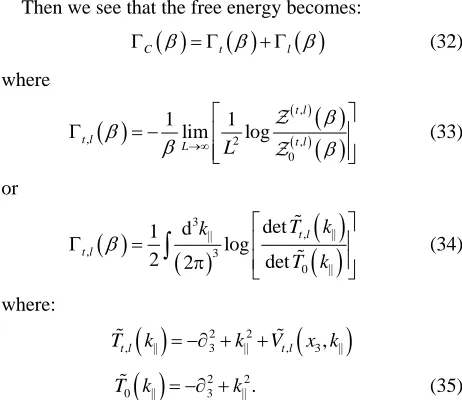
Then we see that the free energy becomes:
C t l
(32)
where
,
, 2 ,
0
1 1
lim log
t l
t l L L t l
(33)
or
3 , , 3 0 det d 1 log2 2 det
t l t l T k k T k
(34) where:
2 2
, 3 , 3,
t l t l
T k k V x k
2 20 3 .
T k k (35) The system has been reduced to two independent Casimir problems, each one of them corresponding to a real scalar field in the presence of its potential backg-
round t l, . These potentials are built in terms of the
functions that appear in the decomposition of the vacuum polarization tensor into a set of irreducible tensors.
V
Applying the general formula derived in [8], we may write for each contribution above:
12 2 21 2 2, 1 1
11 11 ,
1
log 1 e ,
2
k l
t l
k t l
T T T T
(36)where t l, is the result of performing the following
change of basis to the matrix T , t l A : 1 ,
t l t l
T B A B , (37)
with 1 1 1 , 1 1 2
B
(38)
and At l, are defined as in [8], regarding each one, or
, as due to an independent field, in its own background potential.
t
l
5. Zero Width Mirrors
We characterize thin mirrors here as systems where the interaction between field and mirrors is confined to zero-width planes. Thus, in this case,
2 2
2 2, 0, , 3 3 , 0, ,
I I
t l I I t l
f k k x a x a g k k
, .
(39)
and
2 2, 3, 3 , 0
I
t l I t l
I
V x k
x a g k k (40)Recalling the known result of [8] for the case of a real scalar field in the presence of zero width mirrors, we see
that:
2 , , , , , e 1log 1 .
2 2 2
k l
L R
t l t l
t l L
k t l t l
g g
k g k g
R
(41)Then, the Casimir force per unit area becomes:
t
l
C C C
(42)
with
, 2 , , , 2 21 1 1 e
t l C
k k l
L R
t l t l
k k k g g
(43)
where the arguments of ,
02, 2 andL t l
g k k
gt l ,R
k02,k2
were omitted.For a graphene sheet ([11-13]), which can be reasona- bly described by a zero-width mirror, the corresponding
g functions may be read off from its vacuum polariza-
tion tensor, the result being:
2 2
2 2 20, 0
t F
g k k k v k
2 22 2 0
0
2 2 2
0 , l F k g k k v k k k
(44)
with 2 16 e N
, where is the number of fermion
flavours, the couppling constant, and
N
e vF the Fermi
velocity.
Using these expressions into the general formula for thin mirrors, we obtain the Casimir force for cases involving either two graphene sheets or, as a limiting case, a graphene sheet and a conducting mirror. The latter may be obtained from the graphene case by setting
the Fermi velocity to 1 and in one of the
mirrors.
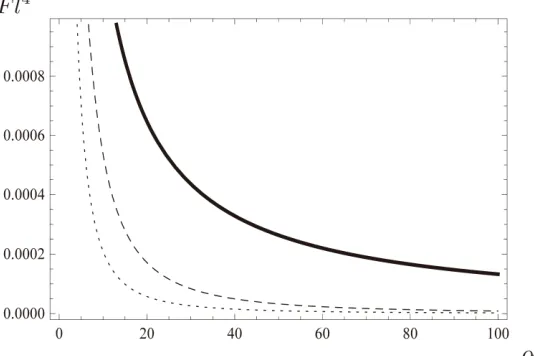
In Figure 1 we plot the zero temperature pressure
times l4 as a function of for the case of a perfectly
conducting mirror in front of a graphene sheet, for
different values of vF
F v
, and in Figure 2 for two identical
graphene sheets. Note that in both figures the solid line
corresponding to 1 represents a ‘relativistic
matter’ case, where ft I fl I , considered in [6].
6. Conclusions
[image:5.595.56.287.88.288.2]Figure 1. Casimir force times l4 as a function of
, for a perfectly conducting and a graphene mirror with different values of vF. The solid line corresponds to vF 1, the dashed line to vF0.2 and the dotted one to vF 0.
Figure 2. Casimir force times l4 as a function of
, for two identical graphene mirrors characterized by . The solid line corresponds to , the dashed line to and the dotted one to
F
v
F
v 1 vF 0.2 vF 0.
7. Acknowledgements
for which one can apply the previously known expres- sion for the functional determinant.
This work was supported by CONICET, and UNCuyo. The result is expressed in terms of the invariants of the
Euclidean version of the vacuum polarization tensor due to the charged matter inside the mirror. In this way one may bypass the calculation of the reflection coefficients of each mirror, as it would be the case with the usual version of Lifshitz formula. Besides, the result for small- width mirrors allows for cases where the material media have a non trivial dependence along the normal direction; for example, one could consider vacuum polarization tensors corresponding to stratified media.
REFERENCES
[1] E. M. Lifshitz, “The Theory of Molecular Attractive Forces between Solids,” Sov. Phys. JETP, Vol. 2, 1956, pp. 73-83.
[2] H. B. G. Casimir, “On the Attraction between Two Per- fectly Conducting Plates,” Indagationes Mathematicae, Vol. 10, 1948, pp. 261-263; Koninklijke Nederlandse Aka- demie van Wetenschappen Proceedings, Vol. 51, 1948, pp. 793-795; Frontiers of Physics, Vol. 65, 1987, pp. 342-344; Koninklijke Nederlandse Akademie van Weten- schappen Proceedings, Vol. 100, No. 3-4, 1997, pp. 61- 63.
[image:6.595.164.431.324.502.2][3] P. W. Milonni, “The Quantum Vacuum: An Introduction to Quantum Electrodynamics,” Academic Press, San Diego, 1994.
[4] N. Graham, R. L. Jaffe, V. Khemani, M. Quandt, O. Schroeder and H. Weigel, “The Dirichlet Casimir Prob- lem,” Nuclear Physics B, Vol. 677, No. 1-2 2004, pp. 379-404. doi:10.1016/j.nuclphysb.2003.11.001
[5] C. D. Fosco, F. C. Lombardo and F. D. Mazzitelli, “Casi- mir Energies with Finite-Width Mirrors,” Physical Re- view D, Vol. 77, 2008, pp. 085018 1-12.
[6] C. D. Fosco, F. C. Lombardo and F. D. Mazzitelli, “Casi- mir Effect with Dynamical Matter on Thin Mirrors,” Physics Letters B, Vol. 669, No. 5, 2008, pp. 371-375. doi:10.1016/j.physletb.2008.10.004
[7] C. D. Fosco and E. Losada, “Casimir Effect with Nonlo- cal Boundary Interactions,” Physics Letters B, Vol. 675, No. 2, 2009, pp. 252-256.
doi:10.1016/j.physletb.2009.03.084
[8] C. Ccapa Ttira, C. D. Fosco and F. D. Mazzitelli, “Lif-shitz Formula for the Casimir Force and the Gelfand- Yaglom Theorem,” Journal of Physics A, Vol. 44, 2011,
pp. 465403 1-13.
[9] I. M. Gelfand and A. M. Yaglom, “Integration in Func- tional Spaces and It Applications in Quantum Physics,” Journal of Mathematical Physics, Vol. 1, No. 1, 1960, pp. 48-69. doi:10.1063/1.1703636
[10] G. V. Dunne, “Functional Determinants in Quantum Field Theory,” Journal of Physics A, Vol. 41, 2008, pp. 304006 1-15.
[11] M. Bordag, B. Geyer, G. L. Klimchitskaya and V. M. Mostepanenko, “Lifshitz-Type Formulas for Graphene and Single-Wall Carbon Nanotubes: Van der Waals and Casimir Interactions,” Physical Review B, Vol. 74, 2006, pp. 205431 1-9.
[12] M. Bordag, I. V. Fialkovsky, D. M. Gitman and D. V. Vassilevich, “Casimir Interaction between a Perfect Con- ductor and Graphene Described by the Dirac Model,” Physical Review B, Vol. 80, 2009, pp. 245406 1-5.