Munich Personal RePEc Archive
Critical considerations on defining and
measuring performance in public
organizations
Cioclea, Alexandra Ema
19 September 2011
Online at
https://mpra.ub.uni-muenchen.de/33642/
CRITICAL CONSIDERATIONS ON DEFINING AND MEASURING
PERFORMANCE IN PUBLIC ORGANIZATIONS
Alexandra Ema Cioclea, PhD Student Doctoral School of Economics,
"Alexandru Ioan Cuza" University, Iasi, Romania [email protected]
Abstract
Performance evaluation plays a central role in improving public service quality and increasing efficiency and accountability in the public sector. New Public Management recommends performance evaluation as a tool for rationalizing public budgeting, promoting better reporting systems and developing internal diagnosis systems.
This paper aims to analyze the characteristics of performance evaluation and to highlight its influences in public organizations. The study is based on review and analysis of academic research, government documents and personal perspectives.
The paper argues that managerial practices and tools for defining and evaluating performance can be used for cultivating the “achievement culture” in public sector organizations.
Key words
Public management, performance, evaluation, indicators
Context
Traditionally, government, whether central or local, has focused its policies on issues related to administrative legitimacy and formal control, characteristics of bureaucratic organizations and inherent expressions of the public sector. But in the last two decades, there has been a change in policy orientation, as well as in practice and public organizations showed interest in management practices and tools that could improve its structure and its activities.
Mike Bolton [2003] identifies two main factors determining change both in the private and public sector. They are, on the one hand, globalization and borderless competition, requiring competitiveness regardless of location, and on the other hand, changes that occurred in the expectations of citizens. Specifically, their expectations have risen, they are better educated, better informed and more aware of what takes place in their community. They also have access to a larger volume of information on which they can base their judgment.
In this context, New Public Management has emerged as an alternative to Weberian bureaucracy, seen as an “administrative dinosaur”, too big, too slow, too insensitive, lacking in adaptability and taking to long to send the message through the hierarchical structure.
The term itself – New Public Management (NPM) – was first used by Christopher Hood in 1990, when he noticed a number of relevant changes that had occurred in different administrative systems, yet with similar manifestations. So, he gathered under this term heterogeneous public reforms, although they didn’t have the same causes and certainly they won’t have the same results and he rejected the idea of universality. On the other hand, Osborne and Gaebler, American consultants who wrote the bestseller “Reinventing Government”, consider the managerial approach of the public sector as an inevitable and global development.
From their point of view, we can speak of discovering a new model – managerialism, different from the traditional bureaucratic approach and characterized by its main components:
Managers are free to coordinate, to act and to ensure problem solving; Explicit implementation of performance criteria and measurement; Increased attention to results of internal control;
Increased competition due to short-term contracts and public procurement procedures;
Enhanced discipline and control in resource utilization.
We can already see that performance evaluation is on the short list defining the managerial approach in public organizations and the authors mentioned above are just the first to pay attention to its role and influence in modernizing public sector.
The concept of performance and its dimensions in the public sector
Not only in practice, but also in research articles the need for “reinventing” public administration became a much discussed subject and the solution seemed to be a transition from a bureaucratic system to a coherent and flexible one, able to respond, to react to changes and challenges, to provide services at the lowest cost. So, in the last 20 years there has been an increase in research papers that place the notion of performance on the main page [Johnson and Kaplan 1987; Carter, Day and Klein 1992; Neely 1999; Behn 2003; Hood 2006].
Public performance is not an objective reality, easily available to be measured and evaluated, it is in fact a social construct, distinctly perceived by different stakeholders [Ghobadian, 2009], so it must be defined broadly enough to include all key dimensions as they are perceived by the major stakeholders.
Regardless the size, sector or activities, organizations tend to be interested in the same facets of performance: financial performance, citizen satisfaction, performance of operations and processes, employee and stakeholders satisfaction. While in the private sector the main indicator is profit, public organizations don’t have generally accepted indicators for performance. In public organizations the concept should be analyzed in relation to program objectives, especially whether or not they were reached through appropriate outcomes.
In public institutions it is necessary to measure achievements and progress against objectives and managers must decide on how to make measurement relevant. That is why, some key measures with more features are more effective than a variety of single-faced measures. The chosen evaluation system should also resolve the problem faced by many organizations the so-called “drowning in data”. Key measures should include those concerning: financial performance, operational performance and human resources performance [Armstrong, 2006].
In terms of overall performance in administration, there are specific factors [Ghobadian, 2009] that should be taken into account:
Diversity – a high number of stakeholders with different interests make it difficult to achieve consensus in setting the goal and the objectives of the organization;
Interdependence – between resources, processes and decisions;
Instability – social, economic and technological changes have an important impact on the policies, goals and objectives already established.
The “classical” dimensions of performance have been considered efficiency, effectiveness and economy, but recent theories added other E’s to the well-known trio, such as equity, excellence, ethics. Still, most evaluation frameworks focus on the first three:
Efficiency – the ratio between inputs and outputs;
Effectiveness – the impact achieved (outcome) related to planned objectives;
Economy – minimum resource consumption.
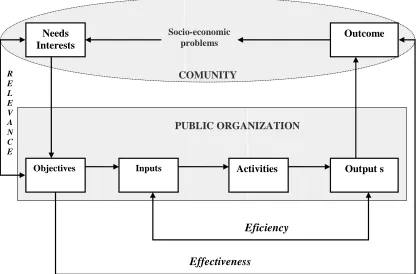
[image:4.612.97.514.237.511.2]As there are many causal relations between organizational objectives, the needs of the community and the three E’, the illustration below is useful for understanding the concept of performance.
Figure 1.Performance – a conceptual model, adapted after Pollit & Bouckaert, 2004.
Even in the model suggested by Pollitt & Bouckaert [2004], performance links results to the initial objectives, taking into account not only what the results are, but also how they are achieved. Under these considerations, Brumbach [1988] defines the concept of performance as both behaviors and results. The behavior of those involved transforms performance into action [Armstrong, 2006].
In a more recent book, Bouckaert and this time Halligan [2008] add new considerations on the concept of performance. They identify two facets of performance: the
span of performance and the depth of performance. The span of performance is actually illustrated in the 2004 model above, as it comprises of relations between input, activity, output and effects/outcome and an additional element – trust.
On the other side, the depth of performance is based on the distinction of three levels of performance: micro performance refers to the individual public sector organization, the meso-performance to a policy and the macro performance to the government or governance as a whole [Bouckaert & Halligan, 2008].
Effectiveness
COMUNITY
Socio-economic problems
PUBLIC ORGANIZATION
R E L E V A N C E
Eficiency
Needs Interests
Outcome
Performance has a somewhat elusive conceptual content, it’s not easy to find a general accepted definition. From the above model and mentioned authors we can only try to identify its main dimensions. We’ve already identified the classic 3 E’s and the logical chain input-activity-output-outcome.
But Summermatter & Siegel,in 2009, have conducted a very helpful research, based on papers, selected from 14 academic journals and dealing explicitly with theoretical or empirical aspects of performance management or measurement in the public sector.
They analyzed the content of the papers and searched for definitions or statements about the concept of performance. They classified the terms and concepts they had found in the categories from the table below:
Dimension Subsumed terms and concepts
Input costs, budgets, expenses, revenue, expenditure, economy, resources
Throughput process, production process, organizational processes, activities, capacities, operations, volume of work, workload, levels of activity or of proficiency, operating characteristics
Output results end of the production process; quantity and quality of outputs, services
Outcome effects, results, impacts, benefits, public value, accomplishments, consequences
Efficiency relation of “efforts to outputs”, the “ratio of output to input”, technical efficiency, “cost per unit of output”, relative efficiency
Effectiveness “how well services or programs meet their objectives”, “a measure of outcome, illustrating the result or impact of a service”, “the extent to which customer requirements are met, “cost-outcome measures”
Additional types of ratios
Productivity, “value for money”, cost effectiveness, return on investment, “return on taxpayer money”, unit or per capita costs
Quality Quality of staff activity, services or outputs, “extent to which the nature of the output and its delivery meet requirements or are suitable to their purpose”, “conformance, reliability, on-time delivery”.
Requirements Targets, goals, objectives, standards, timeliness, pledges, benchmarks
Stakeholder-related aspects
“consumer‘s evaluation of various features or facets of the product or service, based on a re-cent consumption experience”,
satisfaction, trust of actors and stakeholders, customer satisfaction
Value and ethical aspects
[image:5.612.113.523.181.633.2]“equity, transparency, or other democratic values”, equity, “equitable distribution of benefits”, fairness
Tabel no. 1. Terms and concepts of performance dimensions [Summermatter & Siegel, 2009]
Performance evaluation in public organizations
Concern for performance evaluation is becoming more pronounced as organizations try to implement new measurement systems to support organizational objectives [Cavalluzzo & Ittner, 2004]. These initiatives originated in the private sector, but recent efforts to improve government performance have focused on evaluation as a means of empowering policy-makers and bringing coherence for the decision-making process.
In the context of the new managerial approach, performance measurement and reporting are critical. For public managers, information on performance is the most valuable resource in decision making and strategic planning. Information on performance of programs, organizations and individuals illustrates managerial commitment for continuous development and it also contributes to more efficient and effective fulfillment of objectives [Kettl, 1997]. As for the accountability of managers, performance evaluation provides information to all stakeholders either within the organization - elected officials, other managers, employees - or outside - the customers, citizens, civil society, entrepreneurs.
Performance evaluation should offer information for managers interested in internal control as well as to any citizen that wishes to know the results of the institution. This way, they can evaluate the organizational activity, based on relevant indicators, making comparison between public organizations and encouraging benchmarking.
The performance measurement systems were developed mostly in the 90’s as a tool for private companies to support strategic management functions. The most popular system from at that time was the Balanced Scorecard, created by Kaplan and Norton [1992, 1996]. Initialy structured for big private companies, measurement systems have been adapted and recently used for small and medium entreprises and evan, the public sector. But due to the characteristics of the public organizations, there are aspects that influence the design and implementation of these systems. Rantanen [2007] identified some of them in the Finnish public sector:
many stakeholders with conflicting interests; undefind or unquantifiable goals and end services; lack of competition;
low managerial capacity.
At the same time, based on past research and his own observations, Saad [2001] argues that the effectiveness of a strategic evaluation system for public performance is determined by the following elements:
evaluation criteria;
level of importance or priority for each criterion;
evaluation process itself, including those applying it and the way it’s implemented, sequential or simultaneous;
defining each criterion for each evaluated aspect.
Inplementing and supporting performance evaluation systems require a major effort from the organization, in order to determine if its vision and strategic goals are indeed citizen-oriented. For the evaluation process to succeed, it has to respect three important criteria:
The evaluation process should be oriented towards clearly defined aspects, it’s not possible nor desirable to evaluate/measure everything.
+
Measure the right things – before using certain types of frameworks, the organization should clarify and understand what is to be evaluated
+
Performance evaluation is a means, not a goal itself. The organization should focus on achieving its goals, using performance evaluation.
accountability for spending public money, especially as the first performance measure frameworks were taking into account only financial data.
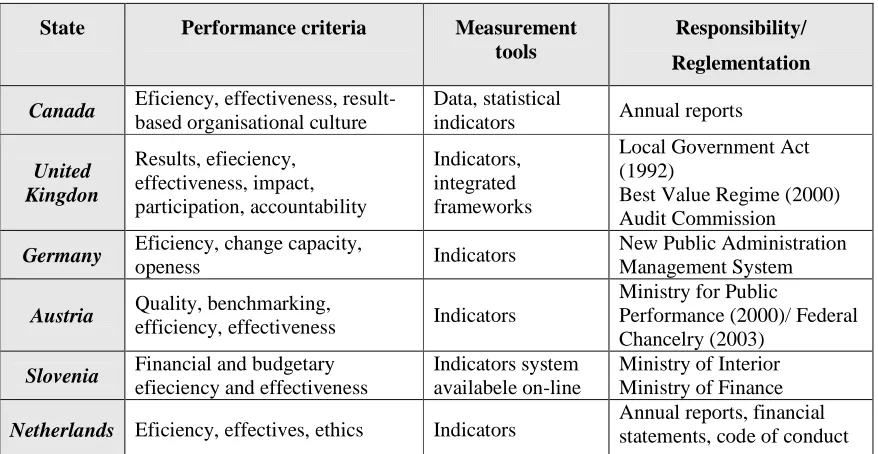
Now most of the research on performance evaluation uses a descriptive approach, similar to Saad’s [2001]. Analyzing the design of evaluation frameworks already used in some public organizations, especially in Western European states, we can see that indicators are frequently present in evaluation practices.
State Performance criteria Measurement tools
Responsibility/ Reglementation
Canada Eficiency, effectiveness,
result-based organisational culture
Data, statistical
indicators Annual reports
United Kingdon
Results, efieciency, effectiveness, impact, participation, accountability
Indicators, integrated frameworks
Local Government Act (1992)
Best Value Regime (2000) Audit Commission
Germany Eficiency, change capacity,
openess Indicators
New Public Administration Management System
Austria Quality, benchmarking,
efficiency, effectiveness Indicators
Ministry for Public
Performance (2000)/ Federal Chancelry (2003)
Slovenia Financial and budgetary
efieciency and effectiveness
Indicators system availabele on-line
Ministry of Interior Ministry of Finance
[image:7.612.101.540.135.362.2]Netherlands Eficiency, effectives, ethics Indicators Annual reports, financial statements, code of conduct
Tabel no. 2. Performance evaluation systems – adapted from Laura Tampieri,2005.
Conclusions
The development of the New Public Management brought special interest in results and impact evaluation in public organizations, as it is considered that public policies and management decisions should be based on performance information. Still, due to the characteristics of public institutions, not all evaluation initiatives were successful and probably it will be the case for some future attempts too. Performance evaluation can also have undesired, even negative influences on organizational activity and they are worth discussed on a future paper, as there are already authors interested in challenging the highly praised benefits of performance evaluation.
References
1. Ammons D. N. (2002), Performance measurement and managerial thinking, Public Performance and Management Review, vol. 25, nr. 4.
2. Armstrong M. (2006), Performance Management. Key Strategies and Practical Guidelines, Kogan Page Ltd, UK.
3. Behn R. (2003), Why Measure performance? Different purposes Require Different Measures, Public Administration Review, vol. 63, nr. 5.
4. Bouckaert, G., & Halligan, J. (2008). Managing Performance: International Comparisons. London/New York, N.Y, Routledge.
5. Bolton M. (2003), Public sector performance measurement: Delivering greater accountability, Work Study, vol. 52, nr. 1.
6. Carter N., Day P. and Klein R. (1992), How Organisations Measure Success. The Use of Performance Indicators in Government, London, Routledge.
7. Cavalluzzo K., Ittner C. (2004), Implementing performance measures innovations: evidence from government, Accounting, Organizations and Society, nr. 29.
8. Ghobadian A.(2009), Explaining the unintended consequences of public sector reform,
Management Decision, vol. 47, nr. 10, 2009.
9. Hood, C (1991), A public management for All Seasons?, Public Administration, nr. 69.
10. Kettl, D.F. (1997), The Global Revolution in Public Management: Driving Themes, Missing Links, Journal of Public Policy Analysis and Management, vol. 16, nr. 3.
11. Osborne D, Gebler T. (1993), Reinventing Government: How the Entrepreneurial Spirit is Transforming the Public Sector, London, Plume.
12. Pollitt C., Bouckaert G. (2004), Public management reform: a comparative analysis, 2nd edition, Oxford, Oxford University Press.
13. Rantanen H, Kulmala H., Lonnqvist A, Kujansivu P. [2007], Performance measurement systems in the Finnish public sector, international Journal of Public Sector Management, Vol. 20, Issue no. 5.
14. Saad G.H. (2001), Strategic performance evauation: descriptive and prescriptive analysis, Industrial Management and Data Systems, Vol. 101, Issue no. 8.
15. Summermatter L., Siegel J.P. (2009), Defining Performance in Public Management: Variations over time and space, Paper for IRSPM XXIII, Copenhagen, 6-8 April, 2009.
![Tabel no. 1. Terms and concepts of performance dimensions [Summermatter & Siegel, 2009]](https://thumb-us.123doks.com/thumbv2/123dok_us/7810877.730264/5.612.113.523.181.633/tabel-terms-concepts-performance-dimensions-summermatter-siegel.webp)