L E T T E R
Open Access
The COMET Initiative database: progress
and activities update (2015)
E. Gargon
1*, P. R. Williamson
1, D. G. Altman
2, J. M. Blazeby
3, S. Tunis
4and M. Clarke
5Abstract
This letter describes the substantial activity on the Core Outcome Measure in Effectiveness Trials (COMET) website in 2015, updating our earlier progress reports for the period from the launch of the COMET website and database in August 2011 to December 2014. As in previous years, 2015 saw further increases in the annual number of visits to the website, the number of pages viewed and the number of searches undertaken. The sustained growth in use of the website and database suggests that COMET is continuing to gain interest and prominence, and that the resources are useful to people interested in the development of core outcome sets.
Keywords:Core outcome set, Database, Resources
Correspondence/findings Background
As the New Year bells were ringing and the fireworks were exploding to welcome 2016 in cities such as Fray Bentos in South America, an Internet user in Tianjin, China ran the 10,000th search of the Core Outcome Measures in Effectiveness Trials (COMET) database. They were looking for information about non-small-cell lung cancer (NSCLC), and will have been shown details of two core outcome sets (COS) recently added to the database [1, 2]. This letter describes the substantial ac-tivity on the COMET website [3] in the 365 days before that search. We update our earlier progress since the launch of the COMET website and database in August 2011 to December 2014 [4, 5].
Activity and content
A total of 720 studies relevant to the development of COS were included in the COMET database at the end of December 2015, with 147 added during the year. This included 32 reports relating to 29 COS identified in the most recent update to the systematic review of COS [2], which had originally been performed in 2013 [1].
As in previous years, 2015 saw further increases in the annual number of visits to the website (Table 1) and
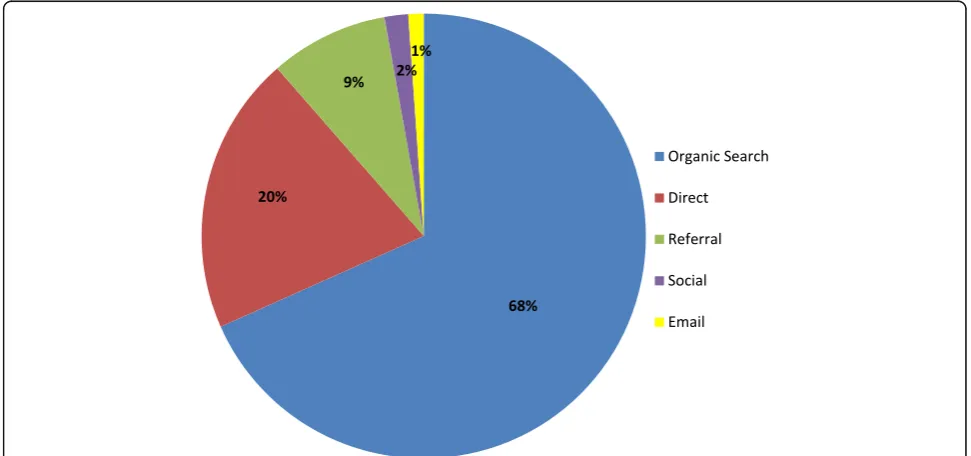
although the proportional change declined in 2015, the absolute numbers continue to increase. For instance, the proportional increase in new visitors from 2014 to 2015 was 33%, compared to 43% for 2013 to 2014; but the ab-solute increase from 2014 to 2015 was 3269 compared to 2936 for 2013 to 2014. Most visitors to the website ar-rived either via links following an organic search using a search engine, such as Google (68%), or direct (20%) (Fig. 1). However, new for 2015, were arrivals from links in emails, which is in large part attributable to the move of the COMET newsletter from a PDF format to an email format.
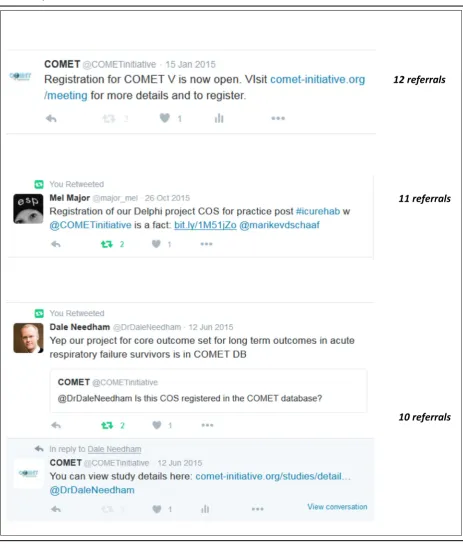
Social media also leads many people to the website and Twitter accounted for 89% of social referrals to the COMET website in 2015 (Table 2). The COMET Twitter account is monitored by the research team and tweets are sent when new COS papers are published, to announce relevant presentations at conferences and to retweet COS-related tweets from others that we follow. The COMET account has more than 1300 followers and the Twitter page links to the COMET website.
The highest proportions of referrals were from the Core Outcomes in Women’s Health (CROWN) Initiative (10%), the University of Liverpool (6%), Trials journal (5%), MRC Hubs for Trials Methodology Research (5%), Cochrane Canada (5%) and the Standard Protocol Items: Recommendations for Interventional Trials (SPIRIT) * Correspondence:[email protected]
1Department of Biostatistics, University of Liverpool, 1st floor Duncan
Building, Daulby Street, Liverpool L69 3GA, UK
Full list of author information is available at the end of the article
initiative (4%). CROWN is an international initiative to harmonise outcome reporting in women’s health re-search. More than 70 journals have committed to en-couraging the development and reporting of COS in this area and CROWN advises all COS developers to register with COMET [6]. Trials has published several COS papers which generated referrals to the COMET website, including ‘Developing core outcome sets for clinical trials: issues to consider’[7], the special collec-tion of the meeting proceedings and abstracts from the 4th COMET meeting in Rome in November 2014, and the report of the first meeting to discuss Trial Forge [8]. The 5th COMET meeting was jointly hosted with Cochrane Canada in Calgary in May 2015, hence the large number of referrals from Cochrane Canada, and the more than doubling in the annual number of visits from Canada, from 624 in 2014 to 1449 in 2015 (Table 3). The referrals from SPIRIT reflect that initia-tive’s encouragement of trial investigators to consider measuring the outcomes in a COS in their trial as part of their effort to improve the quality of clinical trial
protocols by defining an evidence-based set of items to address in a protocol.
In 2015, there were a total 80,799 page views, a 10% increase from 73,617 in 2014. Analyses of the COMET website data show that 56% of visitors went beyond the page on which they landed in 2015, similar to 2014 and, as in previous years, the most common first interaction was to search the COMET database. Other first interac-tions included moving to the overview of the COMET Initiative, accessing the database without completing a search, and checking the resources page. This Core Re-source Pack is once again the second most highly accessed resource on the website (after the database), with 1372 page views in 2015, compared to 1064 in 2014 (29% increase).
[image:2.595.56.541.99.179.2]The total number of visits increased by 25% in 2015 compared to 2014.The number of unique visitors also increased by 25%, and the number of new visitors increased by 33%. Full details are provided in Table 1. Visitors came from 127 countries, with 53% of visits now coming from outside the UK, an increase of 2% from 8565/16,768 in 2014 to 11,090/20,952 in 2015 (Table 3).
Table 1Core Outcome Measures in Effectiveness Trials (COMET) website usage statistics 2012 to 2015
Number of visits Number of unique visitors Number of new visitors Number of searches
Year 2012 2013 2014 2015 2012 2013 2014 2015 2012 2013 2014 2015 2012 2013 2014 2015
Total 7982 12332 16768 20952 5471 8369 12257 15366 4611 6844 9780 13049 1597 2139 2383 3411
Increase per year (%) n/a 55% 36% 25% n/a 53% 47% 25% n/a 48% 43% 33% n/a 34% 11% 43%
Overall increase from 2012 to 2015 (%)
163% 181% 183% 114%
[image:2.595.55.541.484.712.2]By the end of December 2015 in the time zone of the COMET website, a total of 9999 searches had been undertaken in the COMET database, with 3411 in 2015 alone (a 43% increase from 2014). The most frequently used search criteria were consistent with previous years with the most frequently searched
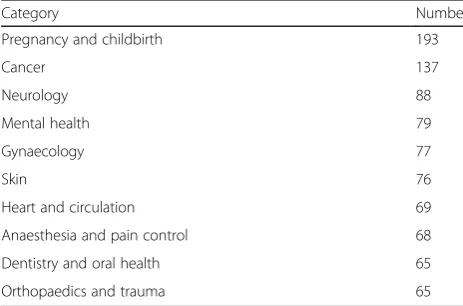
[image:3.595.66.530.96.647.2]category being Disease Category. The ‘top 10’ searched for terms are shown in Table 4. In 2014, the most commonly searched term was ‘cancer’ (n= 129) and although this increased to 137 searches in 2015, it was superseded in 2015 by ‘pregnancy and childbirth’ (n= 193).
In 2015, we conducted a pop-up survey to find out why people were searching in the COMET database. The survey appeared at the beginning of each search during a 1-month period, asking people to select single response to give their reason for searching in the COMET database. Full details of the survey have been published [2] but, in summary, it showed that the most common reasons for searching the database were to form decision-making about developing a COS, or to in-form the outcomes in planning a clinical trial. The pop-up survey also confirmed the importance of keeping the contents of the database up to date, if it is to help re-searchers to avoid unnecessary duplication of effort and minimise waste [9].
The sustained growth in use of the website and data-base suggests that COMET is continuing to gain interest and prominence, and that the resources are useful to people interested in COS development. To help ensure that the content is kept up to date a second update of the systematic review of COS [1, 2] is underway and the COMET website and database usage figures will con-tinue to be monitored and assessed annually.
Abbreviations
COMET:Core Outcome Measures in Effectiveness Trials; COS: Core outcome set(s); CROWN: Core Outcomes in Women’s Health; NSCLC: Non-small-cell lung cancer; SPIRIT: Standard Protocol Items: Recommendations for Interventional Trials
Acknowledgements
Ms. Mel Major, Associate Professor Marike vander Schaaf and Professor Dale Needham consent for their Twitter profiles and tweets to be used in this manuscript.
Funding
This work was supported by the MRC North West Hub for Trials Methodology Research (MR/K025635/1), and the NIHR Senior Investigators Award (NF-SI_0513-10025).
Availability of data and materials
Not applicable (but data used to prepare the tables is available from the authors).
Authors’contributions
EG and MC conceived the idea for these periodic reports. EG performed the analysis. EG, PW, MC, JB, ST and DA interpreted data. EG wrote the manuscript. All authors read and approved the final manuscript.
Competing interests
DA, JB, MC, ST and PW are members of the COMET Management Group and coapplicants on grants to support COMET and related work. EG is a member of the COMET Management Group and is the COMET project coordinator.
Consent for publication
Not applicable.
Ethics approval and consent to participate
Not applicable.
Author details 1
Department of Biostatistics, University of Liverpool, 1st floor Duncan Building, Daulby Street, Liverpool L69 3GA, UK.2University of Oxford, Centre for Statistics in Medicine, Botnar Research Centre, Windmill Road, Oxford OX3 7LD, UK.3School of Social and Community Medicine, University of Bristol, Canynge Hall, 39 Whatley Road, Bristol BS8 2PS, UK.4Center for Medical Technology Policy (CMTP), World Trade Center Baltimore, 401 East Pratt Street, Suite 631, Baltimore, MD 21202, USA.5Queen’s University Belfast, Institute of Clinical Sciences, Block B, Royal Hospitals, Grosvenor Road, Belfast BT12 6BJ, UK.
[image:4.595.56.540.99.254.2]Received: 25 May 2016 Accepted: 9 January 2017
Table 3Countries with the most visits to the Core Outcome Measure in Effectiveness Trials (COMET) website in 2012 to 2015
2012 2013 2014 2015
United Kingdom 5577 United Kingdom 7526 United Kingdom 8203 United Kingdom 9862
United States 431 United States 1022 United States 2038 United States 2444
Canada 326 Canada 501 Italy 1115 Canada 1449
Australia 201 Australia 321 Canada 624 Australia 654
Germany 186 Italy 315 Germany 581 France 593
Netherlands 166 Netherlands 308 Netherlands 510 Netherlands 570
Italy 161 Germany 285 Australia 494 Germany 553
France 125 Japan 228 France 374 India 477
Ireland 113 France 227 India 306 Italy 439
Norway 62 Ireland 159 Ireland 239 Ireland 415
Table 4‘Top 10’search terms in 2015
Category Number
Pregnancy and childbirth 193
Cancer 137
Neurology 88
Mental health 79
Gynaecology 77
Skin 76
Heart and circulation 69
Anaesthesia and pain control 68
Dentistry and oral health 65
[image:4.595.56.288.578.731.2]References
1. Gargon E, et al. Choosing important health outcomes for comparative effectiveness research: a systematic review. PLoS One. 2014;9(6):e99111. 2. Gorst SL, et al. Choosing important health outcomes for comparative effectiveness research: an updated review and user survey. PLoS One. 2016;11(1):e0146444.
3. COMET. Core Outcome Measures in Effectiveness Trials. Available from: www.comet-initiative.org. Accessed 27 Jan 2017.
4. Gargon E, et al. The COMET Initiative database: progress and activities from 2011 to 2013. Trials. 2014;15(1):279.
5. Gargon E, et al. The COMET Initiative database: progress and activities update (2014). Trials. 2015;16(1):515.
6. Khan K. The CROWN Initiative: journal editors invite researchers to develop core outcomes in women’s health. J Ovarian Res. 2015;8(1):6.
7. Williamson PR, et al. Developing core outcome sets for clinical trials: issues to consider. Trials. 2012;13(1):132.
8. Treweek S, et al. Making randomised trials more efficient: report of the first meeting to discuss the Trial Forge platform. Trials. 2015;16:261.
9. Ioannidis JPA, et al. Increasing value and reducing waste in research design, conduct, and analysis. Lancet. 2014;383(9912):166–75.
• We accept pre-submission inquiries
• Our selector tool helps you to find the most relevant journal • We provide round the clock customer support
• Convenient online submission • Thorough peer review
• Inclusion in PubMed and all major indexing services • Maximum visibility for your research
Submit your manuscript at www.biomedcentral.com/submit