Kinesiology Dissertations Department of Kinesiology and Health
Spring 5-12-2017
A Descriptive Profile of Dance Curriculum in
Physical Education Teacher Education Programs
Jenee M. MarquisGeorgia State University
Follow this and additional works at:https://scholarworks.gsu.edu/kin_health_diss
This Dissertation is brought to you for free and open access by the Department of Kinesiology and Health at ScholarWorks @ Georgia State University. It has been accepted for inclusion in Kinesiology Dissertations by an authorized administrator of ScholarWorks @ Georgia State University. For more information, please [email protected].
Recommended Citation
Marquis, Jenee M., "A Descriptive Profile of Dance Curriculum in Physical Education Teacher Education Programs." Dissertation, Georgia State University, 2017.
ACCEPTANCE
This dissertation, A DESCRIPTIVE PROFILE OF DANCE CURRICULUM IN PHYSICAL
EDUCATION TEACHER EDUCATION PROGRAMS, by JENÉE MARQUIS, was prepared
under the direction of the candidate’s Dissertation Advisory Committee. It is accepted by the
committee members in partial fulfillment of the requirements for the degree, Doctor of
Philoso-phy, in the College of Education and Human Development, Georgia State University.
The Dissertation Advisory Committee and the student’s Department Chairperson, as
representa-tives of the faculty, certify that this dissertation has met all standards of excellence and
scholar-ship as determined by the faculty.
_________________________________
Michael Metzler, Ph.D. Committee Chair
_________________________________ _________________________________ Jacalyn Lund, Ph.D. Shannon Barrett-Williams, Ph.D.
Committee Member Committee Member
_________________________________ _________________________________ Betty Block, Ph.D. Rachel Gurvitch, Ed.D.
Committee Member Committee Member
_________________________________
Date
_________________________________ Mark Geil, Ph.D.
Chairperson, Department of Kinesiology and Health
_________________________________
Paul A. Alberto, Ph.D. Dean
By presenting this dissertation as a partial fulfillment of the requirements for the advanced degree
from Georgia State University, I agree that the library of Georgia State University shall make it
available for inspection and circulation in accordance with its regulations governing materials of
this type. I agree that permission to quote, to copy from, or to publish this dissertation may be
granted by the professor under whose direction it was written, by the College of Education and
Human Development’s Director of Graduate Studies, or by me. Such quoting, copying, or
pub-lishing must be solely for scholarly purposes and will not involve potential financial gain. It is
un-derstood that any copying from or publication of this dissertation which involves potential
finan-cial gain will not be allowed without my written permission.
All dissertations deposited in the Georgia State University library must be used in accordance
with the stipulations prescribed by the author in the preceding statement. The author of this
dis-sertation is:
Jenée Marie Marquis 1108 Pughes Creek Way Lawrenceville, GA 30045
The director of this dissertation is:
Dr. Michael W. Metzler
Department of Kinesiology and Health College of Education and Human Development
Jenée Marquis
ADDRESS: 1108 Pughes Creek Way Lawrenceville, GA 30045
EDUCATION:
PROFESSIONAL EXPERIENCE:
2013-present Graduate Research Assistant Georgia State University
2013-2015 Graduate Teaching Assistant Georgia State University
2013-2015 Editorial Assistant
Quest
2011-2013 Graduate Research Assistant Georgia State University
PRESENTATIONS AND PUBLICATIONS:
Marquis, J. & Metzler, M. (in press). Curricular space allocated for dance content in physical edu-cation teacher eduedu-cation programs: A literature review. Quest.
doi:10.1080/00336297.2016.1256223
Ph.D. 2016 Georgia State University Kinesiology and Health
Kinesiology – Physical Education Teacher Education
Master’s Degree 2013 Georgia State University Kinesiology and Health Health and Physical Education
on Scholarly Teaching. Atlanta, GA.
Metzler, M., Diamond, E., Hunt, K., Jackson, J., Marquis, J., Trent, M. (2016, March). Instruc-tional alignment in college teaching: A pilot study. Poster presentation at the Scholarship of Teaching and Learning Commons Conference. Savannah, GA.
Metzler, M., Barrett-Williams, S., Hunt, K., Marquis, J., Trent, M. (2015, October). The plausi-bility and feasiplausi-bility of a 2-year HOPE CSPAP implementation. Presentation at the PETE/HETE Conference. Atlanta, GA.
Trent, M., Hunt, K., Marquis, J., Jackson, J., Yao, A., Burgess, J. (2015, October). Envisioning the future of PETE: What does your program stand for? Presentation at the PETE/HETE Conference. Atlanta, GA.
Metzler, M., Barrett-Williams, S., Hunt, K., Marquis, J., & Trent, M. (2015, March). First flight of the fledgling: Advancing comprehensive school physical activity program research.
Presentation at the SHAPE America National Convention. Seattle, WA.
Metzler, M., Hunt, K., Barrett-Williams, S., Trent, M., & Marquis, J. (2015, February). Imple-menting and evaluating a comprehensive school physical activity program (CSPAP): Year 1 results. Poster Presentation at the Active Living Research Conference. San Diego, CA.
Marquis, J. (2015, February). Bhangra beats! Incorporating Indian dance into physical educa-tion. Presentation at the SHAPE America Southern District Conference. Atlanta, GA.
Marquis, J. (2015, February). Shake and shimmy! How to incorporate belly dance into your phys-ical education curriculum. Presentation at the SHAPE America Southern District Confer-ence. Atlanta, GA.
Marquis, J. & Gurvitch, R. (2015). Shake it out! Belly dancing in physical education. Journal of Physical Education, Recreation & Dance, 86(8), 14-21.
Hunt, K., Trent, M., Jackson, J., Marquis, J., Barrett-Williams, S., Gurvitch, R., Metzler, M. (2015). The effect of content delivery media on student engagement and learning out-comes.Journal of Effective Teaching, 16(1),5-18.
PROFESSIONAL SOCIETIES AND ORGANIZATIONS
2015 National Dance Education Organization
2013 National Association for Kinesiology in Higher Education 2011 Society of Health and Physical Educators
by
JENÉE MARQUIS
Under the Direction of Dr. Michael W. Metzler
ABSTRACT
Dance as a content area has received little attention within physical education teacher
edu-cation (PETE) research. To date, there has been only one study, conducted in 1992, that examined
dance courses within PETE programs. In order for PETE faculty to make informed programmatic
decisions about the role of dance education within PETE and P-12 physical education, the
find-ings of this study must be updated. The primary purpose of this mixed methods study is to gather
current descriptive information about dance courses in PETE programs. A secondary purpose of
this study is to uncover both personnel and institutional elements that act as either facilitators or
inhibitors of dance instruction within PETE programs. Data collected via an online questionnaire
(n = 580, 17.9% return rate) revealed that a quarter of respondents (25.8%, n = 23) neither offered
taught are rhythmic activities (88.9%), line dance (70.4%), folk/world dance (61.1%), creative
dance (61.1%), and square dance (48.1%). Data also revealed that PE major students gained
ped-agogical content knowledge (PCK) from writing lesson plans (89.5%), student learning outcomes
and assessments (71.1%), learning the history of dance and/or dance appreciation (39.5%) as well
as theories of dance education (29.0%). Over half of dance courses (51.1%) are taught by a
mem-ber of the Professoriate or the Department Chair and the mean tenure of dance course instructors
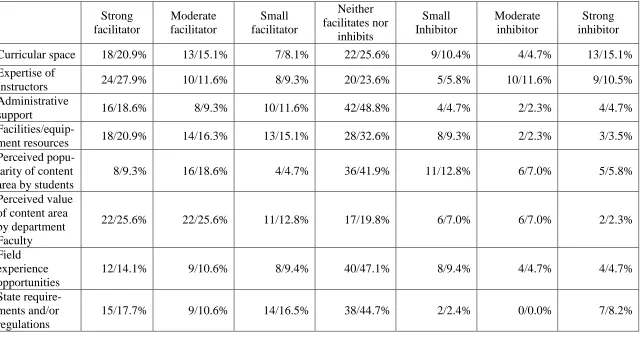
is 9.2 years. Last, the questionnaire revealed that the strongest facilitator of dance instruction was
instructor expertise (27.9%) and the strongest inhibitor of dance instruction was lack of curricular
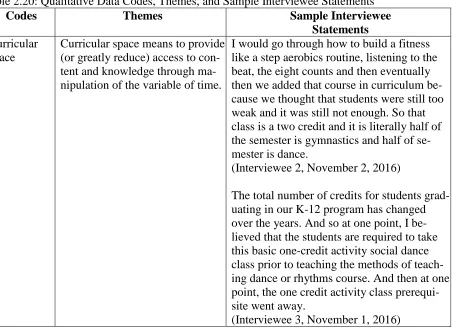
space (15.1%) which was corroborated by the interview data. Furthermore the interview data,
which was coded using Descriptive Coding coupled with Phenomenological and Thematic
Analy-sis, found that interviewee’s highly valued dance as both a lifelong physical activity and as an
es-sential component to a P-12 PE program.
A DESCRIPTIVE PROFILE OF DANCE CURRICULUM IN PHYSICAL EDUCATION TEACHER EDUCATION PROGRAMS
by
JENÉE MARQUIS
A Dissertation
Presented in Partial Fulfillment of Requirements for the
Degree of
Doctor of Philosophy
in
Kinesiology
in
Kinesiology and Health Department
in
the College of Education and Human Development
Georgia State University
Copyright by Jenée M. Marquis
LIST OF TABLES………..iv
LIST OF ABBREVIATIONS………v
1 CURRICULAR SPACE ALLOCATED FOR DANCE CONTENT IN PHYSICAL EDUCATION TEACHER EDUCATION PROGRAMS: A LITERATURE REVIEW ... Error! Bookmark not defined. Introduction…. ... Error! Bookmark not defined. Review………...10
References………...28
2 A DESCRIPTIVE PROFILE OF DANCE CURRICULUM IN PHYSICAL EDUCATION TEACHER EDUCATION PROGRAMS... 31
Methodology ... …..Error! Bookmark not defined.1 Purpose and Research Questions………... ……32
Results ... 43
Discussion...61
Conclusions and Recommendations...73
References…...76
1.1 Dance and Rhythm Vocabulary within the National Standards...4
1.2 Frequency of Dance and Rhythm Outcomes by Grade Level...5
2.1 Questionnaire Participants by SHAPE America District……….…………45
2.2 Questionnaire Participants by Institutional Enrollment……...………45
2.3 Questionnaire Participants by Institution Type………...….………46
2.4 Questionnaire Participants by Gender……….…….46
2.5 Questionnaire Participants by Highest Educational Degree Completed……….…...46
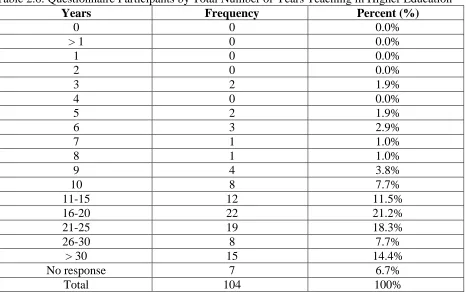
2.6 Questionnaire Participants by Total Number of Years Teaching in Higher Education……...46
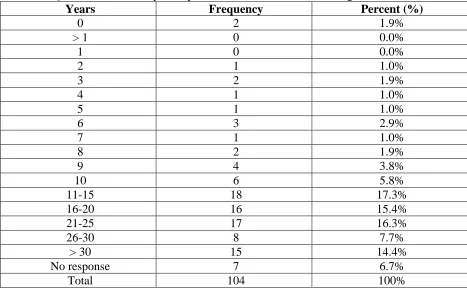
2.7 Questionnaire Participants by Total Number of Years Teaching in PETE……….….47
2.8 Questionnaire Participants by Current Position Title……….……..47
2.9 Institutional Demographics of Interview Participants……….……….……47
2.10 Personal Demographics of Interview Participants……….…….48
2.11 Curricular Space Allocated to Dance Courses by Program Certification Type……….51
2.12 Frequency of Dance Content Knowledge……….……….…….51
2.13 Frequency of Dance Pedagogical Content Knowledge………...………52
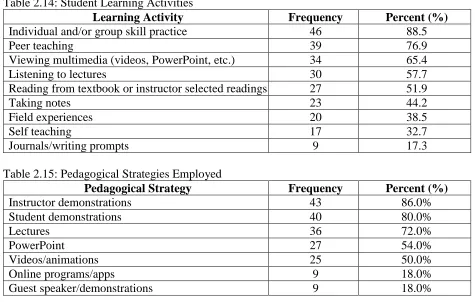
2.14 Student Learning Activities………..……….…….52
2.15 Pedagogical Strategies Employed……….……….52
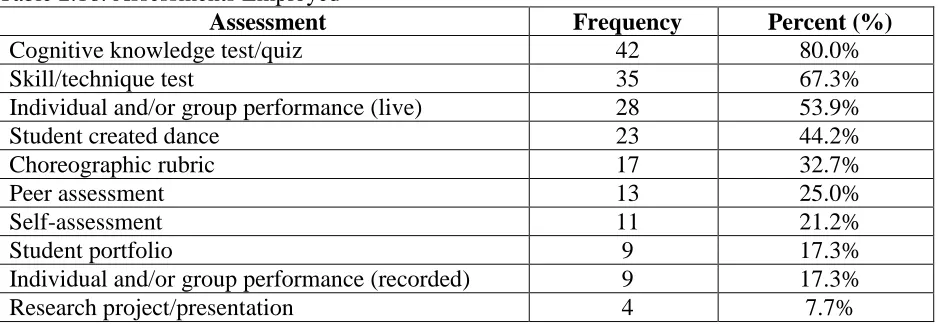
2.16 Assessments Employed……….……….53
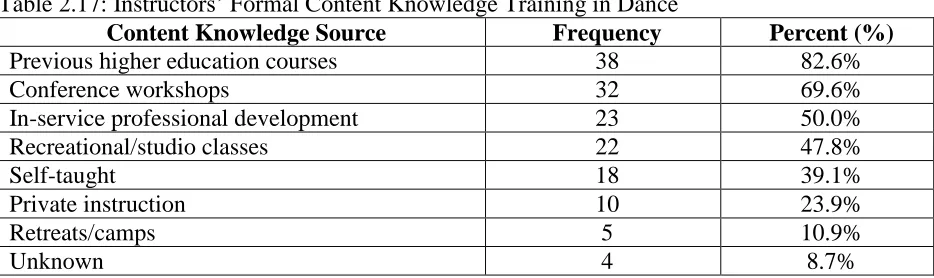
2.17 Instructor’s Formal Content Knowledge Training in Dance……….…….54
2.18 Instructor’s Formal Pedagogical Content Knowledge Training in Dance……….54
2.19 Facilitators and Inhibitors of Dance Instruction………....…….55
CK Content Knowledge
GTA Graduate Teaching Assistant
IRB Institutional Review Board
NASPE National Association for Sport and Physical Education
NDA National Dance Association
PA Physical Activity
PE Physical Education
PCK Pedagogical Content Knowledge
PETE Physical Education Teacher Education
PE-PCK Physical Education-Pedagogical Content Knowledge
PK Pedagogical Knowledge
SHAPE Society of Health and Physical Educators
1 CURRICULAR SPACE ALLOCATED FOR DANCE CONTENT IN PHYSICAL
EDUCATION TEACHER EDUCATION PROGRAMS:
A LITERATURE REVIEW
Introduction
Dance is a form of lifelong physical activity that can be practiced and enjoyed by
every-one. Proponents of dance education within physical education (PE) argue that teaching dance can
positively affect students in all three learning domains (Bolen, Heatherly, Ratliff, &
McCulloch-Vinson, 2012; Pangrazi &Beighle, 2016). Within the psychomotor domain, research has shown
that engaging in various forms of dance can improve children’s movement repertoire, develop
coordination and balance, increase overall physical activity frequency in adolescents, and boost
students’ flexibility, strength and overall fitness levels (Chen & Cone, 2003; Cone & Cone,
2003; O’Neill, Pate, & Liese, 2011; Pangrazi, 2016). More aerobic forms of dance and
combin-ing dance with technology, as with the case of exergamcombin-ing, has the potential to increase daily
physical activity levels and can promote weight loss or maintenance (Zan & Ping, 2014).
Cogni-tively, dance can foster creativity and self-expression, increase focus and self-awareness,
pro-mote quick decision making and critical thinking, offer a sense of ownership and autonomy, and
even improve academic performance (Chen & Cone, 2003; Linthicum, 2009; Lorenzo-Lasa, R.
Ideishi, & S. Ideishi, 2007; Pangrazi & Beighle, 2016; Ross, 2006). Also, integrating dance
con-tent with classroom subjects, such as science or language arts, can help motivate students and
promote transfer of learning to other content areas (Linthicum, 2009; Wirszyla & Gorecki,
1998). From an affective perspective, dance can help students learn cooperation, social etiquette,
respect for others, increase confidence, improve listening skills and can deepen appreciation for
al., 2007; Pangrazi & Beighle, 2016; Ross, 2006; Ward, 2013). Last, from a critical lens,
teach-ing dance in PE can open avenues for class discussions on gender issues, cultural competency,
and social justice (Gard, 2003; Ward, 2013).
In the 1930s, dance education within the P-12 school system became officially housed
within the PE curriculum through increased dance advocacy within the American Physical
Edu-cation Association (Murray, 1968). The largest professional association of health and physical
educators within the United States, the Society for Health and Physical Educators (SHAPE
America), has continued to incorporate dance standards into the national grade level outcomes
for P-12 physical education, created in part to assist physical educators in designing and
as-sessing physical education program content.
In 1994, the National Dance Standards were published in the report National Standards
for Arts Education: What Every Young American Should Know and Be Able To Do in the Arts.
This undertaking was developed by the Consortium of National Arts Education Associations
(CNAEA) which included the American Alliance for Health, Physical Education, Recreation and
Dance (AAHPERD), the National Dance Association (NDA, now dissolved), the National Art
Education Association (NAEA), and the Music Educators National Conference (MENC). The
purpose of these standards was to “render, in operational terms, the value and importance of the
arts for the educational well-being of our young people and our country” (Mahlmann, J., 1994, p.
12). Since one of the sponsoring agencies for this report included AAHPERD, it could be argued
that the arts standards were also meant, in part, to complement the National Physical Education
Standards and were intended to assist both dance and physical educators when planning for their
dance curriculum. However, this document is distinctly labeled as arts education standards and
National Dance Standards are not housed on the SHAPE America website and, along with the
National Adapted PE/PA Standards, are maintained on an external website separate from
SHAPE America (SHAPE America, 2013). The organization that contains the National Dance
Standards is the ArtsEdge program of The Kennedy Center and the standards are filed under
“Standards in Dance, Music, Theater, and Visual Arts” (n.d.). Given that the dance standards are
linked so strongly to the arts standards in these two public mediums, it is reasonable to ask how
many physical education teacher education (PETE) faculty and/or P-12 physical educators are
aware of the National Dance Standards and, if they are, how many actually reference them when
planning for their dance curriculum? Therefore, with such questions surrounding their frequency
of use by PETE and P-12 physical educators, the authors chose not to include further discussion
of the National Dance Standards within the confines of this manuscript and are solely focusing
on the National Physical Education Standards.
An examination of the grade level outcomes as determined by SHAPE America (SHAPE
America, 2013) reveals the extent to which dance skills, knowledge, and dispositions should be
emphasized in P-12 PE. For the purpose of this particular analysis, the authors employed the
Op-erational Definition of Activity Categories provided by SHAPE America in the Grade Level
Out-comes document. SHAPE America delineates Dance and Rhythm Activities to include “activities
that focus on dance or rhythms and might include, but are not limited to dance forms such as
cre-ative movement/dance, ballet, modern, ethnic/folk, hip hop, Latin, line, ballroom, social and
square” (SHAPE America, 2013). However, for the following literature review we will apply the
umbrella term of “dance” to denote both dance and rhythmic activities. Table 1.1 illustrates the
placement and frequency in which the terms “dance” or “rhythm” appear in the grade level
Table 1.1: Dance and Rhythm Vocabulary within the National Standards
Standard 1: The physically literate individual demonstrates competency in a variety of motor skills and movement patterns.
Elementary School Middle School High School
E1.4 E1.5a E3.5 E5.K - 5 E7.5 E8.1 E8.5 E10.5 E11.2 - 5 E12.3
M1.6 – 8 H2.L1 – 2
Standard 2: The physically literate individual applies knowledge of concepts, principles, strategies, and tactics related to movement and performance.
Elementary School Middle School High School
E1.Kb – 2 E1.5 E2.2 E2.4 – 5 E3.5c E4.3a – b E4.4 – 5
M12.6 – 7 H1.L1 – 2
H4.L1 – 2
Standard 3: The physically literate individual demonstrates knowledge and skills to achieve and maintain a health-enhancing level of physical activity and fitness.
Elementary School Middle School High School
No outcome mentioning rhythms/dance knowledge, skills, or dispositions.
M3.6 M3.8 M4.6 M5.6 M5.8
H6.L1 – 2
Standard 4: The physically literate individual exhibits responsible personal and social behavior that respects self and others.
Elementary School Middle School High School
No outcome mentioning rhythms/dance knowledge, skills, or dispositions.
M6.6 – 8 H2.L1
H4.L1 H5.L1 – 2
Standard 5: The physically literate individual recognizes the value of physical activity for health, enjoyment, challenge, self-expression and/or social interaction.
Elementary School Middle School High School
E2.5 E3.2
No outcome mentioning rhythms/dance knowledge, skills, or dispositions.
Table 1.2 represents the total number of grade level outcomes in elementary, middle, and
high school as well as the total number of outcomes specifically related to rhythms/dance within
each level (expressed as both a number and as a percent). Outcomes at the elementary school
level stating “Developmentally appropriate/emerging outcomes first appear in Grade...” are not
included in the total calculations, but sub-elements of outcomes (i.e. 4a, 4b, 4c) are incorporated.
Outcomes at the high school level written as “If the outcome was not achieved in Level 1, it
should be a focus in Level 2” are included, but outcomes written as “...is a focus in Level 2” are
excluded in the total outcome calculations.
Table 1.2: Frequency of Dance and Rhythm Outcomes by Grade Level
Level Total Outcomes Rhythms/Dance Outcomes %
Elementary 287 32 11.15%
Middle 201 13 6.47%
High 59 16 27.12%
Totals 547 61 11.15%
There are some ambiguities in Table 1.2 that may lead one to assume that there is little
emphasis of rhythms/dance activities across the physical education standards. It should be noted
that of the outcomes do not mention rhythms/dance specifically, such as Standard 3 at the
ele-mentary school level; sports or games content are also not specifically mentioned in that
stand-ard. In addition, while several outcomes across all three levels do not mention rhythms/dance
ex-plicitly, they could be interpreted to potentially embrace dance content. For example, Standard 4
at the elementary level lists outcomes that demonstrate personal responsibility, such as “Follows
directions in group settings” (S4.E1.K) and “Works independently for extended periods of time”
(S4.E2.3). These outcomes do not refer to any particular content and therefore could include
outcomes for self-expression and enjoyment as “Identifies how self-expression and physical
ac-tivity are related” (S5.M5.6) and “Identifies and participates in an enjoyable acac-tivity that prompts
individual self-expression” (S5.M5.8). Both of these outcomes could easily encompass
rhythms/dance activities. Therefore, the presence (and resulting overall percentage) of
rhythms/dance outcomes in P-12 PE has the capacity to increase depending on the interpretation
of the PE content included within the more ambiguously worded outcomes.If today’s physical
educators are expected to teach dance in accordance with outcomes established by SHAPE
America, it is essential to know both the quantity and quality of dance instruction in P-12 schools
today to assess whether or not those outcomes are being achieved.
Using these grade level outcomes as a guide allows us to construct a framework for the
content knowledge (CK) and pedagogical content knowledge (PCK) that physical educators need
in order to effectively teach this content to their students. Within the realm of PETE, activity
based/movement content courses are the primary avenue by which preservice physical educators
supposedly learn the CK found in P-12 school PE curriculum, yet how many credit hours within
PETE programs are actually allotted to the teaching of physical activity performance skills and
knowledge? There has been literature to suggest that PETE programs place too much emphasis
on pedagogical knowledge (PK), or the “broad principles and strategies of classroom
manage-ment and organization that appear to transcend subject matter” and not enough on CK (Shulman,
1987, p. 8). Vickers (1987) argues:
The focus in teacher education has been on developing skills in the process of teaching.
Subject matter is presented in separate degree and course experiences and is most often
not integrated into teacher education programs in a systematic and deliberate fashion. (p.
Despite the fact that Vickers’ article was published almost 30 years ago, the argument for
more courses in skill acquisition in PETE remains. In Siedentop’s Keynote Address given at the
C&I Academy Conference in 1989 (published in 2002) he begs the question, what CK is
in-cluded in the domain of physical education? He asserts that PETE has “given up the historic
con-tent knowledge in our field, and, in doing so, have virtually eliminated the possibility of
develop-ing a serious body of pedagogical content knowledge for the teachdevelop-ing of physical education”
(Siedentop, 2002, p. 368). The link between CK and PCK is inextricable as PCK is moot without
CK. Siedentop (2002) claims that CK courses in PETE programs have been significantly reduced
and the very nature of these courses have been changed “so that they can be passed off as skill
analysis or pedagogy courses” in order to make them “more palatable for curriculum review
committees” (p. 371). He goes on to contend that the reason for this shift from content to
peda-gogy is due to the belief that “sport performance coursework is not worthy of academic status”
and the root problem facing PETE programs is that “the direct study of sport skill and strategy
through experiential learning is not considered to be of sufficient academic quality to form the
core of an undergraduate degree program” (Siedentop, 2002, p. 372). As a result, PETE
pro-grams have produced subpar physical education teachers who “are ill equipped to teach anything
beyond a beginning unit of activity” (Siedentop, 2002, p. 372). The debate over the content of
physical education has resulted in the lack of a “grand macro-theory of what physical education
should be” and therefore, “the norm in PETE has been to present all sides of the debate, with the
implicit notion that individual teachers will make reasoned decisions based on their personal
sit-uations” (Siedentop & Locke, 1997, p. 29). The absence of a strong and cohesive program theory
has granted PETE the freedom to “add content to an already cluttered, coverage-oriented, teacher
In alignment with scholars of the previous generation, several current authors have come
to the consensus that preservice physical educators are in need of more content/subject matter
knowledge, though there is debate over the format of preservice CK courses. In 2013, Johnson
wrote about the value of physical performance within PETE programs. He used John Dewey’s
philosophy of experience to argue that the current “hierarchy of educational subject matter”
val-ues “mind over body” and “thinking over doing” (Johnson, 2013, p. 485). As a consequence, this
school of thought has led to a PETE curriculum that limits activity based courses in favor of
the-ory and/or science courses, thus devaluing the importance of physical skill and experience
(John-son, 2013). Johnson (2013) argues that “leaders do not need to emphasize theoretical knowledge
over practical knowledge to improve the status of physical education in educational institutions”
(p.494). Instead, Johnson concludes that “activity performance courses deserve a much stronger
presence in PETE curricula” and that “exploring and using information in action and
perfor-mance is what really matters” (2013, p. 494). Last, Johnson (2013) expresses concern that PETE
programs will be unable to successfully prepare future physical educators “without building their
skillful performance capabilities because someone cannot be considered educated and
knowl-edgeable in physical education unless they can perform the content well” (p. 494). More
re-cently, Johnson (2015) employed the concept of “lived body knowledge” by way of Maurice
Merleau-Ponty’s philosophy of the lived body. Johnson (2015) argued that “lived body
knowledge cannot be learned in lecture rooms” (p. 233) and that from this perspective the
“scien-tific dimensions of physical activity are not superior to the practice of physical activity” (p. 234).
Johnson goes on to state that preservice physical educators must not only “obtain propositional
or theoretical knowledge about physical activity; a preservice teacher should also experience
who have not or are not pursuing a degree in physical education” (p. 235). Last, Johnson
con-tended that the study of physical education “includes study of both the objective body and the
lived body engaged in physical activity” (p. 235).
Taking a slightly different approach, Ayvazo, Ward, and Stuhr (2010) discussed CK by
focusing not only on how to play a sport or execute a particular skill as having a deep
under-standing of how to play a sport does not necessarily translate to the ability to sequence tasks and
progressions for the beginner learner. Therefore, they suggested that CK courses within PETE
include learning activities that help preservice teachers “learn the content progressively” (p. 42).
The authors also recommended that CK courses should “teach and enhance the teacher
candi-date’s (TC) ability to perform the techniques and tactics associated with the sport” and in order
to facilitate this, “there must be sufficient opportunities to learn” (2010, p. 43). Last, the authors
contended that preservice physical educators often “do not get enough practice recognizing
er-rors and prescribing appropriate progressions” and to remedy this, PETE students need more
time to analyze performances via observations and video clips (Ayvazo et al., 2010, p. 43).
In order to evaluate the current role dance content plays within P-12 PE, we must first
begin by examining the curricular space afforded to the development of dance CK and PCK in
the PETE curriculum. This examination will provide a foundation by which we can determine if
future physical educators are being adequately prepared to teach this content area to their own
students upon graduation. Therefore, the purpose of this review is to (a) examine empirical
stud-ies of curricular space allocated to activity based/movement content knowledge courses in PETE
preservice programs in the United States, (b) examine empirical studies of curricular space
avenues of future research and methodological considerations for dance instruction and
educa-tion in PETE preservice program curricula.
Theoretical Framework
This review is grounded in Shulman’s description of the knowledge base needed for
teachers. He outlines seven categories that are the grounds for teacher understanding: content
knowledge, general pedagogical content knowledge, curriculum knowledge, pedagogical content
knowledge, knowledge of learners and their characteristics, knowledge of educational contexts,
and knowledge of educational ends, purposes, and values (Shulman, 1987). This literature
re-view will focus solely on the role of CK and PCK courses within PETE. CK as defined by
Shul-man (1986) is “the amount and organization of knowledge per se in the mind of the teacher” (p.
9). Furthermore, in terms of subject matter specifics “the ways of discussing the content structure
of knowledge differ. To think properly about content knowledge requires going beyond
knowledge of the facts or concepts of the domain. It requires understanding the structures of the
subject matter” (Shulman, 1986, p. 9). Therefore, teachers need not only know the cognitive
knowledge and/or physical performance skills needed within their subject domain, they must
also “be able to explain why a particular proposition is deemed warranted, why it is worth
know-ing, and how it relates to other propositions, both within the discipline and without, both in
the-ory and in practice” (Shulman, 1986, p. 9).
PCK, as a subset of CK “represents the blending of content and pedagogy into an
under-standing of how particular topics, problems, or issues are organized, represented, and adapted to
the diverse interests and abilities of learners, and presented for instruction” (Shulman, 1987, p.
it comprehensible to students as well as having “an understanding of what makes the learning of
specific topics easy or difficult: the conceptions and preconceptions that students of different
ages and backgrounds bring with them to the learning of those most frequently taught topics and
lessons” (Shulman, 1987, p. 9). By examining the historical trends in credit hour allocation of
activity based and dance courses within PETE, we can discover potential relationships between
CK and PCK expertise (or lack thereof) and the current P-12 PE curriculum.
Methods
Inclusion and Exclusion Criteria
This review examines empirical studies conducted since 1990 on the allocation of
curric-ular space within PETE preservice programs in the United States, with a focus on curriccurric-ular
space allotted to activity based/movement content knowledge courses. For the purpose of this
re-view, an “activity based/movement content knowledge course” is defined as any course within a
PETE preservice program in which students acquire the knowledge, skills, and dispositions
needed to engage in or perform a particular sport, game, dance or other physical activity. Courses
that include both CK and PCK are also included in this definition, but courses that focus solely
on generic pedagogical knowledge (PK) are not. Studies were excluded from this review if they
were conducted prior to 1990, since publication of the National Standards for Physical Education
did not occur until 1995 (NASPE, 1995). In addition, studies that examined PETE preservice
programs outside of the United States were not included because the structure of PETE
preserv-ice programs worldwide varies too greatly to produce an accurate comparison of data across
Search Procedures
The databases that were utilized had a topic focus of education, kinesiology, fitness and
health, or sports and were accessible online through the University System of Georgia or via
in-ternet access through a Google search with no additional cost to purchase the manuscript. The
databases employed within the search were Academic Search Complete, Education Source,
Google Scholar, ProQuest Education, and SportDiscus. Also, dance education journals and dance
research journals, discovered through a Google search, also yielded several sources which were
chosen for further searching. This list was comprised of the Journal of Dance Education,
Re-search in Dance Education, and Dance Education in Practice. Although the aim of the above
journals focuses on dance within an arts education context, the authors chose to include them in
the search using the rationale that there may have been empirical articles published within them
that bolstered the Mehrhof and Ermler study or contained content matter related to it.
Key search terms that were employed in each of the databases and journals above
in-cluded the following word combinations: “curriculum and physical education teacher education”,
“curricular space and physical education teacher education”, “curricular space and physical
edu-cation, dance and physical education”, “dance and physical education teacher education”,
“cur-riculum and dance and physical education teacher education”, “cur“cur-riculum and dance and
cal education”, “dance and benefits of and physical education”, and “dance and benefits of
physi-cal education teacher education”. Practitioner journals, such as the Journal of Physical
Educa-tion, Recreation & Dance, were also included within the search but articles were only included if
they met all of the inclusion criteria. As a result, the following journals are represented within
studies) and ICHPER -- SD Journal of Research in Health, Physical Education, Recreation,
Sport & Dance (one study).
Limitations
Due to the specifications of the scope of the review, very few search results were
in-cluded. There were three strong limiting factors to the inclusion criteria that contributed to only a
select few journals being eligible for inclusion: the timeframe (1990 to present), the location
(U.S. PETE only), and the type of manuscript (empirical).
Results
Curricular Space in PETE
Eight studies matching all of the above criteria are included in this review. These studies
are organized by the methodology employed and are categorized as follows: document analysis,
survey, and a combination of document analysis and survey.
Document analysis. Bahneman (1996) reviewed curricular materials from 29 institutions
that offered both undergraduate and doctoral degrees in physical education to determine current
curricular offerings and to compare the similarities and differences among this particular group
of institutions. Data in the study included the course and credit hour requirements at both the
in-stitutional level and at the major level. Courses at the major level are defined as those that are
taken once a student is admitted into the physical education program and are organized by
Bah-neman (1996) into the following categories: (a) Professional Foundations, (b) Scientific
Founda-tions, (c) Activities, (d) Curriculum and Instruction, and (e) Practica. Bahneman also examined
regards to PETE credit requirements for activity and/or movement content courses, the following
courses were required by all 29 institutions: rhythmic activities, which included low-organized
games (M=2.4 credit hours), track/field (M=2.1 credit hours), volleyball (M=1.9 credit hours),
and basketball (M=1.7 credit hours). Rounding out the top five, softball (including baseball) was
required 28 institutions at a mean of 1.5 credit hours. Although Bahneman offered no
sugges-tions or recommendasugges-tions for improving PETE program curricula, he concluded that this result,
coupled with the remainder of the analysis, indicated that there are more similarities than
differ-ences in curricular offerings among the PETE programs that participated in the study.
Survey. The first survey of PETE preservice program curricula, completed by Strand in
1992, profiled program practices in an attempt to answer the question, “do public school physical
education teachers simply teach the activities they were taught to teach in their university
courses?” (p. 104). Strand analyzed 113 institutions in the United States that offered a
bache-lor’s, master’s, or doctoral degree in physical education. The administered questionnaire
gath-ered data on various aspects of teacher preparation such as coaching, skill/activity courses,
peer/pre-student teaching, and student teaching. Considering only the skill/activity course results,
Strand (1992) found that institutions on a semester calendar required a mean of 9.29 credit hours
of activity courses whereas institutions on a quarter calendar required a mean of 14.21 credit
hours; however, when calculating the overall number of minutes spent in class, semester-based
institutions offered almost 375 more minutes of class time than did institutions on a quarter
cal-endar. In terms of required activity courses, gymnastics and swimming ranked the highest at 68%
and 60% respectively with volleyball (55%), soccer (54%), and tennis (53%) rounding out the
top five. Strand asserts that the most commonly taught activities in public schools based on prior
cited in Strand, 1992) are basketball, soccer, football, volleyball, and softball and thus led him to
ask the question, are PETE faculty preparing physical educators in the wrong physical activities?
Furthering Strand’s earlier work, Hetland and Strand (2010) situated their analysis of
PETE preservice program curricular space within the Central District of the United States in
or-der to: (a) provide a general profile of PETE preservice programs, and (b) highlight program
similarities and differences. Utilizing an online survey, 44 of the petitioned 72 institutions
re-sponded (58% response rate). Items on the survey requested information regarding student
de-mographics, curricular items (which are defined as curricular and/or technology options like
cur-riculum models, Physical Best, pedometers, and heart-rate monitors that are embedded into
PETE programs), observations/field experiences/student teaching, fitness/skill testing, and
simu-lated peer and P-12 teaching experiences. The curricular space results revealed that students
completed a mean of 8.93 hours of “professional activity courses” (out of a mean of 122.70 total
hours needed for degree completion, or 7.28%). Forty-five percent of these courses were offered
as multiple-credit (more than one credit hour) and were categorized by type (individual, dual,
team, and combative sports and physical activities) followed by 20% of multiple-credit courses
that were categorized by grade level (elementary, middle, or high school). Among other
recom-mendations, the authors suggested that PETE preservice programs place a greater emphasis on
the inclusion of lifetime activities as well as physical and health-related activities into the
curric-ulum, a suggestion formerly endorsed in an earlier study of P-12 physical educators by Collier
and Hebert (2004).
The Collier and Hebert (2004) survey of PETE program graduates was intended to
pro-vide PETE faculty with assistance in making curricular decisions in their preservice programs
in-service 12 physical educators. Using a Likert scale questionnaire, researchers surveyed 359
P-12 physical educators (from the Pacific Northwest and the state of Wisconsin) on a variety of
topics pertaining to their preservice preparation, such as personal demographics, the value of
teaching approaches and certifications, as well as the importance of selected teaching skills,
ac-tivity based competencies, course work, programming areas, and in-service training topics. In
terms of activity based competencies, 31% of those surveyed believed that more emphasis should
be given to exercise and health-related fitness, 29% favored fundamental motor skills, and 25%
valued lifelong leisure activities in the PETE initial certification curriculum. Only 1.5% of
re-spondents indicated that dance should receive more emphasis in preservice PETE. In summary,
the authors proposed that PETE faculty examine current curricular offerings in traditional team
and individual sport skills and suggested incorporating more activities that may appeal to the
broad range of interests of today’s P-12 PE students.
Hill and Brodin (2004) surveyed PETE preservice program graduates for potential use in
aiding PETE faculty in determining curricular offerings. Similar to the Collier and Hebert (2004)
survey, their participants were asked via a Likert scale questionnaire to provide information
re-garding demographics, the content of their PETE preservice curriculum, the perceived value of
that curriculum, as well as any difficulties experienced by them during their initial year of
teach-ing. One hundred and thirty-two surveys were completed by current P-12 physical educators in
the state of Washington (37.7% return rate). Reporting only on the data concerning
move-ment/activity based content knowledge, 93.1% of respondents reported that sports
sports skills/knowledge concepts were either “somewhat valuable” or “very valuable” in
prepar-ing them to teach. Finally, the teachprepar-ing of sports skills was rated as the area of least difficulty
ex-perienced during the respondents’ first year of teaching (7.8%).
Ayers and Housner (2008) surveyed 116 PETE preservice programs in order to acquire
descriptive information about institutional characteristics, PETE student demographics, program
requirements (number and type of credit hours required within the program and the minors
of-fered and/or required within the program) and curricular space. Focusing on program
require-ments, the mean number of credit hours required for PETE preservice programs was 129.75 with
a mean of 9.61 hours (7.4% of curricular time) dedicated to sports and/or physical activity
con-tent courses. There was no further breakdown regarding which physical activity or movement
content courses were required and how many hours were dedicated to those courses. In their
dis-cussion, the authors expressed concern that not enough time was being spent teaching sport and
physical activities to preservice physical educators, especially considering the increasing
popu-larity of newer, alternative physical activities available to youth such as rock climbing, roller
blading, and exergaming.
Document analysis and survey. Beginning with the Georgia State University (GSU)
HPETE Assessment Project completed by Metzler, Tjeerdsma, and Walker (2000) included both
document analysis and surveys from the 1996 – 1999 HPETE preservice cohorts in order to
gauge the effectiveness of (and make potential revisions to) that preservice HPETE. A contextual
analysis of the program was completed and included elements such as a student profile, the
pro-gram’s design and structure, learning activities within the program, HPETE faculty experience
and expertise, cooperating teachers and student teaching sites, and administrative/resource
that 72 quarter hours (1996-1998 cohort) and 45 semester hours (1999 cohort) were spent in HPE
Major courses which are taken after completion of a student’s University Core Curriculum as the
student begins their Teacher Education program. Major courses were subdivided into movement
content (47 quarter hours, 29 semester hours) and methods and curriculum (25 quarter hours, 16
semester hours). Honing in on the learning activities offered within the Major’s activity courses,
the authors reported that three activity courses were required in the program which focused on
performance skills, analytic skills, tactics, and rules. One Major course was dedicated to content
and pedagogy in rhythmic activities and one Major course focused on content and pedagogy for
adventure education. What is unknown is how many credit hours per quarter or semester were
allocated to each of these courses or how the course instructors defined “rhythmic activities”.
The authors discussed the challenges associated with a recent credit hour reduction which cut
program time previously devoted to content and methods courses and student teaching and
sug-gested that the outcomes of this project could allow them to refine the program considering the
recently imposed program hour reduction at the time of the study.
Second, Kim, Lee, Ward, and Li (2015) took a critical lens to the time allocation,
pur-pose, focus, and pedagogical tasks found in movement content knowledge courses in PETE
pre-service programs. The authors define movement content as “knowledge of movement forms and
knowledge of techniques and/or tactics of movement as well as the ability to perform movement”
(Kim et al., 2015, p. 60). For the purposes of this review, only the time allocation results of the
movement courses will be analyzed. A purposeful sampling of 26 PETE preservice programs,
recommended based on the quality of their graduates, was selected by the research team from
cur-riculum (as listed on the institution’s website), two movement course syllabi from each
institu-tion (51 total syllabi, as one instituinstitu-tion only offered one movement content course), and collected
additional questionnaire information from program coordinators. The results indicated that the
overall mean time allocated to movement content knowledge courses was 10.4% of the total
credit hours (mean of 13.4 hours within a total mean of 126.8 program hours). Thirteen of the
programs offered three credit hour configurations for these courses, nine programs offered two
credit hours, and four programs offered one credit hour per course. Results also showed that, on
average, four different content areas were covered in each syllabus. The above data, along with
additional results from the study, indicate a great disparity in the examined curriculums on the
amount of time dedicated to developing content knowledge. The researchers concluded that the
10.4% of curricular space allotted to movement content knowledge was insufficient for
preserv-ice P-12 physical educators and recommended a strengthening of movement content courses
within PETE preservice curriculum as part of an overall strategy to improve teacher
effective-ness.
Themes
Despite the sizable chronological span of the reviewed studies above (1992 – 2015) and
the range of methodologies utilized across studies, one can extract two primary themes related to
curricular allocation of movement/activity based content courses in PETE preservice programs in
the United States: curricular space/time (in the form of credit hours) and content. Researchers in
three of the eight studies above discussed either time dedicated to overall major hours (Metzler,
Tjeerdsma, & Walker, 2000) or time dedicated to teaching preservice PETE majors fundamental
physical activity and movement content (Ayers & Housner, 2008; Kim, Lee, Ward, & Li, 2015).
based content across PETE preservice programs. Strand (1992), Hetland and Strand (2010), and
Ayers and Housner (2008) all found that an estimation of nine total credit hours are allotted to
movement/activity based courses. The most recent study by Kim, Lee, Ward, and Li (2015)
re-vealed slightly higher credit hours for activity courses (M=13.4), but these courses made up only
10.4% of major credit hours. In Bahneman’s (1996) survey, he noted that the number of credit
hours dedicated to movement/activity content ranged anywhere between one to four hours
de-pending on the institution. Last, in the GSU HPETE Assessment Project contextual analysis
Metzler, Tjeerdsma, and Walker (2000) noted that three courses in the major curriculum were
dedicated to movement/activity based content whereas two other activity courses (rhythmic
ac-tivities and adventure education) combined content knowledge and pedagogical content
knowledge. Taking into consideration the results from Hill and Brodin (2004) concerning the
value placed on sports skills and movement knowledge by P-12 physical educators, one may ask
why more time is not dedicated to movement/activity based courses?
Turning to content within movement/activity-based courses, Strand (1992), Hetland and
Strand (2010), and Collier and Hebert (2004) examined the appropriateness of content taught in
movement/activity based courses in PETE preservice curricula. In 1992, Strand found that the
top five activity based courses taught in PETE preservice programs were gymnastics, swimming,
volleyball, soccer, and tennis and asked if PETE preservice programs were properly preparing
future physical educators in movement content areas that are (a) feasible in public schools and
(b) that appeal to P-12 students. Collier and Hebert (2004) and Hetland and Strand (2010) further
recommended that more emphasis should be placed in preservice programs on exercise,
health-related physical activities, fundamental motor skills, and lifetime physical activities rather than
five movement/activity based courses required in PETE preservice programs at the time were
rhythmic activities (which included low-organized games), track and field, volleyball, basketball,
and softball and Strand’s (1992) study findings one can see the predominance of traditional team
and individual sports taught in PETE preservice programs which contradicts the findings and
recommendations of more recent studies (Collier & Hebert, 2004; Hetland & Strand, 2010)
which call for more lifetime, exercise, and health-related activity courses. Clearly, more research
needs to be conducted to investigate the current content offerings of movement/activity based
courses in PETE preservice programs today. Keeping in mind the themes of curricular space and
content, this review now turns to an examination of empirical studies investigating time
alloca-tion for dance content (including performance, methods, and pedagogy) in preservice PETE
pro-grams.
Dance Content in PETE
To date, there has been only one study completed in the United States that explored dance
content knowledge courses in initial certification PETE programs. Mehrhof and Ermler (1992)
conducted a survey of 245 colleges and universities to verify the state of dance instruction in
pre-service PETE programs. The questionnaire consisted of items regarding the number of semester
hours of dance required by the program, the types of dances taught, the dance training of the
uni-versity faculty member responsible for teaching the course(s), and the methods of dance
instruc-tion. Results showed that 169 (69%) of the institutions required some form of dance training
whereas the remaining 76 (31%) institutions did not. Regarding the number of credit hours
allo-cated for dance content, of 165 institutions that responded to this question, 6 institutions (3.6%)
required one-half semester hour, 46 institutions (27.9%) required one semester hour, 60
the remaining 17 institutions (10.3%) required four or more semester hours. The calculated mean
of the total number of semester hours required by all 165 institutions equals 2.09 hours. The most
frequently taught forms of dance at the institutions were folk (61.2%), square (58.4%), social
(48.6%), basic rhythms (45.3%), and aerobic (37.6%). Among the PETE faculty responsible for
conducting the dance courses at their institution, 85% reported feeling confident in their ability
to teach dance and 50% of them had 10 or more semester hours of professional preparation in
dance. Most institutions reported employing several different methods of dance instruction in
their programs. The breakdown of frequencies is as follows: 139 (56.7%) employed skill
devel-opment as a method, 142 (58.0%) reported teaching of curricular methods, 104 (42.4%) utilized
skills tests and 79 (32.2%) reported dance appreciation as an instructional method. The
question-naire also asked how important dance education was in the overall PETE preservice program.
Respondents reported that 16% of institutions felt dance was an integral part of the program,
58% reported that dance should be a part of the program, and 21% of respondents felt that dance
education was not as important as sports education.
Mehrhof and Ermler (1992) conclude with four implications for PETE faculty. First, they
propose that the university personnel responsible for teaching dance should concentrate on a
fewer number of dance forms in the hopes that a more narrowed and focused exposure with a
basic foundation will foster higher levels of confidence in preservice PETE program graduates.
Second, they suggest that dance education for physical educators be solely focused on
elemen-tary school level dance in the areas of basic rhythms, folk dance, children’s creative dance, and
square dance since instruction at the elementary level has the potentiality to encourage further
interest and learning of other dance forms in older grades. Third, they recommend a team
programs. Fourth, the authors pose several questions for further consideration, (1) which dance
forms should be taught to preservice PETE students, (2) what should be the required number of
hours of dance instruction in PETE preservice programs, and (3) should dance education remain
as a component of PETE preservice program curricula? This study was conducted almost 25
years ago and thus reflects the culture of dance education in PETE at that point in time.
There-fore, before the questions posed by Mehrhof and Ermler can be examined further and a
discus-sion about the current role of dance in PETE programs can be introduced, these statistics
desper-ately need to be updated to inform researchers of contemporary dance education practices within
PETE.
Discussion
Siedentop (2002) claims that “in distancing ourselves from sport performance as the
cen-tral core of our content area, we have effectively disavowed our tradition which focuses on and
value the physical as experience” (p. 373). The infusion of the sub disciplines of kinesiology
such as biomechanics, anatomy, exercise physiology, and others into the PETE curriculum
cou-pled with the devaluing of physical activity and sport as an academic subject has led to a decline
in content courses for preservice physical educators (Siedentop, 2002). As Siedentop (2002)
suc-cinctly points out, kinesiology is not a P-12 school subject and therefore “cannot logically serve
as the content knowledge base for pre-professional preparation in physical education” (p. 374).
In order to build the argument for augmenting P-12 PE curricular requirements, PETE programs
must “prepare teachers who create and sustain good school programs” which are defined as those
programs that are “inclusive, focused on the development of activity competencies about which
to voluntary participation” (Siedentop & Locke, 1997, p. 27). Therefore, an effective PETE
pro-gram will not consist of courses that are irrelevant to P-12 PE curricular content and will instead
“be defined by a limited conceptual framework . . . The conceptual framework should have a
limited number of derivative themes and core abilities that all teacher candidates should achieve”
(Siedentop & Locke, 1997, p. 30). Defining and fleshing out that framework comes down to
PETE faculty, clinical educators, and P-12 practitioners collaborating to decide what content
should be taught in physical education (Siedentop & Locke, 1997).
Johnson (2013) resonates with Siedentop and Locke (1997) when he refers to the field
“securing academic respect” by highlighting “theoretical knowledge at the expense of practical
knowledge” (p. 490). He argues that “activity/performance courses and field/practical
experi-ences deserve significant attention in PETE curricula” and that “the field can and must
empha-size skillful performance as a principle outcome” (p. 490). Therefore, PETE programs should
emphasize “becoming skillful in two primary ways—performing physical education content and
teaching physical education content” (p. 490). He then goes on to highlight the importance of
skillful movement and performance in Standard 2 of the National Standards for Beginning
Physi-cal Education Teachers (published in 2008 and currently are under revision) and rebuts those
who claim that “teachers do not need to be skillful performers of the content to teach the
con-tent” (Johnson, 2013, p. 493). He states that “being able to articulate isolated knowledge of facts
and technical information about physical education content does not adequately equate to
intelli-gence. Instead, exploring and using information in action and performance is what really
mat-ters” (Johnson, 2013, p. 494). Johnson (2013) cites the example:
A physical education teacher who can explicitly state the performance cues for a
cannot consistently execute quality forearm passes in a volleyball match or personally
de-sign and follow a training program to improve volleyball performance cannot be called
“physically educated”. (p. 493)
Drawing from Dewey, Johnson (2013) calls on performance as authentic experience that “has the
potential to intensify content knowledge acquisition that will eventually enable one to teach the
content” (p. 493).
Based on the empirical research cited previously in addition with the enduring concerns
of preeminent PETE scholars such as Johnson, Locke, Siedentop, and Vickers, there appears to
be (at least) four areas of needed research on dance instruction and education in preservice PETE
programs that can contribute to the decluttering of PETE curriculum:
1. Dance content continues to be represented in the National Physical Education
Stand-ards and grade level outcomes in P-12 PE, so the first step is to find out how that content is
rently being addressed in PETE preservice program curricula and subsequently in P-12 PE
cur-ricula (SHAPE America, 2013).
2. There needs to be research designed to examine the possible relationship between the
physical activity/movement content that physical educators are taught in their preservice
pro-grams, specifically in regards to dance content and the content that these graduates eventually
offer at their schools.
3. If such a relationship exists, then the underlying factors that can both facilitate and
in-hibit dance education and instruction within PETE preservice programs and, subsequently, in
4. If dance content stays within the realm of P-12 PE, then PETE faculty need to
deter-mine what type of content and how much curricular space should be included in PETE
preserv-ice programs to develop physical educators who are competent and confident to teach dance.
Future Research
In his 1986 article, Shulman called for the enrichment of teacher education programs
through the employment of case study research that blends principles, cases, and professional
judgement in order to “provide teachers with a rich body of prototypes, precedents, and parables
from which to reason” (Shulman, 1986, p. 14). Future studies in alignment with this literature
re-view should begin by examining current dance education required by PETE preservice programs,
their impact on current dance instruction practices within P-12 PE and their alignment with the
SHAPE America Grade Level Outcomes (SHAPE America, 2013). From there, potential
rela-tionships between PETE preservice curricula and P-12 PE curricula can be explored. Analyzing
those relationships can give rise to new lines of inquiry that highlights the reasons given by
PETE faculty and P-12 teachers for their inclusion or exclusion of dance content in their
pro-grams. Any found marginalization of dance content in PETE preservice curricula should prompt
a dialogue regarding the overall importance of dance within PETE preservice programs. The
larger picture of possible consequences (both positive and negative) of any exclusionary
prac-tices in dance can also be evaluated along with the impact this exclusion may have on future
physical educators and P-12 students. While some of the above-mentioned studies lend
them-selves well to quantitative data collection methods and analysis (i.e. survey), utilization of a
mixed methodology that incorporates qualitative components such as interviews, focus groups,
and fieldwork would paint a more holistic picture of what is happening in PETE and P-12 PE
and informed conversations that can better apprise PETE faculty on curricular decision-making
and could open up avenues for a broader discussion on the placement of dance education within
References
Ayvazo, S., Ward, P., & Stuhr, P. T. (2010). Teaching and assessing content knowledge in pre-service physical education. Journal of Physical Education, Recreation & Dance, 81(4), 40-44.
Ayers, S. F., & Housner, L. D. (2008). A descriptive analysis of undergraduate PETE programs.
Journal of Teaching in Physical Education, 27(1), 51-67.
Bahneman, C. P. (1996). An analysis of the undergraduate physical education teacher certifica-tion requirements within institucertifica-tions which offer a doctoral degree in physical educacertifica-tion.
Physical Educator, 53(4), 198.
Bolen, Y., Heatherly, B., Ratliff, J., & McCulloch-Vinson, B. (2012). Benefits of social/ballroom dance – What can elementary students gain? Review of Higher Education and Self-Learn-ing, 5(14), 21-24.
Chen, W., & Cone, T. (2003). Links between children’s use of critical thinking and an expert teacher’s teaching in creative dance. Journal of Teaching in Physical Education, 22(2), 169-185.
Collier, D., & Hebert, F. (2004). Undergraduate physical education teacher preparation: What practitioners tell us. Physical Educator, 61(2), 102-112.
Cone, S. L., & Cone, T. P. (2003). Dancing, learning, creating, knowing. Teaching Elementary Physical Education, 14(5), 7-11.
Gard, M. (2003). Being someone else: Using dance in anti-oppressive teaching. Educational Re-view, 55(2), 211-223. doi: 10.1080/0013191032000072236
Hetland, K. M., & Strand, B. N. (2010). A descriptive analysis of undergraduate pete programs in the central district. ICHPER -- SD Journal of Research in Health, Physical Education, Recreation, Sport & Dance, 5(1), 3-9.
Hill, G., & Brodin, K. L. (2004). Physical education teachers' perceptions of the adequacy of uni-versity coursework in preparation for teaching. Physical Educator, 61(2), 75-87.
Johnson, T. G. (2013). The value of performance in physical education teacher education. Quest, 65, 485-497. doi: 10.1080/00336297.2013.811093
Johnson, T. G. (2015). Lived body knowledge: Disciplinary knowledge for preservice physical education teachers. Quest, 67(2), 227-239. doi: 10.1080/00336297.2015.1017589
Kim, I., Lee, Y. S., Ward, P., & Li, W. (2015). A critical examination of movement content knowledge courses in physical education teacher education programs. Journal of Teach-ing in Physical Education, 34(1), 59-75.
Linthicum, K. (2009). When movement spells success: An L.A. elementary school uses dance to sharpen minds. Dance Magazine, 83(3), 54-55.
Lorenzo-Lasa, R., Ideishi, R. I., Ideishi, S. K. (2007). Facilitating preschool learning and move-ment through dance. Early Childhood Education Journal, 35(1), 25-31. doi:
10.1007/s10643-007-0172-9
Mahlmann, J. J. (1994). National standards for arts education: What every young American should know and be able to do in the arts. Reston, VA: Music Educators National Con-ference Publications Sales.
Mehrhof, J. H., & Ermler, K. (1992). Dance education for undergraduate physical education ma-jors. Physical Educator, 49(1), 23.
Metzler, M. W., Tjeerdsma, B. L., & Walker, T. M. (2000). Contextual analysis of the gsu pete program. Journal of Teaching in Physical Education, 19(4), 431-450.
Murray, R. L. (Ed.). (1968). Designs for dance. Washington, D.C.: American Association for Health, Physical Education, and Recreation (NEA).
National Association for Sport and Physical Education (NASPE). (1995). Moving into the future: national standards for physical education: a guide to content and assessment. Reston, VA: NASPE.
O’Neill, J. R., Pate, R. R., Liese, A. D. (2011). Descriptive epidemiology of dance participation in adolescents. Research Quarterly for Exercise and Sport, 82(3), 373-380.
Pangrazi, R. P., & Beighle, A. (2016). Dynamic physical education for school children (18th ed.). New York, NY: Pearson.
Ross, J. (2006). Teaching dance: One man’s journey. Teaching Elementary Physical Education, 17(3), 12-14.
SHAPE America. (2013). Grade-level outcomes for P-12 physical education. Retrieved from http://www.shapeamerica.org/standards/pe/upload/GradeLevelOutcomes_K12PE.pdf
SHAPE America. (2016). National standards. Retrieved from http://www.shapeamer-ica.org/standards/
Shulman, L. S. (1987). Knowledge and teaching: Foundations of the new reform. Harvard Edu-cational Review, 57(1), 1-21.
Siedentop, D. (2002). Content knowledge for physical education. Journal of Teaching in Physi-cal Education, 21, 368-377.
Siedentop, D., Locke, L. (1997). Making a difference for physical education; what professors and practitioners must build together. Journal of Physical Education, Recreation & Dance, 68(4), 25-33. doi: 10.1080/07303084.1997.10604923
Strand, B. N. (1992). A descriptive profile of teacher preparation practices in physical education teacher education. Physical Educator, 49(2), 104-113.
Vickers, J. N. (1987). The role of subject matter in the preparation of teachers in physical educa-tion. Quest, 39, 179-184.
Ward, S. A. (2013). African dance aesthetics in a P-12 dance setting: From history to social jus-tice. Journal of Physical Education, Recreation & Dance, 84(7), 31-34.
Wirszyla, C., & Gorecki, J. (1998). Teaching dance in physical education. Strategies: A Journal for Physical and Sport Educators, 12(1), 13-16. doi: 10.1080/08924562.1998.10591365