R E S E A R C H A R T I C L E
Open Access
Role of lectin pathway complement
proteins and genetic variants in organ
damage and disease severity of systemic
sclerosis: a cross-sectional study
Michael Osthoff
1,2*†, Veronika K. Jaeger
3†, Ingmar A. F. M. Heijnen
4, Marten Trendelenburg
1,2, Suzana Jordan
5,
Oliver Distler
5and Ulrich A. Walker
3Abstract
Background:The role of the complement system in the pathogenesis of systemic sclerosis (SSc) is controversial. This study investigated the role of the lectin pathway of complement as a mediator of ischemia/reperfusion injury in SSc.
Methods:This is a prospective observational cross-sectional study of 211 SSc patients and 29 patients with Raynaud’s phenomenon in undifferentiated connective tissue disease (UCTD) at risk of developing SSc from two outpatient clinics. Serum levels of lectin pathway proteins (FCN-2, FCN-3, MBL, and MASP-2) and eight
MBL2 and FCN2 single-nucleotide polymorphisms (SNP) were analyzed by sandwich-type immunoassays and
genotyping and examined for their association with disease manifestations.
Results: Lectin pathway protein levels and SNPs were similar between SSc and UCTD patients. FCN-2 levels were however higher in SSc patients with present evidence of digital ulcers (mean 1.4 vs. 1.0μg/mL,p= 0.05), pitting scars (mean 1.3 vs. 1.0μg/mL,p= 0.01), and puffy fingers (mean 1.2 vs. 1.0μg/mL,p= 0.04). Similarly, higher FCN-2 levels were observed in SSc patients with Scl-70 autoantibodies (mean 1.5 vs. 1.0μg/mL,p= 0.001), interstitial lung disease (mean 1.2 vs. 0.9μg/mL,p= 0.02), and a forced vital capacity (FVC) below 80% (mean 1.4 vs. 1.0μg/mL, p = 0.02). In line, variant alleles in theFCN-2SNP at position + 6359 were associated with a significantly reduced FVC and diffusion capacity. Furthermore, patients with SSc renal crisis harbored higher MBL levels (mean 2.7 vs. 1.5μg/mL,p= 0.04). No other lectin pathway protein levels or polymorphisms were associated with disease manifestations, low complement C3 and/or C4 levels, or inflammatory markers.
Conclusions: This study does not support a relevant role for several lectin pathway complement proteins in the pathogenesis of SSc. Higher FCN-2 levels were however associated with Scl-70 autoantibody positivity, interstitial lung involvement, and digital vasculopathy. Elevated MBL levels were associated with renal crisis.
Keywords: Mannose-binding lectin, Ficolin-2, Systemic sclerosis, Complement system, Innate immunity
© The Author(s). 2019Open AccessThis article is distributed under the terms of the Creative Commons Attribution 4.0 International License (http://creativecommons.org/licenses/by/4.0/), which permits unrestricted use, distribution, and reproduction in any medium, provided you give appropriate credit to the original author(s) and the source, provide a link to the Creative Commons license, and indicate if changes were made. The Creative Commons Public Domain Dedication waiver (http://creativecommons.org/publicdomain/zero/1.0/) applies to the data made available in this article, unless otherwise stated.
* Correspondence:[email protected]
†Michael Osthoff and Veronika K. Jaeger contributed equally to this work.
1Department of Internal Medicine, University Hospital Basel, 4031 Basel, Switzerland
Background
Systemic sclerosis (SSc) is a difficult-to-treat orphan dis-ease that is associated with a considerable morbidity and mortality [1]. The pathophysiological processes that underlie SSc are complex and not completely under-stood. Vascular injury with a subsequent dysregulation of tissue repair has been proposed as an important para-digm [2, 3]. Dysfunctional innate and adaptive immune responses and microvascular injury contribute to the clinical phenotype. Endothelial cell damage and micro-vascular dysfunction are early and important events in the pathogenesis of SSc and drive the activation of the immune system [4,5]. The complement system, a com-plex cascade of circulating and surface-bound proteins that play an essential role in the innate immune defense, has been implicated in certain rheumatic diseases, such as rheumatoid arthritis and systemic lupus erythemato-sus [6, 7], but its role in SSc is still debated. Abnormal local complement activation has been detected in skin biopsies of SSc patients [8], and low serum complement levels were also part of the first European Scleroderma Trials and Research group activity index [9]. However, in several subsequent studies, hypocomplementemia was not associated with SSc disease activity [10–12].
In the presence of endothelial cell damage, the lectin acti-vation pathway of complement has a central role in ische-mia/reperfusion (IR) injury. After binding of the pattern recognition receptors (PRR) mannose-binding lectin (MBL), collectin liver 1, and ficolins (FCN-1, FCN-2, and FCN-3) to their target structures on pathogens or stressed and dying cells, MBL-associated serine proteases (MASP)-1 and MASP-2 are activated. In addition to downstream complement activation, MASP-1 cleaves substrates of the kinin and coagulation system and activates endothelial cells, thus eliciting clot formation and conveying proinflamma-tory signaling (reviewed in [13]). Several lines of evidence suggest that the lectin pathway aggravates IR injury not only in experimental models but also in humans [14–16].
Removal of cell debris by PRR has also been impli-cated in the pathogenesis of several autoimmune dis-eases [17–19]. Three studies have recently associated MBL, FCN-2, and FCN-3 serum concentrations with disease severity and organ involvement in SSc [20–22]. The number of patients studied was however small, and the results discordant to some extent. Given the central role of the lectin pathway in IR injury and its interaction with stressed endothelial cells and the coagulation sys-tem, we aimed to comprehensively assess the association of the lectin pathway of complement with organ involve-ment and disease severity in a larger group of SSc pa-tients. We also included a group of patients with Raynaud’s phenomenon in undifferentiated connective tissue disease (UCTD) at risk of developing SSc to study an early time point in the course of the disease [23,24].
Methods
Participants
We conducted a cross-sectional prospective study of Raynaud’s phenomenon in undifferentiated connective tissue disease (UCTD) at risk of developing SSc [23,24] and SSc patients enrolled at the University Hospitals of Basel and Zurich as part of the European Scleroderma Trials and Research group centers (EUSTAR) [25]. Fol-lowing approval by the Human Research and Ethics Committee at participating Basel and Zurich University SSc centers, centers were required to provide informed written consent. Since lectin pathway proteins had previ-ously been assessed in a healthy control group compared to SSc patients [18,19] and because of our primary aim to investigate organ involvement and disease severity in SSc patients, a control group of healthy subjects was not included in the present study.
For inclusion into the study, SSc patients were required to fulfill the 1980 American College of Rheumatology (ACR) [26] or the 2013 ACR/EULAR classification criteria [27] and to be over 18 years of age. Patients were classified into limited or diffuse SSc depending on the most severe skin involvement during follow-up. UCTD patients were required to suffer from Raynaud’s phenomenon (RP) in addition to other features compatible with early SSc such as the presence of puffy fingers, antinuclear antibodies, or an abnormal nail fold capillaroscopy, but not to fulfill the 2013 ACR/EULAR classification criteria for SSc [24, 27]. Clinical data at the most recent visit were used for the purpose of this study. The presence or absence of pul-monary hypertension (PH) was recorded according to the judgment of the SSc expert in the center including an esti-mation of the systolic pulmonary arterial pressure > 40 mmHg on transthoracic echocardiography, or confirm-ation by right heart catheterizconfirm-ation. Interstitial lung dis-ease (ILD) was defined as the presence of characteristic abnormalities on high-resolution chest computer tomog-raphy or X-ray, and scleroderma renal crisis was defined as the presence of at least two of the following: new-onset hypertension, microangiopathic anemia, and rising cre-atinine. Digital ulcers were defined as current ulcers distal to or at the proximal interphalangeal joint. Pitting scars were defined as scars distal to or at the PIP joint not thought to be due to trauma. Disease duration was calcu-lated from the onset of the first non-Raynaud’s phenomenon SSc symptom.
Determination of lectin protein serum concentration and genetic variants
samples at 1:25 and 1:100 dilutions for 90 min at room temperature followed by detection of bound MBL with a biotinylated monoclonal anti-MBL antibody (HYB 131-01, BioPorto Diagnostics, Gentofte, Denmark). Sub-sequently, plates were developed with tetramethylbenzi-dine substrate solution (BD OptEIA, Becton Dickinson, Switzerland) after incubation with ExtrAvidin peroxidase conjugate (Sigma-Aldrich, Allschwil, Switzerland), stopped with 1 M H2SO4(Sigma-Aldrich), and read
im-mediately on a plate reader. MBL concentrations were calculated against a standard pool serum (BioPorto Diagnostics). MBL deficiency was defined as a serum level below 0.5μg/mL [29]. FCN-2, FCN-3, and MASP-2 serum levels were quantified using commercially
avail-able ELISA kits (Hycult Biothech, Uden, The
Netherlands).
For genetic analyses, genomic DNA was extracted. Four MBL2 (rs1800451, rs1800450, rs5030737, and rs7096206) and four FCN2 (rs3124953, rs17514136, rs17549193, and rs7851696) promoter or exon polymor-phisms were determined by allele-specific polymerase chain reactions (PCR) using TaqMan fluorescent probes (TaqMan genotyping assays, Thermo Fisher Scientific, Lausanne, Switzerland) as described elsewhere [30]. Pro-moter and exon polymorphisms were analyzed separ-ately and combined as haplotypes [31].
Statistical analysis
We used chi-square tests for comparisons of categorical variables and allele frequencies (dominant model of inher-itance, i.e., wild-type vs. hetero- and homozygous) and to check for the Hardy–Weinberg equilibrium. Lectin path-way protein concentrations were analyzed by means of the Mann–WhitneyUtest with regards to differences in dis-ease severity and organ involvement, then reporting me-dian and interquartile ranges (IQR) or by means of the Student’sttest (then reporting mean and standard devi-ation (SD)), as appropriate. Continuous variables were correlated with lectin pathway protein concentrations using Pearson correlation coefficients. Haplotype frequen-cies were analyzed by means of the expectation-maximum algorithm. Haplotype and linkage disequilibrium analysis was carried out with the Haploview program (version 4.2). All other analyses were performed with Stata/IC 13.1 (Sta-taCorp, College Station, USA).
Results
Demographic and clinical characteristics
The study population consisted of 211 patients with established SSc and 29 UCTD patients with visits be-tween 2005 and 2016. Of the SSc patients, 3 patients (1%) only fulfilled the 1980 ACR criteria [26], 38 patients (18%) only fulfilled the 2013 ACR/EULAR criteria [27],
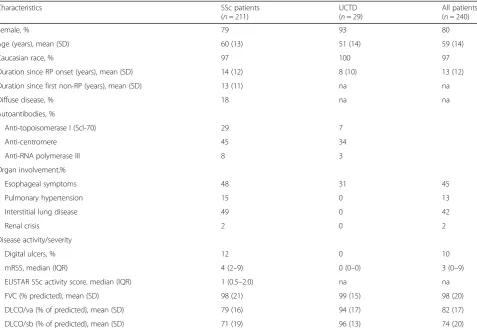
and 170 (81%) fulfilled both criteria. The demographics and clinical characteristics are outlined in Table1.
Mean age (SD) was 60 (13) and 51 (14) years in SSc and UCTD patients, respectively, and 166 (79%) and 27 (93%) were female. Characteristics of UCTD patients in-cluded the presence of antinuclear antibodies in 27 (93%), of puffy fingers in 2 (7%), and of abnormal nail-fold capillaroscopy in 16 (55%) of patients. SSc patients were classified as limited and diffuse SSc subsets in 36% and 18%, respectively, with the remaining patients fea-turing only sclerodactily (26%) or being classified as sine scleroderma (20%). Anti-centromere, anti-Scl-70, and anti-RNA polymerase III antibodies were present in 45%, 29%, and 8% of SSc cases, respectively. ILD was the most frequently encountered organ involvement (49%).
Lectin pathway proteins in UCTD patients vs. those with established SSc
As expected, the time since Raynaud’s phenomenon (RP) onset was significantly shorter in UCTD compared to SSc patients (mean 8.0 years (SD 10.0) vs. 14.2 years (SD 11.7), p= 0.007). Similarly, the prevalence of skin and other organ involvement was lower in UCTD patients (Table1). MBL2 and FCN2allele frequencies at all eight positions were in agreement with the predicted Hardy–Weinberg equilibrium when including all analyzed patients (data not shown).
Serum concentrations of the lectin pathway proteins MBL, FCN-2, FCN-3, and MASP-2 and frequency of FCN2and MBL2polymorphisms did not differ between UCTD and SSc groups. Although, MBL deficiency de-fined as a serum concentration below 0.5μg/mL was nu-merically more common in UCTD patients (48.3% vs. 31.3%, p= 0.07), MBL serum concentrations (mean 1.1 vs. 1.5μg/mL, p= 0.1) and the frequency of MBL2 poly-morphisms were similar (data not shown). There was no correlation of lectin pathway proteins with the time since RP onset as well as with the speed of disease onset, i.e., the duration between the first non-RP manifestation of the disease and the onset of RP (data not shown).
Association of lectin pathway proteins with organ involvement and autoantibodies in patients with established SSc
Regarding SSc subsets, lectin pathway protein concentra-tions and the frequency of FCN2 and MBL2 polymor-phisms were similar. FCN-2 concentrations were significantly higher in SSc patients with present evidence of digital ulcers, with pitting, and with puffy fingers (Table 2), but not with the presence of sclerodactily, tel-angiectasia, or joint synovitis, whereas there was no
asso-ciation with other lectin pathway proteins or
In general, the serum concentrations of lectin pathway proteins and the presence or absence of genetic polymor-phisms were not associated with the modified Rodnan skin score, the EUSTAR SSc activity score [9,32], inflammatory markers (ESR), the presence of hypocomplementemia, or
[image:4.595.60.538.98.428.2]disease duration (data not shown). Similarly, associations of lectin pathway protein concentrations or polymorphisms with SSc organ involvement (including pulmonary hyper-tension, radiographic interstitial lung disease, and pericar-dial effusion) and its surrogate measurements (including
Table 1Characteristics of SSc patients and patients with VEDOSS
Characteristics SSc patients
(n= 211)
UCTD (n= 29)
All patients (n= 240)
Female, % 79 93 80
Age (years), mean (SD) 60 (13) 51 (14) 59 (14)
Caucasian race, % 97 100 97
Duration since RP onset (years), mean (SD) 14 (12) 8 (10) 13 (12)
Duration since first non-RP (years), mean (SD) 13 (11) na na
Diffuse disease, % 18 na na
Autoantibodies, %
Anti-topoisomerase I (Scl-70) 29 7
Anti-centromere 45 34
Anti-RNA polymerase III 8 3
Organ involvement,%
Esophageal symptoms 48 31 45
Pulmonary hypertension 15 0 13
Interstitial lung disease 49 0 42
Renal crisis 2 0 2
Disease activity/severity
Digital ulcers, % 12 0 10
mRSS, median (IQR) 4 (2–9) 0 (0–0) 3 (0–9)
EUSTAR SSc activity score, median (IQR) 1 (0.5–2.0) na na
FVC (% predicted), mean (SD) 98 (21) 99 (15) 98 (20)
DLCO/va (% of predicted), mean (SD) 79 (16) 94 (17) 82 (17)
DLCO/sb (% of predicted), mean (SD) 71 (19) 96 (13) 74 (20)
Abbreviations:DLCOdiffusing capacity of the lung for carbon monoxide,EUSTAREuropean Scleroderma Trials and Research Group,FVCforced vital capacity,mRSS modified Rodnan skin score,RPRaynaud’s phenomenon,SDstandard deviation,SScsystemic sclerosis,nanot applicable
Table 2Association of ficolin-2 concentrations with SSc skin manifestations and organ involvement
Variables Present
(μg FCN-2/ml), mean (SD)
Absent
(μg FCN-2/ml), mean (SD) p value
Skin manifestations
Digital ulcers 1.4 (1.0) 1.0 (0.7) 0.05
Pitting scars 1.3 (0.9) 1.0 (0.7) 0.01
Puffy fingers 1.2 (1.0) 1.0 (0.6) 0.04
Sclerodactily 1.1 (0.8) 1.1 (0.8) 0.9
Telangiectasia 1.1 (0.9) 1.0 (0.7) 0.7
Organ involvement
PH 0.9 (1.2) 1.0 (0.7) 0.6
ILD by radiography 1.2 (1.1) 0.9 (0.6) 0.02
FVC < 80% predicted 1.4 (1.3) 1.0 (0.7) 0.02
Renal crisis 1.4 (1.1) 1.1 (0.9) 0.5
[image:4.595.57.540.546.723.2]esophageal symptoms, pulmonary artery pressure, diffusion capacity, FVC, left ventricular ejection fraction, and pro-teinuria), or the presence of antinuclear autoantibodies (ANA) in general and the presence of SSc-specific autoanti-bodies in particular were absent (data not shown). There were however three important exceptions (Table2).
First, there were higher FCN-2 concentrations in SSc patients harboring Scl-70 autoantibodies than in patients who were Scl-70 autoantibody negative (mean 1.5μg/mL (SD 1.2) vs. 1.0 (SD 0.7),p= 0.001).
Second, FCN-2 concentrations were associated with a radiographic diagnosis of ILD (Table 2). Additionally FCN-2 concentrations were lower in patients with a FVC below 80% predicted than in those with a FVC above 80% predicted (Table2). In line with this observation, FVC and diffusing capacity (DLCO) were significantly lower in pa-tients with hetero- or homozygous variant alleles in the
FCN-2 polymorphism at position + 6359 C>T
(rs17549193), which are associated with elevated FCN-2 serum concentrations [33], compared to those with the presence of the wild-type allele (mean FVC 95% of pre-dicted (SD 19%) vs. 101% of prepre-dicted (SD 21%),p= 0.03; mean DLCO 67% of predicted (SD 20%) vs. 74% of pre-dicted (SD 18%),p= 0.02).
Third, MBL concentrations were substantially higher in five patients with scleroderma renal crisis (mean 2.7 (SD 2.1) vs. 1.5 (SD 1.3)μg/mL,p= 0.04). In line, all five patients with renal crisis were homozygous for the wild-type allele of the MBL2 exon1 polymorphism at position + 54 G>A (rs18004500) and at position + 52 C>T (rs5030737), which is strongly associated with a high MBL concentration.
Discussion
The present study examined the association of lectin path-way complement proteins with disease activity and organ manifestations in a large group of SSc patients and for the first time in a small number of patients with Raynaud’s phenomenon in UCTD at risk of developing SSc [23]. Con-trary to our a priori hypothesis, we failed to identify any relevant association of several lectin pathway protein levels andFCN2orMBL2polymorphisms with SSc disease activ-ity or organ involvement. There was however an exception of potential importance, namely an association of higher FCN-2 concentrations with the presence of Scl-70 anti-bodies, several hallmarks of SSc vasculopathy (digital ulcers, pitting scars and puffy fingers), and fibrotic features (com-promise in FVC and radiographic evidence of ILD). In addition, the presence of variant alleles in theFCN-2 poly-morphism at position + 6359 C>T (rs17549193) was associ-ated with a decreased FVC and a diminished diffusion capacity compared to the presence of the wild-type allele. This is in support of the protein measurements, as it was shown that variant alleles at this position are associated
with higher FCN-2 concentrations [33]. As differences in allele frequencies in the analyzed FCN2 polymorphisms were mostly lacking (with the exception of the association of the + 6359 polymorphism with FVC and diffusion cap-acity), these data may at first sight be consistent with an in-crease in FCN-2 concentrations (increased hepatic synthesis) as a consequence of an increased SSc activity or the progression of SSc over time. Longitudinal comparisons with FCN-2 concentrations in SSc patients before the dis-ease onset are however lacking. We also can formally not exclude the possibility that high FCN-2 concentrations may induce Scl-70 autoantibody positivity or other mechanisms that trigger more severe SSc.
Our results are in line with a previous study of 90 SSc patients, which reported an association of higher FCN-2 levels with the presence of ILD and a reduced FVC [21]. In patients with idiopathic pulmonary fibrosis, above threshold levels of plasma FCN-2 were even associated with prolonged progression-free survival [34]. Whereas low FCN2 levels may predispose patients to pulmonary infections and bronchiectasis [35], increased FCN2 levels as observed in patients with ILD in the present study may trigger or maintain a detrimental inflammatory re-sponse to stressed endothelial cells in the lung [36] ul-timately resulting in the development of clinically relevant ILD. Indeed, FCN-2 was also shown to partici-pate in the clearance of dying cells maintaining tissue homeostatis [37] and hence may influence the induction of autoimmunity through mechanisms of the innate im-mune system [38]. Although complement deposition has been detected in pulmonary, renal, and dermal vessels [39–41], mechanistic data regarding local FCN-2 con-centrations in the lung and their effect on endothelial and vascular injury and fibroblast activation are however currently lacking.
Our results complement previous studies with regards to MBL and FCN-3, which are two other important PRRs of the lectin pathway [21, 22]. In a study of 90 Australian SSc patients, higher MBL levels were signifi-cantly associated with vascular dysfunction, local tissue damage, skin involvement, and ILD [21]. With the exception of an association of higher MBL concentra-tions with scleroderma renal crisis, our study does not support a significant involvement of MBL in the patho-genesis of SSc, at least not when measured in the serum or when assessed by genotyping. Although local comple-ment activation has been described in scleroderma renal crisis [42, 43], the involvement of the lectin pathway as compared to the classical or alternative pathway has never been investigated previously. Thus, our results warrant confirmation in a larger set of patients with scleroderma renal crisis.
predominately included Caucasians (97% vs. 84% vs. 0% in previous studies [21, 22]) and a significant proportion of sine scleroderma SSc patients (15% vs. 1% vs. 0% in previous studies [21, 22]). SSc is a heterogeneous dis-ease, and hence, analyses of the lectin pathway in sub-groups based on clinical phenotype or the presence of certain autoantibodies may be desirable but requires a larger study.
FCN-3 serum concentrations were not associated with any of the investigated parameters or outcomes in the present study. Miyagawa et al. had however previously reported significantly lower FCN-3 serum concentra-tions in diffuse vs. limited cutaneous SSc patients, and a trend towards a higher prevalence of ILD in SSc patients with lower FCN-3 concentrations [20]. In line with the function of FCN-2, clearance of apoptotic cells is also mediated by FCN-3 [44]. Given that FCN-3 is also pro-duced in the lungs, sufficient pulmonary FCN-3 levels may prevent extensive local inflammation as a conse-quence of apoptosis, and hence, lower levels may theor-etically predispose SSc patients to interstitial lung disease. However, data regarding pulmonary FCN-3 levels are lacking and the small cohort size (n= 48) of the previous study and differences in ethnic background (100% Asian vs. 97% Caucasian in the present study) limit the significance of the observed FCN-3 results.
While the present study provides evidence for the in-volvement of circulating FCN-2 in SSc patients, our re-sults do not exclude a participation of other lectin pathway proteins in the local regulation of complement activation in SSc [45]. Indeed, the evidence regarding the involvement of the lectin pathway in acute IR injury is convincing in rodents [46, 47] and even in humans [15, 48], although its importance in the setting of chronic low-grade ischemia, atherosclerosis, and vascu-lar damage is less well defined [30, 49]. For example, whereas high-producing MBL2 genotypes were associ-ated with an increased risk of future ischemic heart dis-ease and myocardial infarction in patients with rheumatoid arthritis [49], the opposite was true with re-spect to the development of myocardial infarction in dia-betic and hypercholesterolemic individuals [50]. In addition, different pathophysiological mechanisms dom-inate over time in SSc, and the complement system may play a differential role depending on the disease dur-ation. For example, microvascular dysfunction is a hall-mark of early SSc, and the lectin pathway may contribute to inflammation during this stage. In contrast, the complement system may have limited impact at the fibrotic stage of SSc. Analyses of the lectin pathway dur-ing different disease stages are required to verify this hypothesis.
Limitations of the present study include the post hoc analysis of a predefined number of PRRs of the lectin
pathway and the multiple statistical comparisons investi-gated. In addition, the sample size may curb the detec-tion of small differences of lectin pathway proteins or polymorphisms, especially when analyzing rare events such as scleroderma renal crisis. The analysis of predom-inately Caucasian patients (97%) and of only a small per-centage of patients with diffuse SSc (18%) may limit the generalizability of our study results.
Conclusion
In conclusion, the present study results do not indicate a relevant role for several lectin pathway complement pro-teins in the pathogenesis of SSc. However, our observa-tion of higher FCN-2 levels in SSc patients with digital vasculopathy and ILD is notable and requires validation.
Abbreviations
FCN:Ficolin; IR: Ischemia/reperfusion; ILD: Interstitial lung disease;
IQR: Interquartile range; MASP: Mannose-binding lectin-associated serine-protease; MBL: Mannose-binding lectin; PRR: Pattern recognition receptor; SD: Standard deviation; SSc: Systemic sclerosis
Acknowledgements
Not applicable.
Funding
This work was supported by an early career research grant from the University of Basel (DMS2296) to MO and by a research grant from the Fondation Machaon, Switzerland (a not-for-profit private foundation) to MO. The funders had no role in study design, data collection and analysis, decision to publish, or preparation of the manuscript.
Availability of data and materials
The datasets used and analyzed during the current study are available from the corresponding author on reasonable request.
Authors’contributions
MO and UAW designed the study. MO carried out all the experiments. IH, SJ, OD, and UAW provided the patient samples. OD and UAW recruited the SSc patients. VJ and SJ contributed to the database design and data collection. MO and VJ drafted the manuscript. VJ performed the statistical analysis. All authors were involved in the interpretation of data, critical revision of the manuscript for important intellectual content, and read and approved the final manuscript.
Ethics approval and consent to participate
Approved by the Ethics Committee at participating Basel and Zurich University EUSTAR centers, patients were required to provide informed written consent.
Consent for publication
Not applicable.
Competing interests
OD has/had consultancy relationship and/or has received research funding from Actelion, AnaMar, Bayer, Boehringer Ingelheim, ChemomAb, espeRare foundation, Genentech/Roche, GSK, Inventiva, Italfarmaco, iQvia, Lilly, medac, MedImmune, Mitsubishi Tanabe Pharma, Pharmacyclics, Novartis, Pfizer, Sanofi, Serodapharm, and UCB in the area of potential treatments of scleroderma and its complications. In addition, Prof. Distler has a patent mir-29 for the treatment of systemic sclerosis licensed. MO, IH, SJ, VJ, and UAW declare that they have no competing interests.
Publisher’s Note
Author details
1Department of Internal Medicine, University Hospital Basel, 4031 Basel, Switzerland.2Department of Biomedicine, University Basel, 4031 Basel, Switzerland.3Department of Rheumatology, University Hospital Basel, 4031 Basel, Switzerland.4Division of Medical Immunology, Laboratory Medicine, University Hospital Basel, 4031 Basel, Switzerland.5Department of Rheumatology, University Hospital Zurich, 8091 Zurich, Switzerland.
Received: 28 November 2018 Accepted: 5 March 2019
References
1. Elhai M, Meune C, Avouac J, Kahan A, Allanore Y. Trends in mortality in
patients with systemic sclerosis over 40 years: a systematic review and
meta-analysis of cohort studies. Rheumatology. 2012;51:1017–26.
2. Denton CP, Khanna D. Systemic sclerosis. Lancet. 2017;390:1685–99.
3. Varga J, Trojanowska M, Kuwana M. Pathogenesis of systemic sclerosis:
recent insights of molecular and cellular mechanisms and therapeutic
opportunities. J Scleroderma Relat Disord. 2017;2:137–52.
4. Mahoney JM, Taroni J, Martyanov V, Wood TA, Greene CS, Pioli PA, et al.
Systems level analysis of systemic sclerosis shows a network of immune and profibrotic pathways connected with genetic polymorphisms. PLoS Comput Biol. 2015;11:e1004005.
5. Matucci-Cerinic M, Kahaleh B, Wigley FM. Review: evidence that systemic
sclerosis is a vascular disease. Arthritis Rheum. 2013;65:1953–62.
6. Trouw LA, Pickering MC, Blom AM. The complement system as a potential
therapeutic target in rheumatic disease. Nat Rev Rheumatol. 2017;13:538–47.
7. Leffler J, Bengtsson AA, Blom AM. The complement system in systemic
lupus erythematosus: an update. Ann Rheum Dis. 2014;73:1601–6.
8. Scambi C, Ugolini S, Jokiranta TS, De Franceschi L, Bortolami O, La Verde V,
et al. The local complement activation on vascular bed of patients with systemic sclerosis: a hypothesis-generating study. PLoS One. 2015;10: e0114856.
9. Valentini G, Della Rossa A, Bombardieri S, Bencivelli W, Silman AJ, D'Angelo
S, et al. European multicentre study to define disease activity criteria for systemic sclerosis. II. Identification of disease activity variables and
development of preliminary activity indexes. Ann Rheum Dis. 2001;60:592–8.
10. Foocharoen C, Distler O, Becker M, Muller-Ladner U, von Muhlen C,
Leuchten N, et al. Clinical correlations of hypocomplementaemia in systemic sclerosis: an analysis of the EULAR Scleroderma Trial and Research
group (EUSTAR) database. Scand J Rheumatol. 2012;41:243–6.
11. Esposito J, Brown Z, Stevens W, Sahhar J, Rabusa C, Zochling J, et al. The
association of low complement with disease activity in systemic sclerosis: a prospective cohort study. Arthritis Res Ther. 2016;18:246.
12. Valentini G, Iudici M, Walker UA, Jaeger VK, Baron M, Carreira P, et al. The
European Scleroderma Trials and Research group (EUSTAR) task force for the development of revised activity criteria for systemic sclerosis: derivation and validation of a preliminarily revised EUSTAR activity index. Ann Rheum
Dis. 2017;76:270–6.
13. Dobo J, Schroeder V, Jenny L, Cervenak L, Zavodszky P, Gal P. Multiple roles
of complement MASP-1 at the interface of innate immune response and
coagulation. Mol Immunol. 2014;61:69–78.
14. Orsini F, Villa P, Parrella S, Zangari R, Zanier ER, Gesuete R, et al. Targeting
mannose-binding lectin confers long-lasting protection with a surprisingly
wide therapeutic window in cerebral ischemia. Circulation. 2012;126:1484–94.
15. Osthoff M, Katan M, Fluri F, Schuetz P, Bingisser R, Kappos L, et al.
Mannose-binding lectin deficiency is associated with smaller infarction size and favorable outcome in ischemic stroke patients. PLoS One. 2011;6:e21338.
16. Fust G, Munthe-Fog L, Illes Z, Szeplaki G, Molnar T, Pusch G, et al. Low
ficolin-3 levels in early follow-up serum samples are associated with the severity and unfavorable outcome of acute ischemic stroke. J Neuroinflammation. 2011;8:185.
17. Davies EJ, Snowden N, Hillarby MC, Carthy D, Grennan DM, Thomson W, et
al. Mannose-binding protein gene polymorphism in systemic lupus
erythematosus. Arthritis Rheum. 1995;38:110–4.
18. Troelsen LN, Garred P, Jacobsen S. Mortality and predictors of mortality in
rheumatoid arthritis--a role for mannose-binding lectin? J Rheumatol. 2010;
37:536–43.
19. Hein E, Nielsen LA, Nielsen CT, Munthe-Fog L, Skjoedt MO, Jacobsen S, et al.
Ficolins and the lectin pathway of complement in patients with systemic
lupus erythematosus. Mol Immunol. 2015;63:209–14.
20. Miyagawa T, Asano Y, de Mestier Y, Saigusa R, Taniguchi T, Yamashita
T, et al. Serum H-ficolin levels: clinical association with interstitial lung
disease in patients with systemic sclerosis. J Dermatol. 2017;44:1168–71
21. Osthoff M, Ngian GS, Dean MM, Nikpour M, Stevens W, Proudman S,
et al. Potential role of the lectin pathway of complement in the pathogenesis and disease manifestations of systemic sclerosis: a case-control and cohort study. Arthritis Res Ther. 2014;16:480.
22. Akamata K, Asano Y, Aozasa N, Noda S, Taniguchi T, Takahashi T, et al.
Serum levels of mannose-binding lectin in systemic sclerosis: a possible contribution to the initiation of skin sclerosis in the diffuse cutaneous
subtype. Eur J Dermatol. 2014;24:123–5.
23. Minier T, Guiducci S, Bellando-Randone S, Bruni C, Lepri G, Czirjak L,
et al. Preliminary analysis of the very early diagnosis of systemic sclerosis (VEDOSS) EUSTAR multicentre study: evidence for puffy fingers as a pivotal sign for suspicion of systemic sclerosis. Ann Rheum Dis.
2014;73:2087–93.
24. Avouac J, Fransen J, Walker UA, Riccieri V, Smith V, Muller C, et al.
Preliminary criteria for the very early diagnosis of systemic sclerosis: results of a Delphi Consensus Study from EULAR Scleroderma Trials and Research
Group. Ann Rheum Dis. 2011;70:476–81.
25. Walker UA, Tyndall A, Czirjak L, Denton C, Farge-Bancel D, Kowal-Bielecka O,
et al. Clinical risk assessment of organ manifestations in systemic sclerosis: a report from the EULAR Scleroderma Trials And Research group database.
Ann Rheum Dis. 2007;66:754–63.
26. Preliminary criteria for the classification of systemic sclerosis (scleroderma).
Subcommittee for scleroderma criteria of the American Rheumatism Association Diagnostic and Therapeutic Criteria Committee. Arthritis Rheum.
1980;23:581–90.
27. van den Hoogen F, Khanna D, Fransen J, Johnson SR, Baron M, Tyndall A,
et al. 2013 classification criteria for systemic sclerosis: an American College of Rheumatology/European League against Rheumatism collaborative
initiative. Arthritis Rheum. 2013;65:2737–47.
28. Minchinton RM, Dean MM, Clark TR, Heatley S, Mullighan CG. Analysis of the
relationship between mannose-binding lectin (MBL) genotype, MBL levels and function in an Australian blood donor population. Scand J Immunol.
2002;56:630–41.
29. Eisen DP, Dean MM, Boermeester MA, Fidler KJ, Gordon AC, Kronborg G,
et al. Low serum mannose-binding lectin level increases the risk of death
due to pneumococcal infection. Clin Infect Dis. 2008;47:510–6.
30. Osthoff M, Dean MM, Baird PN, Richardson AJ, Daniell M, Guymer RH, et al.
Association study of mannose-binding lectin levels and genetic variants in lectin pathway proteins with susceptibility to age-related macular degeneration: a case-control study. PLoS One. 2015;10:e0134107.
31. Ouf EA, Ojurongbe O, Akindele AA, Sina-Agbaje OR, Van Tong H, Adeyeba
AO, et al. Ficolin-2 levels and FCN2 genetic polymorphisms as a
susceptibility factor in schistosomiasis. J Infect Dis. 2012;206:562–70.
32. Valentini G, Bencivelli W, Bombardieri S, D'Angelo S, Della Rossa A, Silman
AJ, et al. European Scleroderma Study Group to define disease activity criteria for systemic sclerosis. III. Assessment of the construct validity of the
preliminary activity criteria. Ann Rheum Dis. 2003;62:901–3.
33. Kilpatrick DC, St Swierzko A, Matsushita M, Domzalska-Popadiuk I,
Borkowska-Klos M, Szczapa J, et al. The relationship between FCN2 genotypes and serum ficolin-2 (L-ficolin) protein concentrations from a
large cohort of neonates. Hum Immunol. 2013;74:867–71.
34. Ashley SL, Xia M, Murray S, O'Dwyer DN, Grant E, White ES, et al.
Six-SOMAmer index relating to immune, protease and angiogenic functions predicts progression in IPF. PLoS One. 2016;11:e0159878.
35. Metzger ML, Michelfelder I, Goldacker S, Melkaoui K, Litzman J, Guzman D,
et al. Low ficolin-2 levels in common variable immunodeficiency patients
with bronchiectasis. Clin Exp Immunol. 2015;179:256–64.
36. Leach HG, Chrobak I, Han R, Trojanowska M. Endothelial cells recruit
macrophages and contribute to a fibrotic milieu in bleomycin lung injury.
Am J Respir Cell Mol Biol. 2013;49:1093–101.
37. Jensen ML, Honore C, Hummelshoj T, Hansen BE, Madsen HO, Garred P.
Ficolin-2 recognizes DNA and participates in the clearance of dying host
cells. Mol Immunol. 2007;44:856–65.
38. Waldner H. The role of innate immune responses in autoimmune disease
development. Autoimmun Rev. 2009;8:400–4.
39. Salerni R, Rodnan GP, Leon DF, Shaver JA. Pulmonary hypertension in the
CREST syndrome variant of progressive systemic sclerosis (scleroderma). Ann
40. Scott DG, Rowell NR. Immunohistological studies of the kidney in systemic lupus erythematosus and systemic sclerosis using antisera to IgG, C3, fibrin,
and human renal glomeruli. Ann Rheum Dis. 1974;33:473–81.
41. Kay DM, Tuffanelli DL. Immunofluorescent techniques in clinical diagnosis of
cutaneous disease. Ann Intern Med. 1969;71:753–62.
42. Okroj M, Johansson M, Saxne T, Blom AM, Hesselstrand R. Analysis of
complement biomarkers in systemic sclerosis indicates a distinct pattern in scleroderma renal crisis. Arthritis Res Ther. 2016;18:267.
43. Devresse A, Aydin S, Le Quintrec M, Demoulin N, Stordeur P, Lambert C,
et al. Complement activation and effect of eculizumab in scleroderma renal crisis. Medicine. 2016;95:e4459.
44. Honore C, Hummelshoj T, Hansen BE, Madsen HO, Eggleton P, Garred P.
The innate immune component ficolin 3 (Hakata antigen) mediates the
clearance of late apoptotic cells. Arthritis Rheum. 2007;56:1598–607.
45. Sprott H, Muller-Ladner U, Distler O, Gay RE, Barnum SR, Landthaler M, et al.
Detection of activated complement complex C5b-9 and complement receptor C5a in skin biopsies of patients with systemic sclerosis
(scleroderma). J Rheumatol. 2000;27:402–4.
46. van der Pol P, Schlagwein N, van Gijlswijk DJ, Berger SP, Roos A, Bajema IM,
et al. Mannan-binding lectin mediates renal ischemia/reperfusion injury
independent of complement activation. Am J Transplant. 2012;12:877–87.
47. Walsh MC, Bourcier T, Takahashi K, Shi L, Busche MN, Rother RP, et al.
Mannose-binding lectin is a regulator of inflammation that accompanies
myocardial ischemia and reperfusion injury. J Immunol. 2005;175:541–6.
48. Trendelenburg M, Theroux P, Stebbins A, Granger C, Armstrong P, Pfisterer
M. Influence of functional deficiency of complement mannose-binding lectin on outcome of patients with acute ST-elevation myocardial infarction undergoing primary percutaneous coronary intervention. Eur Heart J. 2010;
31:1181–7.
49. Troelsen LN, Garred P, Madsen HO, Jacobsen S. Genetically determined high
serum levels of mannose-binding lectin and agalactosyl IgG are associated with
ischemic heart disease in rheumatoid arthritis. Arthritis Rheum. 2007;56:21–9.
50. Saevarsdottir S, Oskarsson OO, Aspelund T, Eiriksdottir G, Vikingsdottir T,
Gudnason V, et al. Mannan binding lectin as an adjunct to risk assessment for myocardial infarction in individuals with enhanced risk. J Exp Med. 2005;