2017 2nd International Conference on Computer Engineering, Information Science and Internet Technology (CII 2017) ISBN: 978-1-60595-504-9
The Optimization and Implementation of
Collaborative System for Power Grid
Operation Mode Calculation
JILIN CHEN, FENGQUAN ZHANG, ZHONGHUA GUO and WEIJIANG QIU
ABSTRACT
The collaborative system for power grid operation mode calculation implements data management of multi-level paralleling operated dispatching department’s indifferent places and joint operation mode calculation, which is based on the calculated data of power grid operation modes. The transient stability analysis monitors the components of electrical variation curve through the network transmission to the web page. When more users and more curves reaches a certain extent, the overall simulation time is longer and the curve is stuck because of the limitation of the transmission bandwidth and the refresh rate of the web page. This paper, The Douglas-Peucker algorithm is used in system to solve the data transmission of large amount of data delay problem and achieve the transmission of the large amount of data, the overall simulation time of curve in the web page display is decreased, and the curves are refreshed smoothly.
KEYWORDS
Douglas-Peucker Algorithm, Collaborative System, multi-level paralleling.
INTRODUCTION
With the large-scale construction of power grid access, new energy power generation and construction of interconnected power grid, the grid of size and complexity are increasing, at the same time the power system operation mode calculation of collaborative system has been widely used. The collaborative system for power grid operation mode calculation is based on the calculation data of power grid operation mode, so as to realize the data management and combined mode calculation of multi-level dispatching organization in different places. In the transient stability simulation calculation, the component electrical quantity variation curve is transmitted to the web page through the network. When the user monitors more curves and the number of curves reaches a certain extent, the overall simulation time is longer and the curve is stuck because of the limitation of the transmission bandwidth and the refresh rate of the web page. The operation effect of the system is affected.
_________________________________________
Jilin Chen, [email protected], Weijiang Qiu, China Electric Pow er Research Institute, Beijing 100192, China
Douglas-Peucker (DP) algorithm is an iterative adaptive algorithm, the algorithm will reduce the number of points and approximate the curve by a series of points, it has the advantages of translation and rotation invariance, the given threshold and sampling results in DP algorithm. The transient stability simulation can show the changes of the electrical element, but the curve points of the transient simulation are more, and real-time curve transmission is slow, the Douglas-Peucker algorithm is applied to the system to solve the data transmission of large amount of data delay problem and achieve the transmission of the large amount of data, the overall simulation time of curve in the web page display is decreased, the curve is refreshed smoothly.
DOUGLAS-PEUCKER ALGORITHM
The main idea of Douglas-Peucker algorithm is the first point and last point of each curve is a straight line, we can get the distance between all the points and line, and find the maximum distance value Dmax, all the points in first and last points are compared with Dmax and tolerance D, if Dmax <D, the middle points of the curve are abandon; if Dmax = D, retain the Dmax corresponding to the coordinates of the point, and the curve is divided into two parts, the two parts are used the same method repeat. The diagram analysis is as show in detail:
At the beginning and end of the curve is the straight line, get the distance between the remaining points and the straight line as shown above (1); choose the largest distance which is compared with a threshold, if it is more than the threshold, then retain point which is maximum distance from the straight-line, otherwise they are eliminated between the end of each point in line, as the right figure (2). The fourth point is retained. Keep on this way, the curve is divided into two parts, repeat operation just as first step, second step, the largest distance point is compared to the threshold, the point has been retained and abandoned in turn until there is no point in the end, finally web can get curve point which is the given tolerance difference, as shown in figure (3). (4) The Sixth point and seventh point are retained, all other points are abandoned, and we get the simplification line.
(1) (2)
(3) (4)
2
1
3 4
5
6
7
8
2
1
3 4
5
6
7
8
1
4
5
6
7
8
1
4
6
7
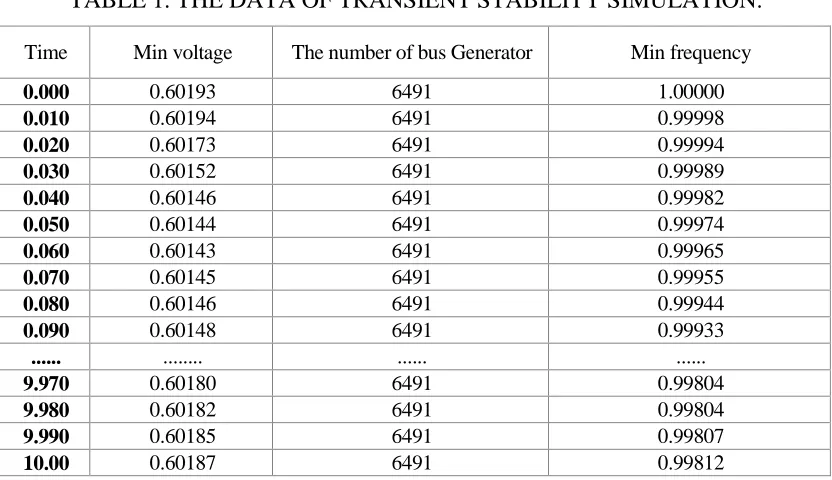
TABLE 1. THE DATA OF TRANSIENT STABILITY SIMULATION.
Time Min voltage The number of bus Generator Min frequency
0.000 0.60193 6491 1.00000
0.010 0.60194 6491 0.99998
0.020 0.60173 6491 0.99994
0.030 0.60152 6491 0.99989
0.040 0.60146 6491 0.99982
0.050 0.60144 6491 0.99974
0.060 0.60143 6491 0.99965
0.070 0.60145 6491 0.99955
0.080 0.60146 6491 0.99944
0.090 0.60148 6491 0.99933
... ... ... ...
9.970 0.60180 6491 0.99804
9.980 0.60182 6491 0.99804
9.990 0.60185 6491 0.99807
10.00 0.60187 6491 0.99812
THE CURVE DATA OF POWER SYSTEM TRANSIENT STABILITY ANALYSIS
In the analysis of power system simulation, transient stability analysis curve is a record in the change of each element in the simulation process, the generator power angle and voltage equivalent are shown at the appointed time within the period of time, which reflects the change of state in each time the process of power grid.
In the analysis of power system simulation, the power elements change process of the minimum voltage and the minimum frequency are simulated in a certain period of time, such as all the time is 10s, the step is 0.01 s, and the minimum voltage and minimum frequency of generator bus data are as follows:
In power system calculation collaborative system, the transient stability calculation sets a lot of element variables, each variable corresponds to a group of curves, and when much more users submit at the same time, all points must be displayed on the screen through the web transmission, the simulation curves are shown delay and refreshed not smoothly.
THE CURVE DATA OF POWER SYSTEM TRANSIENT STABILITY ANALYSIS
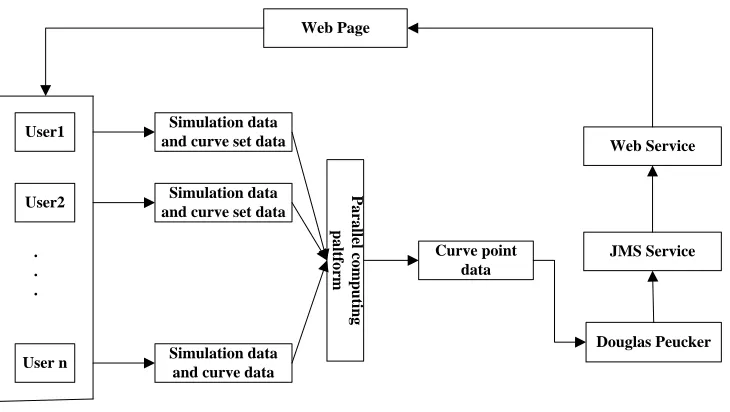
In collaborative system for power grid operation mode calculation, Multi users monitor curve settings for the transient stability of the power system on the web client, all the setting are submitted to the computing platform. The computing platform accepts the data sent by the client and calls the transient stability calculation, the curve point data according to the user's settings will be output
User1
User2
Simulation data and curve set data
Simulation data and curve set data
User n . . .
Simulation data and curve data
P
a
ra
lle
l c
o
m
p
u
tin
g
p
a
lt
fo
rm Curve point data
[image:4.612.127.492.51.257.2]Douglas Peucker JMS Service Web Service Web Page
Figure 1. The flow chart of transient stability analysis of collaborative system.
计算平台暂稳输出 点数据
根据设置,取分段 数据
道格拉斯普克算法 取特定阀值,默
认为0.01
计算完成
否
优化后数据写入数 据服务器 是
结束
Figure 2. The flow chart of Douglas-Peucker algorithm used in data processing.
The data processing flow of the curve point of the calculation in platform is shown as figure 2. At first, determine whether the computation is complete. If not finished, Douglas-Peucker algorithm deals the set of segmented data, the specific threshold is 0.01 seconds by default for data optimization, at the end. These data are written to the JMS server, the system iterates in this way until the calculation is complete.
APPLICATION
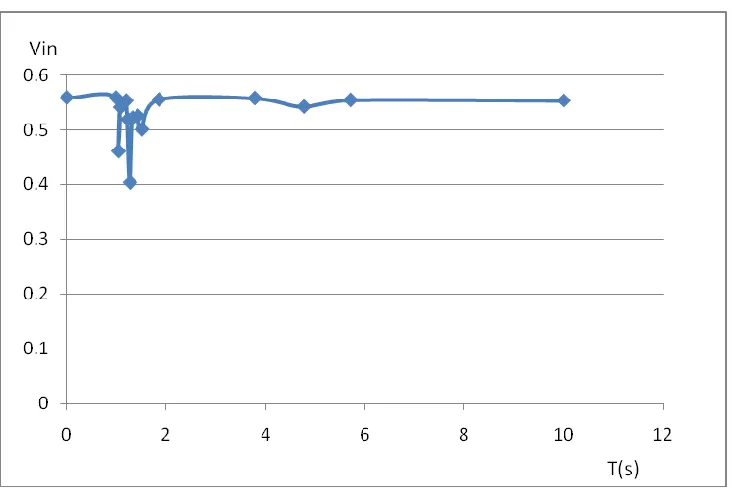
[image:4.612.116.483.298.474.2]from 0 to 10 seconds, a total of 1001 points are output according to the total 10 seconds and the step is 0.01 seconds, the curve is shown as in figure 3:
Figure 3. The transient stability calculation voltage curve.
Figure 4. The voltage curve optimization by Douglas-Peucker algorithm.
[image:5.612.116.482.354.601.2]SUMMARY
The collaborative system for power grid operation mode calculation is based on internet synchronous power grid, offline data, real-time EMS operation data and high performance, the system uses parallel computing technology and distributed computing technology to achieve multi-level scheduling mechanism concurrent data management and joint calculation, the delay problem of large data transmission is solved by using Douglas-Peucker algorithm, achieving data transmission in the large amount of data, the curve display time is decreased overall simulation on web page, and the curve points are refreshed smoothly.
REFERENCES
1. Song Xiaomei, Cheng Changxiu, Zhou Chenghu, et al. Gestalt-based Douglas-Peucker algorithm to keep shape similarity and area consistency of polygons. Sensor Letters, 2013,11( 6 /7): 1015-1021. 2. He Jin, Fei Lifan. Further study on three dimensional Douglas-Peucker algorithm and its application
to generalization of DEM. Geomatics and Information Science of Wunan University, 2008, 33(2): 160-163.
3. Li Bijun, Fu Hongjun, Hu Yangyu, et al. Design and implementation of automatic computation and report generation system for annual power grid operation mode. Automation of Electric PowerSystems, 2010, 34(4):112-115.
4. Zheng Chao, Hou Junxian, Yan Jianfeng, et al. Functional design and implementation of online dynamic security assessment and early warning system. Power System Technology, 2010,34(3): 55-60.
5. Mitchel M T, Lei M, Su C J A collaborative control system for mass customization manufacturing. Annals of the CIRP, 1997, 46(1):373-376.
6. Zhang Xingfu, Huang Shaobin. Adaptive neighborhoods based locally linear embedding algorithm. Journal of Harbin Engineering University, 2012, 33( 4):489-495.
7. Sun Xin, Xia Qing. Power grid operation mode based on elaborating management .Automation of Electric Power Systems 2008, 32(21):14-17.
8. State Grid Corporation of China. Smart grid dispatch technology support system design. Beijing: State Grid Corporation of China, 2008.
9. Douglas D H, Peucker T K. Algorithms for the Reduction of the Number of Points Required to Represent a Digitized Line or its Caricature. The Canadian Cartographer, 1973, 10(2):112-122. 10. Yu Zhuohuang, Lin Hui, Liu Jing. Oriented to massive data power forecast system based on
SCADA system[J]. Computer Engineering and Design, 2010(5): 1114-1117.