2017 2nd International Conference on Artificial Intelligence: Techniques and Applications (AITA 2017) ISBN: 978-1-60595-491-2
Development and Application of Power Grid Planning Assistant System
Based on GIS Platform
Bo JIANG
1, Zi-an SUN
1, Bin ZOU
1and Qi JIANG
2,*1
Xi'an, Shiyuan Road, No. 218, China
2
Xi'an, Wenyi Road, No. 101, China
*Corresponding author
Keywords: Geographic Information System (GIS), Power grid planning, Power flow calculation, Assistant decision making.
Abstract. Aiming at the status the grid planning mainly based on history, combined with the
experience of experts to make planning, this paper establishes a system based on GIS platform, which has a good use of power flow analysis and simulates after planning. Based on advanced planning theory and database, the system has the characteristics of advanced technology, high intelligence, practical, flexible and so on. It makes the planning to be scientific, efficient and practical.
Introduction
Power grid planning, also called transmission system planning, is based on load forecasting and power planning. Power grid planning will determine when and how to build transmission lines to achieve the required transmission capacity, at the constraints of reliability and economy. City is the main center of power system load. The operation of city power grid is good or not which depends on whether the city grid is scientific, economic and reasonable. For huge fixed assets power supply enterprise, the city network planning work always plays a decisive role in the survival and development of power supply enterprises. The power supply enterprise is not only the government's power management department, but also the power supplier. The goal of the city planning of power supply enterprises is to improve the power supply capability, the quality of power supply and the reliability of power supply to meet the needs of society for electricity.
development of urbanization makes the land information change constantly, and the delay of power network planning leads to the possible inadaptability. (2)Power flow calculation is an important analysis basis for power grid planning, but the current power flow analysis still has a lot of defects in accuracy and reliability.(3)In the process of power grid planning, the information is complex and how to manage and utilize various information is still confused.
The power grid planning assistant system based on GIS introduced in this paper has solved the existing problems in the traditional system, combined with computer technology and database methods. Based on grid power flow analysis and Multi-database, the visual response of the GIS platform to the planning plan can be completed, and the effect of the planning scheme can be fully reflected.
System Structure
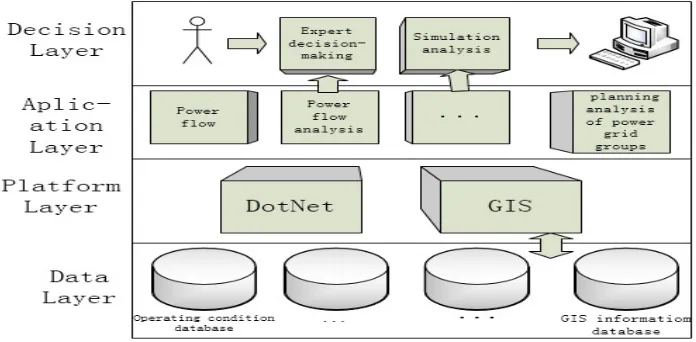
[image:2.612.132.480.300.471.2]The system based on the architecture of client / server mode (C/S, Client/Sever), is divided into four levels: data layer, platform layer, application layer, decision layer, As shown in Figure 1.
Figure 1. System structure diagram.
The data layer uses the database system, which is mainly responsible for the storage of historical data and the storage of the current data. These data mainly include the historical conditions of the power grid and the alternative planning scheme of the power grid.
The platform layer supported by platform subsystem, has application service middleware, application system integration and data exchange module and GIS service component deployment configuration, general service deployment, special service deployment and coverage of data acquisition, transmission, processing, storage, application, decision support and release all links.
The application layer mainly consists of two parts, the acquisition function and the analysis function. Collect the information of power flow and work condition in power grid, analyze the data, and forecast the power network information. The client interface faces the end user, and the server implements all kinds of practical functions in the form of functional modules. Finally, various effective planning schemes are put forward.
System Module Function
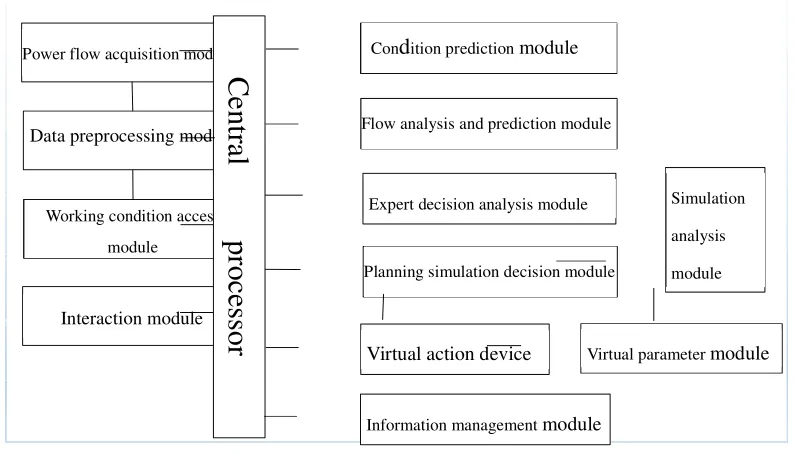
According to the process and characteristics of system planning, modules of the system are divided in detail, including the acquisition of power flow calculation module, power flow analysis and prediction module, grid condition access module, data processing module, network module, power grid group planning prediction analysis module, expert decision analysis module, a central processor, planning decision simulation module virtual actuator, virtual parameter module, simulation module, power management module, human-computer interaction module, principle diagram as follows. These functions can be suitable for different power supply requirements, but also can provide as much as possible to optimize the network planning process, to improve the effectiveness and safety of the network control system, to improve the network operation of power system stability and efficiency. As shown in Figure 2.
[image:3.612.107.504.264.491.2]The main modules function are as follows:
Figure 2. System module function diagram.
The network working condition access module is used to access the real-time operation data of each power equipment.
Network situation prediction module, drive method of establishing short-term prediction unit use statistical regression and data flow data using the grid condition data collected and calculated, to produce the short-term power generation forecast information, for the use of joint planning analysis module for power supply network.
Joint planning power grid group analysis module, according to the received data pretreatment module of power grid construction information, uses multi block differential evolutionary algorithm to obtain grid group plan to improve the power grid situation.
Expert decision analysis module, for receiving plans from Joint planning power grid group analysis module, compares the situation of power grid changes caused by different grid joint planning alternatives, and puts forward the final management plan.
The planning decision simulation module is used to establish a power grid physical model through the Flac3D data according the final plan.
Power flow acquisition module
Data preprocessing module
Working condition access module
Interaction module
Condition prediction module
Expert decision analysis module Flow analysis and prediction module
Information management module Planning simulation decision module
Virtual action device Virtual parameter module Simulation analysis module
C
e
n
tr
al
p
ro
ce
ss
o
System Features
Power Grid Planning, Coordinate with Geographic Information Changes
City geographic information system time-varying constantly updates, combined with system planning and effective integration of various resources, to avoid the waste of the various resources, coordinate the development of power grid and city development, improve the economy, reliability and feasibility of power grid planning. Based on geographic information and related information such as input power grid, substation site, load information, line information and the development of the city information, and historical information, the system updates and shares effective information, finally realizes the coordinated development of power grid and the city.
Effective Power Flow Analysis
Power flow calculation is a very important analyse and calculation in power system. In the transmission network planning, the power flow calculation of power system planning is used for inspecting schemes proposed whether or not they can meet the requirement of various operation modes, including the various components in the system (line and transformer) whether there will be overload, and excessive load should be taken preventive measures.
In this paper, the trend analysis is improved. Firstly, the optimal two-dimensional wavelet base is selected to analyze the multi-scale decomposition of the two-dimensional tidal current data and the layers are reconstructed separately. Secondly, the data of each layer of the reconstructed data are modeled and predicted by NPLS and the mean square error of cross validation is obtained. Then the submodel is fused by the calculated weight. Finally, the results and performance of the multi-scale - two-dimensional tidal current data model are evaluated by predicting the mean square root error and correlation coefficient. This method is compared with the conventional model, can significantly improve the model accuracy and reliability of conventional power flow data, not only provided a new characterization of digging out the information of power flow data, and avoid the loss of information, makes the trend data analysis more simple and reliable. This method can be suitable for different power supply reliability requirements, at the same time can provide as much as possible to optimize the process of power grid planning, improving the efficacy and safety of power grid network control, increasing the efficiency and the stability of the power grid network operation, and the grid planning decisions before the implementation would have a simulation, further ensure the safety of the power network operation.
Multi Database Support
The main form of the database management subsystem, by data storage and management platform of the regional power grid data center, forming a grid based configuration database, remote sensing image database, historical database, power distribution system of the regional economic benefit of the public database. At the same time, formed in the service of the business application is suitable for the actual situation of power grid planning whole basin management database, the database operation, power grid tide, video monitoring database, meteorological database.
Conclusion
planning auxiliary system. Introduced in this paper based on grid planning assistant system covers the entire planning process, after the information collection for grid conditions, through effective analysis of the proposed alternatives, under expert decision in the planning scheme, finally the corresponding simulation system for simulation. These work will help the grid planning work effectively.
References
[1] Wan Li, Xiong Shengyuan, Roman Tam, Yan Jiong, Xin Gang, Dou Xiaofeng, Liu Dong, Yuan Rongxiang. Design of auxiliary system for urban distribution network planning based on GIS [J].Electric power information, 2012, (09): 89-94.
[2] Luo Qing, Wu Liangliang, Shou Ting, Zhu Tieming, Huang Gang. Decision support system for power grid planning management based on CIM [J].Power system protection and control, 2016, (04): 111-117.
[3] Zhou Kunpeng, Fang Fang, Yan Jiong, Kang, Chongqing, Lin Haiying, Liu Xiukun. Design and implementation of power grid planning intelligent decision support system [J]. Automation of electric power systems, 2013, (03): 77-82.