2016 6th International Conference on Information Technology for Manufacturing Systems (ITMS 2016) ISBN: 978-1-60595-353-3
1 INTRODUCTION
Small and medium-sized LNG full capacity storage tank project involves a wide range, and is different from the general bidding quotation, the current project costs personnel generally use Excel or some of the petrochemical quotation software for the project valuation. Whether using Excel or the petrochemical quotation software for the preparation, there is a lack of accuracy, low efficiency and other issues. Therefore, in view of the small and medium-sized LNG full capacity storage tank project characteristics, integrated and developed the relevant software, so that the accuracy can be guaranteed, but also greatly improve the working efficiency of the quotation. The software adopts C/S architecture, using VB programming module development inside Visual Studio 2010, using SQL Server 2008, which belongs to the stand-alone version of a relational database system, so it can be in the current run every version of Windows.
2 THE ANALYSIS OF SYSTEM REQUIREMENTS
(1) Due to operator's computer knowledge is generally poor, so the quotation system requires a good man-machine interface;
(2)To facilitate the management of the system resource, it requires two permissions, administrators and ordinary users;
(3) Software requires that data entry and modification is simple and convenient;
(4) Convenient for query about material price and the company's quota data;
(5) Data calculation automatically complete, as far as possible to reduce manual intervention;
(6) Excel export and report printing function is required.
3 SYSTEM PLANNING
LNG storage tank EPC quotation system is different from the ordinary system. On the one hand, small and medium-sized LNG full capacitance tank construction is different from ordinary construction projects, has its own process characteristics; On the other hand, the EPC general contracting project involves many aspects, such as the design, procurement and construction, including the whole process of service in the engineering construction. The system mainly includes the system management module, the EPC quotation module and the database query and maintenance module
3.1 The system management module
The main task of the module is to maintain the normal operation and account security of the software system.
3.2 The EPC quotation module
The module is the core of the system, and the main functions include creating a new blank project, reference to the existing template to create a new project and view the existing project.
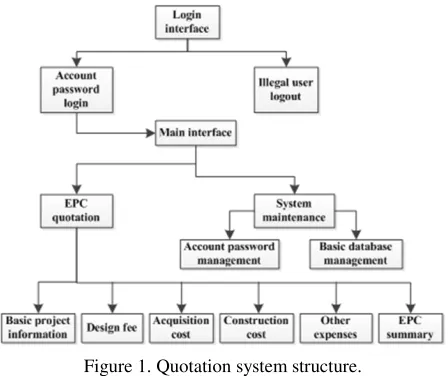
This module takes into account the characteristics of the small and medium-sized LNG full capacitance tank construction and EPC general contract project, which has different structure forms, including basic information of the project, design fees, acquisition costs, construction costs, other expenses and EPC summary, a total of six parts.
(1) The basic information of the project is mainly used for a brief description of the basic situation of the project;
Small and Medium-sized LNG Full Capacitance Tank EPC Fast
Quotation System Software Development
Huan Jin, Gongsheng Yang, Chunyuan Duan, Wenduo He
Offshore Oil Engineering Co., Ltd., Tianjin, China
(2) The design fee shall be provided with two billing models according to the offer;
(3) The acquisition costs include the costs of materials, equipment costs and procurement costs summary, a total of three parts;
(4) The construction costs mainly include six parts: the pile foundation engineering, civil engineering, installation engineering, the tank cold insulation project, the outer cold insulation engineering and the construction costs summary;
(5) Other expenses;
(6) EPC summary for all expenses.
[image:2.612.65.289.209.397.2]Quotation system structure is shown in the figure1 below.
Figure 1. Quotation system structure. 3.3 Database query and maintenance module
The module mainly carries on the necessary inquiry and the maintenance to the basic information database of the quotation software, mainly including: (1) Query related price and fixed information, which can be used in two ways of intelligent matching and manual selection;
(2) Insert, update and delete the basic information library, especially with the Excel import interface, easy to import the relevant price and fixed library for users.
4 QUOTATION SOFTWARE DATABASE DESIGN
Since the system involves a wide range, it needs to provide users with password management, basic quotation data management, industry price and quota information management. Thus creating a small and medium-sized LNG full capacitance tank EPC bid database, the information of different topics should be stored in different tables. The database can be divided into two major categories: the basic database and the project database.
4.1 Basic database
Basic database includes user information, main material price database and the company quota database, mainly used for user password management, material and equipment price information and company construction quota information record.
4.1.1 User information data table design
User information table is used to manage the user name, password and access information, including user name, password, permissions and creation time, a total of 4 fields.
4.1.2 Main material price library data table design
Main material price library is mainly used to record the relevant material information required for the construction of the LNG storage tank. It includes ID, number, goods name, main specifications, procurement quantities and units, the contract foreign currency price, contract price of RMB, contract price of foreign currency, contract unit price of RMB, purchase, exchange rate, manufacturers, and notes, a total of 14 fields.
4.1.3 Company quota library data table design
The company quota library is used to store the company's existing small and medium LNG full capacity storage tank construction data information, convenient for users to query. The company quota database includes ID, a fixed number, division component project name, unit, quantity, equipment, materials, fixed price, labor costs, material costs, machinery costs, management fees and profit risk, a total of 13 fields.
4.2 Project database
Project database includes the project basic information database, design fees 1, design fees 2, main material costs, equipment costs, procurement costs summary, pile foundation engineering, civil engineering, installation engineering tank, inner tank cold insulation engineering, outer tank cold insulation engineering, construction costs summary, other expenses and EPC summary. Procurement costs and construction costs of calculation is the core of EPC quotation system, here mainly introducing three data tables procurement costs: main material costs, equipment costs and procurement costs summary.
4.2.1 Project basic information data table design
4.2.2 Design fees data table design
According to the actual quotation, the costs of the design are to create two different data forms to store the relevant data of the project design fees.
(1) Design fee 1: mainly including ID, number, name, design fees, rate, total, notes, project name eight fields.
(2) Design fee 2: mainly including ID, number, names, put into manual, manual unit, total, notes and project name eight fields.
4.2.3 Procurement costs data table design
Procurement costs include the costs of materials, equipment costs and procurement fees summary, a total of three data tables.
(1)Main material costs data table design
Main material costs data table is used for classify project procurement main material costs in total. Main material fee fields include ID, number, name, main parameters, unit, quantity, unit price, total, acquisition range, bidding strategy, professional, remarks and project name. Setting the ID as the primary key, the code is set to grow automatically, 1 per time; professional information is used for importing material information according to the profession; the scope of procurement and bidding strategies is used for classification of relevant import surcharges, mining fee accounting and material costs summary; the project name is used for screening and management database. Number, name, main parameters, unit, unit, unit price, total, and notes are used to record the storage quotation about the basic information needed.
(2) The equipment costs data table design
The equipment costs data table is used to classify the items purchased. Equipment costs and material costs of the table are basically the same, the fields include ID, number, name, main parameters, unit, quantity, unit price, total, acquisition range, bidding strategy, professional, remarks and project name.
(3)Procurement costs summary data table design Procurement costs summary data sheet is mainly used to collect data on procurement costs. Procurement costs summary including ID, number, name, unit, quantity, total domestic, total imports, total and notes. The ID as the primary key, the code is set to grow automatically, 1 per time; total domestic and total imported respectively to summarize domestic and imported material and equipment costs; finally summarize combined to aggregate column. Procurement costs to unify the format of the data summary table, directly to main material equipment summary table; different projects are used unified format summary, which is convenient for the user to use.
4.2.4 The construction costs data table design
The construction costs include the pile foundation engineering, civil engineering, installation
engineering, the tank cold insulation engineering, the outer cold insulation engineering and the construction cost summary, a total of six data tables.
(1) Pile foundation engineering data table design Pile foundation engineering data table is used to store the pile foundation construction of partial engineering, measure expense, fees, taxes and other information. It mainly includes the ID, number, name, character description, measurement units, quantity, comprehensive unit price, valence, professional, remarks and project name, a total of eleven fields.
(2) Civil engineering data table design
Civil engineering data table is used to store the civil construction of partial engineering, measure expense, fees, taxes and other information. It mainly includes the ID, number, name, character description, measurement units, quantity, comprehensive unit price, valence, professional, remarks and project name, a total of eleven fields.
(3) Installation engineering data table design Installation engineering data table is used to store the installation construction of partial engineering, measure expense, fees, taxes and other information. It mainly includes the ID, number, name, character description, measurement units, quantity, comprehensive unit price, valence, professional, remarks and project name, a total of eleven fields.
(4) The tank cold insulation engineering data table design
The tank cold insulation engineering data table is used to store the tank cold insulation construction of partial engineering, measure expense, fees, taxes and other information.It mainly includes the ID, number, name, character description, measurement units, quantity, comprehensive unit price, valence, professional, remarks and project name, a total of eleven fields.
(5) The outer cold insulation engineering data table design
The outer cold insulation engineering data table is used to store the outer cold insulation construction of partial engineering, measure expense, fees, taxes and other information. It mainly includes the ID, number, name, character description, measurement units, quantity, comprehensive unit price, valence, professional, remarks and project name, a total of eleven fields.
4.2.5 Other expenses data table design
Other expenses data table is used to store other information related to the EPC bid, including ID, number, name, total costs, notes and project name, a total of six fields.
4.2.6 EPC summary
EPC summary data table is used to collect design fees, procurement costs, construction costs and other expenses of the small and medium-sized LNG full capacity storage tank, using E, P, C form combined. This data table includes ID, numbers, name, unit, quantity, amount and note, a total of seven fields.
5 SYSTEM IMPLEMENTATION
5.1 System management module
The module is supported by the user information data table as the background.
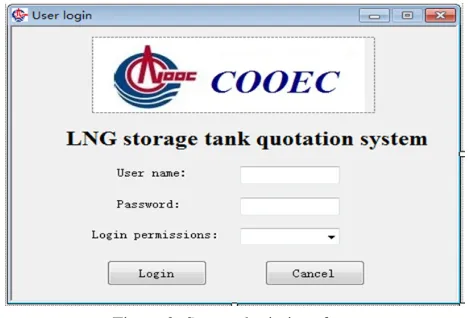
System login interface using CNOOC logo, the user can get into the main interface by importing the user name and the matching password and selecting the correct permissions, as shown in Figure 2. System queries the users information data tables to determine whether a user name, password and access agreement, otherwise the user can't login the system.
[image:4.612.316.557.197.335.2]Password setting interface is mainly used for the system to modify the user's password. According to the current user name, system updates the corresponding password information.
Figure 2. System login interface. 5.2 The EPC quotation module
This module is the core part of the quotation system, which involves all the data tables of the project database. The module mainly includes the project's basic information, design fees 1, design fees 2, main material costs, equipment costs, procurement costs summary, pile foundation engineering, civil engineering, installation engineering, the tank cold insulation engineering, the outer cold insulation engineering, construction costs summary, other expenses and EPC summary. According to the actual
needs of users, the data tables needs to query, insert, update, delete, etc.
[image:4.612.59.294.425.584.2]The main operating interface is shown in figure 3. The user can make the EPC quotation about the small and medium-sized LNG full capacity storage tank through creating a new project or open the existing project. The software realizes the interaction between the user interface and the database through the “datagridview” control. In addition, the software supports Excel import and export operation, so the user can directly import the construction data sheets and export the required Excel form when they complete the project quotation.
Figure 3. EPC offer interface.
5.3 Database query and maintenance module
The module mainly carries on the necessary inquiry and the maintenance to the basic information database of the quotation software, mainly including: (1) Query related price and fixed information. The user needs to inquire about the price information and the fixed information in the process of quoting, and the system supports two modes of intelligent matching and manual screening.
(2) The maintenance of basic information include query, insert, update, delete, especially with Excel import interface, which can directly import the relevant price and fixed library in accordance with the provisions.
6 CONCLUSION
The paper mainly introduces the LNG rapid EPC quotation system for small and medium sized above, especially about the design of the system database and the realization of the system. The system is highly targeted, easy to operate, can release the quote staff from the tedious search, summary, calculation of free, greatly improving the work efficiency
7 ACKNOWLEDGEMENTS
support by the Innovation and development of regional marine economy demonstration projects including Deep-sea oil and gas fields to build large structures critical equipment industry (No.CXSF2014-01), offshore oil and gas construction of large modules and complete sets of non-skid equipment industry engineering (No.CXSF2014-13).
REFERENCES
[1] Jian-jun L. Construction of the LNG storage tank technology [J]. Journal of welding technology, 2006, 35 (4): 54-56.
[2] Bao-sheng Y, Jian-gang Y, n Z H, et al. Quick quote system for bridge crane based on internet [J]. Computer Integrated Manufacturing Systems, 2004.
[3] Hjorteset K, Wernli M, LaNier M W, et al. Development of large-scale precast, prestressed concrete liquefied natural gas storage tanks[J]. PCI Journal, 2013, 55(9):40-54. [4] Gao-shang S. LNG storage tank fast modeling and its
application [D]. Harbin engineering university, 2013. [5] Bing W, Xue-dong C, Guo-ping W. Large new progress of
low temperature LNG storage tank design and construction technology [J]. Journal of natural gas industry, 2010, 30 (5): 108-112.