http://dx.doi.org/10.4236/jbcpr.2013.14013
A Multi-Criteria Decision Support System for the Selection
of Low-Cost Green Building Materials and Components
Junli Yang, Ibuchim Cyril B. Ogunkah*
Department of Construction, School of Architecture and the Built Environment, University of Westminster, London, UK. *Corresponding author: [email protected]
Received September 18th, 2013; revised October 25th, 2013; accepted November 4th, 2013
Copyright © 2013 Junli Yang, Ibuchim Cyril B. Ogunkah. This is an open access article distributed under the Creative Commons Attribution License, which permits unrestricted use, distribution, and reproduction in any medium, provided the original work is properly cited. In accordance of the Creative Commons Attribution License all Copyrights © 2013 are reserved for SCIRP and the owner of the intellectual property Junli Yang, Ibuchim Cyril B. Ogunkah. All Copyright © 2013 are guarded by law and by SCIRP as a guardian.
ABSTRACT
The necessity of having an effective computer-aided decision support system in the housing construction industry is rapidly growing alongside the demand for green buildings and green building products. Identifying and defining finan-cially viable low-cost green building materials and components, just like selecting them, is a crucial exercise in subjec-tivity. With so many variables to consider, the task of evaluating such products can be complex and discouraging. Moreover, the existing mode for selecting and managing, often very large information associated with their impacts constrains decision-makers to perform a trade-off analysis that does not necessarily guarantee the most environmentally preferable material. This paper introduces the development of a multi-criteria decision support system (DSS) aimed at improving the understanding of the principles of best practices associated with the impacts of low-cost green building materials and components. The DSS presented in this paper is to provide designers with useful and explicit information that will aid informed decision-making in their choice of materials for low-cost green residential housing projects. The prototype MSDSS is developed using macro-in-excel, which is a fairly recent database management technique used for integrating data from multiple, often very large databases and other information sources. This model consists of a data-base to store different types of low-cost green materials with their corresponding attributes and performance character-istics. The DSS design is illustrated with particular emphasis on the development of the material selection data schema, and application of the Analytical Hierarchy Process (AHP) concept to a material selection problem. Details of the MSDSS model are also discussed including workflow of the data evaluation process. The prototype model has been developed with inputs elicited from domain experts and extensive literature review, and refined with feedback obtained from selected expert builder and developer companies. This paper further demonstrates the application of the prototype MSDSS for selecting the most appropriate low-cost green building material from among a list of several available op-tions, and finally concludes the study with the associated potential benefits of the model to research and practice.
Keywords: Analytical Hierarchy Process (AHP); Decision Support System (DSS); Low-Cost Green Building Materials; Decision Analysis; Material Selection Factors
1. Introduction
As the green building movement begins to sweep through the housing construction industry, the applica-tion of cost effective and energy efficient building mate-rials has become necessary in today’s demanding eco-nomic market [1,2]. Recent discussions on the need to lower the growing demand for conventional sources of energy have highlighted the value of using low-cost green building materials and components, given their
argue that several attempts to adopt low-cost green building materials for housing design projects have gen-erally been viewed as challenging, given that most de-signers are vaguely informed about the full life-cycle impacts of such products. They note that information relating to the impacts of such building materials in the housing construction sector appears to be less available, as evidence [11,12] indicates that only a small proportion of design and building professionals seem to have suffi-cient knowledge that could allow effective decision-
making. Ashraf [11] and Zhou et al. [12,13] suggest that
maximizing their potential use in the housing industry requires seamless access to appropriate informed infor-mation and full understanding of the various options available, so as to inform decision traoffs at the de-sign stage.
Despite the availability of accurate and reliable data, Seyfang [14] and Malanca [15] however, noted that most designers are found to make decisions regarding the se-lection of such materials on the basis of their past ex-perience. They observed that inexperienced designers generally engage the traditional mode of selection, by relying on subjective individual perceptions of values and priorities in the material selection process, which rather than facilitate or drive their design ideas, appear to do the opposite thereby limiting creativity and sometimes resulting in considerable frustration [16,17].
Trusty [18-21] & Woolley [22] further disclosed that existing databases on such materials and their formats are not designed to efficiently and directly provide such in-formation to decision makers. They note that the avail-able data on such materials are normally in the read-only format, and are stored in various operational databases that are not easily accessible to decision makers in usable forms and formats. As a result, decision-making failures during the planning and design stage(s) of low-cost green housing projects hinder their use in terms of their indus-trial capacity utilisation in the housing industry.
While several studies [14,15,20] have emphasized the relative importance of information access in aiding well-considered and justifiable material choices during
the early stages of the design process, Wastiels et al. [16]
argue that the existing material selection method focuses mainly on limited aspects of such materials, in terms of their properties and factors that influence the decision- making process. Quinones [17] asserted that some low- cost green building materials, for example, contain high embodied energy that leads to ecological toxicity and fossil fuel depletion impacts during their manufacturing phase. She argued that ignoring the relevant factors or properties of any of such materials during the crucial material selection phase could reduce the effective life of that product to less than half of its normal effective life span.
Moreover, Seyfang [14] and Trusty [18-22] argue that choosing the right materials for a particular project can be a very complex decision-making task, given that the selection process is influenced and determined by nu-merous preconditions, decisions and considerations. They suggested the idea of a decision support system (DSS) as a useful aid in making quick and critical deci-sions during crucial material selection process. They stressed that the considered approach to encourage the wider scale use of low-cost green building materials in mainstream housing should enable design professionals to have easy access to adequate information on the available options, hence, making the selection results more reasonable and bringing more standardization to the material selection decision-making process at the design stage. They went on advising that whatever method is employed must be such that it allows comparison of not only the cost or technical performance of such materials, but also able to take into account several decision-mak- ing criteria, so as to derive conclusive and valid evidence of the differing impacts of various material alternatives.
While there seem to be no compelling evidence of technical research on a holistic approach used by design professionals for the evaluation and selection of building materials, previous material assessment models such as the Leadership in Energy and Environmental Design (LEED) and Building Research Establishment Environ-mental Assessment Methods (BREEAM), have shown great promise for guiding evaluations of material predic-tor performance [23]. The findings of the main research study yet, criticised and noted the flawed existing support systems for being partially objective and fraught with problems of fairness [24]. The study revealed that exist-ing methods are found wantexist-ing in that they are culturally implicit, and that such methods or tools treat the sustain-ability [of the] wider built environment as simply a mat-ter of energy and mass flows with little or no regard to the socio-economic, technical, emotive and political di-mensions of sustainability [24]. It further revealed that individual country teams establish scoring weights sub-jectively when evaluating building products, which often pose problems when applied to other regions [25,26]. The analysis of the study however, showed little evi-dence to justify the assumption that there are tools of demonstrable reliability for designers to assess the sus-tainability and suitability of such materials or products or their applicability and utility for their potential use in the design of low-cost green housing projects. Hence, a more reliable method is needed to aid design and building pro-fessionals in the selection of such building materials and components for low-cost green residential housing pro-jects.
individually and as assembled building components, a Decision Support System (DSS) is presented in this pa-per as an aid to design and building professionals. The objective of this study is to support decision-makers in selecting low-cost green building products that are envi-ronmentally, socio-culturally, technically and economi-cally balanced through a proposed conceptual system. The model is to facilitate the integration of more sus-tainable materials into future designs by helping design-ers quantify how they compare to materials already per-mitted under existing codes, using the concept of the Analytical Hierarchy Process (AHP). The AHP approach is designed to be practical, as it combines environmental, technical, socio-cultural and economic performance into a single performance value that is easily interpreted.
In the following sections, the reviews of existing tech-nological approaches are summarised and the main find-ings and themes to emerge from the literature review and the fieldwork seminars and interviews are reported. Then a step-by-step methodology is presented to illustrate the different stages of the DSS model development. Finally, the application of the prototype DSS for selecting appro-priate floor material for a residential project in the Lon-don Borough of Sutton is demonstrated. The final section concludes the study and suggests areas for further re-search.
2. Technology in Material Selection: Review
For the past ten years, proven and commercialized tech-nologies have been developed to promote environmental awareness amongst built environment professionals [18,22,23]. Empirical research validates that various studies on building material selection support systems have developed in size and specification within the last
ten years [24-26]. Castro-Lacouture et al. [26] note that
the application of green building support/assessment tools has been widely accepted as an effective and useful way of promoting green housing construction in the housing construction industry. Keysar and Pearce [27]
and Bayer et al. [28] however, argue that the contexts in
which building environmental assessment methods now operate, and the roles that they are increasingly playing, are qualitatively different than earlier expectations. They note that material assessment tools are now classified based on the type of analysis they perform, such as product, assembly, or whole building analysis, or classi-fied as region-specific tools, either considered based on the life-cycle phases they cover, or on the required skills necessary to operate the tool.
While there is clearly an urgent need for new tech-nologies to optimise the use of low-cost green building materials, it is also true that there are many technologies or systems already in use [25-28]. The first real attempt to establish a comprehensive means of simultaneously
assessing a broad range of environmental considerations in building materials was the Building Research Estab-lishment Environmental Assessment Method (BREEAM) [28]. The BREEAM tool assesses the environmental im-pacts of over 150 various materials and components most commonly used in home construction. The tool takes environmental issues into account, then adds measure-ments and user-defined weighting to arrive at environ-mental impacts, measured as “Eco-points” for each building material being assessed. Twelve different envi-ronmental impacts are individually scored, together with an overall summary rating, which enables users to select materials and components according to overall environ-mental performance over the life of the building. This scientifically accepted program however, focuses only on the environmental performance of products rather than environmental, social and financial considerations going hand in hand as parts of the material evaluation and se-lection process.
With emphasis on the Leadership in Energy and Envi-ronmental Design tool (LEED), Keysar and Pearce [27] conducted a detailed evaluative study comparing the ef-fectiveness of five different relative importance indices for selecting appropriate material selection tools such as: relative advantage; compatibility; complexity; trialability; and observability, with the goal of improving the sus-tainability of materials for capital projects. Here, materi-als such as; regionally manufactured materimateri-als, materimateri-als with recycled content, rapidly renewable materials, sal-vaged materials, and sustainably forested wood products are selected based on credit scores. Analyses of their study however, revealed that the LEED model for exam-ple specifically requires an energy model, a task often handled by a specialist within a design firm or out-sourced to a third party specializing in energy modeling.
Due to the inflexibility inherent in the application of first generation tools, and since they tend to require greater technical expertise to implement, many different tools of the second generation group have also been launched to address these limitations. Among this cate-gory is the ATHENA estimator. This has been one of the most popularly used material data-analytic models that analyses over 1200 building material and assembly com-binations [28]. It allows the users to look at the life cycle environmental effects of a complete structure or of indi-vidual assemblies and to experiment with alternative de-signs and different material mixes to arrive at the best
scenario. Bayer et al. [28] noted that the major
draw-backs to this tool are the fixed assembly dimensions, software cost, the cost and required skills to use it, the limited options of designing high-performance assem-blies, and the overall incomplete assessment of whole buildings environmental impacts [28-30].
estimator, The National Institute Standards and Tech-nology (NIST) developed the Building for Environ-mental and Economic Sustainability (BEES®) 4.0. This model provides a cradle-to-grave product-to-product comparison of over 230 building products based on manufacturer and supply company information [28-30]. The impact categories are weighed, normalized, and merged into a final environmental performance score, to generate a single measure of desirability for product al-ternatives by combining qualitative and quantitative data. The BEES 4.0 model is however, not capable of provid-ing data for a full LCA of a complete buildprovid-ing product, as it only produces data for a limited amount of building materials and evaluative factors [28-31]. These single- attribute claims ignore the possibility that other life-cycle stages or environmental impacts can yield offsetting im-pacts. Other limitations include; limited product options, limited use for local/regional impact materials and de-valuating weighing process [17].
Trusty [18-21] argued that these sets of first and sec-ond-generation tools less often consider any of the Multi- Criteria Decision Methods available to solve MCDM problems, adding that some systems do not even consider Life Cycle Cost (LCC) and other performance criteria simultaneously or completely. Moreover, he claimed that the existing performance requirements/criteria approach used in such tools tend to rely on immeasurable charac-teristics in demonstrating the extent of sustainability in a product, which makes them over-burdensome to imple-ment and communicate.
Since the highlighted material assessment tools were developed primarily to be used in different countries, and the data sources used by each tool differed, further ef-forts have been undertaken to develop knowledge-based or expert DSS for assistance in material selection. For
instance, Rahman et al. [32,33] developed an integrated
knowledge-based cost model for optimizing the selection of materials and technology for residential housing de-sign using Technique of ranking Preferences by Similar-ity to the Ideal Solution (TOPSIS). The system is devel-oped to assist architects, design teams, quantity surveyors and self house builders to make decisions for the design from early stage to detailed design stage by ranking the performance and cost criteria of technologies and
materi-als. Loh et al. [34] however, criticised the tool for
pro-viding partial assistance in the material selection process of the whole building design as it only considers the cost of roofing materials. They argue that material selection process depends on a number of other factors such as the location, zoning and environmental regulations, demo-graphic characteristics, etc. that are not considered in their system. They note that the TOPSIS approach adopted does not only lack the ability to eliminate bias in the selection process but also unable to allow fairer
trade-off process.
Loh et al. [34] emphasise that strategic selection of
sustainable materials and building design prior to the building construction is crucial to increasing building life cycle energy performance. They argue that stakeholders involved in the early design process often have conflict-ing priorities for both buildconflict-ing design and construction materials. They developed an environmentally focused decision support system in the form of an Environmental Assessment Trade-off Tool (EATT), which supports the development of the ideal building design and materials combination that meets stakeholders’ requirements. It is designed to assist users select the most appropriate mate-rial among a set of candidate matemate-rials based on the ana-lytical hierarchy process (AHP) concept of decision- making, since AHP technique has the robust ability to handle the complexities of real world problems, and to deal formally with judgment error, which is distinctive of the AHP method. The system rank orders a set of prese-lected, technically feasible materials using different deci-sion factors with and without tangible values, such as a clients favour over a particular building design, publicity potential of the building design, life cycle cost, capital cost and energy performance of different materials and
building layouts. Zhou et al. [12] argued that the
ap-proach adopted by Loh et al. [34] lacked in robustness as
it does not take into account the full-life cycle impacts of newly-accepted building products, and did not specify the sort of materials under studied.
Zhou et al. [12] developed a decision support multi-
objective optimization model for sustainable material selection. The material selection tools and material data sheets provide extensive information that includes factors such as cost, mechanical properties, process performance and environmental impact throughout the life cycle based
on expert knowledge. Wastiels et al. [16], confirmed that
the tool, however, lack the considerations or descriptions to evaluate the intangible aspects of building materials, which are important to architects. They also criticised the selection methodology for being highly restrictive to a limited range of factors and incompatible with other stakeholders.
Ashby and Johnson (2002) introduce “aesthetic attrib-utes” in the material properties list for product designers when describing material aspects such as the transpar-ency, warmth, or softness. Within the discipline of archi-tecture, however, the intangible qualities of materials are not described and mapped within the current design models. No selection framework was provided to support the implementation of a system.
Wastiels et al. [16], proposes a qualitative and
computerisa-tion as done by Zhou et al. [12]. In the presented
frame-work, no pronouncement is made upon how sustainable considerations from these different categories could in-fluence each other, and what MCDM approach could possibly be used if developed.
A similar study by Ding [35], developed a comprehen-sive assessment decision support system that measures the environmental characteristics of a building product using a common and verifiable set of criteria and targets for building owners and designers to achieve higher en-vironmental standards. Upon analysis it was found that the assessment for her study focused heavily on envi-ronmental issues rather than the broader social, cultural, technical and economic aspects of sustainable green con-struction.
Keysar & Pearce [27] cited extensive research litera-ture describing how material selection tools facilitate the innovation diffusion process and radical decision-making transformation. They however, note that most of the ex-amined models make choices that result in “fabricated assemblies of standardized performance attributes”, im-plying that they do not choose for materials but rather for ‘material systems’.
Hopfe et al. [36] conducted a study that assessed the
features and capabilities of six software tools to screen the limits and opportunities for using BPS tools during early design phases. The tools classification was based on six criteria namely the capabilities, geometric model-ing, defaultmodel-ing, calculation process, limitation and opti-mization. However, the authors did not report what methodology was used to compile these criteria.
A cost modeling system for roofing material selection was further proposed in Perera and Fernando [37]. Sev-eral factors were identified and considered in the selec-tion process. Results demonstrated large inconsistency in the evaluation process. No particular reference was made to the selection methodology.
Other influencing reviews within the scope of this study include Mohamed and Celik [38] who proposed a computerised framework that is responsible for materials selection and cost estimating for residential buildings where users are able to choose their preferred one from list of materials without evaluation and synthesis of mul-tiple design criteria and client requirements. No mention was made about the MCDM technique used for evaluat-ing the list of materials selected and their respective quantities.
Mahmoud et al. [39] suggested a method for the
selec-tion of finishing materials that covered floors, walls and ceilings and integrates cost analysis at the appropriate decision points, but without the selection information requirements or methodology as proposed in this study.
Lam et al. [40] carried out a survey on the usage of
performance-based building simulation tools. His study
examined the relative impacts and limitations of knowl-edge-base tools in decision-making. Murray argues that while there is a natural tendency for design and building professionals to focus on the scientific and technological aspects of green and sustainable construction, their ap-proach does not necessarily maximise the positive con-tributions professionals have to offer if tools are designed to replace professional judgment in the choice of materi-als. Murray suggests that this is because tools cannot address the intrinsic motivations people need if they are to embrace the positive changes sustainability requires. He continues that limiting the assembly of buildings to the specification of systems would impede the discovery of design opportunities inherent in materials themselves. Similar patterns of consistency, and lack thereof, have also been obtained [for detailed reviews see 17,24-27,31].
By highlighting the different green building material assessment tools, it can be deduced that existing tools are dispersed and based on individual initiatives without a unified consensus based framework [41,42]. It is appar-ent that each tool has its own unique application. While each tool could be called an LCA tool, there was little consistency in the methodologies used from one tool to another. In addition, while one tool considered the build-ing as a system, other tools considered primarily the product’s individual attributes rather than how that spe-cific product performed within the building system [42]. A key question therefore, is whether current assessment methods that were conceived and created to specifically evaluate the environmental merits of conventional build-ing materials can be easily transformed to account for a qualitatively different set of materials.
Giorgetti & Lovell [43] for instance have reported the sub-optimal performance of existing tools. They argued that the subjective values and priorities of the authors of the assessment scheme largely dictate the technical char-acteristics of the systems, and currently represent the major focus of discussion. They suggest that it is neces-sary for potential users to analyse the local situation and identify the adaptability of using any tool before apply-ing a universal green buildapply-ing assessment tool to a spe-cific country and region. They warned that some existing tools such as BREEAM, LEED, and even current expert tools might potentially institutionalize a limited defini-tion of environmentally responsible building practice at a time when exploration and innovation should be encour-aged in another region.
The findings of the review have shown that each of the indices applied in developed regions to deal with issues associated with the impacts and performance of low-cost green building materials in other regions have proven unsatisfactory [44,45]. This finding is premised on the fact that most existing material selection systems have been designed by countries with more developed econo-mies such as the UK, where the scale of social issues and lack of access to resources is simply not as critical as observed in the developing nations [45,46]. The setbacks that associates with the tools reviewed in this research thus, highlights the opportunity for developing a Material Selection Decision Support System (MSDSS), to better address the specific needs and attributes specific to the use of low-cost green materials for tool adopters new to green housing.
The following section briefly highlights the aim and objectives of the study. It extensively describes specific methods adopted for each task in Section 3.1.
3. Research Methodology
In order to identify the key selection factors or variables that formed the basis for the development of the proto-type multi-criteria decision support system (DSS), suit-able clusters of research approaches were considered in the research exercise, some of which include: exploratory literature reviews, networking with domain experts and practitioners, series of questionnaire surveys and
knowl-edge-mining interviews [47]. Table 1 provides an
over-view of the research aim, objectives and the methodology undertaken in four major stages.
3.1. Research Design
To provide a clear theoretical framework for the rela-tively new area of study, and develop preliminary ideas on issues specific to the research theme within the con-text of decision-making associated with the impacts of low-cost green building materials and components in housing construction, this study reviewed relevant litera-ture through synthesis and analysis of recently published data, using a range of information collection tools such as; books, and peer-reviewed journals from libraries and internet-based sources. Recognising the limitations of the literature review in terms of examining current research thinking in respect of decision support systems for the selection of low cost green building materials and com-ponents, a preliminary research study was undertaken to check and validate prior assumptions in the background and review sections.
In order to build upon knowledge gained from the lit-erature review, and recognising the limitations of the preliminary research survey in terms of examining cur-rent research thinking in respect of decision support
sys-tems for low cost green building materials and compo-nents, a mixed method was adopted for this study. This was followed by in-person interviews to further clarify and elaborate on less detailed and pertinent issues asso-ciated with the use low-cost green building materials. The in-depth interviews consisted of 10 participants, who involved a sample of practicing architects, engineers, material specifiers, and a host of building profession-als-who influence material choice decisions in the UK housing construction industry. This approach was used to examine the potentials of the proposed MSDSS, (being a tool for the assessment and evaluation of low-cost green materials). It further investigated the effectiveness of design and decision support tools, as well as identified requirements of Life Cycle Assessment (LCA) tools for design decisions at the various stages of the design proc-ess.
Consequently, a quantitative questionnaire was devel-oped as the result of the analysis of the results from the interviews. In order to elicit the “most important” factors, a questionnaire survey was conducted among the execu-tives of some selected builder/developer firms. They were asked to rank order from a list of factors (compiled from existing literature on the topic and after initial con-sultation with some of the executives) based on their judgment and experience. The executives were also asked to indicate desired features they would like to have in a DSS for low-cost green material selection. Since the respondents were widely dispersed, and because it was anticipated that building professionals would be more likely to reply and cooperate with a less time-consuming research method, giving the constraints of time, wider coverage, and budget, it was therefore, decided that a questionnaire sent and returned by email would be the most convenient way of collecting the required data. The inclusion of qualitative open-ended questions provided respondents a chance to express their views more freely.
The target groups of respondents were also taken from a database or directory of building professionals provided by the UK, China, Canada, South Africa, Brazil and US Green Building Councils (GBCs). The selection ap-proach followed the random sampling technique to avoid bias and uneven sample sizes amongst different profes-sional groups, and ensure uniformity, consistency and quality of data. To facilitate the response rate, snowball sampling was also adopted, where the approached re-spondents were asked to distribute the questionnaire to their colleagues and partners within the field [47].
Table 1. Basic summary of the research methods.
AIM
To develop a decision support system (DSS) that will provide designers with useful and explicit information associated with low-cost green building materials and components, to aid informed decision-making in their choice of materials for low-cost green residential housing projects.
Stage Objectives Tasks Method
1.Examine current views on themes related to decision-making associated with the use of low cost green materials in the housing industry, to identify new ideas & issues arising from the study
Step 1. Reviewed relevant literature through synthesis and analysis of recently published data, using a range of information collection tools such as; books, peer-reviewed journals, and articles from libraries and internet base sources
AA,
1: REVIEW
2. Review various DSSs currently used at national and international levels for the selection of materials to identify knowledge deficits and the potential benefits associated with their use
Step 2. Carried out a preliminary research study with leading researchers who influence the selection of building materials in the field of housing construction
AA, QS, INT
Step 3. Conducted a pilot study, by deploying a test-questionnaire to a small sample of researchers who possess relevant knowledge on issues specific to the use of low cost green materials using the email addresses taken from the databases of recognised building construction companies and research institutions
Step 4.Conducted the main survey, by administering the revised questionnaire through email contacts taken from databases of interested registered building professional groups, who influence the selection of construction materials from throughout the construction value chain
Step 5. Conducted in-person interviews with interested building professionals who influence material choice decision in housing construction using audio recording system to avoid re-contacting the respondents or falsification of information 2: DATA
COLLECTION &SYNTHESIS
3. Conduct surveys and interviews with building professionals, to identify the potential factors or variables that influence the informed selection of low cost green building materials and components
Step 6. Carried out inspection on available expert systems most commonly used in building firms in the UK, USA, China etc. by interviewing experts, with years of experience in the industry, who have implemented or used such systems and directly observing how they function when in operation
AA, QS, INT
3: DATA ANALYSIS
4. Evaluate and establish the weighted importance of the key factors or variables that will help to determine the relative impacts of the different choices of building materials and components
Step 7. Analysed the information and report gathered from the survey exercise(s) using a suite of statistical analytical programs, and various quantitative data analytical techniques
AA, QS M
Step 8. Assembled the key components by synthesising the relevant databases to be incorporated in developing the proposed DSS model.
5. Develop a system to integrate the necessary information appropriate to the informed selection of low-cost green
building materials & components Step 9. proposed system by creating links among the various Developed the main structure workflow of the databases,
AA, QS, M
Step 10. Inputted relevant data to test the internal links to know what needed to be measured within the system, and checking the output of the results against easily calculated values
M
Step 11. Conducted experts survey by deploying a sample of the prototype system via email of those who participated in the main survey, using feedback questionnaires as a quicker and cost effective means of assessing respondents’ judgments about the system
QS
Step 12. Made necessary changes based on the feedback from
the survey M
4: DEVELOPMENT
6. Test the functionality of the proposed approach; and validate the effectiveness by applying it to a building material selection problems using a series of case study residential building projects in the UK
Step 13. Validate the modified prototype system using a series of completed building projects in the UK, by comparing the outputs from the algorithms to monitored data from the completed building
M, CS
development of green building tools (as they have had the most uptakes in both geographical regions and being part of an emerging market).
To receive a reasonably sized sample, 500 surveys were sent out by email, over a two-month period of March and April 2012. Using a progressive approach of data collection, a total of 250 respondents returned the completed survey, representing a response rate of 50%. The response rate was accepted as the normal ranges between 20% - 30% were found in most of the construc-tion industry related research [33,34]. Prior to distribu-tion, the questionnaire was pre-tested for comprehensi-bility by consulting five academics at two universities [47]. A number of changes were suggested and imple-mented.
Respondents were also invited to post their ideas about current limitations or improvements that should be avoided or integrated in the development of the proposed MSDSS model at the later part of the questionnaire. The questionnaire also examined the adequacy/inadequacy between traditional manual approach of material selec-tion and computer-aided decision support tools. One of the group’s participants commented that one of the hall-marks of good science is that a result can be tested inde-pendently and proven to be right or wrong in the latter method. The analysis of the questionnaire survey and interviews provided a list of “key” decision-related fac-tors having significant impacts on the process of material selection for residential development as shown in Section 4.1.1.
3.2. Research Findings
The results of the study however, revealed the following.
• Many existing decision support systems in the
devel-oped countries do not have the appropriate perform-ance threshold for addressing the most relevant issues specific to less developed countries;
• Current DSS models are unable to relate to matters
associated with the informed selection of materials that are commonly used for housing projects in coun-tries with rather less-mature markets;
• The lack of informed knowledge by building
profes-sionals in terms of the principles, characteristics, and best practices relevant to the use of low-cost green materials at the design stage, has been identified as a common constraint peculiar to their wider-scale use in the housing industry;
• The majority of building professionals still regard
cost and environmental factors as conventional pro-ject priorities when selecting building materials or components, but rarely consider the implications of social, political, technical, sensorial, legal and cultural factors in their choice of materials; and finally,
• The majority of low-cost green building materials are
yet to be certified under the building regulations, standard specifications and codes of practice; and most importantly,
• There are no demonstrable and compelling evidence
of technical research on a holistic approach used by design professionals for the evaluation and selection of low cost green building materials and components at the design stage.
The results of the study thus, provided the platform that suggested the need for a system that could aid in-formed decision-making to improve understanding, and enhance the effectiveness of actions to implement and promote the wider-scale use of low-cost green building materials and components at the core of the construction business process. In light of their feedback and useful suggestions from building experts who partook in the study, the following portions of the DSS model were either readjusted or improved.
• Easy searchable material selection inputs database;
• Ability to add/remove material selection features with
ease;
• Ability to make custom reports;
• Ability to easily navigate all components with ease;
• Comprehensive “HELP or USER INSTRUCTIONS”
menu explaining what the tool is doing;
• Being able to understand the material selection
proc-ess through the lens of non experts;
• Ability to perform trade-off analysis to compare
dif-ferent material options;
• Clarity on the algorithms used to perform the
simula-tions; and Real-time results;
• Data input forms to ensure easy and consistent data
input; and,
• Having a huge amount of customizability in terms of
output.
After the improvement, the system was shown to the same participants, and minor adjustments were made on the basis of second feedback. In the following sections the proposed MSDSS selection methodology is discussed, and a conceptual framework for the decision support system based on the methodology is presented. Subse-quently, the MSDSS model is applied to a hypothetical but realistic material selection problem to rank order the candidate materials for selecting the most appropriate one.
4. System Development
VBA (MEVBA) was utilized for the following reasons:
• Macro-in-Excel VBA (MEVBA) has the capabilities
to perform all necessary calculations and is common enough that most people are familiar with it;
• It has the ability to write scripts that could
automati-cally convert material data from any graphic table format to an appropriate condensed data table (hidden from the user’s view) to allow quick and reliable in-dexing of material data;
• The Macro-in-Excel VBA framework has the code
that makes Windows forms work, so any language can use the built-in code in order to create and use standard Windows forms;
• Makes the application easier to maintain; With
MEVBA, codes were easily built into the form or re-port’s definition, since the DSS model contained a large number of macros that respond to events on forms and reports; which would have been difficult to maintain using any other application;
• With Macro-in-Excel VBA it was easy to step
through a set of records one record at a time and per-form an operation on each record;
• Macro-in-Excel VBA helped to supply a standard
security mechanism, which was made available to all parts of the MSDSS data application model;
• Enables the developer to create his own functions:
The MSDSS contains a series of mathematical model and computational algorithmic procedures that pro-vided a basis for computing the green development index of material alternatives within an integrated de-cision-support framework or tool(s).
• Ability to mask error messages during the tests run;
• Enables the system to quickly analyze existing data to
discover trends so that predictions and forecasts can be made with reasonable accuracy;
• Allows for extensions and expansions: since the
components of the framework are modular, meaning that each may be developed independently, and data may be added as it is acquired to supplement the knowledge and databases, macro-in-excel was used to achieve that goal
4.1. MSDSS Database/Data Warehouse Design
The data warehouse design constitutes the major portion of the MSDSS development and hence will be explained in detail in this section. The data warehouse design es-sentially consists of four steps as follows:
Step 1: Identifying the key influential factors that will impact on the choice of materials;
Step 2: Designing the material selection methodology framework and identifying the objectives of each step;
Step 3: Designing the various components of the MSDSS model and defining their features and functions;
Step 4: Defining the workflow selection methodology
and analytical procedure of the actual prototype MSDSS model
4.2. Identifying the Key Influential Factors
In order to identify the relative importance of the sub- categorical factors or variables based on the survey data, ranking analysis was performed. Five important levels were transformed from Relative Index values: Highly
Significant Level (H) (0.8 ≤ RI ≤ 1), High-Medium Level
(H–M) (0.6 ≤ RI < 0.8), Medium Level (M) (0.4 ≤ RI<
0.6), Medium-Low Level (M–L) (0.2 ≤ RI < 0.4), and
Low Level (L) (0 ≤ RI < 0.2).
From the results of the analysis, 40 factors were iden-tified under the “Highly significant” level for evaluating low-cost green building materials with an RI value rang-ing from 0.952 to 0.806 and a total of 15 factors, were recorded to have “High-Medium” importance levels with an RI value ranging from 0.795 to 0.652. The analysis of the main survey identified a total of 55 key influential factors out of 60 initial factors as important components of the material selection process.
“Life Expectancy” was ranked as the first priority in the technical category with an RI value of 0.952, and it was also the highest among all factors and was high-lighted at “High” importance level. “Resistance to fire” was also rated high in importance among the selection factors. “Maintenance Cost” was ranked third in impor-tance. It was clear from this research that there is a per-ception of ambiguity surrounding the long-term mainte-nance of low-cost green building materials. This is not entirely any surprise given that maintenance free build-ings are increasingly sought after by clients, anxious to minimise the running costs associated with buildings. “Life-cycle cost” has been, and will continue to be, major concerns for building designers, as well as important traditional performance measure.
Among the top 20 ranking factors, it was observed that only one factor from the environmental category out of the list was ranked high among the selection factors. This again suggests that environmental issues within the con-text of the developing countries are not strongly consid-ered despite the high environmental awareness exhibited by design and building professionals in developed re-gions. This finding also corroborates the initial observa-tions of various studies [14,15] repeatedly highlighted in the background and literature studies. They suggest that the problems within the developing regions are charac-terised by mainly social and economic issues, unlike the developed regions where the scale of social issues and lack of access to basic resources are simply not much of a problem as it is in the developing world.
From Figure 1, a total of 15 factors, consisting of 12
levels. Although these 15 variables were in the same im-portance level category, the “building orientation” factor within the “general/site category” (average RI = 0.652) was considered to be the least important variable com-pared to the factor “Glossiness” under the “sensorial category” (with an average RI = 0.774), and “material availability” still under the “general/site category” (with an average RI = 0.795). However, it should be noted that site factor accounted for 75% in the “High-Medium” importance level. The result is an example of evidence pointing to the trend that environmental and perhaps site issues are no longer considered as the most important factors for material selection in housing projects, espe-cially within the context of the less developed regions.
Some factors in the three categories were ranked rela-tively higher in the “High-Medium” level. For example, “material availability (GS1)” was rated as first in the general/site subcategory, and ranked as thirty-fifth in the overall ranking with an RI value of 0.795. An interesting observation from the results is that none of the criteria fell under the medium and other lower importance level. This clearly shows how important the factors are to building designers in evaluating low-cost green building materials. All factors were rated with “High” or “High- Medium” importance levels. However factors such as Compatibility with other materials, Skills availability, and UV resistance fell within the medium-low level. The
findings of the analysis asserted that the criteria with medium or low RI does not mean they are not important for selecting materials, but rather created an opportunity to highlight the relative importance of the key criteria from their vantage points. The following shows a frame- work consisting of the key factors in their order of im- portance.
4.3. Designing the MSDSS Selection Methodology
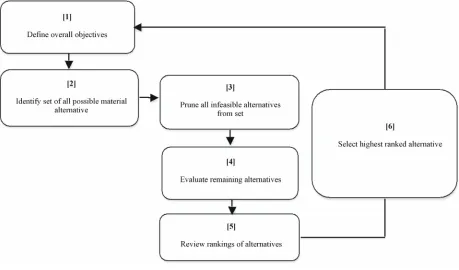
The diagram shown in Figure 2 demonstrates the
con-ceptual framework of the selection methodology for the
decision support system. Table 2 describes a step-by-
step procedure of the selection methodology for the ma-terial selection decision support system. Section 4.4 pre-sents various components of the MSDSS schema or model.
4.4. Designing the Features of the MSDSS Model
The next stage of the model development was to design the various features of the databases containing the logic and showing relationships between the data organized in different modules. Each module contains the physical information and contents needed to aid in the material evaluation and selection process.
!!! ! (GS) General/Site Factor
GS2-Material Availability GS1-Geographic Location of Site GS10-Building and Space Usage GS9-Knowledge Base in Construction GS6- Withstand Natural Disasters GS7-The Type of Building Material(s) GS4-Building Certification for Use GS5-Design Concept
GS12-Spatial Scale: Building Size and Mass GS8-Project Site Geometry/Setting/Condition GS3-Distance
GS11-Building Orientation!
(EH) Environmental/Health Factor!
EH3-Safety and Health of End-users EH6-The Climatic Condition of the Region EH7-Material Environmental Impact EH2-Level of Carbon Emissions and Toxicity EH4-Habitat Disruption: Ozone Depletion Potential EH1-Environmental Statutory Compliance EH5-The Amount of Pesticide Treatment Required
(EH) Economic/Cost Factor!
C4-Maintenance or Replacement Cost C5-Labour or Installation Cost C1-Total Life Cycle Cost C3-Capital/Initial Cost C2-Material Embodied Energy Cost
(SC) Socio-Cultural Factor!
SC5-Knowledge of the Custom
SC1-Material Compatibility with Traditions SC6- Compatibility with Client’s Preference SC2-Material Compatibility with Regional Settings SC3-Cultural Restriction(s) on Usury
SC4-Family Structure: Type & Size of Family Unit
(SN) Sensorial Factor!
SN4-Temperature SN6-Odour SN10-Lighting Effect SN5-Acoustics
SN1-Aesthetics or Visual density SN2-Texture
SN3-Colour
SN7-Thickness/Thinness SN9-Hardness SN8-Glossiness/Fineness SN11-Structure SN12-Translucence
(T) Technical Factor!
T15-Life Expectancy T7-Resistance to Fire T9-Resistance to Moisture T11-Resistance to Weather T5-Availability of the Technical Skills T8-Resistance to Heat
T13-Resistance to Decay
T3-Level of Maintenance Requirement T6-Ease and Speed of Method fixing T4- Expansion-Contraction Tolerance T1-Recyclability and Reusability T12-Resistance to Chemicals T2-Ease to Remove/Re-Affix/Replace T14-Weight & Mass of material T10- Resistance to Scratch T-16-Renewability
T17- Compatibility with other Materials T18-UV Resistance
[image:10.595.60.538.420.714.2]Material Alternatives Analytical Hierarchy Process Preferred Material Choice
Table 2. Description of the selection methodoly.
OBJECTIVE TASK
1. Define or state overall objective/goal The first step of the methodology is to define the main goal of the intended task.
2. Identify Set of all Possible Material Alternatives to be Assessed
After defining the main goal of the task, the next step is to generate the set of all possible alternatives that are available for selection based on the decision-making parameters. In the material selection process, this comprehensive set of alternatives includes all construction materials and components currently in the database, and the market in context.
3. Prune all infeasible alternatives from set
The third step is to reduce the complete set of alternatives by eliminating/pruning those alternatives, which are clearly infeasible for the intended application from the database consisting of all materials, based on classifications of materials according to the Construction Standards Institute (CSI) Divisions, and material heuristics. For example, if the element under consideration is a structural beam, materials such as roofing sheet and glass are automatically pruned from the set of possible alternatives under consideration, since none of these materials fall under the CSI structural divisions. This should result in a subset of alternatives, all of which would be feasible choices for the intended application. The “pruning” approach is used rather than allowing the user to select feasible materials from the whole set because users tend to overlook alternatives which might be unfamiliar to them but are nonetheless feasible.
4. Evaluate Remaining Alternatives
• Weight Attributes (Decision Factors)
• Calculate Values for Attributes
• Amalgamate Weighted Attributes
• Develop Ranking
The fourth step in the methodology is to evaluate the feasible alternatives using the AHP model such that a ranking can be developed according to the relative importance of the material for the intended application.
• First, the decision maker weights each factor or variable according to the relative importance that the decision factor or variable holds for the decision maker. It involves the decision-maker replacing probabilities with user weightings for each factor or variable to supplement, not replace, his judgment.
• Second, values for each of the factors or variables are determined for each material with regard to the manufacturer’s information & details of the material or component contained in the material database, and then, a normalized value between zero and one is calculated for each factor value.
• After weights have been established and values calculated for each attribute against a set of materials or components, the weights and normalized values are multiplied and summed to create an index of preference for that alternative(s).
• Then, a list of alternatives ranked according to the relative importance of the factors or variables is then presented.
5. Review Ranking of Alternatives
When the indices of factors or variables have been calculated for all feasible alternatives, a ranking is developed sorting the alternatives according to each utility value based on the AHP model of decision-making. The alternative with the highest utility value is recommended from the ranked list of potential materials for each design/building element.
6. Select Alternative Based on Ranking
The decision maker may then either elect/decide to select the highest ranked alternative, or choose another alternative from the set based on his professional judgment.
7. Proceed to Next Design Elements The decision maker satisfied with the selection process, then proceeds to the next design/building element.
The conceptual model/framework of the prototype MSDSS tool consists of a number of interconnected modules/features. A logical model illustrating the
devel-oped DSS for material selection is shown in Figure 3.
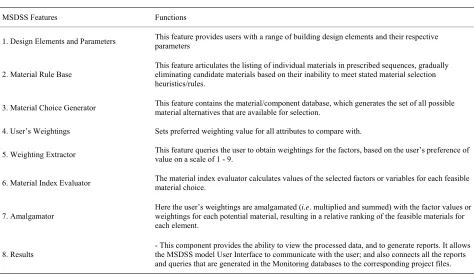
Table 3 describes the functions of each component of the MSDSS model.
4.5. How the System Works
The following steps explain how the prototype MSDSS model works during the material evaluation process.
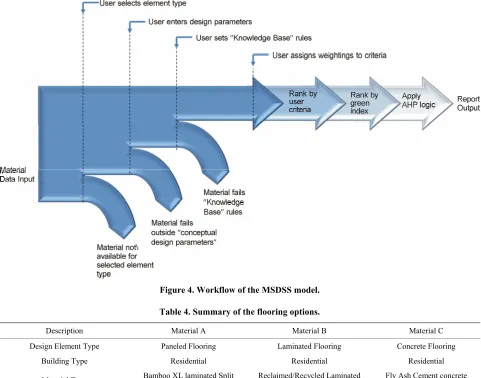
Step 1: The load manager provides the user with a list
of design elements from the “Design Elements” module, and then prompts the user to select the design element of his/her choice in accordance with the terms and specifi-cations of the Construction Standards Institute (CSI) Di-visions;
Step 2: The User then selects the particular design element needed for the intended task from a list of design elements (as broken down by the Construction Standard Institute Division);
Figure 2. Selection methodology for the MSDSS model.
Figure 3. Conceptual framework of the MSDSS model.
of the selected design element, and then sets the thresh-old values in the material knowledge base
Step 4: The system validates the design parameters and threshold details entered by the user, and then gener-ates the set of all feasible material alternatives that are available for selection, (which includes all categories of construction materials contained in the materials
data-base);
based on the decision maker’s preference of value; Step 6: After weights have been established and values calculated for each factor for a particular material, the weights and normalized values are multiplied and sum- med to create an index of subjective utility for each al-ternative;
Step 7: The alternative with the highest utility value is recommended by the system;
Step 8: The user reviews the system’s recommended choice for each element in the “Result” module, and then either selects the highest ranked alternative, or chooses another alternative from the set based on professional judgment and/or the system’s recommendation.
Step 9: The user may choose to generate a printout re-port or graphical representation of the list of selected materials and green utility indices if desired.
Step 10: The selection process then proceeds to the next design element.
Figure 4 presents a graphical representation of the system workflow.
An illustrative example of the AHP concept is dis-played and explained in following section to demonstrate the selection process by applying the prototype MSDSS model to a hypothetical case study design project.
5. Application
The following example illustrates the selection process of floor covering products. It selects the best one among three alternatives. The prototype MSDSS, developed
using the AHP technique, was used to select the most appropriate residential building floor material for hous-ing development in the city of London, located in the Sutton County of London. The results demonstrate the capabilities of the MSDSS system in a real-life but hy-pothetical application scenario. In the following section this process of application is described and discussed.
5.1. A Hypothetical Study Case
The next stage of the model development was to design the various features of the databases containing the logic and showing relationships between the data organized in different modules. Each module contains the physical information and contents needed to aid in the material
evaluation and selection process. Table 4 summarizes
the details for the three options of flooring materials for the proposed residential low-cost green housing project.
The description of the three options in Table 4 was based
on the standard practices and construction details com-monly used in the housing construction industry.
These three (3) floor materials described above will be analysed amongst a host of other material alternatives for the selection of a more sustainable option. In other words, this section will analyse the problem using the MSDSS model, which relies on the use of the AHP mathematical multi-criteria decision-making technique, to identify and decide which material is the most sustainable and suit-able flooring material in this case.
[image:13.595.60.534.460.739.2]To achieve this goal, the MSDSS model was sent to 10
Table 3. Functions of the features of the MSDSS model.
MSDSS Features Functions
1. Design Elements and Parameters This feature provides users with a range of building design elements and their respective parameters
2. Material Rule Base
This feature articulates the listing of individual materials in prescribed sequences, gradually eliminating candidate materials based on their inability to meet stated material selection heuristics/rules.
3. Material Choice Generator This feature contains the material/component database, which generates the set of all possible material alternatives that are available for selection.
4. User’s Weightings Sets preferred weighting value for all attributes to compare with.
5. Weighting Extractor This feature queries the user to obtain weightings for the factors, based on the user’s preference of value on a scale of 1 - 9.
6. Material Index Evaluator The material index evaluator calculates values of the selected factors or variables for each feasible material choice.
7. Amalgamator Here the user’s weightings are amalgamated (weightings for each potential material, resulting in a relative ranking of the feasible materials for i.e. multiplied and summed) with the factor values or each element.
8. Results
Figure 4. Workflow of the MSDSS model.
Table 4. Summary of the flooring options.
Description Material A Material B Material C
Design Element Type Paneled Flooring Laminated Flooring Concrete Flooring
Building Type Residential Residential Residential
Material Type Bamboo XL laminated Split Paneled Flooring Reclaimed/Recycled Laminated Wood Flooring and Paneling Fly Ash Cement concrete Floor Slab
Size of Materials 230 mm × 150 mm 50 mm × 6000 mm 900 mm × 900 mm
expert evaluators who had the following qualities:
• Considerable amount of knowledge in material
analy-sis based on the AHP concept;
• Used a wide range of green building assessment tools
for material selection; and
• Taken part in the previous survey.
The aim of this exercise was to compare their view of the prototype MSDSS model with existing models in terms of their usability, flexibility, and interoperability attributes using the concept of the Analytical Hierarchy Process (AHP).
5.2. Rationale for Adopting the AHP Concept
The study adopted the use of the AHP technique to in-vestigate the interrelationships amongst various criteria and low-cost green material alternatives due to the fol-lowing reasons:
• AHP is a method that is conceptually easy to use, and
decisionally robust to handle the complexities of real
world problems;
• It does not require the very strong assumption that the
stakeholders make absolutely no errors in providing preference information;
• It has the ability to deal formally with judgment error,
which is distinctive of the AHP method;
• The AHP method provides the objective mathematics
to process the unavoidably subjective preference in-herent in real- world evaluations;
• Possesses an inherent capability to handle qualitative
and quantitative criteria important for sustainable material selection; and finally,
• Can enable all members of the evaluation team to
visualize the problem systematically in terms of par-ent criteria and sub-criteria.
Figure 5. Flowchart of the AHP concept.
5.3. Applying the AHP Model to the Problem
According to Reza et al. [48], AHP is a subjective
MCDM method that does not necessarily involve or rely on a large sample for its analysis. To better illustrate the procedure of the AHP technique of decision-making, with reference to the case presented in Section 5.1, a complete example of applying AHP to the problem of material selection is provided here based on evaluators’ results. Twenty (20) respondents representing various fields of the housing construction industry, and who had fore knowledge of the AHP procedure were selected to participate in the AHP survey.
By evaluating the consistency level of the collected questionnaires, 5 questionnaires out of the 10 received had acceptable consistency and were entered into the system. In order, to avoid arbitrary and inconsistent an-swers in the data, the mean values of five (5) out of the ten (10) respondents were used to fill out the pair-wise comparison matrices for the parent and sub-factors.
The package included the model, evaluation question-naire and a cover letter stating the purpose of the re-search, the validation process and what was expected of them. To conduct the exercise, the study adopted Chua’s
et al. [49] approach based on a number of suggestions as
• A document that reminded and explained the overall aim and objectives of the study to the respondents, followed by a step-by-step demonstration of its op-eration;
• A demo illustrating a practical exercise. This allowed
the evaluators the experience of using the system en-sued. During the practical assessment session of the demo, evaluators were able to see the controls and get a general overview of the MSDSS interface;
• An illustrative example of the objective and
method-ology of the AHP technique based on the instructions in the demo, to guide and illustrate to every respon-dent on how to browse and conduct analysis;
• After the introduction, a feedback questionnaire was
forwarded to the evaluators;
• After each evaluation, each evaluator highlighted
their experience(s) and provided feedback on the feel of the system, with special attention to the problems that they encountered during the evaluation process;
• Finally, a reflective or post-user questionnaire was
completed to obtain feedback;
• Evaluators were asked to answer each statement or
question relating to the model in the questionnaire based on their personal view(s);
• They were also asked to assess the importance of the
system based on their perception. Evaluators were also asked to add general comments on the system, and provide feedback on the applicability of the pro-totype system in assisting in specific material selec-tion problems during their experience and other ways of improvement;
• Problems uncovered or areas that proved difficult to
understand during the evaluation process were imme-diately modified so that it did not arise in subsequent sessions, as this procedure followed each evaluation;
• The respondents were instructed of the relevance of
observing consistency in their answers whilst using the MSDSS model;
• The questions relating to different aspects were
pre-sented in different sections. This helped respondents to focus on one aspect at a time.
The following sections exemplify the process.
5.4. Decomposition of the Decision Problem
The evaluation exercise provided users with the
opportu-nity to define the problem. Figure 6 shows the
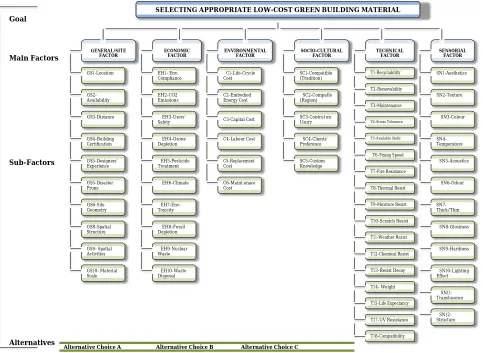
exem-plary hierarchy of the problem. The goal is placed at the top of the hierarchy. The hierarchy descends from the more general or parent factors in the second level to sub- factors in the third level to the alternatives at the bottom
or fourth level as shown in Figure 6). To select a suitable
choice among alternatives, the users were instructed to define the decision factors needed for the analysis. In other words, the users determined which alternative
could be the best choice to meet the goal considering all
the selected decision factors or criteria displayed in
Fig-ure 6.
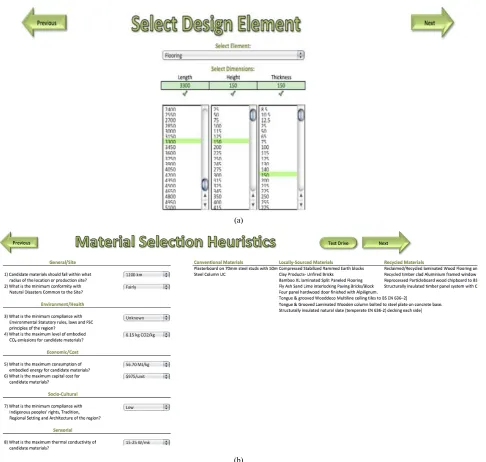
The first step of the methodology (as illustrated in fig-ure 2) was to define the main goal of the intended task, by identifying the design element needed for the analysis, and inputting the relevant dimensional scale for the
sug-gested design element (see Figure 7(a)).
After defining the main goal of the task, the next step was to generate the set of all possible alternatives that were available for selection with reference to the
deci-sion-making parameters as shown in Figure 7(b). At this
stage the users are prompted or alerted by the MSDSS model to identify a set of feasible floor material alterna-tives based on a range of material selection heuristics/ knowledge-based rules. The goal is to choose a suitable floor material among options for the project case de-scribed in Section 5.1.
5.5. Pair-Wise Comparison of Parent Factors
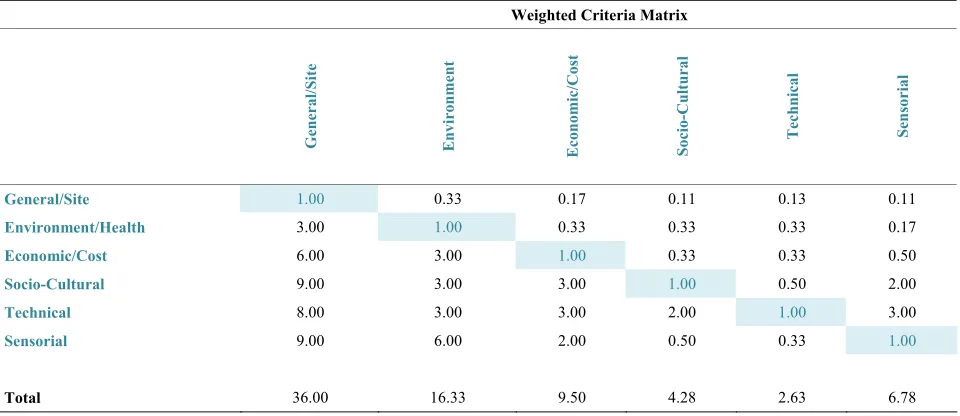
After selecting the design element, and identifying a set of feasible alternatives using the material selection heu-ristics/knowledge-based rules, the respondents were made to perform pair-wise comparisons following the demo instruction guide of the MSDSS model. This in-cluded the analysis of all the combinations of parent fac-tors and sub-facfac-tors relationships. The sub-facfac-tors were compared according to their relative importance (based on the ratio scale proposed by Saaty [50-55], with respect to the parent element in the adjacent upper level. After performing all pair-wise comparisons by the decision- makers, the individual judgments were aggregated, bas-ing its analysis on the geometric mean technique as Saaty suggested [52-55].
5.6. Pair-Wise Analysis of the Parent Factors
To avoid arbitrary and inconsistent answers in the data obtained from the 10 participants who consented to par-taking in the study, the mean values of five (5) out of the ten (10) respondents were used to fill out the pair-wise comparison matrices for both the parent and sub-factors. The pair-wise comparison matrices obtained from 5 re-spondents were combined using the geometric mean ap-proach at each hierarchy level to obtain the correspond-ing consensus pair-wise comparison matrices [54-56].
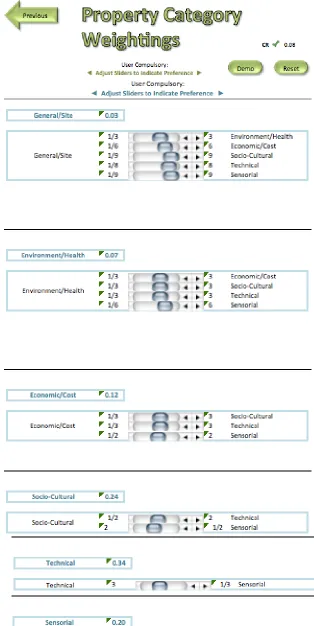
Using the verbal/ratio scale shown in Figure 8,
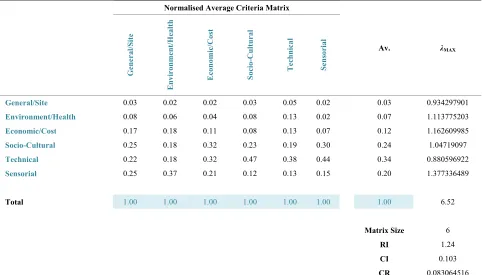
respon-dents obtained weightings for each parent factor, based on the preference of value(s) on a scale of 1 - 9. The MSDSS model then automatically translated each of the matrixes into the corresponding largest eigenvalue prob-lem and was solved to find the normalised and unique
priority weights for each factor (as shown in Figure 9).