Munich Personal RePEc Archive
Agro-Ecosystem Services – Governance
Needs and Efficiency
Bachev, Hrabrin
Institute of Agricultural Economics, Sofia
October 2010
Online at
https://mpra.ub.uni-muenchen.de/25978/
Agro-Ecosystem Services – Governance Needs and Efficiency
Hrabrin Bachev1
Institute of Agricultural Economics, Sofia
Abstract. This paper incorporates the interdisciplinary New Institutional and Transaction Costs Economics and suggests a holistic framework for analysis of management agro-ecosystem services. That new approach for analyses and assessment of management of agro-ecosystem services includes: definition of the agro-ecosystem services and the governance; specification of governance needs of agro-ecosystem services and the spectrum of available governing modes (formal and informal institutions, market, private, public and hybrid forms); assessment of efficiency of different modes of governance in terms of their potential to protect diverse eco-rights and investments, assure a socially desirable level of agro-ecosystem services, minimize overall costs, coordinate and stimulate eco-activities, meet individual and social preferences and reconcile conflicts of related agents etc.
Key words: ecosystem services, mechanisms of governance, environmental management, market, private, public and hybrid governance
Introduction
The governance and assessment of ecosystem services is among the most topical issues in academic, business, and policy debates in recent years [1,2,3,4,5,6]. It is recognized that the maintenance and improvement of ecosystem services requires an effective social order (governance) and coordinated actions at various levels (individual, organizational, community, regional, national, and transnational).
It is also known that the effective forms of governance are rarely universal and there is a huge variation among different ecosystems, regions, countries etc. The efficiency of environmental management depends on the specific governing structures which affect in dissimilar ways individual’s behavior, gives unlike benefits, commands different costs, and leads to diverse actual performances [2,3,7].
Agro-ecosystems comprise a considerable portion of the ecosystems and they are associated with diverse services [8]. Nevertheless, research on the management of this specific ecosystem services is still at the beginning stage [9,10,11,12].
Most studies focus on certain hotspots or type agro-ecosystems (e.g. pastoral, crop), and individual modes of management (formal, contract, business, public). What is more, significant costs associated with the eco-system services management (known as transaction costs) are not entirely taken into account. Furthermore, uni-disciplinary approach dominates, and efforts of ecologists, economists, lawyers, behavioral and political scientists are rarely united. Besides, there are little studies on specific natural, economic, institutional,
1
international etc. factors responsible for the variation among different ecosystems, regions and countries.
This paper incorporates the interdisciplinary New Institutional and Transaction Costs Economics [14,15,16,17] and suggests a holistic framework for analysis of management agro-ecosystem services.
That new approach for analyses and assessment of management of agro-ecosystem services includes: definition of the agro-ecosystem services and the governance; specification of governance needs of agro-ecosystem services and the spectrum of available governing modes (formal and informal institutions, market, private, public and hybrid forms); assessment of efficiency of different modes of governance in terms of their potential to protect diverse eco-rights and investments, assure a socially desirable level of agro-ecosystem services, minimize overall costs, coordinate and stimulate eco-activities, meet individual and social preferences and reconcile conflicts of related agents etc.
1. Agro-ecosystem services and the governance
Humans benefit from multiple resources, products and processes supplied by natural ecosystems known as ecosystem services [6]. They include:
- provisioning services - food; water; pharmaceuticals, biochemicals, and industrial products; energy; genetic resources etc.;
- regulating services - carbon sequestration and climate regulation; waste decomposition and detoxification; purification of water and air; crop pollination; pest and disease control; mitigation of floods and droughts, etc.;
- supporting services - soil formation; nutrient dispersal and cycling; seed dispersal; primary production, etc.;
- generation and maintenance of biodiversity;
- cultural services - cultural, intellectual and spiritual inspiration, recreational experiences, scientific discovery, etc.
The agro-ecosystem services comprise ecosystem services provided by the agro-ecosystems. The later are commonly defined as spatially and functionally coherent units of agricultural activity incorporating the living and nonliving components and their interactions (9, 18). That implicitly includes as a key component the agricultural activity such as crop production, raising animals, natural resource management (land modification, set aside measures) etc.
According to their specific characteristics and the goals (and levels) of the analysis, the
parcel, a meadow, a pond), located in numerous farms, or cover a larger region in a country or (sub)continent. Moreover, the individual agro-ecosystem could include, be a part, or overlap with other ecosystems - dryland, mountain, coastal, urban etc.
[image:4.595.88.533.289.629.2]The type and the amount of agro-ecosystem services depends on the natural evolution of ecosystems, the progression of farming practices and technologies, the development of social demand and preferences etc. (Figure 1). Moreover, the particular value (and priority) that individual communities and societies give on diverse agrarian resources, activities, outputs and services are quite specific at any moment of time, and depends on socio-economic development, endowment with natural resources, culture, progress in science, public education and awareness of potential benefits and hazards etc.
Figure 1: Mechanism of governance of ecosystem services
Therefore, in the beginning the analysis is to specify various ecosystem services associated with different agro-ecosystems. Modern science offers quite precise methods to classify diverse ecosystems and their services (including agro-ecosystems ones), and their spatial and temporal scales [6]. For instance, Figure 2 illustrates the spectrum of services of Agro-ecosystems in Zapadna Stara Planina – a mountainous region in North-West part of Bulgaria.
Se
E
E
C
C
O
O
S
S
Y
Y
S
S
T
T
E
E
M
M
S
S
I N D I V I D U A L S
Public governance
Private governance
Hybrids
Services of nature
Human actions Market governance
Institutions
Figure 2: Services of Agro-ecosystems in Zapadna Stara Planina in Bulgaria
Maintaining a sustainable supply of agro-ecosystem services requires an effective social order (governance) regulating behavior and relations of individuals related to ecosystem services [8]. The management of agro-ecosystem services does not mean “management of services of nature” but management of environment preservation and improvement activities of various agents. The later requires a system of coordination and stimulation of eco-activity which is to induce appropriate behavior of individuals2 and coordinated actions at local, national, and transnational levels.
According to (awareness, symmetry, strength, harmonization costs of) interests of agents associated with agro-ecosystem services (consumers, contributors, transmitters, interest groups etc.) there are different needs for management of actions.
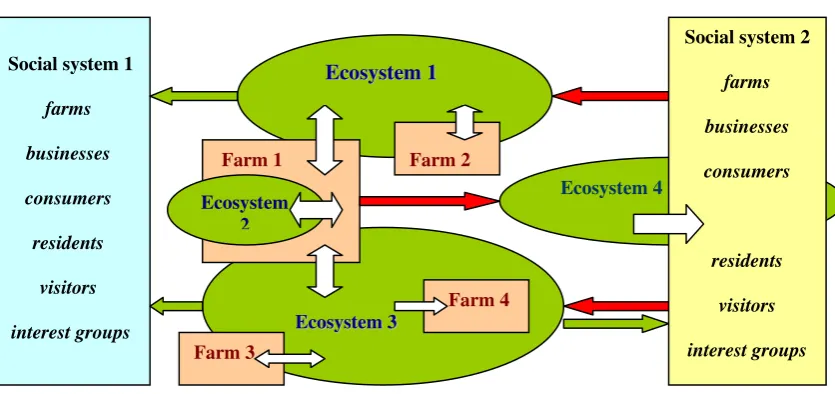
For instance, Farm 1 must govern its efforts and relations with Farm 2 since both receive services from Ecosystem 1 and affect (positively or negatively) the service supply of the ecosystem (Figure 3). Moreover, both farms are to govern their relations with consumers of services from Ecosystem 1 (Social System 1) to meet total demand and compensate costs for maintaining ecosystem services in that direction. In addition, Farms 1 and 2 must coordinate efforts with Social System 1 to mitigate conflicts with Social System 2. Furthermore, Farm 1 is to govern its relations with Farm 3 for effective service supply from Ecosystem 3, and manage its interaction with Ecosystem 2. Moreover, Farms 1 and 3 have to govern their relations with Farm 4 and Social Systems 1 and 2. Finally, Farm 1, affecting adversely
2
“pro-environmental” actions, “anti-environmental” inactions.
Ecosystem ZSP
Agro-ecosystems
Feed for private animals
Herbs for honey bees and medical products
Farm products and services
Favorite life style
Traditions
Soil quantity and quality
Landscape
Carbon sequestration
Wild fruits, mushrooms, herbs, birds, animals, fish
Clean mountain and mineral water
Purification of water and air
Biodiversity
Natural wonders
Recreation and treatment
Ecosystem 4 services, is to govern relations with agents in Social System 2 to reconcile conflicts and secure the effective flow of ecosystem services. Therefore, Farm 1 is to be involved in seven different systems of governance in order to assure the effective supply of services from ecosystems it belongs to or affects.
Figure 3: Governance needs for effective supply of agro-ecosystem services
Therefore, the second step of the analysis is to identify the specific management needs for each agro-ecosystem service. The later depend on particular characteristics of the ecosystem (services, scale, interactions with other eco-systems), and the number and interests of related agents.
Simultaneously trends, factors, problems and risks associated with services of agro-ecosystems are to be clarified. Modern science offers precise methods to evaluate trends and risks in the evolution of various ecosystems, and to identify driving ecological and social factors for their progression [6].
In any case persistence of serious eco-problems and risks is an indicator that an effective system of management is not put in place.
Individuals behavior (actions, restriction of actions) are affected and managed by a number of distinct modes and mechanisms of governance including (Figure 1):
– institutional environment (or “rules of the game”) – that is the distribution and evolution of formal and informal rights and obligations between individuals, groups, generations, and the system(s) of enforcement of these rights and rules [15, 16].
The spectrum of rights could embrace material assets, natural resources, intangibles, certain activities, labor safety, clean environment, food security, intra- and inter-generational justice
EEccoossyysstteemm 33
Farm 1
Ecosystem 2
Farm 2
Farm 3
Social system 1
farms
businesses
consumers
residents
visitors
interest groups
Farm 4 EEccoossyysstteemm 11
Ecosystem 4
Social system 2
farms
businesses
consumers
residents
visitors
etc. A part of the rights and rules are constituted by the formal laws, regulations, standards, court decisions etc. In addition, there are important informal rules and rights determined by tradition, culture, religion, ideology, ethical and moral norms. Enforcement of rights and rules is done by the state, community pressure, trust, reputation, private modes, and self-enforcement.
Institutions and institutional modernization create dissimilar incentives, restrictions and costs for maintaining and improving eco-system services, intensifying eco-exchange and cooperation, increasing eco-productivity, inducing private and collective eco-initiatives, developing new eco and related rights, decreasing eco-divergence between social groups and regions, responding to ecological and other challenges etc. For example, (socially, legally) acceptable norms for use of labor, plant, livestock, and environmental resources; employment of certain forms of contracts or organizations; trade with particular resources and products etc., all they could differ even between various regions of the same country3.
The institutional “development” is initiated by the public (state, community) authority, international actions (agreements, assistance, pressure), and the private and collective actions of individuals. The later is associated with the modernization and/or redistribution of the existing rights; and the evolution of new rights and the emergence of novel (private, public, hybrid) institutions for their enforcement.
In the modern society a great deal of individuals’ activities and relations are regulated and sanctioned by some (general, specific) formal and informal institutions. However, there is no perfect system of preset outside rules that can govern effectively the entire activities of individuals in all possible (and quite specific) circumstances of their life and relations associated with diverse ecosystems (services).
– market modes (“invisible hand of market”) – those are various decentralized initiatives governed by free market price movements and market competition – e.g. spotlight exchanges, classical contracts, production/trade of organic products, origins etc.
The importance of free market for the coordination (direction, correction) and stimulation of economic activities, exchanges and allocation of resources is among fundamentals of modern economics. Individual agents use (adapt to) markets profiting from the specialization and mutually beneficial exchange (trade) while their voluntary decentralized actions govern the overall distribution of efforts and resources between activities, sectors, regions, eco-systems, countries.
Nevertheless, there are many instances of lack of individual incentives, choices and/or unwanted exchanges - e.g. missing markets, monopoly and power relations, positive or negative externalities etc. Consequently, free market “fails” to govern effectively the entire activity, exchanges, and resources of individuals.
3In Valonia for instance, the environmental standards are much more restrictive than in other
– private modes (“private or collective order”) – those are diverse private initiatives and special contractual and organizational arrangements – e.g. voluntary actions, codes of behavior, eco-contracts, eco-cooperatives etc.
Individual agents take advantage of economic, market, institutional etc. opportunities and deal with institutional and market deficiency by selecting or designing mutually beneficial private modes (rules) for governing of their behavior, relations and exchanges. The private mode negotiates own rules or accepts existing private (collective) order, transfers existing rights or gives new rights to counterpart(s), and safeguards absolute (assigned by the dominating institutions) and/or contracted rights.
In modern society a great part of the agrarian activity is governed by private negotiations, “visible hand of the manager”, or collective decision-making. Nevertheless, there are many examples of “private sector deficiency and failures” in governing of socially desirable activity such as environmental preservation, eco-system services etc.
– public modes (“public order”) – these are various forms of public (community, government, international etc.) intervention in market and private sectors - e.g. public guidance, public regulation, public taxation, public assistance, public funding, public provision, property right modernization etc.
The role of public (local, national and transnational) governance has been increasing along with the intensification of activity and exchange, and the growing interdependence of social, economic and environmental activities.
In many cases, the effective management of individual behavior and/or organization of certain activity through a market mechanism and/or a private negotiation would take a long period of time, be very costly, could not reach a socially desirable scale, or be impossible at all. Thus a centralized public intervention could achieve the willing state of the system faster, cheaper or more efficiently4. Nonetheless, there are a great number of bad public involvements (inaction, wrong intervention, over-regulation) leading to significant problems of sustainable development around the globe [20].
– hybrid forms – some combination of other modes of governance.
“Governance matters” and depending on the (efficiency of) the system of governance “put in place”, the outcome of the development is quite different with diverse levels of socio-economic progression, environmental conservation and ecosystem services (Figure 1).
4 At current stage (“globalization”) many of the challenges facing economical and agrarian
2. Factors for governance choice
The choice of management mode depends on a number of key factors:
- personal characteristics of individual agents – preferences, believes, ideology, knowledge, capability, training, managerial experience, risk-aversion, bounded rationality, tendency for opportunism, reputation, trust, power etc. For instance, “sustainability movements” initially developed as a new ideology and later on formally institutionalized in programs, norms, legislation etc. Farming organization is often restricted to a family partnership. If farmer is a good manager he will be able to design and control a bigger organization managing effectively more internal (labor) and outside (market and contract) transactions. When counterparts are family members (or close friends) there is no need for complex organization since relations are easily “governed” by the good will and mutual interests of parties.
Furthermore, benefits for agrarian agents could range from monetary or non-monetary income; profit; indirect revenue; pleasure of self-employment or family enterprise; enjoyment in agricultural activities; desire for involvement in environment, biodiversity, or cultural heritage preservation; increased leisure and free time; to other non-economic benefits.
- formal and informal institutions - often the choice of governing mode is (pre)determined by the institutional restrictions as some forms for carrying farming, environmental etc. activities could be socially unacceptable or illegal5. For instance, corporate and cooperative organization of farming is forbidden in many countries; market trade of farmland, natural resources, and some outputs (inputs) is illegitimate, private management of natural ecosystems (parks, reserve zones) is not allowed etc.
What is more, the institutional environment considerably affects the level of governance costs and thus the choice of one or another form of organization. For instance, in conditions of well-working public system of regulations (quality standards, price guarantees) and laws and contract enforcement, a preference is given to spotlight and classical (standard) contracts. On the other hand, when rights on major agrarian and natural resources are not defined or not well defined, and absolute and contracted right effectively enforced, that lead to domination of primitive subsistence farming, informal, personal and over-integrated forms, unsustainable organizations, undeveloped and missing markets etc [21].
- natural and technological factors - eco-governance strongly depends on natural recourses endowment and the specific features of each eco-system (type, scale, services, interactions, risks etc.) as well as on development of technologies and agro-techniques. For instance, the governance of water resources would depend on the natural supply of water and
5
its correspondence (over-supply, shortage) to water demands. Furthermore, it will depend on development of water conservation, use and recycle technologies etc.
In some cases there is only one practically possible form for governance of a particular eco-activity. For example, in Japanese dispersed paddy agriculture water supply could not have been conducted by individual farmers (high interdependency, nonseparability of water use) and since earliest period water use organization developed as public projects [22].
Very often, an effective governance of environmental activities requires a certain scale and thus collective actions at local, regional, national or transnational scale [20].
Nevertheless, most eco-activity and exchange could be governed through a great variety of alterative forms [8]. For instance, a supply of environmental preservation service could be governed as: a voluntary activity of a farmer; though private contracts of the farmer with interested or affected agents; though an interlinked contract between the farmer and a supplier or a processor; though a cooperation (collective action) with other farmers and stakeholders; though a (free) market or assisted by a third-party (a certifying and controlling agent) trade with special (eco, protected origins, fair-trade) products; though a public contract specifying farmer’s obligations and compensation; though a public order (regulation, taxation, quota for use of recourses or emissions); within a hierarchical public agency or by a hybrid form.
Different governance modes are alternative but not equally efficient modes for the organization of a particular eco-activity. Each of governing modes has distinct advantages
and disadvantages to protect eco-rights and investment, and coordinate and stimulate socially desirable eco-behavior and activities, explore economies of scale and scope, save environmental maintenance (enhancement) and governance costs etc.
For instance, the free market has a big coordination and incentive advantages (“invisible hand of market”, “power of competition”), and provides “unlimited” opportunities to benefit from specialization and exchange. However, market governance could be associated with a high uncertainty, risk, and costs due to low appropriability of some rights (“public good” character), price instability, a great possibility for facing an opportunistic behavior, “missing market” situation etc.
The special contract form (“private ordering”) permits a better coordination and intensification of activity, and safeguard of agent’s rights and investments. However, it may require large costs for specification of contract provisions, adjustments with constant changes in conditions, enforcement and disputing of negotiated terms etc.
management (collective decision making, control on coalition members opportunism, supervision and motivation of hired labor etc.).
The separation of ownership from management (cooperative, corporation, public farm/firm) gives enormous opportunities for growth in productivity and management efficiency – internal division and specialization of labor; achieving ecosystem’s requirements; exploration of economies of scale and scope; introduction of innovation; diversification; risk sharing; investing in product promotion, brand names, relations with customers, counterparts and authorities. However, it could be connected with huge transaction costs for decreasing information asymmetry between management and shareholders, decision-making, controlling opportunism, adaptation etc. In addition, the cooperative and non-for profit form suffers from low capability for internal long-term investment due to non-for-profit goals and non-tradable character of shares (so called “horizon problem”).
Besides proper “production” (technological, agronomic, ecological etc.) costs for maintaining and improving eco-system services their management is usually associated with significant
governance (known as transaction) costs. The later could be defined as costs for protection, contracting and exchange of individual rights or costs for governing relations with other agents - individuals, private entities, public authorities. For example, agents related to ecosystem services have costs for identification and protection of various (eco, ownership etc.) rights; complying with diverse institutional restrictions (norms, standards, rules); finding best prices and partners; negotiating conditions of exchange; contract writing and registration; enforcing negotiated terms through monitoring, controlling, measuring and safeguarding; disputing through a court system or another way; adjusting or termination along with evolving conditions of exchange etc6.
If transaction costs were zero then the mode of management would have no economic importance [14, 17]. Individuals would govern their relationships with the same (equal) efficiency though free market (adapting to price movements), and private modes of different types (contracts, firms), and collective decision making (cooperative, association), and in a
nationwide hierarchy (a single private or state company). Then ecological requirements and technological opportunities for economies of scale and scope (the maximum ecosystem services and productivity of resources, “internalization of externalities”) would be easily achieved [14]. All information for the effective potential of activity and exchange (optimization of resources, meeting various social demands, respecting assigned and transferred rights) would be costlessly available to everybody, and individuals would costlessly define new rights, and protect their (absolute7 and contracted) rights, and trade owned resources (and products) in mutual benefit until exhausting the possibilities for increasing productivity and sustainable development.
However, when transaction costs are significant, then costless assignment, protection, negotiation and exchange of rights are not possible. Therefore, the initial allocation of the
6
Transaction costs have two behaviour origin – agents bounded rationality and tendency for opportunism [17].
7
property rights between individuals is critical for the overall efficiency and sustainability8. What is more, when important rights are not well-defined and/or enforced, then the high transaction costs could block the efficient use of resources and/or (mutually) beneficial exchanges. For instance, if “rights of sustainable environment” are not well defined, significant difficulties in effective ecosystem service supply are created - costly disputes between polluting and affected agents, disregards of interests of certain groups or generations etc. Consequently, the institutional structures for carrying out the agrarian and environmental activities become an important factor, which eventually determines the outcome of the system (the efficiency) and the type of development (sustainability) [7].
The type of the governance becomes crucial since various modes give unequal possibilities for participants to coordinate activities, and stimulate an acceptable behavior of others (counterparts and dependents), and protect their contracted and absolute rights from unwanted expropriation [17]. In the specific economic, market, institutional and natural environment, the rational agrarian agents will seek, choose, and/or develop such modes for governing their activities and relations with others, which will maximize their benefits and minimize their total (production and transacting) costs. Moreover, both (current) costs for using individual governance forms and the long-term costs for their development (initiation, maintenance, modernization, and liquidation) have to be taken into account [21].
Eventually, the distribution of overall (agrarian, environmental etc.) activities between different farms, organizations, and markets would be determined by the comparative costs for using various governing arrangements as the most efficient one(s) will tend to prevail [21]. However, a high efficiency and sustainability of the different governing forms (farms, business organizations, collective actions, and public forms) does not always mean a high efficiency and sustainability of the development. As North and Williamson have proved, the history of institutional development is full of examples of “failures” while the (business) organization modernization is usually a success story [16, 17]. Furthermore, the high sustainability of (inefficient) public forms is a result of the high transaction costs for their reformation (political decision-making and bargaining, strong vested interests of powerful groups) and/or the “inefficiency by design” making that transformation complicated [17].
Therefore, the third step of the analyses is to identify practically possible (existing and other feasible) alternatives for governance for the specific conditions of each eco-system and its services. The available (alternative) management modes are to be assessed in terms of
absolute and comparative potential (limits) of protect eco-rights and investments of agents, assure socially desirable level of agro-ecosystem services, minimize overall costs, coordinate and stimulate eco-activities, reconcile conflicts, recover long-term costs for organizational development etc. in the specificeconomic, institutional and natural environment.
8
3. Principle governance matrix
Comparative analysis is to include the overall (private and public) eco-system related
production (eco-maintenance, eco-enhancement etc.) and transaction costs associated with the individual management forms.
The assessment of the precise levels of transaction costs in eco-activity is often not possible or very expensive [8]. That is why the analysis is to focus on the combination of critical dimensions of eco-activity and transaction9 - the factors responsible to the variation of transacting costs between alternative governance modes. As Williamson puts it “align
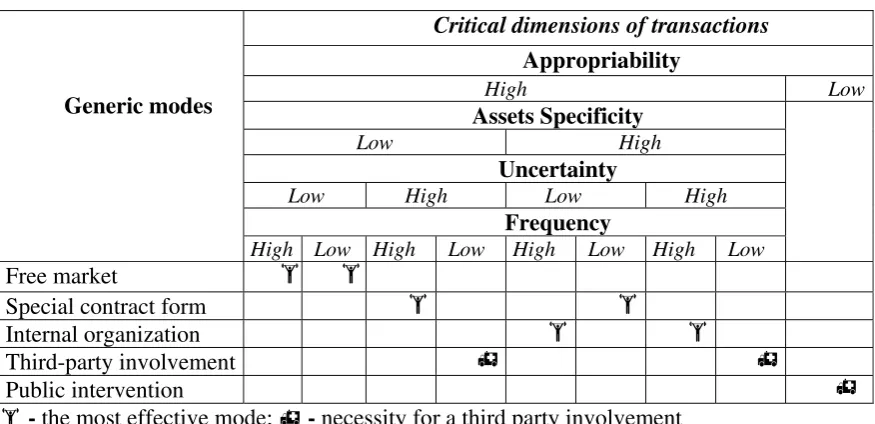
[image:13.595.88.526.343.555.2]transactions (which differ in their attributes) with governance structures (which differ in their costs and competence) in discriminating (mainly transaction cost economizing) way” [17]. Accordingly, depending on the specific characteristics of each activity and transaction, there will be different the most effective form of economic organization for that particular activity (Figure 4).
Figure 4: Principle modes for governing of ecosystem services
Critical dimensions of transactions
Appropriability
High Low
Assets Specificity
Low High
Uncertainty
Low High Low High
Frequency Generic modes
High Low High Low High Low High Low
Free market h h
Special contract form h h
Internal organization h h
Third-party involvement K K
Public intervention K
h- the most effective mode; K- necessity for a third party involvement
Eco-activity (transactions) with good appropriability of rights, high certainty, and universal character of investments could be effectively managed by free market through spotlight or
classical contracts. There are widespread market modes for selling pure “ecosystem services” (eco-visits, hunting, fishing, harvesting wild plants and animals) or “ecosystem services” interlinked with other products and services (e.g. organic, fair-trade, special origins, on-farm sale, self-pick, eco-education, eco-tourism, horse-riding, eco-restaurants etc.).
9
Transactions with low specificity and high appropriability could be effectively managed through a special contract. For example, eco-contracts and cooperative agreements between farmers and interested businesses10 or communities are widely used including a payment for ecosystem services, and leading to production methods (enhanced pasture management, reduce use of agrochemicals, wetland preservation) protecting water from pollution, mitigating floods and wild fires etc.
Transactions with high frequency, big uncertainty, great assets specificity, and high appropriability, have to be governed within internal organization. Very often the effective scale of specific investment in agro-ecosystem services (minimum required for eco-impact, exploring economies of scale and scope) exceeds borders of traditional agrarian organizations (family farm, small partnership). If specific capital (knowledge, technology, equipment, funding) cannot be effectively organized within a singe organization11, then effective external form(s) is to be used – joint ownership, interlinks, cooperative, lobbying for public intervention. For instance, environmental cooperatives are very successful in some EU countries [24]. Nevertheless, costs for initiation and maintaining collective organization for overcoming unilateral dependency are usually great (big number of coalition, different interests of members, opportunism of “free-riding” type) and it is unsustainable or does not evolve at all.
4. Needs and modes of public intervention
The next step of analysis is to identify situations of market and private sector deficiency
(failures) and the needs for public intervention in ecosystem services.
For instance serious problems arise when condition of assets specificity is combined with high uncertainty and low frequency, and when appropriability is low (Figure 4). In all these cases, a third part (private agent, NGO, public authority) involvement in transactions is necessary (through assistance, arbitration, regulation) in order to make them more efficient or possible at all. Emergence and unprecedented development of special origins, organic farming and system of fair-trade, are good examples in that respect. There is increasing consumer’s demand (price premium) for these products but their supply could not be met unless effective trilateralgovernance (including independent certification and control) is put in place.
Respecting others rights or granting out additional rights could be managed by “good will”
or charity actions. For instance, a great number of voluntary environmental initiatives (“codes of behavior”) have emerged driven by farmers’ preferences for eco-production, competition in industries, and responds to public pressure for a sound environmental management. However, environmental standards are usually “process-based”, and “environmental audit” is not conducted by independent party, which does not guarantee a
10
e.g. drinking water companies in Germany [24], mineral water company Vittel in France [5].
11
“performance outcome”. In any case, voluntary (charity) initiatives could hardly satisfy the entire social demand especially if they require considerable costs.
Management of most ecosystem services requires large organizations with diversified interests of agents (providers, consumers, destructors, interest groups). Emergence of special
large-members organizations for dealing with low appropriability is slow and expensive, and they are not sustainable in long run (“free riding” problem). Therefore, there is a strong need for a third-party public (Government, local authority, international assistance) intervention to make such eco-activity possible or more effective [8].
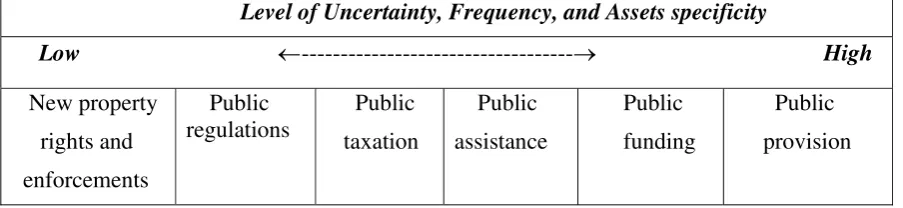
The next step of the analysis is to identify feasible (technically, economically, politically possible) modes of public intervention in agro-ecosystem services. Efficiency of different modes of public intervention is to be assessed in terms of correspondence to the needs of third-party involvement (Figure 4) and the comparative (coordinating, stimulating, costs-minimization) efficiency to other feasible modes of public intervention (assistance, public-private partnership, property rights modernization etc.) [8].
[image:15.595.87.539.417.521.2]The overall (public and private) implementation and transaction costs are to be taken into account. The later would depend on uncertainty, frequency, and necessity for specific investment of public involvement (Figure 5).
Figure 5: Principle modes for effective public intervention in ecosystem services
Level of Uncertainty, Frequency, and Assets specificity
Low ←---→ High
New property
rights and
enforcements
Public regulations
Public
taxation
Public
assistance
Public
funding
Public
provision
Generally, the interventions with a low uncertainty and assets specificity would require a
smaller public organization (more regulatory modes; improvement of the general laws and contract enforcement etc.).
When uncertainty and assets specificity of the transactions increases a special contract mode
would be necessary – e.g. employment of public contracts for provision of private services, public funding (subsidies) of private activities, temporary labor contract for carrying out special public programs, leasing out public assets for private management etc.
Initially, the existing and emerging problems (difficulties, costs, risks, failures) in the organization of market and private transactions have to be specified. The appropriate pubic involvement would be to create an environment for: decreasing the uncertainty surrounding market and private transactions, and increasing the intensity of exchange, and protecting
private rights and investments, and making private investments less dependent etc. For instance, the State establishes and enforces quality, safety and eco-standards for farm inputs and produces, certifies producers and users of natural resources, regulates employment relations, transfers water management rights to farms associations, sets up minimum farm-gate prices etc. All that facilitates and intensifies (market and private) transactions and increases efficiency of economic organizations.
Next, practically possible modes for increasing appropriability of transactions have to be considered.
The low appropriability is often caused by unspecified or badly specified private rights [21]. In some cases, the most effective government intervention would be to introduce and enforce
new private property rights – e.g. rights on natural, biological, and environmental resources; rights on issuing eco-bonds and shares; marketing and stock trading of ecosystem services protection; tradable quotas for polluting; private rights on intellectual agrarian property and origins etc. That would be efficient when the privatization of resources or the introduction (and enforcement) of new rights is not associated with significant costs (uncertainty, recurrence, and level of specific investment are low). That public intervention effectively transfers the organization of transactions into the market and private governance, liberalizes market competition and induces private incentives (and investments) in certain activities. For instance, tradable permits (quotas) are used to control the overall use of certain resources or level of a particular type of pollution. They give flexibility allowing farmers to trade permits and meet their own requirements according to their adjustment costs and specific conditions of production. That form is efficient when a particular target must be met, and the progressive reduction is dictated through permits while trading allows the compliance to be achieved at least costs (through a private governance). The later let also a market for environmental quality to develop12.
In other instances, it would be efficient to put in place regulations for trade and utilization of resources and products – e.g. standards for labor (safety, social security), product quality, environmental performance, animal welfare; norms for using natural resources, introduction of foreign species and GM crops, and (water, soil, air, comfort) contamination; a ban on application of certain chemicals or technologies; regulations for trading ecosystem service protection; foreign trade regimes; mandatory eco-training and licensing of farm operators etc.
The large body of environmental regulations in developed countries aim changing the farmers behavior and restricting the negative impact on environment. It makes producers responsible for the environmental effects (externalities) of their products or the management of products uses (e.g. waste). This mode is effective when a general improvement of the performance is desired but it is not possible to dictate what changes (in activities,
12
technologies) is appropriate for a wide range of operators and environmental conditions (high uncertainty and information asymmetry). When the level of hazard is high, the outcome is certain and the control is easy, and no flexibility exists (for timing or the nature of socially required result), then the bans or strict limits are the best solution. However, the regulations impose uniform standards for all regardless of the costs for compliance (adjustment) and give no incentives to over-perform beyond a certain level.
In other instances, using the incentives and restrictions of the tax system would be the most effective form for intervention. Different sorts of tax preferences (exception, breaks, credits) are widely used to create favorable conditions for the development of certain (sub)sectors and regions, forms of agrarian organization, segment of population, or specific types of activities. The environmental taxation on emissions or products (inputs or outputs of production) is also applied to reduce the use of harmful substances. The later impose the same conditions for all farmers using a particular input and give signals to take into account the “environmental costs” inflicted on the rest of society. Taxing is effective when there is a close link between the activity and the environmental impact, and when there is no immediate need to control the pollution or to meet the targets for reduction. However, an appropriate level of the charge is required to stimulate a desirable change in farmers behavior. Furthermore, some emissions vary according to the conditions of application and attempting to reflect this in tax may result in complexity and high administrating costs.
In some cases, a public assistance and support to private organizations is the best mode for intervention. Large agrarian and rural support and development programs have been widely used in all industrialized countries. They let a “proportional” development of agriculture and improvement of farmers welfare (“income parity”).
The public financial support for the environmental actions is the most commonly used instrument for the improving environment performance of farmers. It is easy to find a justification for the public payments as a compensation for the provision of an “environmental service” by farmers. However, the share of farms covered by various agri-environmental support schemes is not significant. That is a result of the voluntary (self-selection) character of this mode which does not attract farmers with the highest environment enhancement costs (most intensive and damaging environment producers). In some cases, the low-rate of farmers’ compliance with the environmental contracts is a serious problem. The later cannot be solved by augmented administrative control (enormous enforcement costs) or introducing bigger penalty (politically and juridical intolerable measure).
the current level of environmental capital but less successful in enhancing the environmental quality.
Often providing public information, recommendations, training and education to farmers, other agrarian and rural agents, and consumers are the most efficient form. In some cases, a
pure public organization (in-house production, public provision) will be the most effective as in the case of as in case of important agro-ecosystems and national parks; agrarian research, education and extension; agro-meteorological forecasts; border sanitary and veterinary control etc.
Usually, the specific modes are effective if they are applied alone with other modes of public intervention. The necessity of combined intervention (a governance mix) is caused by: the complementarities (joint effect) of the individual forms; the restricted potential of some less expensive forms to achieve a certain (but not the entire) level of the socially preferred outcome; the possibility to get an extra benefits (e.g. “cross-compliance” requirement for participation in public support programs); the particularity of the problems to be tackled; the specific critical dimensions of the governed activity; the uncertainty (little knowledge, experience) associated with the likely impact of the new forms; the practical capability of Government to organize (administrative potential to control, implement) and fund (direct budget resources and/or international assistance) different modes; and not least important the dominating (right, left) policy doctrine [20].
Besides, the level of an effective public intervention (governance) depends on the kind of the problem and the scale of intervention. There are public involvements which are to be executed at local (ecosystem, community, regional) level, while others require nationwide
governance. And finally, there are activities, which are to be initiated and coordinated at
international (regional, European, worldwide) level due to the strong necessity for trans-border actions (needs for a cooperation in natural resources and environment management, for exploration of economies of scale/scale, for prevention of ecosystem disturbances, for governing of spill-overs) or consistent (national, local) government failures. Very frequently the effective governance of many problems (risks) requires multilevel governance with a system of combined actions at various levels involving diverse range of actors and geographical scales.
The public (regulatory, inspecting, provision etc.) modes must have built special mechanisms
Principally, a pure public organization should be used as a last resort when all other modes do not work effectively [17]. The “in-house” public organization has higher (direct and indirect) costs for setting up, running, controlling, reorganization, and liquidation. What is more, unlike the market and private forms there is not an automatic mechanism (such as competition) for sorting out the less effective modes13. Here a public “decision making” is required which is associated with high costs and time, and it is often influenced by the strong private interests (the power of lobbying groups, policy makers and their associates, employed bureaucrats) rather than the efficiency. What is more, widespread “inefficiency by design” of public modes is practiced to secure (rent-taking) positions of certain interest groups, stakeholders, bureaucrats etc. [17]. Along with the development of general institutional
environment (“The Rule of Law”, transparency) and the measurement, communication etc.
technologies, the efficiency of pro-market modes (regulation, information, recommendation) and contract forms would get bigger advantages over the internal less flexible public arrangements.
Usually hybrid modes (public-private partnership) are much more efficient than the pure public forms given the coordination, incentives, and control advantages. In majority of cases, the involvement of farmers, farmers organizations and other beneficiaries increases efficiency - decreases asymmetry of information, restricts opportunisms, increases incentives for private costs-sharing, reduces management costs etc. [21]. For instance, a hybrid mode would be appropriate for carrying out the supply of preservation and improvement of environment, biodiversity, landscape, historical and cultural heritages. That is determined by the farmers information superiority, the strong interlinks of that activity with the traditional food production (economy of scope), the high assets specificity to the farm (farmers competence, high cite-specificity of investments to the farm and land), and the spatial interdependency (needs for cooperation of farmers at a regional or wider scale), and not less important – the farm’s origin of negative externalities. Furthermore, the enforcement of most labor, animal welfare, biodiversity etc. standards is often very difficult or impossible at all. In all these cases, stimulating and supporting (assisting, training, funding) the private voluntary actions are much more effective then the mandatory public modes in terms of incentive, coordination, enforcement, and disputing costs.
Anyway, if there is a strong need for a third-party public involvement but an effective (government, local authority, international assistance etc.) intervention is not introduced in a due time, the agrarian “development” would be substantially deformed [21]. Thus the public
(Government) failure is also possible and often prevails. In Bulgaria, there have been a great number of bad examples for public under- and over-interventions in agrarian sector during post-communist transition now [20]. Consequently, a primitive and uncompetitive small-scale farming; predominance of over-integrated and personalized exchanges; ineffective and corrupted agrarian bureaucracy; blocking out all class of agrarian transactions (innovation and extension supply, long-term credit supply, supply of infrastructure and environmental goods); and development of a large informal (gray) sector, all they have come out as a result.
13
Suggested analysis let us define efficiency and potential of divers mechanisms and modes of management (institutions, market, private, public) to deal with diverse problems and risks for sustainable flow of agro-ecosystem services. Moreover, it let us improve the design of the new forms of public intervention according to the specific market, institutional and natural
environment of a particular eco-system region, sub-sector, country,14 and in terms of
perfection of the coordination, adaptation, information, stimulation, restriction of opportunism, controlling (in short – minimization of transaction costs) ofparticipating actors
(decision-makers, implementers, beneficiaries, other stakeholders).
What is more, that analysis unable us to predict likely cases of new public (local, national, international ec.) failures due to impossibility to mobilize sufficient political support and necessary resources and/or ineffective implementation of otherwise “good” policies in the specific economic and institutional environment of a particular country, region, sub-sector etc. Since the public failure is a feasible option its timely detection permits foreseeing the persistence or rising of certain problems in agrarian development, and informing (local, international) community about associated risks.
Conclusion
We have demonstrated that the suggested new framework let us better understand, assess and improve the governance of agro-ecosystem services in the specific market, institutional and natural environment of individual ecosystems, regions, countries etc.
Application of that new approach would have a significant academic as well as practical importance. First, it would provide a new framework for analyzing and assessing divers agro-ecosystem services. Next, it would give new tools for assisting the design of individuals, business, and collective actions and organizations, and for improving public policies and forms of public intervention in agro-ecosystem services. Finally, it would give new devices for making more realistic prediction about likely prospects of ago-ecosystem services development in the specific conditions of different eco-systems, regions, and countries.
14
References
[1] Boyd J. and Banzhaf S. What Are Ecosystem Services? The Need for Standardized Environmental Accounting Units, Resources for the future. Elsevier B.V. 2007.
[2] Daily G. (2000). Management objectives for the protection of ecosystem services.
Environmental Science and Policy 3, 2000: 333-339.
[3] Duraiappah A. Markets for Ecosystem Services, A Potential Tool for Multilateral Environmental Agreements. International Institute for Sustainable Development: Winnipeg, 2007.
[4] Farber S., Costanza R., and Wilson M. Economic and ecological concepts for valuing ecosystem services. Ecological Economics 41, 2002: 375-392.
[5] Hanson C., Ranganathan J. and Iceland C.; Finisdore, J. The Corporate Ecosystem Services Review. Guidelines for Identifying Business Risks and Opportunities Arising from Ecosystem Change, World Resources Institute, 2008.
[6] MEA. Millennium Ecosystem Assessment. Ecosystems and Human Well-Being: Synthesis.
Island Press: Washington, 2005.
[7] Bachev H. Governing of Agrarian Sustainability. ICFAI Journal of Environmental Law, Vol.VI, No 2, 2007: 7-25.
[8] Bachev H. Governing of Agro-ecosystem Services. Modes, Efficiency, Perspectives. VDM Verlag: Saarbrucken, 2009.
[9] AEHP. Agro-ecosystem Health Project. Agroecosystem health. University of Guelph: Guelph, 1996.
[10] Antle J. Modeling Agro-ecosystem Services for Policy Analysis, paper for the Workshop on “California Agro-ecosystem Services: Assessment, Valuation and Policy Perspectives”, University of California at Davis, September, 2007.
[11] Jolejole M., Swinton S. and Lupi, F. Incentives to Supply Enhanced Ecosystem Services from Cropland, paper presented at Agricultural and Applied Economics Association Annual Meeting, Milwaukee, Wisconsin, July 26-28, 2009.
[12] WISP. Forgotten Services, Diminished Goods: understanding the agro-ecosystem of pastoralism, World Initiative for Sustainable Pastoralism, Policy note No. 8, 2008.
[13] Gatzweiler F., Hagedorn K. and Sikor T. People, Institutions and Agroecosystems in Transition, paper resented at "The Commons in an Age of Globalization", 9th Conference of International Association for Study of Common Property, Victoria Falls, June 17-21, 2002. [14] Coase R. The Problem of Social Costs. Journal of Law and Economics 3, 1960: 1-44. [15] Furuboth E. and Richter R. Institutions and Economic Theory. Contribution of New Institutional Economics. University of Michigan Press: Ann Arbor, 1998.
[16] North D. Institutions, Institutional Change and Economic Performance. Cambridge University Press: Cambridge, 1990.
[17] Williamson O. Mechanisms of Governance; Oxford University Press: New York, 1996. [18] Shiferaw B., Freeman H. and Swinton S. Natural Resource Management in Agriculture: Methods for Assessing Economic and Environmental Impacts. CABI Publishing: Wallingford, 2005.
[20] Bachev H. Governance of Agrarian Sustainability. Nova Science Publisher: New York, 2010.
[21] Bachev H. Efficiency of Agrarian Organizations. Farm Management and Rural Planning No 5, 2004: 135-150.
[22] Mori T. The History of Japanese Agriculture, in Agricultural Policy in Japan, XXI IAAE Conference, Tokyo, 1991.
[23] Bachev H. and Labonne, M. About Organization of Agrarian Innovations. INRA: Montpellier, 2000.