1 | EUR 2627.e
SWS
EUROPEAN ATOMIC ENERGY COMMUNITY -
EURATOM
NEUTRON TRANSPORT IN A SPHERICAL REACTOR,
A STUDY
IN THE APPLICATION OF THE j
NAPPROXIMATION
OF THE MULTIPLE COLLISION METHOD
by
T. ASAOKA
1966
•"■•¿•.V T 'fi ¿ H i .
'
■ν*η»>(' | · . ~ ,
Joint Nuclear Research Center
Ispra Establishment - Italy
This document was prepared under the sponsorship ot ttxe Com mission of the European Atomic Energy Community (EURATOM). Neither the EURATOM Commission, its contractors nor any person
acting on their behalf: Û : - '
·-*«>* Make any warranty or representation, express or implied, with respect to the accuracy, completeness, or usefulness of the infor mation contained in this document, or that the use of any infor mation, apparatus, method, or process disclosed in this document may not infringe privately owned rights; or
■ ib
Assume any liability with respect to the use of, or for damages resulting from the use of any information, apparatus, method or process disclosed in this document.
1-,>i»V
This report is on sale at the addresses listed on cover page 4
at the price of F F 5. FB 50 DM 4, Lit. 620
W h e n ordering, please quote the EUR number and the title, .., which are indicated on the cover of each report.
ifiPiiP
ii^lleSiliiilillf
Jrrmted by bmeets sprl
i]3 Brussels, January 1966 >-y
i
[ti
i
iii
EUR 2627.e
NEUTRON TRANSPORT IN A SPHERICAL REACTOR, A STUDY IN THE APPLICATION OF THE j N APPROXIMATION OF THE MULTIPLE COL-LISION METHOD by T. ASA OKA
European Atomic Energy Community - EURATOM Joint Nuclear Research Center - Ispra Establishment (Italy) Reactor Physics Department - Reactor Theory and Analysis Service Brussels, January 1966 - 32 Pages - FB 50
The jN, approximation to the solution of neutron transport problems has emerged in the course of developing the multiple collision method, which is based on the random walk approach. By means of this new method, transport problems for a multiregion spherical reactor, where the total neutron cross-sections are independent of the spatial region (position), are treated in the
EUR 2627.e
NEUTRON TRANSPORT IN A SPHERICAL REACTOR, A STUDY IN THE APPLICATION OF THE j * APPROXIMATION OF THE MULTIPLE COLLISION METHOD by T. ASAOKA
European Atomic Energy Community - EURATOM Joint Nuclear Research Center - Ispra Establishment (Italy) Reactor Physics Department - Reactor Theory and Analysis Service Brussels, January 1966 - 32 Pages - FB 50
context of a multigroup model under the assumption that the scattering of neutrons is spherically symmetric in the L system.
The critical radii for bare spheres, calculated by using the jN approximation
in combination with a one-group model, are compared with those obtained from the SN method and the exact values. In addition, by fixing the radius,
the values of kerr and the asymptotic time-constant (or the so-called Rossi-**)
are calculated and the flux distributions corresponding to these two calcula tions are compared with each other. For a subcriticai system, the flux obtained from the time-constant calculation decreases more slowly as the radial co ordinate increases than that obtained from the k(.ff calculation. In order to
give a numerical illustration of the multigroup model, calculations are per formed on two fast neutron critical assemblies, Codiva and Jezebel, and the results are compared with those of the S4 approximation and experiment.
It can be seen from these results that the js approximation gives a com
parably accurate result to the S. calculation for all bare systems of interest.
context of a multigroup model under the assumption that the scattering of neutrons is spherically symmetric in the L system.
The critical radii for bare spheres, calculated by using the ju approximation in combination with a one-group model, are compared with those obtained from the SN method and the exact values. In addition, by fixing the radius,
the values of kcrr and the asymptotic time-constant (or the so-called Rossi-α)
are calculated and the flux distributions corresponding to these two calcula tions are compared with each other. For a subcriticai system, the flux obtained from the time-constant calculation decreases more slowly as the radial co ordinate increases than that obtained from the ker< calculation. In order to
EUR 2627e
EUROPEAN ATOMIC ENERGY COMMUNITY - EURATOM
NEUTRON TRANSPORT IN A SPHERICAL REACTOR,
A STUDY
IN THE APPLICATION OF THE j
NAPPROXIMATION
OF THE MULTIPLE COLLISION METHOD
by
T. ASAOKA
1966
Joint Nuclear Research Center
Ispra Establishment - Italy
TABLE O F CONTENTS
1. Introduction <> 3
2 . General Formulations ^
3β Numerical Results for a Bare Sphere and
Discussion · 10
3.1 Numerical results in a one-group model „. 11
3·2 Numerical examples in a multigroup model 17
k.
Conclusion 18
References 19
Appendix · * · 21
Summary
The jN approximation to the solution of neutron transport problems has
emerged in the course of developing the multiple collision method, which is based on the random walk approach. By means of this new method, transport problems for a multiregion spherical reactor, where the total neutron cross-sections are independent of the spatial region (position), are treated in the context of a multigroup model under the assumption that the scattering of neutrons is spherically symmetric in the L system.
The critical radii for bare spheres, calculated by using the js- approximation
in combination with a one-group model, are compared with those obtained from the SN method and the exact values. In addition, by fixing the radius,
the values of ke f f and the asymptotic time-constant (or the so-called Rossi-α)
are calculated and the flux distributions corresponding to these two calcula tions are compared with each other. For a subcriticai system, the flux obtained from the time-constant calculation decreases more slowly as the radial co ordinate increases than that obtained from the ke f t calculation. In order to
give a numerical illustration of the multigroup model, calculations are per formed on two fast neutron critical assemblies, Godiva and Jezebel, and the results are compared with those of the S4 approximation and experiment.
It can be seen from these results that the j: l approximation gives a com
1. Introduction
By means of the multiple collision method developed by the author, neu-tron transport problems for a homogeneous slab have been solved with reasonable accuracy, the solution applying equally to large and small systems (Asaoka et al., 1964). This method is an analytical approach based on a viewpoint different from that of Boltzmann equation, namely, the life-cycle in contrast to the neutron-balance viewpoint.
As was shown in the previous paper, the essential point of the method lies not only in the adoption of a viewpoint different from the usual transport equation, but also in the introduction of discontinuity fac-tors with which one can easily take into account the finiteness of the system and fix the point of measurement. As a result, problems for a finite system can be dealt with in a similar manner to those for an in-finite system. In addition, it has been shown that the application of the method is greatly simplified by the appropriate employment of ex-pansions in spherical Bessel functions. When this expansion is trunca-ted beyond the N-th order spherical Bessel function, j„, the resulting
N approximation has been called "the j approximation".
N
It was shown in the previous paper that these mathematical techniques arising from the life-cycle approach can be used to solve problems based on the neutron-balance viewpoint more easily.
The present work is concerned with a further development of the mul-tiple collision method. By applying the above-mentioned mathematical techniques directly to an equation governing the balance of neutrons, a theory valid for spherical systems is obtained. A part of this work, connected with the critical condition and flux distribution for a bare sphere (in the constant cross-section approximation), has already
been presented in a EURATOM report (Asaoka et al», 1963).
- *f
2. General Formulations
We consider here, within the context of a multigroup {G energygroups) model, a multiregion (M regions) spherical reactor in which the neu tron scattering is spherically symmetric in the L system.
Let Y be the radial coordinate, Li the cosine of the angle between the neutron velocity and direction of y , Σ,α and V*. the macroscopic total crosssection and speed of the neutrons in the ?th energy group respectively and ^^J"^3) t n e mean number of secondary neu trons produced in the Ηth group as a result of a collision in the
? th group.
The number of neutrons which, due to collisions in the J? th group, are born in the 'i th group with directions in the range CM, jA.JT(hi.) , positions in the spherical shell of volume 4:fC\,2~<X\f around f and at times in the interval (XX around "t—t is given by
Assuming that ¿7« and Va are constant and independent of the spatial region, the probability that these neutrons travel for a time l with out further collision is Jb$P\¿~2jTA"t" ) aXi^i the radial coordinate after
this time is expressed by the relation:
Hence, the number of neutrons in the 5· th group in the spherical shell ■ή-TCY2-AY around Y at time X can be written as
Tij ( r, t n*r^r=έ [ Ar'w* j
OÄ^-SJ^
(-XjiyO
where Kif and Js; are the inner radius and outer radius of the L th region, respectively, Q ( 1 ^ j ) stands for C ( 1 ^ 1 ) for this i th
region and
5»=J
ì'\iVA'f+ZX'vA'u
Replacing M by ^a , rewriting % (^o^-X^) in the form of the Fourier representation :
and performing the integration over jo from ΙΥ-Ί^Τ | to Y+TAt , we get :
M , f ^
ή ^ . . ,
^^
(
^(5*
/+
)*0Jf¿r¿j
A
Lzp
-Ej
"R,-i
'o
* ^ 2
Wqyfyffij / W z <}
ψ] )Xff'n
r
k r, -t-t'i
(2)
where the definition of ï » ^/ ^ / has been extended to Y< 0 by put ting 71%(Y, t) = 7l« (V" ~t ") "Efluation (2) can be written in the form:
to
'fa
Λ'
'0
y|(j^+j^)^
T
áW^yV
T;tt/)
·
-*i ψ
(3)2jV,t
Next, by taking the Laplace transform of ΊΛΤΪΑ ( Y,t)^ ' > we get;
rl
?
(Y
/
i) =
YJ
í
ttx^u7
í1
(u)^
,v,t
oO
_
'ik:
_ 6
-where
rfr-i ,R,
Μ
{ή~
χri \
ùtfr'
'
*j
'Ψ
-EM
Í
' iC5)
It follows from equations (4) and (5) that the function ' ( J ^ / ^ J satisfies the following integral equation:
where i (Χ) is the ΤΖ,th order spherical Bessel function.
If Γ ($~*(f/^/4 / is now expanded in spherical Bessel functions:
¡=I,2,-,H-1
orM,
'TI'LÍY, ι ) can be transformed into the following form derived from equa tion (4):
Y o j T u a t ) / ^
im ( 8 )
7
The asymptotic behaviour of 7Zj(r,t) as f>£>0 can thus be written:
<9)
where
and Λ Ζ , ^ Λ , is a pole of the quantity Bn(^,A)=^4m^h^)
which has the largest real part and B¿(fl,J,) i s the residue at Λ=Ζ,ν)Λ, . As is easily seen from equation (9), only the terms with odd values of fit
remain on the right hand.side because Yflj(r,t) is an odd function of \ . The explicit expression for the integral (on the right side of equation
(9) ) with odd values of TfL is shown in the Appendix.
According to equation (7), a relation between the coefficients 4^γΧ,-Α) with different values of i can be obtained in the form:
-4Vru>
(™
+1
>f&Vr*
*
) if*
C7t
-
w)
,
(10)where rOO
Ia<*.m)=-^L*«t*W>
-coHVJ
0J2: (%, Tizm atua 7M+7l= evert;
= -<
(V5)^%; jfecaw^+OlW-n/jtlV^J,
* O, o t h e r w i s e ,
■Í)W
8
-in which (XA and 0(¡ s t a n d f o r 2*\Kfc and 2|EV r e s p e c t i v e l y ( t h e f u n c t i o n Ιί&(7Μ/71) i s independent of 2Γ/ and when "Q=P(fe > t h a t
i s , i-% > t h e expression reduces t o SCmrYLV^ffL+l ) ) . Now, by applying Gegenbauer*s a d d i t i o n theorem:
j.(H)-^i)J
r(pJ
r0O
to the kernel on the right side of equation (6) and using the ortho gonality relation for spherical Bessel functions, the following in finite set of linear equations satisfied by the B^Cf/X/líí;) c a n be derived
WïT^1>
zW.>Z
oZ
E¿j
(γ->ρΦΐ,ΖΜΐ
Cll)where
. - / . ' ^ x f r M
^^)=^^>%^^Γ
Μ
Χ9
+
υ^^ν«ί)ί;ψρ
' t f
W^P^·^^
(12)
in which
*vp-%«nyW»^i,
(13)
»^^fi^^.
9
-τ/
The explicit expressions for the -'Jjif'fr) with Ρ and %■£: 7 have been given in the appendix of a previous paper (Asaoka et al., 1964).
Since j/:typ= L j Q , f ) > it follows from equation (12) that Ewy'i^l)
The condition that Β^(?, Zity-O should diverge beyond all bounds is
thus
α
βί | ( ^ + ΐ ) Ε ^ ( ^ ) - ^ ^
Λ| = ο ^
lf=iJr,G iox7n,n=i
/3,5/--
?(is)
which gives a relation between the physical properties of a reactor (as contained for example in the parameter C ) , geometrical dimension
|\ and asymptotic time-constant J,~i (see equation (9) ) .
For a critical reactor, ^( must be equal to unity and equation (15) with -Λ(=ί therefore gives the critical condition, that is a relation bet ween the physical properties and geometrical dimension of a critical re actor. In order to obtain the value of the effective multiplication fac tor -fidi for a given reactor, C^CÎ^fO i s divided into two parts; the
scattering part ^&(ΐ^59=.^.£(?^?9/ΖΓ} aiíd the fission part cfßC|»?9
= 'Áv (VS)« /2»5 ' Using this separation the value of τ?Μ is obtained
by solving equation (15) with J,=ƒ and
The ratios between the Drøij/^T/Vj-i,)'S can now be determined by the use of equations (11) and (15) for any of the above-mentioned problems, that is, the evaluation of the time-constant, critical condition or the value
of -jPftW . Having thus obtained the B ^ ?s, the flux distribution or
-
10-3. Numerical Results for a Bare Sphere and Discussion
For a bare sphere (M = 1), equations (9), (11) and (15) reduce to
^
tM^/
í^%^A^tíi¿^L^^
C9f)Cu·)
det | (m+Oc'(f+pj
?
V70-S
n
who,
M'=\.2r;Q
for
n,n=K3A'~.
<
15
*>
In a one-group model (G = 1), these equations reduce even further to the following results respectively:
Mm(T.t)-/
,
'
Wr
'
>t
Í,EUM.>¿Hftíii
<a
*i(zi4)
j^B
m
ízvA^Z/j'm,n)B
%
(zvA\
O")
d i " )
det|(2W+!)C'J/(»l/7l)-^|=:0/ 111,71 = 1,3,5,-, C15")
which for a critical system ( J,~J ) have already been derived in a
11
3.1. Numerical results in a onegroup model
The numerical values of C for critical bare spheres with various values of 2lR between 0.005 and 50 are given in Table 1. Even the results of the j approximation (containing just two terms on the right hand side of equation (9"))have shown that the difference between Carlson's result and ours is indistinguishable on a figure (Asaoka et al., 1963). By using a quadratic trial function in the singleiteration moments method, Carlson calculated the critical radius for various values of C between
1.1 and 3.0 (Carlson, 1949). In Table 1 are also shown the values of the socalled extrapolation distance ci > the distance between the boundary and the point at which the asymptotic neutron flux expressed in the form MflijCY/iR+dyJi/Y would extrapolate to zero. These are calculated from the following equation (see Asaoka, 1961):
x ¿
7wr
Z R
·
<16)
In the j approximation, the asymptotic expressions for these quantities
•5 a r e
iff05+^7)íX-^(i+j§^57)(X%
tf«í,
, _ι_, m?
( f f U
J 1^ / y i * — ã \ '
TffS-75'
~C~) . 7 . IT?? (17)
zi
r\y(18)
where (X = Z R . For large (X , the corresponding expressions in the i^ approximation are as follows:
- 12
r y i Τ T T Õ T T T Í —
«■
íém
¿ [image:16.595.104.519.658.734.2]jç
I1I-H45
(19)Table 2 shows the numerical values of the flux distribution in critical spheres with 2JR = 0.005, 0.5 and 10. For large 21R , the results ob tained from elementary diffusion theory by using Hd. = 0.71 show good agreement with ours except in the region within about a mean free path from the boundary. The asymptotic expressions for the flux distribution in the j approximation are given by
^gW
(20)
where ^ = 2 Y and g is the EulerMascheroni constant. For large 0{ , the asymptotic expressions in the j approximation can be written in the forms :
jy?v5)10
3¿o10-mii5
3l5J5^O
r,. , .
Λ-
13-Furthermore, the extrapolated end-point, that is, the distance beyond the boundary of the medium at which the asymptotic flux (due to the pole 2 = O in equation (9") ) vanishes (see Appendix), takes the value (3+,/5)/7 = 0.7480 in the j approximation for infinite (X , this being measured in units of the total mean free path.
As can be seen from the above-mentioned results, the infinite series on the right hand side of equation (9") converges faster for smaller 2iR and hence the results obtained from the j approximation can be regarded as accurate for the smaller values of 2lR . On the other hand, for large 2lR , the infinite series does not converge very quickly but the j_ approximation will give a sufficiently accurate result for orac-5 tical purposes.
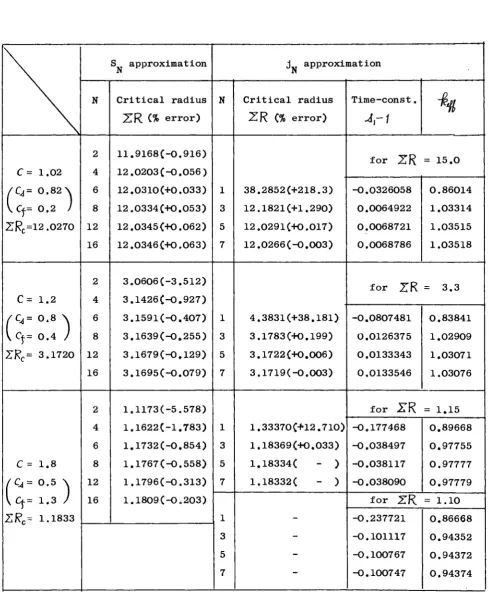
Additional test calculations with a one-group model were performed on several bare spheres and the results were compared with the exact ones and with those of the S calculations. In Table 3 are shown the results
N
for bare spheres with C equal to 1.02, 1.2 or 1.8. The exact critical radius 2TPC is given in the first column of the table and the critical radius obtained from the S approximation with various values of N is shown in the second column. The deviation from the exact result is shown in parenthesis. All these values are obtained from a paper by C.E. Lee (1962). In the third column are shown the critical radii obtained from the j approximation with several values of N, the deviation from the N
exact result being given in parenthesis. It will be noted from these re sults that the j approximation gives a reasonably accurate result while
ύ
the j approximation is exact for all systems of interest. In the fourth 5
and fifth columns of Table 3 are shown respectively the values of the time-constant Af~\ «(see equation (9M > ) and rial for a fixed value oí the radius. These were calculated by means of the j approximation. The asymptotic expressions for the critical radius (XC = 21P are, in the j approximation,
(Χ,
I^Sr i i ^ j W f , ■ /,_J753J57 Ν
lo5j5¿ 1
35C
V
TV
20Ϊ7Ι5
'/53125c J,
c>>í
J7
^ ~ r , _ 3 5 7 i T r — τ ι
, , _ ,
(22)
14
-and in the j
approximation,
^J
Ì0
~?Ì
S
U
JW
^
5Ì
^
ITT]
i-*-«i
<
23
>
c
V
i-i/c I
J^JO:^
ch
' C
< < ; 1.
In addition, the asymptotic expressions in the j approximation for the timeconstant and ~£Μ of a sphere with a radius (X=£>(c(| + £ ) with |£|
<^C 1 are
f
limili
(
l +
jfe
5
7 )
C£ =
'· ^ 3 3 ¿ c £ , c>>í,
- V M
r
,
(24)
[2Cc-oe[l~2£(i-^>^(c-J)(i-é£)+-fCc-/f]
C - 1 « / ,
where ( c O C / C f can be rewritten in terms of ^^=VZf/2IÄ in the
form:
For small C~\ , the asymptotic expression for "T^Æ in the j approxima
tion is:
15
while the expression for -ά,~1 in the j_ approximation is the same
5
as the second of equations (24).
From equations (24) and (25), the mean lifetime^ of neutrons can be obtained in the following form by using the relation Ρ=(-^Μ-Ι Vfo£V(A~OÌ *
l |o5t5ér, I753J57
Χ'
i=
o.
frémis
VX*J_\05Kb( 1753/57 Nf + FÇ L 10515É, |753ΜΜ+εΐ ZVCf ]53j25U ^o?7/5 A ' ^ ^ - l ^ ^ i ' - ^ Ä " ) c J
^ί{ηε^-ο.ί45ο2η?ψ]
;c » í ,
( 2 7 )
t«i,
and t h e expression for small \~ j/c in the j approximation i s given by
·*- ZVCf/CL ^ IWlO-315'' c V } ΙΊ24ΫΠJ7-2ff0 l ' cJV1 4 - ;
I
+
*
ε
%0-ϊ)]
^
c^ ) 0 - k > - a r ø ° 7 7 7 0 - ^
(28)
The expressions for |- l/fc« Í show that, as expected, ji^ \/{^Z^)
16
Tables 4 and 5 show the flux distributions in spheres calculated by means of the j and j approximations respectively. In each case, C takes on the values 1.02 and 1.8 and the flux is evaluated three times on the basis of criticality, timeconstant and -jzdl calcula tions. An interesting feature to be seen from these tables is that
calculation
the flux obtained from the timeconstantAWith a negative value of _¿ -\ (subcriticai system) decreases more slowly as the radial coordinate increases than that obtained from the ~iiili calculation. This tendency can be demonstrated analytically for large 0i=2R by using equation (20) or (21).
The flux distribution in the timeconstant calculation is given by equation (20) or (21) by replacing (X and ^ by DC=ÍX [|+(Λ,θ] a n d
^/=50+(A~1)l » respectively, while that in the -$¿n calculation is given by the unmodified equation. Hence, in the timeconstant cal culation the ratio of the flux value at the outer boundary of the sphere with a large radius « to that at the centre is given by
c a
fu—j
ι
η((χ)
Î0K(I+<AI))l' Ítf(l+(AD)i,
71(0) I
fl3K(l+(4
rl))l
Μ 7 2 « Ο + 0 Γ » )h
in the j approximation,
(29)
in the j_ approximation.
5
1?
-3.2. Numerical examples in a multigroup model
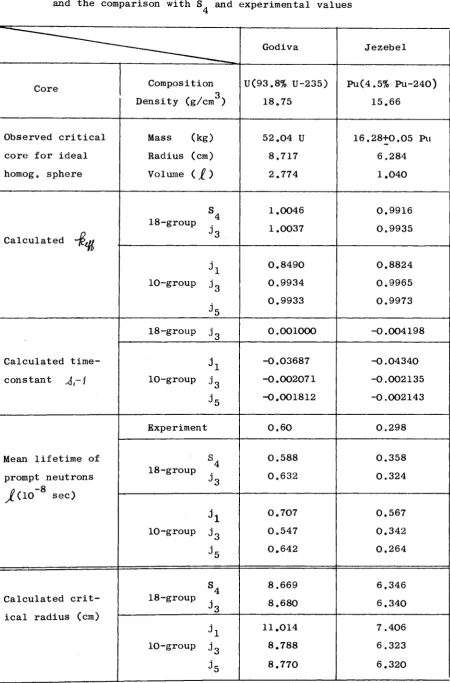
As numerical examples of a multigroup model, calculation*, were performed on two fast neutron critical assemblies, Godiva and Jezebel. The numeri-cal results are summarised in Table 6. For all these numeri-calculations, the 18-group (10 MeV-thermal) set of cross-sections of LASL (Mills, 1959) is adopted in the transport approximation. A 10-group model has been con-structed by extracting just the higher 10 energy-groups out of the 18 groups. Since the contribution of slow neutrons to the reactor behaviour can be neglected, it is better to reduce the number of energy-groups G by cutting out the lower energies so that the rounding error in the evaluation of a determinant of order (r(N+1)/2 can be reduced (see equation (15*) ), N being the order of j approximation.
Since the radii of these assemblies are equivalent to 2-3 fast neutron
mean free paths, the S approximation will overestimate Sdf slightly
while the j approximation should give an accurate value with a very slight underestimation (see Table 3). Although this tendency cannot be seen clearly from the results shown in Table 6 because of the transport approximation and the rounding error in the j approximation (the trans-port approximation has resulted in an overestimate of the number of
se-conkry neutrons per collision ^(J-^O -* > a 1 1 t n e calculated values
except those of the j approximation agree quite well with the experi-mental results (Hansen, 1958 and Jarvis et al„, 1960). The mean life-time of prompt neutrons in the j approximation was calculated by using
the formula J= (.-%&-1 )/[Z,V¡{-¿r1 )] (see equation (9') ), while
that in the S approximation is given by the total importance divided by the rate of destruction of importance (see Goertzel, 1955),
- 18
estimated from the values given by Stewart as a result of counting statistics alone. The experimental values are approximately extra-polated to 10 MeV and to 0.1 MeV (for Godiva) by the author, though the observed upper limit was about 9 MeV and the lower limit was 0.2 MeV (for Godiva). As is seen from this table, the j results coincide quite well with those of the S calculation for both the assemblies. In addition, they agree satisfactorily with the observed values in the case of Godiva, though the calculated values depend on the adopted nulcear cross-sections. For Jezebel, the calculated values for the highest energy-group are too small but the agreement is, on the whole, reasonably good (the j approximation has failed to give satisfactory values because of the rounding error arising in the course of calculating the flux distribution (see Table 8) ) ,
Table 8 shows the calculated neutron spectra (the total number of fission neutrons produced being normalized to unity) at the centre
of the assemblies ( Y/R = 0) and near the boundary ( Y/R - 0.95).
It is seen here again that the 1 results coincide very well with N
those obtained from the S calculation, if we exclude the j values for Jezebel as mentioned already.
4. Conclusion
The neutron transport problems for a spherical reactor dealt with in this report have been solveu satisfactorily by the j approximation (or the multiple collision method). In particular, it has been shown that the j approximation (keeping just first two terms of expansions
in spherical Bessel functions) gives results (critical condition, "Fdt ,
19
The computer code which has been used is designed to obtain the re sults of an (up to) 18 energy-group model in (up to) the i_
approxi-5
mation for a bare sphere. As will be clear from the formalism pre sented above, this code calculates, in contrast to the S code, first
N
the eigenvalue (that is the critical radius, SiU or time-constant) and then the flux distribution (or neutron spectrum) corresponding to this eigenvalue. A typical running time on the IBM-7090 is nearly 15 min. to obtain all the three eigenvalues by the use of the j approximation and 18-group model. The -%sR and the corresponding flux calculations take about 10 min,
A computer code for a two-region sphere is now under test running which seems to show that the infinite series in spherical Bessel functions converges rather slowly in this case. Later, it is hoped to extend the method to more general problems.
Acknowledgments - The author wishes to thank Miss M,C. Dubujadoux of TCR, EURATOM-CCR, Ispra for writing the computer code for the present work.
References
Asaoka T. (1961) J. Atomic Energy Soc. Japan, 3, 531.
Asaoka T. et .al.. (1963) Neutron Distribution in a Critical Slab by the Multiple Collision Method, Report EUR 479.e,
Asaoka T. et al.(1964) J. Nuclear Energy, Parts Α/Β, 18, 665.
Carlson B. (1949) Neutron Diffusion Theory; Integral Theory Methods and Formulae, AECD-2835 (LA-990), or see Reactor Handbook, Vol. Ill, Part A, Chap. 4, 154, 1962, Interscience Publishers.
-
20-Hansen G.E. (1958) Properties of Elementary Fast Neutron Critical
Assemblies, Proc. Geneva Conf., Vol.12, P/592.
Jarvis G.A. et al.(1960) Nucí. Sci. Engng., 8, 525.
Lee C E . (1962) The Discrete S Approximation to Transport
Theory, LA-2595.
Mills C.B. (1959) Physics of Intermediate Reactors, LAMS-2288.
21
-Appendix
Explicit expression for -^
DO
Reforming the integration, we get:
PO
— € 5 0
where
' ,Μ.ίϊ Í2 ,„χ r£2
J
(*)=l
C£)x'M
if?)/'
(note that /"* (£)=[ (2)1
and (I? ( f (2) )? = 0 stands for the residue of f(2) at 2 = 0.
Hence, the explicit expression can be obtained in the following form
by introducing the abbreviation E
n.= E
7l(o(|")E
n(o(+5), wkere Ε"
Λ(Χ)=
- 22
w = v
J _ £ ( i 5 3 i 5 X , i n J 4 _ M l ^ _ 3 1 5
i/551f_3oo31í .2071
2£>f* pp (X
e25
25
3«5
? «
a5
¿5
+^«35 t¿
■ 3ÜJ5p/. I35l35
r/, )35!35
Γ/Λ
When CX is small, these expressions can be reduced to the following asymptotic formulae:
m _ l
' ¿Oí PU/05 t' 5^;in.ft^ + ^ ( ' 75«5) y C' øfOJ,
771
^ ' ¿ a o ( L 3 2 j
u'^iîf^^
1Off
ΛίΛ«--j + jf
0«(» //3tr
+7j3^V
23
Furthermore, the asymptotic expressions for small 5 are:
, ^r+33of+7fl(Vof*-*
wι
r
/^£7CX
3 5J ,
¿«" I 7 1 " " ^
+2 0 f
+""fl*"
/ ¿
l?A(
i T5ff*'a*
T
/¿
U3 « V t f +
/έ> Λ
ί +^ '
rt«
3«
3OF tf*
+ Ä* )i
, 37o27+37o27(V+l
Wittum
fl
3+37ftfe?fl
5+
cx
é-«
w, 4 5 Q f 5 + ^ o f 5 0 ( 117325«
3+3yfO «
J-Hft7fl++
3¡0(
5-HX
d~
K&.
]
¡20^
X 5i.
Table ,1 M e a n number of secondaries oer collision and extrapolation distane© for critical spheres θί r&dius Radius
ZR
0.005 0.05 0.25 0.5 1 2 5 10 50 Mean numb j approx. 256.0795 26.1915 5.77735 3.23740 1.988696 1.396344 1.096470 1.028710 1.001342er of secondaries, C
J5 approx. j approx.
256.0748 256.0727 26.1909 26,1907 5.77764 5.77759 3.23729 3.23728 1.988413 1.988391 1.395896 1.395876 1.095779 1.095763 1.028160 1.028150 1.001279 1.001278 Ext j approx. 1.8124 1.7995 1.7446 1.6818 1.5724 1.4045 1.1149 0.8572 -0.4602 rapolation dist j approx. 1.8124 1.7995 1.7446 1.6818 1.5726 1.4059 1.1350 0.9598 0.7506
ance, ¿*d.
Table 2 Scalar flux distribution in critical spheres of radius^ R (normalized to unity at the centre, Τ = O)
\
T/R
0 0 . 2 0 . 4 0 . 6 0 . 8 0 . 9 0.96 1 Radius
h
1 0.97282 0.89270 0.76379 0.59244 -0.36879ZR = o.
J5 1 0.97211 0.89032 0.76000 0.58892 -0.36722 005
J
7 1 0.97127 0.88795 0.75732 0.58743 -0.36611ZR
=
0.5
h
1 0.96962 0.88323 0.73651 0.54740 -0.30810h
1 0.96843 0.87872 0.72990 0.54144 -0.30579h
1 0.96787 0.87713 0.72815 0.54052 -0.30515D i f f .
26
Table 3 Critical radius, timeconstant and τ^Μ by the j approximation and the comparison with the S and exact results
\
\
C= 1.02 / Q = 0 . 8 2 \
\Cf=
0.2
J
ZR
C=12 .0270
C= 1.2
/ Q = 0 . 8 \
VC
t= 0.4 /
ZR
C= 3.1720
C = 1.8
fCA = 0 . 5 \
V
C¡ =
1.3 /
Zi?
c= 1.1833
S a p p r o x i m a t i o n Ν Ν 2 4 6 8 12 16 2 4 6 8 12 16 2 4 6 8 12 16
C r i t i c a l radius
Z R (% e r r o r )
1 1 . 9 1 6 8 ( 0 . 9 1 6 ) 1 2 . 0 2 0 3 ( 0 . 0 5 6 ) 12.0310(+0.033) 12.0334(+0.053) 1 2 . 0 3 4 5 ( + 0 . 0 6 2 ) 1 2 . 0 3 4 6 ( + 0 . 0 6 3 )
3 . 0 6 0 6 ( 3 . 5 1 2 ) 3 . 1 4 2 6 ( 0 . 9 2 7 ) 3 . 1 5 9 K 0 . 4 0 7 ) 3 . 1 6 3 9 ( 0 . 2 5 5 ) 3 . 1 6 7 9 ( 0 . 1 2 9 ) 3 . 1 6 9 5 ( 0 . 0 7 9 )
1 . 1 1 7 3 ( 5 . 5 7 8 ) 1 . 1 6 2 2 ( 1 . 7 8 3 ) 1 . 1 7 3 2 ( 0 . 8 5 4 ) 1 . 1 7 6 7 ( 0 . 5 5 8 ) 1 . 1 7 9 6 ( 0 . 3 1 3 ) 1 . 1 8 0 9 ( 0 . 2 0 3 )
j approximation Ν Ν 1 3 5 7 1 3 5 7 1 3 5 7 1 3 5 7
C r i t i c a l radius
Z R (% e r r o r )
38.2852(+218.3) 12.1821(+1.290) 12.0291(+0.017) 12.0266(O.003) 4.3831(+38.181) 3.1783(+0.199) 3.1722(+0.006) 3 . 1 7 1 9 ( 0 . 0 0 3 )
1.33370(+12.710) 1.18369(+0.033) 1.18334( ) 1.18332( )
Timeconst.
4-1
for Z R
0.0326058 0.0064922 0.0068721 0.0068786
for
Z R
0.0807481 O.0126375 0.0133343 0.0133546
f o r 2xt\
O.177468 0.038497 0.038117 0.038090
for
Z R
0.237721 0.101117 0.100767 0.100747
h
= 1 5 . 0
0.86014 1.03314 1.03515 1.03518
= 3 . 3
0.83841 1.02909 1.03071 1.03076
= 1.15 0.89668 0.97755 0.97777 0.97779 = 1.10
[image:30.595.30.520.181.778.2]Table 4 Flux distributions obtained from three different j calculations (normalized to unity at the centre of the sphere, Y = 0 )
C
Radius
Zf(
T/R
0 0.2 0.4 0.5 0.6 0.7 0.8 0.9 0.95 1 1.02 12.1821 Critical 1 0.96127 0.84509 0.75797 0.65154 0.52596 0.38181 0.22160 0.13831 0.05509 15. Λγ\=0.0064922 1 0.96110 0.84441 0.75689 0.64994 0.52361 0.37821 0.21548 0.13016 0.04559 0 ·%Η=1.03314 1 0.96111 0.84442 0.75692 0.64998 0.52367 0.37829 0.21562 0.13037 0.04584 1.18369 Critical 1 0.96655 0.86796 0.79583 0.70986 0.61153 0.50260 0.38462 0.32171 0.24811 1.8 1.10 ¿,-1=-0.101117 1 0.96729 0.87092 0.80044 0.71645 0.62035 0.51379 0.39807 0.33607 0.26307^ = 0 . 9 4 3 5 2
Table 5 Flux distributions obtained from three different j calculations (normalized to unity at the centre of the sphere, Y = 0)
C
RadiusZR
Ύ/R 0 0.2 0.4 0.5 0.6 0.7 0.8 0.9 0.95 1 1.02 12.0266 Critical 1 0.94149 0.77887 0.66880 0.54698 0,41932 0.29139 0.16792 0.10892 0.04685 15Ari =0.0068786
1 0.94049 0.77506 0.66312 0.53933 0.40989 0.28071 0.15690 0.09829 0.03772 .0
^ = 1 . 0 3 5 1 8
-
29Table 6 Numerical results obtained from the j approximation N
and the comparison with S and experimental values
Core
Observed critical core for ideal homog. sphere
Calculated -j&y
Calculated time-constant xJ,-i
Mean lifetime of prompt neutrons
—ft
^£(10 sec)
Calculated crit-ical radius (cm)
Composition 3 Density (g/cm )
Table 7 Leakage spectra obtained from the j approximation and the comparison with S and experimental results
N 4
^ ^ ^ ^ Energy group 1 2 3 4 5 6 7 8 9 10 103 31.4 1.40.9 0.90.4 0.40.1 10017 173 30.454 45461.44 61.44 MeV keV eV S4 18group 0.07861 0.14450 0.09012 0.14631 0.09181 0.01052 0.047665 0.062786 0.094301 0.0123196
G j3 10group 0.07928 0.14574 0.09096 0.14763 0.09232 0.01050 0.047704 0.062782 0.094290
o d i ν a
J
5 10group 0.07900 0.14539 0.09094 0.14793 0.09268 0.01056 0.047816 0.0 2832 0.094545 Experiment 0.0812+15% 0.1391+ 8% 0.0902+ 5% 0.1516+ 4% 0.1042+ 4% . S4 18group
| 0.11036 0.19179 ¡ 0.10686 ¡ 0.13541 0.08669 { 0.01198 ¡ 0.041472 ¡ 0.071726 ¡ 0.01X4991 ¡ 0.0143049
J e ζ e
J
3 10group 0.11439 0.19860 0.11033 0.13929 0.08861 0.01220 0.041489 0.071745 0.0123297
b e l
31
Table 8 Neutron spectra at the core centre and near the core boundary obtained from the i and S, calculations
N 4
'
Spectrum at the core centre
(Y/R=O)
Spectrum near "the core
boundary CT/fe=o.?5) Energy group 1 2 3 4 5 6 7 8 9 10 1 2 3 4 : 5
6 7 8 9 10 S4 18group 0.0 6232 0.0011713 0.037377
0.0012554 0.039783
0.0 1426 0.0 1244 0.0 5575 0.01O1135
0.0131130
0.0 1708 0.0 3178 0.031996
0,033323
0.0 2315 0.043059
0.0 2390 9 0.0 9892 O.Oi:L1908
14 0.0 1846
Godiva ¡j
J3
10group
0.036140
0.0011520 0.037239
0.0012258 0.039460
0.0 1374 0.051190
0.0 5303 0.01O1078
0.0 1685 0.033134
0.031965
0.033261
0.032272
0.0 3000 6 0.0 2339
9 0.0 9633 O.Oi:L1839
j5 »
10group ¡j
0.035553 ¡j
0.0010500 ¡! 0.036705 ¡J
0.0011625 ¡j 0.039150 !|
0.031322 ||
0.051182 ||
0.085340 1!
0.01O1084¡¡
II
0.031695 ||
0.033156 ||
0.0 1982 || 0.033294 ||
0.032297 ||
0.043042 ||
6 II
0.0 2373 || 0.099756 |¡
O.Oi:L1889||
II
S4 18group 0.001278 0.002257 0.001280 0.001718 0.001292 0.0 2130 0.0 3096 0.0 3946 0.01216360.0169648
0.034154
0.0 7271 0.034086
3 0.0 5306 0.033632
0.045434
0.077021
0.01O8352
0.01 3132
0.0161740
Jezebel J3 10group 0.001377 0.002428 0.001370 0.001823 0.001351 0.0 2214 0.0 3129 0.0 3907 0.0122604
0.0 4146 0.037265
0.0 4089 0.0 5327 0.033674
0.045517
0.0 7212 0.01O8594
J5 10group 0.001518 0.002632 0.001400 0.001713 0.001119 0.0*1874 0.0 1815 0.091876
0.0122874
0.0 4778 0 .η9 4 0 5
iii
m
JIM 3"πη»>:·ί m 11 ι '{"Tasi
•JfSÉiiiiili
To disseminate knowledge is to disseminate prosperity — I mean general prosperity and not individual riches — and with prosperity disappears the greater part of the evil which is our heritage from i darker times.
«int
l l i l i i P
Alfred Ν
m
SALES OFFICES
All Euratom reports are on sale at the offices listed below, at the prices given on the back of the cover (when ordering, specify clearly the EUR number and the title of the report, which are shown on the cover).
i .lies 6
PRESSES ACADEMIQUES EUROPEENNES 98, Chaussée de Charleroi, Bruxelles
Banque de la Société Générale · Bruxelles compte N° 964.558,
Banque Belgo Congolaise - Bruxelles compte N° 2444.141,
Compte chèaue post
Compte chèque postal - Bruxelles - N° 167.37,
Postcheckkonto - Köln - Nr. 160.861
Lloyds Bank (Europe) Ltd. - 10 Moorgate, London E.C.2, Belgian American Bank and Trust Company - New York compte No. 22.186,
OFFICE CENTRAL DE VENTE DES PUBLICATIONS DES COMMUNAUTES EUROPEENNES
2, place de Metz, Luxembourg (Compte chèque postal N° 191-90)
BELGIQUE — BELGIË GRAND-DUCHE DE LUXEMBOURG MONITEUR BELGE OFFICE CENTRAL DE VENTE 40-42, rue de Louvain - Bruxelles DES PUBLICATIONS DES BELGISCH STAATSBLAD COMMUNAUTES EUROPEENNES
9, rue Goethe - Luxembourg
DEUTSCHLAND
Lcuvenseweg 40-42 - Brussel
BUNDESANZEIGER Postfach · Köln 1
FRANCE
SERVICE DE VENTE EN FRANCE DES PUBLICATIONS DES
COMMUNAUTES EUROPEENNES 26, rue Desaix · Paris 15*
TT AT TA
DELLO STATO jrdi, 10 - Roma LIBRERIA DELLO STATO Piazza G. Verdi, 10 - Roma
NEDERLAND
STAATSDRUKKERIJ
Christoffel Plantijnstraat - Den Haag
ü §
$M
51-53, r u e B e l l i a r d Bruxelles ( B e l g i q u e )