Journal of App Published Onlin http://dx.doi.org Open Access
Dev
Ele
ABSTRAC
Most civil eng face-to-surfac extremely var perfect interac tween two ma the process of The novelty in ples prove theKeywords: Tr
1. Introduc
Civil enginee that are system ious shapes an and infrastruc perform the m For example, pression is qu systematic ass [1]. Under lat to horizontal compared to t though constru computational ongoing resea damentally so analysis of st encompassing softening prop gradient enhan ing damaged iNumerical per to illustr clearly. The re
*Corresponding a
plied Mathemati ne November 20 g/10.4236/jamp.
velopme
ement U
CT
gineering struc e interaction p riable; simplifi ction, on the o aterials of diffe f developing a n this paper is e stability of thransient Gradi
ction
ering structurematically and r nd forms for ae cture. The ass
modules unde although an uite brittle, m sembly of bric teral loads wal sliding are sh those that fail ucted of same lly efficient m arch with the ound, yet sim tructures, a re g two materials
perties has bee nced non-loca interface intera examples are ate the proce esults show the
author.
ics and Physics, 013 (http://www .2013.16009
ent of a
Using D
Ali Science
ctures are form playing key rol
ied and extrem other hand, pre erent softening bi-material rep s the developm he approach for
ient Non-Loca
es are formed repetitively as esthetically ple sembled struct er similar load individual bri masonry arches cks are relative ll type structur hown to have
due to diagon materials [2]. models are yet objective of d mplified mode epresentative v s (Brick and M en developed u al homogenisa action of the tw
provided thro ess of formul
e stability of th
, 2013, 1, 43-47 w.scirp.org/journ
Bi-Mat
amaged
Jelvehpour* and Engineering of Technolog Email: *a.jel Receivedmed using a nu le on the overa mely detailed m
edict unsafe be g properties is d
presentative vo ment of non-lo
r a simplified R
l; Homogenisa
using module sembled in va easing building tures often ou ding condition ick under com s encompassin ely more ducti
res that fail du higher ductilit nal cracking a No reliable an available. In a developing fun els for reliab volume elemen Mortar) of strai using a transien tion incorpora wo materials. oughout the p
ating the RV he approach.
7 nal/jamp)
terial R
d Homo
*
, Manicka D g Faculty, Quee gy, Brisbane, Au [email protected] d September 20
umber of mate all response of models trialed ehavior. In this developed usin olume element
cal transient d RVE and enco
ation; Damage es ar- gs ut- ns. m- ng ile ue ty al- nd an n- le nt in nt, at- a- VE
2. Con
Qua
2.1. El In the isotropi stress-s where and CiEinstein 3). The damage A da enable [4]: where current ter whi materia damage nearly Kuhn-T
Represe
ogenisa
Dhanasekar ensland Universi ustralia edu.au 13erials that are b f the structure.
to date prove s paper a dam ng homogenisa t (RVE) using damage identif ourage applicat e Mechanics
ntinuum Da
asi-Brittle M
lasticity Base classical cont ic damage qua strain relationsij
ij
is the Ca
ijkl represents
n’s summation e Poisson’s rat
e.
amage loading the model to
feq
~ , is the equ
state of strain ich represents al has experien
e growth pres elastic. Chan Tucker relation f
ntative
tion Ap
itybonded to eac Unfortunately quite complex age mechanics ation approach damaged hom fication algorit tion to other sh
amage Mec
Material
ed Damage M
tinuum damag antity ω has b hip in the follo
1
Cijkl auchy stress, the elasticity n convention a tio is assumed
g function is in predict damag
~eq,
~eq uivalent strain n tensor and maximum equ nced. For, f sent and mate nge in param ns [4]:, 0 ,
0
f
f
Volum
pproach
ch other with t y these interac x. Models that s based interac h. This paper d mogenisation ap
thm. Numerica hapes of RVEs
hanics for
Mechanics
ge mechanics been introduce owing way [3]
kl
kl
is the line y matrix com applies (i, j, k, d not to be aff
ntroduced, in ge growth, as
which depend
, is a history uivalent strain
0
, there wi erial would be meter , foll
0 JAMP
me
h
their sur- tions are t assume ction be- describes pproach. al exam- s. a scalar ed in the: (1)
ear strain mponents. l = 1, 2, fected by
order to follows
(2)
ds on the parame- n that the ill be no ehave li- ows the
which implies that damage growth will happen when
0
f , where history parameter satisfies ~eq.
2.2. Definition of Equivalent Strain
Shape and size of the loading surface depends on the definition of equivalent strain ~ , which maps the eq strain tensor into a scalar value by weighting its compo- nents considering their different effects on cracking. In this paper, a strain based modified von Mises definition which is able to differentiate between tensile and com- pressive strains. This differentiation is needed in order to predict the behavior of quasi-brittle materials such as concrete and brick. This definition reads as follows [5]:
1
2 2
1 2
2 2
1 2 1 2
1
1 12
2 1 2 1
eq k
I k
k k
I J
k
(4)
where I1, is the first invariant of strain tensor and J2, is the second invariant of deviatoric strain tensor. Pa- rameter k controls the sensitivity of the equivalent strain to tension and compression which is usually set to the ratio of compressive strength of material to its tensile strength. In this equation, Poisson’s ratio has been repre- sented by .
2.3. Damage Evolution Law for Quasi-Brittle Material
Fracture in quasi-brittle material is not a result of growth of one dominant defect but a collective process of dam- age growth and nucleation in its microstructure. Quasi- brittle materials like concrete, brick and mortar, demon- strate a gradual loss of strength, instead of a sudden loss of deformation resistance like brittle fracture.
Several scalar damage evolution laws have been de- veloped in the literature [6,7]. In engineering material softening is nonlinear which has a relatively steep stress drop when cracking starts and a moderate decrease af- terwards. In this work, an exponential softening law for concrete has been used in the form of
e i
i
1 1 (5)
Due to crack bridging the experimentally obtained load displacement data has a long tail. Using this expres- sion when , stress approaches
1
Ei whichcan represent this long tail. Parameter controls the damage growth rate which depends on the tensile frac- ture energy of the material. When is higher,model will show a faster crack growth and a more brittle re- sponse. This type of damage evolution lawwas used for both constituents.
3. Non-Local Model for Strain Softening
Material
Damage growth is highly dependent on the microstruc- ture of the material. In quasi-brittle material such as con- crete, brick and mortar, cracks are bridged by aggregates. Therefore, the fracture process is directly related to the aggregates size and distribution. However, in classical damage mechanics models the scale of microstructure has not been included. This unrealistic shortcoming of classical damage models results in the damage localisa- tion [8]. To overcome this localisation problem in simu- lation of strain softening material, we can introduce non-locality to the constitutive relation so that the growth of damage variable depends on the average deformation of the material in a certain region. Addition of this non- local concept to the damage model will result in a smooth damage growth depending on the length scale [9].
3.1. Gradient Enhanced Non-Local Model
Non-local strain can be introduced as the solution of the following partial differential equation
eq eq
eq c
2 ~ (6)
This means that the damage field variable should de- pend on a non-local equivalent strain eq, instead of
local equivalent strain ~ . Gradient parameter eq c, is a
constant related to the squared of the internal length pa- rameter. eq, can now be implicitly calculated in terms
of ~ , using a eq C0-continues finite element domain. To
solve this Helmholtz partial deferential equation a natural boundary condition has been considered as proposed in [9].
0 .
eqn (7)
in which n, is the unit normal to boundary .
3.2. The Transient-Gradient Damage Model
Using a constant parameter c, in the gradient model leads to an increase of damage growth in and outside the localisation zone. This issue can be resolved by consid- ering a transient value instead of a constant for the gra- dient parameter [10]. This modification transforms Equa- tion (6) as follows
eq eq
eq
2 ~ (8)
in which , represents the transient gradient parameter and is defined as follows
c c
n
A. JELVEHPOUR, M. DHANASEKAR
Open Access JAMP 45
In order to solve this new partial differential equation, an extra set of continuity equation needs to be added to the original gradient enhanced model. To avoid adding this extra continuity equation, Equation (9) can be di- vided by 0, which leads to the diffusion equation [11]
eq
eq
eq 2 ~ (10)
which requires the same number of continuity equations as the original gradient enhanced model. The transient gradient parameter needs to be slightly changed to avoid division by zero into [11]
c c c c
n
)
( 0
0 (9)
in which c0, is considered to be an arbitrary positive value so that non-local interaction is prevented at the beginning of the analysis.
4. Computational Homogenisation
To derive an enhanced constitutive material model for a complex composite like masonry computational homog-enisation can be used so that we can derive the global behaviour of the masonry from its constituents such as concrete block and mortar. Uniform loading and periodic geometry for masonry has been assumed and thus, ho- mogenisation theory for periodic media which was adopted in [12,13] seems suitable to use. Computations have been performed on a single representative volume element (RVE) which contains the information of the entire mesostructure. A boundary value problem has been solved on the RVE using finite element method. Based on homogenisation theory for periodic media, strains should be compatible and the stresses should be anti-periodic on two opposite sides of the RVE. This will ensure that two neighbouring RVEs fit together.
4.1. Strain-Periodic Displacement Field
The strain-periodic displacement field has the form
) ( . )
(x x w x
u (11) where , is the macroscopic strain tensor, x, is the position vector and w(x), is a mesoscopic displacement
fluctuation field which distinguishes the real meso- structural displacement field from the linear .x, field [13]. The fluctuation field is assumed to be periodic. The volume average of the mesoscopic strain field resulting from equation (11) is given by
RVE RVE
d w x d
u
RVE RVE
. 1
) (
1 (12)
which shows the volume average of mesoscopic strain field is equal to macroscopic strain . By using the Hill-Mandel work equivalence the total macro-stress can be determined as
RVE
d
m
RVE
1 (13)
in which , and m, represent macro and meso stress,
respectively.
4.2. Mesoscopic Representative Volume Element (RVE)
In order to minimize the computational cost at the mesoscopic scale and also capture all possible failure mechanisms, the RVE should be chosen carefully. It is important to note that if the average behaviour remains unique any periodic RVE predicts equivalent results, i.e. in an infinitesimal strain setting and before localisation happens. For masonry, due to periodicity of the initial mesostructure, the RVE is chosen as the smallest peri- odic element. Based on the assumption that arrangement of the constituent materials is the main cause of average stiffness degradation, the initial and damage induced anisotropy will be captured correctly using this RVE [13].
4.3. RVE’s Boundary Conditions
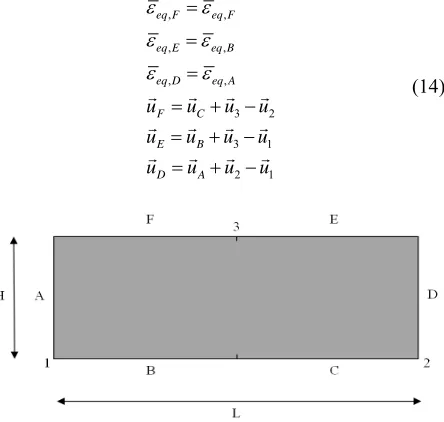
Periodic boundary conditions have been applied on three controlling nodes (see Figure 1) of the RVE as indicated
in [13] and justified in [12].
The periodicity conditions for edges can then be for- mulated in terms of the controlling nodes as
, ,
, ,
, ,
3 2
3 1
2 1
eq F eq F
eq E eq B
eq D eq A
F C
E B
D A
u u u u
u u u u
u u u u
[image:3.595.316.538.494.705.2](14)
This means riodic in the periodic stres is applied on points as illus and L, are wi tively. Moreo allel to bed j shear stress, re
5. Numeric
After implem sections, a R length, 60 mm 110 mm. The 5 mm mortar critisation wh lustrated in F
have been co experimental obtained in [1 Mesoscopic can be found chanics has be Quadratic i ered for the d functions hav Parameters fo model are sho method is em been obtained Two loadin compression p pendicular to have been app Evolution of dicular and pa and 5, respect
to bed joint, d brick-mortar i In the second allel to bed jo spot and conti
Figure
s both displace RVE. These p ses and strain
the RVE by m strated in Figu
dth, height an over, xx, y
oint, stress pe espectively.
cal Example
menting the pr RVE has been m height and RVE consists around all its hich was used
Figure 3. The
onsidered, in o results on c 4].
c material pro in Table 1.
een considered interpolation f displacement f ve been consid or the transient
own in Table
mployed since t d under load co ng cases have parallel to bed
bed joint. T plied on the RV
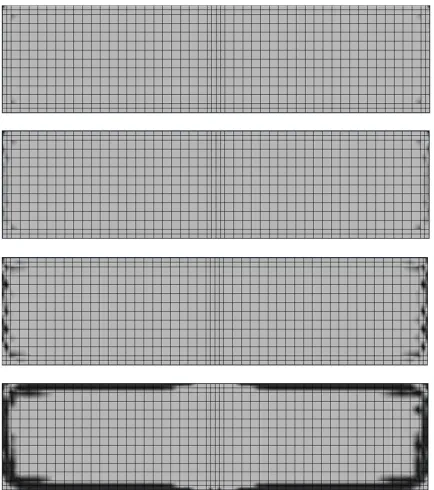
damage unde arallel to bed j tively. In case damage growth
interface and c case which is oint, damage g inues to grow i
2. Loading mod
ement and dam periodicity con s mesoscopic means of the th
ure 2. In these
nd length of th
yy, and, xy,
erpendicular to
es
rocess explain n constructed
an out-of-pla s of a 230*50 c
sides. The fin for the analy ese geometric order to simu onventional m
operties used f Elasticity base d for both mate functions hav fields and line dered for the t gradient enha
2. Convention
the experimen ontrol tests.
been consider d joint and co These loading
VE as illustrat er compressio oint can be se of compressio h initiates on th continues into m s under compre growth initiates into the perpen
des applied on
mage will be p nditions lead t
fields. Loadin hree controllin e figures W, H he RVE, respe
, are stress pa o bed joint an
ned in previou with 240 mm ne thickness o clay brick and nite element di sis has been i c configuration ulate the biaxi
masonry pane
for the analys ed damage me erials.
ve been consid ear interpolatio non-local fiel anced non-loc nal load contro ntal results hav
red for analysi ompression pe configuration ted in Figure
on load perpen een in Figures
on perpendicul he corner of th mortar bed join ession load pa s from the sam nd joints.
the RVE.
e- to ng ng H, c- ar- nd
us m of d a is- il- ns ial els
sis e-
d- on d. cal ol ve
is; er- ns
2.
n-
4
ar he nt. ar- me
Figure
Tab
Mater Bric Mort
Ta
Mater Bric Mort
Figure perpend
Dam have a perimen sient gr
6. Con
In this als with gated u ous dam dient en the mo
3. Typical finit
le 1. Material p
rial E ck 14000
tar 3000
able 2. Paramet
rial c ck 2
tar 2
4. Evolution of dicular to bed j
mage evolution good agreeme ntal investigat radient model h
nclusion
contribution, h different so using a homog mage growth a nhanced non-l del. Influence
te element mesh
parameters for
0.2 1.0 0.2 1.0
ters for transien
0
c
0.01 0.01
f damage in the joint.
patterns obtai ent with failur tions. Mesh s has been inves
the interaction ftening proper genisation appr and mesh sens local model h e of the choice
h used in comp
RVE computa
800 10 100 10
nt gradient mo
n 1.0 1.0
e RVE for com
ined from the re patterns see ensitivity of t stigated in [10,
n between two rties has been roach. To avo itivity, a trans has been introd
e of this mode
utations.
ations.
i
0.0002 0.0003
odel.
e 0.002 0.003
mpression
analysis en in ex- the tran- ,11].
A. JELVEHPOUR, M. DHANASEKAR
[image:5.595.65.282.86.331.2]Open Access JAMP 47
Figure 5. Evolution of damage in the RVE for compression parallel to bed joint.
evolution of damage under two loading cases has been investigated. The overall RVE behaviour using the tran- sient gradient model indicates that calibration of the tran- sient parameter under different loading conditions needs to be investigated.
REFERENCES
[1] A. Cavicchi and L. Gambarotta, “Collapse Analysis of Masonry Bridges Taking into Account Arch-Fill Interac- tion,” Engineering Structures, Vol. 27, No. 4, 2005, pp.
605-615.
http://dx.doi.org/10.1016/j.engstruct.2004.12.002
[2] M. Dhanasekar, “Review of Modelling of Masonry Shear,”
International Journal of Advanced Engineering Science Applied Mathematics, Vol. 2, No. 3, 2010, pp. 106-118. http://dx.doi.org/10.1007/s12572-011-0022-2
[3] J. L. Chaboche, “Continuum Damage Mechanics. Present State and Future Trends,” Nuclear Engineering and De- sign, Vol. 105, No. 1, 1987, pp. 19-33.
http://dx.doi.org/10.1016/0029-5493(87)90225-1
[4] R. H. J. Peerlings, “Enhanced Damage Modelling for Fracture and Fatigue,” Ph.D. Thesis, Technische Univer- siteit Eindhoven, 1999.
[5] J. H. P. De Vree, W. A. M. Brekelmans and M. A. J. Van Gils, “Comparison of Nonlocal Approaches in Continuum Damage Mechanics,” Computers and Structures, Vol. 55,
No. 4, 1995 pp. 581-588.
http://dx.doi.org/10.1016/0045-7949(94)00501-S
[6] G. Pijaudier-Cabot, Z. P. Bažant and M. Tabbara, “Com- parison of Various Models for Strain-Softening,” Engi- neering Computations, Vol. 5, No. 2, 1988, pp. 141-150.
http://dx.doi.org/10.1108/eb023732
[7] R. H. J. Peerlings, R. de Borst, W. A. M. Brekelmans and M. G. D. Geers, “Gradient Enhanced Damage Modelling of Concrete Fracture,” Mechanics of Cohesive-Frictional Material, Vol. 3, No. 4, 1998, pp. 323-342.
http://dx.doi.org/10.1002/(SICI)1097-0207(19961015)39: 19<3391::AID-NME7>3.0.CO;2-D
[8] Z. P. Bažant, T. Belytschko and T. Chang, “Continuum Theory for Strain-Softening,” Journal of Engineering Mechanics, Vol. 110, No. 12, 1984, pp. 1666-1692. http://dx.doi.org/10.1061/(ASCE)0733-9399(1984)110:12 (1666)
[9] R. H. J. Peerlings, R. de Borst, W. A. M. Brekelmans and J. H. P. de Vree, “Gradient Enhanced Damage for Quasi- Brittle Materials,” International Journal for Numerical Methods in Engineering, Vol. 39, No. 19, 1996, pp. 3391- 3403.
http://dx.doi.org/10.1002/(SICI)1097-0207(19961015)39: 19<3391::AID-NME7>3.0.CO;2-D
[10] M. G. D. Geers, R. de Borst, W. A. M. Brekelmans and R. H. J. Peerlings, “Strain-Based Transient-Gradient Dam- age Model for Failure Analyses,” Computer Methods in Applied Mechanics and Engineering, Vol. 160, No. 1-2, 1998, pp. 133-153.
http://dx.doi.org/10.1016/S0045-7825(98)80011-X [11] S. Saroukhani, R. Vafadari and A. Simone, “A Simplified
Implementation of a Gradient-Enhanced Damage Model with Transient Length Scale Effects,” Computational Me- chanics, Vol. 51, No. 6, 2013, pp. 899-909.
http://dx.doi.org/10.1007/s00466-012-0769-8
[12] A. Anthoine, “Derivation of the In-Plane Elastic Charac- teristics of Masonry through Homogenization Theory,”
International Journal of Solids and Structures, Vol. 32,
No. 2, 1995, pp. 137-163.
http://dx.doi.org/10.1016/0020-7683(94)00140-R
[13] T. J. Massart, “Multi-Scale Modelling of Damage in Ma- sonry Structures,” Ph.D. Thesis, Technische Universiteit Eindhoven, 2003.