http://dx.doi.org/10.4236/wjcmp.2015.51007
Heating of the Electrons and the Rectified
Current at the Contacts That Are in an
Alternating Electromagnetic Field
G. Gulyamov, M. G. Dadamirzaev
Namangan Engineering Pedagogical Institute, Namangan, Uzbekistan Email: [email protected]
Received 7 February 2015; accepted 25 February 2015; published 28 February 2015
Copyright © 2015 by authors and Scientific Research Publishing Inc.
This work is licensed under the Creative Commons Attribution International License (CC BY).
http://creativecommons.org/licenses/by/4.0/
Abstract
The paper deals with the heating of electrons and current rectification in contact, which is located in an alternating electromagnetic field. It was found that the electrical component of the micro-wave (UHF) micro-waves inside the p-n-junction was curved. This leads to the perpendicular component of the electric field of the microwave wave. This component modulates the height of the potential barrier with the frequency of the microwave. In the p-n-junction, straightening microwave current occurs. It is shown that the rectifying contact in the microwave electromagnetic field is always an electromotive force. This is due to carrier heating and straightening microwave current. It is shown that electron heating and straightening of the microwave power will lead to higher ideality factor of the diode.
Keywords
Hot Electrons, The Microwave Field, The Open Circuit Voltage, Short Circuit Current, CVC, p-n-Junction
1. Introduction
carri-ers, a signal rectification of alternating current. In order to avoid straightening AC p-n-junction, in the measure-ment of the thermopower of hot carriers, the vector of the microwave electric field is directed perpendicular to the concentration gradient [2].
[3] studied the current and the emf arising in asymmetrical p-n-junctions under the influence of a strong mi-crowave field. It revealed that, in asymmetric p-n-junction, a strong mimi-crowave field for the analysis of voltages and currents must be considered as the heating of electrons and holes.
In [4], the results of theoretical and experimental studies of the emergence of negative differential resistance in the diode structures are based on the p-n-junction in a strong microwave field.
Under the influence of the electromagnetic wave, it increases the average energy of the carriers in the contact area with the metal-semiconductor interface. As a result, the potential barrier of electrons is heated by flowing current [2]. On the other hand, due to changes in the barrier height at the contact, alternating current generated by the electric field of the wave is rectified. Due to the fact that the directions of the currents of hot carriers and rectified currents are identical, establishing the true mechanism of the generated EMF diode is an important is-sue.
The aim of this work is to study electron heating and current rectification to contact in an alternating electro-magnetic field.
2. Influence of Electron Heating and Current Rectification on Track in a
Strong Microwave Field
We estimate the current arising under the influence of electromagnetic waves on a thin Schottky diode. If the wave period longer than the transit time of electrons through the barrier, on the basis of the theory of electron diode current passing through the barrier is given by:
( )
( )
0 e e cos
e
exp B 1
s
e
U t
j j
kT kT t
ϕ ω
ϕ
+
= − −
(1)
where js is the saturation current; ϕ0 is the height of the potential barrier in the absence of an
electromag-netic wave; ϕ ϕ= 0−U; U is the resulting voltage across the diode;
0 d d
B
U = −
∫
EΒ x is the AC voltage of theincident wave, created by the barrier diode; T is the temperature of the lattice; k is the Boltzmann constant;
( )
e
T t is the temperature of the electron gas in contact with the region; ЕB is the electric field of the wave; e is the charge of the electron.
The average value of the diode current is determined by the following integral:
( )
( )
( )
( )
1
2π 2
0 0
0
cos d
e
exp 1 .
2π
B е
s e
U t U t t
Т j
j Т k T T t
ϕ ω ω
ϕ ω + + = − −
∫
(2)The values of the electron temperature are determined by the wave field strength.
At low wave power can not take into account the heating of the electrons, while the constant current arises only because of rectification:
( ) ( )
2π 0
0
e cos d
e
1 exp exp .
2π
B
s
U t t
U j
j kT kT
ω ω
+ = − −
∫
(3)Here U0 is the DC offset applied to the barrier. Detected voltage in the diode is given by:
( ) ( )
2π
0
d e
ln 1 ln exp cos .
e 2π B s t U kT j U t j kT ω ω = + − −
∫
(4)( ) ( )
2π
0
d e
ln exp cos .
e 2π
B ос t U kT U t kT ω ω =
∫
(5)Short-circuit current is the following:
( ) ( )
2π
0
e 1
1 exp cos d .
2π B s U j t t
j kT ω ω
+ = −
∫
(6)Equation (5) defines the CVC diode situated in the field of the electromagnetic wave when the current occurs only through rectification of alternating current.
At high power microwave energy when Te≠T, CVC diode has the following form:
( ) ( )
1 2π 2 0 0 0e cos d
e
1 exp exp .
2π
B e
s e e e
U t t
T
j U
j T k T T T kT
ω ω
ϕ ϕ
+ = − − −
∫
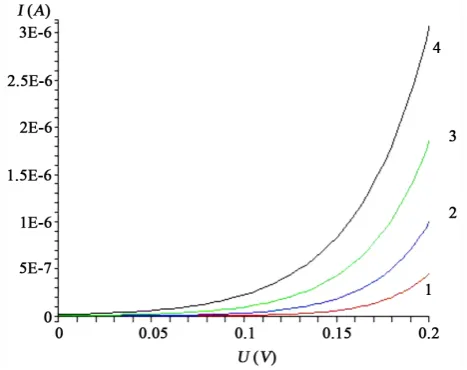
(7)Using Formula (7) we will investigate the effect of electron heating in the CVC p-n-junction in a strong mi-crowave field. CVC p-n-junction temperature change of the electrons is shown in Figure 1.
This shows that the inclusion of straightening and heating of electrons increases in the strong currents of the diode microwave field. The degree of increase of the current is determined by the following factor:
( ) ( )
2π
0
e cos d
exp
2π
B
e
U t t
kT ω ω −
∫
(8)when e B 1
e
U
kT this value increases rapidly and strongly affects the CVC diode.
Now consider the short-circuit current of the Formula (7) (for U=0) we have the following expression for the short-circuit current:
( ) ( )
1 2π 2 0 0 0e cos d
e
1 exp exp .
2π
B
sc e
s e e
U t t
j T
j T k T T kT
ω ω
ϕ ϕ
+ = − −
∫
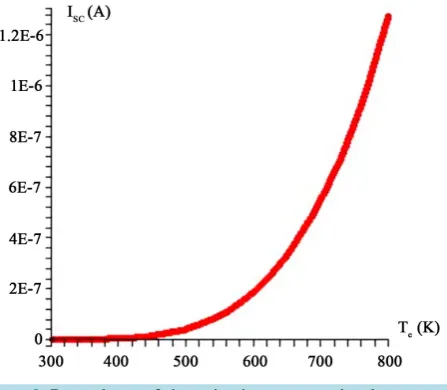
(9) [image:3.595.181.415.506.691.2]This shows that the inclusion of rectification increases the short circuit current by a factor of (8). C using the Formula (9) is plotted as the short circuit current of the electron temperature (Figure 2).
Figure 2that the short circuit current is strongly dependent on the temperature of the electrons. With the in-crease of the electron temperature inin-creases rapidly short-circuit current.
Figure 1. CVC p-n-junction at different electron temperature. 1—
Figure 2. Dependence of short circuit current on the electron tem-perature according to the Formula (9).
For the open-circuit voltage of hot electrons from the Formula (7) (for j=0) we have the following expres-sion:
( ) ( )
1 2π 2 0
0
e cos d
1 ln exp .
e 2π
B
e e e
oc
e
U t t
T kT T
U
T T kT
ω ω
ϕ
= − − − −
∫
(10)
The first term of this formula gives emf, heated by the electron in the potential barrier [2], and the second part—the voltage generated due to rectification. However, it should be noted that the second portion (10) differs from the rectifying electromotive force (5), when the electrons are not warmed up. If you do not take into ac-count current rectification caused by electromagnetic wave, the first term of the Formula (10) corresponds to the EMF of the heated electrons produced in the potential barrier ϕ0 [2].
Formula (10) allows to analyze graphically the dependence of f U
(
oc,Te)
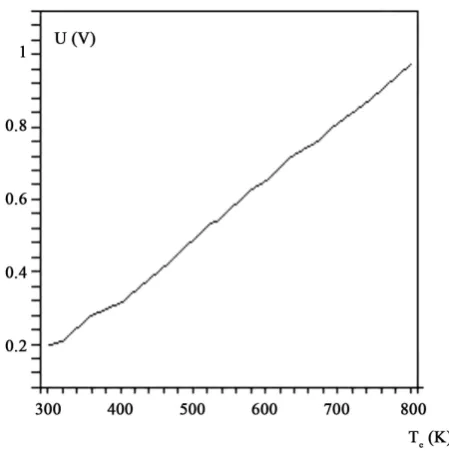
. Figure 3 shows the dependenceof the open circuit voltage of the electron temperature f U
(
oc,Te)
. This shows that in the p-n-junction due to the heating of electrons increases the open circuit voltage.Analyze the second part of the Formula (10) is associated with straightening:
(
)
1 2π 2 rect
0
ln exp cos 2π d
e
e B
kT Y
U θ z z
θ
= −
∫
(11)where Te
Т
θ= is the dimensionless electron temperature; e B B
e
U Y
kT
= is the dimensionless potential wave;
z=ωt.
This formula shows that the dependence of Y UB rect differs from linearity. The linear dependence of the de-tected voltage of the electric field of the wave, is often regarded as the result of rectification of the AC signal. From the analysis of (11) we can conclude that this conclusion is not always justified. This is due to the fact that the deviation from the linear dependence of the rectified voltage on the intensity of the microwave field is due to the heating of the electrons.
Figure 3. The dependence of the open circuit voltage of the elec-tron temperature.
The emergence of large values of EMF [5], in our opinion may be due to the following reasons yet.
When the location of the p-n-junction in a microwave electromagnetic field is a redistribution of the field ЕВ waves in the space inside the sample. The result is distorted parallel to the plane of the ЕВ p-n-junction. This leads to the inevitable emergence of the electric field component perpendicular to the plane of the p-n-transition, which is not uniformly distributed in the p-n-junction. By turning the p-n-junction relative to ЕВ can be re-duced to a minimum average value of the perpendicular component E⊥, but it is impossible to completely
eliminate. The parallel component of the electric field to the p-n-junction is not rectify the high frequency elec-tric current, and is involved only in the heating media. A perpendicular component is at the p-n-junction rectifi-cation microwave current [6] [7]. Thus, in the rectifying contact in the electromagnetic field occurs as a heating carriers and straightening of the microwave power. Consequently, there is excessive DC component and gener-ate additional EMF.
Therefore, a strong microwave field in the calculation of EMF occurring at the p-n-junction in addition to the heating of electrons must be considered and straightening of the microwave power.
The expression for the effective electron temperature, calculated from Formulas (7)-(10) has the form:
( ) ( )
2π
0 0
e cos d
1 ln exp .
e 2π
e e
e
U t t
kT
T T
kT
ω ω
ϕ
⊥
∗= + −
∫
(12)Here
0 d d
U⊥ = −
∫
E⊥ x, E⊥—perpendicular component of the wave field to the surface of the p-n-junction.You can enter the ideality factor m in the following form:
e e
T∗=mT (13)
( ) ( )
2π
0 0
e cos d
1 ln exp .
e 2π
В
e
U t t
kT m
kT
ω ω
ϕ
⊥
= + −
∫
(14)The second term in the square brackets is due to the more effective temperature of the electrons due to recti-fication. When U⊥ =0 we have Te Te
∗=
, effective temperature coincides with the actual temperature of the electrons. In this case there is no extension. When U⊥ ≠0 always have Te Te
∗ >
, straightening as it effectively increases the temperature Te
∗
. With the increasing power of the electromagnetic wave incident on the diode and the difference between Te
∗
and Te increases (see Equation (12)) Te ∗
experiment [5]. The authors of these studies neglect the distortion of the microwave field, the increase asso-ciated with the increase Te
∗
nonideality factor m with increasing electric field strength. However, there is no quantitative analysis. If we consider the rectification, we can quantitatively explain the relationship between m and the field strength. Effect of carrier heating charges on nonideality factor CVC p-n-junction is discussed in [8] [9].
3. Conclusion
The rectifying junction in the microwave electromagnetic field is always an electromotive force, which is due to electron heating and straightening microwave current. This is due to the distortion of the electric component of the microwave inside the p-n-junction. Distortion direction of the electric component of the microwave will cause the perpendicular component of the electric field that causes rectification of the microwave current through the p-n-junction. Heating of the electrons and the microwave current rectification increases the ideality factor of the diode.
References
[1] Pozhela, J.K. and Repshas, K.K. (1968) Thermoelectric Force of Hot Carriers. Physica Status Solidi, 27, 757-762.
http://dx.doi.org/10.1002/pssb.19680270233
[2] Veynger, A.I., Paritssky, L.G., Hakobyan, E.A. and Dadamirzaev, G. (1975) Thermopower Hot Carriers on the p-n- Transition. Semiconductors-Leningrad, 9, 216-224.
[3] Dadamirzaev, M.G. (2013) Heating of Electrons and Holes in Asymmetric p-n-Junction, Located in a Microwave Field.
Physical Surface Engineering-Ukraine, 11, 191-193.
[4] Usanov, D.A., Skripal, A.V., Ugryumova, N.V., Wenig, S.B. and Orlov, V.E. (2000) The Occurrence of Negative Dif-ferential Resistance Mode and Switch to the Tunnel Diode by an External Microwave Signal. Semiconductors-St. Pe-tersburg, 34, 567-571.
[5] Ablyazimova, N.A., Veynger, A.I. and Nutrition, V. (1988) Elektricheskie Properties of Silicon p-n-Junctions in Strong Microwave Fields. Semiconductors-St. Petersburg, 22, 2001-2007.
[6] Gulyamov, G., Dadamirzaev, M.G. and Boydedaev, S.R. (2000) Kinetics of the Establishment of the Thermopower of Hot Carriers in the p-n-Junction, Taking into Account the Heating of the Lattice. Semiconductors-St. Petersburg, 34, 266-269.
[7] Gulyamov, G., Dadamirzaev, M.G. and Boydedaev, S.R. (2000) Emf of Hot Carriers Due to the Modulation of the Surface Potential in a Strong Microwave Field. Semiconductors-St. Petersburg, 34, 572-575.
[8] Shamirzaev, S.H., Gulyamov, G., Dadamirzaev, M.G. and Gulyamov, A.G. (2009) Ideality Factor of the Current-Vol- tage Characteristics of p-n-Junctions in the Strong Field of the Microwave. Fizika i Tekhnika Poluprovodnikov-St. Pe-tersburg, 43, 53-57.