http://dx.doi.org/10.4236/nm.2015.61005
How to cite this paper: Yasui, Y. (2015) Control Pathways from the Subcortical Limbic Structures to the Trigeminal Motor System in the Lower Brainstem: A Hodological Review. Neuroscience & Medicine, 6, 24-34.
http://dx.doi.org/10.4236/nm.2015.61005
Control Pathways from the Subcortical
Limbic Structures to the Trigeminal
Motor System in the Lower Brainstem:
A Hodological Review
Yukihiko Yasui
*Department of Anatomy and Morphological Neuroscience, Shimane University School of Medicine, Izumo,
Japan
Email:
*[email protected]
Received 23 February 2015; accepted 8 March 2015; published 11 March 2015
Copyright © 2015 by author and Scientific Research Publishing Inc.
This work is licensed under the Creative Commons Attribution International License (CC BY).
http://creativecommons.org/licenses/by/4.0/
Abstract
The organization of the emotion-related somatic motor behavior, including jaw movements, is
go-verned not only by the cortical limbic system but also by the subcortical limbic system including the
amygdala and hypothalamus. GABAergic neurons in the central amygdaloid nucleus (CeA) and
glu-tamatergic neurons in the posterior lateral hypothalamus (PLH) exert inhibitory and excitatory
in-fluences, respectively, upon premotor neurons for the motor trigeminal nucleus (Vm) in the
par-vicellular reticular formation (RFp) of the medulla oblongata. The CeA also has an inhibitory
in-fluence on non-dopaminergic (probably GABAergic) neurons in the retrorubral field of the
mid-brain that send their axons to the RFp. Furthermore, the CeA and lateral hypothalamus including
the PLH may also modulate Vm neurons via projections to the mesencephalic trigeminal nucleus
which contains the cell bodies of primary afferent neurons conveying inputs from the masticatory
muscle spindles or the periodontal ligament receptors to jaw closing motoneurons within the Vm.
These pathways from the subcortical limbic structures to the trigeminal motor system in the
low-er brainstem undlow-erlie the regulation of emotional jaw movements.
Keywords
Amygdala, Hypothalamus, Motor Trigeminal Nucleus, Jaw Movement, Emotion
1. Introduction
suprahyoid muscles. The masticatory muscles as well as the mylohyoid muscle and anterior belly of the digastric
muscle are innervated by motoneurons in the motor trigeminal nucleus (Vm). Within the Vm, the neurons
in-nervating each muscle are assembled and constitute subgroups. The motoneurons inin-nervating the jaw-closing
muscles, such as the masseteric and tempolaris muscles, are assembled in the dorsolateral part of the Vm
(Vm-dl), whereas those innervating the jaw-opening muscles, such as the mylohyoid muscle and anterior belly
of the digastric muscle, are assembled in the ventromedial part of the Vm (Vm-vm).
The organization of the emotion-related somatic motor behavior, including jaw movements, is governed by
neural circuits in the limbic system, which include the amygdala, hypothalamus, and several regions of the
cere-bral cortex. The amygdala has been known to play a crucial role in the development and expression of emotional
behavior, such as the fear reaction and defense response (for review, see
[1]-[3]
), and has been considered to
participate in the control mechanism of jaw movements
[4]-[7]
. On the other hand, the hypothalamus has been
known to be involved in a variety of functions, including not only the control of endocrine and autonomic
func-tions but also motivated and emotional behaviors (for review, see
[8]
). It is also known that electrical stimulation
of the hypothalamus induces attacks or defense responses in which opening and closing movement of jaws is one
of the obvious elements
[9]-[11]
.
In this communication, I summarize recent neuroanatomical and neurochemical studies on the control
path-ways to the Vm from the subcortical limbic structures, such as the amygdala and hypothalamus.
2. Premotor Neuron Pools for Vm
Jaw movements are carried out by Vm motoneurons activated by inputs from the periphery and/or from the
up-per motor centers. Most of these inputs are transmitted to the Vm via interneurons called premotor neurons. The
Vm-premotor neurons send their axons directly to the Vm and many of them are distributed in the lower
brains-tem, such as the pons and medulla oblongata
[12]-[14]
. In particular, most of them are found in the sensory
tri-geminal nuclei including the mesencephalic, principal and spinal tritri-geminal nuclei, as well as in the lateral
reti-cular formation including the retireti-cular formation around the Vm, parvicellular retireti-cular nucleus (RFp), and
in-termediate reticular nucleus (IRt) of the pontomedullary and medullary brainstem (
Figure 1
); the reticular
formation around the Vm adjoins the RFp, and includes the supratrigeminal region dorsal to the Vm, intertri-
geminal region between the principal sensory trigeminal nucleus and the Vm, juxtatrigeminal region medial to
the Vm and reticular formation ventral to the Vm. The Vm-premotor neurons, except for neurons of the
mesen-cephalic trigeminal nucleus (Vmes), are generally distributed bilaterally, and play an important role in the
initia-tion and regulainitia-tion of jaw movements by acting as interneurons in the brainstem reflexes, as well as by transmit-
ting information from the upper motor centers to the Vm motoneurons. On the other hand, Vmes neurons that
innervate jaw-closing muscle spindles and periodontal mechanoreceptors
[15]-[17]
send their axons ipsilaterally
[image:2.595.196.435.500.642.2]
(a) (b)
to Vm motoneurons for controlling jaw movements
[16] [18]
.
3. Descending Pathways from the Amygdala to the Vm
3.1. Neuroanatomical Organization
As for the possible pathways relaying output signals of the amygdala to the Vm, the direct pathway from the
cen-tral amygdaloid nucleus (CeA) to the Vm has been suggested by Mascaro
et al.
[19]
, who observed retrograde-
labeled neurons in the CeA after injecting Fluoro-gold (FG) into the Vm. However, studies using injection of
biotinylated dextran amine (BDA) into the CeA have shown BDA-labeled fibers with bouton-like varicosities
around the Vm but not within the Vm, suggesting the unlikely existence of a direct CeA-Vm pathway
[20] [21]
.
On the other hand, the disynaptic pathway from the CeA to the Vm via the supratrigeminal region
[22]
or via the
RFp of the pons
[23]
has been suggested by anatomical studies using a combined degeneration and horseradish
peroxidase method. A physiological study
[6]
also indicated the existence of disynaptic inputs from the
amyg-dala to the Vm motoneurons mediated by the supratrigeminal region. It is well known, however, that the
des-cending fibers from the CeA are distributed in the RFp not only of the pons but also of the medulla oblongata
[24]-[26]
. Furthermore, the RFp of the medulla oblongata contains many trigeminal premotor neurons that
project directly to the Vm
[12]-[14] [27] [28]
. Taken together, these data make it likely that the CeA also exerts
its influences on the regulation of jaw movements through the pathway from the CeA to the Vm via the RFp of
the medulla oblongata. We therefore demonstrated the existence of a CeA-RFp-Vm pathway by using a
combina-tion of anterograde and retrograde tracing techniques
[20]
. When ipsilateral injections of BDA into the CeA and
cholera toxin B subunit (CTb) into the Vm were made in the rat, the prominent overlapping distribution of
BDA-labeled axons and CTb-labeled neurons was found in the RFp region just ventral to the nucleus of the
so-litary tract and medial to the spinal trigeminal nucleus throughout the caudalmost part of the pons and the rostral
half of the medulla oblongata (
Figure 2
). Within the neuropil of the RFp region, BDA-labeled axons made
sym-metrical synaptic contacts predominantly with dendrites and additionally with somata of the RFp neurons, some of
which were labeled with CTb.
According to Gonzales and Chesselet
[29]
, a dense projection from the CeA is observed in the lateral part of
the substantia nigra (SN) pars compacta as well as in the SN pars lateralis. Not only the lateral part of the SN
pars reticulata but also the lateral part of the SN pars compacta and SN pars lateralis have been known to contain
neurons projecting to the reticular region around the Vm
[30]
, as well as to the RFp of the medulla oblongata
[31]
. Taken together, these data suggest the likely occurrence of a disynaptic pathway from the CeA to the RFp
via the SN, which is also considered to be responsible for the control of jaw movements. Experiments using
electron microscopy will be necessary in order to establish the existence of this disynaptic pathway.
Gonzales and Chesselet
[29]
, and Wallace
et al
.
[32]
have shown that CeA fibers are also densely distributed
in the lateral part of the retrorubral field (RRF); the RRF has been considered to be involved in the orofacial
motor function
[33] [34]
. Furthermore, the RRF region contains a population of neurons sending their axons to
the RFp of the medullary and pontomedullary brainstem
[35] [36]
. Judging from the above, it seems probable
that the output signals from the CeA have direct influence on the retrorubroreticular pathway in the control of
jaw movements. After ipsilateral injections of BDA into theCeA and FG into the RFp, we demonstrated that the
prominent overlapping distribution of BDA-labeled axon terminals and FG-labeled neurons was found in the
lateral part of the RRF ipsilateral to the injection sites (
Figure 3
), where the BDA-labeled axon terminals made
symmetrical synapses with somata and dendrites of the FG-labeled neurons
[37]
.
Furthermore, the CeA sends projection fibers to the Vmes and Vmes neurons are closely apposed by CeA
axonal varicosities
[21] [38]
; the Vmes contains the somata of primary afferent neurons whose peripheral processes
are associated with the muscle spindles of jaw-closing muscles and mechanoreceptors within the periodontal
li-gaments and most of the central processes terminate in the Vm. Recently, Shirasu
et al.
[39]
showed that many
CeA fibers with terminal boutons are distributed in the caudal Vmes and that a part of these terminal buttons
formed axo-somatic synapses with Vmes neurons, suggesting that the CeA regulates bite strength by modifying
neuronal activity in the Vmes.
3.2. Neurochemical Organization
Figure 2. Line drawings showing the sites of biotinylated dextran amine (BDA) injection into the central amygdaloid nucleus (CeA) (shaded area in (a)) and cholera toxin B subunit (CTb) injection into the motor trigeminal nucleus (Vm) (shaded area in (b)), and resulting anterograde and retrograde labeling in the lower brainstem ipsilateral to the injection sites ((b)-(e), rostral to caudal). BDA-labeled fibers and terminals are presented by fine lines and fine dots, respectively. CTb-labeled cell bodies are presented by filled circles, each of which represents about two labeled cell bodies. ACo, anterior cortical amygdaloid nucleus; BL, basolateralamygdaloid nucleus; BM, basomedialamygdaloid nucleus; caudate-putamen; CPU, caudate-putamen; DMV, dorsal motor nucleus of the vagus nerve; E, endopiriform nucleus; GP, globuspallidus; I, interstitial amygdaloid nucleus; ic, internal capsule; La, lateral amygdaloid nucleus; LR, lateral reticular nucleus; ot, optic tract; Me, medial amygdaloid nucleus; PH, prepositus hypoglossal nucleus; Pir, piriform cortex; Ve, vestibular nucleus; Vi, interpolarsubnucleus of the spinal trigeminal nucleus; Vo, oral subnucleus of the spinal trigeminal nucleus; VII, facial nucleus. Other abbreviations are as
shown inFigure 1.
almost all the CeA neurons are positive for glutamic acid decarboxylase (GAD) 65 mRNA
[40]
and GAD67
mRNA
[41]
but not for vesicular glutamate transporter (VGLUT) 1 mRNA
[40]
and VGLUT2 mRNA
[40] [41]
;
GAD is an enzyme that converts glutamate to GABA and is a marker for GABAergic neurons, while VGLUT1
and VGLUT2 are a marker for glutamatergic neurons. These data support the idea that CeA neurons are
GA-BAergic. Recently, we demonstrated for the first time that almost all the CeA axon terminals in the RRF are
immunoreactive for GAD
[37]
. Such GABAergicCeA axon terminals have also been observed in other
brains-tem regions including the parabrachial nucleus
[42]
and nucleus of the solitary tract
[43] [44]
, as well as in the
forebrain regions including the parastrial nucleus
[45]
and lateral hypothalamic area
[46] [47]
.
The SN contains many dopaminergic neurons, which are distributed mainly in the pars compacta, referred to
as the A9 dopamine cell group. The RRF also contains numerous dopaminergic neurons that are referred to as
the A8 dopamine cell group. However, SN neurons projecting to the brainstem regions, such as the inferior
col-liculus
[48]
and reticular formation around the Vm
[30]
, have been revealed not to be immunonegative for
tyro-sine hydroxylase (TH), which catalyzes the rate-limiting step in the synthesis of catecholamine. Recently, we also
demonstrated that RRF neurons projecting to the RFp are not immunonegative for TH
[37]
. Taken together, these
data suggest that both the SN and RRF neurons sending their axons to the lower brainstem are non-dopaminergic
and probably GABAergic
[49]
. Studies combining retrograde tract-tracing with immunolabeling for GABA or
GAD or with
in situ
hybridization for GAD mRNA should help to demonstrate this idea.
Figure 3. Line drawings illustrating the sites of biotinylated dextran amine (BDA) injection into the central amygdaloid nucleus (CeA) (shaded area in (a)) and Fluoro-gold (FG) injection into the parvicellular reticular formation(shaded area in (e)), and resulting distributions of BDA-labeled terminals (small dots) and FG-labeled neurons (large dots) in the retrorubral field (RRF) region ((b)-(d), rostral to caudal). Each RRF region in the midbrain section (b)-(d) is enlarged in (b)-(d), respectively. Amb, ambiguous nucleus; cp, cerebral peduncle; Den, dorsal endopiriform nucleus; IP, interpeduncular nucleus; ml, medial lemniscus; PAG, periaqueductal gray; PLCo, posterolateral cortical nucleus; Pn, pontine nucleus; PrH, prepositus hypoglossal nucleus; py, pyramis; R, red nucleus; SC, superior colliculus; SNr, substantia nigra pars reticulata; SpVe, spinal vestibular nucleus; SP5, spinal trigeminal nucleus; sp5, spinal trigeminal tract; III, oculomotor nucleus. Other
abbreviations are as shown inFigure 1 and Figure2.
reactive for GAD or glycine are also distributed in the RFp
[52]
. Recently, Travers
et al.
[50]
indicated that a
quarter of Vm-premotor neurons in the RFp and IRt are immunoreactive for GAD65/67. Travers
et al.
[50]
also
indicated that relatively few Vm-premotor neurons in the RFp and IRt are either nitrergicor cholinergic.
Vmes neurons have been indicated to be glutaminergic
[53] [54]
. A recent study revealed that VGLUT1 is
expressed in both the central axon terminals and the peripheral sensory endings of Vmes neurons and further
that VGLUT1 mRNA is expressed in the cell bodies of Vmes neurons
[55]
. These data suggest that Vmes
neu-rons are glutamatergic.
4. Descending Pathways from the Hypothalamus to the Vm
4.1. Neuroanatomical Organization
The hypothalamic projection to the Vm has been examined by using retrograde tracers
[19] [56]
. McGregor
et al.
[56] found retrogradely labeled neurons in the dorsomedial hypothalamic nucleus, perifornical nucleus and LHA
after CTb injection into the Vm. Furthermore, Mascaro
et al
.
[19]
observed retrogradely labeled neurons in the
posterior lateral hypothalamus (PLH) region just medial to the subthalamic nucleus after FG injection into the
Vm; this PLH region has been identified as the parasubthalamic nucleus by Wang and Zang
[57]
. However, we
found only some passing BDA-labeled fibers without bouton-like varicosities within the Vm after BDA
injec-tion into the PLH, suggesting the unlikely existence of a direct PLH-Vm pathway
[58]
. There have been no
an-terograde tracing studies to indicate the direct hypothalamo-Vm projections from the paraventricular,
dorso-medial, and perifornical nuclei as well as from the LHA although a couple of peptidergic projections from the
LHA to the Vm have been reported as describe below.
[image:5.595.144.493.83.313.2]projecting hypothalamic neurons and indicated that the highest number of RFp-projecting neurons is located in
the PLH region just medial to the subthalamic nucleus
[58]
. Using a combined anterograde and retrograde tracing
technique, we further showed that the prominent overlapping distribution of PLH fibers and Vm-premotor
neu-rons in the RFp region just ventral to the nucleus of the solitary tract and medial to the spinal trigeminal nucleus
(
Figure 4
), and that the PLH axon terminals make an asymmetrical synaptic contact predominantly with dendrites
and additionally with somata of the RFp neurons, some of which were labeled with CTb injected into the Vm.
Interestingly, anterograde tracing studies with
Phaseolus vulgaris
-leucoagglutinin
[60] [61]
or with BDA
[46]
have been indicated that the PLH receives a dense projection from the CeA. In light of these data, it seems likely
that RFp-projecting PLH neurons are under the direct influence of the CeA.
4.2. Neurochemical Organization
[image:6.595.144.488.330.622.2]Neumerous hypothalamic neurons labeled with CTb injected into the Vm region have been revealed to display
glutamate-like immunoreactivity
[56]
. Recently, VGLUT has been considered to be a much better marker for
glutamatergic neurons
[62]
, and it has been reported that LHA neurons express predominantly VGLUT2 mRNA
and additionally VGLUT1 mRNA
[63]
. In addition, the axon terminals with glutamate immunoreactivity
[64]-
[66]
or with VGLUT2 immunoreactivity
[67]
have been reported to make asymmetrical synapses with their
tar-get structures. In accordance with the above-mentioned data, we demonstrated that the PLH axon terminals with
VGLUT2 immunoreactivity make asymmetrical synapses with RFp neurons, suggesting that glutamatergic PLH
neurons exert excitatory influence upon RFp neurons.
Figure 4. Line drawings showing the sites of biotinylated dextran amine (BDA) injection into the posterior lateral hypothalamus (shaded area in (a)) and cholera toxin B subunit (CTb) injection into the motor trigeminal nucleus (Vm) (shaded area in (b)), and resulting anterograde and retrograde labeling in the lower brainstem ipsilateral to the injection sites ((b)-(e), rostral to caudal). BDA-labeled fibers and terminals are presented by fine lines and fine dots, respectively. CTb-labeled cell bodies are presented by filled circles, each of which represents about two labeled cell bodies. Arc, arcuate nucleus; Cu, cuneate nucleus; ECu, external cuneate nucleus; F, nucleus of the fields of Forel; fx, fornix; icp, inferior cerebellar peduncle; mt, mam- millothalamic tract; MVe, medial vestibular nucleus; PM, premammillary nucleus; Pr, prepositus hypoglossal nucleus; SPF, subparafacicular nucleus; st, solitary tract; STh, subthalamic nucleus; ZI, zona incerta. Other abbreviations are as shown in
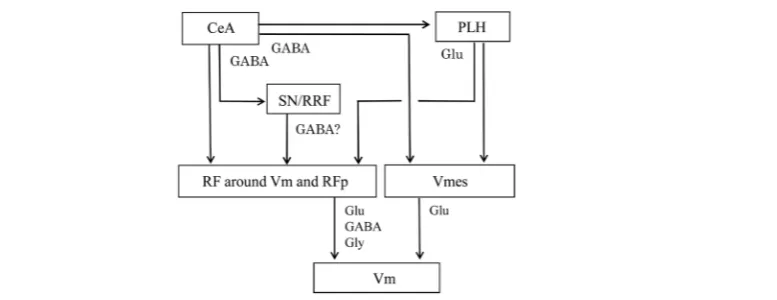
Figure 5. Summary diagram showing the control pathways from the central amygdaloid nucleus (CeA) and posterior lateral hypothalamus (PLH) to the motor trigeminal nucleus (Vm), both subcortical limbic structures control jaw movements through their direct projections to Vm-premotor neurons in the reticular formation (RF) around the Vm in the pons, parvicellular reticular formation (RFp) in the pontomedullary and medullary brainstem, as well as in the mesencephalic trigeminal nucleus (Vmes). In addition, the CeA control jaw movements through its indirect projections to these premotor neuron pools via the substantia nigra (SN)/retrorubral field (RRF). The neurotransmitter(s) used in each pathway are also indicated. Glu, glutamate; Gly, glycine.
As for the neuropeptides, by using retrograde tracing in combination with immunohistochemical methods,
re-cent studies in the cat
[68]
and rat
[69]
have demonstrated at the light microscopic level that hypothalamic
orex-inergic/hypocretinergic fibers are in contact with Vm motoneurons, although there are only sparse orexinergic
fibers in the Vm. More recently, Mascaro
et al.
[38]
demonstrated that orexinergic fibers are distributed in the
Vm and that approximately one-third of the LHA neurons sending their axons to the Vm are immunoreactive for
orexin. McGregor
et al.
[56]
, who also found orexinergic Vm-premotor neurons in the LHA, further indicated
that Vm-premotor neurons in the LHA as well as in the perifornical nucleus are immunoreactive for melanin
concentrating hormone (MCH). Saito
et al.
[70]
have demonstrated that MCH-immunoreactive fibers are
distri-buted in the Vm where many neurons express MCH receptor mRNA, suggesting that the MCH system may be
related to the processes underlying mastication. Mascaro
et al.
[38]
and Zhang and Luo
[69]
have also observed
orexin-immunoreactive fibers in the Vmes where they closely contact the Vmes neuronal somata, suggesting
that orexinergic fibers are involved not only in the control of mastication but also in the genesis of nocturnal
bruxism.
5. Conclusion
This article summarizes neuroanatomical and neurochemical organization of the control pathways to the Vm from
the subcortical limbic structures, such as the amygdala and hypothalamus. The summary diagram is shown in
Figure 5
. The CeA and PLH innervate the Vm through their direct or indirect projections to Vm-premotor
neu-rons including RFp and Vmes neuneu-rons. These projections belong to the lateral component of the emotional
mo-tor system that controls specific emotional momo-tor activities (see
[71] [72]
, for review). The RFp is the major
pre-motor neuron pool not only for the Vm but also for the facial and hypoglossal nuclei. Therefore, the amygdala
and hypothalamus are thought to control the orofacial muscles during aggression, freezing or other emotional
behaviors through their projections to the orofacial motor nuclei via the RFp.
Acknowledgements
The author is grateful for the support of Drs. R. Fujimoto, K. Fujita, T. Goeku, M. Kuzushima, T. Mukai, Y.
Munenaga, T. Sakurai, Y. Sakurai, H. Taguchi, K. Tanaka, K. Urashima, H. Yamaoka, S. Yamazaki and K.
Yo-shida. This study was partly supported by Grant-in-Aid for Scientific Research (C) (19500294, 21500325 and
24500412) from the Ministry of Education, Science, Sports and Culture of Japan.
References
http://dx.doi.org/10.1146/annurev.ne.15.030192.002033
[2] Holstege, G. (1991) Descending Motor Pathways and the Spinal Motor System: Limbic and Non-Limbic Components.
In: Holstege, G., Ed., Role of the Forebrain in Sensation and Behavior, Elsevier, Amsterdam, 307-421.
[3] LeDoux, J.E. (2000) Emotion Circuits in the Brain. Annual Review of Neuroscience, 23, 155-184.
http://dx.doi.org/10.1146/annurev.neuro.23.1.155
[4] Mishima, K., Sasamoto, K. and Ohta, M. (1982) Amygdaloid or Cortical Facilitation of Antidromic Activity of
Trige-minal Motoneurons in the Rat. Comparative Biochemistry and Physiology Part A: Physiology, 73, 355-359.
http://dx.doi.org/10.1016/0300-9629(82)90167-0
[5] Nakamura, Y. and Kubo, Y. (1978) Masticatory Rhythm in Intracellular Potential of Trigeminal Motoneurons Induced
by Stimulation of Orbital Cortex and Amygdala in Cats. Brain Research, 148, 504-509.
http://dx.doi.org/10.1016/0006-8993(78)90738-2
[6] Ohta, M. and Moriyama, Y. (1986) Supratrigeminal Neurons Mediate Shortest, Disynaptic Pathway from the Central
Amygdaloid Nucleus to the Contralateral Trigeminal Motoneurons in the Rat. Comparative Biochemistry and
Physi-ology Part A: Physiology, 83, 633-641. http://dx.doi.org/10.1016/0300-9629(86)90702-4
[7] Sasamoto, K. and Ohta, M. (1982) Amygdaloid-Induced Jaw Opening and Facilitation or Inhibition of the Trigeminal
Motoneurons in the Rat. Comparative Biochemistry and Physiology Part A: Physiology, 73, 349-354.
http://dx.doi.org/10.1016/0300-9629(82)90166-9
[8] Card, J., Swanson, L.W. and Moore, Y. (2003) The Hypothalamus: An Overview of Regulatory Systems. In: Bloom,
F.E., Landis, S.C., Roberts, J.L., Squire, L.R. and Zigmond, M.J., Eds., Fundamental Neuroscience, 2nd Edition,
Aca-demic Press, San Diego, 897-909.
[9] Brody, J.F., DeFeudis, P.A. and DeFeudis, F.V. (1969) Effects of Micro-Injections of L-Glutamate into the
Hypotha-lamus on Attack and Flight Behaviour in Cats. Nature, 224, 1330. http://dx.doi.org/10.1038/2241330a0
[10] Brown, J.L., Hunsperger, R.W. and Rosvold, H.E. (1969) Defence, Attack, and Flight Elicited by Electrical
Stimula-tion of the Hypothalamus of the Cat. Experimental Brain Research, 8, 113-129.
[11] Chi, C.C. and Flynn, J.P. (1971) Neural Pathways Associated with Hypothalamically Elicited Attack Behavior in Cats.
Science, 171, 703-706. http://dx.doi.org/10.1126/science.171.3972.703
[12] Travers, J.B. and Norgren, R. (1983.) Afferent Projections to the Oral Motor Nuclei in the Rat. Journal of Comparative
Neurology, 220, 280-298. http://dx.doi.org/10.1002/cne.902200303
[13] Li, Y.-Q., Takada, M., Kaneko, T. and Mizuno, N. (1995) Premotor Neurons for Trigeminal Motor Nucleus Neurons
Innervating the Jaw-Closing and Jaw-Opening Muscles: Differential Distribution in the Lower Brainstem of the Rat. Journal of Comparative Neurology, 356, 563-579. http://dx.doi.org/10.1002/cne.903560407
[14] Ter Horst, G.J., Copray, J.C.V.M., Liem, R.S.B. and Van Willigen, J.D. (1991) Projections from the Rostral
Parvicel-lular Reticular Formation to Pontine and Medullary Nuclei in the Rat: Involvement in Autonomic Regulation and
Orofacial Motor Control. Neuroscience, 40, 735-758. http://dx.doi.org/10.1016/0306-4522(91)90009-D
[15] Jerge, C.R. (1963) Organization and Function of the Trigeminal Mesencephalic Nucleus. Journal of Neurophysiology,
26, 379-392.
[16] Nomura, S. and Mizuno, N. (1985) Differential Distribution of Cell Bodies and Central Axons of Mesencephalic
Tri-geminal Nucleus Neurons Supplying the Jaw-Closing Muscles and Periodontal Tissue: A Transganglionic Tracer
Study in the Cat. Brain Research, 359, 311-319. http://dx.doi.org/10.1016/0006-8993(85)91442-8
[17] Liem, R.S., Copray, J.C. and van Willigen, J.D. (1991) Ultrastructure of the Rat Mesencephalic Trigeminal Nucleus.
Acta Anatomica, 140, 112-119. http://dx.doi.org/10.1159/000147045
[18] Luo, P. and Li, J. (1991) Monosynaptic Connections between Neurons of Trigeminal Mesencephalic Nucleus and Jaw-
Closing Motoneurons in the Rat: An Intracellular Horseradish Peroxidase Labeling Study. Brain Research, 559, 267-
275. http://dx.doi.org/10.1016/0006-8993(91)90011-J
[19] Mascaro, M.B., Bittencourt, J.C., Casatti, C.A. and Elias, C.F. (2005) Alternative Pathways for Catecholamine Action
in Oral Motor Control. Neuroscience Letters, 386, 34-39. http://dx.doi.org/10.1016/j.neulet.2005.05.062
[20] Yasui, Y., Tsumori, T., Oka, T. and Yokota, S. (2004) Amygdaloid Axon Terminals Are in Contact with Trigeminal
Premotor Neurons in the Parvicellular Reticular Formation of the Rat Medulla Oblongata. Brain Research, 1016, 129-
134. http://dx.doi.org/10.1016/j.brainres.2004.04.080
[21] Lazarov, N.E., Usunoff, K.G., Schmitt, O., Itzev, D.E., Rolfs, A. and Wree, A. (2011) Amygdalotrigeminal Projection
in the Rat: An Anterograde Tracing Study. Annals of Anatomy, 193, 118-126.
http://dx.doi.org/10.1016/j.aanat.2010.12.004
[22] Takeuchi, Y., Satoda, T. and Matsushima, R. (1988) Amygdaloid Projections to the Commissural Interneurons for
[23] Takeuchi, Y., Satoda, T., Tashiro, T., Matsushima, R. and Uemura-Sumi, M. (1988) Amygdaloid Pathway to the
Tri-geminal Motor Nucleus via the Pontine Reticular Formation in the Rat. Brain Research Bulletin, 21, 829-833.
http://dx.doi.org/10.1016/0361-9230(88)90052-4
[24] Hopkins, D.A. and Holstege, G. (1978) Amygdaloid Projections to the Mesencephalon, Pons and Medulla Oblongata
in the Cat. Experimental Brain Research, 32, 529-547. http://dx.doi.org/10.1007/BF00239551
[25] Krettek, J.E. and Price, J.L. (1978) Amygdaloid Projections to Subcortical Structures within the Basal Forebrain and
Brainstem in the Rat and Cat. Journal of Comparative Neurology, 178, 225-254.
http://dx.doi.org/10.1002/cne.901780204
[26] Price, J.L. and Amaral, D.G. (1981) Anautoradiographic Study of the Projections of the Central Nucleus of the
Mon-key Amygdala. Journal of Neuroscience, 1, 1242-1259.
[27] Mogoseanu, D., Smith, A.D. and Bolam, J.P. (1993) Monosynaptic Innervation of Trigeminal Motor Neurons Involved
in Mastication by Neurons of the Parvicellular Reticular Formation. Journal of Comparative Neurology, 336, 53-65.
http://dx.doi.org/10.1002/cne.903360105
[28] Yasui, Y., Tsumori, T., Ono, K. and Kishi, T. (1997) Nigral Axon Terminals Are in Contact with Parvicellular
Reticu-lar Neurons Which Project to the Motor Trigeminal Nucleus in the Rat. Brain Research, 775, 219-224.
http://dx.doi.org/10.1016/S0006-8993(97)00957-8
[29] Gonzales, C. and Chesselet, M.F. (1990) Amygdalonigral Pathway: An Anterograde Study in the Rat with Phaseolus
vulgaris Leucoagglutinin (PHA-L). Journal of Comparative Neurology, 297, 182-200.
http://dx.doi.org/10.1002/cne.902970203
[30] Yasui, Y., Nakano, K., Nakagawa, Y., Kayahara, T., Shiroyama, T. and Mizuno, N. (1992) Non-Dopaminergic
Neu-rons in the Substantia Nigra Project to the Reticular Formation around the Trigeminal Motor Nucleus in the Rat. Brain
Research, 585, 361-366. http://dx.doi.org/10.1016/0006-8993(92)91237-9
[31] Yasui, Y., Tsumori, T., Ando, A. and Domoto, T. (1995) Demonstration of Axon Collateral Projections from the
Subs-tantia Nigra Pars Reticulata to the Superior Colliculus and the Parvicellular Reticular Formation in the Rat. Brain
Re-search, 674, 122-126. http://dx.doi.org/10.1016/0006-8993(94)01459-U
[32] Wallace, D.M., Magnuson, D.J. and Gray, T.S. (1992) Organization of Amygdaloid Projections to Brainstem
Dopami-nergic, NoradreDopami-nergic, and Adrenergic Cell Groups in the Rat. Brain Research Bulletin, 28, 447-454.
http://dx.doi.org/10.1016/0361-9230(92)90046-Z
[33] Arts, M.P., Bemelmans, F.F. and Cools, A.R. (1998) Role of the Retrorubral Nucleus in Striatally Elicited Orofacial
Dyskinesia in Cats: Effects of Muscimol and Bicuculline. Psychopharmacology, 140, 150-156.
http://dx.doi.org/10.1007/s002130050752
[34] Uchida, T., Adachi, K., Fujita, S., Lee, J., Gionhaku, N., Cools, A.R. and Koshikawa, N. (2005) Role of GABA(A)
Receptors in the Retrorubral Field and Ventral Pallidum in Rat Jaw Movements Elicited by Dopaminergic Stimulation
of the Nucleus Accumbens Shell. European Journal of Pharmacology, 510, 39-47.
http://dx.doi.org/10.1016/j.ejphar.2005.01.012
[35] von Krosigk, M. and Smith, A.D. (1991) Descending Projections from the Substantia Nigra and Retrorubral Field to
the Medullary and Pontomedullary Reticular Formation. European Journal of Neuroscience, 3, 260-273.
http://dx.doi.org/10.1111/j.1460-9568.1991.tb00088.x
[36] von Krosigk, M., Smith, Y., Bolam, J.P. and Smith, A.D. (1992) Synaptic Organization of GABAergic Inputs from the
Striatum and the Globus Pallidus onto Neurons in the Substantia Nigra and Retrorubral Field Which Project to the
Medullary Reticular Formation. Neuroscience, 50, 531-549. http://dx.doi.org/10.1016/0306-4522(92)90445-8
[37] Tsumori, T., Qin, Y., Yokota, S., Niu, J.G. and Yasui, Y. (2009) Central Amygdaloid Axon Terminals Are in Contact
with Retrorubral Field Neurons That Project to the Parvicellular Reticular Formation of the Medulla Oblongata in the
Rat. Brain Research, 1306, 18-28. http://dx.doi.org/10.1016/j.brainres.2009.09.118
[38] Mascaro, M.B., Prosdócimi, F.C., Bittencourt, J.C. and Elias, C.F. (2009) Forebrain Projections to Brainstem Nuclei
Involved in the Control of Mandibular Movements in Rats. European Journal of Oral Science, 117, 676-684.
http://dx.doi.org/10.1111/j.1600-0722.2009.00686.x
[39] Shirasu, M., Takahashi, T., Yamamoto, T., Itoh, K., Sato, S. and Nakamura, H. (2011) Direct Projections from the
Central Amygdaloid Nucleus to the Mesencephalic Trigeminal Nucleus in Rats. Brain Research, 1400, 19-30.
http://dx.doi.org/10.1016/j.brainres.2011.05.026
[40] Poulin, J.F., Castonguay-Lebe, Z., Lafores, S. and Drolet, G. (2008) Enkephalin Co-Expression with Classic
Neuro-transmitters in the Amygdaloid Complex of the Rat. Journal of Comparative Neurology, 506, 943-959.
http://dx.doi.org/10.1002/cne.21587
[41] Oka, T., Tsumori, T., Yokota, S. and Yasui, Y. (2008) Neuroanatomical and Neurochemical Organization of
Neuroscience Research, 62, 286-298. http://dx.doi.org/10.1016/j.neures.2008.10.004
[42] Jia, H.G., Zhang, G.Y. and Wan, Q. (2005) A GABAergic Projection from the Central Nucleus of the Amygdala to the
Parabrachial Nucleus: An Ultrastructural Study of Anterograde Tracing in Combination with Post-Embedding
Immu-nocytochemistry in the Rat. Neuroscience Letters, 382, 153-157. http://dx.doi.org/10.1016/j.neulet.2005.03.013
[43] Jia, H.-G., Rao, Z.-R. and Shi, J.-W. (1997) Evidence of Gamma-Aminobutyricacidergic Control over the
Catechola-minergic Projection from the Medulla Oblongata to the Central Nucleus of the Amygdala. Journal of Comparative
Neurology, 381, 262-281. http://dx.doi.org/10.1002/(SICI)1096-9861(19970512)381:3<262::AID-CNE2>3.0.CO;2-0
[44] Saha, S., Batten, T.F. and Henderson, Z. (2000) A GABAergic Projection from the Central Nucleus of the Amygdala to
the Nucleus of the Solitary Tract: A Combined Anterograde Tracing and Electron Microscopic Immunohistochemical
Study. Neuroscience, 99, 613-626. http://dx.doi.org/10.1016/S0306-4522(00)00240-2
[45] Tsubouchi, K., Tsumori, T., Yokota, S., Okunishi, H. and Yasui, Y. (2007) A Disynaptic Pathway from the Central
Amygdaloid Nucleus to the Paraventricular Hypothalamic Nucleus via the Parastrial Nucleus in the Rat. Neuroscience
Research, 59, 390-398. http://dx.doi.org/10.1016/j.neures.2007.08.010
[46] Tsumori, T., Yokota, S., Qin, Y., Oka, T. and Yasui, Y. (2006) A Light and Electron Microscopic Analysis of the
Con-vergent Insular Cortical and Amygdaloid Projections to the Posterior Lateral Hypothalamus in the Rat, with Special
Reference to Cardiovascular Function. Neuroscience Research,56, 261-269.
http://dx.doi.org/10.1016/j.neures.2006.07.005
[47] Nakamura, S., Tsumori, T., Yokota, S., Oka, T. and Yasui, Y. (2009) Amygdaloid Axons Innervate Melanin-Concentrating
Hormone- and Orexin-Containing Neurons in the Mouse Lateral Hypothalamus. Brain Research, 1278, 66-74.
http://dx.doi.org/10.1016/j.brainres.2009.04.049
[48] Yasui, Y., Nakano, K., Kayahara, T. and Mizuno, N. (1991) Non-Dopaminergic Projections from the Substantia Nigra
Pars Lateralis to the Inferior Colliculus in the Rat. Brain Research, 559, 139-144.
http://dx.doi.org/10.1016/0006-8993(91)90296-8
[49] Mugnaini, E. and Oertel, W.H. (1985) Atlas of the Distribution of GABAergic Neurons and Terminals in the Rat as
Revealed by GAD Immunoreactivity. In: Björklund, A. and Hökfelt, T., Eds., Handbook of Chemical Neuroanatomy:
GABA and Neuropeptides in the CNS, Part 1, Vol. 4, Elsevier, Amsterdam, 436-595.
[50] Travers, J.B., Yoo, J.E., Chandran, R., Herman, K. and Travers, S.P. (2005) Neurotransmitter Phenotypes of
Interme-diate Zone Reticular Formation Projections to the Motor Trigeminal and Hypoglossal Nuclei in the Rat. Journal of
Comparative Neurology, 488, 28-47. http://dx.doi.org/10.1002/cne.20604
[51] Pang, Y.W., Ge, S.N., Nakamura, K.C., Li, J.L., Xiong, K.H., Kaneko, T. and Mizuno, N. (2009) Axon Terminals
Ex-pressing Vesicular Glutamate Transporter VGLUT1 or VGLUT2 within the Trigeminalmotor Nucleus of the Rat:
Ori-gins and Distribution Patterns. Journal of Comparative Neurology, 512, 595-612. http://dx.doi.org/10.1002/cne.21894
[52] Li, Y.Q., Takada, M., Kaneko, T. and Mizuno, N. (1996) GABAergic and Glycinergic Neurons Projecting to the
Tri-geminalmotor Nucleus: A Double Labeling Study in the Rat. Journal of Comparative Neurology, 373, 498-510.
http://dx.doi.org/10.1002/(SICI)1096-9861(19960930)373:4<498::AID-CNE3>3.0.CO;2-X
[53] Kaneko, T., Itoh, K., Shigemoto, R. and Mizuno, N. (1989) Glutaminase-Like Immunoreactivity in the Lower
Brains-tem and Cerebellum of the Adult Rat. Neuroscience, 32, 79-98. http://dx.doi.org/10.1016/0306-4522(89)90109-7
[54] Chen, P., Li, J.-L., Li, J.-S. and Mizuno, N. (2001) Glutamic Acid Decarboxylase-Like Immunoreactive Axon
Termin-als in Synaptic Contact with Mesencephalic Trigeminal Nucleus Neurons in the Rat. Neuroscience Letters, 298, 167-
170. http://dx.doi.org/10.1016/S0304-3940(00)01736-5
[55] Pang, Y.W., Li, J.L., Nakamura, K., Wu, S., Kaneko, T. and Mizuno, N. (2006) Expression of Vesicular Glutamate
Transporter 1 Immunoreactivity in Peripheral and Central Endings of Trigeminal Mesencephalic Nucleus Neurons in
the Rat. Journal of Comparative Neurology, 498, 129-141. http://dx.doi.org/10.1002/cne.21047
[56] McGregor, R., Damián, A., Fabbiani, G., Torterolo, P., Pose, I., Chase, M. and Morales, F.R. (2005) Direct
Hypotha-lamic Innervation of the Trigeminal Motor Nucleus: A Retrograde Tracer Study. Neuroscience, 136, 1073-1081.
http://dx.doi.org/10.1016/j.neuroscience.2005.08.028
[57] Wang, P.Y. and Zang, F.C. (1995) Outline and Atlas of Learning Rat Brain Slices. Northwest University Press, Xi’an.
[58] Notsu, K., Tsumori, T., Yokota, S., Sekine, J. and Yasui, Y. (2008) Posterior Lateral Hypothalamic Axon Terminals
Are in Contact with Trigeminal Premotor Neurons in the Parvicellular Reticular Formation of the Rat Medulla
Oblon-gata. Brain Research, 1244, 71-81. http://dx.doi.org/10.1016/j.brainres.2008.09.076
[59] Shammah-Lagnado, S.J., Costa, M.S. and Ricardo, J.A. (1992) Afferent Connections of the Parvocellular Reticular
For-mation: A Horseradish Peroxidase Study in the Rat. Neuroscience, 50, 403-425.
http://dx.doi.org/10.1016/0306-4522(92)90433-3
[60] Bourgeais, L., Gauriau, C. and Bernard, J.F. (2001) Projections from the Nociceptive Area of the Central Nucleus of
http://dx.doi.org/10.1046/j.0953-816x.2001.01640.x
[61] Tsumori, T., Yokota, S., Kishi, T., Qin, Y., Oka, T. and Yasui, Y. (2006) Insular Cortical and Amygdaloid Fibers Are
in Contact with Posterolateral Hypothalamic Neurons Projecting to the Nucleus of the Solitary Tract in the Rat. Brain
Research, 1070, 139-144. http://dx.doi.org/10.1016/j.brainres.2005.11.040
[62] Kaneko, T. and Fujiyama, F. (2002) Complementary Distribution of Vesicular Glutamate. Transporters in the Central
Nervous System. Neuroscience Research, 42, 243-250. http://dx.doi.org/10.1016/S0168-0102(02)00009-3
[63] Ziegler, D.R., Cullinan, W.E. and Herman, J.P. (2002) Distribution of Vesicular Glutamate Transporter mRNA in Rat
Hypothalamus. Journal of Comparative Neurology, 448, 217-229. http://dx.doi.org/10.1002/cne.10257
[64] Clarke, N.P., Bolam, J.P. and Bevan, M.D. (1996) Glutamate-Enriched Inputs from the Mesopontine Tegmentum to
the Entopeduncular Nucleus in the Rat. European Journal of Neuroscience, 8, 1363-1376.
http://dx.doi.org/10.1111/j.1460-9568.1996.tb01599.x
[65] Gundersen, V., Ottersen, O.P. and Storm-Mathisen, J. (1996) Selective Excitatory Amino Acid Uptake in
Glutamater-gic Nerve Terminals and in Glia in the Rat Striatum: Quantitative Electron Microscopic Immunocytochemistry of
Ex-ogenous (D)-Aspartate and EndEx-ogenous Glutamate and GABA. European Journal Neuroscience, 8, 758-765.
http://dx.doi.org/10.1111/j.1460-9568.1996.tb01261.x
[66] Tai, Q. and Goshgarian, H.G. (1996) Ultrastructural Quantitative Analysis of Glutamatergic and GABAergic Synaptic
Terminals in the Phrenic Nucleus after Spinal Cord Injury. Journal of Comparative Neurology, 372, 343-355.
http://dx.doi.org/10.1002/(SICI)1096-9861(19960826)372:3<343::AID-CNE2>3.0.CO;2-2
[67] Fujiyama, F., Hioki, H., Tomioka, R., Taki, K., Tamamaki, N., Nomura, S., Okamoto, K. and Kaneko, T. (2003) Changes
of Immunocytochemical Localization of Vesicular Glutamate Transporters in the Rat Visual System after the
Retino-fugal Denervation. Journal of Comparative Neurology, 465, 234-249. http://dx.doi.org/10.1002/cne.10848
[68] Fung, S.J., Yamuy, J., Sampogna, S., Morales, F.R. and Chase, M.H. (2001) Hypocretin (Orexin) Input to Trigeminal
and Hypoglossal Motoneurons in the Cat: A Double-Labeling Immunohistochemical Study. Brain Research, 903, 257-
262. http://dx.doi.org/10.1016/S0006-8993(01)02318-6
[69] Zhang, J. and Luo, P. (2002) Orexin B Immunoreactive Fibers and Terminals Innervate the Sensory and Motor
Neu-rons of Jaw-Elevator Muscles in the Rat. Synapse, 44, 106-110. http://dx.doi.org/10.1002/syn.10050
[70] Saito, Y., Cheng, M., Leslie, F.M. and Civelli, O. (2001) Expression of the Melanin-Concentrating Hormone (MCH)
Receptor mRNA in the Rat Brain. Journal of Comparative Neurology, 435, 26-40. http://dx.doi.org/10.1002/cne.1191
[71] Holstege, G. (1992) The Emotional Motor System. European Journal of Morphology, 30, 67-79.
[72] Holstege, G. (2010) The Emotional Motor System and Micturition Control. Neurology and Urodynamics, 29, 42-48.