Performance Analysis of Unsupervised Classification
Based on Optimization
K.Velusamy
Department of Computer Science, KSR College of Arts and Science, Tiruchengodu,
Tamilnadu, India
R.Manavalan
Department of Computer Science, KSR College of Arts and Science,Tiruchengodu,
Tamilnadu, India
ABSTRACT
Unsupervised classification is one of the primary research areas in data mining. Clustering algorithm partitions a data set into several groups based on the similarity. Quick reduct algorithm is used to find a minimal feature subset from the original feature space while retaining a suitably high accuracy in representing the original features. Fuzzy-C-Mean (FCM) clustering algorithm is one of the most popular clustering methods since it is an efficient, straightforward, easy to implement and sensitive to initialization. Since, the weakness is easily trapped in local optima. In this paper proposes hybrid Fuzzy c means with an evolutionary algorithm known as Ant Colony Algorithm (ACO) for clustering problem in order to flee from local optima by utilizing the merits of both algorithms FCM and ACO. The experimental results confirm the efficiency of the proposed method
Keywords
Fuzzy Clustering, Ant Colony Optimization, Fuzzy C Means, Particle Swarm Optimization,
1.
INTRODUCTION
In machine learning, unsupervised classification refers to the problem of trying to find hidden structure in unlabeled data. There is no error or reward signal to evaluate a potential solution, since the unlabeled instances are given to the learner. This distinguishes unsupervised classification from supervised classification and reinforcement classification. Clustering is an unsupervised [1] method which is introduced by Jar dine and Sibson in 1968 with the aim of grouping sets of objects into classes such that similar objects are placed in the same cluster while dissimilar objects are in separate clusters.
Lotfi Zadeh introduced fuzzy theory, which is incorporate with clustering by researcher in order to assign data objects partially into multiple clusters. In the fuzzy clusters the degree of membership depends on the closeness of the data object to the cluster centers. The fuzzy clustering algorithm is Fuzzy C-Means (FCM) which introduced by Bezdek [2] in 1974 and now it is widely used. Even though it is an [3] effective algorithm, but the random selection in center points makes iterative process falling into the local optimal solution easily. For solving this problem, recently evolutionary algorithms such as Genetic Algorithm (GA), Simulated Annealing (SA), Ant Colony Optimization (ACO) and Particle Swarm Optimization (PSO) have been successfully applied.
The rest of this paper is organized the following manner, section 2 presents introduction about rough set and quickreduct algorithm, section 3 illustrate fuzzy c means
present proposed method that is hybrid fuzzy c means with fuzzy ant colony optimization, section 8 discuss experimental results and analysis and this work is conclude in section IX.
2.
ROUGHSET THEORY
Rough sets theory [5] was proposed by Z. Pawlak in 1982. It makes an approximation of sets using a collection of elementary sets. No need external parameters to analyze data and to draw conclusions methodology based on Rough set. It offers many opportunities for developing Knowledge Discovery methods using partition properties and the discernibility matrix. In the feature selection problem the major idea is to identify the dispensable and indispensable features, using the discernibility matrix. The purpose of using Rough sets is to find the Core, that is, the set of all indispensable features.
2.1
Feature selection based on rough set
theory
The reduction of attributes is achieved by comparing equivalence relations generated by sets of attributes. Attributes are detached so that the reduced set provides the same quality of classification as the original. A reduct [6] is defined as a subset R of the conditional attribute set C such that
( )
D
( )
D
R
C
. A given dataset may have many attribute reduct sets, so the set R of all reducts is defined as:
{ | , ( ) ( )
R X X C X D C D
all
{ }( )
a D
( ),
D
a
X
X
X
The intersection of all the sets in Rall is called the core, the
elements of which are those attributes that cannot be removed without introducing more contradictions to the representation of the dataset. For many tasks, a reduct of minimal cardinality is ideally searched for. That is, an attempt is to be made to locate a single element of the reduct set
min all
R
R
. The step by step procedure of QuickReduct is given here under.{
|
,
,|
| |
|}
min
R
X X
R
Y
R
X
Y
all
all
guarantee a minimal subset and may only discover a local minimum.
3.
METHODS
3.1
Fuzzy C Means
The Fuzzy C-Means algorithm (FCM) is an iterative algorithm that finds clusters in data and which uses the concept of fuzzy membership, [8] instead of assigning a pixel to a single cluster, each pixel will have different membership values on each cluster. It partitions set of n objects
1 2 { , ,... }n
O o o o in Rd dimensional [14] space into c (1 < c <
n) fuzzy clusters with Z{ , ,...., }z z1 2 zn cluster centers. The fuzzy clustering of objects is described by a fuzzy matrix μ with n rows and c columns in which n is the number of data objects and c is the number of clusters.
µ
ij, the element in the ith row and jth column in μ, point out the degree of association or membership function of the ith object with the jth cluster.The characters of μ are as follows:
i
[0, 1] i=1, 2…n
j
=1, 2…c (1)µ
1
1
c
ij
j
i=1, 2…n (2)µ
1
c
o
ij
n
j
j=1, 2…c (3)The objective function of FCM algorithm is to minimize the
Eq. (4):
1 1
c n
J d
m ij ij
j i
(4)
where
d
ij
|
o
i
z
j
|
(5)From the above equations, m (m>1) is a scalar termed the weighting exponent and controls the fuzziness of the resulting clusters and dij is the Euclidian distance from object
1 2 { , ,...., }n
Z z z z to the cluster center
z
j. Thez
j, centroids of the jth cluster, is obtained using below equation1
1 n
mo ij i i zj n
m ij i
(6)
There are two stopping rules can be used. First is, if the previous iteration of centroid values and current iteration of centroid values are same, terminate the algorithm, then otherwise go to step 2. And second is the maximum iteration is reached.
3.2
Particle Swarm Optimization
Kennedy and Eberhart, in 1995, introduced Particle swarm optimization (PSO) [8] which is population based stochastic optimization technique inspired by bird flocking and fish schooling originally designed and introduced. The PSO starts with a population of particles whose positions represent the potential solutions for the studied problem, and velocities are randomly initialized in the search space. It searches optimal personal best position and global best position in each iteration. The personal best position, pbest, is the best position the particle has visited and gbest is the best position the swarm has visited since the first time step. A particle’s velocity and position are updated by using (8).
( 1) . ( ).1 1( ( ) ( )
( ( ) ( ))
2 2
V t wV t c r pbest t X t
c r gbest t X t
(8)
(
1)
( )
(
1)
X t
X t
V t
(9)Algorithm 1 Quick reduct
Input: C is the set of all conditional features; D is the set of decision features. Output: R is the Selected Features Step 1.
R
{}
Step 2. Do Step 3. TR Step 4. X (CR)
Step 5. ( ) ( )
{ }
if D D
T R X
( ) ( ( )) / ( )
whereR D card POSR D Card
Step 6.
T
R
{ }
X
Step 7.
R
T
Step 8.until
R
( )
D
C
( )
D
Step 9. return R
Algorithm 2 Fuzzy C Means
Input : Dataset Output : Objective Values Step 1. Select m (m>1) and initialize the membership
function values
µ
ij
,i=1,2,…n, j=1,2…cStep 2.Compute the cluster centers
z j
, j = 1,2,..., c , byusing (6)
Step 3. Compute Euclidian distance
dij
, i = 1,2,..., n;j=1,2,..., c by using (5)
Step 4. Update the membership function
µ
ij, i = 1, 2... n; j=1,2,..., c by using below equation1
2
1
(
)
1
ij
d
c
ij m
k
d
ik
(7)X and V are position and velocity [15] of particle respectively, w is inertia weight, c1 and c2 are positive constants, called acceleration coefficients which control the influence of pbest and gbest on the search process, P is the number of particles in the swarm, r1 and r2 are random values range between 0 and 1.
3.2.1
Fuzzy Particle Swarm Optimization
A particle swarm optimization with fuzzy set theory is called fuzzy particle swarm optimization (FPSO), which is proposed by Peng [9] et al.,. Using fuzzy relation between variables, FPSO redefines the position and velocity of particles. And it also applied for clustering problem. In this method X is the position of particle, the fuzzy relation [16] for the set of data objects, o{ , ,...., }o o1 2 on to set of cluster centers,
1 2 { , ,...., }n
Z z z z , Can be expressed as follows
11
1
1
c
X
nc
n
(10)
Here, μij is the membership function of the ith object with the
jth cluster with constraints stated (1) and (2) therefore we can
see that the position matrix of each particle is the same as fuzzy matrix μ in FCM algorithm. Also the velocity of each particle is stated using a matrix with the size n rows and c columns the elements of which are in range between -1 and 1.
The equations (11) and (12) used for updating the positions and velocities of the particles based on the matrix.
(
1)
( )
(
( )
1 1
( )
(
( )
( ))
2 2
V t
w
V t
c r
pbest t
X t
c r
gbest t
X t
(11)
(
1)
( )
(
1)
X t
X t
V t
(12)
After updating the position matrix, it may violate the constraints given in (1) and (2) since it is compulsory to normalize the position matrix. First we set all the negative elements in matrix to zero. If all elements in a row of the matrix are zero, they need to be reevaluated using series of random numbers within the interval between 0 and 1, and then the matrix undergoes the following transformation without violating the following constraints:
/
/
11
1
1
1
1
1
/
/
1
1
1
c
c
j
c
j
j
j
Xnormal
c
c
nc
nj
nj
n
j
j
(13)
This technique uses the fitness function (14) for evaluating the
( ) K
f X Jm
(14)
Here, K is a constant and
Jm
is the objective function of FCM algorithm (4). The smaller isJm
, the better is the clustering effect and the higher is the individual fitness f (X). The termination condition in this method is the maximum number of iterations or no improvement in gbest in a number of iterations. The algorithm 3 depicted FPSO for clustering problem.
The FCM algorithm is quicker than the FPSO algorithm because it need not as much of function evaluations, but it normally go down into local optima. FCM algorithm incorporated with FPSO algorithm to form a hybrid clustering algorithm called FCM-FPSO which maintains the merits of both FCM and PSO algorithms. FCM-FPSO algorithm [10]-[3] is applied FCM to the particles in the swarm every number of iterations/generations such that the fitness value of each particle is improved.3.3
Hybrid Fuzzy C Means and Fuzzy
Particle Swarm Optimization
The FCM algorithm is quicker than the FPSO algorithm because it need not as much of function evaluations, but it normally go down into local optima. FCM algorithm incorporated with FPSO algorithm to form a hybrid clustering algorithm called FCM-FPSO which maintains the merits of both FCM and PSO algorithms. FCM-FPSO algorithm [10]-[3] is applied FCM to the particles in the swarm every number of iterations/generations such that the fitness value of each particle is improved. The algorithm 4 illustrate hybrid FCM-FPSO.
3.4
Ant Colony Optimization
Ant algorithms [11] was proposed by Dorigo in 1992 and his colleagues as a multi-agent approach to difficult combinatorial optimization problems like the traveling
Algorithm 3.Fuzzy Particle Swarm Optimization
Input : Dataset Output : Objective Values Step 1. Initialize the parameters including population size P,
c1, c2, w and the maximum iterative count. Step 2. Create a swarm with P particles (X, pbest, gbest and
V are n × c matrices). Step 3. Initialize X, V, pbest for each particle and gbest for
the swarm. Step 4. Calculate the cluster centers for each particle using
by (6) Step 5. Calculate the fitness value of each particle using by
(14) Step 6. Calculate pbest for each particle. Step 7. Calculate gbest for the swarm. Step 8. Update the velocity matrix for each particle using by
(11) Step 9. Update the position matrix for each particle using by
i and j is called Euclidean distance which is denoted by
d
ij and data vector Xi is categorized by node i function phijrepresent thepheromone concentration on path from I to j at time of t.
( ). ( ) ( ). ( ) ij ij
ij ij j s
o otherwise
ph t t
j s
ph t t
ij
p
(15)
( ) ij t
=1/
d
ij(16)
The set of all possible paths is represented by S= { |
s sj
X d r, S=1, 2… N} and α, β are two parameters that control the relative weight of the pheromone concentration and the heuristic value. If α = 0 then the closest path is likely to be selected, which is corresponds to a classical stochastic greedy algorithm. In contrary β is zero then only pheromone
amplification is at work, this will lead to the rapid emergence of a stagnation situation with the corresponding generation of tours, which are strongly sub-optimal. A trade-off between heuristic value and pheromone concentration come into sight to be compulsory. In the pheromone update step, pheromone concentration on every path is updated according to the following equation,
(
1)
( )
ph
ij
t
ph
ij
t
ph
ij
(17)here,
represent the evaporating degree of pheromoneconcentration with the elapse of time
ph
ijis the increase of pheromone concentration with on path(i, j) after one iteration. The value of pheromone evaporation lies between 0 and 1.1
n
k
ph
ij
ph
ij
k
(18)
here,
ph
ij is the pheromone concentration left in path (i, j) by the kth ant. k is number of ant.3.4.1
Fuzzy Ant Colony Optimization
The hybridization of ant colony optimization with fuzzy set theory is called fuzzy ant colony optimization proposed. The pheromone is redefined as a fuzzy relationship between variables. Let data vectorXi (i=1… n) and set of data object,
{ ,
,....,
}
1 2
o
o o
on
, to set of cluster{ ,
,....,
}
1 2
Z
z z
zn
. Inwhich ij is the membership function of the i
th
object with jth cluster with constraints stated in Eq. (1) and (2) Fuzzy value can express as (3) and Euclidean distance between data item and centroid values that calculated with weight value using equation (20).
11 1
1
c Ph
nc n
(20)
2
( )
1 m
dij w xi cj k k
(20)
where wkis weight factor for each ant,xiis data item, cjis
denotes centroid value, m is the dimension of vector X and r the clustering radius. ph tij( ) Represents the pheromone concentration on path (i, j) at time t. ij( )t 1 /dij denotes
the heuristic value when moving from node i to j.
( ) ( )
( ) ( )
{
ij ijij ij j s
o otherwise
ph t t
j s
ph t t
ij
p
(21)Algorithm 4 Hybrid FCM-FPSO
Input : Dataset Output : Objective Values Step 1. Initialize the parameters of FPSO and FCM
including population size P, c1, c2, w, and m. Step 2. Create a swarm with P particles (X, pbest, gbest and
V are n× c matrices). Step 3. Initialize X, V, pbest for each particle and gbest for
the swarm
Step 4. FPSO algorithm 4.1 Calculate the cluster centers for each particle
using by (6) 4.2 Calculate the fitness value of each particle
using by (14) 4.3 Calculate pbest for each particle.
4.4 Calculate gbest for the swarm. 4.5 Update the velocity matrix for each particle
using by (11) 4.6 Update the position matrix for each particle
using by (12) 4.7 If terminating condition is not met, go to step
4. Step 5. FCM algorithm
5.1 Compute the cluster centers zj , j = 1,2,..., c ,
by using (6) 5.2 Compute Euclidian distance dij ,i = 1,2,..., n;
j=1,2,..., c by using (5)
5.3 Update the membership function
µ
ij, i = 1,2.nj=1,2,..., c by using (7) 5.4 Calculate pbest for each particle. 5.5 Calculate gbest for the swarm. 5.6. If FCM terminating condition is not met, go
to step 5. Step 6. If FCM-FPSO terminating condition is not met, go
(
1)
( )
ph
ij
t
ph
ij
t
ph
ij
(22)If all elements in a row of the matrix are zero, they need to be reevaluated using series of random numbers within the interval between 0 and 1. Then the matrix undergoes the transformation without violating the constraints as (13)
3.5
Hybrid Fuzzy C Means and Fuzzy Ant
Colony Optimization
ACO is the well-known swarm intelligent algorithm for solving combinatorial optimization problem and discrete optimization problem. FCM algorithm integrated with FACO algorithm to form a hybrid [13] [18] clustering algorithm called FCM-FACO which keeps the merits of both FCM and ACO algorithms. The procedure is shown in algorithm 6.
4.
Experimental Analysis
4.1
Parameter Setting
FCM, FPSO, FACO, FCM-FPSO, FCM-FACO algorithms are obtained result and performance based on their parameter are selected. In FPSO, c1,c2 are select the value of 2.0,
population is 10, and weight values are the minimum of weight value is 0.1 and maximum of value is 0.9. In FACO, α, β are two parameters that control the relative weight of the pheromone concentration which value is α=1, β=1, r=0.5,
=0.75 and all algorithms are used m is 2.4.2
Experimental Analysis
The algorithms discussed in the previous section have been implemented using MATLAB. For evaluating the all methods are used well known real world dataset is iris have been considered:
Fisher’s iris dataset, which consisting of three different species of iris flower. For each species, 50 samples with four features were collected.
Wine, which consists of 178 objects and 3 different type classes, each type has 13 features.
the original feature, Iris dataset has four features and it has selected three features only.
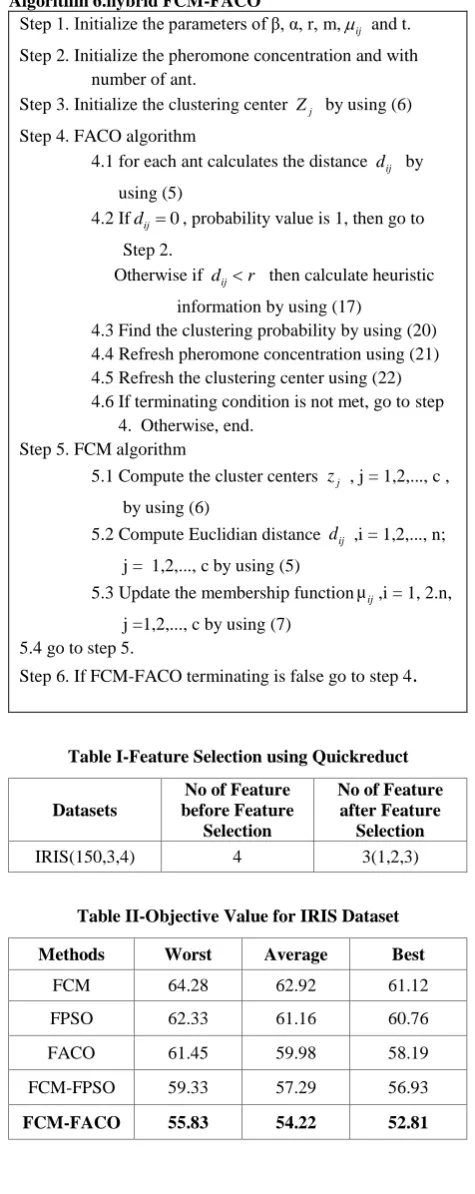
The experimental result of over 100 independent for FCM and 10 independent runs for FPSO, FACO, FPSO and FCM-FACO are summarized in TABLE II based on objective value.
Performance of all cases are illustrate in TABLE II, the hybrid
Algorithm 5.Fuzzy Ant Colony Optimization
Step 1. Initialize the parameters of β, α, r, m,ij and t.
Step 2. Initialize the pheromone concentration and with
number of ant. Step 3. Initialize the clustering center Zj by using (6)
Step 4. For each ant calculates the distance dij by using (5)
Step 5. Ifdij0, probability value is 1, then go to Step 2. Otherwise if dijr then calculate heuristic information by using (17) Step 6. Find the clustering probability by using (20) Step 7. Refresh pheromone concentration using (21) Step 8. Refresh the clustering center using (22)
Step 9. If terminating condition is not met, go to step 4.
Otherwise, end.
Algorithm 6.hybrid FCM-FACO
Step 1. Initialize the parameters of β, α, r, m,ij and t.
Step 2. Initialize the pheromone concentration and with
number of ant. Step 3. Initialize the clustering center Zj by using (6)
Step 4. FACO algorithm 4.1 for each ant calculates the distance dij by
using (5)
4.2 Ifdij0, probability value is 1, then go to Step 2.
Otherwise if dijr then calculate heuristic
information by using (17) 4.3 Find the clustering probability by using (20)
4.4 Refresh pheromone concentration using (21) 4.5 Refresh the clustering center using (22)
4.6 If terminating condition is not met, go to step
4. Otherwise, end. Step 5. FCM algorithm
5.1 Compute the cluster centers zj , j = 1,2,..., c ,
by using (6) 5.2 Compute Euclidian distance dij ,i = 1,2,..., n;
j = 1,2,..., c by using (5) 5.3 Update the membership functionµij,i = 1, 2.n,
[image:5.595.310.548.172.770.2]j =1,2,..., c by using (7) 5.4 go to step 5. Step 6. If FCM-FACO terminating is false go to step 4
.
Table I-Feature Selection using Quickreduct
Datasets
No of Feature before Feature
Selection
No of Feature after Feature
Selection
IRIS(150,3,4) 4 3(1,2,3)
Table II-Objective Value for IRIS Dataset
Methods Worst Average Best
FCM 64.28 62.92 61.12
FPSO 62.33 61.16 60.76
FACO 61.45 59.98 58.19
FCM-FACO obtained the best results other then all methods and iris dataset is escapes from local optima.
The table II is represents objective value of each method and the bold font values are representing best result compare then other methods. So, FCM-FACO is improved method then other methods.
5.
CONCLUSION
The clustering problem is a most important problem in data mining. There are many algorithm has been proposed for clustering. In this paper present a new hybrid with fuzzy c means and fuzzy ant colony algorithm has been applied successfully for real world datasets. The computational results show that the performance of the proposal algorithm is better than other existing algorithms.
6.
REFERENCES
[1] Mehdizadeh.E, Sadi-Nezhad.S and Tavakkoli-Moghaddam.R, Optimization of Fuzzy Clustering Criteria by a Hybrid PSO and Fuzzy C-Means Clustering Algorithm,” Iranian Journal Of Fuzzy Systems Vol. 5, No. 3, (2008).
[2] Jeng-Ming Yih, Yuan-Horng Lin, Hsiang-Chuan Liu,”Clustering Analysis Method based on Fuzzy C-Means Algorithm of PSO and PPSO with Application in Image Data,” ISBN: 978-960-474-028-4, Proceedings of the 8th WSEAS International Conference on Applied Computer Science (Acs'08).
[3] Hesam Izakian a, Ajith Abraham,” Fuzzy C-means and
fuzzy swarm for fuzzy clustering problem,” 0957-4174 2010 Elsevier Ltd., doi:10.1016/j.eswa.2010.07.112
[4] Selvi.V Dr.R.Umarani, “Comparative Analysis of Ant
Colony and Particle Swarm Optimization Technique,” International Journal of Computer Applications (0975 – 8887)Volume 5– No.4, August 2010.
[5] Zhiding Yu, OscarC Au, RuobingZou, WeiyuYu, JingTian, “An adaptive unsupervised approach toward pixel clustering and color image segmentation,”
0031-3203, 2009 Elsevier Ltd,
doi:10.1016/j.patcog.2009.11.015
[6] Velayutham.C and Thangavel.K ,” Unsupervised Quick
Reduct Algorithm Rough Set Theory “Journal of Electronic Science and Technology, Vol. 9, No. 3, September 2011Hg
[7] Zhang.M, Yao J. T, “A Rough Sets Based Approach to
Feature Selection, “University of Regina, Saskatchewan.
[8] Qiang Niu, Xinjian Huang,”An Improved Fuzzy
C-means Clustering Algorithm based on PSO,” Journal Of Software, Vol. 6, no. 5, may 2011.
[9] Peng. W, Wang.k, zhou.c, long.l ,”Fuzzy Disctrete
Particle Swarm Optimization For Solving Traval Salsemen Person,” In Prceedings Of The Fourth International Conference On Computer And Information Technolong, IEEE Cs Press, pp 796-800(2004).
[10] Hesam Izakian a, Ajith Abraham,” Fuzzy C-means and
fuzzy swarm for fuzzy clustering problem,” 0957-4174 2010 Elsevier Ltd., doi:10.1016/j.eswa.2010.07.112
[11] Chandra Mohan.B. Baskaran.R ,”A survey: Ant Colony
Optimization based recent research and implementation on several engineering domain,” 0957-4174, 2011 Elsevier Ltd.
[12] Yanfang Han_, Pengfei Shi, “An improved ant colony algorithm for fuzzy clustering in image segmentation,”
0925-2312 Elsevier
doi:10.1016/j.neucom.2006.10.022,2006
[13] Zhiding Yu, OscarC Au, RuobingZou, WeiyuYu, JingTian, “An adaptive unsupervised approach toward pixel clustering and color image segmentation,”
0031-3203, 2009 Elsevier Ltd,
doi:10.1016/j.patcog.2009.11.015.
[14] Chen Yanyun, Qiu Jianlin, Gu Xiang, Chen Jianping, Ji Dan Chen Li, “Advances in Research of Fuzzy C-Means Clustering Algorithm” , IEEE, 10.1109/NCIS.2011.104.
[15] Szabo.A, de Castro.L.N,” The proposal of a fuzzy clustering algorithm based on particle swarm”, Nature and Biologically Inspired Computing (NaBIC), Third World Congress on 2011, IEEE, 978-1-4577-1122-0.
[16] Sanya, Hainan China,” SVM Combined with FCM and
PSO for Fuzzy Clustering, Seventh International Conference on Computational Intelligence and Security” IEEE, 978-0-7695-4584-4.
[17] Chun-Wei Tsai, Kai-Cheng Hu, Ming-Chao Chiang Chu-Sing Yang, “Ant colony optimization with dual pheromone tables for clustering” Fuzzy Systems (FUZZ), 2011 IEEE International Conference’,978-1-4244-7315-1.