Volume 8– No.1, October 2010
28
Decision Support System for Cotton Bales Blending
Using Genetic Algorithm
Prof. Riyaz A. Sheikh
Faculty-DMSR, Tirpude College of Social Work,
Nagpur.
Dr. Ujwal A. Lanjewar
Officiating Principal, Centre Point College,
Nagpur
ABSTRACT
Traditionally the commercial value of cotton is accessed on the basis of subjective grading. The grade of cotton is decided on the basis of color, trash and ginning preparation, staple length and strength. Characteristics like length variation, fineness and maturity are also taken into account.[14] It is necessary for the cotton spinning mills to produce good quality yarn and that too at a competitive price. The cost and quality of yarn is greatly dependent on the cost and quality of cotton. So, wise selection of cotton and control on the cost at different stages of spinning, weaving, processing and marketing is very essential. It is a common practice in textile mills to mix cottons of different varieties. Hence, it is imperative to select the right cottons for the same, since it is one of the major factors affecting the total yarn cost as well as the final yarn quality.
The objective of this research is to design a decision support system which will optimize the cotton bales blending/mixing so as to reduce the cost of overall cotton cost subject to quality constraint. This paper presents a method of optimization based on genetic algorithms. The Genetic Algorithms are a versatile tool, which can be applied as a global optimization method to problems of mixing, because they are easy to implement to non-differentiable functions and discrete search spaces.[13] The test runs were performed with minimal attention to tuning of the genetic algorithm parameters. In most cases, better performance is possible simply by running the algorithm longer or by varying the selection method, population size or mutation rate.
Keywords
Algorithm, Genetic Algorithm, optimization, population, mutation, crossover, Decision Support system
1.
INTRODUCTION
Cotton is the king of all the fibers and hence treated with royal respect. It is considered to be nature's miraculous fiber and has given tremendous importance to Indian Textile industry. Cotton textile industry laid down the foundation of industrialization in India. Indian Cotton Textile Industry has an Agro-Base character.[14] The major raw material used in this industry is cotton. Cotton industry has now become employment oriented and provides job opportunities to millions of people. The job opportunities are in farming, ginning, processing, cotton
seed crushing, manufacturing of fiber yarns, dyes and chemicals, textile-machinery, spare parts manufacturing, marketing of yarn and territory activities like transport etc. Traditionally the commercial value of cotton is accessed on the basis of subjective grading. The grade of cotton is decided on the basis of color, trash and ginning preparation, staple length and strength. Characteristics like length, variation, fineness and maturity are also taken into account.
It is necessary for the cotton spinning mills to produce good quality yarn and that too at a competitive price. The cost and quality of yarn is greatly dependent on the cost and quality of cotton. So, wise selection of cotton and control on the cost at different stages of spinning, weaving, processing and marketing is very essential. It is a common practice in textile mills to mix cottons of different varieties. Hence, it is imperative to select the right cottons for the same, since it is one of the major factors affecting the total yarn cost as well as the final yarn quality.
It is observed that whenever a company places an order for cotton bales to the ginning mill, the order is processed by randomly selecting the cotton bales to meet the required demand in terms of quantity and quality. There is no use of any scientific base for cotton bales mixing. This results in more consumption of cotton of good quality at low price. So there is a need of a technique for mixing of cotton bales to optimize the use of available cotton.
The Genetic Algorithms are a versatile tool, which can be applied as a global optimization method to problems of mixing, because they are easy to implement to non-differentiable functions and discrete search spaces. The test runs were performed with minimal attention to tuning of the genetic algorithm parameters. In most cases, better performance is possible simply by running the algorithm longer or by varying the selection method, population size or mutation rate.
2. LITERATURE SURVEY
In cotton industry, most of people working at low level are not aware of any scientific method. They normally mix cotton bales randomly by their experience and intuition. There is no uniformity in the mixing of bales of cotton. It is observed that improper blending of cotton bales lead to degrade the quality of output. There is a mathematical technique called as Optimum Qualitative and
quantitative Ration of Blending (OQQRB).It is
29
for blending within few seconds. But it is observed that the solutions are still not the optimum.
Findings/Drawbacks
According to the survey, the existing system has got the following major modes for blending or mixing of cotton bales:
1. In the first notion, mills do not follow Mathematical approach for bales mixing in proportionate qualitatively and quantitatively. 2. Bales blending mostly decide on the basis of cost
and not on the basis of suitable quality parameters.
3. It follows higher production speed rather than focusing on strategies to fully exploits the benefits of optimized raw material utilization. 4. There is no analysis system to provide assistance
throughout the Mill Management Process for blending of cotton bales in godowns.
5. All functions performed are based on only one quality i.e. fibre-length.
6. The people responsible for blending are not aware of the various tools available for optimization.
7. Although OQQRB technique of blending is good but it does not generate optimum solutions. 8. To implement this technique, there is need to
have the knowledge of statistics. 9. It involves lot of calculations.
3. COTTON BALES MIXING USING
GENETIC ALGORITHM
The genetic algorithms (G.A.) are typically characterized by the following aspects:
The G.A. work with the base in the code of the variables group (artificial genetic strings) and not with the variables in themselves.
The G.A. work with a set of potential solutions (population) instead of trying to improve a single solution.
The G.A. do not use information obtained directly from the object function, of its derivatives, or of any other auxiliary knowledge of the same one. The G.A. applies probabilistic transition rules, not deterministic rules.
The genetic algorithm process is quite simple; it only involves a copy string, partial string exchanges or a string mutation, all these in random form.[3]
The basic genetic algorithm that can produce acceptable results in many practical problems is composed of three operators:
Reproduction Crossover Mutation
The reproduction process goal is to allow the genetic information, stored in the good fitness artificial
strings, survive the next generation. The typical case is where the population's string has assigned a value according to its aptitude in the object function. This value has the probability of being chosen as the parent in the reproduction process of a new generation.
The crossover is a process by which a string is divided into segments, which are exchanged with the segments corresponding to another string. With these process two new strings different to those that produced them are generated. It is necessary to clarify that the choice of strings crossed inside those that were chosen previously in the reproduction process is random. From the point of view of problem optimization, it is equal to the exploitation of an area of the parameters space.
As with biological systems the mutation is manifested with a small change in the genetic string of the individuals. In the case of artificial genetic strings, the mutation is equal to a change in the elementary portion (allele) of the individuals' code. The mutation takes place with characteristics different to those that the individuals had at the beginning, characteristics that didn't possibly exist in the population. From the point of view of problem optimization, it is equal to a change of the search area in the parameters space.[10]
The genetic algorithms seek their goal recurrently (by generation), evaluating each individual's aptitude in the object function which is in fact the optimization approach.
Terms commonly used in Cotton Industry
Length: The average length of cotton fiber after the ginning process.
Lint : The cotton fiber obtained by the ginning process once the cotton seed, leaves and casing have been removed.
Foreign matter: Anything that is not part of the cotton plant.
Metric cotton count : An indirect system measuring length per unit of mass i.e. the number of km per half kg.
Micronaire : The size of an individual cotton fiber taken in cross section.
Strength: power of the fiber to sustain the application of force without breaking.
Uniformity: The degree to which the fibers in a sample are uniform based on the ratio of mean length to the upper half mean length. Given as a percentage.
Grade: Official US classification system given to lint to describe its quality in terms of colour and leaf content.
Problem Formulation
Minimize Cost = ΣCi Xi Subject toQuality(PFP = (L X S X UR%) X ( - F))> Q Xi < D
D = Σ Xi
Where (Ci,Xi,Q,D) > 0 Assumptions
Volume 8– No.1, October 2010
30
of cotton)
= 6 (Constant Factor)
For mixing weighted average formula is used
Each type of cotton bales are available in equal quantity.
4. DATA USED FOR TESTING
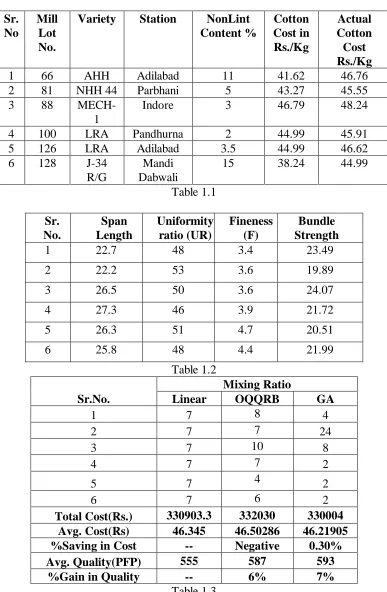
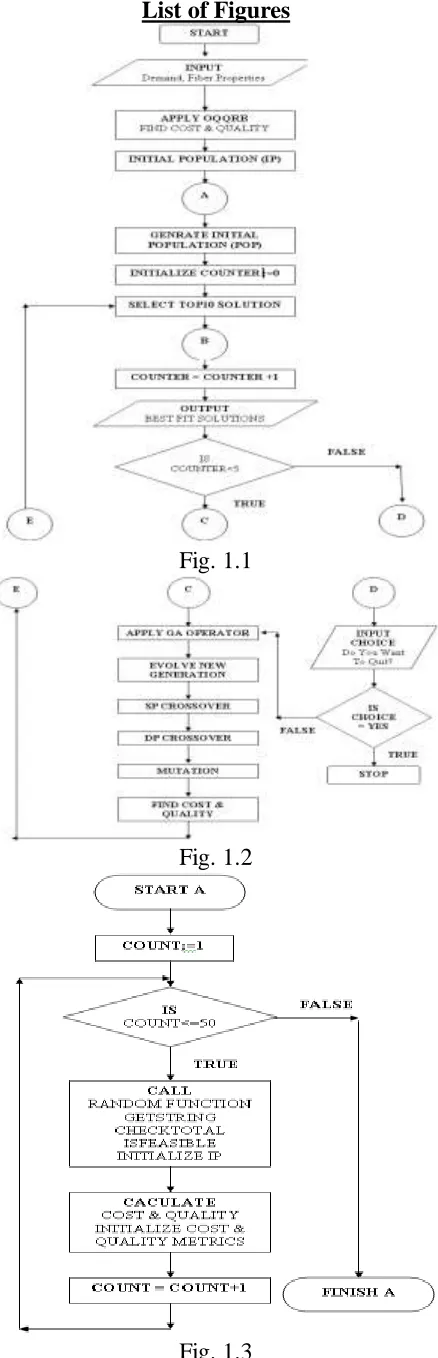
See Table 1.1 & 1.2GA Flowchart See Fig. 1.1, 1.2 & 1.3 Graphical Representation See graph 1.1 & 1.2
The above graph shows the possible solutions for mixing of cotton bales. The graph is drawn for Generation Vs. Quality and Generation Vs. Cost. As shown in graph 1.1, the minimum cost is found subject to quality constraint as shown in graph 1.2.
See graph 1.3 & 1.4
The above graph shows the mixing ratio. There are three methods applied. As shown, GA satisfies the demand requirement subject to quality and cost constraint.
5. GA RESULTS
See table 1.3As shown in the table 1.3 , there is definite reduction in cost without affecting the quality of product. It is observed that the quality of output get increased substantially. As compare to available methods of mixing, GA can reduce the cost without affecting the quality. From study it is found that a company blend around 500 bales per day. Hence With proper application of GA, company can save Rs. 10,000 to 15,000 Per day.
6. CONCLUSION
Indian Textile industry largely depends on cotton fibre. There is a need of proper utilization of this natural resource. From the above case, it is proved that genetic algorithm can help cotton industry to improve the efficiency of cotton bales mixing. With the help of GA, cost of product can be reduced to greater extent. The quality of cotton bales mixing can be improved in the range of 7% to 15%. This tool can save up to Rs. 10,000 to Rs. 15,000 per day for a company. This will increase the profit of the company. It will also help to optimize the use of available cotton varieties.
REFERENCES
[1] Ariel Dolan, GA Playground Documentation, www.aridolan.com/ga/gaa/gaa.html, 9th December 2006 Wikipedia - The Free Encyclopedia, Entry for Genetic Algorithm,
[2] Bundy, Alan (Ed.), Artificial Intelligence Techniques; A Comprehensive Catalogue. Springer Publishing, Section 104.
[3] Darell Whitley, “A Genetic Algorithm tutorial”
[4] Deb K, Anand A. & Joshi D. (2002), A computationally Efficient Evolutionary Algorithm for Real Parameter Optimization, KanGAL report: 2002003 [5] Deb K, Mohan M. & Mishra S. (2003), A Fast Multi-objective Evolutionary Algorithm for Finding Well-Spread Pareto-Optimal Solutions. KanGAL Report No. 2003002
[6] Deb K. (2002), Multi-objective Optimization using Evolutionary Algorithms. John Willy And Sons Ltd [7] Deb K. (2003), A Population-Based Algorithm-Generator for Real-Parameter Optimization. KanGAL Report No. 2003003
[8] Deb K. (2004), Single and Multi-Objective Optimization Using Evolutionary Algorithms. KanGAL Report No. 2004002
[9] DeSantics, G. and Gullupe, B., Group Decision Support Systems: A new frontier, Database , Winter, 1985.
[10] Dr N.R. Bandyopadhyay, Dr P.P. Chattopadhyay , Dr Shubhabrata Datta, “International Workshop On Neural Network And Genetic Algorithm In Material Science And Engineering”, Tata Mcgraw-Hill
[11] en.wikipedia.org/wiki/Genetic-algorithm, March 2006. Wikipedia - The Free Encyclopedia, Entry for Crossover Strategies, en.wikipedia.org/wiki/Crossover-genetic-algorithm, March 2006.
[12] Falkenauer, Emanuel. 1997. Genetic Algorithms and Grouping Problems. John Wiley
[13] Goldberg D, “Genetic Algorithms in Search, Optimization and Machine Learning Reading”, MA Addison Wesley
[14] http://www.cottonnetwork.org/report-2/research-india.htm
[15] NASA Website, Exploring the Universe
-Evolvable Systems,
http://www.nasa.gov/centers/ames/research/exploringtheu niverse/exploringtheuniverseevolvablesystems. html [16] R. Panneerselvam, Operation Research, Prentice Hall Publication, New Delhi
[17] Randy L. Haupt, Sue Ellen Haupt , “Practical Genetic Algorithms” John wiley & Sons
[18] Srinivas N. & Deb K. (1994), Multi-objective optimization using non-dominated sorting in genetic algorithms. Evolutionary Computation, 2(3), 221-248 [19] Turban, E., Decision support and Expert Systems: Management Support Systems , Macmillan, New York, 1990.
[20] V.K. Kapoor, Operation Research-Tools and techniques, S.Chand Publication, New Delhi