http://dx.doi.org/10.4236/jbbs.2014.49042
How to cite this paper: Martínez-Sanchis, S., Bernal, M.C., Costa, A. and Gadea, M. (2014) Abnormal Linguistic Lateraliza-tion and Sensory Processing in High FuncLateraliza-tioning Children with Autism Spectrum CondiLateraliza-tions. Journal of Behavioral and Brain Science, 4, 432-442. http://dx.doi.org/10.4236/jbbs.2014.49042
Abnormal Linguistic Lateralization and
Sensory Processing in High Functioning
Children with Autism Spectrum Conditions
Sonia Martínez-Sanchis1,2*, María Consuelo Bernal3,4, Ana Costa5, Marien Gadea1,4
1Department of Psychobiology, University of Valencia, Valencia, Spain
2Neurodevelopmental Disorders Research Unit, University of Valencia, Valencia, Spain 3Department of Social Psychology, University of Valencia, Valencia, Spain
4IDOCAL, University of Valencia, Valencia, Spain
5Pediatric Neurorehabilitation Unit, Hospital of Manises, Valencia, Spain
Email: *[email protected]
Received 10July 2014; revised 26August 2014; accepted 13September 2014
Copyright © 2014 by authors and Scientific Research Publishing Inc.
This work is licensed under the Creative Commons Attribution International License (CC BY).
http://creativecommons.org/licenses/by/4.0/
Abstract
Brain lateralization for language in high-functioning children with autism spectrum conditions (ASC) and sensory processing were explored as a part of a neuropsychological profile. A dichotic listening test and the Luria laterality subtest were administered to all participants (including con-trols) and the sensory profile test only to the ASC group. The usual right ear advantage was not ex-hibited by children with ASC and anomalies in auditory filtering were found. The sensory profile of 60% of the sample was characterized by hypersensitivity to auditory stimuli, hyposensitivity to vestibular information, high emotional reactions to sensory experiences, poor psychosocial coping strategies, high distractibility and inability to interpret body and facial language. Hyper-respon- siveness to environmental auditory stimuli was significantly associated with impaired attention. Similarly, non-adaptive responses to sensory quotidian experiences were strongly connected to poor coping strategies. Our results, although preliminary, contribute to emphasizing the impor-tance of including additional assessment methods such as the dichotic listening and the sensory profile questionnaire in the evaluation of cognitive profile in high-functioning children with ASC to plan an individualized psycho-educative intervention.
Keywords
Children, High-Functioning Autism, Linguistic Lateralization, Neuropsychology, Sensory Profile
1. Introduction
People with autism spectrum conditions (ASC) exhibit a neuropsychological pattern which includes some of the behavioral diagnostic markers such as communication impairments and poor social cognition. However, on the whole, the neuropsychological profile is much wider and is characterized by enhanced bottom-up information processing, lack of accurate global integration of data from different sources (top-down processing) and an ab-errant sensory profile (hypo-, hyper-responsiveness and seeking behavior). Several authors consider these neuropsychological features to be powerful influencing factors which contribute to communication problems and strong adherence to routines [1]-[4].
Between 60% and 95% of people with ASC characteristically exhibit an unusual sensory profile [5]-[8]. In fact, the presence and limiting effect of sensory perception abnormalities have been considered sufficiently im-portant to include them as one of the behavioral markers in the domain of the restricted and repetitive behaviors in the DSM-V [9]. Some authors argue that, because of their high incidence, specificity and their presence along the life span, these sensory symptoms have become good candidates to be added to the nuclear characteristics that define this type of disorder [7] [10]. Hypersensitivity to several sounds, tactile defensiveness or texture food rejections (hypersensitivity to tactile stimuli) are among the first noticeable red flag signs, even prior to those which refer to social interaction deficits. Furthermore, first concerns in parents of children with ASC previous to the diagnosis are also hearing impairment, severe attention deficits or behavioral problems, which could be re-lated to sensory issues. In early childhood, many of these children do not usually respond to their name or follow verbal instructions which could reflect auditory processing alterations such as discrimination, modulation or in-tegration difficulties. Moreover, there are many studies that indicate the existence of anomalies in auditory processing of language and reduced language left lateralization in the majority of individuals with autism (see for a review [11] [12]). Russo, Zecker, Trommer, Chen, and Kraus [13], using evoked potentials, showed how the auditory processing of children with high-functioning ASC in a quiet ambience is identical to that of children with neurotypical development in a noisy environment. Thus, there is evidence of problems in auditory process-ing of language at the central nervous level. Additionally, they do not benefit from visual cues such as lip read-ing, which would be a disadvantage in an excessively noisy ambience [14] [15]. Although several works have studied the laterality pattern for speech and language in ASC using EEG, MEG and fMRI, only a few aimed to relate this issue with the sensory processing problems. Orekhova et al. [16] and Stroganova et al. [17] found a strong correlation between the degree of sensory abnormalities, the presence of abnormal arousal, and an atypi-cal hemispheric lateralization of the P100m component of auditory magnetic field response.
2. Methods
2.1. ParticipantsThe total sample consisted of thirty-five 6-year-old male children without intellectual disability (cognitive de-velopment previously evaluated by the psychologists in each center), hearing loss (assessed through threshold tonal audiometry), or visual impairment.
The ASC group included 17 individuals with diagnoses established by a psychologist and a pediatric neurolo-gist with ASC expertise (according to DSM-IV: Autistic Disorder, Asperger’s Syndrome or Pervasive Devel-opmental Disorder, Not Otherwise Specified). Diagnoses were corroborated by the ADOS [28]. These children were recruited from “Psicotrade”, a specialized autism center in Valencia (Spain).
An age-matched control group was formed by 18 boys with no evidence of sensory processing impairment, speech/language disorder or learning disabilities. These participants were recruited randomly from “Esclavas de María” school in Valencia (Spain).
2.2. Procedure
After collecting written informed parental consent and data about socio-demographic characteristics, an audi-ometry of each of the subjects was carried out in the speech frequency (2000 Hz) in order to check that they showed no hearing loss. If they met the audiometric inclusion criteria (<10 dB difference between ears at 500, 1000, 2000, 3000 and 6000 Hz), the DL test and the Luria laterality subtest were administered. The sessions lasted around 40 minutes and took place in the morning in a quiet room. Only parents of the ASC children filled in the sensory profile (SP) questionnaire regarding sensory responsiveness exhibited by their sons in quotidian situations. It was administered and interpreted by an occupational therapist specialized in sensory modulation and integration disorders and this professional also gave assistance during the administration of the test. The study was approved by the ethics committee of clinical investigation at the University of Valencia (Spain) and was in accordance with the ethical standards in human research, contained in the Helsinki Declaration of 1975, as revised in 2000 (http://www.wma.net/en/30publications/10policies/b3/index.html).
2.3. Dichotic Listening
This standard Consonant-Vowel DL test assesses hemispheric processing and ear preference using variables such as attention, concentration or type of information to be processed [29]. It has been widely validated through different studies [30]-[32] and reaches a test-retest reliability of 0.86 [29]. The children were asked to report only the syllables which were perceived the most clearly after being informed that they would be presented si-multaneously to each ear (monosyllables at the standard frequency of the human voice of 2000 Hz). The sylla-bles reproduced are TA, KA, GA, PA, BA and DA. Firstly, they are each paired with themselves in order to en-sure that the participants are able to recognize them without any problem. All syllables are then paired between themselves, forming 60 pairs (30 initial and homonyms, for example KA-GA, GA-KA). These combinations are made so that each syllable of the pair is heard by each ear, subjects being instructed to verbalize aloud what they hear. Scoring is carried out by taking into account which of the two syllables, presented at the same time, is identified and correctly pronounced.
2.4. Luria Manual Laterality Test (Standardized for Spanish Children by [33])
This is a complementary test of the Luria Initial Battery which evaluates motor ability in young children (4 to 6 years old), testing differences in the use of both hands by observing their performance while carrying out activi-ties. This task is based on the neuropsychological Luria-Nebraska Battery (for children aged 12 and older) [34]. It consists of five tasks: writing, drawing, throwing a ball, using scissors, and brushing teeth. The laterality pref-erence quotient is obtained in order to classify subjects according to the preferred hand: (right hand score – left hand score) × 10.
2.5. Sensory Profile (SP; [35])
in-volved in functional or dysfunctional performance. It is composed of 125 items rated with a five-point Likert scale (from never to always) and evaluates responses to tactile, olfactory, gustatory, vestibular, auditory and visual stimuli. All items are classified into 14 sections which are grouped into three categories (sensory pro- cessing, modulation, and behavioral/emotional responses). Additionally, 9 factors can be identified (see Table 1). The possible scores are organized into three groups (typical performance, probable difference or definite dif-ference) in accordance with the performance of a population sample of children without disabilities (n = 1307); lower scores indicate greater symptoms. Probable difference corresponds to scores greater than 1 SD and less than 2 SD from the mean, and definite differences to scores greater than 2 SD from the normative mean. Internal consistency based upon Cronbach’s alpha ranges from 0.47 to 0.91 and the internal validity correlations ranges from 0.25 to 0.76 [40].
2.6. Statistical Analysis
Normality (Kolmogorov-Smirnov) and homogeneity of variances (Levene) were checked for all variables.
Table 1.Sensory profile item categories.
A. Sensory Processing
1 Auditory Processing Responses to things heard (e.g., “is distracted or has trouble functioning if there is a lot of noise around”)
2 Visual Processing Responses to things seen (e.g., “is bothered by bright lights after others have adapted to the light”)
3 Vestibular Processing Responses to movement (e.g., “becomes anxious or distressed when feet leave the ground”)
4 Touch Processing Responses to stimuli that touch the skin (e.g., “becomes irritated by shoes or socks”)
5 Multisensory Processing Responses to activities that contain a combined sensory experience (e.g., “seems oblivious within an active environment”)
6 Oral Sensory Processing Responses to touch and taste stimuli to the mouth (e.g., “limits self to particular food textures/temperatures”)
B. Modulation
7 Sensory Processing Related to Endurance/Tone Ability to sustain performance
8 Modulation Related to Body Position and Movement Ability to move effectively
9 Modulation of Movement Affecting Activity Level Demonstration of activeness
10 Modulation of Sensory Input Affecting Emotional Responses Ability to use body senses to generate emotional responses
11 Modulation of Visual Input Affecting Emotional Responses
and Activity Ability to use visual cues to establish contact with others
C. Behavioural and Emotional Responses
12 Emotional/Social Responses Psychosocial coping strategies
13 Behavioural Outcomes of Sensory Processing Ability to meet performance demands
14 Items Indicating Thresholds for Response Level of modulation
Factor Scores
1 Sensation Seeking Interest in and pleasure with sensory experiences in everyday life
2 Emotionally Reactive Affective responses to sensory experiences in everyday life
3 Low Endurance/Tone Ability to use muscle tone to support self while engaging in activity
4 Oral Sensory Sensitivity Responses to textures, tastes and smells, particularly related to foods
5 Inattention/Distractibility Tendency to be pulled away from activities due to external stimuli, particularly sounds
6 Poor Registration Tendency to miss cues from sensory experiences in everyday life
7 Sensory Sensitivity Level of detection of movement stimuli during everyday life experiences
8 Sedentary Tendency to be passive during everyday life
Means of test scores and standard deviations for the different groups (ASD and control) were calculated. For DL, ANOVA with repeated measures was performed on the correctly reported items according to the design: 2 (Ear input: right vs. left) × 2 (Group: ASD vs. control). Post-hoc DHS Tukey tests were applied when corresponding. Afterwards, the means of the differences and their 95% confidence intervals were obtained to compare per-formance between both groups in the tests. Due to the size of the sample, Cohen’s d index was calculated to es-tablish the magnitude of the effects of t tests [36]. Finally, the correlation between raw scores of each ear was explored with the Pearson test in each group. Concerning the sensory data, percentages of definite and probable differences regarding typical performance were calculated and Pearson’s Correlations between each of the SP components were obtained. SPSS for Windows version 19 was used for data analysis.
3. Results
According to the Luria Laterality Test, all subjects included in the sample were totally or preferably right- handed.
3.1. DL
Three ASC children were excluded from the DL data due to reluctance to put on the headphones in two of them and the presence of perseverations during the test in one child (e.g. more than 25 “Ka” responses). Thus, the sample for DL data consisted of 14 ASC and 18 control children.
All variables were normally distributed (Kolmogorov-Smirnov test: p > 0.05) and variance was homogeneous (Levene test: p > 0.05). The ANOVA based on the children’s data showed a significant main effect for the factor Group (F (1, 30) = 62.383, MSE = 675.22, p < 0.001) due to overall better accuracy for the control group (Mean of correctly reported items = 26.58, range 25.46 - 27.7) than for the ASC group (Mean of correctly reported items = 20.04, range 18.77 - 21.30). The main effect for the factor ear was significant (F (1, 30) = 5.273, MSE = 118.08, p < 0.05), the performance for the right ear was superior (Mean = 24.68, range 23.06 - 26.30) than for the left ear (Mean = 21.94, range 20.61 - 23.27). Finally, the Ear × Group interaction was also significant (F (1, 30) = 6.738, MSE = 150.89, p < 0.05). Post-hoc comparisons revealed that the group of controls showed a REA (t (17) = 3.947, p < 0.001), while the group of ASC did not show this otherwise typical REA (t (13) = −0.185, p = 0.856). Moreover, controls showed a significantly higher number of correct right ear items than ASC (t (30) = −6.070, p < 0.001), as well as a significantly higher number of left ear items than ASC, although to a lesser de-gree (t (30) = −2.652, p < 0.05). Figure 1depicts performance for both ears in each group. Finally, the Pearson correlations showed that the right and left ear scores were inversely correlated for controls (r = −0.629, p < 0.01), but not for the group of ASC (r = −0.162, p = 0.579).
3.2. SP
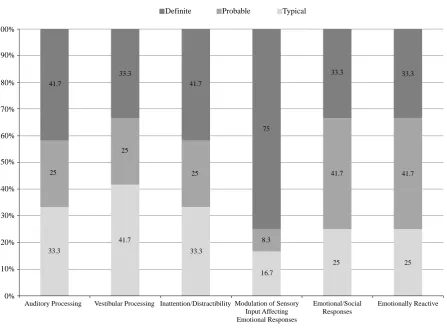
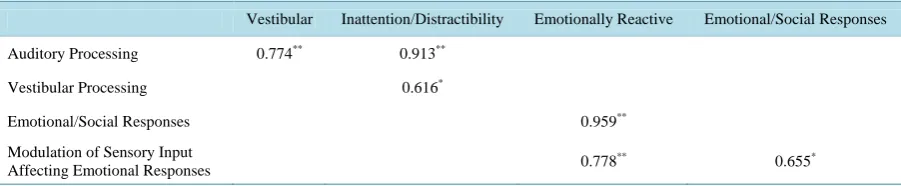
Taking into account the SP data, more than 50% of the ASC sample showed differences (probable and definite) with respect to typical performance in inattention/distractibility, auditory and vestibular processing, modulation of sensory input affecting emotional responses, emotional and social responses and, in the emotionally reactive factor (seeFigure 2 and Table 2). The sensory profile of the sample was characterized by hypersensitivity to auditory stimuli, hyposensitivity to vestibular information, high emotional reactions to sensory experiences, poor psychosocial coping strategies, high distractibility and inability to interpret body and facial language. Table 3 shows the analysis of total scores from SP categories, which revealed a significant correlation. Inattention/dis- tractibility correlated significantly with auditory (p < 0.01) and vestibular (p < 0.05) processing modalities. Ad-ditionally, a significant correlation was found between the last two (p < 0.01). Similarly, modulation of sensory input affecting emotional responses, emotional/social responses, and emotionally reactive variables correlated significantly between one another (p < 0.01 and p < 0.05). All these correlations indicate that if a lower score was found in one of these modalities, a lower score was more likely to be found in the other.
4. Discussion
0 5 10 15 20 25 30 35 ASC CONTROL Left ear Right ear
2.23 0.98
Huge Large
[image:6.595.171.456.87.327.2]effect effect Effect size Cohen’s (d) M E AN C OR R E C T R E S P ONS E
Figure 1.Differences between high-functioning children with ASC and con-trols in the mean correct response of right and left ear (Means and Standard Errors provided). *p < 0.001, +p < 0.05.
Auditory Processing Vestibular Processing Inattention/Distractibility Emotional/Social Emotionally Reactive Responses
Modulation of Sensory Input Affecting Emotional Responses 0% 10% 20% 30% 40% 50% 60% 70% 80% 90% 100%
Definite Probable Typical
41.7
33.3
41.7
75
33.3 33.3
25
25
25 41.7 41.7
8.3
33.3 33.3
41.7
25 25
16.7
[image:6.595.89.537.370.698.2]Table 2.Percentages of children who always or frequently displayed behaviors on the SP.
Item %
Auditory Processing
1. Responds negatively to unexpected or loud noises (for example, cries or hides at noise from vacuum cleaner,
dog barking, hair dryer) 33.3
2. Holds hands over ears to protect ears from sound 16.7
3. Has trouble completing tasks when the radio is on 25.0
4. Is distracted or has trouble functioning if there is a lot of noise around 50.0
5. Can’t work with background noise (for example, fan, refrigerator) 16.7
6. Appears to not hear what you say (for example, does not “tune-in” to what you say, appears to ignore you) 25.0
7. Doesn’t respond when name is called but you know the child’s hearind is OK 16.7
8. Enjoys strange noises/seeks to make noise for noise’s sake 25.0
Vestibular Processing
18. Becomes anxious or distressed when feet leave the ground 8.3
19. Dislikes activities where head is upside down (for example, somersaults, roughhousing) 16.7
20. Avoids playground equipment or moving toys (for example, swing set, merry-go-round) 8.3
21. Dislikes riding in a car 0.0
22. Holds head upright, even when bending over or leaning (for example, maintains a rigid position/posture during activity) 0.0 23. Becomes disoriented after bending over sink or table (for example, falls or gets dizzy) 0.0 24. Seeks all kinds of movement and this interferes with daily routines (for example, can’t sit still, fidgets) 33.3 25. Seeks out all kinds of movement activities (for example, being whirled by adult, merry-go-rounds, playground equipment) 25.0
26. Twirls/spins self frequently throughout the day (for example, likes dizzy feeling) 8.3
27. Rocks unconsciously (for example, while watching TV) 0.0
28. Rocks in desk/chair/on floor 0.0
Modulation of Sensory Input Affecting Emotional Responses
92. Needs more protection from life than other children (for example, defenseless physically or emotionally) 41.7
93. Rigid rituals in personal hygiene 25.0
94. Is overly affectionated with others 41.7
95. Doesn’t perceive body language or facial expressions (for example, unable to interpret) 50.0
Emotional/Social Responses
100. Seems to have difficulty liking self (for example, low self-esteem) 16.7
101. Has trouble “growing up” (for example, reacts immaturely to situations) 50.0
102. Is sensitive to criticisms 50.0
103. Has definite fears (for example, fears are predictable) 41.7
104. Seems anxious 33.3
105. Displays excessive emotional outbursts when unsuccessful at a task 50.0
106. Expresses feeling like a failure 16.7
107. Is stubborn or uncooperative 33.3
108. Has temper tantrums 25.0
109. Poor frustration tolerance 33.3
110. Cries easily 41.7
111. Overly serious 8.3
112. Has difficulty making friends (for example, does not interact or participate in gropu play) 33.3
113. Has nightmares 0.0
114. Has fears that interfere with daily routine 25.0
115. Doesn’t have a sense of humor 16.7
116. Doesn’t express emotions 0.0
Emotionally Reactive
121. Has difficulty tolerating changes in plans and expectations 16.7
122. Has difficulty tolerating changes in routines 25.0
Inattention/Distractibility
48. Has difficulty paying attention 50.0
49. Looks away from tasks to notice all actions in the room 58.3
Table 3.Pearson correlation coefficients among sensory variables (**p < 0.01, *p < 0.05).
Vestibular Inattention/Distractibility Emotionally Reactive Emotional/Social Responses
Auditory Processing 0.774** 0.913**
Vestibular Processing 0.616*
Emotional/Social Responses 0.959**
Modulation of Sensory Input
Affecting Emotional Responses 0.778
** 0.655*
persons with ASC, only a few studies have been carried out in high-functioning children with ASC. Additionally, scarce literature has been published in the ASC field using the DL task, which has been proved to be a reliable non-invasive instrument to evaluate language laterality and hemisphere functioning in typically developing con-trols and clinical conditions [37].
Contrary to results found in controls, individuals from the ASC group did not exhibit either the REA or the significant negative correlation between data from both ears, which could indicate an abnormal linguistic later-alization pattern (either bilateral or mixed processing dominance) and a lack of interhemispheric integration of the information. The latter was found in fathers but not mothers of this ASC sample, supporting the existence of a certain genetic vulnerability [38]. In a recent systematic review, Lindell and Hudry [11] have stated that con-tradictory results found in the previous studies using DL in children with ASC could be due to the sample size. For these authors, a sample of 19 subjects is enough to power the analysis as in the study carried out by Prior and Bradshaw [26], although up to date there has been no replication. In the current study, size effect was calcu-lated (Cohen’s d and r) and revealed that the differences between groups were large or huge (see Figure 1). Nevertheless, it would be convenient in future research to increase the sample and the age interval, and also in-clude other comparison groups with sensory modulation difficulties without ASC.
Cardinale, Shih, Fishman, Ford, and Müller [39] have examined hemispheric asymmetry of several functional networks in a group of high-functioning children and adolescents (9 - 18 years old) and found an atypical right-ward asymmetry not only in the auditory network but also in components involved in visual, sensorimotor, visuospatial, executive and attentional processing. These findings support the strong association between ab-normal linguistic lateralization and atypical sensorimotor processing in ASC. Ludlow et al. [40] in high-func- tioning children with ASC found that the greater the sensory disturbances (especially auditory sensitivity) the worse the auditory processing during automatic language tasks (using event-related potentials to meaningless and meaningful speech stimuli).
In concordance with previous studies, modulation disorders in more than one sensory channel were found in our sample. The sensory profile of our sample of children with ASC was characterized by auditory hypersensi-tivity, vestibular hyposensitivity and high distractibility. This profile is similar to the postural inattentive subtype, one of the four subtypes described by Lane et al. [41], and is characterized by an under-responsive seeking sen-sation as well as difficulties in postural processing and auditory filtering. The sensory symptoms are frequently associated with increased autism severity and contribute to social interaction [41] [42]. Hence, although people with high-functioning ASC have no intellectual disability, their sensory quotidian difficulties should not be un-derestimated considering their impact on communication and social cognition [43]. One of the main recent asso-ciations between sensory disturbances and the core ASC features is sensory hyper-responsiveness and commu-nication competence [41]. Taking into account this relationship, we could conclude that as soon as the children are overloaded by auditory information, especially when it is verbal, attention could be seriously impaired. At vestibular level, many people within the autistic spectrum are hypo-responsive and seek this type of stimulation by spinning and rocking themselves, and in our sample this pattern seems to be related to the distractibility and auditory hyper-responsiveness exhibited [42]. Similarly, the intense affective responses to quotidian sensory experiences were closely associated with poor coping strategies and impairments in the interpretation of body and facial language, as revealed by the correlations.
5. Conclusion
allow professionals to build a profile about cognitive deficits and strengths in order to orientate the intervention from a multidisciplinary approach, including not only psychologists, pedagogues or speech therapists but also occupational therapists. Moreover, in terms of research, it would allow the exploration of variations throughout the spectrum. The collection of data referring to language lateralization and the sensory profile would allow professionals to design individualized intervention protocols including sensory-based therapies [44], and psy-cho-educative strategies based on structured teaching relying on visual information like the TEACCH program (Treatment and Education of Autistic and related Communication-handicapped Children [45] [46]).
Acknowledgements
The authors especially wish to thank all the children who participated in the study and their families. They would also like to express their gratitude to staff from “Esclavas de María” school, “Psicotrade” center and Pro-ject Autism Association (ASPAU) for their collaboration.
References
[1] Donnellan, A.M., Hill, D.A. and Leary, M.R. (2013) Rethinking Autism: Implications of Sensory and Movement Dif-ferences for Understanding and Support. Frontiers in Integrative Neuroscience, 6, 124.
http://dx.doi.org/10.3389/fnint.2012.00124
[2] Hilton, C., Graver, K. and LaVesser, P. (2007) Relationship between Social Competence and Sensory Processing in Children with High Functioning Autism Spectrum Disorders. Research in Autism Spectrum Disorders, 1, 164-173.
http://dx.doi.org/10.1016/j.rasd.2006.10.002
[3] O’Connor, K. and Kirk, I. (2008) Brief Report: Atypical Social Cognition and Social Behaviours in Autism Spectrum Disorder: A Different Way of Processing Rather Than an Impairment. Journal of Autism Developmental Disorders, 38, 1989-1997. http://dx.doi.org/10.1007/s10803-008-0559-5
[4] Reynolds, S., Bendixen, R., Lawrence, T. and Lane, S.J. (2011) A Pilot Study Examining Activity Participation, Sen-sory Responsiveness, and Competence in Children with High Functioning Autism Spectrum Disorder. Journal of Au-tism and Developmental Disorders, 41, 1496-1506. http://dx.doi.org/10.1007/s10803-010-1173-x
[5] Baker, A.E.Z., Lane, A., Angley, M.T. and Young, R.L. (2008) The Relationship between Sensory Processing Patterns and Behavioural Responsiveness in Autistic Disorder: A Pilot Study. Journal of Autism and Developmental Disorders,
38, 867-875. http://dx.doi.org/10.1007/s10803-007-0459-0
[6] Baranek, G.T., Boyd, B., Poe, M.D., David, F.J. and Watson, R.L. (2007) Hyperresponsive Sensory Patterns in Young Children with Autism, Developmental Delay and Typical Development. American Journal of Mental Retardation, 112, 233-245. http://dx.doi.org/10.1352/0895-8017(2007)112%5B233:HSPIYC%5D2.0.CO;2
[7] Ben-Sasson, A., Hen, L., Fluss, R., Cermak, S.A., Engel-Yeger, B. and Gal, E. (2009) A Meta-Analysis of Sensory Modulation Symptoms in Individuals with Autism Spectrum Disorders. Journal of Autism Developmental Disorders,
39, 1-11. http://dx.doi.org/10.1007/s10803-008-0593-3
[8] Tomcheck, S.D. and Dunn, W. (2007) Sensory Processing in Children with and without Autism: A Comparative Study Using the Short Sensory Profile. American Journal of Occupational Therapy, 61, 190-200.
http://dx.doi.org/10.5014/ajot.61.2.190
[9] American Psychiatric Association (APA) (2013) DSM-V Diagnostic and Statistical Manual of Mental Disorders. 5th Edition, American Psychiatric Association, Washington, DC.
[10] Tavassoli, T., Miller, L.J., Schoen, S.A., Nielsen, D.M. and Baron-Cohen, S. (2014) Sensory Over-Responsivity in Adults with Autism Spectrum Conditions. Autism, 18, 428-432. http://dx.doi.org/10.1177/1362361313477246
[11] Lindell, A.K. and Hudry, K. (2013) Atypicalities in Cortical Structure, Handedness, and Functional Lateralization for Language in Autism Spectrum Disorders. Neuropsychology Review, 23, 257-270.
http://dx.doi.org/10.1007/s11065-013-9234-5
[12] Nielsen, J.A., Zielinski, B.A., Fletcher, P.T., Alexander, A.L., Lange, N., Bigler, E.D., Lainhart, J.E. and Anderson, J.S. (2014) Abnormal Lateralization of Functional Connectivity between Language and Default Mode Regions in Autism. Molecular Autism, 5, 8. http://dx.doi.org/10.1186/2040-2392-5-8
[13] Russo, N., Zecker, S., Trommer, B., Chen, J. and Kraus, N. (2009) Effects of Background Noise on Cortical Encoding of Speech in Autism Spectrum Disorders. Journal of Autism Developmental Disorders, 39, 1185-1196.
http://dx.doi.org/10.1007/s10803-009-0737-0
http://dx.doi.org/10.3389/fnhum.2010.00237
[15] Iarocci, G., Rombough, A., Yager, J., Weeks, D.J. and Chua, R. (2010) Visual Influences on Speech Perception in Children with Autism. Autism, 14, 305-320. http://dx.doi.org/10.1177/1362361309353615
[16] Orekhova, E.V., Tsetlin, M.M., Butorina, A.V., Novikova, S.I., Gratchev, V.V., Sokolov, P.A., Elam, M. and Stroga- nova, T.A. (2012) Auditory Cortex Responses to Clicks and Sensory Modulation Difficulties in Children with Autism Spectrum Disorders (ASD). PloS ONE, 7, e39906. http://dx.doi.org/10.1371/journal.pone.0039906
[17] Stroganova, T.A., Kozunov, V.V., Posikera, I.N., Galuta, I.A., Gratchev, V.V. and Orekhova, E.V. (2013) Abnormal Pre-Attentive Barousal in Young Children with Autism Spectrum Disorder Contributes to Their Atypical Auditory Be- havior: An ERP Study. PloS ONE, 8, e69100. http://dx.doi.org/10.1371/journal.pone.0069100
[18] Westerhausen, R. and Hugdahl, K. (2008) The Corpus Callosum in Dichotic Listening Studies of Hemispheric Asym- metry: A Review of Clinical and Experimental Evidence. Neuroscience and Biobehavioral Reviews, 32, 1044-1054.
http://dx.doi.org/10.1016/j.neubiorev.2008.04.005
[19] Hardan, A.Y., Pabalan, M., Gupta, N., Bansal, R., Melhem, N.M., Fedorov, S., Keshavan, M.S. and Minshew, N.J. (2009) Corpus Callosum Volume in Children with Autism. Psychiatry Research: Neuroimaging, 174, 57-61.
http://dx.doi.org/10.1016/j.pscychresns.2009.03.005
[20] Just, M.A., Cherkassky, V.L., Keller, T.A., Kana, R.K. and Minshew, N.J. (2007) Functional and Anatomical Cortical Underconnectivity in Autism: Evidence from an fMRI Study of an Executive Function Task and Corpus Callosum Morphometry. Cerebral Cortex, 17, 951-961. http://dx.doi.org/10.1093/cercor/bhl006
[21] Kana, R.K., Keller, T.A., Cherkassky, V.L., Minshew, N.J. and Just, M.A. (2006) Sentence Comprehension in Autism: Thinking in Pictures with Decreased Functional Connectivity. Brain, 129, 2484-2493.
http://dx.doi.org/10.1093/brain/awl164
[22] Arnold, G. and Schwartz, G.E. (1983) Hemispheric Lateralization of Language in Autistic and Aphasic Children. Jour- nal of Autism and Developmental Disorders, 13, 129-139. http://dx.doi.org/10.1007/BF01531814
[23] Blackstock, E.G. (1978) Cerebral Asymmetry and the Development of Early Infantile Autism. Journal of Autism and Childhood Schizophrenia, 8, 339-353. http://dx.doi.org/10.1007/BF01539636
[24] Hayashi, M., Takamura, I., Kohara, H. and Yamazaki, K. (1989) A Neurolinguistic Study of Autistic Children Emplo- ying Dichotic Listening. The Tokai Journal of Experimental and Clinical Medicine, 14, 339-345.
[25] McCann, B.S. (1982) Hemispheric Asymmetries and Early Infantile Autism. Journal of Autism and Developmental Disorders, 11, 401-411. http://dx.doi.org/10.1007/BF01531615
[26] Prior, M.R. and Bradshaw, J.L. (1979) Hemisphere Functioning in Autistic Children. Cortex, 15, 73-81.
http://dx.doi.org/10.1016/S0010-9452(79)80008-8
[27] Coleman, M. and Gillberg, C. (2012) The Autisms. Oxford University Press, New York.
[28] Lord, C., Rutter, M., DiLavore, P.C. and Risi, S. (1999) Autism Diagnostic Observation Schedule-WPS (ADOS-WPS). Western Psychological Services, Los Angeles.
[29] Gadea, M., Gómez, C. and Espert, R. (2000) Test-Retest Performance for the Consonant-Vowel Dichotic Listening Test with and without Attentional Manipulations. Journal of Clinical and Experimental Neuropsychology, 22, 793-803.
http://dx.doi.org/10.1076/jcen.22.6.793.959
[30] Hugdahl, K. (1995) Dichotic Listening: Probing Temporal Lobe Functional Integrity. In: Davidson, R.J. and Hugdahl, K., Eds., Brain Asymmetry, MIT Press, Cambridge, 123-156.
[31] Hugdahl, K., Carlsson, G., Uvebrant, P. and Lundervold, A.J. (1997) Dichotic-Listening Performance and Intracarotid Injections of Amobarbital in Children and Adolescents. Preoperative and Postoperative Comparisons. Archives of Neu- rology, 54, 1494-1500. http://dx.doi.org/10.1001/archneur.1997.00550240046011
[32] Hugdahl, K., Westerhausen, R., Alho, K., Medvedev, S., Laine, M. and Hämäläïnen, H. (2009) Attention and Cogni-tive Control: Unfolding the Dichotic Listening Story. Scandinavian Journal of Psychology, 50, 11-22.
http://dx.doi.org/10.1111/j.1467-9450.2008.00676.x
[33] Manga, D. and Ramos, F. (2006) Luria Inicial. Evaluación neuropsicológica en la edad preescolar. Publicaciones de Psicología Aplicada, TEA Ediciones, Madrid.
[34] Golden, C.J., Hammeke, T.A. and Purisch, A.D. (1978) Diagnostic Validity of a Standardized Neuropsychological Ba- ttery Derived from Luria’s Neuropsychological Tests. Journal of Consulting and Clinical Psychology, 46, 1258-1265.
http://dx.doi.org/10.1037/0022-006X.46.6.1258
[35] Dunn, W. (1999) Sensory Profile. The Psychological Corporation, San Antonio.
[36] Cohen, J. (1988) Statistical Power Analysis for the Behavioral Sciences. 2nd Edition, Erlbaum, Mahwah.
76, 211-213. http://dx.doi.org/10.1016/j.bandc.2011.03.006
[38] Martínez-Sanchis, S., Bernal, M.C., Cortés, R. and Gadea, M. (2014) Language Laterality, Handedness and Empathy in a Sample of Parents of Children with Autism Spectrum Disorder. Psicothema, 26, 17-20.
[39] Cardinale, R.C., Shih, P., Fishman, I., Ford, L.M. and Müller, R.A. (2013) Pervasive Rightward Asymmetry Shifts of Functional Networks in Autism Spectrum Disorder. JAMA Psychiatry, 70, 975-982.
http://dx.doi.org/10.1001/jamapsychiatry.2013.382
[40] Ludlow, A., Mohr, B., Whitmore, A., Garagnani, M., Pulvermüller, F. and Gutierrez, R. (2014) Auditory Processing and Sensory Behaviours in Children with Autism Spectrum Disorder as Revealed by Mismatch Negativity. Brain and Cognition, 86, 55-63. http://dx.doi.org/10.1016/j.bandc.2014.01.016
[41] Lane, A.E., Molloy, C.A. and Bishop, S.L. (2014) Classification of Children with Autism Spectrum Disorder by Sen-sory Subtype: A Case for SenSen-sory-Based Phenotypes. Autism Research, 7, 323-333.
http://dx.doi.org/10.1002/aur.1368
[42] Lane, A.E., Dennis, S.J. and Geraghty, M.E. (2011) Brief Report: Further Evidence of Sensory Subtypes in Autism. Journal of Autism Developmental Disorders, 41, 826-831. http://dx.doi.org/10.1007/s10803-010-1103-y
[43] Ausderau, K., Sideris, J., Furlong, M., Little, L.M., Bulluck, J. and Baranek, G.T. (2013) National Survey of Sensory Features in Children with ASD: Factor Structure of the Sensory Experience Questionnaire (3.0). Journal of Autism and Developmental Disorders, 44, 915-925. http://dx.doi.org/10.1007/s10803-013-1945-1
[44] Iwanaga, R., Honda, S., Nakane, H., Tanaka, K., Toeda, H. and Tanaka, G. (2014) Pilot Study: Efficacy of Sensory In-tegration Therapy for Japanese Children with High-Functioning Autism Spectrum Disorder. American Journal of Oc-cupational Therapy, 21, 4-11. http://dx.doi.org/10.1002/oti.1357
[45] Mesibov, G.B., Shea, V. and Schopler, E. (2005) The TEACCH Approach to Autism Spectrum Disorders. Springer, New York.