0095-1137/06/$08.00⫹0 doi:10.1128/JCM.00113-06
Copyright © 2006, American Society for Microbiology. All Rights Reserved.
Classifying
spa
Types in Complexes Improves Interpretation of Typing
Results for Methicillin-Resistant
Staphylococcus aureus
Werner Ruppitsch,* Alexander Indra, Anna Sto
¨ger, Barbara Mayer, Silke Stadlbauer,
Gu
¨nther Wewalka, and Franz Allerberger
Austrian Agency for Health and Food Safety, Institute of Medical Microbiology and Hygiene, Spargelfeldstrasse 191, 1226 Vienna, Austria
Received 18 January 2006/Returned for modification 23 February 2006/Accepted 6 May 2006
A total of 382 isolates of methicillin-resistant Staphylococcus aureus originating from three Austrian
regions and one adjacent Italian region (Vienna, Lower Austria, North Tyrol, and South Tyrol) were typed
by DNA sequence analysis of the variable repeat region of the protein A gene (spa typing). The strain
collection consisted of arbitrarily chosen isolates originating from clinical specimens taken in the years
2003 to 2005 at 17 hospitals. The most commonspa types found were t001 (28.8% of all isolates), t190
(27.0%), t008 (14.1%), and t041 (11.3%). The 42 remaining spa types accounted for <2.4% each. The
dominating spa types varied between the different regions. As short sequence DNA repeat units are
unstable entities, the 46spatypes were classified into sevenspacomplexes with respect to short sequence
repeat unit composition and organization. Such classification into complexes can provide additional information for the hospital epidemiologist, empowering one to differentiate the introduction of a new
strain from mere variation of endemicspatypes.
Staphylococcus aureus is one of the most significant health care-associated pathogens and is responsible for a wide range of hospital infections (7, 27, 44). Since the first identification of methicillin-resistantStaphylococcus aureus (MRSA) in the early 1960s (18), the incidence of S. aureus bacteremia has been rising and has multiplied in some European countries in the past 25 years (11, 25). This increase coincides with an increased rate of community-acquired MRSA infections (5, 17, 26, 36). The emergence of community-associated MRSA strains has further increased public health concerns (26). Therefore,S. aureustyping has become an important tool in the study of strain origin, surveillance of health care-associated infections, and epidemiological outbreak investigation. A large number of molecular methods have been developed for typing of MRSA strains. The most widely used molecular typing method for the study of MRSA epidemiology is pulsed-field gel electrophoresis (PFGE) (1, 29). However, the use of PFGE remains limited by problematic interlaboratory comparison, problems of interpretation, low throughput, and high costs (6, 42). PFGE is a suitable method for the determination of clonal relationships but not for long-term epidemiological investiga-tions (2, 3). Typing techniques based on DNA sequencing have an obvious advantage in speed, unambiguous data interpre-tation, simplicity of database creation, and standardization among diverse laboratories (24). Multilocus sequence typing (MLST) is a highly discriminatory method for strain typing and characterizes bacterial isolates on the basis of the sequence fragments of seven housekeeping genes. An isolate is defined by the allelic profile, or sequence type (9). Similar sequence types are grouped into clonal complexes. The low mutation
rate of the seven housekeeping genes makes MLST more suit-able for long-term and global epidemiological studies (10, 24). However, MLST of S. aureusis an expensive and laborious method that requires the sequencing of approximately 3,500 nucleotides and does not have the resolving power of PFGE. Recently, DNA sequencing of short sequence repeats (SSR) of the polymorphic X region of the protein A gene (spa) was proposed as an accurate method for typingS. aureus(13, 14, 34, 37). Althoughspatyping does not have the fine resolution of PFGE, it has advantages in terms of speed, interpretation, and interlaboratory comparison (34, 44). The polymorphic X region consists of a variable number of 21-bp to 27-bp repeats and is located upstream of the region encoding the cell wall attachment sequence (38). The determination ofspatypes was simplified by developing appropriate software (16, 34), and to date 111 diverse repeat units and more than 1,400spatypes have been described (http://spaserver.ridom.de). Although the function of the octapeptide of the polymorphic X region is not known, SSR variations are clearly related to bacterial patho-genesis and virulence (22, 32, 41, 43).
Despite the variability of the DNA sequence of the variable X region, the amino acid sequences of the repeats remain relatively constant. The peptides of diverse spa types show similar amino acid hydropathicities and similar secondary structures (20). Thus, mutations mainly affect the wobble base and all repeats are in frame, so that deletions or additions of repeat units will not alter the reading frame.
In most cases, rearrangements of repetitive sequences are caused by replication slippage or the repair of double-strand breaks during DNA replication (4, 12, 43). Conflicting results on the variability of the X region of thespagene have been reported (13, 19, 34, 37, 39). Without selective pressure (i.e., under laboratory conditions), the frequency of genetic varia-tion of SSR is low (13, 31, 37, 39). However, under selective pressure (i.e., in vivo), up to 10% of the analyzed MRSA
* Corresponding author. Mailing address: Austrian Agency for Health and Food Safety, Institute of Medical Microbiology and Hy-giene, Spargelfeldstrasse 191, A-1226 Vienna, Austria. Phone: 0043 50 555 32204. Fax: 0043 50 555 32219. E-mail: [email protected].
2442
on May 16, 2020 by guest
http://jcm.asm.org/
strains showed mutations within the polymorphic X region of thespagene (19, 39). It is probably a limitation to use the X region as a sound target for epidemiological investigations (40). The hypervariability of the SSR region and the huge number of spatypes identified demand further classification intospacomplexes with respect to SSR unit similarity (10, 30). Thespacomplexes so determined showed a good correlation to the recently determined clonal complexes (10, 21, 30), am-plified fragment length polymorphism complexes (25), and DNA microarray data (20). Thus, analysis ofspa complexes may increase the usefulness ofspatyping for short-term as well as long-term epidemiological investigations.
For the first time, MRSA isolates collected from three Aus-trian regions and one adjacent Italian region were analyzed by
spatyping using this bifunctional approach to view the MRSA population. The diversity of the MRSA isolates was deter-mined by the number of distinctspatypes. The clonal structure of the MRSA population was determined by the number ofspa
complexes, which were defined as a group of spatypes with similar SSR profiles. Thesespacomplexes were correlated to clonal complexes or to an MLST if the specific sequence type had not been assigned to a clonal complex.
MATERIALS AND METHODS
Bacterial strains.The 382 MRSA isolatesspatyped originated from the region of South Tyrol, Italy (isolates provided by Sanitary Service Bozen,n⫽56), and the Austrian regions of North Tyrol (University Hospital Innsbruck,n⫽76), Lower Austria (Hospital Gmuend, Danube-Clinic Tulln, Hospital St. Poelten, Hospital Korneuburg/Stockerau, Danube-Clinic Gugging, and Waldviertel-Clinic Horn,n⫽80), and Vienna (Hospital Rudolfstiftung, Hospital Meidling, Lorenz-Boehler Hospital, Hospital Speising, Hospital Lainz, Hospital Kaiser-Franz-Josef, Vienna Medical Center East, Hospital Wilheminen, and Hospital St. Elisabeth,n⫽170).
spasequencing.A loopful of material from an overnight culture (grown on blood agar plates) was suspended in 0.5 ml sterile H2O. The suspension was heated to 95°C for 10 min and was immediately frozen at⫺20°C for at least 30 min. After thawing, 1.0l of the suspension was used for PCR.
The variable X region of thespagene was amplified in a 50-l reaction volume using RedTaq Ready mix (Sigma, St. Louis, Mo.). The oligonucleotides used for amplification correspond to the 5⬘end (1113F, 5⬘-TGTAAAACGACGGCCAG TTAAAGACGATCCTTCGGTGAGC) and the 3⬘end (1514R, 5⬘-CAGGAA ACAGCTATGACCCAGCAGTAGTGCCGTTTGCTT) (16, 28) containing an M13 primer sequence (31). PCR conditions were 95°C for 5 min; 35 cycles each of 95°C for 15 s, 58°C for 30 s, and 72°C for 45 s; and a final step at 72°C for 10 min. Prior to sequencing, 10l of the amplified products was analyzed on 1.5% agarose gels. The remaining 40l was purified using a GenElute PCR clean-up kit (Sigma) according to the manufacturer’s instructions.
[image:2.585.48.541.581.699.2]Sequence analysis was performed by cycle sequencing (SequiTerm Excel II cycle sequencing kit; Epicenter, Madison, Wis.) with fluorescent-labeled primers
TABLE 1. spacomplex I
spa
typea SSR profile
No. of isolatesb
ST NT LA VIE Total
t661 26 30 17 34 17 20 17 34 17 20 17 12 17 12 17 16 1 1
t838 26 30 17 34 17 20 17 34 17 20 17 12 17 17 16 1 1 2
t896 26 30 17 34 17 20 17 34 17 12 12 12 17 16 4 4
t041 26 30 17 34 17 20 17 34 17 20 17 12 17 16 11 5 13 14 43
t001 26 30 17 34 17 20 17 12 17 16 5 56 38 11 110
t002 26 23 17 34 17 20 17 12 17 16 1 2 3
t1062 26 23 17 34 17 2 17 12 17 16 2 2
t1003 26 17 20 17 34 17 20 17 12 17 16 1 1
t003 26 17 20 17 12 17 17 16 2 2
t811 26 30 17 34 17 20 17 17 16 1 1 2
t551 26 30 17 34 17 20 17 16 1 1
t288 26 30 17 16 2 2
Total 16 67 58 32 173
a
t001, t002, t003, and t041 were assigned to CC5.
b
The frequency of eachspatype within a region is shown. ST, South Tyrol; NT, North Tyrol; LA, Lower Austria; VIE, Vienna.
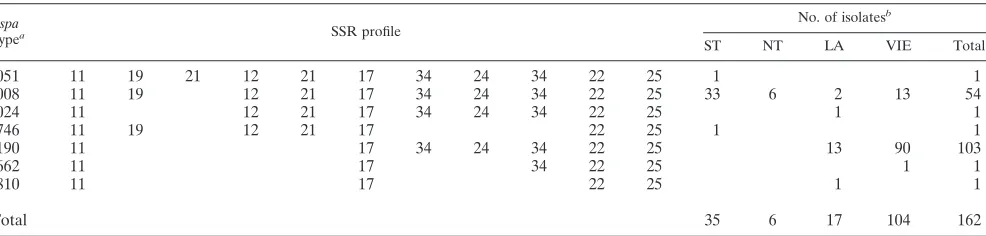
TABLE 2. spacomplex II
spa
typea SSR profile
No. of isolatesb
ST NT LA VIE Total
t051 11 19 21 12 21 17 34 24 34 22 25 1 1
t008 11 19 12 21 17 34 24 34 22 25 33 6 2 13 54
t024 11 12 21 17 34 24 34 22 25 1 1
t746 11 19 12 21 17 22 25 1 1
t190 11 17 34 24 34 22 25 13 90 103
t662 11 17 34 22 25 1 1
t810 11 17 22 25 1 1
Total 35 6 17 104 162
at051, a North German MRSA, Archaic/Iberian type (ST247:MRSA:SCCmecI), may represent the prototype ofspacomplex II. t051, t008, t024, and t190 were
assigned to CC8.
bThe frequency of eachspatype within a region is shown. ST, South Tyrol; NT, North Tyrol; LA, Lower Austria; VIE, Vienna.
on May 16, 2020 by guest
http://jcm.asm.org/
M13 univ. (5⬘-TGTAAAACGACGGCCAGT) and M13 rev. (5⬘-CAGGAAAC AGCTATGACC) (MWG-Biotech, Ebersberg, Germany), using a LI-COR 4200S automated DNA sequencer (LI-COR Bioscience, Lincoln, Nebr.) accord-ing to the manufacturer’s instructions.
Sequence data analysis.The standard chromatogram files of the forward and reverse sequences obtained from each sample were assembled and edited and
spatypes were determined using Ridom StaphType software (16).
Classification ofspatypes.spatypes with similar repeat profiles were grouped into aspacomplex. Since sequence-based alignment using algorithms is not useful for analysis of repeat regions, visual analysis of repeat organization is a more reliable and easier method for comparing relatedspatypes. Aspacomplex was characterized byspatypes that shared identical SSR units arranged in an identical order. Within a complex,spatypes were differentiated due to deletions or duplications of SSR units, which is the major cause of genetic rearrangement within an SSR region (4, 41). Exceptions were due to less frequent mutation events such as deletion, duplication, and exchange of triplets or single nucleotide polymorphisms, resulting in a change of single SSR units within a repeat region. The general structure of repeat units of a repeat region may not be changed by single nucleotide polymorphisms.
RESULTS
Typing of the 382 clinical MRSA isolates from the four regions, South Tyrol, North Tyrol, Lower Austria, and Vienna, yielded 46 spatypes (Tables 1 to 7). The most commonspa
types identified were t001 (28.8% of all isolates), t190 (27.0%), t008 (14.1%), and t041 (11.3%). The 42 remainingspatypes found accounted forⱕ2.4% each. Considering SSR unit sim-ilarity of the SSR region, the 46 spa types identified were classified into sevenspacomplexes (Tables 1 to 7).spa com-plexes were defined by the following repeat profiles: complex I, 26-(30/23)-(17-34-17-20/2)n-(17-12)n-17-16; complex II,
11-(19-21-12-21)-17-(34-24-34)-22-25; complex III,
15/1/8-(12)-(16-2)n-(25)-(17)-(24/25)-24n; complex IV,
8/9-(16)-(2-16-34-13-17-34)-16-34; complex V, 26-(23)n-13-23-(31-29/5-17)n
-25-17-25-16-28; complex VI, which might consist of two subcomplexes, 4-20/21-(12-17)n-20-17-12-12/17-17 and
7-23-12-21-21-(17)-20-17-(12)n-(17); and complex VII, which
might also consist of subcomplexes, 7-23-(21)-12/17/16-(34)n
-(33)-34/12/13-(12-23)-(2-12-23) (Tables 1 to 7).
One hundred seventy-three isolates, or 45.4%, belonged to
spacomplex I (Table 1). Thespatypes t001, t002, t003, and t041 of complex I were assigned to clonal complex 5 (CC5). The South German MRSA type t001 and the Rhine Hesse MRSA type t002 represent the prototypes within this complex. In North Tyrol and Lower Austria, spa types of complex I prevailed, with frequencies of 88.2% and 72.5%, respectively (Table 1). In both regions, t001 was the most prevalentspa
type, with a frequency of 73.7% in North Tyrol and with a frequency of 47.5% in Lower Austria (Table 1).
One hundred sixty-two isolates, or 42.5%, belonged tospa
complex II (Table 2). Thespatypes t008, t190, t051, and t024 were assigned to CC8. spa types of complex II were most frequent for Vienna and South Tyrol, with frequencies of 60.5% and 62.5%, respectively (Table 2). With a frequency of 52.3%,spatype t190 was the predominantspatype in Vienna.
spatype t190 was not found in South Tyrol. In this region,spa
type t008 was the dominant spa type, with a frequency of 58.9%.spatype t008 was the exclusive representative of com-plex II in North Tyrol (Table 2).
Fifteen isolates, or 3.9%, belonged tospacomplex III (Table 3). The spatypes t012, t018, and t019 of complex III were
TABLE 3. spacomplex III
spa
typea SSR profile
No. of isolatesb
ST NT LA VIE Total
t018 15 12 16 2 16 2 25 17 24 24 24 1 1
t012 15 12 16 2 16 2 25 17 24 24 1 1
t582 1 12 16 2 16 2 25 24 24 1 1
t019 8 16 2 16 2 25 17 24 1 1
t037 15 12 16 2 25 17 24 24 1 1 2
t030 15 12 16 2 24 24 1 4 5
t425 15 12 16 2 25 17 25 1 1
t930 15 16 2 24 24 2 2
t633 8 24 1 1
Total 2 1 12 15
at018 may represent the prototype ofspacomplex III. t012, t018, and t019 were assigned to CC30, whereas t030 and t037 were assigned to CC239. bThe frequency of eachspatype within a region is shown. ST, South Tyrol; NT, North Tyrol; LA, Lower Austria; VIE, Vienna.
TABLE 4. spacomplex IV
spa
typea SSR profile
No. of isolatesb
ST NT LA VIE Total
t015 8 16 2 16 34 13 17 34 16 34 2 2
t065 9 2 16 34 13 17 34 16 34 1 1
t550 8 17 34 16 34 1 1
t390 8 16 16 34 1 1
Total 1 4 5
at015, t065, and t390 were assigned to CC45. t004 (ST45:MRSA:SCCmecIV) may represent the prototype ofspacomplex IV. bThe frequency of eachspatype within a region is shown. ST, South Tyrol; NT, North Tyrol; LA, Lower Austria; VIE, Vienna.
on May 16, 2020 by guest
http://jcm.asm.org/
assigned to CC30/39, and spa types t030 and t037 of this complex were assigned to CC239. Thespatype t018 and the Vienna MRSA type t037 might represent the prototypes of this complex. Thirteen of 15 isolates of complex III were found in the Vienna region (Vienna and bordering districts of Lower Austria).
The spacomplex IV consisted of four different spa types, derived from five isolates (Table 4). Thespatypes t015, t065, and t390 were assigned to CC45. The Berlin MRSA type t004 (ST45:MRSA:SCCmec IV) (where ST45 is sequence type 45 and SCCmec IV is staphylococcal chromosome cassettemec
type IV) might represent the prototype of this complex. All isolates were from the adjacent geographical areas Vienna and Lower Austria.
Thespacomplex V consisted of nine isolates (Table 5). With the exception ofspatype t005, which was a single isolate from South Tyrol, all other isolates were from Vienna. Thespatypes t005, t032, and t223 were assigned to CC22.
Thespacomplex VI consisted of four isolates that belong to four differentspatypes (Table 6). Thespatypes of this complex might consist of two different subcomplexes due to the first SSR units of the SSR region and show, at least to some extent, similarity to the spa types of complex I and complex VII. Similarspatypes of complex VI were assigned to CC25.
Complex VII was a heterogeneous group (Table 7), and might consist of two or even more subcomplexes. However, because of common repeat units and due to the limited num-ber of similar spatypes thesespatypes were grouped into a common complex. Nine of 14 isolates (64%) of the six spa
types within this complex belonged tospatype t044. Thespa
types of this complex were assigned to CC1 (t127), CC15 (t084), ST7 (t091), and ST80 (t044 and t416).spatypes within this complex were found in South Tyrol and the Vienna region.
DISCUSSION
The Antibiotic Resistance, Prevention and Control (ARPAC) project, a European Commission DG Research-funded concerted action, identifiedS. aureusresistant to methicillin/oxacillin as an alert organism of concern in Europe (23). Typing alert organisms by use of molecular techniques is considered a high-priority rec-ommendation for national health authorities.
To determine the diversity of the MRSA population in Aus-tria, isolates from diverse regions and hospitals were typed. Because of the high level of polymorphism within the X region of the protein A gene and the fact thatspatyping is associated with speed, low costs, and comparability of data,spatyping was used in this study for typing of MRSA isolates. Forty-six dif-ferentspatypes were found, of which the majority, 82%, be-long to four spatypes only. However, as SSR are generally described as unstable entities that undergo frequent DNA se-quence variation (19, 33, 39, 40, 41), these 46spatypes were grouped intospacomplexes with respect to SSR unit compo-sition and organization (34). This system of classification of related types had already been used to group MLSTs into clonal complexes (8). The grouping of related types (spa, MLST, or PFGE) is a valuable tool for strain analysis and supports a hospital epidemiologist’s work by simplifying the identification of epidemiologically related strains. However, molecular subtyping on its own is not able to elucidate whether distinct subtypes have evolved from one another or whether they represent single introductions from outside. Without ad-ditional epidemiological information, it is, for instance, impos-sible to say whetherspatype t008 in Vienna is the precursor of the most frequentspatype, t190, or whether thesespatypes occurred independently. Moreover, without epidemiological data it is even impossible to postulate a correlation between
TABLE 5. spacomplex V
spa
typea SSR profile
No. of isolatesb
ST NT LA VIE Total
t032 26 23 23 13 23 31 29 17 31 29 17 25 17 25 16 28 5 5
t379 26 23 23 13 23 31 29 17 25 17 25 16 28 2 2
t005 26 23 13 23 31 5 17 25 17 25 16 28 1 1
t223 26 23 13 23 5 17 25 17 25 16 28 1 1
Total 1 8 9
a
The Barnim MRSA type t032 is the prototype ofspacomplex V. t032, t005, and t223 were assigned to CC22.
b
The frequency of eachspatype within a region is shown. ST, South Tyrol; NT, North Tyrol; LA, Lower Austria; VIE, Vienna.
TABLE 6. spacomplex VI
spa
typea SSR profile
No. of isolatesb
ST NT LA VIE Total
t897 4 20 12 17 12 17 20 17 12 17 17 1 1
t349 4 21 12 17 20 17 12 12 17 1 1
t585 7 23 12 21 12 20 17 12 12 1 1
t148 7 23 12 21 12 17 20 17 12 12 17 1 1
Total 1 1 2 4
aMLST profiles of thesespatypes were not available. Similarspatypes were assigned to CC25.
bThe frequency of eachspatype within a region is shown. ST, South Tyrol; NT, North Tyrol; LA, Lower Austria; VIE, Vienna.
on May 16, 2020 by guest
http://jcm.asm.org/
rarespatypes, for example, t037 in Vienna and in North Tyrol. Nevertheless, these rarespatypes are those of special interest for epidemiological investigations, because the chance of elu-cidating chains of infection is increased compared to doing so with widely distributed types. Thus, dominantspatypes may be too frequent to provide useful hints in investigating the chains of transmission. Additional markers are necessary to differen-tiate these frequent strains.
The allocation of similarspatypes intospacomplexes facilitates the differentiation of new, emergingspatypes into descendants of the localspacomplexes and newspatypes and unrelated types. The grouping of similarspatypes considers that variousspatypes are encountered among strains with similar overall genotypes, which is an indication that the speed of SSR evolution does not reflect the speed of overall genome evolution (25, 39). Thespa
complexes generated with respect to these features showed a good correlation to recently determined clonal complexes, coag-ulase groups, and amplified fragment length polymorphism clus-ters (8, 10, 25, 35). Moreover, recently reported microarray data correlate with SSR composition and organization (20). Thus, this bifunctional application combines a rapidly evolving marker use-ful for outbreak investigations with the more stable core structure of a complex useful for long-term epidemiology by sequencing a single DNA fragment.
However, one discrepancy in comparison to the MLST com-plexes could be observed. Althoughspatypes ofspacomplex III have a uniform SSR structure, spatypes of this complex were assigned to the different clonal complexes CC30/39 and CC239. Strains of the clonal complex CC239 are related to strains of the clonal complex CC8 (8). CC8 is equivalent tospa complex II. Thus, we might have a situation where similar spa types have evolved from different precursors. The opposite, the evolution of different MLSTs from a commonspatype, cannot be ruled out. Further work has to be done to elucidate this question.
Due to the lack of a sufficient number of spa types and isolates, thespacomplex VI may containspatypes that belong to two related but different spa complexes. Although the MLST of our isolates ofspacomplex VI is not known, similar
spatypes were assigned to CC25. The SSR structure of spa
complex VI shows a distant relation tospacomplex I. As with complex VI, there is a high probability that the spa
types ofspacomplex VII belong to different groups. This is sup-ported by the fact thatspatypes ofspacomplex VII have been assigned to different MLSTs (ST1, ST15, ST7, and ST80).
Nev-ertheless,spatypes ofspacomplex VII have similar SSR struc-tures. Moreover, it was previously shown that isolates of ST1 and ST80 both carry the Panton-Valentine leucocidin gene and SCCmecIV (15). Thus, there might be a phylogenetic correlation of thesespatypes within complex VII that is reflected by a related SSR structure, although the MLST is different.
With respect to the classification ofspatypes intospa com-plexes, each region has its distinctspa population. Interest-ingly, the neighboring regions of South Tyrol and North Tyrol and those of Vienna and Lower Austria have quite different
spapopulations. There is a higher similarity between thespa
populations of the geographically distant regions North Tyrol and Lower Austria on the one hand and Vienna and South Tyrol on the other hand. In our opinion, this finding underlines the importance of local efforts to cope with local MRSA prob-lems. Whereas South Tyrol, North Tyrol, and Lower Austria have quite uniformspapopulations, consisting of mainly two
spacomplexes each (with a fewspatypes belonging to other complexes), due to a homogenous population, the occurrence of allspacomplexes in Vienna probably reflects the multina-tional population structure of this large city.
It is of interest that the prevalentspatype withinspa com-plex II in South Tyrol is t008, whereas it is t190 in Vienna. This prevalence of differentspatypes, both of one complex, may be the result of adaptation to different ecological conditions (39). In conclusion, we considerspatyping a highly effective and rapid typing tool forS. aureusthat has significant advantages over other typing techniques, with the potential to benefit largely the surveillance of antimicrobial resistance and infec-tion control. The system presented here of reporting com-plexes in addition to the merespatype should foster the use of
spatyping as a tool for long- and short-term epidemiological investigations. Although some spa types cannot be grouped unambiguously into a distinctspacomplex, the grouping ofspa
types into complexes, in addition to the simple reporting of
spatypes, seems to be a promising tool to simplify the use of
spatyping for epidemiological investigations. We recommend a reclassification of the⬎1,400 already-determinedspatypes that would consider the relatedness of certainspatypes, for example, I-001 (I for thespacomplex and 001 for thespatype). The grouping of the large number ofspatypes of the Ridom database and the determination of MLSTs of so far-unclassi-fied isolates will show a more complete and accurate situation as to the numbers and types ofspacomplexes. Even
difficult-TABLE 7. spacomplex VII
spa
typea SSR profile
No. of isolatesb
ST NT LA VIE Total
t084 7 23 12 34 34 12 12 23 2 12 23 1 1
t091 7 23 21 17 34 12 23 2 12 23 1 1
t593 7 23 12 34 2 12 23 1 1
t127 7 23 21 16 34 33 13 1 1
t044 7 23 12 34 34 33 34 2 1 6 9
t416 7 23 12 34 1 1
Total 4 2 8 14
a
spacomplex VII probably consists of at least two subcomplexes, which is reflected by the assignment of thespatypes to diverse clonal complexes and sequence types (CC1, CC15, ST7, and ST80).
b
The frequency of eachspatype within a region is shown. ST, South Tyrol; NT, North Tyrol; LA, Lower Austria; VIE, Vienna.
on May 16, 2020 by guest
http://jcm.asm.org/
to-group types (i.e.,spatypes consisting of one, two, or three SSR units) should be amenable to grouping into a complex with the additional information of the MLST.
ACKNOWLEDGMENT
This work was supported by funding from the Austrian Agency for Health and Food Safety, project no. 20105/05.
REFERENCES
1.Bannerman, T. L., G. A. Hancock, F. C. Tenover, and J. M. Miller.1995. Pulsed-field gel electrophoresis as a replacement for bacteriophage typing of
Staphylococcus aureus. J. Clin. Microbiol.33:551–555.
2.Blanc, D. S., M. J. Struelens, A. Deplano, R. de Ryck, P. M. Hauser, C. Petignat, and P. Francioli.2001. Epidemiological validation of pulsed-field gel electrophoresis patterns for methicillin-resistantStaphylococcus aureus. J. Clin. Microbiol.39:3442–3445.
3.Blanc, D. S., P. Francioli, and P. M. Hauser.2002. Poor value of pulsed-field gel electrophoresis to investigate long-term scale epidemiology of methicil-lin-resistantStaphylococcus aureus. Infect. Genet. Evol.2:145–148. 4.Bzymek, M., and S. T. Lovett.2001. Instability of repetitive DNA sequences:
role of replication in multiple mechanisms. Proc. Natl. Acad. Sci. USA
93:7120–7124.
5.Chambers, H. F.2001. The changing epidemiology ofStaphylococcus aureus? Emerg. Infect. Dis.7:178–182.
6.Cookson, B. D., P. Aparicio, A. Deplano, M. Struelens, R. Goering, and R. Marples.1996. Inter-centre comparison of pulsed-field gel electrophoresis for the typing of methicillin-resistantStaphylococcus aureus. J. Med. Micro-biol.44:179–184.
7.Di Fiore, J.1956.Staphylococcus aureussepticemia, meningitis, endocarditis, and septic embolization. N. Y. State J. Med.56:1948–1949.
8.Enright, M. C., D. A. Robinson, G. Randle, E. J. Feil, H. Grundmann, and B. G. Spratt.2002. The evolutionary history of methicillin-resistant Staphy-lococcus aureus(MRSA). Proc. Natl. Acad. Sci. USA99:7687–7692. 9.Enright, M. C., N. P. J. Day, C. E. Davies, S. J. Peacock, and B. G. Spratt.
2000. Multilocus sequence typing for characterization of methicillin-resistant and methicillin-susceptible clones ofStaphylococcus aureus. J. Clin. Micro-biol.38:1008–1015.
10.Feil, E. J., J. E. Cooper, H. Grundmann, D. A. Robinson, M. C. Enright, T. Berendt, S. J. Peacock, J. M. Smith, M. Murphy, B. G. Spratt, C. E. Moore, and N. P. J. Day.2003. How clonal isStaphylococcus aureus? J. Bacteriol.
185:3307–3316.
11.Fitzgerald, J. R., D. E. Sturdevant, S. M. Mackie, S. R. Gill, and J. M. Musser.2001. Evolutionary genomics ofStaphylococcus aureus: insights into the origin of methicillin-resistant strains and the toxic shock syndrome epidemic. Proc. Natl. Acad. Sci. USA98:8821–8826.
12.Francino, M. P., L. Chao, M. A. Riley, and H. Ochman.1996. Asymmetries generated by transcriptional-coupled repair in enterobacterial genes. Science
272:107–109.
13.Frenay, H. M. E., A. E. Bunschoten, L. M. Schouls, W. J. van Leeuwen, C. M. van den Broucke-Grauls, J. Verhoef, and F. R. Mooi.1996. Molecular typing of methicillin-resistantStaphylococcus aureuson the basis of protein A gene polymorphism. Eur. J. Clin. Microbiol. Infect. Dis.15:60–64.
14.Frenay, H. M. E., J. P. G. Theelen, L. M. Schouls, C. M. J. E. van den Broucke-Grauls, J. Verhoef, W. J. van Leeuwen, and F. R. Mooi.1994. Discrimination of epidemic and nonepidemic methicillin-resistant Staphylo-coccus aureusstrains on the basis of protein A gene polymorphism. J. Clin. Microbiol.32:846–847.
15.Harbarth, S., P. Francois, J. Schrenzel, C. Frankhauser-Rodriguez, S. Hugonnet, T. Koessler, A. Huyghe, and D. Pittet.2005. Community-associ-ated methicillin-resistantStaphylococcus aureus, Switzerland. Emerg. Infect. Dis.11:962–965.
16.Harmsen, D., H. Claus, W. Witte, J. Rothga¨nger, H. Claus, D. Turnwald, and U. Vogel.2003. Typing of methicillin-resistantStaphylococcus aureusin a university hospital setting by using novel software forsparepeat determina-tion and database management. J. Clin. Microbiol.41:5442–5448. 17.Herold, B. C., L. C. Immergluck, M. C. Maranan, D. S. Lauderdale, R. E.
Gaskin, S. Boyle-Vavra, C. D. Leitch, and R. S. Daum.1998. Community-acquired methicillin-resistantStaphylococcus aureusin children with no iden-tified predisposing risk. JAMA279:593–598.
18.Jevons, M. P.1961. Celbenin-resistant staphylococci. Br. Med. J.1:124– 125.
19.Kahl, B. C., A. Mellmann, S. Deiwick, G. Peters, and D. Harmsen.2005. Variation of the polymorphic region X of the protein A gene during persis-tent airway infection of cystic fibrosis patients reflects two independent mechanisms of the genetic change inStaphylococcus aureus. J. Clin. Micro-biol.43:502–505.
20.Knox, R., and J. T. Smith.1961. Nature of penicillin resistance in staphylo-cocci. Lancetii:520–521.
21.Koreen, L., S. V. Ramaswamy, E. A. Graviss, S. Naidich, J. M. Musser, and
B. N. Kreiswirth.2004.spatyping method for discriminating among Staphy-lococcus aureusisolates: implications for use of a single marker to detect genetic micro- and macrovariation. J. Clin. Microbiol.42:792–799. 22.Kuhn, G., P. Francioli, and D. S. Blanc.2006. Evidence for clonal evolution
among highly polymorphic genes in methicillin-resistant Staphylococcus aureus. J. Bacteriol.188:169–178.
23.Li, Y.-C., A. B. Korol, T. Fahima, and E. Nevo.2004. Microsatellites within genes: structure, function, and evolution. Mol. Biol. Evol.21:991–1007. 24.MacKenzie, F. M., M. J. Struelens, K. J. Towner, I. M. Gould, et al.2005.
Report of the Consensus Conference on Antibiotic Resistance, Prevention and Control (ARPAC). Clin. Microbiol. Infect.11:938–954.
25.Maiden, M. C., J. A. Bygraves, E. Feil, G. Morelli, J. E. Russell, R. Urwin, Q. Zhang, J. Zhou, K. Zurth, D. A. Caugant, I. M. Feavers, M. Achtmann, and B. G. Spratt.1998. Multilocus sequence typing: a portable approach to the identification of clones within populations of pathogenic microorgan-isms. Proc. Natl. Acad. Sci. USA95:3140–3145.
26.Melles, D. C., R. F. J. Gorkink, H. A. M. Boelens, S. V. Snijders, J. K. Peeters, M. J. Moorhouse, P. J. van der Spek, W. B. van Leeuwen, G. Simons, H. A. Verbrugh, and A. van Belkum.2004. Natural population dynamics and expansion of pathogenic clones of Staphylococcus aureus. J. Clin. Investig.114:1732–1740.
27.Nolan, C. M., and H. N. Beaty.1976.Staphylococcus aureusbacteremia. Current clinical patterns. Am. J. Med.60:495–500.
28.Oliveira, D. C., I. Crisostomo, I. Santos-Sanches, P. Major, C. R. Alves, M. Aires-de-Sousa, M. K. Thege, and H. de Lencastre.2001. Comparison of DNA sequencing of the protein A gene polymorphic region with other molecular typing techniques for typing two epidemiologically diverse collec-tions of methicillin-resistantStaphylococcus aureus. J. Clin. Microbiol.39:
574–580.
29.Prevost, G., B. Poettecher, M. Dahlet, M. Bientz, J. M. Mantz, and Y. Piemont.1991. Pulsed field gel electrophoresis as a new epidemiological tool for monitoring methicillin-resistantStaphylococcus aureusin an intensive care unit. J. Hosp. Infect.17:255–269.
30.Robinson, D. A., and M. C. Enright.2003. Evolutionary models of the emergence of methicillin-resistant Staphylococcus aureus. Antimicrob. Agents Chemother.47:3926–3934.
31.Ruppitsch, W., A. Sto¨ger, and M. Keck.2004. Stability of short sequence repeats and their application for the characterization ofErwinia amylovora
strains. FEMS Microbiol. Lett.234:1–8.
32.Said-Salim, B., P. M. Dunman, F. M. McAleese, D. Macapagal, E. Murphy, P. J. McNamara, S. Arvidson, T. J. Foster, S. J. Projan, and B. N. Kreiswirth.2003. Global regulation ofStaphylococcus aureusgenes by Rot. J. Bacteriol.185:610–619.
33.Schnabel, E. L., and A. L. Jones.1998. Instability of a pEA29 marker in
Erwinia amylovorapreviously used for strain classification. Plant Dis.82:
1334–1336.
34.Shopsin, B., M. Gomez, S. O. Montgomery, D. H. Smith, M. Waddington, D. E. Dodge, D. A. Bost, M. Riehman, S. Naidich, and B. N. Kreiswirth.1999. Evaluation of protein A gene polymorphic region DNA sequencing for typing ofStaphylococcus aureusstrains. J. Clin. Microbiol.37:3556–3563. 35.Shopsin, B., M. Gomez, M. Waddington, M. Riehman, and B. N. Kreiswirth.
2000. Use of coagulase gene (coa) repeat region nucleotide sequences for typing of methicillin-resistantStaphylococcus aureusstrains. J. Clin. Micro-biol.38:3453–3456.
36.Steinberg, J. P., C. C. Clark, and B. O. Hackmann.1996. Nosocomial and community acquiredStaphylococcus aureusbacteremias from 1980 to 1993: impact of intravascular devices and methicillin resistance. Clin. Infect. Dis.
23:255–259.
37.Tang, Y.-W., M. G. Waddington, D. H. Smith, J. M. Manahan, P. C. Kohner, L. M. Highsmith, H. Li, F. R. Cockerill III, R. L. Thomson, S. O. Montgomery, and D. H. Persing.2000. Comparison of protein A gene sequencing with pulsed-field gel electrophoresis and epidemiologic data for molecular typing of methi-cillin-resistantStaphylococcus aureus. J. Clin. Microbiol.38:1347–1351. 38.Uhlen, M., B. Guss, B. Nilsson, S. Gatenbeck, L. Philipson, and M. Lindberg.
1984. Complete sequence of the staphylococcal gene encoding protein A. J. Biol. Chem.259:1695–1702.
39.van Belkum, A., N. Riewerts Eriksen, M. Sijmons, W. van Leeuwen, M. van den Bergh, J. Kluytmans, F. Espersen, and H. Verbrugh.1996. Are variable repeats in the spa gene suitable targets for epidemiological studies of meth-icillin-resistantStaphylococcus aureusstrains? Eur. J. Clin. Microbiol. Infect. Dis.15:768–770.
40.van Belkum, A.1999. The role of short sequence repeats in epidemiologic typing. Curr. Opin. Microbiol.2:306–311.
41.van Belkum, A., S. Scherer, L. van Alphen, and H. Verbrugh.1998. Short-sequence DNA repeats in prokaryotic genomes. Microbiol. Mol. Biol. Rev.
62:275–293.
42.van Belkum, A., W. van Leeuwen, M. E. Kaufmann, B. Cookson, F. Forey, J.
on May 16, 2020 by guest
http://jcm.asm.org/
Etienne, R. Goering, F. Tenover, C. Steward, F. O’Brien, W. Grubb, P. Tassios, N. Legakis, A. Morvan, N. El Solh, R. de Ryck, M. Struelens, S. Salmenlinna, J. Vuopio-Varkila, M. Kooistra, A. Talens, W. Witte, and H. Verbrugh.1998. Assessment of resolution and intercenter reproducibility of results of genotypingStaphylococcus aureusby pulsed-field gel electrophore-sis of SmaI macrorestriction fragments: a multicenter study. J. Clin. Micro-biol.36:1653–1659.
43.Verstrepen, K. J., A. Jansen, F. Lewitter, and G. R. Fink.2005. Intragenic tandem repeats generate functional variability. Nat. Genet.37:986–990. 44.Wernitz, M. H., S. Swidsinski, K. Weist, D. Sohr, W. Witte, K. P. Franke, D.
Roloff, H. Ru¨den, and S. K. Veit.2005. Effectiveness of a hospital-wide selective screening programme for methicillin-resistant Staphylococcus aureus(MRSA) carriers at hospital admission to prevent hospital-acquired MRSA infections. Clin. Microbiol. Infect.11:457–465.