Education and Mobility
Fabian Waldinger
D issertatio n su b m itte d for th e degree
D octor of P hilosophy in Econom ics a t
T h e London School of Econom ics an d P olitical Science
UMI Number: U615675
All rights reserved
INFORMATION TO ALL USERS
The quality of this reproduction is dependent upon the quality of the copy submitted.
In the unlikely event that the author did not send a complete manuscript and there are missing pages, these will be noted. Also, if material had to be removed,
a note will indicate the deletion.
Dissertation Publishing
UMI U615675
Published by ProQuest LLC 2014. Copyright in the Dissertation held by the Author. Microform Edition © ProQuest LLC.
All rights reserved. This work is protected against unauthorized copying under Title 17, United States Code.
ProQuest LLC
789 East Eisenhower Parkway P.O. Box 1346
F
D eclaration
I declare th a t the work presented in this thesis is my own except where the collaboration with
a coauthor is explicitly acknowledged.
Fabian Waldinger
D ate
I agree w ith the above statement.
M atthias Parey (Coauthor)
University College London
Date
I agree with the above statem ent.
Prof. Jorn-Steffen Pischke (Supervisor)
The London School of Economics and Political Science
D eclaration
I certify th a t chapter 2 of this thesis, "Studying Abroad and International Labour M arket
Mobility - Evidence from the introduction of ERASMUS", was coauthored with M atthias Parey.
Fabian Waldinger contributed 50 percent to the genesis of the project, 50 percent to the empirical
work on the data, and 50 percent to the writing of the text.
Prof. Jorn-Steffen Pischke (Supervisor)
The London School of Economics and Political Science
D ate
I agree with the above statem ent.
M atthias Parey (Coauthor)
University College London
A b stract
This thesis analyses interconnections between educational policies and different aspects of mo
bility. In the first chapter I use the dismissal of scientists in Nazi Germany to analyse peer effects
among university scientists. The usual problems related to estimating peer effects are addressed
by using the dismissal of researchers by the Nazi government as a source of exogenous variation
in the scientists’ peer group. Using a dataset of all physicists, chemists, and mathematicians at
all German universities from 1925 until 1938 I investigate spillovers at different levels of peer
interactions. There is no evidence for peer effects a t the departm ent level or the specialization
level. I find, however, th a t peer quality m atters for coauthors. Losing a coauthor of average
quality reduces the productivity of a scientist by about 12.5 percent in physics and 16.5 percent
in chemistry. The second chapter analyses the effect of studying abroad on international labour
market mobility later in life. I have collaborated w ith M atthias Parey for this research project.
We exploit the introduction of the ERASMUS student exchange programme as a source of ex
ogenous variation in student mobility. Our results indicate th a t student exchange mobility is an
im portant determ inant of international labour m arket mobility: Studying abroad increases an
individual’s probability of working in a foreign country by about 15 to 20 percentage points. We
investigate heterogeneity in returns and find th a t studying abroad has a stronger effect for credit
constrained students. The last chapter of the thesis investigates the effect of school tracking on social mobility of students. In particular I investigate whether ability tracking exacerbates the
role of parental background for students’ educational achievement. Using m icrodata from differ
ent educational studies I exploit cross-country variation in tracking policies to identify the effect
of tracking. Controlling for unobserved country level variables using difference-in-differences, I
find no increase in the importance of a student’s family background after tracking has taken
place. This result runs contrary to the findings of the current literature. I show th a t the results
A cknow ledgem ents
I would like to thank Steve Pischke, my advisor, for his great support during my years at
the LSE. Attending his undergraduate Labour Economics course has sparked my interest in
empirical economic research and Labour Economics in particular. His knowledge and advice
have been extremely helpful. I am also grateful for the many opportunities he has created for
me. Furthermore, I would like to thank David Card for giving me the possibility to spend a
year at the University of California in Berkeley. His enthusiasm for economics has been very
inspiring. I also thank all researchers a t the LSE and in Berkeley who have commented on my
work and have created an intellectually stimulating work environment.
I am very grateful for the financial support from Cusanuswerk Bischofliche Studienforderung,
the Royal Economic Society, the Economics D epartm ent a t the LSE, and the Center for Labor
Economics at the University of California in Berkeley.
I owe a lot to my friends at the LSE and UCL - especially Cornelius, Enrico, Giacomo, M atthias,
and Rocco. They made the time of my PhD not only intellectually but also personally a great
experience.
I am extremely grateful for M aria’s love and encouragement during the last years.
This thesis is dedicated to my parents who have instilled my interest in education. I could not
P reface
6
This thesis analyses different interlinkages between education and mobility. In this context
mobility is broadly defined to encompass physical mobility but also social mobility.
Links between education and mobility have become more salient in the public debate b ut also
in economic research in recent years. These links are im portant a t all educational levels. In this
thesis I investigate issues of mobility and education at the university level but also at the school
level. At the former, it is widely acknowledged th a t universities willing to produce first class
research and teaching have to attract scholars and students from abroad. Many universities,
therefore, benefit from more international mobility. The flip side of increased mobility may be
th a t countries with less attractive universities might lose their brightest students and researchers
if they move abroad. W hether the countries which lose students and researchers are truly
harmed by the increase in international mobility is, however, not entirely clear. The migrants
might return later in life or promote the home country’s interests abroad. This thesis analyses
a subset of issues linked to international mobility of scientists and students.
In the first chapter I use the forced mobility of scientists in Nazi Germany to identify peer effects
among university scientists. The Nazi government dismissed all Jewish and so-called ‘politically
unreliable’ scholars from the German universities as soon as they came into power. The vast
majority left Germany and was therefore no longer able to closely collaborate with their former
colleagues in Germany. As the number of dismissed scholars varied widely across different
universities and departments I can use this dismissal to identify peer effects among scientists.
The dismissals not only affected the size of the scientists’ peer group b u t also their average
quality. I can therefore separately identify the effect of the number of peers and the effect of
average peer quality on a scientist’s productivity. I also investigate peer effects at different
levels of interactions, namely at the departm ent level (e.g. within the physics departm ent),
the specialization level (e.g. among the theoretical physicists in a departm ent), and among
coauthors.
Student mobility is another im portant phenomenon in higher education. Especially since stu
dents have become more and mobile in recent years. The second chapter of this thesis analyses
how studying abroad affects international labour market mobility later in life. Estim ates of the
effect of student mobility on later labour market mobility are often contam inated by the fact
th a t individuals who study abroad are probably more mobile th an students who do not study
abroad. We therefore use the introduction of the ERASMUS student exchange programme
as a source of exogenous variation in the probability of studying abroad. We show th a t the
introduction of the ERASMUS programme in a student’s departm ent did indeed increase her
probability of studying for some time in a foreign country. We can therefore use the ERASMUS
programme to identify the causal effect of educational mobility on later labour market mobility.
Mobility or the lack thereof is also an im portant issue at the school level. Parents move closer
to attractive school in order to improve the education of their children. The vast literature on
7
haviour. Another im portant aspect of mobility in schools is social mobility. The third chapter
of my thesis analyses one potentially im portant determ inant of social mobility within school
systems; namely whether students are placed into different school tracks. In particular I in
vestigate whether the tracking regime affects the role of a student’s family background for her
educational attainm ent. As countries differ not only in their tracking regime I try to control for
the pre-tracking im portance of parental background by using a difference-in-differences strategy.
Using a test score before tracking has occurred in any of the countries of my sample and one
C ontents
A bstract 4
A cknow ledgem ents 5
Preface 6
C ontents 8
List o f Tables 10
List o f Figures 12
1 Peer Effects in Science 13
1.1 In tro d u ctio n ... 13
1.2 The Expulsion of Jewish and ‘Politically Unreliable’ Scholars from German Uni versities 17
1.3 D a t a ... 21
1.3.1 D ata on Dismissed S c h o la rs ... 21
1.3.2 D ata on all Scientists a t German Universities between 1925 and 1938 . . . 22
1.3.3 Publication D a t a ... 23
1.4 Id e n tific a tio n ... 25
1.5 Effect of Dismissal on Researchers who remained in G e r m a n y ... 32
1.5.1 D epartm ent Level Dismissal E f f e c t ... 32
1.5.2 Specialization Level Dismissal E f f e c t ... 35
1.6 Using the Dismissal to Identify Peer Effects in S c ie n c e ... 36
1.6.1 D epartm ent Level Peer E f f e c t s ... 36
1.6.2 Specialization Level Peer E f f e c t s ... 38
1.7 Sensitivity of Departm ent Level IV Results . . ... 39
1.8 Effect of Dismissal on C o a u th o r s ... 39
1.9 Conclusion ... 42
1.10 T a b l e s ... 44
1.11 Appendix for Chapter 1 ... 55
2 Studying Abroad and International Labour M obility 60 2.1 Introduction . . 60
2.2 D a t a ... 62
2.3 Identification S tr a t e g y ... 67
2.4 First Stage R e s u lts ... 75
2.5 Main Results and Sensitivity A n a ly s is ... 76
2.6 How Studying Abroad Affects International labour Market M o b i l i t y ... 81
C O N TE N TS 9
2.8 T a b l e s ... 85
3 Tracking and th e R ole o f Family Background 94 3.1 In tro d u c tio n ... 94
3.2 Previous R e s e a r c h ... 99
3.3 Id e n tific a tio n ... 100
3.4 D a t a ... 102
3.4.1 D ata on Test Scores, Student Characteristics, Family Characteristics, and School Quality V ariables... 102
3.4.2 D ata on T rack in g ... 104
3.5 Main R e s u l t s ... 105
3.5.1 Reading R e s u l t s ... 105
3.5.2 M athem atics R e s u lts ...107
3.6 Sensitivity A n alysis...108
3.7 Discussion and C onclusion... 110
3.8 T a b l e s ... ,...113
3.9 Appendix for Chaper 3 ... 121
10
List o f Tables
1.1 Number of Dismissed Scientists across different S u b je c ts ... 44
1.2 Dismissals across different U n iv e rsitie s... 45
1.3 Characteristics of Dismissed S ch o lars ... 46
1.4 Top J o u r n a l s ... 46
1.5 Reduced Form (Departm ent Level Peers) ... 47
1.6 Reduced Form (Specialization Level Peers) ... 48
1.7 First Stages (Departm ent Level P e e r s ) ... 49
1.8 Instrum ental Variables (Departm ent Level P e e r s ) ... 49
1.9 F irst Stages (Specialization Level P e e r s ) ... 50
1.10 Instrum ental Variables (Specialization Level P e e r s ) ... 50
1.11 Robustness Checks Instrum ental Variables Physics (D epartm ent Level Peers) . . 51
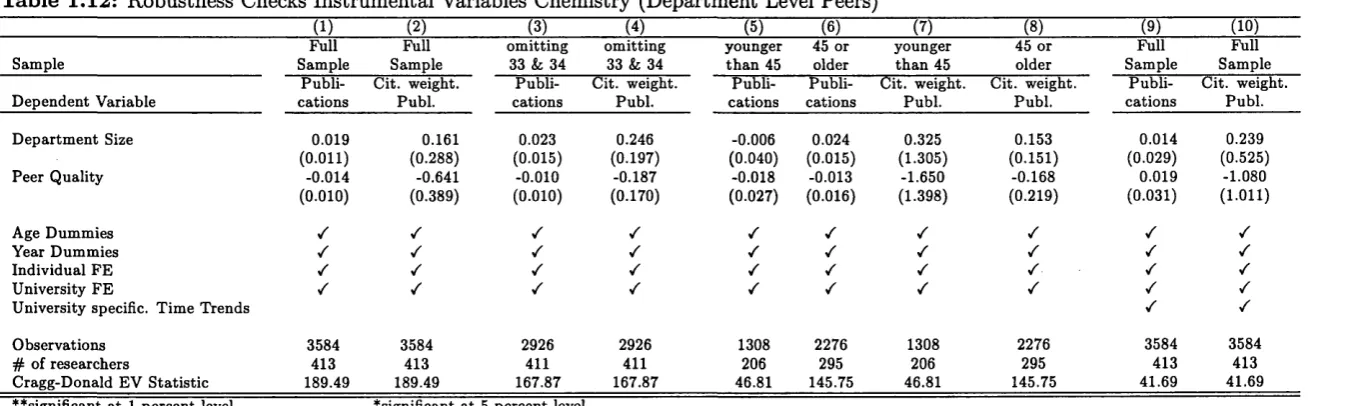
1.12 Robustness Checks Instrum ental Variables Chemistry (Departm ent Level Peers) 51 1.13 Robustness Checks Instrum ental Variables M athematics (Departm ent Level Peers) 52 1.14 Effect of Dismissal on C o a u t h o r s ... 53
1.15 Coauthors: Normalized P u b lic a tio n s ... 53
1.16 Coauthors: Timing of C o a u th o r s h ip ... 54
1.17 Coauthors: Publications w ithout dismissed C o a u t h o r s ... 54
1.18 S p e c ia liz a tio n s ... 56
1.19 Top Researchers 1925-1932 (Citation Weighted Publications M e a s u r e ) ... 57
1.20 Probability of Being Chaired P ro fe sso r... 58
1.21 Robustness Checks Instrum ental Variables Physics (Specialization L evel)... 58
1.22 Robustness Checks Instrum ental Variables Chemistry (Specialization Level) . . . 59
1.23 Robustness Checks Instrum ental Variables M athematics (Specialization Level) . 59 2.1 Summary S ta tis tic s ... 85
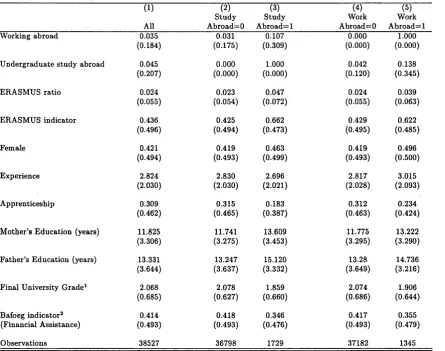
2.2 First S ta g e s ... 86
2.3 Falsification Test: First Stages with Different D e stin a tio n s... 87
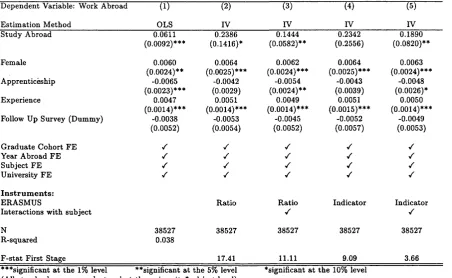
2.4 Main R e s u l t s ... 88
2.5 Sensitivity Analysis 1: Parental B ack gro un d... 89
2.6 Sensitivity Analysis 2: Early M o b i l i t y ... 90
2.7 Sensitivity Analysis 3: Foreign Students a t Home U n iv ersity... 91
2.8 Sensitivity Analysis 4: Time Trends and Additional F E ... 92
2.9 Heterogeneity in Returns and Credit C o n s tr a in ts ... 93
2.10 Destinations of work a b r o a d ... 93
2.11 Reasons for working a b r o a d ... 93
3.1 Countries in Different Estim ation S a m p le s...113
3.2 Countries in the PISA 2003 and TIMSS 95 (Secondary) Samples, Tracking Grade, and Means of Relevant V a r ia b le s ...114
L IS T OF TA B L E S 11
3.4 Difference-in-Differences Reading (PIRLS 2001 and PISA 2 0 0 3 )... 115
3.5 Difference-in-Differences M athematics (TIMSS 95 Grades 3/4 and Grades 7/8) . 116 3.6 Sensitivity Analysis 1: Early Tracking Thresholds (R ead in g)...117
3.7 Sensitivity Analysis 1: Early Tracking Thresholds (M a th e m a tic s)...117
3.8 Sensitivity Analysis 2: Tracking Measures ( R e a d in g )... 118
3.9 Sensitivity Analysis 2: Tracking Measures (Mathematics) ...118
3.10 Sensitivity Analysis 3: Different D ata Reading: PIRLS 2001 and PISA 2000 . . . 119
3.11 Sensitivity Analysis 3: Different D ata Maths: TIMSS 95 3/4 and TIMSS 99 7 /8 120 3.12 Robustness of Hanushek and Woessmann R e s u lts ... 120
3.13 DiD Reading (PIRLS 2001 and PISA 2003) W ithout School Q u a l i t y ...121
3.14 DiD M athematics (TIMSS 95) W ithout School Q u a lity ... 122
12
List o f Figures
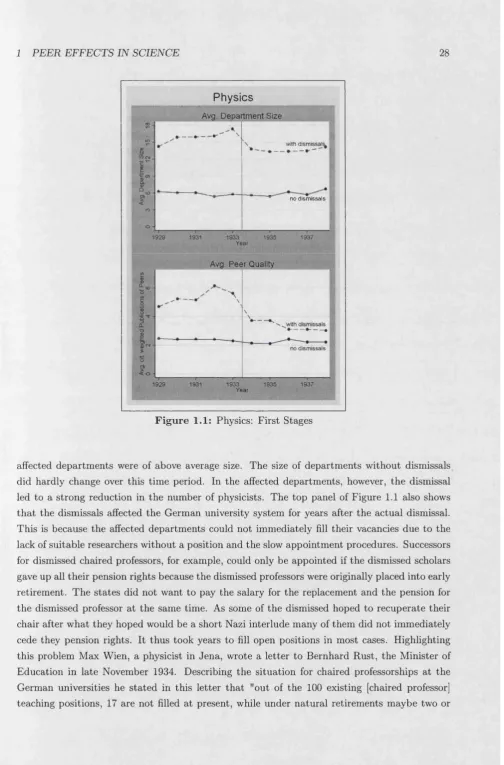
1.1 Physics: First Stages . -... 28
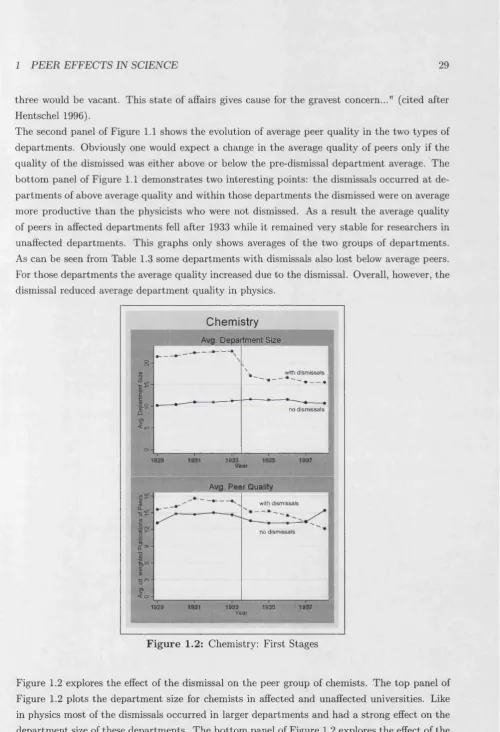
1.2 Chemistry: F irst S t a g e s ... 29
1.3 M athematics: F irst Stages ... 30
1.4 Reduced Form P h y s ic s ... 33
1.5 Reduced Form C h e m is tr y ... 33
1.6 Reduced Form M a th e m a tic s... 34
1.7 Effect of Dismissal on Coauthors P h y sics... 40
1.8 Effect of Dismissal on Coauthors C h e m is try ... 41
1.9 List of Displaced German Scholars: Sample P a g e ... 55
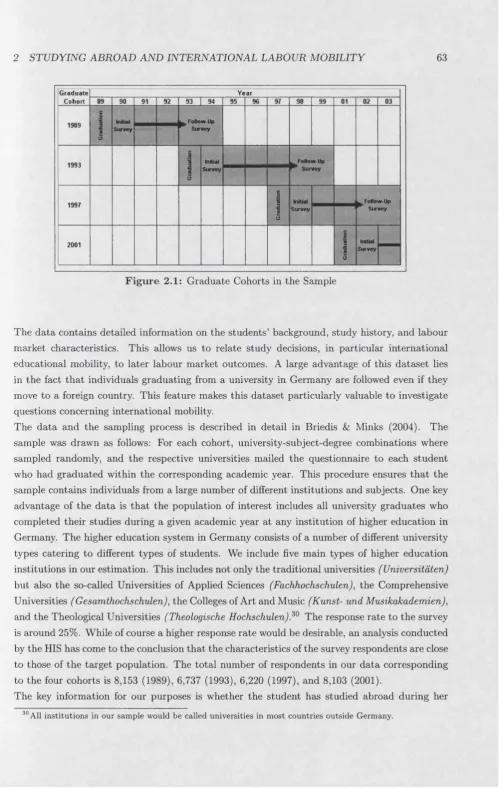
2.1 G raduate Cohorts in the S a m p l e ... 63
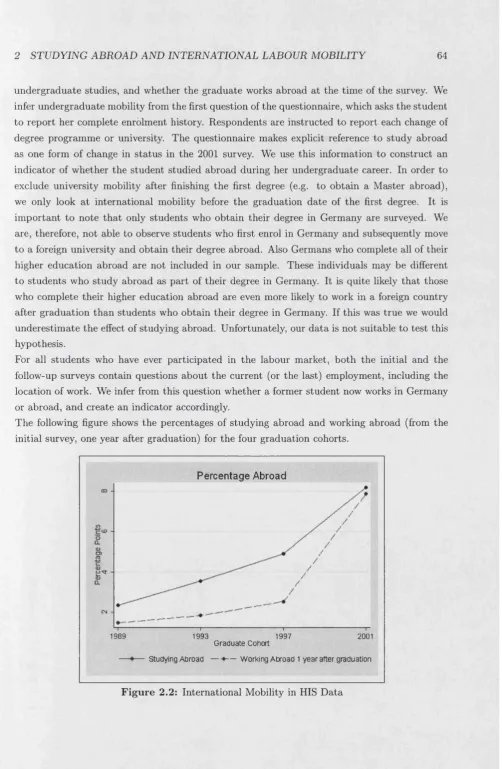
2.2 International Mobility in HIS D a t a ... 64
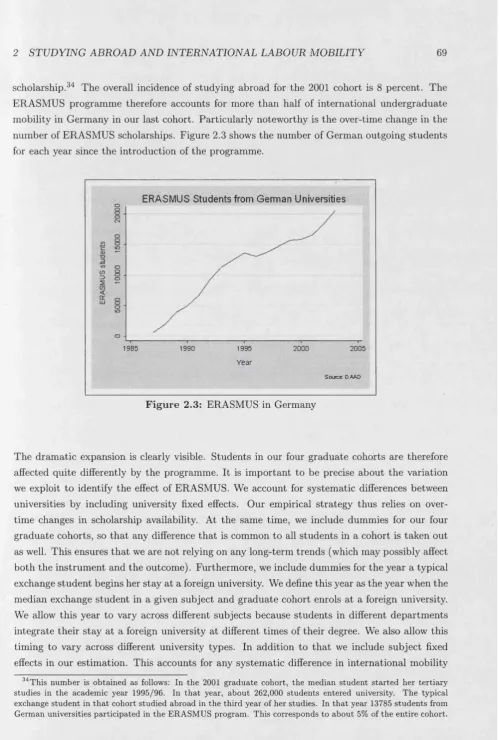
2.3 ERASMUS in G e r m a n y ... 69
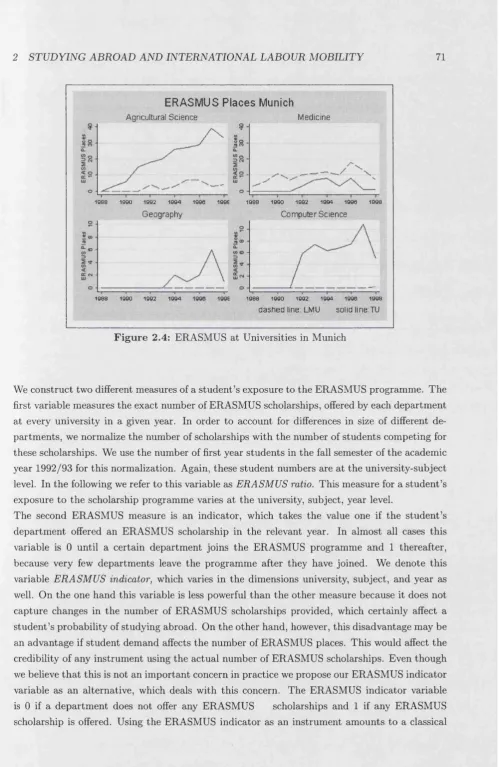
2.4 ERASMUS at Universities in M u n ich ... 71
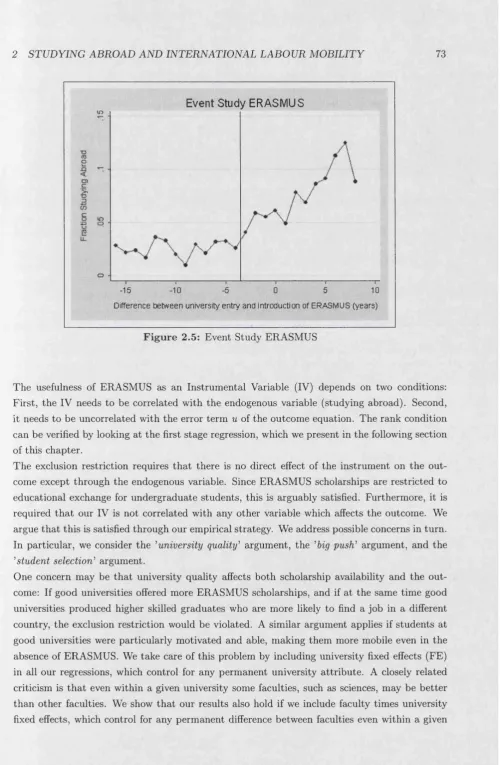
2.5 Event Study E R A S M U S ... 73
3.1 Family Background and Tracking PISA 2003 (Grades 9 / 1 0 ) ... 95
3.2 Family Background and Tracking TIMSS 1995 (Grades 7/8) 96
3.3 Family Background and Tracking PIRLS 2001 (Grade 4 ) ... 97
3.4 Family Background and Tracking TIMSS 1995 (Grades 3 / 4 ) ... 98
1
P eer E ffects in Science
13
E v id e n c e from th e D ism issa l o f S c ie n tists in N a z i G erm an y
1.1 In tr o d u ctio n
This chapter analyses peer effects among university scientists. It is widely believed th a t peer
effects are an im portant element of academic research. Individual researchers, however, may not
consider these effects when deciding about their place of employment. This could potentially
lead to a misallocation of talent and to underinvestment in academic research. Having a good
understanding of peer effects is therefore crucial for researchers and policy makers alike. Despite
the widespread belief in the presence of peer effects among scientists there is only limited
empirical evidence for these effects.
The main reason for this lack of evidence lies in the fact th a t obtaining causal estimates of peer
effects is very challenging. An im portant problem for any estim ation of peer effects is caused
by sorting of scientists. Highly productive scientists often work alongside other productive
researchers while less productive researchers often work in universities with less productive
colleagues. The key question is whether productive scientists are more productive because they
are collaborating w ith successful peers or because their productivity is higher per se. Estim ation
techniques which do not address th e sorting of researchers will thus overestimate the importance
of peer effects. Another problem corroborating the estimation of peer effects is the presence
of unobservable factors which affect a researcher’s productivity but also the productivity of
his peers. For scientists these factors could be the construction of a new laboratory which the
econometrician may not observe. These unobserved factors would usually lead to an upward bias
of peer effects. Estim ates of spill-over effects may also be distorted by measurement problems.
The main problem is the correct measurement of a researcher’s peer group. It is not only
difficult to identify the peers of any given scientist but also to ascertain the quality of these
peers. These problems will complicate any attem p t to obtain unbiased estimates of peer effects.
A promising strategy to estimate peer effects is therefore to analyse a scientist’s productivity if
his peer group changes due to reasons which are unrelated to his own productivity.
In this chapter I propose the dismissal of scientists by the Nazi government as an exogenous and
dramatic change in the peer group of researchers in Germany. Almost immediately after H itler’s
National Socialist party secured power in 1933 the Nazi government dismissed all Jewish and
so called "politically unreliable" scholars from German universities. Around 13 to 18 percent of
all scientists were dismissed between 1933 and 1934 (13.6 percent of physicists, 13.1 of chemists,
and 18.3 percent of mathematicians). Many of th e dismissed scholars were outstanding members
of their profession, among them the famous physicist and Nobel Laureate A lbert Einstein, the
chemist Georg von Hevesy who would receive the Nobel Prize in 1943, and the Hungarian
mathematician Johann von Neumann. Scientists at the affected departm ents were thus exposed
to a dram atic change in their peer group. Researchers in unaffected departm ents, however, did
1 P E E R E F FEC TS IN SCIENCE 14
in Germany to identify peer effects among physicists, chemists, and mathematicians.
I focus on these subjects because advancements in these fields are widely believed to be an im
p o rtan t source of technological progress. Other reasons for focusing on science are the following.
T he productivity of scientists can be well approximated by analysing publications in academic
journals. It was p art of the scientific culture to publish results in scientific journals already in
th e 1920s and 1930s, which is the tim e period studied in this chapter. I also concentrate on the
sciences because of the attem pt of the Nazi regime to ideologize all p arts of society after 1933.
These policies also affected university research. The im pact on different subjects, however, was
very different. Subjects such as economics, psychology, history, or sociology were affected much
more than the sciences.1 The last reason for focusing on physics, chemistry, and mathematics
is the fact th a t researchers at the German universities were in many cases the leading figures
in those fields in the early 20th century. Examples for this leading role of German science at
th e time are the Nobel Prize awards to researchers from German universities. Between 1910
and 1940, 27 percent of Nobel laureates in physics and 42 percent of Nobel prize winners in
chemistry were affiliated with a German university; this is a much larger fraction th an th a t of
any other country at th a t time. If peer effects are an im portant determ inant of a researcher’s
productivity they are likely to be especially im portant in a flourishing research environment
such as Germany in the early 20th century.
In order to investigate peer effects, I construct a new dataset of all physicists, chemists, and mathematicians teaching at all 33 universities and technical universities (Technische Hochschulen)
in Germany at the time. Using d a ta from historical university calendars I obtain a panel dataset
of all scientists at these universities covering the years 1925 until 1938. I do not consider the
years after 1938 because of the sta rt of World War II in 1939. In order to assess the extent of
the dismissal I compile a list of all dismissed physicists, chemists and mathematicians from a
number of different d ata sources. Finally, I obtain d ata on publications and citations of these
researchers in the leading academic journals of the time. More details on the d ata sources are
given in the d ata section below.
This dataset allows me to investigate spill-over effects among scientists. The collaboration
of researchers can take different levels of intensity. A very direct way of peer interaction is
the collaboration on joint research projects involving joint publication of results. There are,
however, more subtle interactions of colleagues in universities. Peer effects would also be present
if researchers discuss ideas and comment on each other’s work bu t do not copublish. Yet another
way in which peers may affect a researcher’s productivity is through peer pressure. A scientist’s
work effort may depend on the effort of his peers because he may want to m atch or surpass
their research output. Having more (less) productive peers would thus increase (reduce) a
researcher’s productivity. The definition of peer effects in this chapter encompasses any of these
different types. In addition to these different levels in the intensity of peer interactions there
1 P E E R E F FEC TS IN SCIENCE 15
are two main dimensions of peer groups which may m atter for academic research. The first
dimension is the number of peers a researcher can interact with. Another im portant dimension
of a scientist’s peer group is the quality of his colleagues. The work presented in this chapter is
the first to separately identify the importance of these two aspects of peer interactions.
This thesis is also the first to analyse three different geographic dimensions of spill-over effects,
namely at the departm ent level, at the specialization level, and at the level of coauthors. Many
researchers believe th a t peer interactions occur at the level of academic departments. The first
part of the analysis therefore investigates spill-over effects at the departm ent level. The dismissal
is a very strong and precise predictor of changes in the number and the average quality of peers.
I find, however, th a t neither the number of dismissed colleagues nor the dismissal induced change
in average departm ent quality significantly affects the productivity of physicists, chemists or
mathematicians. I also estim ate a more structural model of peer effects instrum enting the peer
group variables w ith the dismissal. I do not find any significant effects of the number of peers
or their average quality at the department level.
Using the same methodology I can also analyse peer effects a t the level of a researcher’s spe
cialization within the departm ent. I t is therefore possible to investigate the presence of peer
effects among all theoretical physicists in a departm ent for example. The dismissal is a very
strong predictor for the number and the quality of peers at the specialization level. Neither
the number of dismissed peers in a researcher’s specialization nor their average quality have a
significant im pact on a researcher’s productivity over time. W hen instrum enting a researcher’s
peer group with the dismissal I do not find evidence for peer effects at the specialization level.
In addition to th a t I investigate an even narrower definition of a researcher’s peer group by
estimating peer effects among coauthors for physics and chemistry. Due to the very low level of
coauthorships in mathematics I cannot analyses spill-over effects for coauthors in mathematics.
I find th a t losing a coauthor of average quality reduces the average researcher’s productivity by
about 12.5 percent in physics and 16.5 percent in chemistry. Losing coauthors of higher than
average quality leads to an even larger productivity loss. Furthermore, I show th a t the effect is
solely driven by recent collaborations. The productivity of scientists who lose a colleague with
whom they did not coauthor in the last four years before the dismissal does not fall due to the
dismissal. It is not entirely clear whether one would like to call the joint publication of papers
a real spill-over effect. I therefore investigate whether authors who lose a coauthor also publish
less if one focuses on the publications which were not coauthored w ith the dismissed coauthor.
Finding a drop in these publications after the dismissal would suggest classic spill-over effects
between coauthors. I find a negative and significant effect from losing a high quality coauthor
even on the publications which were published without the dismissed coauthor. This is evidence
for peer effects among coauthors.
Understanding the effects of the dismissal of a large number of scientists during the Nazi period
is interesting in its own right. The findings of this thesis may also lead to a better understanding
of similar events which occurred in other countries. One example is the purge of thousands of
1 P E E R EF FEC TS IN SCIENCE 16
The scope of this work, however, goes beyond the understanding of historical events, because it
allows the identification of peer effects using an exogenous variation in a researcher’s peer group.
The question remains whether evidence on peer effects in Germany in the 1920s and 1930s can
be used to understand peer interactions today. A number of reasons suggest th a t the findings
of this study may be relevant for understanding spillovers among present-day researchers. The
three subjects studied in this chapter were already well established at th a t time; especially
in Germany. Scientific research followed practices and conventions which were very similar
to current research methods. Researchers were publishing their results in refereed academic
journals, conferences were common, and researchers were surprisingly mobile. Unlike today,
they could not communicate via E-mail. They did, however, vividly discuss research questions
in letters. Given the dram atic fall in communication and transportation costs it is quite likely
th a t localized peer interactions are even less im portant today th an in the 1920s and 1930s.
The increased specialization in scientific research makes it harder to find researchers working
on similar topics in the same departm ent. This will further contribute to the fact th a t today’s
departm ent level and within departm ent specialization level peer effects axe less im portant than
in the past.
As described before I do find th a t peer effects among coauthors are im portant. The reduction
in transportation and communication costs would suggest th a t potential benefits from collabo
rating with researchers who are located in a different university may be even more im portant
today. The increased importance of teams in the production of scientific research and increased
cooperation between researchers from different universities and even countries may be a result
of peer effects among coauthors.2 Thus my results are likely to provide a lower bound for peer
effects among coauthors.
This study contributes to a growing literature on peer effects among university researchers. It
is, however, one of the first to analyse peer effects among scientists using credibly exogenous
variation in peer quality. To my knowledge it is the first study which is able to separate the
effects from the number of colleagues and the average quality of those peers. Furthermore, it
is the first work to directly analyse peer effects a three levels of peer interactions: at the level
of academic departm ents, at the level of specializations within those departments, and among
coauthors.
Azoulay, Wang and Zivin (2007) investigate peer effects among coauthors in the life sciences.
Using the death of a prolific researcher as an exogenous source of variation in a scientist’s
peer group they find th a t deaths of coauthors lead to a decline in a researcher’s productivity.
They find stronger effects for more prolific coauthors. Furthermore, they find th a t co-location of
scientists does not increase the effect of a dead coauthor. Surprisingly, they do not find a stronger
decline for recent coauthors compared to coauthors who coauthored with the dead scientist long
before he died. As they only observe coauthors but not the universe of peers at the university
of a dying researcher they cannot directly investigate departm ent level or specialization level
1 P E E R E F F E C TS IN SCIENCE 17
peer effects. A recent study by Weinberg (2007) analyses peer effects among Nobel Prize
winners in physics. He finds evidence for mild peer effects among physics Nobel laureates.
Using the timing of starting Nobel Prize winning work he tries to establish causality. It is
quite likely, however, th a t this does not fully address the endogeneity problem which may affect
his results on spillovers. Kim, Morse, and Zingales (2006) estim ate peer effects in economics
and finance faculties and find positive peer effects for the 1970s, and 1980s, but negative peer
effects for the 1990s. They show some evidence th a t their results are not contaminated by
endogeneity problems. The regression specifically analysing peer effects, however, does not
control for endogenous selection of peers.3
The remainder of the chapter is organized as follows: the next section gives a brief description
of historical details. A particular focus is given to the description of the quantitative and
qualitative loss to German science. Section 1.3 gives a more detailed description of th e data
sources used in the analysis. Section 1.4 describes the identification strategy in further detail.
The effect of the dismissal on the productivity of departm ent level and specialization level peers
remaining in Germany is analysed in section 1.5. Using the dismissal as an exogenous source
of variation in peer quality I then present instrum ental variable results of departm ent level and
specialization level peer effects in section 1.6. Regressions presented in Section 1.7 probe the
robustness of these findings. In section 1.8 I then present evidence on peer effects between
coauthors. Section 1.9 concludes.
1.2 T h e E x p u lsio n o f J e w ish an d ‘P o litic a lly U n r e lia b le ’ Sch olars from G er
m a n U n iv e r sitie s
Shortly after the National Socialist P arty seized power in 1933 the Nazi government implemented
the "Law for the Restoration of the Professional Civil Service" on the 7th of April of 1933.
Despite this misleading title the law was used to expel all Jewish and "politically unreliable"
persons from civil service in Germany. At th a t time most German university professors were
civil servants. Therefore the law was directly applicable to them. Via additional ordinances the
law was also applied to university employees who were not civil servants. Thus the law affected
all researchers at the German universities. The main parts of the law read:
Paragraph 3: Civil servants who are not of Aryan descent axe to be placed in
retirement... (this) does not apply to officials who had already been in the service
since the 1st of August, 1914, or who had fought in the World W ar at the front for
the German Reich or for its allies, or whose fathers or sons had been casualties in
the World War.
1 P E E R E F FEC TS IN SCIENCE 18
Paragraph 4: Civil servants who, based on their previous political activities,
cannot guarantee th a t they have always unreservedly supported the national state,
can be dismissed from service.
["Law for the Restoration of the Professional Civil Service", quoted after Hentschel
(1996)]
In an implementation decree it was further specified th a t all members of the Communist P arty
were to be expelled. The decree also specified "Aryan decent" in further detail as: "Anyone
descended from Non-Aryan, and in particular Jewish, parents or grandparents, is considered
non-Aryan. It is sufficient th a t one parent or one grandparent be non-Aryan." The law was
immediately implemented and resulted in a wave of dismissals and early retirement from the
G erman universities. A careful early study by H arthorne published in 1937 counts 1111 re
searchers from German universities and technical universities4 who were dismissed between
1933 and 1934. This amounts to about 15 percent of the 7266 university researchers present at
the beginning of 1933. Most dismissals occurred in 1933 immediately after the law was imple
mented. Not everybody was dismissed as soon as 1933 because the law allowed Jewish scholars
to remain in office if they had been in office since 1914 or if they had fought in the First World
W ar or had lost a father or son in the War. Nonetheless, many of the scholars who could stay
according to this exception decided to leave voluntarily; for example the Nobel laureates James
Franck and Fritz Haber. They were ju st anticipating a later dismissal as the Reich citizenship
laws (Reichsbiirgergesetz) of 1935 revoked the exception clause.
Table 1.1 reports the number of dismissals in the three subjects studied in this chapter: physics,
chemistry, and mathematics. Similarly to Harthorne, I focus my analysis on researchers who
had th e Right to Teach (venia legendi) at a German university. According to my calculation
about 13.6 percent of the physicists who were present at the beginning of 1933 were dismissed
between 1933 and 1934.5 In chemistry the loss between 1933 and 1934 was about 13.1 percent
and thus slightly lower th an in physics.6 M athematics experienced the biggest loss of the three
subjects with about 18.3 percent dismissals between 1933 and 1934.7 It is interesting to note,
th a t the percentage of dismissals in these three subjects and a t the German universities overall
was much higher th an the fraction of Jews living in Germany. It is estimated th a t about 0.7
percent of the to tal population in Germany was Jewish a t the beginning of 1933.
My d ata does not allow me to identify whether the researchers were dismissed because they were
Jewish or because of their political orientation. O ther researchers, however, have investigated
this issue. Deichmann (2001) studies chemists in German and A ustrian universities (after
4 The German university system had a number of different university types. The main ones were the traditional universities and the technical universities. The traditional universities usually covered the full spectrum of subjects. The technical universities focused on technical subjects.
5This number is consistent with the number obtained by Fischer (1991) who reports that 15.5 percent of physicists were dismissed between 1933 and 1940.
6 Deichmann (2001) calculates a loss of about 24 percent from 1933 to 1939. The difference between the two figures can be explained by the fact that she includes all dismissals from 1933 to 1939. Furthermore my sample includes 5 more universities which all have below average dismissals.
1 P E E R EF FEC TS IN SCIENCE 19
th e German annexation of A ustria in 1938 the Nazi government extended the aforementioned
laws to researchers at Austrian universities). She finds th a t about 87 percent of the dismissed
chemists were Jewish or of Jewish decent. The remaining 13 percent were dismissed for political
reasons. Siegmund-Schultze (1998) estimates th a t about 79 percent of the dismissed scholars
in m athem atics were Jewish. This suggests th a t th e vast m ajority of the dismissed were either
Jewish or of Jewish decent.
Before giving further details on the distribution of dismissals across the different universities I
am going to provide a brief overview over the fate of the dismissed researchers. Immediately
after the first wave of dismissals in 1933 foreign Emigre aid organizations were founded to assist
th e dismissed scholars with obtaining positions in foreign universities. The first organization to
be founded was the English "Academic Assistance Council" (later renamed into "Society for the
Protection of Science and Learning"). It was established as early as April 1933 by the director
of the London School of Economics, Sir William Beveridge. In the US the "Emergency Com
m ittee in Aid of Displaced Scholars" was founded in 1933. Another im portant aid organization,
founded in 1935 by some of the dismissed scholars themselves, was the Emergency Alliance
of German Scholars Abroad ("Notgemeinschaft Deutscher Wissenschaftler im Ausland"). The
main purpose of these and other, albeit smaller, organizations were to assist the dismissed schol
ars in finding positions abroad. In addition to th a t prominent individuals like Eugen Wigner,
Albert Einstein or Hermann Weyl tried to use their extensive network of personal contacts to
find employment for less well-known scientists. Due to the very high international reputation
of German physicists, chemists, and mathematicians many of them could find positions without
the help of the aid organizations. Less renowned and older scientists had more problems in
finding adequate positions abroad. Initially many dismissed scholars fled to European coun
tries. Many of these countries were only tem porary refuges because the dismissed researchers
often obtained tem porary positions, only. The expanding territory of Nazi Germany in the
early stages of World War II led to a second wave of emigration from the countries which were
invaded by the German army. The main destinations of dismissed physicists, chemists, and
mathematicians were the United States, England, Turkey, and Palestine. The biggest propor
tion of dismissed scholars in all three subject eventually moved to the United States. For the
purposes of this research it is im portant to note th a t the vast m ajority of the emigrations took
place immediately after the researchers were dismissed from their university positions. Further
collaborations with researchers staying in Germany were thus extremely difficult and did hardly
occur. A minority of the dismissed, however, did not leave Germany and most of them died
in concentration camps or committed suicide. Very few, managed to stay in Germany and
survive the Nazi regime. Even these scientists who stayed in Germany were no longer allowed
to use university laboratories and other resources. The possibility of ongoing collaboration of
the dismissed scientists with researchers staying a t the German universities was thus extremely
limited.
The aggregate numbers of dismissals hides the fact th a t the German universities were affected
1 P E E R E F F E C TS IN SCIEN CE 20
different departm ents. W hereas some departments did not experience any dismissals others
lost more th an 50 percent of their personnel. The vast m ajority of dismissals occurred in 1933
and 1934. Only a limited number of scientists was dismissed after these years. All dismissals
occurring after 1933 affected researchers who had been exempted under the clause for war
veterans or for having obtained their position before 1914. In order to have a sharp dismissal
measure I thus focus on the dismissals in 1933 and 1934. Table 1.2 reports the number of
dismissals in the different universities and departments. An example for the huge variation in
dismissals is the university of Gottingen, one of the leading universities at the time. It lost
40 percent of its researchers in physics and almost 60 percent in mathematics. The reduction
of peer quality in physics and mathematics was even higher than the fraction of dismissed
scholars. In chemistry, however, no a single scholar was dismissed in Gottingen. Table 1.2 also
dem onstrates th a t the dismissal did not always have a negative impact on average peer quality.
Negative signs in the "Fall in Peer Quality" variable indicate an improvement in the average
quality of the stayers’ peers. An improvement in average peer quality could occur if below
departm ent average researchers were dismissed.
Table 1.3 gives a more detailed picture of the quantitative and qualitative loss in the three
subjects. In physics about 13 percent of all researchers were dismissed between 1933 and 1934.
The proportion of chaired professors among the dismissals was, however, slightly lower at about
11 percent. The dismissed were on average about 5 years younger than the stayers. It is
remarkable th a t the proportion of Nobel laureates (who either already had received the Nobel
Prize or were to receive it in later years) among the dismissed was far higher than one would
expect given the to tal number of dismissals. The fact th a t the dismissed made above average
scientific contributions is also exemplified by the fact th a t the proportion of publications in
the leading journals was about 20 percent which is higher th an the 13 percent which would
correspond to their head count.8 W hen considering a publication’s quality by weighting the
publications with subsequent citations of a paper, the high productivity of the dismissed becomes
even more apparent. The dismissed physicists published about 39 percent of citation weighted
publications. The fact th a t the dismissed physicists were of above average quality has already
been noticed by Fischer (1991).
About 33 percent of the publications in the top journals were co-written papers. A bout 11
percent (for th e dismissed 14 percent) of all papers were w ritten with a coauthor who was
teaching at a university in Germany. There are two main reasons for the fact th a t only one
third of the coauthors were teaching at a German university. Presumably, a large fraction of
coauthors of the physicists in my dataset are their assistants or PhD. students. Furthermore,
coauthors could teach a t a foreign university or be employed by a research institute. The last
line of Table 1.3 shows the low level of cooperation within a departm ent; only about 4 percent
(9 percent of the dismissed) of all publications were coauthored with a member of staff from
the same university.
1 P E E R E F FEC TS IN SCIENCE 21
The dismissed chemists are more similar to the average in their field as can be seen from
the second panel of Table 1.3. The proportion of full professors among the dismissed almost
corresponded to their proportion among all chemists. Also their average age was very close to
the population average in chemistry. The proportions of Nobel Prize winners, publications and
citation weighted publications was higher th an one would expect from their proportion in the
overall population. These differences, however, were smaller than in physics. The percentage
of co-written papers was much higher in chemistry compared to physics. About 76 percent of
published papers were published by more th an one author. Interestingly only about 12 percent
of the top publications in chemistry were published with coauthors who had the Right to Teach
at a G erman university. Only about 5 percent of all published papers were copublished with a
coauthor who was a member of staff in the same department. This is low given the overall high
level of coauthorship in chemistry.
In mathem atics the differences between the dismissed scholars and the stayers are even more
pronounced th an in physics. The dismissed scholars were less likely to be full professors b u t they
were also on average about 7 years younger th an the stayers. The dismissed not only published
more th an their counterparts who remained at the German universities but their publications
seem to be of much higher scientific importance. This is exemplified by the fact th a t their
publications were cited far more often than their proportion in the general population would
suggest. Only about 11 percent (15 percent for the dismissed) of the publications in mathematics
were coauthored. An even smaller fraction of the papers were coauthored with researchers who
had the right to teach a t the German universities. Coauthorships with mathematicians from
the same departm ent only accounted for 3 percent of all published papers (4 percents for the
dismissed). This suggests an even lower level of inter-departm ental cooperation in mathematics
compared to the other two subjects.
Despite a relatively similar quantitative loss in all three subjects the qualitative loss in chemistry
was lower th an in physics. The qualitative loss in mathematics was even higher than in physics.
Before investigating the effect of the dismissal on the productivity of researchers who stayed in
Germany I first describe my d ata sources in the next section.
1.3 D a ta
1.3.1 D ata on D ism issed Scholars
The d ata on the dismissed scholars is obtained from a number of different sources. The main
source is the "List of Displaced German Scholars". This list was compiled by the relief orga
nization "Emergency Alliance of German Scholars Abroad". W ith th e aid of the Rockefeller
Foundation it was published in 1936. The purpose of publishing this list was to secure positions
for the dismissed researchers in countries outside Nazi Germany. Overall, the list contained
about 1650 names of researchers from all university subjects. The list gives a very complete
picture of th e dismissal of scholars by the Nazi government. I extracted all dismissed physicists,
1 P E E R E F FEC TS IN SCIENCE 22
physics section of th a t list. Interestingly, there are four physicists on th a t page who had already
received the Nobel Prize or were to receive it in later years. O ut of various reasons a small
number of dismissed scholars did not appear in th a t list. To get a more comprehensive picture
of all dismissals I complement the information in the "List of Displaced German Scholars" with
information from other sources.
The main additional source is the "Biographisches Handbuch der deutschsprachigen Emigration
nach 1933 - Vol. II : The arts, sciences, and literature". The compilation of the handbook
was initiated by the "Institut fur Zeitgeschichte Mtinchen" and the "Research Foundation for
Jewish Immigration New York". Published in 1983 it contained short biographies of artists and
university researchers who emigrated from Nazi Germany. Kroner (1983) extracted a list of all
dismissed university researchers from the handbook. I use Kroner’s list to append my list of all
dismissed scholars.
In addition to these two main d ata sources I rely on d ata compiled by historians who studied
individual academic subjects during the Nazi era. Beyerchen (1977) included a list of dismissed
physicists in his book about the physics community in Nazi Germany. I use the information
included in th a t list to amend my list of dismissed scholars. Furthermore, I use d ata which is
contained in an extensive list of dismissed chemists which was compiled by Deichmann (2001).
In a similar fashion I complement my list w ith the information listed in Siegmund-Schultze’s
(1998) book on dismissed mathematicians.
It is im portant to note th a t my list of dismissals also contains the few researchers who were
initially exempted from being dismissed b ut resigned voluntarily. The vast m ajority of them
would have been dismissed due to the racial laws of 1935 anyway and were thus only anticipating
their dismissal. All of these voluntary resignations were directly caused by the discriminatory
policies of the Nazi regime.
1.3.2 D ata on all Scientists at German U niversities betw een 1925 and 1938
To investigate the im pact of the dismissals on the researchers who stayed at the German univer
sities I construct a full list of all scientists at the German universities from 1925 to 1938. Using
the semi-official University Calendar9 I compile an annual roster of all physicists, chemists, and
mathematicians at the German universities from the winter semester 1924/1925 (lasting from
November 1924 until April 1925) until the winter semester 1937/1938. The d ata for the tech
nical universities starts in 1927/1928, because the University Calendar included the technical
universities only after th a t date. The University Calendar is a compilation of all individual uni
versity calendars fisting the lectures held by each scholar in a given departm ent. If a researcher
was not lecturing in a given semester he was still listed under the heading "not lecturing". From
this list of lectures I infer the subject of each researcher to construct yearly faculty lists of all
1 P E E R E F FEC TS IN SC IENCE 23
physics, chemistry, and m athem atics departments. This allows me to track yearly changes of
all researchers of individual departm ents between 1925 and 1938.10,11
To assess a researcher’s specialization I consult seven volumes of "Kurschners deutscher Gelehrten-
Kalender". These books are listings of German researchers compiled in irregular intervals since
1925.12 The editors of the book obtained their d a ta by sending out questionnaires to the re
searchers asking them to provide information on their scientific career. I use the information in
all volumes published until 1950 to ascertain a scientist’s specialization. Because of the blurred
boundaries of the specializations in mathematics many mathematicians did not provide their
specialization. In those cases I infer their specialization from the main publications they list
in the " Gelehrtenkalender". As the participation of the researchers in the complication was
voluntary not all of them provided their personal information to the editor. If I cannot find
a scientist’s specialization in any of the volumes of the "Gelehrtenkalender", which occurs for
about 10 percent of the scientists, I conduct an internet-search for the scientist to obtain his
specialization. Overall I obtain the scientist’s specialization for about 98 percent of all re
searchers.13 Table 1.18 in the appendix of chapter 1 gives an overview of all specializations and
the fraction of scientists in each of them.
1.3.3 Publication D ata
To measure a researcher’s productivity I construct a dataset containing th e publications of each
researcher in the top academic journals of the time. At th a t tim e most German researchers
published in German journals. The quality of these German journals was usually very high
because many of the German physicists, chemists, and mathematicians were among the leaders
in their field. This is especially true for the time before the dismissal as is exemplified by the
following quote; "Before the advent of the Nazis the German physics journals (Zeitschrift fu r
Physik, Annalen der Physik, Physikalische Zeitschrift) had always served as the central organs
of world science in this domain... In 1930 approximately 700 scientific papers were printed
10 At that time a researcher could hold a number of different university positions. Ordinary Professors held a chair for a certain subfield and were all civil servants. Furthermore there were different types of Extraordinary Professors. First, they could be either civil servants (beamteter Extraordinarus) or not have the status of a civil servant (nichtbeamteter Extraordinarius). Universities also distinguished between extraordinary extraordinary professors (ausserplanmafiiger Extraordinarus) and planned extraordinary professors (planmafliger Extraordinar ius). Then as the lowest level of university teachers there were the Privatdozenten who were never civil servants. Privatdozent is the first university position a researcher could obtain after the ’venia legendi’.
11 The dismissed researchers who were not civil servants (Privatdozenten and some Extraordinary Professors) all disappear from the University Calendar between the winter semester 1932/1933 to the winter semester 1933/1934. Some of the dismissed researchers who were civil servants (Ordinary Professors and some Extraordinary Profes sors), however, were still listed even after they were dismissed. The original law forced Jewish civil servants into early retirement. As they were still on the states’ payroll some universities still listed them in the University Calendar even though they were not allowed to teach or do research anymore. My fist of dismissals includes the exact year after which somebody was barred from teaching and researching at a German university. I thus use the dismissal data to determine the actual dismissal date and not the date a dismissed scholar disappears from the University Calendars.
12The first volume was compiled in 1925. The other volumes I have used were published for the years 1926, 1928/29, 1931, 1935, 1940/41, and 1950.
1 P E E R E F FEC TS IN SCIENCE 24
in its (the Zeitschrift ftir P hysik's) seven volumes of which 280 were by foreign scientists."
(American Association for the Advancement of Science (1941)). Simonsohn (2007) shows th a t
neither the volume nor the content of the "Zeitschrift ftir Physik" changed dramatically in the
post dismissal years until 1938. Not surprisingly, however, he finds th a t the dismissed physicists
published less and less in the German journals after the dismissal. It is im portant to note th a t
th e identification strategy outlined below relies on changes in publications of researchers in
different German departm ents which were differentially affected by the dismissal. A decline in
the quality of the considered journals would therefore not affect my results as all regressions are
estim ated including year fixed effects.
The list of top publications is based on all German general science, physics, chemistry, and
mathem atics journals which are included in the "ISI Web of Science" for the time period 1915
to 1940. Furtherm ore I add the leading general journals which were not published in Germany,
namely N ature, Science, and the Proceedings of the Royal Society of London to the dataset. I
also add four non-German top specialized journals which were suggested by historians of science
as journals of some importance for the German scientific community.14 The "Web of Science"
is an electronic database provided by Thomson Scientific containing all contributions in a very large number of science journals. In 2004 the database was extended to include publications
between 1900 and 1945. The journals included in th a t extension were all journals which had
published the most relevant articles in the years 1900 to 1945.15 This process insures th a t all
publications which can be obtained for the early time period 1900 to 1945 were published in
the most im portant journals.
Table 1.4 lists all journals used in my analysis. For each of these journals I obtain all articles
published between 1925 and 1940 from the "ISI Web of Science". A very small number of the
contributions in the top journals were letters to the editor or comments. I restrict my analysis
to contributions classified as "articles" as they provide a cleaner measure for a researcher’s
productivity. The database includes the names of the authors of each article and statistics on
the number of subsequent citations of each of these articles. For each researcher I then calculate
two yearly productivity measures. The first measure is equal to the sum of publications in top
journals in a given year. In order to quantify an article’s quality I construct a second measure
which accounts for the number of times the article was cited in any journal included in the Web
of Science in the first 50 years after its publication. This includes citations in journals which
are not in my fist of journals but which appear in the Web of Science. This therefore includes
citations from the international scientific community and is not as heavily based on Germany as
the publications measure. This measure, which I call citation weighted publications, is defined
as the sum of citations (in the first 50 years after publication) of all articles published in a
14 The relevant journals for chemists were suggested by Ute Deichmann and John Andraos who both work on chemistry in the early 20th century. Additional journals for mathematics were suggested by Reinhard Siegmund-Schultze and David Wilkins; both are specialists in the history of mathematics.
1 P E E R E F FEC TS IN SCIENCE 25
certain year. The following simple example illustrates the construction of the citation weighted
publications measure. Suppose a researcher published two top journal articles in 1932. One is
cited 5 times in any journal covered by the Web of Science in the 50 years after its publication.
The other article is cited 7 times in 50 years. Therefore the researcher’s citation weighed
publications measure for 1932 is 5+7=12.
Table 1.19 lists the top researchers for each subject according to the citation weighted publi
cations measure. The researchers in this table are the 20 researchers w ith the highest yearly
averages of citation weighted publications for publications between 1925 and 1932. It is reassur
ing to realize th a t the vast m ajority of these top 20 researchers are well known in the scientific
community. Economists will find it interesting th a t Johann von Neumann is the most cited
m athem atician. The large number of Nobel laureates among the top 20 researchers indicates
th a t citation weighted publications are a good measure of a scholar’s productivity. Nevertheless,
the measure is not perfect. As the "Web of Science” only reports last name and the initial of
the first name for each author there axe some cases where I cannot unambiguously m atch re
searchers and publications. In these cases I assign the publication to th e researcher whose field
is most closely related to the field of the journal in which the article was published. In cases
where this assignment rule is still ambiguous between two researchers I assign each researcher
half of the publications (and half of the citations). Another problem is the relatively large
number of misspellings of authors’ names. All articles published between 1925 and 1940 were
of course published on paper. In order to include these articles into the electronic database
Thomson Scientific employees scanned all articles published in the historically most relevant
journals. The scanning was error prone and thus lead to misspellings of some names. As far as
I discovered these misspellings I manually corrected them. It is possible, however, th a t there
are still misspellings which I could not detect. Therefore, there may still be articles which are
not or wrongly assigned to the relevant author.
I merged the publications d ata to th e roster of all German physicists, chemists, and m athem ati
cians. From the list of dismissed scholars I can identify the researchers who were dismissed and
those who stayed at the German universities. The end result is a panel dataset of all physicists,
chemists, and mathem aticians at all German universities from 1925 until 1938 with detailed
information on their publications in the top academic journals and their dismissal status.
1.4 Id en tifica tio n
The main purpose of this chapter is to estim ate peer effects among scientists. The standard
approach when estimating peer effects consists of regressing an individual’s productivity on the
average productivity of his peers. The productivity of academic researchers, however, is not only
affected by the average quality of their peers but also by the number of peers they can interact
with. Having sm art colleagues may be useful in many ways: coauthored work may be of higher
quality and comments from prolific peers may be useful for their own work. Furthermore, peers