The London School of Economics and Political
Science
Caseflow Management: A Rudimentary Referee Process
,
1919-70
Michael Paul Reynolds
UMI Number: U 615990
All rights reserved
INFORMATION TO ALL U SE R S
The quality of this reproduction is d ep en d en t upon the quality of the copy subm itted.
In the unlikely even t that the author did not sen d a com plete m anuscript
and there are m issing p a g e s, th e se will be noted. Also, if material had to be rem oved, a note will indicate the deletion.
Dissertation Publishing
UMI U 615990
Published by ProQ uest LLC 2014. Copyright in the Dissertation held by the Author. Microform Edition © ProQ uest LLC.
All rights reserved. This work is protected against unauthorized copying under Title 17, United S ta tes C ode.
ProQ uest LLC
789 East E isenhow er Parkway P.O. Box 1346
£
^ o i 5
®
D e c la r a tio n
1 certify that the thesis I have presented for examination for the MPhil/PhD degree o f the London School o f Econom ics and Political Science is solely my own work other than where I have clearly indicated that it is the work o f others (in which case the extent o f any work carried out jointly by me and any other person is clearly identified in it).
The copyright o f this thesis rests with the author. Quotation from it is permitted, provided that full acknowledgem ent is made. This thesis may not be reproduced without the prior written consent o f the author.
1 warrant that this authorisation does not, to the best o f my belief, infringe the rights o f any third party.
Michael P Reynolds
Abstract
This thesis discovers that a form o f caseflow management was practised by Official Referees in England more than 70 years before the W oolf reforms. It also describes an innovative concept o f judicial sponsorship o f settlement at an early interlocutory stage. For its time it was revolutionary. Such process created a distinct subordinate judicial culture which promoted economy and expedition in the management o f complex technical cases. This culture was facilitated by the referees’ subordinate function as officers o f the High Court and the type o f casework undertaken.
The essential elements o f my theory o f rudimentary micro caseflow management emerge from a study o f the methods used by Sir Francis Newbolt K.C. These are analysed and discussed by way o f a literature review, qualitative and quantitative analysis. I conclude that this form o f rudimentary caseflow management and judicial settlement process made the court more efficient. This process, identified as Newbolt’s “Scheme,” is traced from its inception through the judicial activities o f Newbolt and other referees who followed this approach whether actively or passively.
Having traced the origin and reasons for such officers this study considers the senior and subordinate judicial figures involved, their influence and encouragement as to the employment o f innovative interlocutory techniques. Contemporaneous records including reports and correspondence are analysed in considering these innovations.
The analysis is supported by the results o f a quantitative study o f Judicial
Statistics between 1919 and 1970 and other contemporaneous judicial records
including the referees’ notebooks and judicial time records known as Minute Books.
A number o f conclusions are drawn which suggest a correlation between such techniques and levels o f efficiency providing an interesting comparison for those interested in wider questions o f civil justice reform.
281 words
Acknowledgements
This research arose out o f an interest in civil litigation and alternative dispute
resolution both from practice as a solicitor and an arbitrator, and from a study o f
these subjects at M aster’s level. The interface between these diverse disciplines
has always fascinated me and therefore the opportunity o f undertaking doctoral
research on the court where I practised was particularly inviting. My interest also
stems from observations as an arbitration pupil to the last Senior Official Referee,
John Newey QC and the business-like and “user friendly” way, in which he and
those appearing before him conducted interlocutory proceedings. Further impetus
for my research stems from an interest in the Access to Justice Movement and
civil justice reform. It seemed to me that many o f the recent reforms may have
had their origin in what was the Official Referees’ Court and that what they did
decades ago has only recently been adopted across the system as a whole. This
thesis does not set out to prove that, but certainly demonstrates an undiscovered
prototype model which may teach us further lessons and contribute to the
literature on this subject.
Procedural reform is not necessarily the collective responsibility o f judges,
lawyers and parties to litigation. Today it goes beyond that to all those eminent
academics who have enriched our knowledge o f the system and who have an
essential role to play within that system. All must strive for greater procedural
efficiency and effectiveness as well as economy, learning from the experiences o f
the past. As Professor Marc Galanter wrote:
Lawyers and judges have a joint responsibility with the academic community to
foster and support the developm ent o f a cumulative body o f reliable knowledge
about the working o f legal institutions, and they have a heavy stake in its
developm ent.1
It is fitting that this study was undertaken at the London School o f Economics part
o f whose expanding modem complex now inhabits the former referees’ chambers
in Portugal Street and one o f whose founders, Lord Haldane, Lord Chancellor o f
England, was a strong supporter o f the referee’s office. It was Haldane who in the
military field had said that “economy and efficiency were not incompatible,” a
1 H ow to Im prove C ivil Ju stice Policy, 77 JUDICATURE 185 (1994).
theme which finds much in empathy in an entirely different context with the hero
o f this story Sir Francis Newbolt K.C.
This study and its completion would not have been possible without the
inspiration, patience and encouragement o f Professor Simon Roberts my
supervisor. For many years he has been a leading exponent o f a more enlightened
and efficient resolution process. In that endeavour he was joined by Professor
Michael Zander, my second supervisor, who in the field o f civil justice reform
must be regarded as a legend in his own time.
N either would such study and research have been feasible without the facilities
extended to me by the LSE Law Department, the LSE library, the National
Archive, and Lambeth Palace Library. I would like to thank Mr Justice Jackson,
Mr Justice Dyson (as he then was), Judge Anthony Thornton QC, and Judge
Edgar Faye QC who were kind enough to discuss aspects o f the Official Referees’
role.
To my family I owe a debt o f enormous forbearance.
Abstract
Acknowledgements Table o f Contents
3 4
6
Table o f Contents
Chapter 1
A Study in Rudimentary Caseflow Management
1.1. Incipient micro-caseflow management 23
1.2. Caseflow management theory 24
1.3. Purpose o f research study 24
1.4. Importance and interest 25
1.5. Hypothesis 27
1.6. Research questions 28
1.7. Use o f research 28
1.8. Evolution o f the referee 29
1.9 Limitations on research 33
1.10 Methodology 34
1.11 Organisation o f study 37
1.12 Contribution to research in civil justice and dispute resolution 38
Chapter 2
In Chancery: The Inception o f Micro Caseflow Management
2.1 Macro-management problems in the civil justice system 39
2.2 Judicial overload and backlog 39
2.3 First Report o f the Commissioners 1869 42
2.4 The Official Referee: reasons for creation 42
2.4.1 Chancery and Common Law practice 42
2.4.2 Experts 44
2.4.3 Juries 45
2.4.4 Arbitrators 45
2.5 The Judicature reforms 46
(a) Administrative reform 47
(b) Procedural reform 47
2.6 Pioneers o f caseflow management: Selboume and Cairns 49
2.6.1 Lord Selboume 49
2.6.3 A judge without jurisdiction 51
2.6.4 Rules o f the Supreme Court 52
2.6.5 Lord Cairns 1874-80 54
2.7. Importance o f chambers business 57
2.8. Legacy o f the Commission 58
2.9 The growth in referral business 59
2.10 Conclusions at macro-level-general 64
2.11 Conclusions at macro-level-specific 65
2.12 Conclusions at micro-level 66
Chapter 3
Rudimentary Prototypes in Caseflow Management Techniques (1919-1949)
3.1. A beginning 68
3.1.1 Sir Francis Newbolt 68
3.1.2 Lord Birkenhead 69
3.1.3 Sir Edward Pollock 69
3.1.4 Sir Tom Eastham 70
3.1.5 William Hansell 70
3.1.6 George Scott K.C 71
3.2. Definition o f theory 71
3.3. Micro caseflow management 71
3.4. Events leading to the invention o f caseflow management and judicial
settlement 72
3.5. Explanation o f theory 74
3.6 Against the theory 75
3.7 Exposition o f the basis for a theory: Newbolt’s first report to the Lord
Chancellor 75
3.8 Discussion and analysis o f elements o f rudimentary caseflow management
3.8.1 Early procedural evaluation and rudimentary informal referee resolution 84
3.8.2 Judicial intervention promoting expedition and economy 90
3.8.3 Experts 90
(a) Use o f single joint expert/court expert 90
(b) Expert determination and investigators o f fact 92
(c) Experts and settlement 93
3.10 Invention o f special pleadings 97
3.11 Preliminary issues and questions for the court 97
3.12 Geographic and more economic location for the parties 98
3.13 Conclusions 100
Chapter 4
From Rudimentary Prototypes to an Early Model Form of Micro-Caseflow M anagement
4.1 In search o f N ewbolt’s “Scheme” 102
4.2 The Eastham Memorandum 102
4.2.1 Acting as a jury 106
4.2.2 Acting as an arbitrator 107
4.3. Further discussion and analysis o f rudimentary caseflow
management: methodology applied to judicial records (1946-70) 107
4.3.1 Early procedural evaluation and informal referee resolution 108
4.3.2 Judicial intervention promoting economy and expedition 111
4.3.3. Experts.
(a) Use o f single joint expert/court expert 123
(b) Expert determination and investigators o f fact 125
(c) Experts and settlement 128
4.3.4 Application o f proportionality on costs 129
4.3.5 Invention o f special pleadings 132
4.3.6 Preliminary issues and questions for the court 134
4.3.7 Geographic and economic location for the parties 142
4.4 Other aspects o f rudimentary caseflow management 143
4.4.1 Early directions hearings 143
4.4.2 Inter-referee transfers 144
4.4.3 Enquiry and report 144
4.4.4 Necessity for caseflow management 146
4.4.5 Preliminary assessment o f the “Scheme” 147
4.5 Conclusions as to literature review and qualitative analysis 150
4.5.1 As to early procedural evaluation 150
4.5.2 As to judicial intervention promoting economy and expedition 150
4.5.3 As to experts 151
4.5.5 As to special pleadings 152
4.5.6 As to preliminary issues 152
4.5.7 As to geographic location 153
4.6 Summary 153
Chapter 5
Efficiency and Economy in Referee Caseflow Management
5.1 Impact o f N ew bolt’s “Scheme” 155
5.2 Quantitative analysis 156
PART A CASEFLOW
5.3 Data Collection 1: Judicial Statistics 1919-70 158
5.3.1Testing the hypothesis 158
5.3.2 Trial averages 160
5.3.3 Testing the anti-hypothesis 161
5.3.4 Key to caseflow management earlier resolution 162
5.4 Statistical Conclusions and formulaic analysis before and after the war 162
5.4.1 Testing efficiency by averages-“For hypothesis” Tests 1 164
Test 2 166
5.4.2 Against the hypothesis 168
5.4.3 Testing comparative periods 171
5.4.4 Application o f formulaic analysis 172
5.4.4.1 Analysis o f disposal rates 172
5.4.4.2 Formula A Test 176
5.4.4.3 Formula B Test 177
5.4.4.4 Formula C Test 179
5.4.4.5 Formulaic conclusions 180
5.4.4.6 Summary o f findings from formulae applied to years 1919-70 181
5.4.5 Comparative average analysis o f (a) Newbolt period. 1920-36 182
(b) Eastham period 1936-54 182
(c) Richards period 1954-70 182
PART B EXPENDITURE OF TIME
5.5 Statistical analysis o f time expended 184
5.5.1 Average trial time 184
PART C MICRO-CASEFLOW MANAGEMENT
5.6.1 Data analysis: Minute Books 186
5.6.2 Time expended {Judicial Statistics) 187
5.6.3 Time expended (Minute Books) 189
5.6.4 Caseflow time management analysis 190
5.6.5 M icro-caseflow management elements 191
5.7 Data analysis 2: Minute Books 1965-67 192
5.7.1 Time expended {Judicial Statistics) 1965-67 193
5.7.2 Time expended (Minute Books) 1965-67 194
5.7.3 Caseflow time management analysis 1965-67 195
5.7.4 Micro-caseflow management elements 1965-67 197
PART D CONCLUSIONS AS TO QUANTITATIVE ANALYSIS
5.8 Summary and general conclusions 199
5.9 Direct best evidence o f micro-caseflow management 201
5.9.1 Proportionate usage o f rudimentary caseflow management 1959-62,
and 1965-67 205
5.9.2 The utility o f micro-caseflow management 205
5.9.2.1 Before the war (1919-38) 206
5.9.2.2 After the war (1947-70) 206
5.9.2.3 Case and non case-m anaged (1959-62) 207
5.9.2.4 Case and non case- managed (1965-67) 207
5.9.3 Possible extent o f referee case-managed cases 207
5.10 Specific conclusions on quantitative analysis 208
Chapter 6
The Implementation o f Micro-caseflow Management.
6.1 Synthesis o f macro and micro-caseflow management 216
6.1.1 M acro-caseflow management level 216
6.1.2. Subordinate jurisdiction as a facet o f macro-caseflow management 219
6.1.3 Aspects o f subordinate jurisdiction 220
6.1.4 Conclusions as to subordinate jurisdiction 223
6.2 Evaluating contradictory trends and results o f the two periods 224
6.2.1. Significance o f the “Scheme” 226
6.2.2 Effectiveness o f the “Scheme” 227
6.2.3 General conclusions 228
6.3 Referee micro-caseflow management overview 233
6.3.1 Backlog problem 233
6.3.2 Possible effect o f caseflow management 234
6.3.3 Nature o f referrals and probable cause o f delay 235
6.4 Research limitations 237
6.5 Referee workload 238
6.6 Conclusions 238
Chapter 7
Expedition and Economy in Caseflow Management: Conclusions and Recommendations
7.1 Research questions 241
As to:
(a) why the office o f referee was invented and what caused and facilitated
case-flow management? 241
(b) what was N ew bolt’s "Scheme, ” and what were the reasons for his
application o f this rudimentary form o f case management? 242
(c) what was the impact o f such “Scheme” according to the literature review o f the archival materials that survive and what conclusions
can be drawn? 249
(d) to what extent did N ewbolt’s “Scheme” promote expedition and
economy in the court’s work? 243
(e) to what extent, if at all, did the referees promote settlement and
save costs? 245
(f) what was the impact o f this “Scheme” as ascertained by
qualitative and quantitative analysis o f Judicial Statistics and the
original court records? 249
7.2. Discussion o f hypothesis o f efficiency and economy 249
7.3. Support for hypothesis o f efficiency and economy 250
7.4. The advantage o f a subordinate judicial official 252
7.5.The procedural judge 253
7.6' Synthesis from study 254
7.7. For hypothesis 258
7.8. Against hypothesis 260
Chapter 8
In Pursuit o f Justice
8.1. Key findings from research 262
8.2 O f W oolf and Newbolt; contrasting case management concepts 263
8.4 Reconciling critiques 268
8.5 A new model judge 270
8.6 A riadne’s thread 272
8.7 Sailing on the Arbella 276
List o f charts
Chart C. 1.1 Referrals 1876-98
Chart C 5.1 Caseflow management analysis
Chart C.5.2 Percentage o f cases settled or disposed o f before trial
Chart C.5.3 Percentage o f cases tried withdrawn or transferred (Formula A)
Chart C.5.4 Percentage o f cases tried to cases brought in (Formula B)
Chart C.5.5 Percentage o f cases tried to cases referred (Formula C)
Chart C.6.1 Overall comparison
Chart C.6.2 Backlog analysis 1919-70
Chart C.6.3 Mean average analysis o f backlog 1919-70
List o f tables
Table T 1.% Numbers o f referees in post 32
Table T.2 A Rate o f increase o f actions 1859-66 41
Table T.2.2 Rate o f increase o f actions 1868-69 41
Table T. 2.3 Annual referrals 1876-98 60
Table T 3.1 Amounts recovered 89
Table T.4.1 Number o f trials 1949-54 144
Table T.4.2. Total referrals and trials 147
Table T.4.3. Total cases withdrawn and disposed o f and percentages o f same 147
Table T.4.4. Percentage o f trials and disposals 148
Table T.4.5. Average percentage o f referrals resolved before and at trial 148
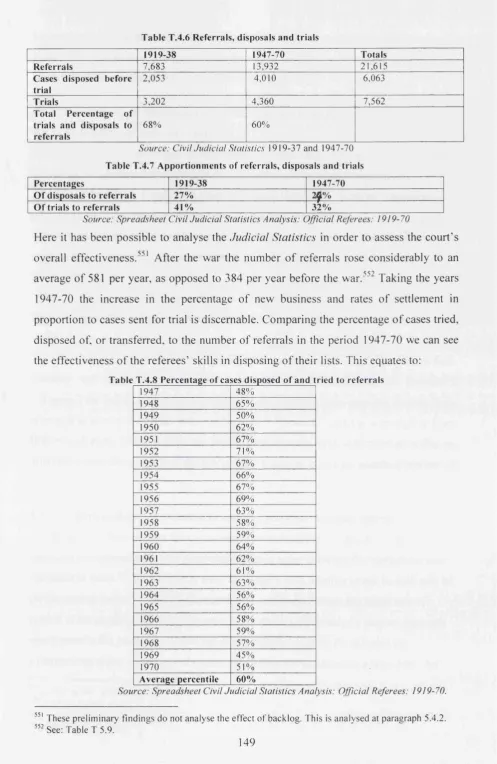
Table T.4.6 Referrals, disposals and trials 149
Table T.4.7 Average apportionments o f referrals, disposals and trials 149
Table T.4.8 Percentage o f cases disposed of, tried and disposed to referrals 149
Table T.5.1. Referral workload and average efficiency 159
Table T 5.2. Trial workload and time spent 159
Table T 5.3 Average trial times and trials per referee 161
Table T 5.4 Backlog calculations 161
30
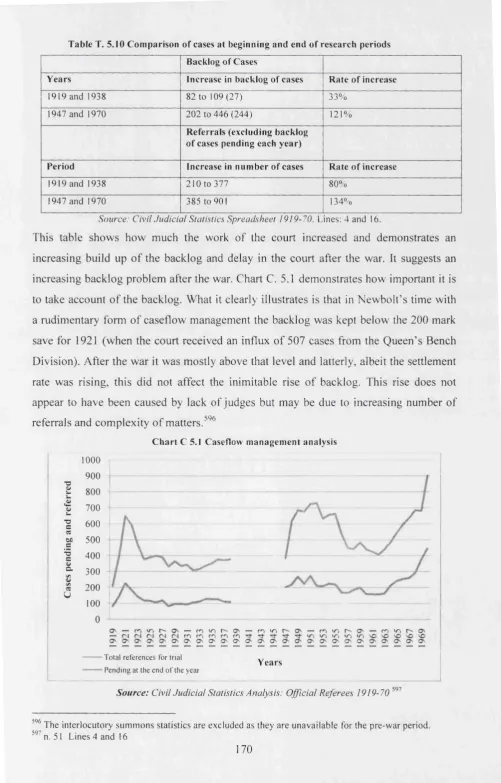
170
173
176
177
179
224
230
Table T 5.5 Referrals 166
Table T 5.6 Trials 166
Table T.5.7 Settlements, disposals and transfers 168
Table T.5.8 Backlog 168
Table T.5.9 Increase in caseload 169
Table T. 5.10 Comparison o f cases at beginning and end o f research periods 170
Table T 5.11 Comparative periods 1919-27 and 1957-64 171
Table T 5.12 Comparison o f trials, disposals and backlog 1932-38 175
Table T. 5.13 Highest trial efficiency pre-war 180
Table T. 5.14 Highest trial efficiency post-war 180
Table T 5.15 Formulae findings 181
Table T 5.16 Comparative average analysis 182
Table T 5.17 Average days sat per referee 184
Table T 5.18 Average time per trial 184
Table T 5.19 Referrals 1959-62 187
Table T 5.20 Expenditure o f time 188
Table T 5.21 Notional time 188
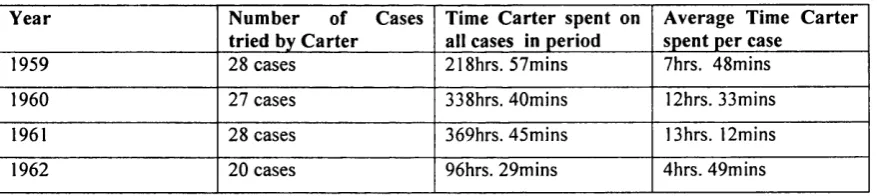
Table T 5.22 Carter time recorded 1959-62 188
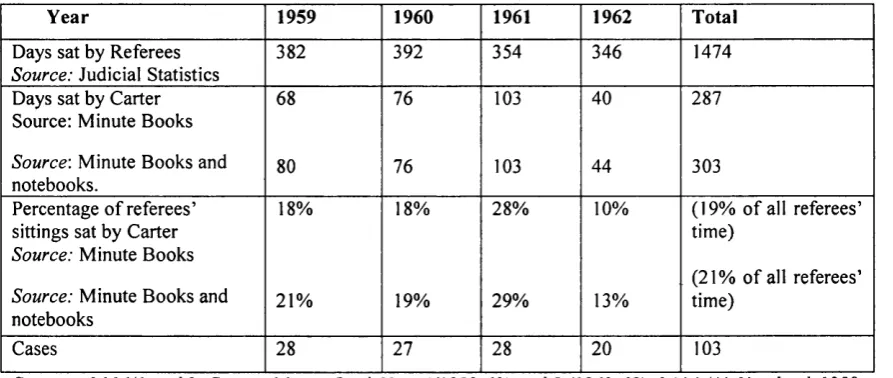
Table T 5.23 Carter’s share o f caseload 189
Table T 5.24 Carter’s sittings 1959-62 189
Table T 5.25 Case type/time spent (Minute Books and notebooks) 1959-62 190
Table T 5.26 Case type time related analysis 1959-62 191
Table T 5.27 Referrals 1965-67 193
Table T 5.28 Expenditure o f time 193
Table T 5.29 Average times per case 194
Table T 5.30 W alker-Carter turnover rates 194
Table T 5.31 Day sittings analysis 195
Table T 5.32 Case type/time spent Minute Books and notebooks 195
Table T 5.33 Case type/time spent (Minute Books and notebooks) 1965-67 196
Table T 5.34 Case type time related analysis 1965-67 197
Table T.5.35 Usage o f micro caseflow management tools 201
Table T.5.36 Proportion o f usage 204
Table T.5.37 Proportionate usage o f caseflow management tools 205
Table T.5.39 Hypothetical application 208
Table T.5.40 M icro-caseflow management elements 1959-62 211
Table T.5.41 M icro-caseflow management elements 1965-67 214
Table T.6.1 Newbolt/Richards comparison 226
Table T.6.2 Referral influx 1919-21 227
Table T.6.3 Rates o f disposal before trial 1928-31 227
Table T.6.4 Rates o f disposal before trial 1963-66 228
Table T.6.5 Number o f referees’ notebooks 234
Table T.6.6 Referees’ caseload and value o f cases 235
Table T.6.7 Summary o f average annual caseload and disposals per referee 238
Table T.7.1 Comparative disposal rates 248
Table o f statutes
Common Law Procedure Act 1854, s. 3
Chancery (Amendment) Act 1858, s.3
Supreme Court o f Judicature Act 1873, ss., 56 and 57
Supreme Court o f Judicature Act 1925, ss., 88 and 89
Supreme Court o f Judicature Act 1894, s. 1(5)
Administration o f Justice Act 1932
Administration o f Justice Act 1956, s. 15
Rules o f the Supreme Court
1873 Rules o f the Supreme Court 1873
r. 34 (Proceedings before an Official Referee)
r. 35 (Effect o f the Decision o f the Referee).
1875 Rules o f the Supreme Court
O. 36 r. 2.
1883 Rules o f the Supreme Court
0.3 6
0 .3 6 r.l9 A
O. 37A
1957 Rules o f the Supreme Court
O. 36A, r.l, r.2, r.5(2)
Amendments to Rules o f the Supreme Court
RSC (N o .l) 1933. RSC (No.2) 1934 RSC (N o .l) 1957
Annual Practice 1930
Notes on the practice before the Official Referee, pp. 640-641
Annual Practice 1955
Table o f reported cases
Albemarle Supply Company Limited v Hind and Company [1928] 1 KB 307 61
American Braided Wire Company v Thompson. [1890] 44 Ch Div 274 63
Anantapadmanabhaswami v Official Receiver o f Secunderabad [ 1933] AC 61
396
Audley Land Company Ltd v Kendall [1955] 1 WLR 639 222
Baroness Wenlock v River Dee Company [1887] 19 QBD 155 62
Beaman v A.R.T.S. [1949] 1 KB 550 61
Bickerton v Northwest Metropolitan Hospital Board [1970] 1 W.L.R. 607, 220
[1967] 1 ALL ER 977 at pp.979, 989 269
Biddell Brothers v E Clemens Horst Company [1911] 1 KB 934 61
Bradlaugh v Newdegate [1883] 11 QBD 1 62
Burrard v Calisher [ 1878] 19 Ch Div 644 61
Commercial Bank o f Canada v Great Western Railway Company o f Canada 30
[1865] 16 Eng Rep 112 1809-1865
Cole v Kelly [1920] 2 KB 107 61
Cropper v Smith [1884] 26 Ch Div 700 63
Cruikshank v The Floating Swimming Baths Company [1876] 1 CP 260 216
Davies v Property and Reversionary Investments Corporation [1929] 2 KB 61
223
Dunkirk Colliery v Lever [1878] 9 Ch Div 25 219
Elder v Auerbach [1950] 1KB 373 61
Gathercole v Smith [ 1881 ] 7 QBD 626 62
Gyles v Wico (1740) 2 Atk 141 43
Hornby v Cardwell; Hanbury (Third Party) [1881] 8 QBD 329 60
Hulland v William Sanders & Son [1945] KB 78 63
Hutchinson v Gillespie [1838] 12 Eng Rep 997 1809-1865 30
Re Letters Patent No. 139,207, Re Carbonit Aktiengesellschaft [1924] 2 Ch 63
53
In re M arried Women’s Property Act 1882 Re, Humphrey and Humphrey 61
[1917] 2 KB 72
In re Piers [ \ m ] 1 QB 628 60
Jackson v Rotax Motor and Cycle Company [1910] 2 KB 937 61
Jebara v Ottoman Bank [1927] 2 KB 254 61
Jenkins v Bushby [1891] 1 Ch 484 60
Joshua Henshaw and Son v Rochdale Corp [1944] KB 382 63
Joyner v Weeks [1891] 2 QB 31 60
Kay v Field & Co [1886] 10 QBD 241 63
Lady de la Pole v Dick [1885] 29 Ch Div 351 62
Lascelles v Butt [1876] 2 Ch Div 588 60
Leigh v Brooks [1876] 5 Ch Div 592 62
Lowe v Holme and Anor [1883] 10 QBD 286 63
Marsh v James [1889] 40 Ch Div 563 61
Miller v Pilling [1882] 9 QBD 736 62
Ormerod and Others v The Todmorden Joint-Stock Mill Company (Limited) 61
[1882] 8 QBD 664
Osenton v Johnston [1942] AC 130 32 235
Pirelli v Oscar Faber & Partners [1983] 2 AC 1 122
Porter v Tottenham Urban Council [1915] 1 KB 778 63
Potter v Jackson [1880] 13 Ch Div 845 62
Proudfoot v Hart [1890] 25 QBD 42 60
Phillips v Homfray [1883] 24 Ch Div 439 60
Reigate v Union Manufacturing Company (Ramsbottom) Limited and Elton 62
Cop Dyeing Co Ltd [1918] 1 KB 592
Rice v Reed [1900] 1 QB 54 62
Richards v May [1883] 10 QBD 400 63
Rochefoucald v Boustead [1897] 1 Ch 213 62
Rockett v Clippingdale [ 1891 ] 2 QB 31 63
Rose and Frank Co v JR . Crompton and Bros [1923] 2 KB 271 61
Rosenthal v Alderton and Sons [1946] KB 375 61
Rowcliffe v Leigh [1876] 4 Ch Div 661 62
Saxby v The Gloucester Wagon Company [1881] QBD 305 63
Strongman v Sincock [1955] 2QB525 222
Sutcliffe v Thackarah [1974] AC 727 122
T Tilling Limited v Dick Kerr & Co Ltd [1905] 1 KB 562 60
Tucker v Linger [1882] 21 Ch Div 18 60
Turnock v Sartoris 43 Ch Div. 150 (1889) 60
Union Bank o f London v Ingram 20 Ch Div 463 (1882) 60
Victoria Laundry ( Windsor) Ltd v Newman Industries Ltd [1949] 2 KB 529 61
137
Woodbridge v Hilton [1784] 28 Eng. Rep. 1202, 1557-1865 30
Woolfe v Wexler [ 1951] 2 KB 154 222
Table o f Unreported cases
(B. Denotes page number in Bibliography)
Agnew v Maycock [ 1948] J. 114/6 p. 15 FR 0 7 0 99,203
Re: a Lease o f St M artin’s Theatre London WC2 and re: Landlord and 221
Tenant Act 1954 Bright Enterprise Ltd v Right Honourable Lord B.24
Willoughby de Burke [1969] J.116/1 p.17 [CIM G0163]
A.G. Baxter(Stotfield)Ltd vJ.S. Dunne [1967] J.l 15/23 Case File 37
A. T. Chown & Co Ltd v Peter Davis Investments Limited [1962] 140
J.116/1 p.290 [HPIM 2116] B.36,56
Adkins v Joseph Cade & Co Ltd [1958] J. 114/34. p.87. [SH 10330] 131
Albert Colegate v D Raymark (Married Woman) [ 1949] J. 114/6 p. 181 123,130,152
[PRO II (FR) 082]]
Alexander andAngell Ltd v F.C. Pilbean [1968] J.l 15/28 Case File 222,249.
[CIM G0117] B.4
Allason & Others v Frankpile Ltd [ 1963] J.l 14/41 p.263 [Dec 2006 151
Series; CIMG 0656]
Allied Ltd v Peerless Representative (London) Ltd [1947] J.l 14/3 p. 64 112
[HPIM 1193]
Alloy and Fibreboard Co Ltd v F Super stein [1966] J.l 15/6 Case file: 120,253
O.R. 56/1965. 1964. A. No. 799. [HPIM 2705] B.45
Ancor Colour Print Laboratories Ltd v J Burley & Sons Ltd and F & D 132,214,236,
Hewitt Limited (ThirdParties) [1967] J.l 16/3 p. 193 [Oct 2006 Series: 246,251
SH101093] B. 48-49
Barrow Brothers (Builders Lancaster) Limited v Haworth [ 1962] 110,143,211,
J.l 16/1 p. 296. [CIMG 0200] 213. B.37,56
Bedford Theatre (London) Limited v Brisford Entertainments Limited. [1952] J. 114/21 p.246 [CIMG 0075-0076]
Benoir Hamburges v WinifredStort [1948] J.l 14/5 [HPIM 1232]
Beswarwick v. Woodbridge [1953] J.l 14/28 p. 92 [Oct 2006 Series SH
101389]
B ickleyv Dawson [1966] J.l 16/3 p. 191 [Oct 2006 Series: S H I01092]
Bogen v Honneyball and Rossal Estates Limited [1973] J. 115/49 Case
File. 1967. B. 2840. [HPIM 2749]
British Electric Traction Co Ltd v Thomas Edwin Langton and Luxury
Land Cruises Limited [1959] J.l 16/1 p. 87 [CIMG0169]
Burtain Ltd v J A Tyler & Sons Ltd [1953] J.l 14/24 p.267 [CIMG
0571]
Butler v Vaughan [1957] J.l 14/35 p.128 [HPIM2780]
Cecil v Ewell [1948] J.l 14/1 p. 252
Charlton Decoration Co L td v Robert Murray [1950] J.l 14/16 p. 67
[HPIM2158]
Clifton Shipways Co Limited v Charles Lane [1960] J.l 16/1 p. 104.
[CIMG 0176]
Commercial Union v Collective Investments Limited [1949] J.l 14/6
p. 176 [FR 080]
Cowley Concrete Ltd v Alderton Construction Co.Ltd. [1966] J. 115/1
Case File [HPIM 2685]
Cruttenden v Philips [1958] J.l 14/35 p.146 [HPIM 2784]
Davidson Engineers v Stephens & Brotherton Ltd [1951] J.l 14/19 p.57
[HPIM 1141]
Dawes v Papdimitiou [1952] J.l 14/24 p. 204 [CIMG0563]
DNL Stepgamy Limited v Millicent (Birmingham) Limited [1950]
J.l 14/14 p.247. [CIMG 0089]
Dorey & Son v Foster [1950] J.l 14/14 p.288 [CIMG 0091]
Duke o f Bedford v Augustus Faillie. [1946] J. 114/2 p. 166 [HPIM 1794]
E S Moss Ltd v J G rem el [1947] J.l 14/2 [HPIM 1796]
Eaton Berry Ltd v King & Anor.[ 1965] J.l 16/3 p.65 [Oct 2006
Series:SH101045]
Extol Engineering Ltd v. The British Process Mounting Co (a firm) and
Andrews Houseware Manufacturers Ltd [1965] J.l 16/2 p.283. [Dec
2006 Series SH101784] and see J 1 14/45 p. 210 [Dec 2006 Series CIMG 0736]
F G off & Sons Limited v Bently G olf and Country Club Limited [ 1974]
J.l 15/56 Case File. [CIMG 0127-130]
Frederick Baden Powell Weil v John Southern [1951] J.l 14/17 pp. 189
and 199 [SH 101132-101134]
Frederick William Young v Charles William Connery [1965] J.l 16/3
p.l [Oct 2006 Series: SH101015]
G Swindon & Co Ltd v William Franklin Stirling Car Hire Services
Limited, Launderette (High Road) Limited, Launderette (Boreham
Wood) Limited [1959] J.l 16/1 [CIMG 0168]
George Osbourne Limited v E.C. Goddard [1950] J. 114/14 p. 125
[CIMG 0086] 108.117 123,129,151, 152 107,145 121.214 B.57 122,247 B.4 221 B.26
116,131,152 B.94 138,203,221 109,113,132 126,151 .B.67 111,150,118 211,247,249, 257. B.27
113.117
247. B.4
110 137
131,202 223
135. B. 79 108 B.87 202. B.44
George v Russell Bros (Paddington) Ltd [1958] J.l 14/35 p.223 138 [HPIM2800]
George v. Russell Bros (Paddington) Limited [I960] J.l 16/1 p.96 139,212
[HPIM 2010] B.27,111
Gloucestershire County Council v Henry William Richardson (Trading 141,142,153
as W.J. Richardson & Son) and Ocean Accident and Guarantee B.4
Corporation Limited, [1966] Case File [HPIM 2733]
Great Western Railway Company v Port Talbot Dry Docks. [1944] 111
J.l 14/1[HPIM1735] B.114
Harper and Preston Limited v Marshall Castings Limited [1961] 143,212
J.116/1 p.170 [ CIMG 0184.] B.31
Harris v Mac Rex Foods Limited. [1946] J.l 14/2 p. 92 [HPIM 1787 - 96,106
HPIM 1789]
Harris v Rex Foods [1946] J.l 14/3. p.56 [CIMG 034.] 96,106
Hayland v Springet & Son [1951] J.l 14/21 p.l [CIMG 0061 -0062] 115,131 B.60
Hiauco Limited v Tauford & Co Limited [1950] J. 114/14 p.74 [CIMG 114
0079-0080]
Hon. Mrs Courtney Cecil Fern Sol v D Ewell (Spinster) [1948] J.l 14/4 109,132,152
p. 172 [HPIM 1779] B.85
Irvin & Sons v Blake [1952] J.l 14/24 p. 108 [CIMG0546] 116 B.20
J C Robertson & Sons (a firm) v House [1952] J. 114/21 p. 213 [CIMG 135,203
0074] B.61
J.H. Plant Ltd v Smithson [1946] J.l 16/1 p. 105 [Oct 2006 Series: HPIM 131
2015] B.27
Jack Hyman Sockel v Isaac Francis Salmon Matthew Francis [1950] 135,142
J. 114/15 p. 179 [CIMG 0466-68] B.63
James Conlon T /a J Conlon & Sons v Lloyds (Builders) Limited [1952] 115,201
J. 114/21 p.64[CIMG0063] B.36
James Kinross v R H Tarrant [1960] J. 116/1 p.107 [CIMG 0178] 119,202,211
Jayes Limited v Home Foods Limited. [1967] J.l 14/6 pp. 67-105. 97, 202
[FR 072-074]
Jays (Engineers) Ltd v Housegoods Limited. [1949] J.l 14/6 p.79 [PRO 130,202, 223
II (FR074)]
John Fletcher Suter v W Pikta [ 1961 ] J. 116/1 p. 186 [CIMG 0188] 128,202,212
Johnson v Johnson [1946] J.l 14/1 21 p. 63 [HPIM 1746] 90
K. Cross (Doncaster) Ltd v County Council o f York (East Riding) 141,215
[1966] J.l 16/3 p.172 [SH101085] B.47
Kefford v Brownleader [1953] J. 114/21 p. 258 [CIMG 0077] 117 B.61
Knibbs v Goodhale Engineers Ltd [1952] J.l 14/19 p.255 [HPIM 1177] 137 B.78,81
La Planche v Newman [1952] J. 114/21 p. 184 [CIMG 0068-0070] 223 B.60
Leighton v Tait & Alt [1966] J.l 16/3 p. 189 [Oct 2006 Series: 111,214
SHI 01091 ] B.47
Lenton v City o f Coventry [1960] J.l 16/1 p. 136 [HPIM 2030] 140B.29
Leon v Beales [1962] J.l 16/1 p. 245 [CIMG 0192] 7 February 1962 124,151,211
B.34-35
London and Canterbury Motors (A Firm) v B L Koppen [1947] J.l 14/3 112,129,152,
p.67 [HPIM 1195] 201,202
B.82
L o u is O b e r m e n te r v R ockw ell L o n d o n & P r o v in c ia l P r o p e r tie s L t d [ 1966] 246
J.l 16/3 p.139 [SH101074] B.45
Martin French v KingswoodH ill Ltd [1959] J.l 16/1 p.6 [HPIM1964] 118,140,202 203,212,249
McConnell v Grant [1957] J.l 14/35 p.128 [HPIM 2780] 139, 203
B.109
Middleton v Blackwell [1965] J.l 16/3 p.13 [CIMG 0096] 138,143,214
B.42
Modern Telephone Company v Pickering [1947] J.l 14/2 p. 168 [HPIM 113
1795]
Moresq Cleaners Limited v Hicks [1966] J.l 16/3 p. 163 [CIMG 0110] 143,215
Mory & Co Limited v Regan Brothers (Haulage) Limited [1965] 221
J.l 16/3 p. 25 [CIMG. 0098] B.42
Nathan Bernard v Britz Brothers Limited and Britz Brothers Limited 257
and Nathan Bernard and Ruth Bernard [1962] J.l 16/1 p.269 [CIMG B.123
0195]
Newbold v George Davies (Haulage) Limited [ 1966] J. 116/3 p. 127 221
[CIMG 0108] 24 March 1966 B. 45
Olga Hilditch (Widow) v Charles E.H Durham and A E L 141
Durham(Married Woman) [1967] J 116/4 p. 19 [Dec 2006 Series: SH B.50,58
101810]
P.C.S. L td vL ew e r [1954] J.l 14/31 p.32 [SH 101190] 138 B.96
Palmers Hebburn Company Limited v The Grimsby Steam Fishing 130
Vessel Mutual Insurance and Protecting Co Ltd and Shire Trawlers Ltd B.68
[1951] J.l 14/16 p. 96 [HPIM 2172]
Parkwood Engineering Co Ltd v Carlington Engineering Ltd [ 1961 ] 140,203,212
J.l 16/1 p.216 [Oct 2006 Series: HPIM 2072jpg] B.33
Pepper & Co Ltd v Harry Green Ltd [1951] J.l 14/19 p. 2 [HPIM 1125] 136,142,203
Phillips v Ward [1955] J.l 14/35 p.8 [HPIM2763] 126,202,
B.108
Plaehet v StormondEngineering Corporation Limited. [1949] J.l 14/8 at 99,203
p. 205
Plant Machinery v HP Thomas Limited [ 1960] J. 114/2. p.93 96
[HPIM 1790]
Praills Motors Ltd v Hills Bros & Mussell [ 1953] J. 114/28 p. 1 [SH 142
101372]
R. Corben & Son Ltd v Forte (Olympics) [1962] J.l 16/1 p.242 [HPIM 123,202
2088] B.34
Ridley & Ors v Kopisitzer [1958] J.l 14/35 p.197 [HPIM2794] 131,202
B . l l l
Rowlett v Champion [1947] J.l 14/1 p. 97 [HPIM 1766] 112
SKaplin & Son (Upholsterers) Limited v Parkins [1959] J.116/1 p.l 110,201,211
[HPIM 1963] also: [CIMG 0160; and SH 101353] B.123
S. J. C. Duqueim v Atlas Assurance Company Limited [ 1946] J. 114/3 107
p. 130 [CIMG 0037-0039] B.60
Sergeious Papa Michael v A K Koritsas [1961 ] J. 116/1 p. 207 211
[CIMG 0190]
Sheering v Wisehill Field Company Ltd [1966] J.l 16/1 p.283 212
[HPIM 2113]
Shopfitting Centre Ltd v RevueIta [1962] J.l 16/2 p.5.[SH 101775] 132,202,212
B.37
Swallow Prams Limited v United Air Coil Limited [1967] J. 116/4 p.35 141,203,215
Sydney Smith Black Mobile Coaches Limited v J F Anderson (Male) 223
[1948] J.l 14/4 p.156 [CIMG 0058] B.60
T JK endel & Co vATA Scientific Progress Ltd [1951] J.l 14/16 p .133 139
[HPIM 2186] B.70
Titler v Brown & Another[ 1956] J 114/35 p .100 [HPIM 2771-2773] and 221
[CIMG 0089] B.108
Townsends Builders Ltd v France [1962] J.l 14/41.p. 180. [Dec. 2006 211
Series CIMG 0638] B.36
United Dominions Trust (Commercial) Ltd v Thomas Gravell & Prized 143
Steele Garage Ltd [1966] J.l 16/3 p.99 [SH101055] B.45
Van Nuffelen v Leicester. [1952] J. 114/21 p.65 [CIMG 0067] 116 B.60
W H Armfleld Ltd v John England Perfumers [1950] J.l 14/19 p.82 134
[CIMG 0456] B.63
W J Barrs Limited v Thomas Foulkes [1965] J.l 16/3 p.49 [CIMG. 150,214,247
0102] B.43
W J Gray & Sons v Royal Mail Lines Limited [ 1946] J. 114/3 p. 157 202
[CIMG 0041] B.60
Webbs Asphalt Roofing & Flooring Co Ltd v Roper & BRM Shopfronts 111,201,214
(A Firm) [1966] J.l 16/3 p. 125 [CIMG. 0106] B.45,57
Westheath Contractors v Borough o f Grantham [1945] J 114/2 p. 1 [FR 112,125,220
031-037] B.113
William George Mellie v Mrs A Mellie (Married Woman) [1947] 109
J.l 14/4 p.l 12 [HPIM1217] B.84
Wilson v Crac [1952] J.l 14/20 p. 169 [HPIM 1776] 116B.81
Wilson v Eastern Counties Farmers Cooperative Association Ltd 138,142
[1953] J.114/28 p.15 [SH 101376]
Zenith Skin Trading Co Ltd v Frankel [1947] J.l 14/4 p. 121 [1947] 96,106,129
Bibliography
Parliamentary Papers and Reports 1
Civil Judicial Statistics 2
House o f Commons Debates 2
National Archive Materials 3
Papers o f Roundel Palmer, Lord Selboume 6
Books 6
Reference Books 7
Journals 7
Newspapers 9
Correspondence 10
Appendices 11
Chronologies 14
Sample Return o f Judicial Statistics 1880 19
Data Collection: Official Referees’ Notebooks and Minute Book records 22
Statistical data spreadsheets 126
The true function o f the court, it is submitted, is especially in comm ercial cases under consideration, not to conciliate or exhort the parties, as is som etim es suggested, much less to hurry them, or to deprive them o f perfect freedom o f action, but to use the available machinery o f litigation to enable them to settle their disputes according to law without grievous waste, and unnecessary delay and anxiety: and in particular to show them how this, if desired, may be accom plished. The only so-called concessions which the parties can be said to make are made not only voluntarily, but in their ow n direct pecuniary interest. This has little, or nothing, to do with the com m on-place saying o f ordinary life that a man loses nothing in the long run by forbearance, fair dealing, or generosity.
Sir Francis N ew b olt2
CHAPTER 1
A STUDY IN RUDIMENTARY CASEFLOW M ANAGEMENT
1.1 Incipient micro-caseflow management
This study makes the large claim that micro-caseflow management was practised by the
Official Referees in the early part o f the twentieth century decades before the 1996
civil justice procedural reforms. In it we also discern the judicial sponsorship o f
settlement as advocated and practised by Sir Francis Newbolt4 and his colleagues in that
court. Such study may lead us to draw wider conclusions in the context o f civil justice.
This thesis seeks to establish that a rudimentary case management regime was practised
in this court as early as the 1920s. This was long before other courts and jurisdictions
experimented in these interlocutory practices, although the process o f preliminary issues
was advocated as far back as 1867 in the First Report o f the Commissioners.5 Two
facets o f caseflow management are explored at micro and macro-level. Micro, in the
context o f how the referees managed their work more effectively and efficiently, and
macro in the sense o f how the Judicature Commission and the superior judiciary
facilitated the more efficient delegation and disposal o f business.
This study concerns two significant periods in the evolution o f micro-caseflow
management in that court: 1919-38, and 1947-70. Within this second period a more
detailed forensic study is focussed upon the years 1959-62 when the court’s Minute
Books provide the first definitive evidence o f time expended. That is supported by a
further detailed study o f the years 1965-67. Whilst there is some empirical evidence o f
rudimentary caseflow management in the Lord Chancellor’s Office files, and in the
2 F. N ew bolt, ‘Expedition and Economy in Litigation’ (1 9 2 3 ) 39 LQR 440.
3 O fficial R eferee(s) hereafter referred to as “referee(s).” The “court” is the Official R eferees’ court unless otherwise indicated.
4 K.C. 1914; Hon. R.A.; J.P., M .A., F.C.S., A.R.E. Hon. Professor o f Law in the Royal Academ y. Publications included: S ale o f G oods A ct 1893; Summ ary P rocedu re in the High Court, and O ut o f Court. O fficial Referee 1920-1936.
contemporaneous judicial records o f the court itself, as well as in an article authored by
its chief exponent, Sir Francis Newbolt,6 in The Law Quarterly Review, there is little
evidence o f it in the official law reports. After Newbolt’s retirement the practice
7 Q
evolved through his successors Sir Tom Eastham QC, Sir Walker Carter QC, and Sir
Norman Richards QC9
1.2 Caseflow management and theory
Caseflow management in this context is synonymous with what is identified in Chapter
3 as N ewbolt’s “Scheme.” This has two principal manifestations. The first is the activist
approach involving a more robust stance o f judicial management demonstrated by
judicial intervention at interlocutory and trial stage. The clearest demonstration o f this
was where Newbolt led settlement discussions in chambers. The second manifestation is
a more traditional role, a passive approach, with the referee being non-interventionist
during the interlocutory and trial stages. In the latter, the parties manage progress, but
the referee facilitates resolution by granting adjournments or stays to assist settlement
discussions between the parties. These approaches are illustrated by case studies and
examples in Chapters 3 and 4 covering the pre and post-war eras.
We need to be clear that Newbolt’s “Scheme” was a self-conscious scheme; he invented
it. This is confirmed in his report to Lord Birkenhead10 dated 5 July 1920, and in his
seminal article11 as well as other evidence analysed in Chapter 2. He clearly believed in
the efficiency o f his “Scheme” from which my theory o f micro-caseflow management
emanates.
1.3 Purpose o f research study
The central purpose o f this study, confined to the research periods, is to consider the
origins and evolution o f caseflow management in this court and the various devices
associated with it in bringing about a more expedient process. The study also considers
those involved and why it was invented. It gives an explanation as to the origin o f a
form o f caseflow management in England in the 1920s, and describes the interlocutory
procedural devices used by the referees from that time. The process or “Scheme” is
analysed in Chapters 3, 4, and 6 and examined in quantitative terms in Chapter 5. The
6 n.2.
7 1936-1954. 8 1954-1971. 9 1963-1978.
latter demonstrates a time saving where it appears to have been applied. Newbolt and
his colleagues (like arbitrators) could only use such devices where the parties consented.
Incidents o f caseflow management are illustrated in the cases o f Newbolt, Eastham and
Carter in varying degrees, and whilst N ewbolt’s reports and writings confirm the
existence o f the “Scheme,” no contemporaneous judicial records (notebooks or Minute
Books) o f his time have survived the war. On the other hand, there is a considerable
amount o f archival material o f his successors that survives as described below.
1.4 Importance and Interest
The “Scheme” is important in understanding to what extent appropriate caseflow
management can be effective at a subordinate judicial level and in ascertaining the
relationship between informal and formal dispute resolution in a court setting. It is
important for other reasons because:
1. It demonstrates macro-caseflow management by judicial delegation and the
advantage o f a subordinate judge;
2. It shows the benefit o f informal proceedings at an interlocutory stage with a
subordinate judge who understands the issues in the case. Such judge may act as
a facilitator promoting earlier settlement with party consent and without
unnecessary waste o f time or money in certain cases;
3. It demonstrates how time and costs may be saved by an interventionist (activist)
and a non-interventionist (passive) approach to the case.
4. It considers the relative success o f the “Scheme” in qualitative and quantitative
terms;
5. It analyses the relative success o f the “ Scheme” in qualitative and quantitative
terms;
6. It synthesises the study with recent trends in civil justice and ADR.
The hypothesis in favour o f efficient referee caseflow management is o f particular
interest in the context o f the times. Newbolt wrote his report in 1920. This was eight
years before a justice o f the Municipal Court in N ew York wrote about his attempts at
1 9
conciliation and mediation in court in the mid 1920s. Newbolt was not undertaking the
same activity as Justice Lauer. He was not conciliating or mediating at trial stage, but
facilitating settlement at the first summons for directions hearing.
Here we trace the origin o f caseflow management in England and consider Newbolt’s
model “Scheme” for earlier resolution. Our analysis juxtaposes the implementation o f
informal and formal management methods extending the ju d g e’s traditional non
interventionist role. It is argued that cases were resolved more efficiently because o f
the subordinate status o f the referee’s office which enabled informal “discussions in
11
chambers.” This would be difficult for a High Court judge who could be criticised for
compromising his independence. In any event the High Court judge had no real
procedural opportunity for this because he did not give directions for trial. The
“Scheme” was operable at the first summons for directions stage after referral from a
master or High Court judge because the pleadings would be closed and all material
issues identified.
Such discovery o f early caseflow management is o f importance and interest to all those
interested in civil justice reform. This is because the traditional perception o f the
English High Court judge before 1996 was that he did not enter the arena or the debate
between the parties.14 He was not a manager o f the process, or an interventionist. He
was not concerned with settlement, or with interlocutory matters before trial. He
remained aloof, symbolised by his elevated physical location in the courtroom itself.
There could be no suspicion o f bias; the judge had to be seen to be independent. Thus,
we may argue that a subordinate judge, operating a more informal process, through
Newbolt’s “discussions in Chambers,” might be less prone to such suspicion, and, more
importantly, resolve cases quicker and more cheaply. N ew bolt’s “Scheme” and this
study therefore questions our perception about a ju d g e’s role and what it should be.
There were differing views about the status o f the referee.
Roland Burrows described them as:
subordinate officers (who) have developed into judges o f important action s.15
On the other hand, Newbolt claim ed:16
w e are High Court judges in all but name, dealing with actions o f great com plexity and importance. I have already tried a case involving a claim for £ 106,000 this term and have another shortly to be tried involving £ 8 0 ,0 0 0 ...
13 n.5 p. 438.
14 Lord W o o lf s F inal R eport to the L o rd Chancellor on the C ivil Ju stice System in E ngland an d Wales.
p. 299. (London. Stationery O ffice, July 1996)
15 Burrows, Roland O fficial Referees (1940) 56 LQR 504-513 at p. 506.
16 LCO 4/1 5 2 N ew b olt to Schuster 1st April 1923. [HPIM 0637]. As may be discerned from the
or, as Eastham argued in his M emorandum:17
The work done by the Official Referees is only comparable with that done by High Court Judges when trying long non-jury actions and it is more difficult, important and requires more legal experience (all these O fficial Referee’s are King’s Counsel o f at least 10 years standing) than the work o f County Court Judges, Stipendiary Magistrates, Masters o f the High Court and Registrars in Bankruptcy.
And subsequently Sir Brett Cloutm an’s expressed the view :18
The truth is that for h alf a century or more he has not been a referee at all, but a judge o f the heaviest cases in contract.
The referee’s role was exceptional for the reasons explained in Chapter 2 embodying a
combination o f functions resembling:
> a jury in giving a verdict;
> a master in dealing with interlocutory issues,
> an arbitrator in acting with the parties consent,
> and a judge in conducting the hearing and giving judgement.
He was a quadri-functionary created by the Judicature Commissioners who were
influenced by a num ber o f factors described in Chapter 2. As The Times reported the
referee was “one o f the most striking novelties in the Judicature Act o f 1873.” 19 Yet the
referees had what Edgar Faye termed “an inauspicious start.”20
The utility o f the office did not really emerge until N ew bolt’s time and the acquisition
o f the Queen’s Bench non-jury list. This sudden heavy influx coincided with Newbolt’s
innovations. He was able to effectively manage interlocutory and trial process.
Interlocutory process was more effective because o f the commercial approach adopted
by solicitors who readily appreciated the benefit to clients o f earlier settlement.
It is contended in Chapter 5 that the “Scheme” may have been used in up to a quarter o f
all referrals.21
1.5 Hypothesis
The hypothesis is that the invention and evolution o f a rudimentary caseflow
management and consensual interlocutory process made referees more effective. This is
demonstrated in Chapters 3 and 4 by examples o f N ew bolt’s activist style compared to
Eastham’s passive approach. We also discern an amalgam between the two facets o f
17 LCO 4/417. [HPIM 0938]
18 O fficial Referee (19 4 8 -6 3 ) LCO 2 /7739 [HPIM 0814] Memorandum citing Order 36A Rule 7 RSC 19 The Times May 29, 1876; p. 11; Issue 28641; col A.
20 E.Fay, O fficial R e fe re e s’ Business, p. 17. (London: Sweet & M axw ell, 2 nd ed, 1988)
macro and micro caseflow management inherent in the organisational reforms o f
Selboume and Caims, and the Newbolt “Scheme.” The latter having two
manifestations: the traditional and more passive approach as demonstrated at times by
Eastham and Carter, and again, the activist approach o f Newbolt and also o f Carter
considered in Chapters 3 and 4.
The hypothesis is further demonstrated by quantitative and qualitative analyses and
literature reviews in other chapters. The underlying concept here is that the referees
developed their own judicial culture in dealing with complex technical cases making
their practice distinctive facilitated by their unique function and role in the High Court.
1.6 Research questions
To test the hypothesis that the invention and evolution o f a rudimentary caseflow
management and consensual interlocutory process made referees more effective, we
address the following research questions:
(a) why the office o f referee was invented and what caused and facilitated case-flow
management?
(b) what was Newbolt’s “Scheme", and what were the reasons for his application o f
this rudimentary form o f case management?
(c) what was the impact o f such “Scheme” according to a literature review o f the
archival materials that survive, and what conclusions can be drawn?
(d) to what extent did Newbolt’s “Scheme” promote expedition and economy in the
court’s work?
(e) to what extent, if at all, did the referees promote settlement and save costs?
(f) what was the impact o f this “Scheme” as ascertained by qualitative and
quantitative analysis o f Judicial Statistics and the original court records?
1.7 Use o f research
This research examines the effectiveness o f the “ Scheme.” Its value lies in its challenge
to the traditional view o f the judge’s role in litigation: that it is no part o f the judge’s
duty to be involved in settlement. In the English adversarial system it was for the parties
to present and prove their respective cases. If they chose to settle it was a matter for
them. In that system little attention was paid to the ju d g e’s case management role save
interventionism. At the time o f Evershed 22 it was thought that “a robust summons for
directions” would resolve matters more quickly. But generally case management was
unknown in England. Thus, this discovery may come as some surprise. The findings are
o f considerable interest in the context o f what has now been introduced right across the
court system without knowledge o f this. The research highlights the role o f an inferior
judge and the advantage that enjoyed; indeed it may provide a role model. It thus
indicates a secondary theme as to the role o f the judge in relation to settlement and
possibly suggests a way forward without giving offence to the concept o f judicial
independence. N ew bolt’s singular achievement seems to be that he was able to facilitate
settlement without compromising the procedural or substantive legal rights o f the
parties either procedurally or substantively. There is no record o f any referee ever being
appealed in relation to, or any critique o f the “Scheme.” Whilst Chapter 3 considers the
understandable reserve o f Lord Birkenhead such reservations did not restrain or prohibit
Newbolt’s practices. The “Scheme” should not therefore be seen as an impediment to
justice, or an abuse o f judicial process.
We conclude that the use o f the research is to allow us to consider what a judge is and
what he ought to be in the context o f caseflow management.
1.8 Evolution o f the referee
This study traces the evolution o f the referee over the course o f a century from 1867 to
1967. In naming the new court officer a “referee” the Judicature Commission
deliberately invented a new subordinate judge that would enable High Court judges to
function more effectively. At macro-level, the referees reduced the High Court caseload
and backlog. At micro level, they revolutionised the judicial process inventing a
rudimentary form o f caseflow management. An essential ingredient o f that was their
active involvement in earlier resolution. They, in particular, Newbolt, shifted the focus
from trial to informal case management resolution which is analysed in Chapters 3 and
4. Such development at micro level might not have been foreseen by the
Commissioners, but there were lessons learned from the pre-1873 role o f a referee that
suited their objectives.
That earlier role dated from the eighteenth century where matters o f detail or account
“ad computandem” were referred to a master or an arbitrator. Woodbridge v Hilton,23
was one o f these early referrals to an arbitrator to settle “all differences save costs.”
References were made under the Common Law Procedure Act 1854 and in the Court o f
Chancery24 described in Chapter 2. There were references from the Judicial Committee
o f the Privy Council in cases such as, Hutchinson v Gillespie,15and in Commercial Bank
o f Canada v Great Western Railway Company o f Canada26 in 1865, where counsel
included Sir Roundell Palmer, and Sir Hugh Cairns with Lord Chelmsford presiding.
Interestingly all three were involved in the creation o f the referees’ office which in itself
provided an excellent example o f the blending o f Chancery and Common Law practice,
a principal feature o f the Judicature Acts.
The first referees were appointed under Section 83 Judicature Act 1873. The Act
invested the referee with the powers o f a High Court judge giving referees more teeth
than the prior legislation or Chancery practice. We can see in .1.1 below how
K
their jurisdiction grew with referrals increasing from under 100 in 1877 to over 300 in
1890.
C hart C 1.1 R eferrals 1876-98
R eferrals
■Referals
350
300
250
200
150
100
50
0
1876-77 1877-78 1878-79 1879-80 1888-89 1889-90 1896-97 1897-98
Source; Returns o f Civil Judicial Statistics 1876-98
23 28 Eng. Rep. 1202 1557-1865
24 Other cases included the referral to a County Court judge having High Court powers. Re: Anna Booth.
5 C.B. (N .S .) 539. p.218. Costs were taxed on High Court basis per Crowder.J. 25 12 Eng. Rep. 997 1809-1865.
26 16 Eng.Rep. 112 1809-1865.
A steep rise in the 1880s coincided with substantial amendments to the Rules o f the
Supreme Court. Order 36 dealing with referees was amended giving them power to
9 7 9 R
hold trial at any place, order discovery and production o f documents, order costs at
9 0
interlocutory and judgm ent stages, and significantly a power to give orders on
directions after reference. It was that power that enabled Newbolt to initiate his
innovative chambers discussions as described in Chapter 3.
*51
In 1888 referees were permitted to transfer cases between each other and in 1889 the 79
Senior Official Referee was required to make a return o f cases to the Lord Chancellor
and Lord C hief Justice so that work could be monitored. In 1893 referees were
empowered to inspect property, an important caseflow management tool.33 The
Judicature Act o f 1894 provided that appeals lay to the Divisional Court. In 1900 the
referees moved premises from their chambers in Portugal Street to the W est Wing o f the
Law Courts.
In 1920 a dynamic era o f procedural innovation began when Lord Birkenhead appointed
two referees: George Scott and Francis Newbolt, who joined Sir Edward Pollock. Their
appointments were practically coincidental with the acquisition o f the non-jury Queen’s
Bench list which trebled the workload o f the referees in the two years from 1919 to
1921. Such a sudden and steep rise in caseload necessitated the invention o f a more
efficient working system in the form o f the “Scheme.” Scott invented his “Scott” or
“Scott’s schedule” as Eastham called it. This document summarised the pleadings in
terms of: the items in dispute, their value, description o f the contract or the works, the
remedial work and its cost with columns in the schedule for the parties’ comments and
the referees’ decision. This device facilitated early settlement by defining the issues o f
fact and quantum and may be considered an element o f the “Scheme.”
It is arguable that the referees’ profile was raised by Section 1 Administration o f Justice
Act 1932 enabling appeals to the Court o f Appeal on a point o f law only, circumventing
the Divisional Court, so that appeals from the referees were to Lords Justices o f Appeal
27 Order 36 Rule 48. RSC 1883. 28 Order 36 Rule 50. RSC 1883
29 Order 36 Rule 5. RSC 1883 (D ec. 1899)
30 Order 30 RSC 1883. Referees gave directions soon after the referral. 31 Order 4 7 A RSC 1883.(D ec. 1888)