University of East London Institutional Repository:
This paper is made available online in accordance with publisher policies. Please scroll down to view the document itself. Please refer to the repository record for this item and our policy information available from the repository home page for further information.
Author(s):
Mousavi, Seyed A. Amin; Pimenidis, Elias; Jahankahni, Hamid.Title:
Five stage development framework for electronic government
Year of publication:
2010Citation:
Mousavi, S. A.A., Pimenidis, E. & Jahankhani, H. (2010) ‘Five stage development framework for electronic government.’10th European Conference on e-Government. University of Limerick in the National Centre for Taxation Studies, Limerick, Ireland, 17-18 June 2010. Academic Conferences International (ACI).Link to conference website:
Five stage development framework for electronic government.
Seyed Amin Mousavi, Elias Pimenidis, Hamid Jahankhani University of East London, London, United Kingdom [email protected]
[email protected] [email protected]
Abstract: The purpose of this paper is to discuss a framework for developing electronic government applications from the early stages of the process. In previous work the authors had reviewed four popular
staged-development models for electronic government, had highlighted their shortcomings and had proposed a five stage model had for developing electronic government. This framework defines activities required to be performed in each stage. It also addresses some of the limitations and the shortcomings of previous models. Some key considerations in developing the proposed electronic government development framework are digital divide, trust, usability, accessibility as well as education and training. In this work the framework is being evaluated against a best practice case of developing electronic government. This is used to assess the
framework’s capability in: addressing and maintaining strengths, encouraging possible opportunities, identifying and addressing weaknesses and threats. The findings show that most of the issues arising from the case study have been addressed by the proposed framework but there are some issues which need further exploration.
Keywords: E-government development, Limitations of staged-development, Digital Divide, Trust, User Training
1. Introduction
This paper aims at proposing a framework for developing e-government from early stages. Developing countries have the opportunity to benefit from experiences of more developed countries for implementing electronic government. On the other hand developing countries are facing more challenges in implementing successful e-government applications compared to those of the developed world (Heeks, 2003). Proper telecommunications and legal infrastructures, supported by the political will for reform, are essential for the success of any e-government project. E-e-government strategies in developing countries should first target the improvement of their operations and processes and also the level of a government’s ability to cooperate with itself (across different departments and services) and third parties. After preparation of such a platform, developing functional e-government systems can begin. Existing models for developing e-government can be used for the purpose of developing electronic government in developing countries. A development model should represent functional and none functional requirements in addition to being accurate, unambiguous, and complete (Bennett et al 2002). Layne and Lee (2001) have introduced a four-stage model for e-government which discusses functions and challenges of several stages of developing e-government. This model has been chosen out of several other models of developing e-government not only because of its unambiguousness and accuracy but also because of its adaptability and applicability to developing countries. The authors have used Layne and lee model as the base for proposing an electronic government model for developing countries. However, Layne and lee (2001) model has its limitations which will be addressed. In this paper after discussion of these limitations, a five-stage model will be introduced based on the Layne and lee (2001) model for developing electronic government. Then the best practice case on developing electronic government in Middle East will be explained and used for evaluating and refining the five-stage model of developing electronic government.
2. Issues which enhance development model:
Implementation of electronic government efforts in most countries starts with the setting up of a website which provides information and then moving towards provision of integrated provision of electronic government services (Brooks et al 2008).
The Layne and Lee model considers evolution of electronic government in the context of technological and organisational changes. The citizens’ views and concerns in this model is only addressed partially and it is limited to privacy and security concerns which will only be addressed by organisational and technological means, as electronic government expands through communication, transaction and integration stages. Such a limitation will cause vulnerability of users in their interaction with electronic government and therefore reduce citizen trust (Mousavi et al., 2008). Carter and Belanger (2004) suggest that trustworthiness is a factor which is influencing citizens’ intention to use government electronic service.
A further limitation of Layne and Lee model is its restricted concern over education and training of the users. Basically their model only considers training in the context of organisation and for the government employees. There is no concern over education and training of citizens. A third shortcoming is also related to citizens’ requirement in using electronic government websites and services, namely accessibility, usability and digital divide. The digital divide eliminates expected utilization of ICT facilities (Bertot, 2003). Trust and its related factors are essential for online transactions (Teo and Liu 2007). In addition to training staff, educating and training other users of electronic government systems and providing accessible and usable interface have been considered as requirements for successful development and implementation of electronic government programs. The main issue which has not been addressed by the Layne and Lee (2001) model is the digital divide. In other words in implementing e-government according to Layne’s model, there is no consideration of citizen
participation and most importantly in the case of developing countries no consideration of the issue of developing citizen trust which has been considered as an extremely important factor in combating the digital divides (Bolissian et al., 2006). To address this weakness of Layne’s model, this research has extended its model in such a way that encouraging and empowering citizens to use electronic services will be considered during the development process of an electronic government project. This approach has been termed as ‘the five-stage development model for deploying e-government in developing countries’.
Based on later studies (Reddick, 2004; Sipior and Ward, 2005; Belanger and Carter, 2006), citizens participation has significant impact on success of e-government. Belanger and Carter (2006) conducted empirical studies in the rural areas and their finding showed significant impact of the digital divide on the use of e-government services. Empirical studies by Reddick (2004) show that growth of electronic government is not linear as mentioned by Layne and Lee (2001) and it follows an S-shape theory which means that after a while, the number of users of electronic services will not increase as it was increasing at the start of introducing e-government services. Furthermore, field studies by Sipior and Ward (2005) in the USA show that while a first time visitation of government websites was high among the users, there were no intention amongst users to continue this use.
3. Five stage model
In order to present an enhanced model existing limitations to Layne and Lee (2001) must be addressed. In this section some initiatives are brought to consideration and a five stage model which includes these initiatives is presented. Set of initiatives can be used to overcome problems associated with citizen’s participation. These initiatives include bridging the digital divide (access divide and skill divide) in the process of e-government development, encouraging citizen participation and empowering citizens to utilise e-government services. Furthermore, a key issue in improving user participation is increasing citizen trust. Corruption is a major problem in many societies in the developing world. Asking citizens to conduct their transactions online with the government implies placing their trust with them. Any model that aims at improving the efficiency and
effectiveness of e-government applications for the developing world would have to consider the issue of
officers and finally the provision of a guidance framework by national government to guide government agencies.
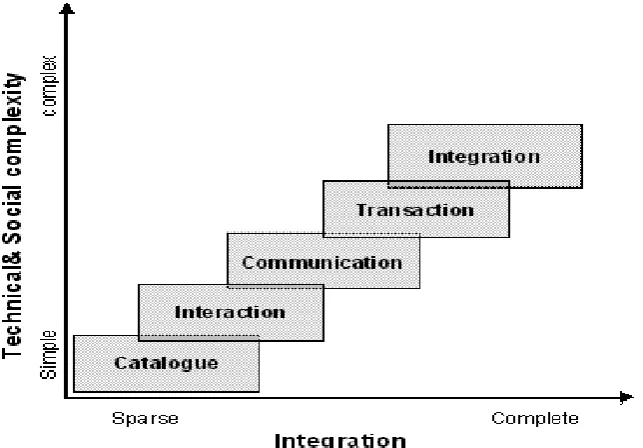
The following figure shows the five-stage model for developing e-government projects.
[image:4.595.73.395.140.364.2]
Figure 1 Five stage model for e-government implementation in developing countries (Mousavi 2009).
3.1 Cataloguing stage
In this stage, government puts some of its information online and tries to create an informational website which enables citizens to find government catalogued information online. Provided information should include information about government and information produced by government. By doing so, the government agency begins to get familiar with online transactions and e-literacy training of its staff begins. This informational presence of government helps citizens to find out what to do to obtain specific government services. In this stage, the main technical challenge is management and designing information access for e-government. Dawes et al. (2004) presented an array of consideration for designing government’s information access. This array focused on the public policy goal of initiative, analyses problem and data management, organisational issues and users’ capabilities and requirements. Changes in citizen behaviour in future stages of developing e-government can be recorded and analysed by this model. Government agencies can use this information for improving their services to e-government stakeholders. In addition to online presence of government websites, information cataloguing, putting contact address of officials and specific information about available services and
downloadable forms can be considered as examples for this stage. It is suggested that not all services should be provided online at this stage. The government agency has to start with the services that are easier to provide electronically, are cost effective, and more likely to be utilized by users electronically. Developers start
providing information about chosen services at this stage. These services might be provided partially rather than complete. One should remember that most of the government services can not be provided entirely at this stage. It is suggested to start partial and incomplete provision of these services at this stage and try to complete them in future stages. If more than one language is spoken in the region then, starting this stage by creating a bilingual and multilingual government website will streamline activities in the next stage which aims at encouraging user interaction.
3.2 Interaction stage
Reengineering of governance processes must be considered by developers in this stage. Existing processes of obtaining electronic government are normally lengthy and confusing for the average citizen. As is the case in Iran obtaining one particular service requires going through a lengthy procedure which may involve bribery and result in the loss of government accountability. Reengineering of the processes should aim at replacing old processes with new processes which are more cost and time effective and also simplifying existing processes to make them understandable for the average citizen. Another aim of new procedures and processes should be eliminating or reducing the chance of bribery and corruption. To encourage citizen’s participation, government has to overcome social and technological barriers. Showing citizens that their contributions and comments are effective and transparency in government procedures which makes it easier for citizens to understand these procedures are motivating factors. The main obstacle to complete this stage is overcoming the digital divide. Improving IT infrastructure, educating citizens, and providing information kiosks in rural areas can help to bridge the digital divide. Some of the indicators and examples for this stage are strategies for encouraging and empowering citizens and businesses to participate in utilising electronic services provided by government. For example, citizens who seek services online will benefit from faster processing of their inquiry, or some services can be provided with discounted charges to encourage citizens to try obtaining services online. Finally to enforce electronic interaction with government, some specific services can be provided electronically only. For successful electronic government implementation, developers must also consider usability, and education and training requirements of users. Providing online training courses for users and considering ease of use and consistency in the format of website are examples for facilitating usable interaction with the system.
3.3 Communication stage
In this stage, government initiates its communication with stakeholders of electronic government. Electronic communication could be one way or in some cases two way in this stage. In other words all types of communication are not facilitated in this stage. For example emails will be exchanged between citizens and government officials two ways but due to technical and legal constraints official forms can not be submitted electronically. Since these forms require the citizen’s signature, electronic submission requires the appropriate technical platform and legal support for electronic signature. Hence minimum requirement for this stage is provision of one way communication between government and its stakeholders. Stakeholders of electronic government are citizens (G2C), businesses G2B), and government itself (G2G). Adding more features to informational websites is the main technical challenge here. Communicating by electronic mail must be utilised in this stage. In this stage, government puts downloadable forms online which can be completed by citizens before contacting government offices. These forms can be sent back to corresponding government offices by post or by person. In both cases, it saves a considerable amount of time and effort for citizens, businesses and government agencies. User feedback can improve the quality of services at this stage. Most visited web pages can be tracked, so more effort will be focused in specific areas. It is possible for different government agencies to track user visits to each web page and the time that they spend on each particular subject. This information is useful for improving the quality of a range of services which government offers but at the same time it can be used for commercial purposes (selling information to third parties). The main issue which arises here is that of privacy and trust (Layne and Lee, 2001).
Reddick (2004) argues that this stage takes more time than is planned. Explicit measures must be used to ensure privacy protection at this stage. In addition to electronic mail of officials, any other information which
facilitated one way electronic communication between users and government can be considered as an indicator for this stage. Automation of existing processes is a pre-requirement for the next stage and must be started at this stage to speed up communication between citizens and government agencies. Government officials will start to communicate with citizens electronically. This has the potential to streamline the procedures for obtaining government services and also eliminating bribery. Reforming the way in which officials are performing assigned tasks and changing current situations will face resistance. Educating and training staff, involving staff and other stakeholders in development and implementation of the new system, and developing, measuring and rewarding good performance and involvement and commitment of top management can reduce staff resistance to change as end users.
3.4 Transaction stage
In this stage, each government agency provides services to citizens and businesses. This stage is more mature compared to the previous stage by facilitating two way communications. In other words, in addition to
of the day obtain their ‘electronic’ building permission. These services are limited compared to the full functionality of the specific government agency which has been contacted by citizens or businesses. For example, if citizens need to contact more than one agency to obtain a business license, they cannot do it online. Renewing a driving license, filling a tax form online and paying tax online are examples of online transactions between government and other e-government stakeholders. Providing database management system to support online transaction and installation of proper security mechanisms are the main technical challenges.
Authorisation and authentication issues also must be addressed in this stage. There is the additional challenge in developing countries for conducting online transactions and providing direct links to government services. Changing and improving the legal framework to be compatible with online transactions is necessary for this stage. This would also address the issues of privacy and trust. Users contact and transact with each agency directly and without any intermediation. Online transaction brings greater savings to users in terms of time and cost. Such examples are; facilitating financial transaction and sending back official forms and documents electronically.
3.5 Integration stage
In this stage, all government agencies will be integrated together and one main e-government portal will be accessible for users. Users can obtain all government services online and through this portal. Layne and Lee (2001) categorise integration into two sub stages. The first phase is vertical integration in which local systems will be connected to the state government and the federal government systems in sequence and the
functionalities of the connected agencies are similar to each other. For example, the local judicial system could be connected to the state judicial system and the state judicial system could be connected to the federal judicial system. In this way, the record of any crime which has been committed in any state is accessible by other states’ judicial systems. Another example is renewing a driving license in a different state than the state which has issued the first license by connecting police systems all over the country. The second phase is connecting systems of different government agencies with different functionalities. Managing complex databases across different agencies and confidentiality of user information are the main challenges in this stage. Another challenge is managing consistency in format and user-interface from one agency to the next. Multi agency partnership is cost effective and helpful for resolving this challenge and cost saving. The function of this stage is quite similar to the aggregator business model (Mousavi et al., 2007). As the aggregator provides one stop shopping, the main function of this stage is deploying one stop government. By completing this stage, the ultimate goal of e-government in the country can be fulfilled and all the stakeholders of e-government can benefit from one stop government services.
3.6 Five stage model Compared to Layne and Lee (2001) Model
The “Interaction stage” has been identified as a required stage to be considered after cataloguing stage. As the result of adding the interaction stage to the Layne and Lee (2001) model, further changes to later stages of developing electronic government is essential. In addition to essential changes to encourage and empower users to interact with electronic government at interaction stage, there are a number of influencing factors which resulted in improvements to former model of developing electronic government. These influencing factors are the need for a service oriented approach in developing electronic government, gradual development of technical infrastructure from communication to transaction stage, and legal requirements for entering integration stage - vertical and horizontal- and therefore realising fully functional electronic government (Mousavi 2009).
4. Evaluation against E-service provision in Dubai municipality
The Dubai federal government has initiated the automation of all government functions in the year 2001. The ruler of Dubai has defined the electronic government vision for the Dubai municipality as delivery of
information and electronic services via a single, reliable and integrated channel which would benefit businesses, residents and partners which aims at continuous improvement of service quality, reducing operation costs, increasing municipality revenues and promoting City’s image as a tourism and commercial centre in the region. Based on the ruler’s demands, the municipality of Dubai outlined its objectives to be:
• Improving municipality processes.
• Minimizing necessity for physical presence
• Providing easy, quick, and 24/7 access to information • Reducing costs of service delivery
• Enhancing municipality revenues • Improving quality of services
• Reducing time required for transaction processing with government • Facilitating exchange of forms and documents electronically • Promoting internal procedures transparency
(Arif 2009)
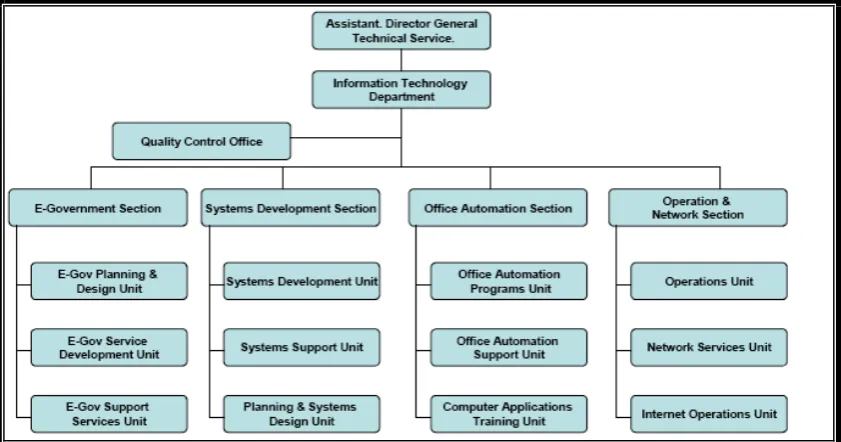
These objectives are service centric and in accordance with federal government requirements. They show that the municipality of Dubai has decided to eliminate bureaucracy, while taking a service oriented approach to some extent, in implementing its electronic government development program. The information technology department in the municipality of Dubai was in charge of performing operational tasks including computer related tasks, providing required equipment for staff, preparing required programs and telecommunication network, planning and developing information systems, secure data processing and setting up and linking the municipality website with the telecommunication network. Figure (5.1) shows the information technology department of the municipality of Dubai.
[image:7.595.74.495.194.415.2]
Figure 2: Structure of the IT department of Dubai Municipality, Arif (2008)
There is a service prioritisation process in the municipality for choosing which particular service will be put forward for implementation. A service will be chosen based on its value to users and the municipality. The service with the highest such value will be checked through the “Quick-Wins” process. The “Quick-Wins” process is used to identify and implement services with higher priority. Identifying priority of electronic services has two stages. In the first stage services will be checked against two criteria. The first criterion is the value of services to Dubai municipality and the second criterion is the value of services to customers. After comparing services with these criteria, those with heist value for Dubai Municipality and customers will be sent to second stage. In the second stage, those services with the highest value to customers and the municipality which has less complexity and more visibility will take priority for implementation. The context of “quick wins” aims at encouraging users to use electronic government services and familiarising them with this type of services. Services with more value to users and less complexity are more likely to be used by citizens.
These two criteria are playing role in encouraging users (citizens) interact with electronic government. The five stage framework as described above, describes some initiatives for encouraging and empowering citizens to participate with electronic government. The “quick wins” process encourages users by implementing services with higher value to them and empowers them in using electronic government services by implementing services with less complexity. Some of the functionalities of the second stage of five stage framework are similar to this process.
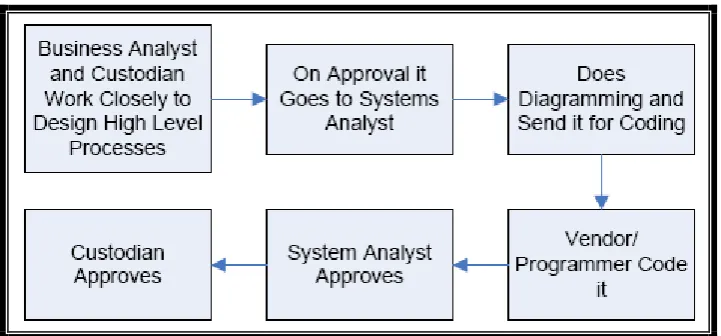
Services with more value to the municipality help in faster realisation of key objectives of the electronic government strategy for the municipality. In general, services with less complexity are easier to implement. Each service chosen to be digitized will be appointed a “Service-Custodian”.
modelling language diagrams and Entity Relationship diagrams. After completion of the design phase,
“Programmers” start coding for the entire system and they will modify codes if required at post implementation phase. Since the five stage framework doesn’t address post implementation issues, this phase can not be compared with any stage of the framework.
[image:8.595.72.433.156.324.2]The following figure represents the service design process in the Dubai municipality:
Figure 4: service design process in Dubai municipality, Arif (2008)
After the completion of system design, coding can be performed by internal programmers or outsourced externally. After the completion of coding, the system analyst is responsible for evaluation and approval of codes. After approval by the system analyst, the custodian approves the service to go online. In the Dubai municipality, custodians and business analysts are spending too much time on mapping involved processes and identification of requirements for preparing particular service to become an electronic service. Another limitation in this process is that programmers and system analysts do not have access to the municipality and they need to rely on documentation provided by the custodian who does not always have an IT background. This has resulted in much reiteration before the acceptance of the final product provided by programmers. The five stage model framework calls for reengineering of governance processes in its second stage which minimize reiteration. However, due to effective program and project management and scalable and robust information and technology infrastructure, the Dubai municipality were able to organize many electronic services.
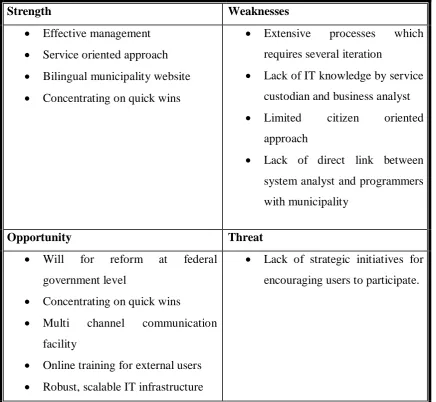
Table 1: SWOT analysis of e-service provision in the municipality of Dubai
Strength
Weaknesses
•
Effective management
•
Service oriented approach
•
Bilingual municipality website
•
Concentrating on quick wins
•
Extensive processes which
requires several iteration
•
Lack of IT knowledge by service
custodian and business analyst
•
Limited citizen oriented
approach
•
Lack of direct link between
system analyst and programmers
with municipality
Opportunity
Threat
•
Will for reform at federal
government level
•
Concentrating on quick wins
•
Multi channel communication
facility
•
Online training for external users
•
Robust, scalable IT infrastructure
•
Lack of strategic initiatives for
encouraging users to participate.
The above table shows the main issues extracted from the best practice approach. Comparing these issues to the description of initiatives in five stage model clarifies that the five stage model addresses most of analysed issues raised from the best practice approach but there are some issues which need further exploration.
The first addressed issue is service oriented approach. In the five stage framework taking the service oriented and citizen centric approach has been mentioned as a pre-requirement and expanded in the cataloguing stage (Mousavi et.al. 2009). Using quick wins approach for implementing electronic services which encourage and empowers citizens in interacting with electronic government is covered in the interaction stage. Another issue which can be addressed by five stage framework is ‘extensive processes which require iteration’. The five stage framework calls for reengineering of governance processes in its second stage which minimize extensive processes.
The issues raised in the best practice approach that have not been addressed in the proposed framework can be categorised in two groups. First type is ‘missing elements’. For example use of multilingual server for
minimizing the gap between system features and the demand of government officers. The five staged framework is based on Layne and Lee model in which multilingual server were not required. In order to improve this framework for developing countries which use more than one language, considering multilingual server as a pre-requirement will improve functionality of the framework. Another issue which is missing is post
implementation issues as have been considered by Dubai Municipality. Considering post implementation issues after completion of each stage and can improve functionality of five stage framework.
Second types of issues which haven’t been addressed are too general as compared to requirements of each stage of the framework. For example effective management at all stages, lack of direct link between municipality and the programmer and system analyst (Mousavi 2009). These second types of issues can not be considered as functionalities of electronic government development framework.
5. Conclusion and future work
This paper aimed at evaluating a framework for developing electronic government and providing guidance for government officials, developers and academics. The main limitation of existing models for developing electronic government was ignorance or limited concerns with issues that resulted in the failure of electronic government projects. Digital divide, electronic readiness, accessibility, trust and its related issues, education and training for stakeholders, as well as usability issues and public process rebuilding were identified as the main concerns. This model has been evaluated against services offered by the municipality of Dubai as the best practice approach. Findings show that the proposed model is compatible with most of the services provided by the municipality of Dubai. Considering Dubai municipality as a case of good practice, this result shows that while the proposed stage model is a workable framework, it requires further improvements to consider those issues that are not addressed by the five stage model.
References
Arif, M. (2008) Customer Orientation in e-Government Project Management: A Case Study. The Electronic Journal of e-Government Information Quarterly, 6, 1.
Bennett, S., Mcrobb, S. & Farmer, R. (2006) Object-Oriented Systems Analysis And Design Using UML, Maidenhead, Berkshire, McGraw-Hill.
Bertot, J. C. (2003) The multiple dimensions of the digital divide: more than the technology ‘haves’ and ‘have-nots'. Government Information Quarterly, 20, 185–191.
Belanger, F. & Carter, L. (2006) The effects of the digital divide on e-government: an empirical evaluation. Paper presented in the Proceedings of the Hawaii International Conference on System Sciences. Hawaii IEEE.
Bolissian, J., Pimenidis, E., Liadis, L. & Andreopoulou, Z. (2006) E-readiness or digital exclusion – evaluating a country’s status. Proceedings of the 2nd E-Democracy National Conference with International Participation. Athens,Greece,
Brooks, L., Weerakody, V. & Agyekum-Ofosu, C. (2008), The Role Of Trust In E-Government Adoption In The Uk. eGovernment Workshop.
Carter, L. & Blanger, F. (2004) Citizen Adoption of Electronic Government Initiatives, Proceedings of the 37th Hawaii International Conference on System Sciences
Dawes, S. S., Pardo, T. A. & Cresswell, A. M. (2004), Designing electronic government information access program: a holistic approach. Government Information Quarterly, 21, 3–23.
Heeks, R. (2003). Success and failure rates of E-Government in developing/transitional countries: Overview. Available at: www.egov4dev.org/sfoverview.htm.
Layne, K. & Lee, J. (2001) Developing fully functional e-government: a four stage model. Government Information Quarterly, 18, 122–136.
Lootah, H. N. (2006) Dubai Municipality’s e-Government Initiative [online]. Available at: www.dm.gov.ae
Mousavi, S. A., Pimenidis, E. & Jahankhani, H. (2007) e-Business Models for use in e-Government for Developing Countries. 7th European Conference on e-Government Den Haag, The Netherlands, Haagse Hogeschool.
Mousavi, S. A., Pimenidis, E. & Jahankhani, H. (2008) Using a Best Practice Case in Evaluating e-Government Potential in Iranian Cities. 8th European Conference on e-Government. Lausanne, Switzerland, Ecole
Polytechnique.
Mousavi, S. A., Pimenidis, E. & Jahankhani, H. (2008) Cultivating Trust – An e-Government Development model for addressing the needs of developing countries. International Journal of Electronic Security and Digital Forensics (IJESDF), 1, 233-248.
Mousavi, S. A(2009) Five-Stage Model for Electronic Government in Developing Government (Ph.D.), University of East London, London, UK.
Reddick, C. G. (2004) A two-stage model of e-government growth: theories and empirical evidence for U.S. cities. Government Information Quarterly, 21, 51–64.
Sipior, J.C. & Ward, B.T. (2005) Bridging the digital divide for e-government inclusion: a united states case study. The Electronic Journal of e-Government, 3, 137–146.
Savvas, I., Pimenidis, E. & Sideridis, A. (2006) E government status in EU: a review across governance models. Proceedings of the 2nd E-Democracy National Conference with International Participation. Athens, Greece.