Analysis Typing To Aid Control of Hospital-Acquired
Clostridium
difficile
Infection: a Multicenter Study
Katherine Hardy,a,bSusan Manzoor,bClaire Marriott,cHelen Parsons,dClaire Waddington,eSavita Gossain,aAla Szczepura,e Nigel Stallard,dand Peter M. Hawkeya,b
West Midlands Public Health Laboratory, Heart of England NHS Foundation Trust, Birmingham, United Kingdoma; School of Immunity and Infection, University of
Birmingham, Birmingham, United Kingdomb; Research and Development, Heart of England NHS Foundation Trust, Birmingham, United Kingdomc; Division of Health
Sciences, Warwick Medical School, University of Warwick, Coventry, United Kingdomd; and Warwick Medical School, University of Warwick, Coventry, United Kingdome
The early identification of outbreaks is crucial for the control ofClostridium difficileinfection. This study aimed to determine if the number of hospital-acquiredC. difficileinfections could be reduced by rapidly typingC. difficilestrains using multiple-locus variable-number tandem-repeat analysis (MLVA) compared to typing using PCR ribotyping. A total of 16 hospitals were re-cruited to the study, and all periods of increased incidence (PIIs) ofC. difficileinfection were identified. The hospitals were ran-domized into two study arms, the test and the control, with all isolates typed in the test using MLVA and in the control using PCR ribotyping. Following a PII, each hospital received a structured questionnaire regarding control measures implemented or stopped prior to or following the typing results. During the study period, there were a total of 1,682 hospital-apportionedC.
dif-ficiletoxin-positive cases, with 868 in the control and 814 in the test, with modeling demonstrating no differences between the
two arms. A total of 245 PIIs occurred, involving 785 patients. There was a significant difference in the mean turnaround time between the ribotyping and MLVA typing (13.6 and 5.3 days, respectively [P<0.001]). The discriminatory ability of MLVA was greater than ribotyping, with 85 outbreaks being confirmed by ribotyping and 62 by MLVA. In the test arm, 40.6% of respon-dents strongly agreed that the typing result had aided their management of clusters, as opposed to 9.9% in the control. The study demonstrated the utility of rapidly typingC. difficilestrains, demonstrating that it aided the management of clusters, enabling effective targeting of infection control resources.
C
lostridium difficileis an important cause of hospital-acquired infection, causing a range of symptoms from diarrhea to toxic megacolon and death. In the mid-2000s, rates ofC. difficile infec-tion (CDI) rose across North America and Europe (8,12). Due to the introduction of a number of control measures, including an-tibiotic stewardship, increased cleaning, and epidemiological typ-ing of isolates, the rates have fallen (4,5). Rapidly identifying definite transmission episodes is important for the effective con-trol of outbreaks. Conversely, demonstrating that clusters of CDI do not constitute an outbreak can also assist management by en-abling the cessation of specific infection control measures. In or-der to manage clusters ofC. difficileinfection in a timely manner, a typing technique with good discriminatory power and a rapid turnaround time is required. A variety of techniques are avail-able, including pulsed-field gel electrophoresis (PFGE), locus sequencing typing (MLST), PCR ribotyping, and multi-ple-locus variable-number tandem-repeat analysis (MLVA) (11). All of the techniques have limitations, with PFGE being time consuming, MLST lacking the discriminatory power, and PCR ribotyping requiring the interpretation of analogue data. In the United Kingdom, a free-of-charge service has been pro-vided by the regional public health laboratories of the Health Protection Agency (HPA) since 2007 for PCR ribotyping of all isolates from periods of increased incidence (PIIs), which is defined as two or moreC. difficiletoxin-positive cases in a ward within a 28-day period (9). The turnaround time for the ri-botyping service is 14 days, which makes rapid infection con-trol intervention difficult. MLVA typing provides a greater dis-criminatory ability and a reduced time in obtaining resultscompared to PCR ribotyping and has been shown to have util-ity in investigating clusters of isolates (13,18).
The primary aim of this study was to determine if the number ofC. difficilecases acquired in the hospital could be reduced by rapidly typing isolates using a highly discriminatory scheme com-pared to typing isolates using PCR ribotyping and by introducing targeted control measures. The secondary aim of this study was to establish if a rapid service could be delivered to 16 hospitals with a target turnaround time of 6 days. In addition, we obtained physi-cian feedback on the impact typing had on the management of clusters.
MATERIALS AND METHODS
Study setting and design.Since the introduction of national guidance in 2009 (5), all hospitals in England have routinely identified periods of increased incidence (PIIs) of CDI, defined as two or more patients devel-oping laboratory confirmedC. difficileinfection within a 28-day period in the same ward. A PII is considered closed if no more cases occur within 28 days following the last case. Hospitals within the East and West Midlands submitted fecal samples from these cases to the Public Health Laboratory, Birmingham, United Kingdom, for PCR ribotyping and MLVA typing.
Received22 March 2012Returned for modification7 June 2012
Accepted16 July 2012
Published ahead of print25 July 2012
Address correspondence to Katherine Hardy, [email protected].
Copyright © 2012, American Society for Microbiology. All Rights Reserved.
doi:10.1128/JCM.00784-12
on May 16, 2020 by guest
http://jcm.asm.org/
All typing was requested and reported using the secureClostridium difficile
ribotyping network (CDRN) website.
During the period of May 2010 to June 2011, 16 hospitals (9 large hospitals and 7 small/medium hospitals) from the East and West Mid-lands were randomized into the control or test arm with randomization stratified by hospital size. Hospitals continued to identify PIIs and submit fecal samples for typing, with no changes to the service offered to hospitals within the control arm. Samples from hospitals within the test arm were typed using a modified MLVA protocol, and results were reported in real time using secure e-mail addresses.
Each hospital followed their own protocol for the identification ofC. difficiletoxin-positive patients and their own infection control procedures for CDI, which were captured using questionnaires at the start of the study.
Following cessation of the study, the isolates from the control arm were also typed using MLVA and the isolates from the test arm were ribotyped to compare the results of the two typing methods.
Laboratory procedures and reporting.All samples were cultured us-ing the alcohol shock procedure with an equal amount of feces and etha-nol being vortexed and then left at room temperature for 30 min. Two drops of the suspension was placed on aC. difficileselective agar plate (Oxoid, United Kingdom) and incubated anaerobically at 37°C for 48 h. An individual colony displaying typical morphology ofC. difficilewas picked for DNA extraction using the Chelex method and subcultured to blood agar to check for purity (15). Ribotyping was carried out as de-scribed previously on all isolates (15). For MLVA, 12 variable-number tandem-repeat (VNTR) loci (A6Cd, B7Cd, C6Cd, E7Cd, G8Cd, CDR5, CDR60, CD9, CD12, CD14, CD19, and CD44) were amplified by PCR as described previously by Manzoor et al., with the product size being deter-mined using a 3130xl DNA sequencer (Applied Biosystems) (13). Analysis was undertaken using BioNumerics software v4.61, and the summed tan-dem-repeat differences (STRD) from all loci were calculated using the Manhattan coefficient. A PII was confirmed as an outbreak by ribotyping if two or more isolates had the same ribotype and by MLVA if the differ-ence between the STRD of two or more isolates wasⱕ4 (5). The report of the MLVA data included an interpretative statement of the results.
Data collection.Prior to the commencement of the study, a question-naire was sent to all participating hospitals to establish the method ofC. difficiletesting, the isolation policy within the hospital, details of antibiotic policies, cleaning regimes, and basic demographics. Following the
report-ing of results from a PII, a short data collection form was sent to each hospital to establish if, following the notification of the results, either additional infection control measures had been introduced or measures that had been introduced previously had been stopped. In addition, users were asked to evaluate whether they considered that the typing result had aided their management of clusters.
For each hospital, the number of hospital-apportionedC. difficile re-ports, defined as patients who are in-patients and have had a specimen taken at an acute hospital two or more days after the date of admission as reported to the mandatory Department of Health surveillance scheme, was obtained (www.hpa.org.uk).
Outcome measures and statistical analysis.The primary outcome was the number of hospital-apportioned cases ofC. difficileat each hos-pital as reported to the mandatory reporting scheme. A negative binomial regression model was constructed to compare the number of hospital-apportioned cases in the test and control arms of the study. The model included the logarithm of the number of beds in the hospital as an offset variable to compensate for the different hospital sizes. All statistical anal-yses were conducted using R (version 2.12.1).
RESULTS
During the study period, there were a total of 1,682 hospital-ap-portionedC. difficiletoxin-positive cases from the 16 hospitals, with 868 in the control and 814 in the test arm. The number of cases per hospital ranged from 32 to 246 (Table 1). Modeling of the differences in the number of hospital-apportionedC. difficile toxin-positive cases between the control and the test arm using negative binomial regression with the logarithm of the number of beds in the hospital as an offset variable indicated that there were no statistically significant differences between the two arms.
[image:2.585.43.544.89.294.2]A total of 245 PIIs occurred, 119 in the control and 126 in the test arm, with an overall mean of 15 per hospital and a range of 0 to 58 per hospital (Table 1). The PIIs involved 785 (46.7%) pa-tients of the 1,682 hospital-apportioned cases identified through mandatory reporting. The number of patients involved in a PII ranged from 2 to 15. The mean length of a PII in the control arm was 19.1 days and in the test arm was 19.9 days, with the longest PII observed being 117 days.
TABLE 1Data from each hospital, detailing the number of hospital-apportionedC. difficilecases, the number of PIIs, and the number of PIIs confirmed as outbreaks by the two typing methodsa
Hospital
Study arm
No. of mandatory reported hospital-apportionedC. difficilecases
Rate ofC. difficile
cases per 10,000 patient days
No. of PIIs
Mean (min, max) no. of cases per PII
No. of PIIs confirmed as outbreaks by ribotyping
No. of PIIs confirmed as outbreaks by MLVA
A Control 32 1.7 3 3.0 (2, 4) 1 1
B Control 108 2.8 10 4.4 (2, 9) 7 7
C Control 48 2.1 5 2.6 (2, 3) 1 1
D Control 52 2.1 8 2.0 (2, 4) 2 1
E Control 246 3.5 58 3.2 (2, 10) 11 5
F Control 131 3.0 8 2.5 (2, 4) 2 2
G Control 156 3.1 8 5.8 (2, 10) 5 4
H Control 95 2.4 19 2.6 (2, 6) 3 1
I Test 63 2.7 3 3.3 (2, 4) 1 1
J Test 199 3.1 33 2.7 (2, 10) 9 7
K Test 46 4.3 3 3.3 (2, 5) 1 1
L Test 57 1.5 11 2.5 (2, 6) 2 2
M Test 74 1.8 15 2.9 (2, 8) 5 5
N Test 108 2.1 15 3.3 (2, 7) 5 4
O Test 167 3.5 46 3.7 (2, 15) 20 17
P Test 100 2.6 0 0 (NA, NA) 0 0
a
Six PIIs contained two different outbreaks. NA, not available; min, minimum; max, maximum.
on May 16, 2020 by guest
http://jcm.asm.org/
Of the 785 patients involved in PIIs, typing results were avail-able for 669 (85.2%) samples,C. difficilewas not isolated in 114 samples, and there were insufficient samples in 2 cases. One hos-pital in the test arm did not submit any samples for typing. The time taken from the identification of the PII, taken as the date the second sample in the PII was obtained, until receiving samples for typing in the laboratory was comparable in the two arms (14.0 and 14.4 days in the control and test arms, respectively). There was a significant difference in the mean turnaround time from sample receipt in the laboratory until reporting between the ribotyping (control) and MLVA (test) typing (13.6 days and 5.3 days, respec-tively [P⬍0.001]).
Of the 245 PIIs, outbreaks were confirmed in 69 (28.2%) in-volving 218 cases by the typing method reported, MLVA in the test and ribotyping in the control. A total of 34 outbreaks were con-firmed in the control arm by ribotyping in 32/119 PIIs (26.9%), with 2 outbreaks, caused by different ribotypes occurring in two of the PIIs. In the test arm, 40 outbreaks were confirmed by MLVA in 37/126 PIIs (29.4%), with three of the PIIs containing 2 outbreaks. Following the completion of the study, all isolates in the test arm were typed using ribotyping and all isolates that were clus-tered using ribotyping in the control arm were typed with MLVA. This enabled exploration of any difference in the discriminatory ability of the two techniques to be highlighted. Of the 34 outbreaks confirmed by ribotyping in the control arm, MLVA typing con-firmed 22, while ribotyping of the isolates in the test arm identified 51 outbreaks, as opposed to 40 with MLVA. There were no in-stances in the test arm where MLVA identified an outbreak that had not been identified by ribotyping. The ribotypes of the out-breaks that were not confirmed by MLVA differed. Combining the test and control arms, a total of 156 cases were considered part of an outbreak by MLVA, while with ribotype, 218 cases were con-sidered part of an outbreak; thus, 62 cases were inappropriately considered to be part of an outbreak by ribotyping. On examining the number of outbreaks identified by MLVA, there were no sta-tistical differences between the two intervention arms.
The appropriateness of defining an outbreak as isolates with an STRD of⬍4 was examined and demonstrated that, if an STRD of 1 had been used, only 45 of the 62 PIIs would have been classified as outbreaks and that, if an STRD of 10 had been adopted, only an additional 4 PIIs would have been classified as outbreaks. Three of the four PIIs that were not considered to be outbreaks by MLVA typing were the epidemic strains 106 and 027.
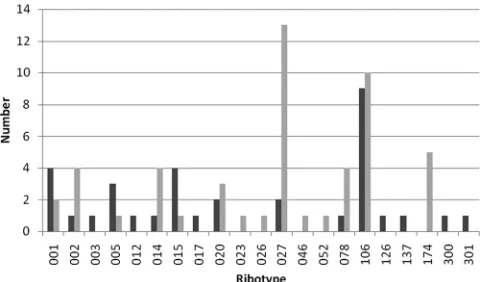
A total of 66 different ribotypes were identified in the control and test arms of the study, with 24 ribotypes only present in single samples. The most prevalent ribotype was 106 (81 samples), fol-lowed by 027 (68 samples), 002 (51 samples), 014 (50 samples), 015 (45 samples), 078 (44 samples), 005 (42 samples), 001 (41 samples), and 020 (35 samples). All of the remaining ribotypes had⬍16 samples. A total of 21 ribotypes were responsible for outbreaks, with 9 ribotypes being common to both the test and control arms and 11 ribotypes causing a single outbreak. The pre-dominant ribotype causing outbreaks overall was 106 (19 out-breaks) in six different hospitals, three in the control and three in the test. However, the predominant ribotype causing outbreaks in the test arm was 027, causing outbreaks in five different hospitals (Fig. 1). Five outbreaks were due to ribotype 174 in the test arm, but this occurred only at one hospital.
A total of 244 PII questionnaires, 120 from the control arm and 124 from the test, were completed. New measures were
imple-mented following the reporting of the typing results on a total of 55 occasions, 13 in the control and 42 in the test. The most fre-quent interventions (55%) were the auditing of practices and the teaching of staff. Following the reporting of typing results, 55 mea-sures in total were stopped, 41 in the control and 14 in the test. In the control arm, the majority of measures were the auditing of practices, while in the test, it was more varied. Physician feedback on the value of the typing result in the management of the clusters strongly favored MLVA rather than ribotyping. Thirteen (9.9%) of the respondents from the control arm strongly agreed that typ-ing had aided their management compared to 54 (40.6%) in the test arm (Table 2).
DISCUSSION
Many studies have investigated the epidemiology ofC. difficile using a variety of typing methodologies, but the majority of these have been retrospective, have not used the results to in-fluence infection control practices in a timely manner, or have assessed the impact of the results on transmission (1,17,20). Although this study failed to demonstrate a difference in the number of hospital-apportionedC. difficilecases between the test and control arms, it did demonstrate that rapid results could be delivered and that the rapid typing assisted the phy-sicians in the management ofC. difficilePIIs. There are a num-ber of possible reasons for the failure to observe a difference between the test and control arms. One of the most likely rea-sons is the wide range and potential combinations ofC. difficile control measures. Following the large outbreaks and rise ofC. difficilein the United Kingdom in the early 2000s, the aware-ness surrounding the control ofC. difficilehas been heightened and a wide range of control measures have been instituted. Guidance issued in the United Kingdom recommends the iden-tification of PIIs, followed by the implementation of control measures, including investigating with ribotyping, increased cleaning, reviewing of antibiotics, auditing of infection control practices, and educating the ward staff (5). The rate of identi-fication of PIIs was much higher in some hospitals than in others, which may be a true reflection of events, with some hospitals having a greater number of sporadic cases, or may be due to differences in protocols within hospitals for the identi-fication of PIIs. This is highlighted by the hospital that, despite repeated encouragement, was not able to submit any samples for typing. If samples from PIIs were not sent for typing, this
FIG 1Number of outbreaks caused by each ribotype in the control and test arms of the study. Control, dark gray bars; test, light gray bars.
on May 16, 2020 by guest
http://jcm.asm.org/
[image:3.585.301.543.66.207.2]could have resulted in potential outbreaks being missed and potentially leading to an increase in cross transmission and a rise in cases. Another limitation of PIIs is that they will only identify clusters of ward-based transmission and not further hospital-wide transmission.
Due to the need to act quickly following the identification of a PII, most hospitals implement additional infection control mea-sures prior to receiving the typing results, including increased cleaning and changing cleaning products. This may, in part, ex-plain why no difference is observed between the test and control arms, with the measures being applied rapidly in both arms. How-ever, the availability of rapid typing results did result in a larger number of new measures being introduced in the test arm com-pared to the control arm, probably due to the results being avail-able in a time to undertake relevant interventions while positive patients were still in the ward. In the control arm, a greater num-ber of measures were stopped after the results were received, with the availability of typing results potentially resulting in cost sav-ings.
Currently, there is a lot of debate regarding the optimal test combinations for the diagnosis ofC. difficileinfection, with some previously commonly used enzyme-linked immunosorbent assay (ELISA) toxin detection tests being demonstrated to have poor sensitivity and specificity (3,6). Combination testing is now ad-vocated, but multiple algorithms are being employed both within laboratories in this study and throughout the United Kingdom (19). The problems with testing are highlighted in our study by the fact thatC. difficilecould not be grown from 14.8% samples; this could be due to the insensitivity of the culture technique or the lack of specificity of the diagnostic testing. The culture positivity rate is comparable to that observed by the CDRN in the United Kingdom, where recovery in 2010 and 2011 was 89.9%.
This study demonstrated that MLVA typing could be delivered in a timely manner with the ability to aid the management ofC. difficile, with a difference of 8 days between the delivery of MLVA typing and ribotyping results. Providing timely results enables ad-ditional or more targeted control measures to be implemented in the case of an outbreak or the cessation of measures if the cluster is demonstrated not to be an outbreak.
The discriminatory ability of a typing scheme is crucial in de-fining whether an isolate is part of the outbreak or sporadic. Mul-tiple MLVA schemes have been described forC. difficile, contain-ing different numbers of loci and havcontain-ing various degrees of discriminatory ability (13, 14, 18). The scheme adopted in this study has been demonstrated to have good discriminatory ability while also clustering isolates in concordance with PCR ribotyping (13). A further complication in the analysis ofC. difficileMLVA is the definition of an outbreak. In MLVA schemes for other organ-isms, for example,Mycobacterium tuberculosis, an isolate is only considered part of the same outbreak if it has an identical MLVA profile (10). However, forC. difficile, this has been demonstrated
to make the typing scheme too discriminatory with isolates that are epidemiologically part of the same outbreak differing slightly in the number of repeats and isolates from within the same feces having different MLVA profiles (16). Different approaches to overcome this have been proposed, with some studies using summed tandem-repeat differences (STRD) to define relatedness, with Marsh et al. stating that isolates with an STRD ofⱕ2 had a high degree of genetic relatedness and Fawley et al. stating that an STRD ofⱕ2 was indistinguishable and an STRD of ⬍10 was highly related (7,14). Broukhanski and colleagues used Manhat-tan disManhat-tance-based clustering and then defined a cutoff of 90% to define similarity (2). This technique involves a rooted tree and is more suited to one of the studies rather than a routine service. Preliminary work investigating clusters with the loci used in this study demonstrated that an STRD ofⱕ4 correlated with the epi-demiology, and this is further reinforced by study results where only four additional PIIs would have been called an outbreak if an STRD of⬍10 had been considered. Three of these PIIs were due to epidemic ribotypes, and therefore, it is highly likely that they were not linked and that they occurred by chance.
The difference in the discriminatory ability of the two tech-niques is highlighted by the number of outbreaks detected. Out-breaks defined by ribotyping could be further split by MLVA, thus reducing the number of true outbreaks. MLVA provided greater discrimination when applied to a wide range of ribotypes, high-lighting its discriminatory ability in all strains and not just ri-botype 027, as has been described previously. Interestingly, there were no outbreaks confirmed by MLVA for ribotype 005. It may be that transmission had not occurred between these patients or that this is a highly evolving strain in which the MLVA loci are relatively unstable and evolve rapidly.
A similar number of PIIs were observed in both the test and control arms of the study, but when the ribotyping of isolates is applied to both arms the test arm had a greater number of PIIs confirmed as outbreaks. This may indicate that more transmission was occurring in these hospitals in the test arm compared to the control arm.
There is quite a marked difference in the ribotypes causing outbreaks between the two arms, with the greatest number of outbreaks being caused by ribotype 027 in the test arm, but only two being due to ribotype 027 in the control. During the 2000s, ribotype 027 was the most dominant strain circulating in the United Kingdom, accounting for⬎50% of all isolates typed in the East and West Midlands in 2008 (www.hpa.org.uk). However, the picture is changing with a greater number of types being ob-served and this is reflected in this study.
[image:4.585.39.288.88.135.2]Although this study does not demonstrate a reduction inC. difficilehospital-apportioned cases between the test and control arms, it does highlight and demonstrate the utility of rapid, dis-criminatory typing. There was a clear difference in starting inter-ventions in the MLVA arm, resulting in a more efficient use of resources, which was supported by physician opinion. The avail-ability of epidemiological typing at the local level is crucial in being able to provide a timely and tailored service to users. It enables the rapid sending and processing of samples and feedback of results, allowing targeted measures to be taken, which in turn should lead to reduced costs of interventions aimed at infection control.
TABLE 2Responses to whether the typing result aided the management of clusters
Study arm
Strongly
agree Agree Disagree
Strongly disagree
No response
Control 13 97 13 4 4
Test 54 61 12 1 5
on May 16, 2020 by guest
http://jcm.asm.org/
ACKNOWLEDGMENTS
We thank all of the hospitals in the East and West Midlands, United Kingdom, that submitted fecal samples and completed questionnaires to make this study possible.
This is an independent report commissioned and funded by the Policy Research Programme at the Department of Health. The views expressed are not necessarily those of the Department of Health.
REFERENCES
1.Bauer MP, et al.2011. Clostridium difficile infection in Europe: a hospi-tal-based survey. Lancet377:63–73.
2.Broukhanski G, Simor A, Pillai DR.2011. Defining criteria to interpret multilocus variable-number tandem repeat analysis to aid Clostridium difficile outbreak investigation. J. Med. Microbiol.60:1095–1100. 3.Carroll KC.2011. Tests for the diagnosis of Clostridium difficile infection:
the next generation. Anaerobe17:170 –174.
4.Cohen SH, et al.2010. Clinical practice guidelines for Clostridium diffi-cile infection in adults: 2010 update by the Society for Healthcare Epide-miology of America (SHEA) and the Infectious Diseases Society of Amer-ica (IDSA). Infect. Control Hosp. Epidemiol.31:431– 455.
5.Department of Health.2009. Clostridium difficile infection: how to deal with the problem. Department of Health, London, United Kingdom. 6.Eastwood K, Else P, Charlett A, Wilcox M.2009. Comparison of nine
commercially available Clostridium difficile toxin detection assays, a real-time PCR assay for C. difficile tcdB, and a glutamate dehydrogenase de-tection assay to cytotoxin testing and cytotoxigenic culture methods. J. Clin. Microbiol.47:3211–3217.
7.Fawley WN, Wilcox MH.2011. An enhanced DNA fingerprinting service to investigate potential Clostridium difficile infection case clusters sharing the same PCR ribotype. J. Clin. Microbiol.49:4333– 4337.
8.Gerding DN.2010. Global epidemiology of Clostridium difficile infection in 2010. Infect. Control Hosp. Epidemiol.31(Suppl 1):S32–S34. 9.Hardy KJ, Gossain S, Thomlinson D, Pillay DG, Hawkey PM.2010.
Reducing Clostridium difficile through early identification of clusters and the use of a standardised set of interventions. J. Hosp. Infect.75:277–281. 10. Hawkey PM, et al.2003. Mycobacterial interspersed repetitive unit typing of Mycobacterium tuberculosis compared to IS6110-based restriction
fragment length polymorphism analysis for investigation of apparently clustered cases of tuberculosis. J. Clin. Microbiol.41:3514 –3520. 11. Killgore G, et al.2008. Comparison of seven techniques for typing
inter-national epidemic strains of Clostridium difficile: restriction endonu-clease analysis, pulsed-field gel electrophoresis, PCR-ribotyping, multilo-cus sequence typing, multilomultilo-cus variable-number tandem-repeat analysis, amplified fragment length polymorphism, and surface layer protein A gene sequence typing. J. Clin. Microbiol.46:431– 437.
12. Kuijper EJ, Coignard B, Tull P.2006. Emergence of Clostridium difficile-associated disease in North America and Europe. Clin. Microbiol. Infect.
12(Suppl 6):2–18.
13. Manzoor SE, et al.2011. Extended multilocus variable-number tandem-repeat analysis of Clostridium difficile correlates exactly with ribotyping and enables identification of hospital transmission. J. Clin. Microbiol.
49:3523–3530.
14. Marsh JW, et al.2006. Multilocus variable-number tandem-repeat anal-ysis for investigation of Clostridium difficile transmission in hospitals. J. Clin. Microbiol.44:2558 –2566.
15. Stubbs SL, Brazier JS, O’Neill GL, Duerden BI.1999. PCR targeted to the 16S–23S rRNA gene intergenic spacer region of Clostridium difficile and construction of a library consisting of 116 different PCR ribotypes. J. Clin. Microbiol.37:461– 463.
16. Tanner HE, Hardy KJ, Hawkey PM. 2010. Coexistence of multiple multilocus variable-number tandem-repeat analysis subtypes of Clostrid-ium difficile PCR ribotype 027 strains within fecal specimens. J. Clin. Microbiol.48:985–987.
17. Tenover FC, et al.2011. Comparison of strain typing results for Clostrid-ium difficile isolates from North America. J. Clin. Microbiol.49:1831– 1837.
18. van den Berg RJ, Schaap I, Templeton KE, Klaassen CH, Kuijper EJ.
2007. Typing and subtyping of Clostridium difficile isolates by using mul-tiple-locus variable-number tandem-repeat analysis. J. Clin. Microbiol.
45:1024 –1028.
19. Wilcox MH, Planche T, Fang FC, Gilligan P.2010. What is the current role of algorithmic approaches for diagnosis of Clostridium difficile infec-tion? J. Clin. Microbiol.48:4347– 4353.
20. Wiuff C, et al.2011. The epidemiology of Clostridium difficile in Scot-land. J. Infect.62:271–279.