Technology (IJRASET)
KNF Computing for
Energy-Efficiency Fault-Tolerance Data Storage
And Processing in Mobile Cloud
Pankaja Bgade1, Prof. R.R.Badre2
1
Pune University, MIT Academy of Engineering Alandi Road, Pune 412105, Pune
Abstract: The advances on hardware for hand-held mobile devices, resource-intensive application still remain off bounds since they require large data processing and storage capabilities. These issues are addressed by employing remote servers, such as clouds and peer mobile devices. However, for mobile devices deployed in dynamic networks, challenges of reliability and energy efficiency remain largely unaddressed. These challenges are addressed by an approach called as k-out-of-n computing. In this solution, mobile devices successfully retrieve or process the reliable data, in the most energy-efficient way, as long as k-out-of-n distance servers are accessible. Through a virtual system implementation, the feasibility of the approach can be proved and the fault tolerance and energy efficiency performance will be improved.
Keywords: Mobile Computing, Cloud Computing, k-out-of-n Computing
I. INTRODUCTION
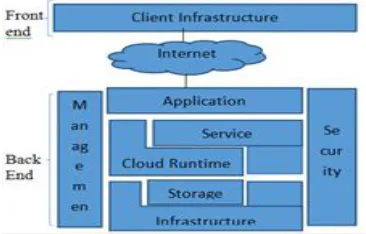
Core concepts like computing as utility, virtualization of resources, on demand access to computing resources, and outsourcing computing services, clouds are large-scaled distributed computing systems are built around these concepts. In recent years mobile devices have gained vast popularity this result in many applications rely on offloading all or part of their works to remote servers like peer mobile devices and clouds [6][7]. Mobile devices derive the energy required for their operation from batteries [10]. Many consumer consume electronics hand-handled devices, especially mobile phones, battery capacity is severely restricted due to constraints on weight and size of the device. This implies that energy efficiency of these devices is very important to their usability [12]. Cloud computing is a new paradigm in which at the users location computing resources such as processing, memory, and storage are not physically present. Instead, a service provider owns and manages these resources, and users access them via the Internet. While power is an important constrained relative to tethered devices in mobile devices, advances in battery and power management technology this will enable mobile devices to manage longer lived computations with fewer burdens on available power consumption [14]. Fig.1 shows the architecture
for cloud computing. Cloud services allow individuals and businesses to use software and hardware that are managed by arbitrator at remote locations. Via the internet the cloud is reliable as it enables access to applications and documents anywhere in the world. Cloud computing is often considered efficient because it allows organizations to free up resources to
[image:2.612.212.395.588.705.2]consumption and fault-tolerant. Algorithm for rearrangement and topology monitoring is in section 4. Section 5 and 6 is the brief analysis of Mathematical model and Results respectively. Finally, conclusions is drawn in section 7.
II.RELATED WORK
M. Satyanarayanan [1], Small scale network in Cloud computing has gained devotion recently. A resource-rich cluster that is Cloudlet is well connected to the Internet and is available for use by nearby mobile devices; it can apply synthesis recursively to generate a family of overlays. Launching VM would involve pipelined application of these overlays, with intermediate results cached for reuse. Earlier stages of the pipeline tend to involve larger overlays that are more widely used across applications and are hence more likely to be found in a persistent cache. Conceptually, it seek a wavelet like decomposition of VM state into a sequence of overlays that decrease in size but increase in specificity. Another deployment challenge relates to the assumption that a relatively small set of base VMs will suffice for a large range of applications. The problem could be intensified by the common practice of releasing security patches for old OS releases. Although the patches effect could be incorporated into the overlay, it would increase overlay size.
Byung-Gon Chun [2]A small Virtual Machine (VM) overlay is delivered to mobile devices to a cloudlet infrastructure and lets it take over the computation is presented. Similar works that use VM migration are also done in CloneCloud. The system overcomes design and implementation challenges to achieve basic augmented execution of mobile applications on the cloud, representing the whole-sale transfer of control from the device to the clone and back. They combine partitioning, migration with merging, and on-demand instantiation of partitioning to address these challenges. The prototype delivers up to 20x speedup and 20x energy reduction for the simple applications
they tested, without programmer involvement, demonstrating feasibility for the approach, and opening up a path for a rich research agenda in hybrid mobile cloud systems.
III. PROPOSED WORK
Energy efficiency and fault tolerant is well studied problem in wireless sensor networks since from last decade successfully. But in mobile devices communication with data storage and mobile cloud processing systems, this problem yet remains to be addressed fully. The resource intensive applications such as video, audio or image processing and storage still remains headed away even if advanced hardware based mobile hand held devices introduced. Due to the requirement of large storage as well as computation costs for such applications, recent methods are proposed by using remote servers like clouds, peer mobile devices etc. However the mobile devices those are used for communication for such flexible networks like mobile cloud are suffered from the problems of energy efficiency and reliability. It is further extending the existing work by adding technique to improve the energy consumption based on type communication as well as improve the communication time, throughput. The technique which are introducing here is based on fuzzy rule algorithm. The aim of the algorithm is to check the possibility of excessive energy loss of mobile nodes and node failure conditions in order to improve the reliability and energy efficiency of mobile cloud data storage processing. The practical analysis of proposed will be done through the extensive simulations.
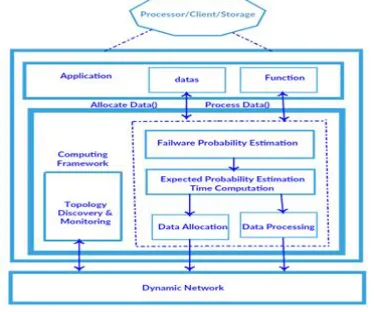
An overview of the proposed framework is depicted in Fig.2 The framework, consecutively on all mobile nodes, provides facilities to applications [13]. In Fig.2, applications create data where it is encoded and partitioned for higher data reliability and availability respectively into the data, as inputs functions that take store data are provided by applications. Each function is directed as multiple tasks that process the data concurrently on different nodes. Nodes executing tasks are processor nodes; call a set of tasks directed from one function a job [6]. The appeal for data allocation or processing operations are done by
Technology (IJRASET)
Figure 2: Amalgamation Architecture for Energy Efficiency and fault tolerance in the k-out-of-n Computing framework. The retrieved information from failure probabilities and network topology helps in computation of ETT matrix that is done by ETT Computation component. Which signifies the expected energy consumption for communication between any pair of nodes. In the component, k-out-of-n Data Storage, the energy consumption for retrieving k fragments by any node is minimized, this is done by partitioning data into n fragments by an erasure code algorithm and stores these fragments in the network. When application prerequisite process the data and to minimize the energy consumption in retrieving and processing the stored data, the component k-out-of-n Data Processing creates a job of K tasks and schedules the tasks on n processor nodes. Therefore the component ensures that all tasks complete as long as k or more processor nodes finish their assigned tasks. The Topology Discovery and Monitoring component constantly monitors the network for any substantial change on the network topology.
IV. PROPOSED ALGORITHM
A.Re-arrangement of Task
When tasks are done scheduling the tasks are rearranged based on the free time slots and no same task is executed on other node simultaneously. With probability 1 the k-out-of-n data processing guarantee k or more functional processing nodes to complete all tasks of a job. It is possible that the subset of processing nodes that are of size less than k complete all assigned tasks.
1)Algorithm 1: Schedule Re-arrangement a)Z = last time slot
b)for time t = 2 → Z do
c)for each scheduled task K in time t do d)n ← processor node of task K e)while n is idle at t - 1 and
f) K is not scheduled on any node at t - 1 do g)Move K from t to t - 1
h)t = t - 1 i) end while j) end for k)end for
B.Topology Monitoring
Algorithm 2. It predefine one node as a topology delegate Mdel which is responsible for maintaining the global topology
information. If e of a node is greater than the threshold τ1, the node changes its state to C and piggybacks it’s ID on a beacon
message otherwise it changes its state back to NC and puts ID in a beacon message. After receiving a beacon message, nodes check the IDs in it. For each ID, nodes add the ID to set ID if the ID is positive; otherwise, remove the ID. If a client node finds that the size of set ID becomes greater than τ2, a threshold for significant global topology change, the node notifies Mdel; and Mdel executes
the Topology Discovery protocol. To reduce the amount of traffic, client nodes request the global topology from Mdel, instead of
running the topology discovery by themselves. After Mdel completes the topology update, all nodes reset their status variables back
to NC and set e = 0.
1)Algorithm 2: Distributed Topology Monitoring a) At beacon interval
b) if e > τ1 and s ≠ C then c) s ← C
d) Put +ID to a beacon message e) end if
f) if e ≤ τ1 and s = C then g) s ← NC
h) Put -ID to a beacon message i) end if
j) After receiving a beacon message on Mi k) for each ID in the received beacon message do l) if ID > 0 then
m)ID ←ID U ID
n) else
o) ID ← ID \ ID p) end if
q) end for r) if |ID| > τ2 then
s) Notify Mdel and Mdel initiate topology discovery t) end if
u) Add the s ID in Mis is beacon message.
V.MATHEMATICAL MODEL
Consider a dynamic network with N nodes denoted by a set V = v1, v2, …., vN. Assume nodes are time synchronized. Let use i and vi interchangeably hereafter. The network is modeled as a graph G = (V,E), where E is a set of edges indicating the communication
links among nodes.
Relationship Matrix A is a N * N matrix defining the relationship between storage nodes and nodes. More precisely, each element Aij is a binary variable if Aij is 0, node i will not retrieve data from storage node j; if Aij is 1, node i will retrieve fragment from
storage node j. Storage node list R is a binary vector containing storage nodes, i.e., Ri = 1 , vi is a storage node.
The Expected Transmission Time Matrix T is defined as a N * N matrix where element Tij corresponds to the ETT for
Technology (IJRASET)
multiple paths due to nodes failures.Scheduling Matrix C is an X * N * M matrix where element Cxij = 1 indicates that task j is scheduled at time r on node i;
otherwise, Cxij = 0. x is a relative time referenced to the starting time of a job. Since all tasks are instantiated from the same
function, assume they spend approximately the same processing time on any node. Given the terms and notations, it is ready to formally describe the k-out-of-n data allocation and k-out-of-n data processing problems.
A.Formulation of k-out-of-n Data Allocation Problem
It is intended to find n storage nodes denoted by X = s1; s2; :::sn , X _ V such that the total expected transmission cost from a node to its k closest storage nodes in terms of ETT is minimized. Formulate the problem as an ILP in Equations 1 - 5.
( 1)
( 2)
( 3)
( 4)
( 5)
The first constraint (2) selects exactly n nodes as storage nodes; the second constraint (3) indicates that each node has access to k storage nodes; the third constraint (4) ensures that jth column of A can have a non-zero element if only if Rj is 1; and constraints
(5) are binary requirements for the decision variables.
B.Formulation of k-out-of-n Data Processing Problem
The intention is to find nodes n in V as processor nodes such that energy consumption for processing a job of K tasks is minimized. Before formulating the problem, define some functions: (i) f1(i) returns 1 if node i in C has at least one task; otherwise,
it returns 0; (ii) f2(j) returns the number of instances of task j in S; and (iii) f3(z; j) returns the transmission cost of task j when it is
scheduled for the zth time. Now formulate the k-out-of-n data processing problem as shown in Equation 6 - 11. x represents the time slot of executing a task; i is the index of nodes in the network; j is the index of the task of a job. The Dr, the Data Retrieval Time Matrix, is a N * M matrix, where the element Drij corresponds to the estimated time for node i to retrieve task j. Then Dr is
computed by summing the transmission time from node i to its k closest storage nodes of the task.
(6)
(7)
(8)
(9)
(10)
(11)
Failure probability of a node examined at time t is the probability that the node fails by time t + T, where T is a time interval during which the estimated failure probability is nominal. A node estimates its failure probability based on the following events/causes: energy depletion, temporary disconnection from a network, and application-specific factors. Let fi be the event that
node i fails and let fiA, fiBand fiC be the events that node i fails due to application specific factors, energy depletion, temporary
disconnection from a network respectively. The failure probability of a node is as follows:
P[fi] = (1-P[fiA])(1-P[fiB])(1-P[fiC])
VI. CONCLUSION
In the paper, the challenges in executing the sophisticated application and in the use limited resource on hand-handled devices are addressed. The k-out-of-n computing is used for energy minimization during assigning data fragments to nodes that leads for energy consumption in storing reliable data and retrieving the data reliably. It provides a crystal clear idea about the wide dimensions of energy consumption for retrieving and processing the distributed data and to support the fault-tolerant under the dynamic network topology.
REFERENCES
[1] M. Satyanarayanan, P. Bahl, R. Caceres, and N. Davies, The case for VM-based cloudlets in mobile computing, Pervasive Computing,, IEEE, vol. 8, pp. 1423, 2009.
[2] B.-G. Chun, S. Ihm, P. Maniatis, M. Naik, and A. Patti, CloneCloud: elastic execution between mobile device and cloud, in Proc. of EuroSys, 2011.
[3] Chien-An Chen, Myounggyu Won, Radu Stoleru, and Geofrey, G. Xie, Energy-Efficient Fault-Tolerant Data Storage Processing in Mobile Cloud, Proc. Of the IEEE, vol. 3, no.1, pp. 476489, 2014.
[4] Imre Kelnyi, Jukka K. Nurminen, Cloud Torrent Energy-Efficient BitTorrent Content Sharing for Mobile Devices via-Cloud Services.
[5] Eric Chen, Satoshi Ogata, Keitaro Horikawa, Off-loading Android Applications to the Cloud without Customizing Android,Eighth IEEE PerCom Workshop on Pervasive Wireless Networking 2012.
[6] Jasbir Kaur, Supriya Kinger , Resource allocation for energy-efficient k-out-of-n system in mobile ad hoc networks , International Journal of Computer Science and Information Technologies, Vol. 5 (5) , 2014.
[7] C. Chen, M. Won, R. Stoleru, and G.Xie, Resource allocation for energy efficient k-out-of-n system in mobile ad hoc networks, in Proc. of ICCCN, 2013. [8] C. A. Chen, M. Won, R. Stoleru, and G.Xie, Energy-efficient-fault tolerant data storage and processing in dynamic network,, in Proc. of MobiHoc, 2013. [9] Kuo-Zuo-koon, Chapter7:The k-out-of-n system model.
[10] S.M.George, W.Zhou, H. Chenji,M.Won, Y. Lee, A. Pazarloglou, R. Stoleru, and P. Barooah , Distress- Net: a wireless AdHoc and sensor network architecture for situation management in disaster response, IEEE Communications Magazine, vol. 48, no. 3, 2010.
[11] D. Shires, B. Henz, S. Park, and J. Clarke, Cloudlet seeding: Spatial deployment for high performance tactical clouds, International Journal on Computer Networks (Elsevier), WorldComp, 2012.
[12] D. Neumann, C. Bodenstein, O. F. Rana, and R.Krishnaswamy, STACEE: enhancing storage clouds using edge devices, WACE, 2011.
[13] D. Huang, X. Zhang, M. Kang, and J. Luo, MobiCloud: Building secure cloud framework for mobile computing and communication, SOSE, 2010. [14] Sun Microsystems, Inc. Introduction to Cloud Computing Architecture, White Paper 1st Edition, June 2009.
AUTHOR PROFILE