Technology (IJRASET)
Analysis of Compressive Strength of Low Volume
Fly Ash Concrete
Saman Khan1, Roohul Abad Khan2, Amadur Rahman Khan3, V.P Singh4 1
Integral University, Lucknow, India 2
King Khalid University, Abha, Saudi Arabia 3
Aligarh Muslim University, Aligarh, India 4
Integral university, Lucknow, India
Abstract: Fly ash is a major by-product of thermal power plant, the alternative option for its disposal was to use it in building materials. Incorporation of fly ash in concrete specimen has shown enhancement in properties of concrete. The study was undertaken to determine the effect of low volume fly ash on the compressive strength of concrete. The fly ash content was 10% by weight of cement. The stone dust was also incorporated for partial replacement of natural aggregate while recycled aggregate (RA) was also introduced at the varying rate of 5%, 10% and 15%. The study concludes that the addition of fly ash, stone dust and recycled aggregate together will enhance its compressive strength and will render it more green and sustainable.
Keywords: Fly Ash, Building Materials, Concrete, Stone Dust, Recycled aggregate
I. INTRODUCTION
The large amount of fly ash around the world from thermal power plants made the trouble of its disposal. The researchers took it as an opportunity to study the effect of fly ah incorporation into building materials. The addition of fly ash improves the mechanical properties of concrete owing to its cementitious properties. After the construction boom in India the alternative options for enhancement of concrete properties was undertaken. Fly ash can be used to replacement cement by a small percent only. Fly ash can improve the workability and reduces the heat of hydration in fresh concrete. It can improve the strength, permeability, and resistance to chemical attack of the hardened concrete. [Roohul et. al.[3],[4] Saman et. al.[1],[1],[2]]
However, the bulk of concrete matrix consists of aggregates. Extensive research has been undertaken to analyse the alternative options for natural aggregates to bring down the cost of the concrete production without comprising its quality. The replacement of fine aggregate by stone dust improves considerably the flexural strength of concrete especially at 28 days. Stone dust can be effectively used in partial replacement of fine aggregate in concrete. Reported that replacing 10 % natural aggregate by recycled aggregate without chemical admixtures, the tensile strength has been gradually increased by 5.88% has been reported in literature. [Roohul et. al., [5] Saman et. al. [6]]
II. MATERIALS
A. Cement
In the present study, 53 grade Ordinary Portland Cement (OPC) of a single batch was used throughout the investigation. The physical and chemical properties of OPC as determined are given in table 1. The cement satisfies the requirement of IS: 12269-1987.
B. Fine aggregate
The fine aggregate used was locally available river sand, which was passed through 4.75 mm. The specific gravity of fine aggregate is 2.74 and fineness modulus is 2.87.
C. Coarse aggregate
sieved before mixing in concrete. Specific gravity of stone dust was 2.50 and water absorption was 0.5%.
III. METHODS AND METHODOLOGY
An experimental investigation was conducted Study of Low Volume Fly Ash Concrete with Recycled Aggregates (LVFAC) to get the strength of specimens (cubes) made with the use of stone dust and recycled aggregates as partial replacement of fine aggregates and coarse aggregates respectively. The strength of conventional concrete and other mixes were determined at the end of 7 and 28 days of water curing. To study the effect of stone dust and recycled aggregates inclusions, cubes of a design mix M25 grade concrete were cast. The 150 mm cubes were tested for compressive strength. The M25 mix proportion was (1:1.56:2.91) at w/c ratio of 0.40. [Saman et.al. [7]]
IV. RESULT AND DISCUSSION
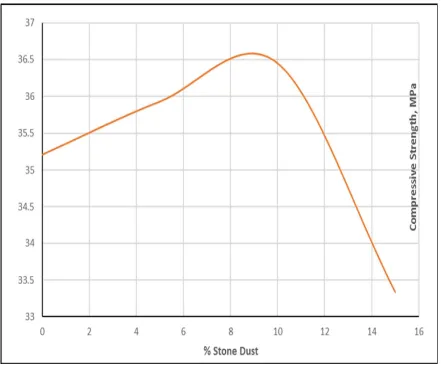
[image:3.612.87.528.250.615.2]The casted concrete specimen for low volume fly ash and high volume fly ash were tested for compressive strength of concrete. A control specimen with 0% stone dust was also tested to determine the increase in strength owing to infusion of stone dust into concrete mix.
Fig. 1 Compressive Strength of ow Volume Fly Ash Concrete with 0% Recycled Aggregate
Technology (IJRASET)
Fig. 2 Compressive strength of Low Volume Fly Ash with 5% Recycled aggregate
The figure 2 represents the compressive strength of low volume fly ash concrete with stone dust at 5% recycled aggregate. The maximum Strength gain was depicted by 5% stone dust specimen at 28 days gaining 36.53 MPa, while at 10% and 15% stone dust 33.53 MPa and 32 MPa could only be achieved which was less than 34.98 MPa achieved by the concrete specimen with 10% Fly Ash and 0% stone dust.
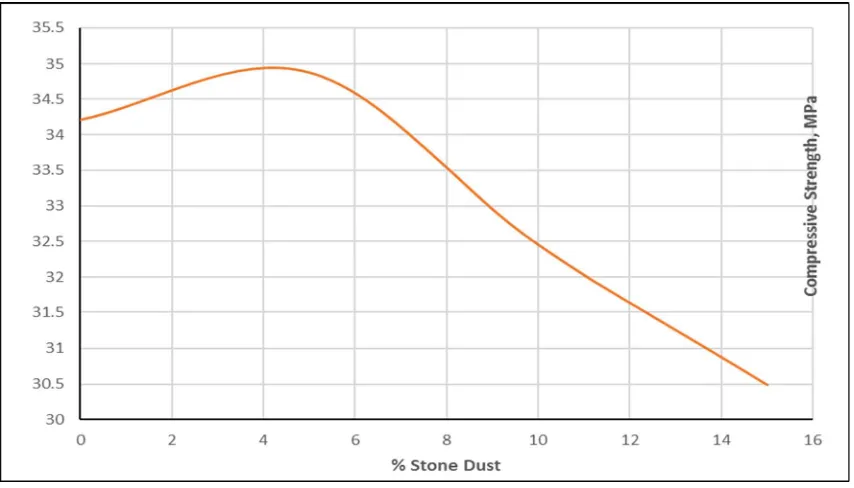
[image:4.612.94.521.438.682.2]32.45 MPa and 30.49 MPa could only be achieved which was less than 34.21 MPa achieved by the concrete specimen with 10% Fly Ash and 0% stone dust.
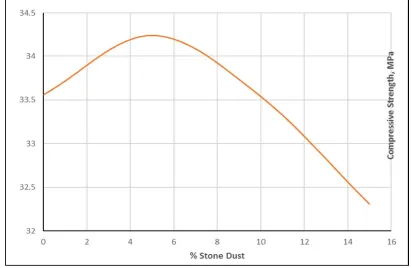
Fig. 4 Compressive Strength of Low Volume Fly Ash Concrete with 15% Recycled aggregate
The figure 4 represents the compressive strength of low volume fly ash concrete with stone dust at 15% recycled aggregate. The maximum Strength gain was depicted by 5% stone dust specimen at 28 days gaining 34.24 MPa, while at 10% and 15% stone dust 33.54 MPa and 32.31 MPa could only be achieved which was less than 33.56 MPa achieved by the concrete specimen with 10% Fly Ash and 0% stone dust.
V. CONCLUSION
The low volume fly ash itself enhances the compressive strength of concrete specimen by achieving 140.84 % of original design mix of M25. This will result in reducing the amount of cement required for the intended design mix.
The addition of stone dust also enhances the compressive strength of concrete specimen. The optimum dosage for stone dust for Low Volume Fly ash concrete at 10% fly ash content ranges between 5-10%.
On analysing the varied infusion of recycled aggregate at the rate of 5%, 10% and 15% the optimum dosage was found to be 5% in all the case.
The study concludes that the optimum design for Low Volume Fly Ash at 10% fly ash content the stone dust and recycled aggregate can be used in partial replacement of natural aggregate by 5% to achieve the maximum compressive strength.
Technology (IJRASET)
[1] Saman Khan, Roohul Abad Khan, Amadur Rahman Khan and Saiful Islam,” Strength Gain Analysis of Polypropylene Fiber Reinforced Concrete,” International Journal of Scientific Research in Science, Engineering and Technology Volume 2, Issue 1, Article first published online: January-Febuary – 2016, Available Online at: http://ijsrset.com/PDF.php?pid=734&v=2&i=1&y=2016&m=January-Febuary
[2] Saman Khan, Roohul Abad Khan, Amadur Rahman Khan, Misbahul Islam and Saman Nayal, “Mechanical Properties of Polypropylene fibre reinforced concrete for M25 and M 30 mixes: A Comparative Study,” International Journal of Scientific Engineering and Applied Sciences, Volume 1, Issue 6, September 2015. Available Online at: http://ijseas.com/volume1/v1i6/ijseas20150634.pdf
[3] Saman Khan, Roohul Abad Khan, Saiful Islam, Suhaib Nazar, Nadeem A Khan, “Comparative study of Compressive and Tensile behaviour of Polypropylene
Fibre reinforced Concrete of M 15 and M 20 Mix,” IJEA Volume 4 Issue 3 March 2015. Available Online at:
http://www.advanceresearchlibrary.com/temp/downloads/ijea/March2015/rk7.pdf
[4] Roohul Abad Khan, Amadur Rahman Khan and Shashank Verma,” Effect of Fibre Content on CBR for Unsoaked RDFS,” International Journal for Research & Development in Technology, Volume-5 issue-3 March 2016. Available Online at: http://ijrdt.org/full_paper/326/14/Effect-of-Fibre-Content-on-CBR-for-Unsoaked-RDFS
[5] Roohul Abad Khan, Amadur Rahman Khan and Saiful Islam,” Analysis of Dry Unit Weight and optimum moisture content,” American International Journal of Research in Formal, Applied and Natural Sciences, ISSN (Print) 2328-3777, ISSN (Online): 2328-3785, March 2016. Available Online at:
http://iasir.net/AIJRFANSpapers/AIJRFANS15-523.pdf
[6] Roohul Abad Khan, Amadur Rahman Khan and Saiful Islam,” Behaviour of CBR for Soaked RDFS at varying fibre length,” e-ISSN: 2394-3343, p-ISSN: 2394-5494, International Journal of Innovative and Emerging Research in Engineering, Volume 3, Issue 2, 2016. Available Online at:
http://ijiere.com/FinalPaper/FinalPaperBehaviour%20of%20CBR%20for%20Soaked%20RDFS%20at%20varying%20fibre%20length170540.pdf
[7] Saman Khan, Roohul Abad Khan and Amadur Rahman Khan,” Strength gain Analysis of Polyethylene terephthalate (PET) fibre reinforced concrete,” International Journal for Research and Development in Technology, Volume 5, Issue 6, June-2016, ISSN (O): - 2349-3585, Available Online at: http://ijrdt.org/full_paper/527/14/Strength-gain-Analysis-of-Polyethylene-terephthalate-PET-fibre-reinforced-concrete