038
THE ANALYSIS OF MATHEMATICS PERFORMANCE AND LEARNING
PROBLEMS OF PRE-ENGINEERING STUDENTS
Asma Ahmad Shariff
Center for Foundation Studies in Science, University of Malaya, Kuala Lumpur, Malaysia Email: [email protected]
ABSTRACT
The focus of this research is to analyze and study the mathematics performance of 185 pre-Engineering students in Center for Foundation Studies in Science (CFS), University of Malaya, based on their achievements in the Malaysian Certificate of Education (MCE) Additional Mathematics (AM). Students with A1 and A2 (Group A) for the MCE AM subject can be considered as good students while those getting B3, B4 and C5 (Group B) are less performed ones. This study shows that the students’ performances in Mathematics were influenced significantly by their AM achievements. Linear regression analysis conducted on AM results and the results of Mathematics paper; generally found that students who excel in Mathematics were students from Group A. However, there are also students from Group A who did not achieve good results in CFS Mathematics. Other than that, almost 100% of the students from Group B failed in the Mathematics subject in CFS. Further study conducted is to identify the ‘outliers’ category students under the regression lines whereby the questionnaire was carried out on them to study the actual problems they faced whether the problem was caused by learning systems or teaching staffs in CFS as well as environmental problems or personal problems.
Keywords: mathematics performance, pre-engineering students, regression analysis, outliers.
INTRODUCTION
Mathematics is the core subject for students who chose engineering field at both pre-university and university level. Good Mathematics result is the entrance prerequisite for admission to the pre-university level. Students who do not meet the requirements had to change course and take courses that are not based on engineering and science instead. In addition, Mathematics is also the compulsory subject for cumulative grade point average (CGPA) calculation at the pre-degree level. For example, throughout semester 1 and 2 period in CFS, students took four compulsory Science and Mathematics subjects, all to be passed at the end of the semester. However, for the placement in public university (IPTA) for the first degree, GPA is calculated using only their three best subjects in which Mathematics is the compulsory subject. Therefore, the results of Mathematics will affect their placement for the first degree.
There were many studies that have been done by researchers to see the performance and achievement of students in Mathematics either at school or university level. There were those who study the relationship between students' attitudes and the subject, and those who examine factors that cause their failure and success. Among these were studies conducted by Nasir [1], Mohamed Ali [2], Richardson [3], Wollet et. al [4] and Reyes [5]. Some studies also proposed and discussed suggestions and recommendations to overcome the problems of teaching and learning Mathematics effectively. These include Alsina [6], Green & Emerson [7], Faridah [8] and Ward & Killian [9].
MATERIALS AND METHODS
For the first part of this study, the data were gathered from 185 Pre-Engineering students for their MCE Additional Mathematics subject (AM) and Semester 1 Mathematics in CFS results. The results for Mathematics are the actual marks obtained by the students at the end of Semester 1, after summing their score for coursework (20%), mid-semester test (20%) and final exam (60%). The results of MCE AM for these students were categorized as grade 1 to grade 5 (A1 - C5) for convenience. Several analyses were performed on both types of data, including the linear regression analysis in which the Mathematics results were used as the dependent variable and the results of AM as the independent variable.
From this analysis, it was found that some of the students’ marks were ranked far below the regression line. Each of these students were identified and thus categorized as 'outliers'. For the second part, the study was carried out to identify the real problems faced by the students in the 'outliers' category whether the problem were caused by the learning and teaching system in CFS, environmental matter or personal problem. Questionnaires were distributed to the identified students; however, there were a few who did not attend the class during the last few weeks of the semester when the study was conducted. All analyses for the first part and the second part were performed using “Statistical Package for Social Sciences" (SPSS) software.
RESULTS AND DISCUSSIONS
The Results of CFS vs MCE
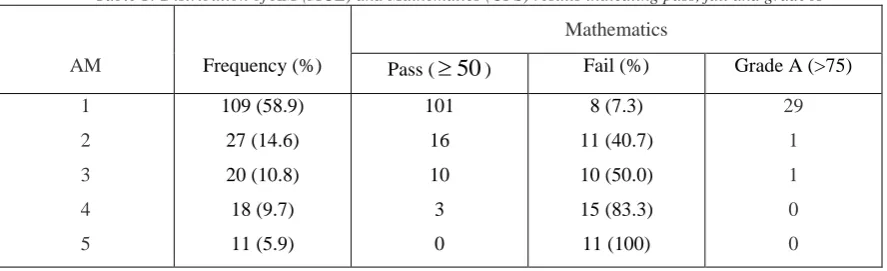
The distribution of AM (MCE) and Mathematics (CFS) results are summarized in Table 1. Table 1 show that only about 6% of the students in grade 1 and 100% of students in Grade 5 failed in the Mathematics subject. Most of the students who got an A for Mathematics in CFS are those who excel in their AM MCE. It is also found that as the grades of AM in MCE goes down the percentage of failures goes up. Table 2 display the detailed statistics of Mathematics results by the results in AM category. From the table it is clear that the results of AM affected the results of Mathematics in foundation level.
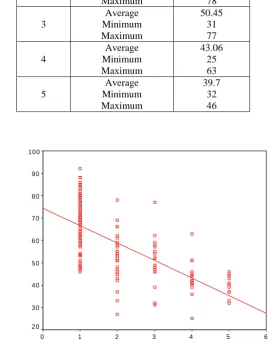
Regression analysis was performed on the results of the two examinations, with Mathematics marks as the dependent variable (y) and the AM results as the independent variable (x). A one-way regression analysis is used as the scores for Mathematics is continuous in nature while the AM results are purely ordinal. The results are illustrated in Figure 1.
[image:2.595.68.512.579.714.2]The obtained regression line is y74.336 7.809 x where the correlation coefficient is r 0.683 (correlation is significant at 0.05 level). The coefficient for the x variable is negative due to the inverted nature for the MCE results, where grade 1 is better than 2, 2 is better than 3, and so on. The value r 0.683 is considered high for correlation coefficient, which shows that there is a close relationship between the two subjects. In other words, it may be concluded that generally students with good results in AM will produce good results in Mathematics and vise-versa .
Table 1: Distribution of AM (MCE) and Mathematics (CFS) results indicating pass, fail and grade A
Mathematics
AM Frequency (%) Pass (
50
) Fail (%) Grade A (>75)1
2
3
4
5
109 (58.9)
27 (14.6)
20 (10.8)
18 (9.7)
11 (5.9)
101
16
10
3
0
8 (7.3)
11 (40.7)
10 (50.0)
15 (83.3)
11 (100)
29
1
1
0
Table 2: Detailed Statistics of Mathematics results by AM results category
AM MATHEMATICS
1
Average Minimum Maximum
67.77 46 92
2
Average Minimum Maximum
52.26 27 78
3
Average Minimum Maximum
50.45 31 77
4
Average Minimum Maximum
43.06 25 63
5
Average Minimum Maximum
39.7 32 46
ADDMATHS
6 5
4 3
2 1
0
P
U
R
A
T
A
R
D
100
90
80
70
60
50
40
30
[image:3.595.159.437.177.526.2]20
Figure 1: Graph of Regression analysis between Mathematics and AM
Legend: ADDMATHS = AM, PURATARD = Mathematics
Learning Difficulties of
‘outliers’
Category Students
The students who scored far below the regression line are categorized as 'outliers' and they are identified using SPSS software. These ‘outliers’data are the students with 'extreme values, i.e. students who scored lowest or highest in the list . In this paper, the 'outliers' term is used for those who are categorized weak and scored less than 45 marks.
day for revision especially during weekends. Although the lectures and tutorials’ attendance rate are quite satisfactory (88% of the students claimed that their presence is > 75%) the researcher found that nearly 25% of failed students (those who achieved marks < 50) did not attend tutorial classes in the last two weeks of the semester. The author feel that the attendance rate for either lecture or tutorial classes should reach up to 100% for those without acceptable excuses.
Adaptation with the learning system and environment in CFS is one of the important factors for new students. Those who need longer time to adapt tended to be affected as this will influence their concentration and involvement in the education system until the end of the semester. From this study, it was found that only 30% (for lecture) and 42% (for tutorial) respondents were able to adapt to the Mathematics learning method in CFS within 1-2 weeks. The others took at least half of the semester.
The study also found that more than 80% of the students reacted positively to the attitude and commitment of both the lecturers and tutors in conducting tutorial classes and lectures or when attending to students who needed help outside the classroom. Although nearly 84% of respondents agreed that the lectures were conducted fast, almost 63% indicated that they could cope up with them. This shows that most students did not consider academic staffs as a major factor contributing to the learning problems for their poor achievements. Although 68% of respondents agreed that the test or quiz questions given during tutorial classes were difficult, they were still able to be completed. 90% agreed that the tutorial questions help them to understand the subject better. Finally, the respondents were asked to give a feedback on(a) the reasons for the difficulties in learning Mathematics and(b) the real problem faced for not achieving good results.
The response given for both items (a) and (b) is shown in Table 5(a) and 5(b) respectively. From the responses given, it can be concluded that the reasons for not able to learn the subject and hence not performing are
(i) difficult to grab and understand the concept of the subject (87%). (ii) difficult to remember important facts and formulae
(iii)difficult to focus on learning because of personal problem s
[image:4.595.98.502.438.778.2]More than half of these students also confessed that they did not try to solve every question in the tutorials. Although personal problem was one of the reasons, none of them specified what their personal problems are.
Table 4: The number of 'outliers' students corresponds with the results of AM and Mathematics marks
AM Results Number of ’outliers’ Students
Min Mathematic Marks
1 2 3 4 5
0 5 3 4 5
- 38.8 34.0 36.2 35.6
Table 5 (a): The reasons for the difficulties in learning Mathematics (percentage agree)
The reasons for the difficulty in Mathematics subject Agree(%)
Elusive concept 87
English language problem 57.8
Lecturer approach during lecture 56.5
Teaching approach during tutorial classes 58.7
No tuition classes in CFS 51
Insufficient of fundamental knowledge in Mathematics 48
Table 5 (b): The real problem of not getting good result (percentage agree)
The real problem of not getting good results Agree(%)
Lack of concentration in class 54
Attendance at lectures and tutorials is not satisfactory 25.5
Do not try to solve every tutorial question 62.5
Easy to forget important things when answering the questions 90
Careless and concentrate on other activities 57
Less focus on learning due to personal problems 66
CONCLUSIONS
From this study it can be concluded that the performance of MCE Additional Mathematics subject contributed much to the Mathematics achievement in the first semester of CFS. Students who got an A in CFS, almost all were students who got A1 in MCE. Students who failed Mathematics in CFS were those from all categories of AM results in MCE (only difference of percentage). This shows that the good AM results in MCE does not guarantee a pass in Mathematics at CFS. Almost all students who obtained B4 (83%) and C5 (100%) in the AM MCE failed their Mathematics subject in CFS.
The students in the ‘outliers’ category who were the respondents for the questionnaire in this study were those who failed and obtained 45 and less in Mathematics subject. From the responses given it can be concluded that they generally agreed that the subject concept is somewhat elusive. Thus we would like to recommend that the lecturers involved in teaching these subjects would use interesting, creative and appropriate approach and method to convey the concept, especially to weak students. In addition, students who are experiencing such problems should be encouraged to discuss their problems with the lecturers more often. Problems such as forgetfulness, lack of concentration and not completing their work on time, need to be addressed and overcome by the students themselves since these factors were not associated with environment or the learning system. Weak students should be provided with and undergo serious motivational courses including effective learning method for their self-improvement before going any further.
It is hoped that the findings and results of this study and the recommendations can be utilized by the academic staffs of Mathematics Division, Centre for Foundation Studies in Science, University of Malaya in particular and other academic staff in general to improve the quality of Mathematics teaching at the Pre-Engineering and degree level. The study is also expected to serve as a guide to the students in order to improve and enhance the quality of learning Mathematics at any level.
ACKNOWLEDGEMENT
I would like to thank my colleagues for assisting me in collecting the data and to University Malaya for the funding.
REFERENCES
[1] Nasir Khalid. 1997. Factors Affecting Mathematics Achievement in Malaysian Schools. Phd Thesis (not published), Indiana University, Bloomington.
[2] Mohamad Ali Hassan. 1995. Attitudes Toward Mathematics of Secondary School Students in Malaysia: Current status, development and some relations to achievement. Phd Thesis (not published).
[3] .Richardson, J. T. E., King, E. Gender Differences in the Experience of Higher Education: Quantitative and Qualitaive Approaches. Educational Psychology, Vol 1, (1991), 363-382
[4] Wollet, P.L., Pedro, J.D., Becker, A., Fennema, E. 1980. Students’ Causal Attributions of Performance in Mathematics. Journal of Research in Mathematics Education, 11, 356-366.
[5] Reyes, L.H. 1984. Affecting, Variables in Mathematics Education. The Elementary School Journal, 84(5), 558-580.
[6] Alsina, C. 2002. Too much is not enough teaching maths through useful applications with local and global perspectives. Educational Studies in Mathematics. 50: 239-250.
[7] Green, K. & Emerson, A. 2008. Reorganizing freshman business mathematics II: authentic assessment in mathematics through professional memos. Teaching Mathematics And Its Applications. 27(2): 66-81. [8] Faridah Hanim Yahya. 2010. Learning Mathematical Concept Using Authentic Problem Scenario in
Rozhan M. Idrus et. al. (Eds.) (2010). Electronic education: Towards an immersive learning environment, New York: Pearson.