Comparative Study And Control System Design
For 4 Level Tank Systems (Non-Linear) Using
Pid And Brain Emotional Learning Based
Intelligent Controller
Abhijeet Dwivedi1, Er. Roshan Nayek2
PG Schlor1, Assistant Professor2
Department of Electrical Engineering Shepherd School of Engineering & Technology, India Sam Higginbottom University of Agriculture Allahabad, India
Abstract: Adaptive control systems have been always under extensive modern research. It has great importance in modern control systems. A lot of intelligent controllers have been modeled and are in use in modern control systems and process industry. A lot of challenges are present in controlling the systems with both linearity and non-linearity efficiently. A lot of adaptive learning mechanisms based on Artificial Intelligence like Neural Networks, Fuzzy Control systems, PSO etc have been implemented so far.
In this work, we present a limbic model of adaptive learning based on Mammalian Brain emotion control mechanism. We have chosen a non-linear system – 4-Level Tank control systems to demonstrate the properties of the BELBIC controller. Also, we have presented a comparative analysis between the static Industrial controllers like PID Controller and our BELBIC Model.The simulation of the 4-level tank system has been simulated. In our simulation results, it is observed that BELBIC is found to be more stable and robust than PID controller. Thus, this shows that BELBIC can be used for controlling non-linear systems efficiently and more robustly with great intelligent adaptively.
Keywords— PID Controller, Brain Emotion Learning Based Intelligent control, Artificial Intelligence, Adaptive Learning
I. INTRODUCTION
Control systems Engineers have always faced challenges and problems for various complex linear/ Non-linear controllers that should be always more adaptive than the conventional industrial static controllers. However, lots of intensive researches and industrial implementation have been done using Artificial Intelligence. The Artificial Intelligence has always been remedy for the scenarios and applications that needs more robustness and adaptive in nature. Various adaptive control controllers have been modeled and implemented but the challenges always remains to be able to robust to the changing environment and state variables emerged with non-linearity. However, the intelligent controllers like ANN (Artificial Neural Networks), Fuzzy-logic controller, PSO (Particle Swarm Optimizer) have been developed and used so far. However, the main challenges remain for the search for a more adaptive, robust and efficient controllers that can mitigate the problems of linearity with more adaptively and can solve for complex non-linear systems.
dependent on prior constraints, models and assumptions that are always very inaccurate.
Fig.1. Limbic model of the mammalian brain
Thus, a model based on limbic-system of mammalian brain emotions has been proposed by Caro Lucas [1] in 2004. He has demonstrated that emotion based decisions are quick and more satisfying all the constraints. He has proposed the model based on dynamic limbic system of brain of mammalian. A BELBIC model [1][2] presents the mimics of the limbic systems components – amygdala, orbito-frontal cortex, thalamus, sensory cortex. It has been implemented for various SISO, MIMO, and other non-linear systems. Various results have demonstrated its very fast control action, better disturbance handling capacity, and robustness. The BELBIC can be applied in various fields like HVAC, unstable systems, Non-linear systems, Speed regulation of DC Motors, Control systems based on Aerospace applications etc.
Fig.2. Functional Block Diagram of BELBIC systems
BELBIC can be mathematically analyzed, tested and simulated in various environments. Emotional learning is based on the analysis of the amygdala and the orbitofrontal cortex and the interaction between them. In mammals, emotional responses are systematically processed in the the limbic system in the cerebral cortex. The main components of the limbic system are the amygdala, orbitofrontal cortex, thalamus and the sensory cortex.
The amygdala is an almond shaped which can communicate with all other cortices within the limbic system. The primary processing of the limbic system occurs within the amygdala. Thus, the association between a stimulus and its emotional result takes place in this region .The learning occurs in two fundamental steps:
(i) Occurrence of particular stimulus and its correlation with an emotional response. The stimulus can be generated from expression of a face, smell, sound, etc.
(ii)Second, the result of the interaction between the stimulus and emotional responses take place in the amygdala. In this region, highly analyzed stimulus correlations in the cortex are associated with an emotional value.
The task of the amygdala is thus to assign a primary emotional value to each stimulus that has been paired with a primary reinforce the reward and punishment that the mammal receives. This task is aided by the orbitofrontal complex. The amygdala appears to handle the presentation of primary reinforcement, while the orbitofrontal cortex is involved in the detection of omission of reinforcement.
II. BRAIN EMOTIONAL LEARNING BASED INTELLIGENCE CONTROLLER (BELBIC)
Emotional Learning Model in Amygdala:- The emotional learning model in mammalian's brain is divided into two parts, abstractly corresponding to the amygdala and the orbitalfrontal cortex (OFC), respectively. Amygdala receives connections from the sensory cortices directly and the thalamus, while the orbital part (OFC) receives inputs from the cortical areas and the amygdala only, furthermore the system receives a reinforcing signal (Emotional cue) as shown in Fig. 1. There is one A node for every stimulus S to amygdala plus one additional node from thalamic stimulus. There is one single node for all outputs of the model, called E. This node simply sums the outputs from the A nodes, and then subtracts the inhibitory outputs from the 0 nodes, where 0 is OFC node for each of the stimuli:
E
A
i
O
i (Including Ath) (1)Additionally, E' node sums the outputs from A except
A
th and then subtracts it from inhibitory outputs of the 0 nodes:
E
A
i
O
i (not includingA
th) (2)The thalamic connection is calculated as the maximum overall stimuli S and becomes another input to the amygdaloid part:
A
th =max(S
i)Unlike other inputs to the Amygdala the thalamic input is not projected into the Orbitofrontal part and cannot be inhabited. For each A node, there is a plastic connection weight V . Any input is multiplied by this weight to provide the output of the node.
A
i
S
iV
i (3) The connection weightsV
i are adjusted proportionally to thedifference between the reinforcer (REW )and the activation of the A nodes. The cra parameter is a standard learning rate
parameter, settable parameter between 0 (no learning) and 1 (instant adaptation).
∆
i i i
a
i
S
REW
A
V
(
.
max(
0
,
))
(4)As shown in there are experimental results which verify the above assumptions. The OFC model is similar to the amygdala model. It also adapts its output according to the sensory data S and the reinforcer (REW). Likewise, the learning rule in OFC is calculated as the difference between E' and the reinforcing signal:
∆
W
i
o(
S
i(
E
'
REW
))
(5) where Wi is the weight of OFC connection and
o is OFCOFC learning is that the OFC connection weight can both increase and decrease as required tracking the desired inhibition. The OFC nodes values are then calculated as follows:
O
i
S
i.
W
i (6)Note that this system works at two levels: the Amygdaloid part learns to predict and react to a given reinforcer. So, the OFC output is adjusted to minimize the discrepancy of the amygdala output and the reinforcer, which was exactly desired
A. Control System Structure
The emotional learning mechanism in mammalians is an open-loop learning system. This means the living creature receives stimuli from outside world(environment) and reacts respectively. Effectiveness of this reaction is being evaluated respectively. in the reinforcement signal and helps the creature to reproduce better responses. To use this algorithm for decision making and control applications a closed-loop scheme must be introduced, A schematic diagram of closed-loop decision making mechanism is suggested in Fig. As it is illustrated in (7), (8), sensory input and reward signal, generally can be arbitrary function of the reference output, yr, controller output, u and error signal (e), and the designer must find a proper function for the controller.
Inputs to emotional learning mechanism are a set of sensory input signals as well as a reinforcing signal. These signals generally can be arbitrary selected by the designer of the control algorithm. It is recommended that the reinforcing signal REW is a function of other signals which can be supposed as a cost function rationale, specifically award and punishment:
REW
(
S
i,
e
,
Yp
)
(7) WhereY
P is the plant output and e is the error signal. Similarly the sensory inputs must be a function of plant outputs and controller outputs as follows:
S
i
f
(
u
,
e
,
Y
p,Y
r)
(8) WhereY
r is the reference signal.B. Pid Controller
In a PID control signal consist of proportional error signal added with derivative and integral of the error signal for PID controller.
k
e
t
dt
dt
t
de
T
t
e
t
III. SIMULATION PARAMETERS
Plant Model Parameters Values
Inner Pipe Diameter (inches) 0.25 Inner Tank Diameter (inches) 10 Inner tank height (inches) 18
Density 1
Acceleration due to gravity (g)- m/s2 9.8
Velocity (V1) - cm/s 500
[image:6.612.195.420.92.233.2]Velocity (V2) - cm/s 500
Table 1. Plant Model Parameters
Table 1 prersents the initial parameters for initialization of the 4-tank Level system as prsented . As given Inner Pipe Diameter & Height are described.The veleocities for filling the tank has been given as V1 and V2 in cm/s.
Controller Parameters
(PID) Values
Proportional (Kp) 22.86
Integral (Ki) 0.0015
Derivative (Kd) 0
Table 2. PID Controller Design ParametersTable 2 represents the control parameters for the design of the PID Controller for the given design of the 4-Level Tank Control system. Thus, the PID has been tuned for the above given plant model as discussed in table 1. The behaviour of ther PID controller has been described using the above design paraameters. Thus, all the results are obtained using the same and compared to the Barin Emotional Learning Based Intelligent Controller Design.
Reward Generator
Parameters Values
Proportional (Kp) 22.86
Integral (Ki) 0.0015
Derivative (Kd) 0
Control (Ku) 0
Table 3.1. Reward Generator Design Parameters
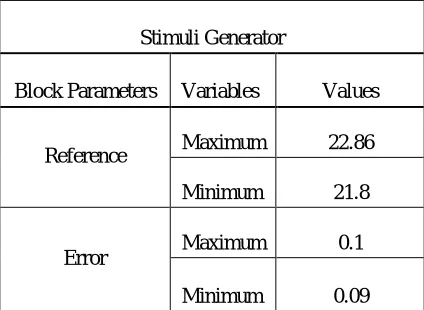
Stimuli Generator
Block Parameters Variables Values
Reference Maximum 22.86
Minimum 21.8
Error Maximum 0.1
[image:6.612.200.412.553.708.2]BEL Controller Parameters
Parameters Values
Alpha 0.00001
Beta 0.3
Initial V 70
Initial Vth -1
Initial W -1
Table 3.3. BEL Controller Design Parameters
Here, Table 3.1, 3.2 and 3.3 represnted the design parameters of the BEL Controller eleemnts design. As described in section III, the Brain Emotional Based Controller has various elements like Amygdala, Orbitocortex, Thalamus etc. Here, analogous to design model as presented, the design elements have been figured.
The major elements presented here: Reward Generator
Stimuli Generator BEL controller – c.1) Thalamus c.2) Sensory Cortex
c.3) Orbito-frontal Processing Unit c.4) Amygdala Processing Unit (sensory) c.5) Amygdala Processing Unit (thalamus)
IV. RESULTS AND DISCUSSIONS
Based on our comparative models for 4-Level Tank Plant Model, we obtained simulation outputs of various responses of PID Controller and the BEL Intelligent controller.
[image:7.612.210.412.80.202.2]Based on the simulation parameters for PID & BELBIC design, we obtain the simulation graphs again time for all the processes and errors. The main comparison between the PID & BELBIC is based on the output response and error response of these controllers and errors. Also, the control behavior have been simulated also and presented here thereby.
fig. 4 Response of the PID controller for tank3
Fig. 4 shows the response of the PID controller for tank 3 system.
Here, we have presented the comparison between the
reference input and the output. Thus, this graph presents the
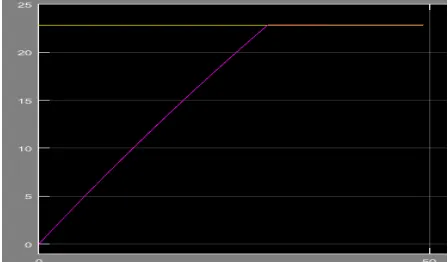
[image:7.612.221.445.490.621.2]fig. 5 Response of the BELBIC controller for tank3
Fig. 5 shows the response of the BELBIC controller for tank 3 system. Here, we have presented the comparison between the reference input and the output. Thus, this graph presents the behavior of the output based on the BELBIC controller.
fig. 6 Response of the PID controller for tank4
[image:8.612.175.418.269.420.2]Fig. 6 shows the response of the PID controller for tank 3 system. Here, we have presented the comparison between the reference input and the output. Thus, this graph presents the behavior of the output based on the PID controller.
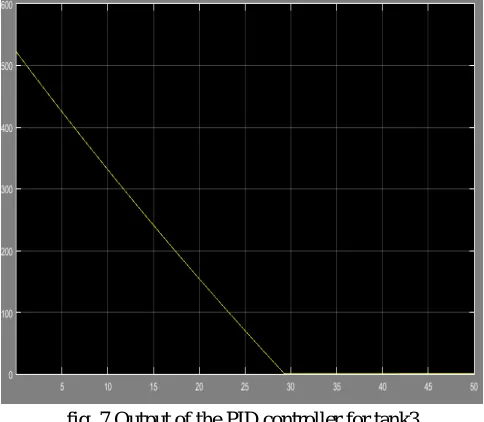
fig. 7 Output of the PID controller for tank3
[image:8.612.185.427.470.681.2]V. CONCLUSIONS
In this work, we have presented a simulation of 4-level tank system that can be considered as a non-linear system considering the relation between the velocities and height of the tanks. We presented the comparative analysis between the PID controller and BELBIC controller. Considering the design parameters and the process parameters, output response has been shown.
We found that BELBIC deals with non-linearity in the system much better than the PID controller. It is very fast as compared to the PID. The simulation results prove that. Thus, we can say that BELBIC is much robust and adaptive in dealing with the complex systems and out performs the PID controller in this way.
REFERENCES
[1] Lucas, C.; Shahmirzadi, D.; Sheikholeslami, N. (2004), "Introducing BELBIC: Brain Emotional Learning Based Intelligent Controller", Intelligent Automation
and Soft Computing, 10: 11–22, doi:10.1080/10798587.2004.10642862J. s
[2] LeDoux, J. E. (1995), "In Search of an Emotional System in the Brain: Leaping from Fear to Emotion and Consciousness", in Gazzaniga, M. S, The Cognitive
Neurosciences, Hillsdale, NJ: Lawrence Erlbaum, pp. 1049–1061
[3] Moren, J.; Balkenius, C. (2000), A Computational Model of Emotional Learning in the Amygdala, MIT Press
[4] Rolls, E. T. (1995), "A theory of Emotion and Consciousness, and its Application to Understanding the Neural Basis of Emotion", in Gazzaniga, M. S., The
Cognitive Neurosciences, Hillsdale, NJ: Lawrence Erlbaum, pp. 127–155
[5] Shahmirzadi, D. (2005). "Thesis: Computational Modeling of the Brain Limbic System and its Application in Control Engineering". Texas A & University.