©IJRASET 2015: All Rights are Reserved
647
A review of genetic algorithm for metal cutting
processes and a research agenda
Krantikumar K. Bhosale1*, Vijay D. Jadhav2* 1
Post Graduate student in Mechanical Engineering Department
2
Professor in Mechanical Engineering Department, Karmaveer Bhaurao Patil College of Engineering Satara, India.
Abstract —Quality of finished product manufactured by metal cutting process depends on various machining factors. Similarly the chemical composition of work piece material also plays important role .So before processing we must know relationship in between machining parameters and material parameters which is studied by various optimization methods. The genetic algorithm (GA) is the one of optimization technique which generates solutions to optimization problems using techniques inspired by natural evolution, such as selection, mutation, and crossover.GA is a good global optimization tool. Keywords—Metal cutting processes, Genetic algorithm, Applications
I. INTRODUCTION
Metal cutting is one of widely used manufacturing processes in engineering industries. The study of metal cutting focuses among others, on the features of tools geometry, chemical composition of work piece and machine (input) parameter settings influencing process efficiency and output quality characteristics (or responses). In today’s rapidly changing scenario in manufacturing industries, applications of optimization techniques in metal cutting processes is essential for a manufacturing unit to respond effectively to severe competitiveness and increasing demand of quality product in the market. Optimization operation is one of the important goals of manufacturing systems, also it simple to use and are increasingly used to solve inherently intractable problems quickly. Genetic algorithm (GA ) is one of the example of nontraditional optimization technique used as a good global optimization tool. Genetic algorithm is developed by Prof. John Holland, his colleagues and his student at the university of Michigan around 1975. Prof David Goldberg who is illustrious student of Prof. John Holland and author of “Genetic Algorithm in Search Optimization and Machine Learning “Addison Wesley 1989. Goldberg was inspired by Darwin's theory of evolution which states that the survival of an organism is affected by rule "the strongest species that survives". Darwin also stated that the “survival of any organism can be maintained through the process of reproduction, crossover and mutation”. A solution generated by genetic algorithm is called a chromosome, while collection of chromosome is referred as a population. A chromosome is composed from genes. These chromosomes will undergo a process called fitness function to measure the suitability of solution generated by GA with problem. Some chromosomes in population will mate through process called crossover thus producing new chromosomes named offspring which its genes composition are the combination of their parent. In a generation, a few chromosomes will also mutation in their gene. The number of chromosomes which will undergo crossover and mutation is controlled by crossover rate and mutation rate value. Chromosome in the population that will maintain for the next generation will be selected based on Darwinian evolution rule, the chromosome which has higher fitness value will have greater probability of being selected again in the next generation. After several generations, the chromosome value will converges to a certain value which is the best solution for the problem. This paper discusses the various concepts and design and applications of genetic algorithms for optimization of process controllers. Section 1 gives the basic introduction of this paper. Section 2 gives brief information of the basic principles of GA and flowchart. In section 3 it clears that GA gives the global minima or global maxima value also shows how GA is best global optimization tool. In section 4 and 5 the various applications of GA in metal cutting processes and in other engineering field are mentioned respectively and in last section 6 the proposed work research agenda is explained in details.
II. BASIC PRINCIPLES OF GA
648
There are total 9 basic principles of GA
[image:3.612.129.494.117.396.2]The flowchart of algorithm can be seen in Figure 1.
Figure 1: GA Flowchart [1]
A. Encoding
It is assumed that a potential solution to a problem may be represented as a set of parameters (for example, the dimensions of the beams in a bridge design). These parameters (known as genes) are joined together to form a string of values (often referred to as a chromosome) usually the binary alphabet {0,1}.
The chromosome then looks like this:
Chromosome 1 1101100100110110
Chromosome 2 1101111000011110
Each chromosome has one binary string. Each bit in this string can represent some characteristic of the solution. Of course, there are many other ways of encoding. This depends mainly on the solved problem. Various encoding techniques used in genetic algorithms (GAs) are binary encoding, permutation encoding, value encoding and tree encoding.
B. Initialization
Initially many individual solutions are randomly generated to form an initial population. The population size depends on the nature of the problem, but typically contains several hundreds or thousands of possible solutions. Traditionally, the population is generated randomly, covering the entire range of possible solutions (the search space). Occasionally, the solutions may be "seeded" in areas where optimal solutions are likely to be found.
C. Selection
During each successive generation, a proportion of the existing population is selected to breed a new generation. Individual solutions are selected through a fitness-based process, where fitter solutions (as measured by a fitness function) are typically more likely to be selected. Certain selection methods rate the fitness of each solution and preferentially select the best solutions. Other methods rate only a random sample of the population, as this process may be very time-consuming.
649
methods include roulette wheel selection and tournament selection.
1) Roulette Wheel Selection
Fitness level is used to associate a probability of selection with each individual solution.
We first calculate the fitness for each input and then represent it on the wheel in terms of percentages. In a search space of ‘N’ chromosomes, we spin the roulette wheel.
Chromosome with bigger fitness will be selected more times.
[image:4.612.71.485.177.331.2]
X X= Value10 normalized between 0 to 10 range Value10: Value of chromosome to the base 10Fig1. Roulette Wheel selection
Figure 2: Roulette Wheel Selection
D. Crossover
It is the process in which genes are selected from the parent chromosomes and new offspring is created..
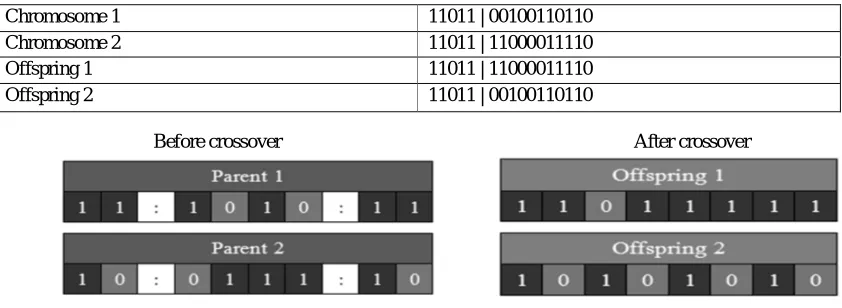
Next step is to perform crossover. This operator selects genes from parent chromosomes and creates a new offspring. The simplest way how to do this is to choose randomly some crossover point and everything before this point copy from a first parent and then everything after a crossover point copy from the second parent.
[image:4.612.97.518.493.647.2]Crossover can then look like this (| is the crossover point):
Table 1: Single Point Crossover
Before crossover After crossover
There are other ways how to make crossover, for example we can choose more crossover points. Crossover can be rather complicated and very depends on encoding of the chromosome. Specific crossover made for a specific problem can improve performance of the genetic algorithm.
E. Mutation
After a crossover is performed, mutation takes place. Premature convergence is a critical problem in most optimization
Chromosome 1 11011 | 00100110110
Chromosome 2 11011 | 11000011110
Offspring 1 11011 | 11000011110
650
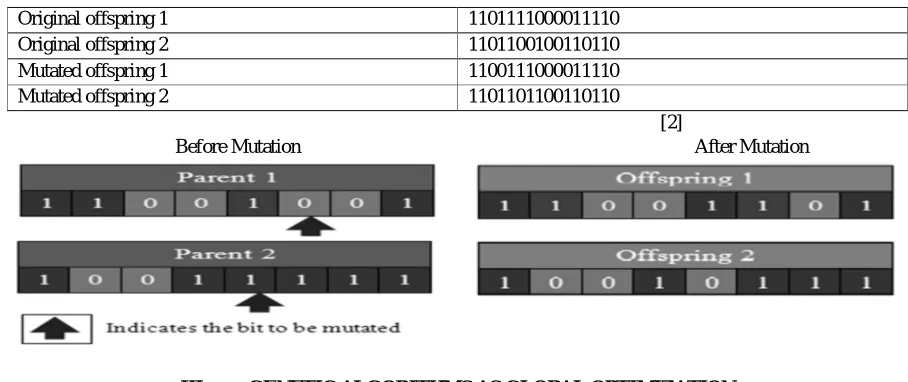
techniques, consisting of populations, which occurs when highly fit parent chromosomes in the population breed many similar offsprings in early evolution time. Crossover operation of genetic algorithms (GAs) cannot generate quite different offsprings from their parents because the acquired information is used to crossover the chromosomes. An alternate operator, mutation, can search new areas in contrast to the crossover. Crossover is referred as exploitation operator whereas the mutation is exploration one. For binary encoding we can switch a few randomly chosen bits from 1 to 0 or from 0 to 1.
Mutation can then be following:
Table 2: Mutation
Original offspring 1 1101111000011110
Original offspring 2 1101100100110110
Mutated offspring 1 1100111000011110
Mutated offspring 2 1101101100110110
[2]
Before Mutation After Mutation
III. GENETIC ALGORITHMS AS GLOBAL OPTIMIZATION
The objective of global optimization is to find the "best possible" solution in nonlinear decision models that frequently have a number of sub-optimal (local) solutions. In the absence of global optimization tools, engineers and researchers are often forced to settle for feasible solutions, often neglecting the optimum values. In practical terms, this implies inferior designs and operations, and related expenses in terms of reliability, time, money, and other resources. The classical optimization techniques have difficulties in dealing with global optimization problems. One of the main reasons of their failure is that they can easily be entrapped in local minima. Moreover, these techniques cannot generate or even use the global information needed to find the global minimum for a function with multiple local minima. Due to its random nature, the genetic algorithm improves the chances of finding a global solution. Thus they prove to be very efficient and stable in searching for global optimum solutions. In figure 3 there are 3 minima (1,2,3) .table clears that minima values for respective region for traditional optimization and genetic algorithm. So it clears that GA gives the global minima value.
[image:5.612.77.531.165.356.2]
Figure 3 : Global minima
A. Genetic algorithms are intrinsically parallel. Most other algorithms are serial and can only explore the solution space to a problem in only one direction at a time whereas GA has multiple offspring, they can explore the solution space in multiple directions at once. If one path turns out to be a dead end, they can easily eliminate it and continue work on more promising avenues, giving them a greater chance each run of finding the optimal solution.
B. Due to the parallelism that allows them to implicitly evaluate many schemas at once, genetic algorithms are particularly well-suited to solving problems where the space of all potential solutions is truly huge – too vast to search exhaustively in
Initial guess Traditional optimization
Genetic algorithm
Pink region (1) Converges to 1 Converges to 2
Blue region (3) Converges to 3 Converges to 2
©IJRASET 2015: All Rights are Reserved
651
any reasonable amount of time. It directly samples only small regions of the vast fitness landscape and successfully finds optimal or very good results in a short period of time after directly.
C. Another notable strength of genetic algorithms is that they perform well in problems for which the fitness landscape is complex - ones where the fitness function is discontinuous, noisy, changes over time, or has many local optima. GA has proven to be effective at escaping local optima and discovering the global optimum in even a very rugged and complex fitness landscape. However, even if a GA does not always deliver a provably perfect solution to a problem, it can almost always deliver at least a very good solution.
D. Another area in which genetic algorithms excel is their ability to manipulate many parameters simultaneously. GAs are very good at solving such problems, in particular, their use of parallelism enables them to produce multiple equally good solutions to the same problem, possibly with one candidate solution optimizing one parameter and another candidate optimizing a different one and a human overseer can then select one of these candidates to use.
E. GAs know nothing about the problems they are deployed to solve. Instead of using previously known domain-specific information to guide each step, they make random changes to their candidate solutions and then use the fitness function to determine whether those changes produce an improvement.
[2]
IV. APPLICATIONS OF GA IN METAL CUTTING PROCESSES
A. “Kernel based regression and genetic algorithms for estimating cutting conditions of surface roughness in end milling machining process”
Antoni Wibowo , Mohammad Ishak Desa
In this paper, we used KPCA based regressions and GAs to estimate the optimal conditions of cutting conditions and the minimum surface roughness [4].
B. “Genetic algorithm-based optimization of cutting parameters in turning processes” Doriana M., Roberto Teti
This paper deals with a novel approach to optimize the machining parameters during turning process, by basing on the use of cognitive paradigms. Integration of the proposed approach with an intelligent manufacturing system will lead to reduction in production cost, reduction in production time, flexibility in machining parameter selection, and improvement of product quality [5].
C. “Optimization of process parameters of mechanical type advanced machining processes using genetic algorithms” Neelesh K. Jaina, V.K. Jainb,_, Kalyanmoy Debb
Real coded version of the GA was used for solving the formulated optimization models. To ensure that the obtained optimum solution is global-optimum or near global-optimum, concept of statistical DOEs was used to optimize three most influential and important parameters of real-coded GA namely population size, SBX parameter and polynomial mutation parameter[6].
D. “Multi-objective optimization of wire-electro discharge machining process by Non-Dominated Sorting Genetic Algorithm” Shajan Kuriakose, M.S. Shunmugam
In this paper, the Wire-EDM process parameters have been optimized by using Non-Dominated Sorting Genetic Algorithm, and a nondominated solution set is obtained. The sorting procedure employs a fitness assignment scheme which prefers nondominated solutions and uses a sharing strategy which preserves diversity among the solutions [7].
E. “Genetic algorithm-based multi-objective optimization of cutting parameters in turning processes” Ramo´ n Quiza Sardin˜ as_, Marcelino Rivas Santana, Eleno Alfonso Brindis
The proposed micro-GA has shown obtain several, uniformly distributed points, in order to arrange the Pareto front, at a reasonably low computational cost. Aspects like diversity maintenance and constraints handling have been successfully sorted for the studied problem [8].
F. “ Optimization of process parameters in the abrasive water jet machining using integrated SA–GA” Azlan Mohd Zaina,, Habibollah Haronb, Safian Sharif c
©IJRASET 2015: All Rights are Reserved
652
distance, abrasive grit size and abrasive flow rate [9].
G. “The Optimization of the Electro-Discharge Machining Process Using Response Surface Methodology and Genetic Algorithms”
R.Rajesha and M. Dev Anandb
A practical method of optimizing cutting parameters for EDM based on multiple regression models and GA are presented in this paper. Current, Voltage, Flow Rate, Pulse ON, Pulse OFF and Gap have been considered as machining parameters. Metal removal rate and surface roughness have been obtained as responses from the EDM process. Metal removal rate and surface roughness are combined to have a single objective as grey relational grade by the application of grey relational analysis. Linear regression model have been developed to map the relationship between machining parameters and output responses [10].
H. “Multi-Objective Optimization of Turning Process during Machining of AlMg1SiCu Using Non-Dominated Sorted Genetic Algorithm”
Rahul Dhabalea, VijayKumar S. Jattib, T.P.Singh
In this study turning experiments were conducted by using the parametric approach of the Taguchi’s method. Regression analysis has been performed to find out the relationship between input factors and responses using Minitab 16 statistical software. General first order model was developed to predict the material removal rate and surface roughness over the experimental region. This establishes the reliability of genetic algorithms as one of the most accurate optimization approaches [11].
I. “Genetic algorithm based optimization and post optimality analysis of multi-pass face milling” Sourabh K. Saha
In this paper an optimization methodology is proposed for the optimization of the multipass face milling process. Binary coded genetic algorithm (GA) is used to minimize the unit production cost along with the satisfaction of several nonlinear constraints[12].
J. “OPTIMIZATION OF MACHINING PARAMETERS IN CNC TURNING OF MARTENSITIC STAINLESS STEEL
USING RSM AND GA” Poornima, Sukumar
This paper provides a detailed study on the surface roughness of the martensitic stainless steel (SS40). The detailed study and the optimization procedure has been made to study the effect of speed, feed and depth of cut while machining which would help in real practice. The machining parameter ranges were analyzed and then the experimentation was carried out according to the optimization approaches[13].
K.“USING GENETIC ALGORITHMS FOR OPTIMIZATION OF TURNING MACHINING PROCESS”
DUSAN PETKOVIC, MIROSLAV RADOVANOVIC
This paper shows the possibilities of using genetic algorithms for solving such problems. Cost of machining in turning process, depending on cutting speed and feed was minimized under some non linear constraints. The possibility of finding the minimum of the function (under linear and nonlinear constraints) and the fact that derivatives or other additional information on the function are not necessary are basic advantages of GA [14].
V. Applications of GA in various other fields
“GAs has been applied in science, engineering, business and social sciences. Number of scientists has already solved many engineering problems using genetic algorithms.”
GA is applicable in all engineering fields for example; In mechanical engineering field GA have many applications in mechanics, hydrodynamics and aerodynamics. It also used to find out optimum set of input parameters of machining process on specific response parameters. In electronics GA is used in circuit design, design of high frequency matching stubs and setting Digital Signal Processing filter coefficient. One of the major applications of evolutionary Algorithm is computing itself, most obviously to design programs or algorithms.
A. GA concepts applied to the engineering problem such as optimization of gas pipeline systems.
653
C. GA is also used in medical imaging system. The GA issued to perform image registration as a part of larger digital subtraction angiographies. It can be found that GAs can be used over a wide range of applications”
D. GA also applied to production planning, air traffic problems, automobile, signal processing, communication networks, environmental engineering.
E. To find the shortest path, genetic algorithms can be used to encode a path in graph into a chromosome. The proposed approach have been tested by Gen M. et.al (1997) with different size from 6 nodes to 70 nodes and from 10 edges to 211 edges. The encouraging results using genetic algorithms can find the optimum very rapidly and with very high probability.
F. A dynamic routing control based on genetic algorithm can provide flexible real time management of the dynamic traffic changes in broadband networks. It was demonstrated through computer simulations using genetic algorithms by Shimamoto N. (2000). The proposed technique can generate the exact solution of path arrangement that keeps the traffic loss rate below the target value, even after changes in traffic.
G. The multiple destination routing algorithm was formulated for finding a minimal cost tree which contains designated source and multiple destination nodes to satisfy certain constraints in a given communication network. The simulation studies for sparse and dense network demonstrate the robustness and efficiency of the proposed algorithm in terms of yielding high quality solutions.
H. A novel approach to solve very large scale integration (VLSI) channel and switch box routing problems was discussed by Lienig et.al (1997). This approach is based upon genetic algorithms that run on a distributed network of workstations. An extensive investigation shows the qualitatively better results and significantly reduction in occurrence of cross talk.
I. Sue Ellen Haupt, Randy L. Haupt, “Genetic algorithm and their applications in environmental sciences.” This paper introduces the elements of GAs and their application to environmental scienceproblems. [3]
VI. RESEARCH AGENDA
In this research, Laser beam machining parameters are optimized on AISI1040 material using genetic algorithm method.
A. Proposed methodology for research work
1) Review and study the literature survey: In this, most of research work related to laser beam machine, AISI1040 material and genetic algorithm are studied.
2) Identify the Gap and Specific objective: In this from literature survey gaps are identified from that gap research area will be selected and then specific objects are mentioned.
3) Identify the input and output parameters: Laser beam machining input factors like cutting speed, feed, pulse width, pulse frequency, gas pressure, duty and Output parameters such as surface roughness, material removal rate, over cut, depth of
cut, HAZ, kerf taper are studied and selected input parameters are selected to find out the response on output parameters .
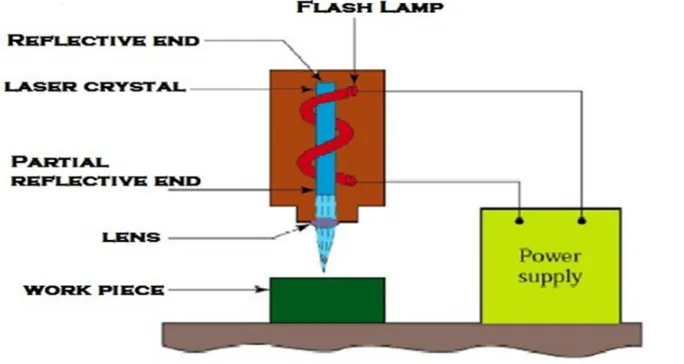
[image:8.612.111.453.489.671.2]4) Experimental work setup
Figure 1 shows the experimental work setup of laser beam machine.
654
5) Analyze the process by using RSM. (Response surface methodology): After experimental procedure, experiments are designed and the mathematical models correlated the desired responses and the control parameters are established using Response Surface Methodology (RSM).
6) Optimize the process by using Genetic Algorithm: The present research work optimizes the desired responses and control parameters by writing .M-files and then solved by GA using the MATLAB software.
7) Validation of experiments: Validation of Genetic algorithm predicted results with the experimental results is done in order to conform the GA predicted results to be acceptable for practical use.
Prediction error%=(Experimental result - GA predicted result) 100 / (Experimental result)
Methodology plan
VII. CONCLUSION
From previous studies and papers, it clear that the genetic algorithm is one of the best optimization technique gives global maxima and minima.GA provides a cost effective soft computing technique for optimizing machining operations. Also literature review provides good information for research work. It will help other researcher to understand genetic algorithm and its applications.
Expected Outcome Validation of experiments
Optimize the process by using Genetic Algorithm (GA). Analyze the process by using RSM. (Response surface methodology)
Measurement of output variables Conduct the experiment Experimental work setup
Identify the output parametersSurface roughness, Kerf taper Identify the input parameters
Pulse width, Pulse frequency, Cutting speed and Gas pressure Statement of hypothesis and specific objective for dissertation work
©IJRASET 2015: All Rights are Reserved
655
REFERENCES
[1] Denny Hermawanto Genetic Algorithm for Solving Simple Mathematical Equality Problem Indonesian Institute of Sciences (LIPI), INDONESIA. [2] Pratibha Bajpai et al. Genetic Algorithm – an Approach to Solve Global Optimization Problems Indian Journal of Computer Science and Engineering Vol 1 No 3 199-206.
[3] Rahul Malhotra, Narinder Singh & Yaduvir Singh Genetic Algorithms: Concepts, Design for Optimization of Process Controllers Computer and Information Science Vol. 4, No. 2; March 2011
[4]Antoni Wibowo ⇑, Mohammad Ishak Desa Kernel based regression and genetic algorithms for estimating cutting conditions of surface roughness in end milling machining process Expert Systems with Applications 39 (2012) 11634–11641
[5]Doriana M. , Roberto Teti Genetic algorithm-based optimization of cutting parameters in turning processes Procedia CIRP 7 ( 2013 ) 323 – 328
[6]Neelesh K. Jaina, V.K. Jainb,_, Kalyanmoy Debb Optimization of process parameters of mechanical type advanced machining processes using genetic algorithms International Journal of Machine Tools & Manufacture 47 (2007) 900–919
[7]Shajan Kuriakose, M.S. Shunmugam∗Multi-objective optimization of wire-electro discharge machining process by Non-Dominated Sorting Genetic Algorithm Journal of Materials Processing Technology 170 (2005) 133–141.
[8]Ramo´ n Quiza Sardin˜ as_, Marcelino Rivas Santana, Eleno Alfonso Brindis Genetic algorithm-based multi-objective optimization of cutting parameters in turning processes Engineering Applications of Artificial Intelligence 19 (2006) 127–133.
[9]Azlan Mohd Zaina,∗, Habibollah Haronb, Safian Sharif Optimization of process parameters in the abrasive waterjet machining using integrated SA–GA Applied Soft Computing 11 (2011) 5350–5359
[10]R.Rajesha and M. Dev Anandb The Optimization of the Electro-Discharge Machining Process Using Response Surface Methodology and Genetic Algorithms Procedia Engineering 38 ( 2012 ) 3941 – 3950.
[11] Rahul Dhabalea, VijayKumar S. Jattib,*, T.P.Singhc Multi-Objective Optimization of Turning Process during Machining of AlMg1SiCu Using Non-Dominated Sorted Genetic Algorithm Procedia Materials Science 6 ( 2014 ) 961 – 966.
[12]Sourabh K. Saha* Genetic algorithm based optimization and post optimality analysis of multi-pass face milling.
[13]Poornima*1, Sukumar*2 OPTIMIZATION OF MACHINING PARAMETERS IN CNC TURNING OF MARTENSITIC STAINLESS STEEL USING RSM AND GA International Journal of Modern Engineering Research (IJMER) ISSN: 2249-6645.
[14]DUSAN PETKOVIC1∗, MIROSLAV RADOVANOVIC1USING GENETIC ALGORITHMS FOR OPTIMIZATION OF TURNING MACHINING PROCESS Journal of Engineering Studies and Research – Volume 19 (2013) No. 1
[15] Sivarao, T.J.S. Anand, Ammar, Shukor, “RSM based Modeling of Surface Roughness Prediction In Laser machining,” International Journal of Engineering & Technology IJET-IJENS Vol:10 No:04
[16] A. Stournaras, P.Stavropoulos, K. Salonitis, “An Investigation Of Quality in CO2 Laser Cutting of Aluminium,” CIRP Journal of Manufacturing Science and Technology 2 (2009) 61-69
[17] Chih-Wei Chang, Chun-Pao Kuo, “Evaluation Of Surface Roughness In Laser Assisted Machining of Aluminium Oxide Ceramics With Taguchi Method,” International Journal of Machine Tool Manufacture.
[18] S. Sun, M.Brandit, “Thermally enhanced machining of hard to materials:- A review,” International Journal of Machine Tool Manufacture 47(2007) 141 147.
[19] Teixidor D, et al. Optimization of process parameters for pulsed laser milling of micro-channels on AISI H13 tool steel. Robotics and Computer Integrated Manufacturing (2012), http://dx.doi.org/10.1016/j.rcim.2012.05.005
[20] Arun Kumar Pandey and Avinash Dubey ,” Modeling and optimization of surface roughness in laser cutting of titanium alloy sheet” , Journal of Mechanical Science and Technology 27(7) (2013) 2115~2124.
[21] Milos, Miroslav, Laurentiu, “Surface Roughness Optimization In CO2 Laser Cutting By Using Taguchi Method” , U.P.B Sci. Bull., Series D, Vol.75, Iss.1, 2013.
[22] Siti Lydia Binti Rahim,” Analysis and optimization of process parameters involved in laser beam machining of stainless steel”, Thesis submitted accordance with requirement of National Technical University of Malaysia for Degree, 2007.
[23] Doriana . Roberto Teti, ”Genetic Algorithm based optimization of cutting parameters in turning process,” Procedia CIRP 7 (2013) 323-328.
[24] Avanish Kumar Dubey and Vinod Yadava, “Laser beam machining—A review,” International Journal of Machine Tools & Manufacture, vol. 48, 2008, pp.609– 628.
[25] Rahul Malhotra, Narinder Singh & Yaduvir Singh ,”Genetic Algorithms: Concepts, Design for Optimization of Process Controllers”, Computer and Information Science www.ccsenet.org/cis Vol. 4, No. 2; March 2011.
[26] Denny Hermawanto Genetic Algorithm for Solving Simple Mathematical Equality Problem Indonesian Institute of Sciences (LIPI)
[27] Indrajit Mukherjee, Pradip Kumar Ray ,”A review of optimization techniques in metal cutting processes”, Computers & Industrial Engineering 50 (2006) 15–34.
![Figure 1: GA Flowchart [1]](https://thumb-us.123doks.com/thumbv2/123dok_us/8584482.861936/3.612.129.494.117.396/figure-ga-flowchart.webp)