Developing quality heathcare software
using quality function deployment: A
case study based on Sultan Qaboos
University Hospital
Ahmed, Mohiuddin and Islam, Rafikul and Alwahaibi, Salim
Khloof
International Islamic University Malaysia (IIUM)
2006
Online at
https://mpra.ub.uni-muenchen.de/11345/
Developing quality healthcare software using quality
function deployment: a case study based on Sultan
Qaboos University Hospital
Mohiuddin Ahmed
Department of Computer Science
Faculty of Information and Communication Technology International Islamic University Malaysia
Jalan Gombak, 53100 Kuala Lumpur, Malaysia E-mail: [email protected]
Rafikul Islam*
Department of Business Administration
Faculty of Economics and Management Sciences International Islamic University Malaysia Jalan Gombak, 53100 Kuala Lumpur, Malaysia E-mail: [email protected]
*Corresponding author
Salim Khloof Al-wahaibi
Sultan Qaboos University Hospital
P.O. Box 38, Alkhod 123, Sultanate of Oman E-mail: [email protected]
Abstract: Traditionally, the rate of failure in software development projects is higher compared to other kinds of projects. This is partly due to the failure in determining software users’ requirements. By using Quality Function Deployment (QFD), this research focuses on identification and prioritisation of users’ requirements in the context of developing quality healthcare software system for Sultan Qaboos University Hospital (SQUH) in Oman. A total of 95 staff working at eight departments of SQUH were contacted and they were requested to provide their requirements in using hospital information systems. Analytic Hierarchy Process has been integrated with QFD for prioritising those user requirements. Then, in consultation with a number of software engineers, a list consisting of 30 technical requirements was generated. At the end of QFD exercise the technical requirements that receive higher weights, should be paid due consideration at the time of designing the healthcare software system for SQUH.
Keywords: software quality; quality function deployment; healthcare software; analytic hierarchy process.
Biographical notes: Mohiuddin Ahmed is an Assistant Professor in the Computer Science Department of the International Islamic University Malaysia (IIUM). Before joining IIUM, he was working in Goldman Sachs, NY, USA, as a Programmer Analyst in the Global Control Division. Prior to that, he was an adjunct faculty in the Department of Electrical and Computer Engineering in North Carolina A&T State University (NC A&T SU). He obtained his MS and PhD both in Electrical Engineering from NC A&T SU, USA in 1993 and 2000, respectively. His current research interests include High Performance Computing (HPC), Artificial Neural Network (ANN), ANN application in signal and image processing, etc.
Rafikul Islam received his MSc degree in Applied Mathematics from Calcutta University in 1988. Subsequently, he obtained his PhD in Operations Research from the Indian Institute of Technology, Kharagpur in 1996. Presently, he is working as an Associate Professor at the Department of Business Administration, International Islamic University Malaysia. His articles have appeared in European Journal of Operational Research, Military Operations
Research, International Journal of Fuzzy Mathematics, Ricerca Operativa,
Journal of Engineering Manufacture, etc. Dr. Islam’s research area includes
multiple criteria decision making, operations and quality management.
Salim Khloof Al-Wahaibi received his Bachelor’s degree from New Hampshire College, London in 1988, and his MBA in Management Information System from the International Islamic University Malaysia in 2004. He was one of the founding members of the Sultan Qaboos University Hospital. In 1989, he was appointed as Medical Records Officer, and he started the Medical Records Department from scratch before the opening of the Hospital. He is currently working as Head of the Medical Records Department, Sultan Qaboos University Hospital, Oman.
1 Introduction
Software quality has become a topic of increasing importance during the past decade. The quality of software is primarily determined by the quality of the software development process. Pai (2002) mentions that even a small improvement in the software development process can result in a significant improvement of software quality. The software development process in the management of information systems has a history of being plagued by many problems. Most of these problems are associated with the specification of user requirements, which, when incorrect, incomplete or inconsistent, lead to significant budget overruns through increased programming and testing costs and product
reworks (Hagg et al., 1996).
Quality, unfortunately, is an ambiguous concept, is hard to define and often difficult to measure. This is especially true for Information Technology (IT) related products. Although there are many different methods that exist to control, measure, manage and improve quality in various other areas, little attention has been paid to measure quality of
IT related systems (Tan et al., 1998).
corresponding cost? How much of the product has to be reworked or repaired either during the manufacturing process or after delivery to the customer and how much is the cost? What are the largest areas of scrap, rework, or repair? Which of the above problems should we be fixing or working on first? In this connection, it is assumed that quality, which is usually based on a product’s compliance to expectations and requirements, is a measurable characteristic and that measurement is based on the quantity and costs of non-conformance. It is also contended that poor quality raises costs tremendously, as
poor quality increases the size and cost of the hidden factors (e.g., scrap and rework).
Value and quality of products can be improved by measuring non-conformance cost and systematically removing the dominant factors that cause non-conformance.
Software quality has traditionally been defined in terms of fitness for use (Ross et al.,
1995). A software product is deemed fit for use if it performs to some extent of user satisfaction in terms of functionality and continuous operation. For developing high quality software, an important part of the development process is the choice of the programming language (Berk and Berk, 2000). According to the authors, there are mainly three aspects that have to be taken in consideration regarding a programming language and its usage which has direct implications in software quality. These aspects are: the design of the programming language, the specification of the programming language, and its incorporation into a programming language standard.
Fitzpatrick (2001) presents 11 issues (strategic drivers) beyond software life-cycle process, which build a new conceptual model called Software Quality-Strategic Drivers Model (SQ-SDM). He defines Strategic Quality Driver as a set of interrelated issues, which must be managed (planned, organised, controlled and directed) in order to achieve success in a specific domain in a specified context. The various forms of Strategic Quality Driver that have impact on the procurer are technical excellence (supportability), user acceptance (acceptability), corporate alignment (alignability), statutory conformance (conformability), investment efficiency (affordability) and competitive support (superiority). The Strategic Quality Drivers that impact the producer are competitive excellence (domination), corporate accreditation (certification), domain specialty (qualification), development excellence (organisation) and quality management (direction). He concludes that in addition to its importance to software suppliers and acquirers, the SQ-SDM is an excellent foundation for the academic syllabus for the study of software quality.
Quality Function Deployment (QFD) is an excellent tool to design a product in
response to customers’ needs (Terninko, 1997; Silva, 2004; Ertay et al., 2005). Since its
development by Professor Mizuno in 1972, the tool has been used in numerous areas (Motwani and Kathawala, 1994; Franceschini and Marco, 1998; Ermer and Kniper, 1998;
Hamza et al., 1999). QFD has been used extensively to design various services using
internet. Lin et al. (2005) have evaluated the performance of the after-sales service
information systems provided by the Taiwanese machine tool industry. The authors conclude that web-based information management system must be used properly, and it can provide an important tool for interaction between enterprises and clients as well as for strengthening corporate operations and competitiveness. Using QFD as the link to
customer requirements, González et al. (2004) have analysed various options used in the
Grenci (2004–2005) has developed an online customer decision support system that can offer product configuration functionality. The author claims that this is a useful prototype that can provide a basis for organising and advancing important implications with respect to the key features and enablers of online customer configuration. Hamilton and Selen (2004) have discussed how integrated services can be delivered over the web in a service chain involving multiple parties. The researchers have used QFD to develop a framework that can fulfil user needs by suggesting appropriate service delivery in terms of web interface and content.
Barnett and Raja (1995) were the early researchers who proposed the use of QFD in developing software. Their proposed Software Quality Function Deployment (SQFD)
model supports the activities in developing software for organisations. Tan et al. (1998)
studied designing IT-related products using QFD. They focused at IT service as its importance was growing to the society and it was useful for the designers to provide services that best meet user needs. They also focused on how to improve an existing system as the life-cycle time for an IT product was usually very short. The findings of the authors’ study showed that QFD method was feasible for defining, measuring and improving IT-related systems.
Hagg et al. (1996) presented the results of a survey on the adaptation and use of
QFD for software development by major software companies. Thirty-seven companies were included in the study. Eighty percent of the organisations stated that the project leaders seriously considered the use of QFD in developing software. The leading purposes were analysing user demands, setting breakthrough targets and measuring the performances of competitors. SQFD was considered to be a step-by-step process for user satisfaction. Lack of management directive was found to be the main barrier and 33% cited no disadvantages concerning the use of SQFD. It was found that SQFD had a significant positive impact on user involvement, system development life cycle and project development.
The following section describes the research methodology used in conducting the present study to implement QFD tool in developing quality healthcare software for the healthcare institutes in general and the Sultan Qaboos University Hospital (SQUH) in particular.
2 Research methodology
The present research pertains to the 500 bed hospital of Sultan Qaboos University. The hospital has all the major departments and more than 200 000 patients’ records are stored in its information systems databases. In a hospital, staff belonging to every department uses some kind of information system. Therefore, it is important to know all kinds of users’ requirements in using the information systems. The respondents for this study comprise 95 staff from all the eight departments of the hospital. Data were collected from
doctors, nurses, staff in-charge of operation theatres, etc.
paper was the coordinator for all the group leaders. Each group leader met with his/her group members and brainstormed to produce a list of factors that were important to them. Specifically, the group members were asked to articulate their requirements or expectations in using software systems in their respective departments. After this brainstorming exercise, the coordinator and all the group leaders assembled and synthesised all the lists by forming a master list (deleting the repeated ones). This information is valuable in the sense that opinions and expectations were captured in the users’ words, not translated or filtered by some technical person. The final list of user requirements has been prioritised to find out the importance level using the Analytic Hierarchy Process (AHP). The reasons for using AHP to prioritise the list are its simplicity and application of the technique increases exactness in the priorities of the items in the list.
In the second phase, we have conducted several interviews with information system specialists and software engineers in order to find out engineering characteristics or technical requirements that will affect one or more user requirements. The interviewees were selected from the Faculty of Information and Communication Technology of International Islamic University Malaysia (IIUM) and the Information System Department of Sultan Qaboos University Hospital. Software engineers and information system specialists are in a better position to specify the engineering characteristics that can satisfy the users’ articulated needs.
We provide brief descriptions of the Analytic Hierarchy Process and Quality Function Deployment in the following two sections.
3 The analytic hierarchy process
The Analytic Hierarchy Process (AHP) (Saaty, 1977; Islam, 2003) is a technique to derive ranking of a finite number of alternatives based upon a finite number of objectives (or criteria). To derive ranking with respect to some specific objective, all the alternatives are compared in a pairwise fashion. The typical form of a Pairwise Comparison Matrix (PCM) is as follows:
Obj. ‘O’ A1 A2 … An
A1 a11 a12 … a1n
A = A2 a21 a22 … a2n
… … …
An an1 an2 … ann
where i
ij j
w a
w
= (for i, j= 1,2,…,n) represents the strength of preference of the alternative
Ai over Aj with respect to the objective ‘O’, ji 1
ij
a a
= and aii =1 for all i, j. wi,
i = 1,2,…,n are the priority weights (to be determined) of the alternatives. The entries aij s
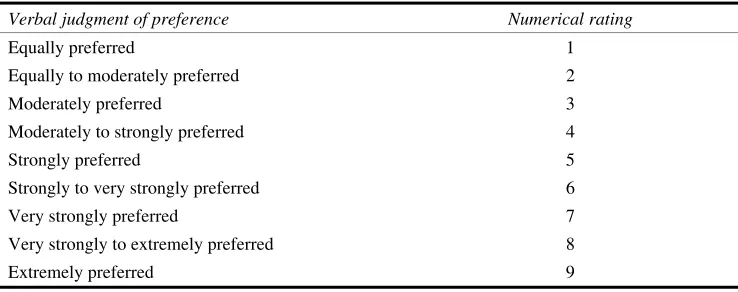
Table 1 Semantic interpretation of the ratios in the comparison matrices
Verbal judgment of preference Numerical rating
Equally preferred 1
Equally to moderately preferred 2
Moderately preferred 3
Moderately to strongly preferred 4
Strongly preferred 5
Strongly to very strongly preferred 6
Very strongly preferred 7
Very strongly to extremely preferred 8
Extremely preferred 9
Note: If alternative Ai has preference strength as any of the above non-zero numbers compared
to Aj, then Aj has the reciprocal value when compared with Ai, i.e., aji = 1/aji.
The priority weights of all the alternatives can be derived by using the following simple geometric mean formula (Crawford, 1987):
1
1
, 1, 2,..., . n
n i ij
j
w a i n
=
⎛ ⎞
=⎜ ⎟ =
⎝
∏
⎠ (1)However, to extract the weights from a pairwise comparison matrix, mathematically more rigorous method is to find out the largest eigenvalue of Matrix A and then compute the corresponding normalised eigenvector. The components of this normalised eigenvector give the weights of the alternatives. In practice, it was shown that the weights obtained by the above geometric mean rule and eigenvector method are quite close to each another. In this paper, to find out the weights, we have used Expert Choice software which uses eigenvector method.
4 Quality Function Deployment (QFD)
graphically the degree of influence between each technical requirement and each customer requirement. Usually, three symbols are used to represent the relationships. These are shown below:
Symbol Meaning Weight
§ Strong relationship 9
{ Medium relationship 3
Ì Weak relationship 1
If any technical requirement is not related, then the corresponding cell in the grid matrix is kept blank. Once we have identified all possible relationships between every pair of customer and technical requirements, we can determine the weights of all the technical requirements. The formula to compute the weights is:
1
, 1, 2,..., n
j i ij i
t c r j n
=
=
∑
= (2)where:
tj = weight of the j-th technical requirement
ci = weight of the i-th customer requirement (in the present study this is determined by
using AHP)
rij = weight of the relationship between i-th customer requirement and j-thtechnical
requirements
5 Data collection
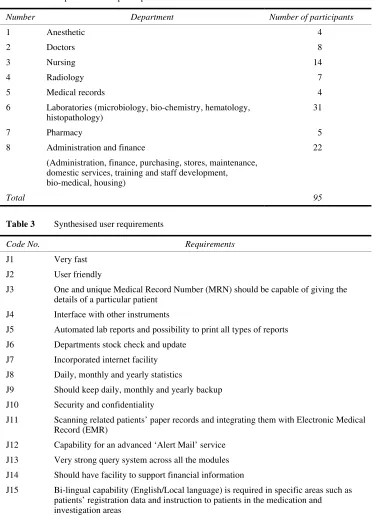
Presently, all kinds of people working in a hospital use information systems to do their work. Consequently, they have their requirements as the users of the systems. As mentioned before, 95 staff from all the eight departments participated in the present study. Department wise break-up of the participants is shown in Table 2.
Participants from each department formed a focus group and generated a list of needs and requirements in response to the question: “what do you wish to have in the new hospital information system?” The lists are shown in the Appendix.
From the lists of user requirements shown in the Appendix, we created a synthesised list of user requirements. This synthesised list has been obtained by considering the common and seemingly more important requirements belonging to various individual (or departmental) lists. The synthesised list is shown in Table 3.
Table 2 Department wise participants
Number Department Number of participants
1 Anesthetic 4
2 Doctors 8
3 Nursing 14
4 Radiology 7
5 Medical records 4
6 Laboratories (microbiology, bio-chemistry, hematology, histopathology)
31
7 Pharmacy 5
8 Administration and finance
(Administration, finance, purchasing, stores, maintenance, domestic services, training and staff development, bio-medical, housing)
22
[image:9.595.113.483.146.359.2]Total 95
Table 3 Synthesised user requirements
Code No. Requirements
J1 Very fast
J2 User friendly
J3 One and unique Medical Record Number (MRN) should be capable of giving the details of a particular patient
J4 Interface with other instruments
J5 Automated lab reports and possibility to print all types of reports
J6 Departments stock check and update
J7 Incorporated internet facility
J8 Daily, monthly and yearly statistics
J9 Should keep daily, monthly and yearly backup
J10 Security and confidentiality
J11 Scanning related patients’ paper records and integrating them with Electronic Medical Record (EMR)
J12 Capability for an advanced ‘Alert Mail’ service
J13 Very strong query system across all the modules
J14 Should have facility to support financial information
M. Ahmed, R. Isl
a
m and S.K
. Al
-w
ahai
bi
Synthesised pairwise comparis
on matrix on user requirements
[image:10.595.140.706.154.434.2]We used Expert Choice, a decision support software that implements AHP, to obtain the priorities of user requirements. The priorities are shown in the last column of Table 4. We observe that J9: “Should keep daily, monthly, and yearly backup” and J10: “Security and confidentiality” have higher weights. The next higher weights are assigned to J8 and J3, which correspond to “Daily, monthly and yearly statistics” and “One and unique Medical Record Number (MRN) should be capable of giving the details of a particular patient”, respectively. The prioritisation of user requirements is expected to be helpful to improve software quality by first addressing the factors that receive higher weights.
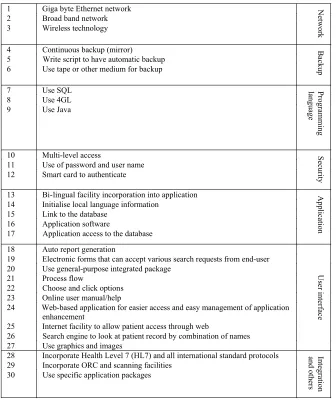
[image:11.595.123.459.320.720.2]In order to identify technical requirements, we consulted several software engineers working in IIUM and IT unit of SQUH. The list is shown in Figure 1. As it is shown in the figure, all the technical requirements are divided into seven categories, namely, network, backup, programming language, security, application, user interface, integration and others.
Figure 1 List of technical requirements
1 Giga byte Ethernet network
2 Broad band network
3 Wireless technology
Network
4 Continuous backup (mirror)
5 Write script to have automatic backup
6 Use tape or other medium for backup
Backup
7 Use SQL
8 Use 4GL
9 Use Java
P
rogra
mming
language
10 Multi-level access
11 Use of password and user name
12 Smart card to authenticate
Securi
ty
13 Bi-lingual facility incorporation into application
14 Initialise local language information
15 Link to the database
16 Application software
17 Application access to the database
Applic
ation
18 Auto report generation
19 Electronic forms that can accept various search requests from end-user
20 Use general-purpose integrated package
21 Process flow
22 Choose and click options
23 Online user manual/help
24 Web-based application for easier access and easy management of application
enhancement
25 Internet facility to allow patient access through web
26 Search engine to look at patient record by combination of names
27 Use graphics and images
User i
n
te
rface
28 Incorporate Health Level 7 (HL7) and all international standard protocols
29 Incorporate ORC and scanning facilities
30 Use specific application packages
Inte
gra
tion
M. Ahmed, R. Isl
a
m and S.K
. Al
-w
ahai
bi
The QFD diagram for developing SQUH’s
quality healthcare software systems
Network Backup Prog. Language Security Application User interface Integration and
others G iga byt e E the rne t n e tw or k B roa d ba nd ne tw or k W ir e le s s t e c h nol og y C ont inuou s ba c kup ( m ir ror ) W ri te s c ri pt t o ha ve a ut om a ti c ba c kup. U se t a pe or ot he r m e di um ba c k up Us e S QL Us e 4 GL Us e J a v a M u lt i-lev e l ac ces s U se of pa s s w or d a nd us e r n a m e S m a rt card t o a u th en ti c a te B i-li ngua l f a c il it y i nc or por a ti on int o a ppl ic a ti on Ini ti a li s e l oc a l la ngua ge i n for m a ti on L ink t o the d a ta ba s e A p p licatio n s o ft w a re A p p licatio n ac ces s to d a ta b a s e A u to rep o rt g e n e ra tio n E le c tr oni c f or m s t ha t c a n a c c e pt va ri ous s e a rc h re que s ts fr o m end -u ser U se ge ne ra l-p ur p os e i nt e gr a te d pa c ka ge P roc e s s f low C hoos e a n d c li c k opt ions On li ne us e r m a nua l/ he lp W e b-b a s e d a ppl ic a ti on f or e a s ie r a c c e ss a nd e a s y m a na ge m e nt of a ppl ic a ti o n e n ha n c e m e nt Int e rne t f a c il it y to a ll ow pa ti e nt a c c e s s t hr ough w e b S e a rc h e ng ine t o l ook a t pa ti e nt r e c or
d by c
om bi na ti on of nam e s U se g raph ic a n d i m ages In c o rp o ra te H e a lth L e v e l 7 (H L 7 ) a n d a ll in te rn a ti o n a l st a nda rd pr ot o c ol s Inc or por a te O R C a nd s c a n ni ng f a c il it ie s U se s p ecif ic ap p li c ati o n p a ck ag es Im por ta nc e of t he W H A T s Ro w n u m b e r
1 2 3 4 5 6 7 8 9 10 11 12 13 14 15 16 17 18 19 20 21 22 23 24 25 26 27 28 29 30
J1 Very fast 1 ) ) 6 ∗ ∗ ∗ ∗ ∗ 6 0.07 1
J2 User friendly 2 ) ∗ ∗ ∗ 6 ) ) ∗ ∗ ∗ ∗ ) 0.06 2
J3 One and unique MRN should be capable of giving the details of a particular patient
3 ∗ ∗ ∗ ∗ ∗ 0.08 3
J4 Interface with other instruments 4 6 ∗ ) ) ) 6 ∗ 0.07 4
J5 Automated lab reports and possibility to print all types of reports
5 ∗ 6 6 ∗ ) ∗ ∗ ∗ ∗ 0.07 5
J6 Departments stock check and update 6 ∗ ∗ ) ∗ 0.02 6
J7 Incorporated internet fac ility 7 ) 6 ∗ ∗ 6 0.03 7
J8 Daily, monthly and yearly statistics 8 ∗ ∗ ) ∗ 0.08 8
J9 Should keep daily, monthly and yearly backup 9 ) ) ) 0.15 9
J10 Security and confidentiali ty 10 ∗ ) ) ) ∗ 0.12 10
J11 Scanning related patients’ paper records and integrates them with Electronic Medical Record (EMR)
11 ) 0.03 11
J12 Capability for an advanced alert mail service 12 ∗ ∗ 0.02 12
J13 Very strong query system across all the system 13 6 ) ∗ ∗ ) ∗ 0.07 13
J14 Should have facility to support financial information 14 ∗ ∗ ) 0.03 14
J15 Bi-lingual capability (English/local language)…. 15 ∗ ) ∗ 0.03 15
Weight 1 0.63 0.97 0.28 2.49 1.40 1.40 1.17 1.35 0.21 1.63 1.12 1.12 0.29 0.41 1.62 0.93 0.49 0.98 1.11 1.02 0.76 0.62 0.18 0.34 0.34 0.68 0.81 0.63 0.41 1.2
Column number 1 2 3 4 5 6 7 8 9 10 11 12 13 14 15 16 17 18 19 20 21 22 23 24 25 26 27 28 29 30
Ranking of the technical requirements 20 14 28 1 4 4 8 6 29 2 9 9 27 24 3 15 22 13 11 12 17 21 30 25 25 18 16 19 23 7
Standard 9-3-1
Strong ) 9
Moderate ∗ 3
[image:12.595.125.702.143.430.2]6 Results
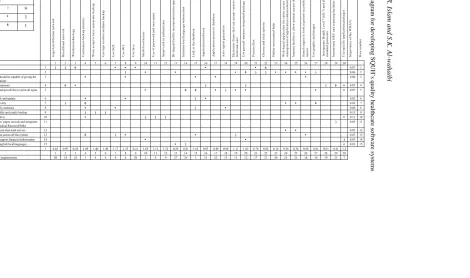
Having developed the technical requirements, we continued construction of the HOQ and established the relationships between the user and the technical requirements. As shown before, numerical values have been assigned to three different symbols in the relationship matrix. By using the formula (2) in Section 2, weights of all the technical requirements have been determined and these are shown in the third row from the bottom of the HOQ diagram shown in Figure 2. The diagram went through several revisions before reaching its present form. This was necessary in order to deliberate on the relationships among user requirements and technical requirements.
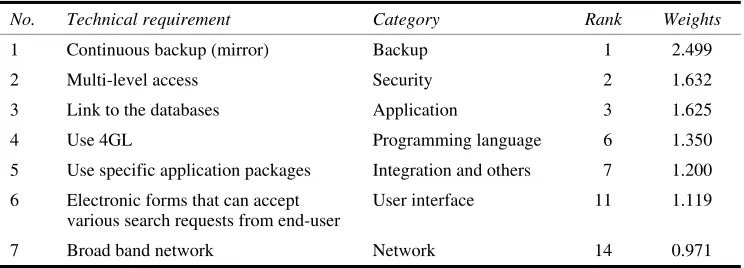
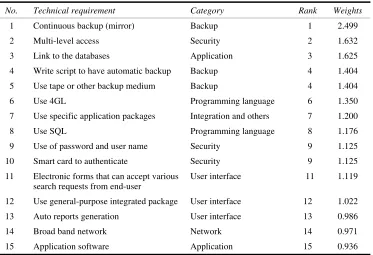
[image:13.595.112.484.368.502.2]From the diagram, we observe that the continuous mirror backup ranks as the most important technical requirement. The second most important technical requirement that affects user satisfaction is the multi-level access. The third important technical requirement is the linkage to the databases. Table 5 shows the most important technical requirements belonging to each of the seven categories. Furthermore, we observe that all the technical requirements belonging to backup and security categories have appeared in the top 15 technical requirements, as shown in Table 6.
Table 5 The technical requirements of higher weights belonging to each category
No. Technical requirement Category Rank Weights
1 Continuous backup (mirror) Backup 1 2.499
2 Multi-level access Security 2 1.632
3 Link to the databases Application 3 1.625
4 Use 4GL Programming language 6 1.350
5 Use specific application packages Integration and others 7 1.200
6 Electronic forms that can accept various search requests from end-user
User interface 11 1.119
7 Broad band network Network 14 0.971
Backup capability is a desired characteristic of any information system. There are numerous instances where organisations have lost millions of dollars due to loss of data/information. It is always safer to have backup files for important data set. The matter has especially been felt at SQUH. As it is clear from the Figure 2, a number of user requirements will be satisfied by having continuous backup option in the system they use. In a hospital like SQUH, people from various departments need to access patients’ records. Multi-level access of patients’ records will greatly enhance user satisfaction. Linkage to the databases will enable the users to quickly retrieve the information they want. It is also directly related to a number of user requirements. In SQUH, only the authorised personnel should have the access to the information system. Higher weights of the items in security category necessitate proper and adequate authentication on the users’ part before using the information system.
Table 6 Top 15 technical requirements
No. Technical requirement Category Rank Weights
1 Continuous backup (mirror) Backup 1 2.499
2 Multi-level access Security 2 1.632
3 Link to the databases Application 3 1.625
4 Write script to have automatic backup Backup 4 1.404
5 Use tape or other backup medium Backup 4 1.404
6 Use 4GL Programming language 6 1.350
7 Use specific application packages Integration and others 7 1.200
8 Use SQL Programming language 8 1.176
9 Use of password and user name Security 9 1.125
10 Smart card to authenticate Security 9 1.125
11 Electronic forms that can accept various search requests from end-user
User interface 11 1.119
12 Use general-purpose integrated package User interface 12 1.022
13 Auto reports generation User interface 13 0.986
14 Broad band network Network 14 0.971
15 Application software Application 15 0.936
7 Conclusion
Information System (IS) development projects are expensive and time consuming. Further, the failure rate of IS projects is higher compared to other kinds of projects. All care should be taken so that the systems developed satisfy users’ needs. The present research has used the quality function deployment tool in helping the IT unit of SQUH to design a quality healthcare software system. Altogether, 95 staff from eight departments of SQUH participated in the study and articulated their needs in using information systems. A synthesised list has been prepared by considering the common and seemingly more important requirements from the lists generated by various focus groups. The list has been prioritised using AHP. Having obtained the prioritised user requirements, a list consisting of 30 technical requirements has been prepared in consultation with several software engineers. The technical requirements belong to seven categories, namely: network, backup, programming language, security, application, user interface, integration and others. At the end of the QFD exercise, we obtain a list of prioritised technical requirements. The requirements that have received higher weightages are: continuous
mirror backup, multi-level access, linkages to the databases, etc. The findings of the
Since Hospital Information System is large, complex, and involves many different modules, we recommend that further studies be carried out to improve each module separately and then integrate them to form a single system. Further, for every department of the hospital, a separate HOQ diagram can be constructed to satisfy the department members’ unique needs. The sample size may be increased and more people may be included from different hospitals and healthcare providers in order to make the findings generalisable.
Acknowledgement
The authors are grateful to the anonymous referees for their insightful comments which have been very useful in revising the paper.
References
Barnett, W.D. and Raja, M.K. (1995) ‘Application of QFD to the software development process’,
International Journal of Quality and Reliability Management, Vol. 12, No. 6, pp.24–42.
Basak, I. and Saaty, T.L. (1993) ‘Group decision making using the analytical hierarchy process’,
Mathematical and Computers Modeling, Vol. 17, pp.101–109.
Berk, J. and Berk, S. (2000) Management for the Technology Sector, MA, USA: Butterworth-Heinemann.
Bossert, J.L. (1991) Quality Function Deployment: A Practitioner’s Approach, Milwaukee, Wisconsin: ASQC Quality Press.
Crawford, G.B. (1987) ‘The geometric mean procedure for estimating the scale of a judgment matrix’, Mathematical Modeling, Vol. 9, No. 3, pp.327–334.
Ermer, D.S. and Kniper, M.K. (1998) ‘Delighting the customer: quality function deployment for quality service design’, Total Quality Management, Vol. 9, Nos. 4–5, pp.S86–S91.
Ertay, T., Büyüközkan, G., Kahraman, C. and Ruan, D. (2005) ‘Quality function deployment implementation based on analytic network process with linguistic data: an application in automotive industry’, Journal of Intelligent and Fuzzy Systems, Vol. 16, pp.221–232.
Fitzpatrick, R. (2001) ‘Strategic drivers of software quality: beyond external and internal software quality’, Proceedings of the Second Asia-Pacific Conference on Quality Software, Hong Kong, pp.65–72.
Franceschini, F. and Marco, T. (1998) ‘An application of quality function deployment to industrial training courses’, International Journal of Quality and Reliability Management, Vol. 15, No. 7, pp.753–768.
González, M.E., Quesada, G., Picado, F. and Eckelman, C.A. (2004) ‘Customer satisfaction using QFD: an e-banking case’, Managing Service Quality, Vol. 14, No. 4, pp.317–330.
Grenci, R.T. (2004–2005) ‘An adaptable customer decision support system for custom configurations’, Journal of Computer Information Systems, pp.56–62.
Hagg, S., Raja, M.K. and Schkade, L.L. (1996) ‘Quality function deployment usage in software development’, Communications of the ACM, Vol. 39, No. 1, pp.42–49.
Hamilton, J. and Selen, W. (2004) ‘Enabling real estate service chain management through personalized web interfacing using QFD’, International Journal of Operations and Production
Management, Vol. 24, No. 3, pp.270–288.
Hamza, A.R., Kwan, C.L. and Woods, P.C. (1999) ‘Quality function deployment in construction design: application in low-cost housing design’, International Journal of Quality and
Islam, R. (2003) The Analytic Hierarchy Process: An Effective Multi Criteria Decision Making Tool, Research Center, International Islamic University Malaysia.
Lin, W.T., Hung, Y.H., Huang, C.T. and Wu, C.C. (2005) ‘A performance evaluation of the after-sales service information systems provided by the Taiwanese machine tool industry’,
International Journal of Management, Vol. 22, No. 1, pp.112–126.
Motwani, J. and Kathawala, Y. (1994) ‘Implementing quality function deployment: a systems approach’, Total Quality Management, Vol. 6, No. 6, pp.31–35.
Pai, W.C. (2002) ‘A quality enhancing software function deployment model’, Information Systems
Management, pp.20–24.
Ross, M., Brebbia, C.A., Staples, G. and Stapleton, J. (1995) ‘Software quality management’,
Measuring and Maintaining Quality, Glasgow, UK: Computational Mechanics Publications,
Vol. 2.
Saaty, T.L. (1977) ‘A sealing method for priorities in hierarchical structures’, Journal of
Mathematical Psychology, Vol. 15, pp.234–281.
Sanford, J.L. (2005) ‘How useful is QFD?’, Quality Progress, January, pp.51–59.
Silva, F.L.R.D. (2004) ‘Combined application of QFD and VA tools in the product design process’,
The International Journal of Quality and Reliability Management, Vol. 21, Nos. 2–3,
pp.231–252.
Tan, K.C., Xie, M. and Chia, E. (1998) ‘Quality function deployment and its use in designing information technology systems’, International Journal of Quality and Reliability
Management, Vol. 15, No. 6, pp.634–645.
Appendix: Information system user requirements
Department Requirements Anesthetic • Once the patient selected from operation list, it should refresh all the modules
on the anesthetic’s desktop.
• It should be possible to access the data related to the selected patient by navigating between modules.
Doctors • Should be possible to access all required modules from the doctor’s desktop. • Customisation (by adding or deleting modules to the desktop) based on the
departmental administrative policy should be easy and flexible.
Nursing • Scrollable list of Medical Record Number (MRN) and names of all the patients admitted in the ward.
• Once the patient is selected from the ward list, it should refresh all the modules on the nursing desktop and it should be possible to access the data related to the selected patient by navigating between modules.
• Customisation (adding or deleting modules to the desktop) based on the nursing administrative policy should be easy and flexible.
• Give an option for printing out the list of patients and their ID number. • Grant an option of printing patient’s list and medication due within specific
hour at any time.
• It should be possible to record the actual administration of drugs/treatments by clicking items in the displayed list.
• Ward stock should be updated automatically. • Capability for an advanced ‘Alert Mail’ service.
Radiology • Scrollable list of Medical Record Number (MRN) and names of all the patients admitted in the ward.
• Once the patient is selected from the ward list, it should refresh all the modules on the nursing desktop and it should be possible to access the data related to the selected patient by navigating between modules.
• Customisation (adding or deleting modules to the desktop) based on the nursing administrative policy should be easy and flexible.
• Give an option for printing out the list of patients and their ID number. • Grant an option of printing patient’s list and medication due within specific
hour at any time.
• It should be possible to record the actual administration of drugs/treatments by clicking items in the displayed list.
Appendix: Information system user requirements (continued)
Department Requirements Medical
records
a Patient registration
• Generation of a unique MRN for each new registration.
• The unique MRN should identify the patient and all related activities and services he/she will receive during his/her lifetime.
• It should have provision to capture a unique patient identification, for example I.C. or passport number.
• Should support three distinct text fields for names and one for family name or tribe.
• There should be a date of birth field with an automated mechanism to display the current age in years, months and days.
• The age should be current whenever the record is accessed. • If the date of birth is unknown, the age should be captured and
approximate date of birth calculated automatically.
• Facility to merge patient records in the event of duplication of MRN or separated if erroneous merging.
• Automatically link mother to newborn baby.
• Ability to print label with basic patient demographic data.
• Produce patient ID card with bar coded MRN either laminated format, printed-paper or embossed plastic card.
• Restriction to specified patient clinical data should be possible. • Facility to classify the financial status of the patient.
b Appointment scheduler
• Maintain list of days the clinic is open; start, and end time. • List of consultants, medical officers, and the clinic where they are
available.
• Link the doctor’s clinic time roster with their leave. • User-friendly display of available slots.
• Fixing appointment for the selected patient by clicking over empty slots. • Possibility to display and print selected list of appointments physician
wise, clinic wise or MRN wise.
• Indication of type of appointment (routine, urgent or immediate). • Provision to print appointment slip in English and local language. c Electronic Medical Record (EMR)
• Capability to display patient’s clinical profile by episode.
• Possibility to printout a list of appointments in any day for retrieval of patients’ files.
• Tracking of patients’ file movement and electronically acknowledge the receipt of files and return them back.
Appendix: Information system user requirements (continued)
Department Requirements • Have an option to use barcode scanners for recording the movements of
patient’s files.
• Flexibility for medical records director to grant or cancel various level of access right to the members of the departments.
• Customisation by adding or deleting modules to the desktop, based on the departmental administrative policy, should be easy and flexible
• Scanning related patients’ paper records and integrating them with Electronic Medical Record (EMR).
Laboratory • There should be an option to restrict the range of display to items to the specific user laboratory.
• It should be possible to clear the display filter and review all items (investigation results, clinical information, treatment record, drug history) related to the selected patients.
• General pathology laboratory should have provision for entering abbreviated SNOMED code against each entry.
• System should interface bi-directional with blood analysers.
• Customisation (by adding or deleting modules to the desktop) based on the departmental administrative policy should be easy and flexible
• A billing system that depends on test and be attributed to clients. • Statistical analysis for the number of each test per month. • Interface with other instruments.
• Capability for an advanced ‘Alert Mail’ service.
Pharmacy • Assist clinical pharmacist in designing appropriate dosage requirements. • Perform various pharmacokinetic calculations.
• Possibility to represent the data graphically. • Provide online pharmacokinetic monographs.
• Integrated inpatient and outpatient systems so that the pharmacy will keep a single record.
• Access level control for restricted drugs.
• A comprehensive drug information system should be available. • Capability for an advanced ‘Alert Mail’ service.
Administration and Finance
• Very strong query system across all the functions.
• Should have facility to support financial information such as account payable and receivable, profit and loss, patient costing, etc.
• Bi-lingual capability (English/Local language) is required in specific areas such as patients’ registration data and instruction to patients in the medication and investigation areas.
• Capability to create training/test environment similar to the live system for demonstration and training.