Comparative Analysis of DSR, GRP and TORA
under IPv6 Environment
Amritbir Singh
Punjabi University Regional Center for Information Technology and Management
Mohali
A
BSTRACT
Mobile Ad Hoc Network is a dynamic network which formed by collection of wireless nodes without any centralized support. Nodes are mobile in mobile ad hoc network and free to move anywhere in network. Due to the mobility of nodes it is difficult to route data between nodes Thus it is challenging to select an appropriate routing protocol, which route data more efficiently. Each routing protocol has its own architecture and working. It is obligatory to analyze the behavior different routing protocols under different environments. IPv6 is a version of internet protocol and got importance because it has some additional features and more secure than IPv4.In this paper three routing protocols of mobile ad hoc network namely DSR, GRP and TORA are tested under IPv6 environment. Performance of these routing protocols is evaluated by using OPNET Modeler 14.5 as simulation tool on the basis of different performance metrics-End-To-End Delay, Network Load and Throughput. On the basis of simulation results it concluded that GRP performs better which stated that it is suitable for efficient routing.
General Terms
Mobile Ad Hoc Network, Routing Protocols, Internet Protocol Version 6
Keywords
MANET, DSR, GRP, TORA, OPNET
1. INTRODUCTION
Due to the advancement in Wireless Technology, mobile ad hoc network has become a prominent means of communication and as such, it attains the consideration of researchers and constrains them to constantly research for developing of mobile Ad hoc network. Mobile Ad Hoc Network is a multi-hop wireless network in which each node connected with other nodes over wireless links to form a network in the absence of pre-defined infrastructure. If one node fails whole network will paralyzed. Mobile ad hoc network has limited transmission range therefore, each node in mobile ad hoc network acts as host or router to coordinate its neighboring nodes and seek it assistance for forwarding data from source to destination. Routing is process of moving data from one network to another. The data is sent in the form of data packets. The concept of routing tables is introduced in routing process. Routing tables are used to kept information about destination. Each node on network maintain their own set of routing tables and it updated when link changed. It helps in recognition of destination
node and ensures correct delivery of data. The nodes are not in direct communication range of all other nodes and so there is a need to discover routing path from which it can route data packets to the destination node. To achieve this, routing protocol is needed. Routing protocols is responsible for routing of data packets from source to destination. Routing protocol performs two types of function. First it selects the routing path for destination and then it delivers the data packets to their correct destinations. It is difficult to route data in mobile ad hoc network because nodes are mobile and moving from one base station to another. Routing of data in moving nodes in absence of pre-defined infrastructure is challenging task. Selection of suitable routing protocol for network is needed. In mobile ad hoc network bandwidth and other resources are limited. Thus, it is necessary to select routing protocol which route data with minimum consumption bandwidth and other resources.
The rest of paper is organized as follows Section 2 gives brief description about work done previously. Section 3 gives description about routing protocols. Section 4 gives description about internet protocol. Section 5 gives description about simulation tool used for research. Section 6 gives description about Performance metrics on basis of which behavior of routing protocol is analyzed. Section 7 gives description about simulation environment and results. Section 8 represent the conclusion.
2. RELATED WORK
Many researcher shown their keen interest in evaluation of mobile ad hoc network routing protocols some of them discuss below:
D.Geetha et al[3] evaluate the performance of TORA and
DSR by using network simulator-2 on basis of packet delivery ratio, network load, end-to-end delay and throughput.The performance is evaluated by varying mobility, packet size and time intervals with 100 nodes.TORA perform better in mobility varation.High mobility shows frequent link failures in TORA.DSR shows good results in end-to-end delay. In time intervals again TORA performs better and DSR shows good results in end-to-end delay. In packet size TORA performs better. At the end it can concluded that TORA performs better as compared to DSR.TORA discover the route faster and repair the links locally
Razan Al-Ani[1] presents performance evaluation of
concluded that OLSR performs better as compared to other routing protocols.
Harmanpreet et al[6] presents performance evaluation of
OLSR, GRP and TORA on the basis of end-to-end delay, network load, media access delay and throughput by using OPNET Modeler. The author stated that OLSR perform better as compared to other two routing protocols.
Kuldeep Vats et al[10] presents evaluation of
OLSR,GRP and DSR by using OPNET Modeler on basis of end-to-end delay, network load, traffic sent and received,retrasmission attempts, media access delay, data dropped throughput with 150 nodes. The author concluded that OLSR performs better.
Manijeh Keshtgray et al[7] presents evaluation of
AODV,OLSR,DSR and GRP on the basis of end-to-end delay,network load, throughput and media access delay by using OPNET Modeler.The author concluded that AODV and OLSR performs better.
3. ROUTING PROTOCOLS
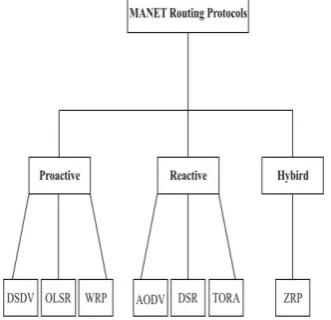
Routing protocols in mobile ad hoc network mainly categorized as follows:
A. Proactive Routing Protocols : It is type of routing
protocol in which each node has their own set of routing tables and it stored information of all other nodes on network in these routing tables. The main advantage of this type of routing protocols is nodes get route information immediately and establish a link.
B. Reactive Routing Protocols: It is type of routing
protocol in which route is established when it needed by source node for forwarding of data packets to destination node. In reactive routing protocol flooding technique is used for discovery of routes. Once route will discover it stored and maintained in route cache. The main advantage of this type of routing protocols is it will save the precious bandwidth of ad hoc network.
C. Hybrid Routing Protocols : It is type of routing
[image:2.595.108.274.587.747.2]protocol which acquire the features of Reactive and Proactive routing protocols.Hybird routing protocols divided whole network in different zones and each zone assign Zone ID.These Zone ID helps to easily recognize the physical location of node on network. The main advantage of hybrid routing protocol is cause minimum routing overhead in forwarding data packets source to destination.
Figure 1: Diagrammatic Representation of Routing Protocols
3.1 Dynamic Source Routing (DSR)
Dynamic Source Routing protocol is routing protocol which used source routing approach for forwarding data packets from source to destination. Source routing is an approach in which data packet header contains complete list of nodes from which data have to pass. This help that source node has complete knowledge of destination path before forwarding data packets is not forwarding periodic messages therefore it uses minimum bandwidth.DSR performs two types of functions: Route Discovery and Route Maintainence.When source node wants to establish a connection it transmit RREQ (Route Request) packet each intermediate node received this message retransmit it, unless it is either a destination or has information about route to destination in its route cache. Once destination node received RREQ packet it transit RREP (Route Reply) packet to source node and information about route is stored in route cache for future use. When RREP packet traverses backward to source node all intermediate nodes know that route is established between source and destination. Route information stored in their route cache. If the link fails the destination node transmit RERR (Error) packet to source node. The RERR packet is generated by destination node to inform source node that link is failed and no longer valid. If links failed the source node removed its information from it route cache. If information about new route to destination is available in route cache it is replaced with previous one. If no such link available in route cache route discovery is reinitiated [5].
3.2 Geographical Routing Protocol (GRP)
Geographical Routing Protocol is a position based routing protocol in which nodes aware about their own and immediate neighbor’s geographical positions. The node periodically updated positions of its immediate neighbors by beaconing. The routing table is not used routing data to destination is depends on information available with each about its immediate neighbors. Global Positioning System (GSP) helps in easy delivery of messages. Two types of routing algorithm is used: Greedy Algorithm and Face Routing Algorithm. In greedy algorithm the data forwarded from source to destination in steps. The data forwarded to suitable neighbor. Suitable neighbor is one who reduces the distance between source to destination in each step. The face routing is type of routing in which each region is edges of planner graph. Routing begins from the point closest to the destination and explore next point closest to destination. Face routing always find point which is closest to the destination. Greedy Algorithm is failed if there is no next hop closest to destination find among neighbor nodes. Then perimeter mode forwarding is continues to find closest point to destination [9].
3.3 Temporally Ordered Routing
Algorithm (TORA)
contains in the header of Query packet. Query packet forwarded through intermediate nodes reach to destination node. When the Query packet reached to destination node it reply by Update packet which contain information about distance to source from destination node. Each node which receives the Update packet set its distance value higher than the packet sender. By this direct link between sources to destination nodes is established. Once a path to destination is obtained it is considered to exist as long as path available unless path length changes due to reconfiguration. When intermediate node discover that route to destination node are invalid it changes distance value to higher than its neighbor and generate Update packet. The neighbor node receive the Update packet reverses the link and Update packet again reach to the node which generated it.This to update DAG entry for destination node. If source node has no neighbor node it generate fresh Query or Update packet. If node detects a partition generate Clear message path information in that partition related to destination is erases [8].
4. INTERNET PROTOCOL
Internet protocol is type of communication protocol which is communicate across interconnected networks. Data is encapsulated in datagrams and it transmitted to destination hosts on the basis IP address. Information about source node and destination node is stored on header of datagram. Internet protocol was first developed in 1970 when Defense Advanced Research Agency (DAPRA) interested in establishing packet-switched network that would facilitate communication between dissimilar computer systems at research institutions. For this DAPRA funded the research of Stanford University and Bolt, Beranek and Newman (BBN). This resulted as development of Internet Protocol [11].
Later TCP/IP was included by Berkeley Software Distribution (BSD) UNIX and laid foundation for internet and World Wide Web (WWW).
Internet protocol has two types of version as follows:
4.1 Internet Protocol Version 4
Internet protocol version 4 (IPv4) is widely used protocol which is deployed by Internet Engineering Task Force (IETF) in 1990. IPv4 has 32 bits address space and able to provide only 4,294,467,294 addresses. Some addresses are reserved for special purposes and not available for public use [4]. This may arise problem of address exhaustion. Address exhaustion is a problem in which person or device wants to communicate but no addresses are available. There are so many techniques are used to overcome from the problem address exhaustion like Classless Inter Domain Routing (CIDR) and Network Address Translation (NAT) but nothing become fruitful.
4.2 Internet Protocol Version 6
Address exhaustion problem of Internet protocol version 4 provide a base for development of Internet protocol version 6 (IPv6).Due to address depletion mobile nodes unable to obtain IP addresses from regional address registries to connect internet. Thus the need to deployment of new internet protocol may arise which is fulfilled with deployment of IPv6 in 1999 by IETF.IPv6 has 128 bits address space and it capable to provide approximately
3.4×1038 addresses. Internet Protocol for Security (IPsec) is mandatory in IPv6.Encryption techniques like Encapsulate Security Payload (ESP) is used for encryption of data. Thus IPv6 is more secure as compared to IPv4.IPv6 uses flow label mechanism so router can easily recognizes where to send information.IPv6 supports multicasting and multi-homing which are not supported by IPv4.IPv6 header size is 40 bytes it is simple and small as compared to IPv4.In IPv6 header extension is optional and it enter any time between header and payload when needed [2]. On the basis of above discussion it evident that IPv6 is future internet protocol and future internet technology depends on IPv6.
5. SIMULATION TOOL
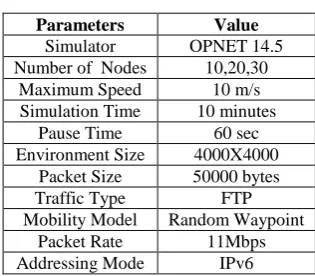
[image:3.595.347.505.476.614.2]In this research OPNET Modeler 14.5 is used for collecting and analyzing results. OPNET is commercial network simulator widely used to design heterogeneous networks like ad hoc networks.OPNET is a graphical user interface based so it is easy to use. OPNET incorporates number of features to support an increase stability and mobility in the mobile ad-hoc network. A number of routing parameters of MANET are supported by OPNET Modeler and it is easy to design network in OPNET Modeler and to evaluate the performance of these routing protocols. These parameters are known as performance metrics. Specific application and transport layer protocols demand their own set of performance metrics to evaluate the network efficiency. In this study, the performance of these routing protocols is evaluated on the basis of three parameters network load, end-to-end delay and throughput. Performance of these routing protocols is evaluated for the selection of efficient routing protocol for the network. The parameters used in this study are summarized below in Table 1:
Table 1: Parameters of Simulation
6. PERFORMANCE METRICS
1. End-To-End Delay: End-To-End Delay is the average
time that take by a data packet to reach its destination. This metric is calculated by subtracting time taken by first packet to traverse the network from time at which first data packet arrived to destination.
2. Network Load: Network load represents the bit/sec
load submitted by all higher layers in all WLAN nodes of the network to wireless LAN layers. When more traffic is coming on the network it is difficult for network to cope up with this heavy load of traffic. Heavy load on network
Parameters Value
Simulator OPNET 14.5 Number of Nodes 10,20,30
Maximum Speed 10 m/s Simulation Time 10 minutes
Pause Time 60 sec Environment Size 4000X4000
Packet Size 50000 bytes
Traffic Type FTP
may affect the performance of network. The performance of network is decreases. In heavy load data packets may collide this may cause congestion on the network and makes the routing process slow. The efficient routing protocol performs best in heavy network load.
3.Throughput: It is ratio of total amount of data transfer
from sender to receiver and the time it takes for the receiver to receive last packet of data from sender. In other words we say that it calculates how constantly data is provided by network to receiver. Throughput is the number of data packets arriving at the receiver per milliseconds.
7. SIMULATION AND
PERFORMANCE ANALYSIS
Simulation process is divided into different scenarios. We use 10, 20 and 30 randomly deployed nodes under campus network environment of 4000X4000 square meters. The FTP high load traffic is used. The file size is 50,000 bytes .Every node moves with constant speed of 10 m/s with 60 seconds pause time. All nodes are defined as workstations with one WLAN server. WLAN connection speed is 11 Mbps.The simulation time is 10 minutes.
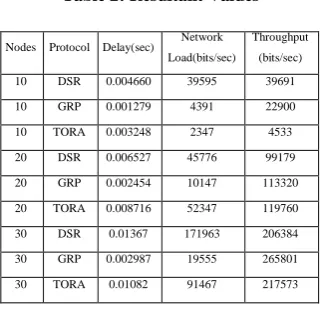
[image:4.595.348.519.69.215.2]In this paper we evaluate the performance of three ad hoc routing protocols DSR, GRP and TORA under IPv6 environment on the basis of three parameters, that is, end-to-end delay, network load and throughput.
[image:4.595.348.519.302.446.2]Figure 2: Simulation Scenario Having 10 Nodes
Figure 3: End-To-End Delay 10 Nodes
[image:4.595.77.294.394.629.2]In figure 3 different routing protocols are simulated for 10 nodes on the basis of end-to-end delay under IPv6 environment.It is evident from graph that end-to-end delay is maximum in DSR.GRP performs better in terms of end-to-end delay.
Figure 4: Network Load for 10 Nodes
In figure 4 evaluation of different routing protocols for 10 nodes on the basis of network load under IPv6 environment is presented.It is evident from graph that network load is maximum in DSR.TORA performs better in terms of network load.
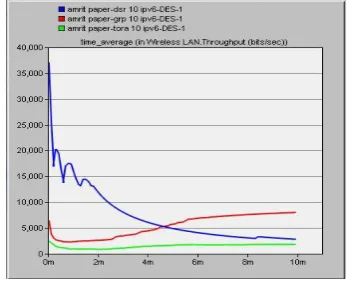
Figure 5: Throughput for 10 Nodes
[image:4.595.346.520.536.679.2]Figure 6:End-To-End Delay for 20 Nodes
[image:5.595.343.524.70.215.2]In figure 6 the evaluation of different routing protocols for 20 nodes on the basis of end-to-end delay under IPv6 environment is presented.It is evident from graph that end-to-end delay is maximum in TORA.GRP performs better in terms of end-to-end delay.
Figure 7: Network Load for 20 Nodes
In figure 7 different routing protocols are simulated for 20 nodes on the basis of network load under IPv6 environment. It is evident from the graph that network load is maximum in DSR.GRP performs better in terms of network load.
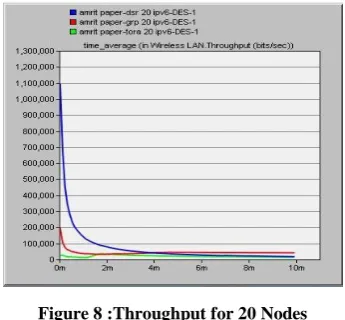
Figure 8 :Throughput for 20 Nodes
[image:5.595.101.271.293.447.2]In figure 8 the evaluation of different routing protocols for 20 nodes on the basis of throughput under IPv6 environment is presented.It is evident from graph that throughput is maximum in DSR.GRP shows good results in terms of throughput.
Figure 9 : End-To-End Delay for 30 Nodes
In figure 9 different routing protocols are simulated for 30 nodes on the basis of end-to-end delay under IPv6 environment.It is evident from graph that end-to-end delay is maximum in TORA.GRP is perform better in terms of end-to-end delay.
Figure 10:Network Load for 30 Nodes
In figure 10 the evaluation of different routing protocols for 30 nodes on the basis of network load under IPv6 environment is presented.It is evident from the graph that network load is maximum in DSR.GRP performs better in terms of network load.
Figure 11: Throughput for 30 Nodes
[image:5.595.344.524.294.447.2] [image:5.595.98.271.518.678.2] [image:5.595.347.521.518.675.2]Table 2: Resultant Values
8. CONCLUSION
In this paper performance of three routing protocols DSR, GRP and TORA are evaluated under IPv6 environment. On the basis of the observations it concluded that GRP performs better than other routing protocols. GRP is position based routing protocol in which routing takes place with selection of closest point to the destination. Each node w h o wants to route the data, select a closest point to the destination and route data on that point and then explore for next closest point to the destination. This process is repeated until data delivers to destination. Due to this, distance from source to destination is reduced and requires less time to reach the destination, hence therefore end-to-end delay is minimum in GRP. The network load is also reduces in GRP because it use minimum network resources to deliver data from source to the destination. In TORA data travels through intermediate nodes, therefore more time is required t o reach the destination causing maximum end-to-end delay in TORA. Network load is minimum in TORA because all information about destination node is removed when link become invalid, this conserve the precious bandwidth of the network. DSR is source routing protocol in which data packet header contains information about nodes from which data packet have to pass, therefore source node is completely aware from t h e path to the destination and there is no need to transmit periodic messages. In DSR route is maintained in route cache and there is no need to discover it again. Once route is discovered information about route is stored in route cache for future use. It use minimum network resources for which throughput is maximum in DSR.
9. REFERENCES
[1] Ani-Al R, “Simulation and Performance Analysis Evaluation for Variant MANET Routing Protocols”, International Journal of Advancements in Computing Technology (IJACT), VOL.3, NO.1(2011), pp 1-12. [2] Deering S, Hinden R “Internet Protocol Version 6”
IETF RFC 2460 December 1998
[3] Geetha D, Sarika T, “ Performance Analysis of TORA & DSR Routing Protocols in Mobile Ad Hoc Networks ” , International Journal of Electronics and Computer Science Engineering (IJECSE), ISSN 2277-1956,VOL.2,NO.1,pp 79-87
[4] Internet Protocol DAPRA IETF RFC 791 September 1981
[5] Johnson D,Hu Y,Maltz D, “The Dynamic Source Routing Protocol (DSR) for Mobile Ad Hoc Networks for IPv4”,IETF,RFC 4728,February 2007 [6] Kaur H, Singh J, “Performance comparison of OLSR,
GRP and TORA using OPNET”, International Journal of Advance Research in Computer Science and Software Engineering (IJARCSSE) ,VOL.2,NO.1(2012),pp 260-267
[7] Keshtgray M, Babiyan V, “Performance Evaluation of Reactive, Proactive and Hybrid Routing Protocols in MANET”, International Journal of Computer Science and Engineering (IJCSE), ISSN 0975-3397, VOL.4, No.2 (2012), pp 248-254
[8] Murthy C.S, Manoj B.S, Ad Hoc Wireless Networks: Architectures and Protocols, Pearson Education, 2004 [9] Tamizhselvi A, Wahida Banu R.S.D, “Performance Evaluation of Geographical Routing Protocol under Different Scenario”, International Journal of Computer Science and Telecommunications (IJCST), ISSN 2047-3338, VOL.3, No.3 (2012), pp 64-67 [10] Vats K, Sachdeva M, Saluja K, “Simulation and
performance Analysis of OLSR, GRP, DSR Routing Protocol using OPNET ”,International Journal of Emerging trends in Engineering and Development (IJETED), ISSN 2249- 6149, VOL.2, No.1 (2012) ,pp. 390-404.
[11] “History of Internet Protocol”, Available at: http://fab.cba.mit.edu/classes/MIT/961.04/people/neil /ip.pdf
Nodes Protocol Delay(sec) Network Load(bits/sec)