Multi-Core Processors for Camera based OMR
A. AL-Marakeby
Systems and Computers Engineering Dept. Faculty of Engineering , Al-Azhar University, Egypt.
ABSTRACT
Today, most of desktops, laptops, tablets, and even smart phones are shipped with multi-core processors. The efficient utilization of multi-core processors computation power can't be achieved by developing traditional applications with sequential algorithms. Parallel algorithms utilize the capabilities of these processors, but need a special design to optimize the application to fit the hardware system. Image processing programs are heavy computational algorithms with very large amount of data. They are very well suited for parallel processing. This work presents a low cost and fast solution for optical mark recognition system working in multi-core processor system. The answer sheet is captured using a digital camera and the image is processed. Initially the borders of the sheet are located then the bubbles are detected. Fast techniques are used to detect the bubbles without a rotation correction. An adaptive binarization has been used to overcome the lighting effects of the camera based images. A classifier is trained to decide if the bubble is marked or not. A dataset of images under different rotations, illuminations, is used to train and test the system. An accuracy of 99.8% is obtained. The algorithms are analyzed and optimized for parallel computation on a multi-core processor. The processing time is reduced to about 40% of the sequential computation time.
Keywords
Parallel Image Processing ,Multi-Core Processors, camera based , OMR .
1.INTRODUCTION
The multi-core processor means to place two or more processing cores on the same chip. Multi-core processor enhances system performance by allocating workload to different cores to process concurrently [7]. The time consumed in processing images makes it a necessary to utilize the parallelism in these processors. There are many hardware architectures and software platforms that supports parallel processing. FPGA , GPU , multi-core CPU ,and DSP are the most common hardware architectures used for parallel processing. For the software, many platforms that support developing parallel algorithms are used such as OpenMP, Intel TBB, Intel ArBB, and CUDA [13].The parallelism can be applied in image processing applications by three main ways: i)Data Parallel, ii) Task Parallel, and iii)Pipeline Parallel. [5].
As illustrated in figure 1 the data parallel divides the image into many parts and each core are responsible for processing this part of the image by applying all required tasks. In task parallel a single task for the whole image is processed in each core. Pipeline parallelization are used in processing a stream of images and different core are processing different images. The designing of the parallelism depends on both the application nature and the hardware architecture. This work represents a parallel processing system for camera based optical mark recognition. Optical Mark recognition is widely used in many fields such as test grading, community survey ,evaluations , feedback and forms filling[2]. The OMR scanners were originally developed in the 1950s with more desktop-sized models entering the marketplace in the 1970s. The original technology was called 'mark sensing' and used a series of sensing brushes in detecting graphite particles on a document that is passed through the machine[6]. image-based OMR systems have been developed which represent more flexible solution [9]. Image-based OMR doesn't need a special hardware devices or special answer sheet which represents an initial and running cost for the system. In addition to that this solution allows the user to design his special answer sheet using word processing software. The image based OMR depends on scanning the document, and using the different image processing and pattern recognition techniques to locate and recognize the class of the bubbles in the answer sheet. Nowadays, Camera-based document
Core 0
Image Part0 All Tasks
Core 1
Core n
Image Part1 All Tasks
Image Part n All Tasks
Core 0
Whole Image Task 0
0 All Tasks
Core 1
Core n
Whole Image Task 1
All Tasks
Whole Image Task n
Fig.1 Data Parallel and Task Parallel
a) data parallel
analysis has received considerable attention due to the wide spread of advanced low priced digital camera [3] [12] [14].
Digital cameras, PC-cams, and even cell phone cameras are becoming increasingly popular and they have shown their potential as an alternative imaging device[3]. Camera based OMR represents a good solution for small sized enterprises ,or for the personal usage. A Teacher can use his PC, Laptop ,or mobile phone to finish test grading without any additional hardware costs. In addition to that, this solution is highly flexible and portable. Tien and Quyet have developed a camera based OMR depends on allocating borders using Hough transform and then skew-correction [15]. Camera based document analysis has some challenges and problems which needs special techniques and algorithms to solve these problems. The illumination problems , zooming and focusing problems , low resolution , and perspective distortion are the main problems facing the camera based document analysis [3][10][12]. In this paper a solution for camera based OMR is presented which solve these problems and achieve very good results. This system depends on special designs of the answer sheet to add some marks which speed up the detection of bubbles. The system is insensitive to rotation scaling and illumination variations. In addition to that the flipped images can be processed and recognized without correction. The solution avoids using heavy computational algorithms such as skew correction, circle detection and Hough transform, to increase the speed of the system [2]. Fig.2 illustrates the different components of the camera based OMR system.
2. PREPROCESSING AND BUBBLE
DETECTION
Before finding the location of bubbles in the answer sheet, the image should be thresholded. Each pixel in the image is classified as an object or a background. The borders are extracted giving us information about the skew and perspective distortion. There are external borders and another internal separation lines between each column. Underline markers are used to convert the bubble detection process from circle detection into a fast line tracking process.
2.1 Adaptive Binarizarion :
One of the main problems in camera based document analysis is the binarization process. Various types of degradations such as uneven illumination, shadows, low contrast, smears and heavy noise densities often make thresholding of the document images a difficult job[11].The simple fixed threshold level used for binarization is not suitable for the lighting variation as shown in fig.3. The adaptive binarization is used where the image is divided vertically into columns with its different thresholding values. Also inside the single column each row has its different thresholding value depending on contrast analysis.
a) Binarization with constant threshold level
b)Adaptive Binarization
2.2 Borders Extraction
:
In the design of the answer sheet, borders and lines have been added to facilitate the bubble detection process. The design of the template with a thick line borders solves many problems and increase the reliability and speed as shown in fig.4. These lines are insensitive to noise and help us to solve the rotation and perspective distortion problems. There are many line detection algorithms with different complexities and robustness. Hough transform is robust for noise and occlusion, but the calculation and/or memory costs are very high. Also digitizing and quantization errors sometimes influence to the accumulation of the peaks in the parameter space[8]. Projection is the fastest way in finding horizontalDifferent Threshold Values
Features
Extraction &
Classification
MultiCoreProc
Time 2
Time 0 Time 1
Preprocessing
& Borders
Detection
Bubble
Detection
MultiCoreProc MultiCoreProc
Fig.2 Parallel Processing for camera based OMR System
and vertical lines in an assigned image, because such lines will produce peaks in projection profiles [16]. This method doesn't work with rotated lines or slightly curved line. Line tracking algorithm has been used, with the addition of many heuristics to increase the speed and robustness. Without using thinning or morphological processing, the thick line is tracked using edge tracking. If the line is broken a connection algorithm is used to connect both segments of the line.The detection of each line in the border ( Right , Left , Top ,Bottom ,..etc.) is assigned to a single core in the multi-core processor. There are no dependencies between different lines detection and the processed are parallelized easily.
2.3 Bubble detection
: Bold lines with small peeks are used under the bubbles to make the detection of bubbles more easy, fast , and accurate as shown in Fig.4. These lines convert the bubble detection process into a line detection process. The small peaks in the line are indicators to the location of the bubbles and also for the direction of the image. A common problem with large number of documents is that some documents are flipped. These marks in the underline detect the flipped image and the system corrects the problem. The edge tracking algorithm with the added heuristics has achieved a fast, and robust bubble detection results. In addition to that it solves the problems of skew ,rotation, and perspective distortion. The parallelization in the bubble detection process are achieved by assigning a specific number of rows to each core.Fig.4 Bubble Detection Process
3.
FEATURE EXTRACTION AND
CLASSIFICATION
The straightforward solution to classify the bubble is the brightness difference between marked and unmarked bubbles. This simple solution has some problems. The small errors and deviations in finding the location of the bubble may cause classification errors. Also the different lighting conditions make problems in finding the threshold between the two classes brightness. To solve these problems different features are extracted, then a training process is applied to reach the best classification results.
3.1 Feature Extraction:
The difference of gray level between Marked and unmarked bubble is the main feature in the classification process. To reduce the effect of noise and illumination variation, the
difference in gray level of the current bubble and the background has been used. In addition to that the differences between the bubble gray level and its neighbor bubbles are added as features as shown in fig.5 .The gradient features are excellent features used in the case of light variations. The pixel feature gradient is given by
Gradient features have been used to detect the smooth transition from black to white indicating a marked bubble.
3.2Classification
:
The classification process can be simple task, while the number of classes are only two. But practically the errors and deviations in finding the location of the bubbles in addition to the different lighting conditions make overlap between the two classes and add some complexity to the classifier. Many classifiers have been used to test the accuracy and performance of the system. Naive Bayes , QDF , MQDF ,and Neural Networks classifiers are used in that system.
Bayes Classifier:
A naive Bayes classifier assumes that the value of a particular feature of a class is unrelated to the value of any other feature, so that1:Where x is the feature vector and Ck is the class.
QDF classifier
: The Quadratic Discriminant Function, QDF approach basedon assuming a different covariance for each class. This gives better performance than linear discriminant functions whichwhere X is the feature vector, g is the discriminant function, u is the mean matrix and is the covariance matrix [1] .
MQDF classifier:
Modified quadratic discriminant function for Kimura [4] is an excellent and widely applied technique. To learn a basic MQDF classifier, it is assumed that samples are normally distributed with unknown mean and covariance matrix. The unknown parameters are generally estimated with maximum likelihood estimation (MLE) [4][17].(
1
)
Difference between a Bubble and its neighbors Difference between a Bubble
and background
Where and represent the eigenvalues and eigenvectors respectively[1][3].
Neural Networks classifier:
Artificial neural networks are flexible and adaptive, learning method. A neural network with 3 layers has been used and trained with the backpropagation algorithm.4.
RESULTS
The Intel Core i5 processor are used to run the system. A dataset of 200 images has been used ,with 30 questions and 4 choices per question giving a total of 24000 bubbles. The system is trained with 4 different types of classifiers namely ,Bayes classifier ,QDF , MQDF , and NN. Table 1 indicates the accuracy of these classifiers.
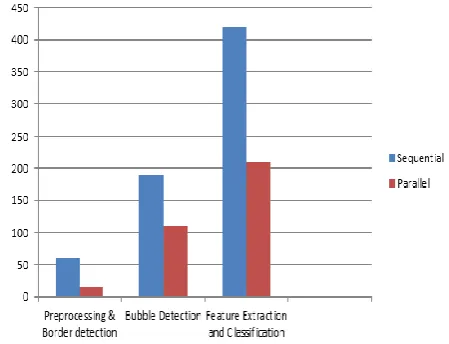
[image:4.595.315.540.75.247.2]Fig.6 illustrates the time analysis of both sequential and parallel computation for all system stages. The processing time of border detection ,bubble detection, feature extraction and classification are reduced due the parallelization. The measuring of time is based on the average of many experiments with small value of deviations .These differences in time measurements are caused by operating system and the scheduler while it gives each process slices of time depends on many different factors.
Fig 6. Computation time analysis
5.
CONCLUSION
The computation power of multi-core processors are wasted by developing sequential algorithms. The image processing algorithms have a high degree of parallelism and can be utilized efficiently. The problems in camera captured documents can be solved with fast and robust algorithms and techniques. Using bold lines and borders as markers to find the location of bubbles solves the problems of rotation, skew, perspective projection and also flipping. The illumination variation problem is solved using the Adaptive binarization technique. Edge following algorithm is a fast method in the detection of lines and borders. The accuracy of 99.8% is a good accuracy and can be improved by improving the bubble detection process while most of errors are caused by the fault bubble detections.
6. REFERENCES
[1] A. Al-Marakeby, F. Kimura , M. Zaki, A. Rashid "Design of an Embedded Arabic OpticalCharacter Recognition", International Journal of Signal Processing Systems March ,2013
[2] A. AL-Marakeby, Fast Camera based optical mark reader system,Journal of Al Azhar University Engineering Sector (JAUES) 2013 (in press)
[3] David Doermann, Jian Liang, and Huiping Li "Progress in Camera-Based Document Image Analysis" International Conference on Document Analysis and Recognition (ICDAR’03)
[4] FUMITAKA KIMURA, KENJI TAKASHINA, SHINJI TSURUOKA, AND YASUJI MIYAKE "Modified Quadratic Discriminant Functions and the Application to Chinese Character Recognition", IEEE TRANSACTIONS ON PATTERN ANALYSIS AND MACHINE INTELLIGENCE, VOL. PAMI-9, NO. 1, JANUARY 1987
[5] Harshad B. Prajapat, Dr. Sanjay K. Vij "Analytical Study of Parallel and Distributed Image " Processing, International Conference on Image Information Processing (ICIIP 2011)
[6] Hui Deng, Feng Wang, Bo Liang "A Low-Cost OMR Solution for Educational Applications" International Symposium on Parallel and Distributed Processing with Applications 2008
Classifier
Total Accuracy
Bayes
99.7 %
QDF
99.8 %
MQDF
99.8
NN
99.5
(
3
)
[7] Jie Zhao, Yong-min Yang, Ge Li "Real-time Image Processing System Base on Multi-core Processor", 2009 Third International Symposium on Intelligent Information Technology Application
[8] Kazuhito Murakami and Tadashi N aruse "High Speed Line Detection by Hough Transform in Local Area" 15th International conference on pattern recognition ,2000.
[9] K. CHINNASARN, “An image-processing oriented optical mark reader”, Applications of digital image processing XXII , Denver CO, 1999
[10] K. Chua, L. Zhang, Y. Zhang, and C. Tan. "A fast and stable approach for restoration of warped document images. " 8th Int’l Conf. on Document Analysis and Recognition, 2005
[11] Landu Jiang1 Kai Chen1 Shibo Yan1 Yi Zhou2 Haibing Guan3 ,"Adaptive Binarization for Degraded Document Images",Information Engineering and Computer Science, 2009. ICIECS 2009. International Conference on
[12] Li Zhang, Andy M. Yip, Chew Lim Tan, "Removing Shading Distortions in Camera-based Document Images Using Inpainting and Surface Fitting With Radial Basis Functions" International Conference on Computer Vision, ICCV 2007.
[13] Luis Miguel Sanchez, Javier Fernandez, Rafael Sotomayor, and J. Daniel Garcia, "A Comparative Evaluation of Parallel Programming Models for Shared-Memory Architectures", 2012 10th IEEE International Symposium on Parallel and Distributed Processing with Applications
[14] Masakazu Iwamura, Tomohiko Tsuji, Akira Horimatsu, and Koichi Kise, "Real-Time Camera-Based Recognition of Characters and Pictograms" , 2009 10th International Conference on Document Analysis and Recognition
[15] TienDzung Nguyen, Quyet Hoang Manh , "Efficient and reliable camera based multiple-choice test grading "system 2011 International Conference on
[16] ZHI-HONG ZHAO, XUE-DONG TIAN, BAO-LAN GUO , "A STUDY ON PRINTED FORM PROCESSING AND RECONSTRUCTION" ,Proceedings of the First International Conference on Machine Learning and Cybernetics 2002