Back Propagation Network Assisted Location
Estimation Approach for Ad-Hoc Sensor Network
Kumar Rahul Priyadarshi D. Srinivasa Rao Anil Singh
Research Scholar Associate Professor Associate Professor Computer Science Engineering Computer Science Engineering Computer Science Engineering MITM, Indore, M.P, India MITM, Indore, M.P, India MIST, Indore, M.P, India
ABSTRACT
Location aware application development and services are today’s necessity. These applications are providing services according to the locality of user. Location estimation is a branch of communication and computing which provides ease in service distribution. In this proposed work, different techniques of location estimation or localization are investigated for accurate positioning information with less resource consumption. In search of efficient localization technique, predictive data models are targeted for investigation. The main advantage of these predictive localization methods is they consume only meaningful mobility patterns for position estimation.
With the motivation to design efficient predictive localization technique for ad-hoc sensor network, we first utilised two existing predictive localization approaches i.e. SMOreg-MP5 Tree and PSO-BBO assisted localization methods. We observed that, these methods are able to localise the mobile node, but the problem with these techniques are it required more time to analysis the historical data. Therefore, a new predictive localization technique is required to design by which, in less training time maximum mobility patterns can be learned. In such direction, a promising ANN based method namely back propagation neural network is modified for reducing number of training cycles. For that purpose, back propagation neural network is changed for initialization phase with the essential mobility features. Initialization with these feature set helps to improve the learning of BPN algorithm.
The implementation of existing approaches are provided using JAVA environment and for generating the real time network’s mobility patterns NS2 oriented network simulation environment is prepared. The performance of proposed approach is evaluated in comparison with real time mobility pattern and predictive values. To evaluate the performance, experimentation with increasing nodes and reducing training cycles are performed. The obtained results demonstrate, PSO provide low performance as compared to SMOreg and SMOreg provides less accurate results with respect to proposed approach. Therefore the proposed location estimation approach is adoptable due to higher learning capability with less number of training cycles.
Keywords
WSN, ANN, BPN, SMOreg, PSO, Epoch Cycle, Generation.
1. INTRODUCTION
Wireless sensors and their originated network have taken as main forefront by the scientific community recently, today’s it is too famous. Everywhere sensor is deployed and they perform their work smartly, no real time data sampling and controlling are possible without sensor. The ad-hoc sensor network is an engineering of various smaller sized objects.
These objects are changed dramatically in their size, operation and their application. These smaller sized objects are enabling the variety of new applications. While using these sensor nodes and when organizing them within the network, there are many research issues are arises and those solutions again counter with certain problems.
Therefore, accurate location estimation is essential for these applications. Thus, here we intended to work with location estimation methods for finding the unique and accurate method for the position estimation i.e. to explore an efficient radio position system [1].
In these applications, we are required to estimate the location of a particular place or person, efficiently, accurately and reliably. It will also formal that, the next generation resource management techniques may be rely on position estimation and prediction. There are mainly two approaches are in fashion for position estimation or localization.
First approach is statistical approach; where position is estimated by using the previous mobility pattern data of a node. Second approach is predictive approach; here localization is performed by utilising the extracted knowledge of the system and the stored mobility pattern of participating nodes [2, 3].
Statistical localization methods are works on the basis of different fundamental characteristics; which are Received signal strength indicator or RSSI, Time of Arrival or TOA, Time difference between arrivals or TDBA and Angle of arrival or AOA etc. It is observed that the statistical localization methods are not much accurate, because of random mobility pattern of the ad-hoc sensor network’s node.
These statistical techniques are also infeasible and very error prone. The performances of these techniques are badly affected by relative environmental condition. Therefore, in modern technological era, statistical techniques are not feasible and reliable to use for accurate and efficient localization [4].
The existing predictive localization techniques also have different limitations. The localization time, localization errors are few of factor; where the existing predictive localization techniques are not perform as desirable.
Therefore, a new predictive localization approach is required to consider from which the location of the mobile sensors accurately measurable. The proposed technique should be distributive and support random mobility pattern with time series evaluation capacity.
This research paper is organized in eight sections. The first section provides you, the basic knowledge about existing localization techniques and its limitation. With the help of section second, we descript the recent evolution and significance of the existing predictive techniques. With section third, we provide a brief comparative study and interrelated approaches of existing predictive localization technique; here we also demonstrate the prepared simulation scenario and simulation setup.
Through section four we descript our proposed localization technique, where core idea and speciality of the proposed technique is best described. Section fifth includes the implementation result of proposed technique, while section sixth deal with the significance of our proposed research work. In section seventh, the future scope of our propose work is given.
2. BACKGROUND
Now a day’s a combination of predictive techniques with hybrid approaches are in fashion and largely used in ad-hoc sensor scenarios, especially for sensor’s localization. Basically, the hybrid technique employs the use of different technological approaches of different domain in interdisciplinary manner. The hybrid technologies are widely used for better result in corresponding manner [5].
After intense research, we observed that the machine learning technique can play prominent role in ad-hoc sensor localization [6]. So, we were start searching the appropriate machine learning approach which can be adaptively used in targeted localization scenario. We observed that the artificial neural network (ANN) and Swarm optimization are among those technologies that are appropriate for our domain. And, yes available research works approved our assumption.
The ANN and Swarm optimization are the widely adopted hybrid concepts that are largely taken in ad-hoc network and sensor network scenario [7]. It had also proven its capacity in high level research when worked out with the different interdisciplinary concepts. Therefore, we are decided to utilise the ANN and Swarm optimization technique and willing to use its variants in our work [8].
After going through the existing research works, we found two useful approaches from these domains; first approach is Sequential Minimal Optimization for Regression (SMOreg) and the second approach is Particle Swarm Optimization (PSO).
2.1 Selected Background Study
The “SMOreg & MP5 Tree” based localization approach is the work of the author Prince Singh et al. They utilises the Time of Arrival (TOA) information of received signal originated by the sensor node with two very famous machine learning algorithms M5 tree Model (M5P) and SMOreg for better localization accuracy in Ad-hoc sensor network. They also applied the same node localization problem to, two previously considered ANN models- Multi Layer Perceptron (MLP) and Radial Basis Function (RBF) Network.
Finally they performed a comparative analysis between selected algorithms and their demonstrated simulation result shows that the advantage of their proposed M5P and SMOreg technique over the existing MLP & RBF technique. Their proposed technique performs better in high noise conditions and in terms of localization error.
For better demonstration of our research work, we perform the re-implementation and simulation of this SMOreg-MP5 Tree
technique. Finally, we observed that initially the performance of SMOreg is better but there is no improvement in its performance with increasing training cycle [9].
The “PSO & BBO” based localization approach is the work of the author Satvir Singh et al. They propose a localization technique which is based on the Particle Swarm Optimization (PSO) and Biogeography Based Optimization (BBO) concept. They used this technique to localise the distributed ad-hoc sensor node optimally, which are deployed randomly over the wide area.
They propose the application PSO and BBO for adaptive localization. Biogeography is a process where a collective learning is performed over the biological organisms which are allotted geographically. BBO works on the concept of science of biogeography. The biogeography states that, the migration operation and its operator shares the information with another anchor or habitats. Finally they form a pattern which is solution or also termed as problem solution.
They describe an error model for localization of a targeted node optimally. The proposed error model is works in such a way that the localization error is much minimized. For this error minimization they propose BBO and PSO algorithms. The introduced algorithms are very capable to perform optimization of the obtained locations.
The optimization performed by the PSO and BBO algorithms is much better as compared to the other existing optimization algorithms. Some existing optimization approaches which are widely adopted in ad-hoc sensor network scenario are Genetic Algorithms and Simulated Annealing.
The introduced PSO model has only one advantage i.e. it is fast convergent. But the problem with this approach is, it is not enough mature to completely optimises the entire set of location data efficiently over the time. The authors propose a very good analysis among the existing and introduced distributed iterative localization technique.
Basically, the distributed iterative localization technique is used to localise the participating sensor nodes with the help of consecutive iteration. Here, iteration is nothing but, just assist the localization same as the anchor node used in statistical method.
They also presented a very good comparative analysis of PSO and BBO. The comparative analysis are performed by the help of different migration variants of PSO and BBO in term of localisation capacity, localization accuracy and localization time [10].
3. COMPARATIVE REVIEW
From starting of research process, our strategy was to first implement and simulates the considered localization technique i.e. SMOreg and PSO. We used Java technology to code the SMOreg and PSO algorithm and uses network simulator NS-2 for simulating the network environment.
This comparative analysis section is organised in three sub section. The first section provides the core idea of SMOreg and PSO approaches. Section second briefs you about the simulation scenario. Through section third, simulation setup is demonstrated.
3.1 Related Study
SMOreg algorithm works on the basis of self organizing map (SOM). Basically, SOM is an unsupervised learning scheme of an artificial neural network. It is also termed as Kohonen's maps or Kohonen's neural network or Kohonen's self-organizing map. It categorises the input reliably. It is a type of unsupervised learning scheme so here there is no supervision carried out during the entire processing of neural network. Simply, the input patterns are processed at input layer and at the output layer we get output. It works without the training. But, training is an optimal process where the magic happens
The pseudo code of the SMOreg approach is as follows:
{w[i] = w[i] – learning Decay and influence (w[i] –
input Weight)}………...Equation (3.1)
Here we used three parameters; a decaying learning rate, a decaying radius and the distance from the best matching node. The decay is controlled such that at the final iteration, inputs have no further influence on themselves or their neighbours.
3.3.2 Particle Swarm Optimization (PSO)
To initialise the PSO algorithm, there is a requirement of set of random particles. These random particles are often called solution. These solutions are used in consecutive generation to update the solution and find the next optimal solution. While with every iteration taking place, each solutions is updated by the two values called best values.
The best value founded by the consecutive generation is a best fit value to the generation. The obtained fitness value should be sorted to calculate the next fit value or optimal solution. This sorted value is a best value which is known as pbest. Another best value also exists which is called gbest; this is tracked by the PSO optimizer. This value is the best of best value among all the best value that obtained so far by any active particle in the population during the consecutive iteration.
Generally, when a particle participate in the consecutive iteration means in an population with its neighbours, then only the local best value is achieved, is called local best or Lbest. After completing with two best values, the particle updates its velocity and position by the help of following equations 3.2 and 3.3.
{v = v [] + c1 * rand () * (pbest[] –present[] + c2 *
rand () * (gbest [] - present []}……Equation (3.2)
{present [] = present [] + v[]} ………Equation (3.3)
Parameter used in the both equation are specified below:
v [] is the Particle velocity.
present [] is the current particle or solution.
we already defined pbest[] and gbest[].
rand () is the random number that exist between 0 and 1.
c1 and c2 is the learning factor. Generally c1=c2=2.
Vmax is the measure of maximum velocity of particles on each dimension. If the Vmax is be surpasses by the particle due to sum of acceleration which is précised by the user, then the velocity on that dimension will be increased.
The pseudo code of the PSO approach is as follows:
1. For each particle
a. Initialize particle
2. END
3. Do
4. For each particle
a. Calculate fitness value
b. If the fitness value is superior than the best
fitness value (pBest) in history
c. Set current value as the new pBest
d. End
5. Choose the particle with the best fitness value of all the particles as the gBest
6. For each particle
a. Calculate particle velocity according equation (3.2)
b. Update particle position according equation (3.3)
c. End
7. While maximum iterations or minimum error criteria is not attained.
3.2 Simulation Scenario
In order to simulate the effect of the predictive algorithms the following simulation scenarios are prepared.
3.2.1 Simulation of SMOreg Approach
In the SMOreg simulation, network is prepared with the different number of nodes and location of nodes during mobility is stored in a file in terms of X and Y positions. On the other hand a SMOreg is implemented using JAVA technology. That trained using the stored mobility pattern of network nodes.
After training again the simulation is running and using the SMOreg approach new node positions are estimated and compared with the real time node mobility. Finally the performance of predictive algorithm is calculated for measuring the effectiveness of the system.
1. Construct a list of array as a x b
2. Assign a P element to array to every node in array list.
Here, the initial values must be arbitrarily distributed or
ranges between 0 and 1.
P is the number of dimensions of input given.
Here initial weights are initialised.
3. For every epoch cycle or training the input vector
a. Select the node with the closest matching weights.
Simple Euclidean distance is effective:
sqrt( (p1 - p2)^2 + (q1 - q2) ^2 ...)
b. Update weights on this node
c. Update the weights of the neighbours’ node
3.2.2 Simulation of PSO Approach
In the simulation of PSO approach, previous node mobility pattern is consumed using the PSO approach and training is performed. After training of algorithm using the PSO approach new positions of network nodes are predicted. We used JAVA technology to code the approach and prepare NS-2 environment to simulate it.
3.2.3 Simulation of Proposed Approach
In the simulation of our proposed approach the node mobility pattern is approximated using the proposed changes over BPN. Our approach accepts the historical mobility pattern of node and new positions are provided in terms of X and Y positions. We used JAVA technology to code our BPN algorithm and prepare NS-2 environment to simulate it.
3.3 Simulation Setup
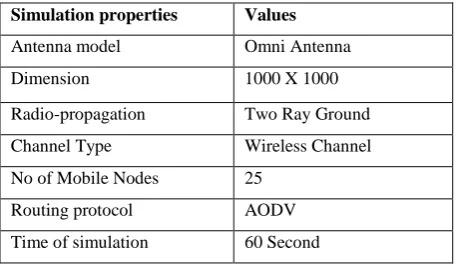
[image:4.595.54.283.306.438.2]In this section we provide the desired network configuration for simulation of proposed location estimation and simulation.
Table 1: Simulation Setup Simulation properties Values
Antenna model Omni Antenna
Dimension 1000 X 1000
Radio-propagation Two Ray Ground
Channel Type Wireless Channel
No of Mobile Nodes 25
Routing protocol AODV
Time of simulation 60 Second
4. PROPOSED WORK
After successfully implementing the SMOreg and PSO approaches, we observed that among the SMOreg and PSO, the SMOreg approach perform well than PSO. Therefore, we take SMOreg as our base approach. We already know that, the SMOreg approach is based on self organising map of ANN model i.e. unsupervised learning approach.
We observed that if we will use the supervised learning scheme instead of unsupervised learning scheme i.e. already used in SMOreg, than we surely achieve desired outcome in our proposed location estimation approach [11, 12]. After intense research, we observed that the back propagation network (BPN) may be the best supervised learning scheme for sensor network domain [13, 14]. So we finally decided to use BPN with our proposed location estimation approach and yes, after successful implementation and simulation of our proposed work we achieved the targeted result.
The BPN is a supervised algorithm; required outcomes are available in training. The real network outcomes are deducted from the real outputs and an error value is estimated. An error value is the feedback for the back propagation, means the error is feedback to neural network by evaluating the contribution of hidden layer, with desire to implant the equivalent adjustment for finding the accurate outcomes. The linking weights are synchronized and neural network has “learned” from the past experience.
4.1 Proposed Approach
In most of the implementations the neural network is implemented through a two dimensional array. In this array the input layer and hidden layer both perform internal calculations. Therefore, input layer and hidden layers are combined using two dimensional arrays. There are three main phases in neural network training first initialization, second weight calculation and finally error correction and weight update. The basic issue in its initialization process, the array is initialized through the randomly generated weights. These weights are adjusted during outcome evaluation and error adjustment.
This process requires more time due to random weights and large amount of cycles are required for weight adjustment. On the other hand, the initialization of network using single value can results linearity additionally initialization with 0 values leads the calculation gap. Because each time the node calculates its weight to 0, therefore not any.
Therefore the following procedure we used to initialize the neural network.
1. Read all input data from learning dataset.
2. Find maximum and minimum of the attributes by which network is required to train.
3. Take input number of hidden layers and input layers.
4. Find the normalized data in the range of 0-1 using the following formula.
5. Use the Euclidian distance for finding nearest values
6. For each row D(x, y) > .5
a. Insert into network array
7. End for
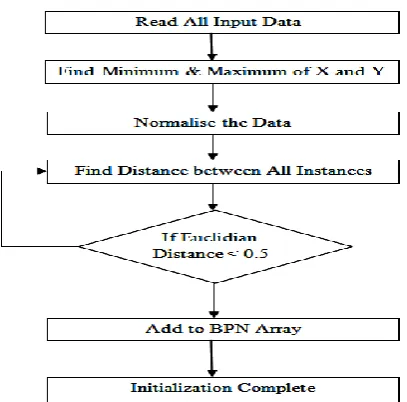
In the above given algorithm or procedure using the learning set data patterns neural network is initialized, but associated data having greater values and network can only initialized with values in range of 0-1.
Therefore in third step the pre-processing technique (min-max) is consumed to scale the in specified range. Now required to find the more suitable values that contain the maximum essential pattern and minimum noise contents are selected using the KNN concept. For that purpose distance between all instances are performed, here the distance between two instance indicate the difference between two learning pattern. Therefore, all rows that having distance less than .5 inserted into the two dimensional array.
Figure 1: Proposed Initialization Process for Modified BPN
4.2 Simulation Architecture
In this sub section the proposed simulation architecture is presented by which the implementation work is performed. The present system includes three different data models that having their own methodology for data analysis and pattern discovery. The given model is described as:
i. NS2 Simulation: in order to generate the location information for the nodes a simulation using NS2 is designed. That capable to visualize the network nodes and their location.
ii. Trace Files: NS2 simulator during simulation generates trace files. These trace file contains information about the node and their activities. The node positions are extracted first using these trace files.
iii. Location Data: the extracted location information is stored into a separate data file this file is used as input for different data models.
iv. SMOreg Approach: the implementation of SOM is performed in this module, which accepts location data as input and predict the new location according to the real time simulation location.
v. PSO Approach: PSO algorithm is a heuristic search process that searches the relevant patterns over data.
vi. Performance Analysis: in this module the real time network simulator outcomes are compared with the data model’s predictive values.
Figure 2: Simulation Architecture
In our simulation scenario the node mobility pattern is approximated using the proposed changes over BPN. The proposed algorithm accepts the historical mobility pattern of node and new positions are provided in terms of X and Y positions. We used JAVA technology to code the entire procedure or algorithm and prepare simulation environment with the help of Network Simulator-2 tool to simulate the procedures.
5. RESULT
The performance evaluation of location estimation approaches is performed in this section over different performance parameters like localization accuracy, localization error etc. For better demonstration, here we use performance of SMOreg, PSO approaches and compare with the performance of our proposed approach. We used GNU Plot to plot the graph of simulation results.
5.1 Accuracy Vs Number of Nodes
Accuracy of a predictive algorithm is a measurement of how accurate next predictive values are approximated with respect to real time obtained values. That can be calculated using the
given formula.
The comparison of localization accuracy of all SMOreg, PSO and our proposed localization approach with increasing number of nodes is well demonstrated by using the Figure 3. In these depicted figures the X axis represents the number of nodes in network and the corresponding Y access represents the accuracy in terms of percentage.
The obtained result indicates that, SMOreg approach performance is manageable; it provides the considerable accuracy only not desirable with increasing number of nodes. The accuracy of PSO approach is lesser than SMOreg approach. On the other hand, the accuracy of our proposed approach is better than both approaches and the performance gain is 10 to 15 percentages.
approach when perform localization with increasing number of nodes is also sufficient enough.
[image:6.595.316.538.77.267.2]
Figure 3: Localization Accuracy Vs No. of Nodes
5.2 Localization Accuracy Vs Generations
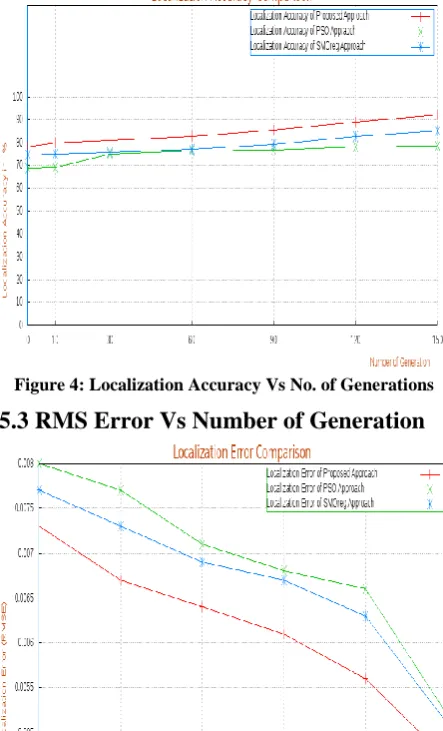
In neural network algorithm for improving the results, numbers of training cycles are utilised for finding more accurate results which is known as epoch cycles or number of generation in different context. In addition of that, in genetically inspired approaches the numbers of generations are consumed for finding optimum results therefore here presented results are provided with increasing number of training cycles and accuracy. In the simulation results, the number of generation are given in X axis and the Y access provides the accuracy of corresponding approaches in terms of percentage.The comparison of localization accuracy of all SMOreg, PSO and our proposed localization approach with increasing number of generation is well demonstrated by using the Figure 4.
Obtained results indicate that, the performances of classifiers are increases as the number of generations or epoch cycles are increases. During analysis of results for SMOreg and PSO approach we observed that these approaches consumes more training cycles for accurate results, on the other hand our proposed approach consumes less number of epoch cycles for finding the accurate results.
Along with the localization accuracy of our proposed approach is desirably increases with the increase of epoch cycle. Our proposed initialisation approach and the modified BPN algorithm really perform magic here. The accuracy is increasing as the training proceeds.
On the other hand the existing SMOreg and PSO approach’s localization accuracy is not improved despite of increasing number of epoch cycle. There accuracy is also not uniform. Therefore, it is clear that our proposed technique require less training cycle or training than existing localization approaches
.
[image:6.595.316.538.85.451.2]
Figure 4: Localization Accuracy Vs No. of Generations
5.3 RMS Error Vs Number of Generation
Figure 5: Localization Error Vs No. of Generations
The localization error can be measure in term of root mean square error. It is also termed as RMS Error or RMSE. Generally root mean square error represents the mean difference between the outcome estimated and the outcome or value that actually observed during entire process. It also measures in term of root mean square deviation.
Actually, the root mean square error significantly represents the sample standard deviation of the actual differences among the estimated or predicted values and observed value. These differences are generally termed as residuals, when the calculation taken out among the available data samples i.e. used for estimation, it called prediction errors when computation taken place through out of sample data.
The comparison of localization error of all SMOreg, PSO and our proposed localization approach with increasing number of generations is well demonstrated by using the Figure 5. The X axis represents the number of generation and the Y axis represents the RMS error.
[image:6.595.65.270.102.296.2]proposed approach is decreasing with increasing number of generation. This expresses the learning ability of our proposed location estimation approach. Therefore, the accuracy of proposed approach is higher than other two existing approaches. It is also considerable that the achieved accuracy will be grater always as training cycle facilitated.
5.4 Result Analysis
This section deals with the results analysis of previously available SMOreg, PSO based location estimation approaches with respect to the proposed approach. According to the obtained results the performance of proposed approach is higher than the previously available approaches. The proposed approach consumes less training cycles for accurate pattern learning, additionally with less number of training cycles the proposed approach can offer better improvements on results with respect to the increasing number of nodes.
6. CONCLUSION
In this presented research work, the mobile sensor network’s location estimation approaches are investigated. We can categorise the location estimation approaches in two arenas.
First those usage the mean and variance for finding the mobility patterns can be categorized with statistical methods, in second the predictive and machine learning methods are applied for finding the mobility patterns over the previous data. On the basis of evaluated mobility patterns upcoming node positions are approximated. Due to observation that is also finding that the location estimation using the second predictive method is able to predict more accurate or near mobility as compared to statistical method.
Therefore, we evaluated two existing predictive location estimation approaches for more improvement in position estimation additional improvement on pre-existing technique is suggested and implemented. The implementation of all the approaches, our proposed approach itself is carried out with the help of NS2 network simulator and JAVA environment. The performance of the proposed technique is evaluated with increasing number of nodes in network. We tried our level best to provide the simulation result more clearly and attributably. For that here we consider two base parameters. Among those two, the first is accuracy of the approach to localise sensor nodes and the second is estimated RMS error of this localization process. According to the performance evaluation the proposed improved BPN algorithm having higher accuracy during increasing number of nodes and the minimizing the number of training cycles. Therefore the proposed scheme is adoptable due to their higher accuracy and the less number of training cycles.
7. FUTURE WORK
The proposed research work is intended to find accurate method for location estimation using the predictive approaches. The proposed location estimation approach is mainly design for the performance improvement in location estimation system and yes it is able to provide more accurate results as compared to existing predictive approaches. Therefore the proposed approach is adoptable for different other applications such as mobility aware routing algorithms, VANET implementation and other low cost location aware service development.
7. REFERENCES
[1] Pengxi Liu and Xinming Zhang, “A Novel Virtual Anchor Node-based Localization Algorithm for Wireless
Sensor Networks”, IEEE International conference on networking (ICN), 2007.
[2] Hongyang Chen and Qingjiang Shi, “Mobile Anchor Assisted Node Localization for WSN”, IEEE 978-1-4244-5213-4/09, 2009.
[3] Shuang Tian, Xinming Zhang and Xinguo Wang, “A Selective Anchor Node Localization Algorithm for WSN”, IEEE International Conference on Convergence Information Technology, 2007.
[4] Yuan Zhu, Baoli Zhang and Fengqi Yu, “A RSSI Based Localization Algorithm Using a Mobile Anchor Node for WSN”, IEEE International Joint Conference on Computational Sciences and Optimization, 2009.
[5] Anil Kumar and Arun Khosla, “Meta-Heuristic Range Based Node Localization Algorithms for WSN”, IEEE, 978-1-4673-2343-7/12, 2012.
[6] Jia Huanxiang, Wang Yong and Tao Xiaolin, “Localization Algorithm for Mobile Anchor Node Based on Genetic Algorithm in WSN”, IEEE 978-1-4244-6837-9/10, 2010.
[7] Ruohong Ruan, Qingzhang Chen and Keji Mao, “A Three-dimension Localization Algorithm for Wireless Sensor Network Nodes Based on SVM”, IEEE 978-1-4244-6878-2/10, 2010.
[8] Bing Hu, Hongsheng Li and Sumin Liu, “Research on Localization Algorithm of Mobile Nodes in WSN”, IEEE 78-1-4244-4507-3/09, 2009.
[9] Prince Singh and Sunil Agrawal, “Node Localization in Wireless Sensor Networks Using the M5P Tree and SMOreg Algorithms”, IEEE 5th International Conference on Computational Intelligence and Communication Networks, 2013.
[10]Jasbir Singh Saini and Satvir Singh, “Computational Intelligence Based Algorithm for Node Localization in Wireless Sensor Networks”, IEEE 2012.
[11]Sharad Sharma and Shakti Kumar, “Routing in Wireless Mesh Networks: Two Soft Computing Based Approaches”, Published in International Journal of Mobile Network Communications & Telematics (IJMNCT) Vol. 3, No.3, June 2013.
[12]Satvir Singh and Etika Mittal, “Evolutionary Performance Comparison of BBO and PSO Variants for Yagi-Uda Antenna Gain Maximization”, TEQIP Sponsored National Conference on Contemporary Techniques & Technologies in Electronics Engineering, March 2013.
[13]Koffka Khan and Ashok Sahai, “A Comparison of BA, GA, PSO, BP and LM for Training Feed forward Neural Networks in e-Learning Context”, I.J. Intelligent Systems and Applications, 2012.