Determination of Thyroid Disorders in the Human
Body using TSH, T3 and T4 Levels
Yash Pal
Dept. of CSE RIET
Phagwara, Punjab
Vikas Verma
Dept. of CSE
Lovely Professional University
Phagwara, Punjab
Rishma Chawla
Dept. of CSE RIET
Phagwara, India
ABSTRACT
This is an endeavour to simulate the concept of determining type of Thyroidism after stipulating the TSH, T3 and T4 levels in the human body by using proposed analog circuit. The Analog devices like operational amplifiers have behaviour similar to the mathematical operations. Till date there are so many software - based techniques used for determination of effective dose to be provided to the patient so that normal level of Thyroxine can be maintained in the human body [1]. There is a need for hardware-oriented analog device to provide an accurate and efficient mean for calculation of effective dose amount and TSH, T3 and T4 values can be used. Basically, the voltages in the high-gain dc amplifiers are equated to these three variables and the operational amplifiers can do the mathematical operations on the voltages, although the accuracy of measuring voltage is limited to certain point. The simulation has been done using CircuitMaker.
Keywords
TSH (Thyroid Stimulating Hormones), T4( Thyroxine), T4( Tri-iodothyronine) and OPAMPs
1.
INTRODUCTION
The thyroid is a gland in the Human neck which generates two thyroid hormones, thyroxine (T4) and Tri-iodothyronine (T3). Thyroxine (T4) is passive and is converted by the tissues and organs that need it into tri-iodothyronine (T3) [2]. The role of thyroid hormones are required to regulate the metabolism of indirectly all the cells in the body. When there is not sufficient thyroid hormone (hypothyroidism) the body’s metabolism reduces and this is reflected by changes in various tissues that are listed here [3]. About 80% of tri-iodothyronine in the body is derived from conversion of thyroxine in the tissues (a process mediated by deiodinase enzymes), the remainder coming directly from the thyroid gland. The free fraction of T4 and T3 in the blood is therefore a more useful measure of thyroid hormone levels than the total amount of these hormones. This is what is meant by free T4 (FT4) and free tri-iodothyronine (FT3).Thus Thyroxine level determines whether a Human Body is suffering Thyroid disorder or not. The normal ranges for these variables can be given as in Table I.
Different values of these variables make different types of thyroid disorders as given in Table II.
TABLEI NORMALRANGES VARIABLES NORMAL RANGES
TSH 0.3-3.0( MIU/L) TOTAL T4 4.5-12.5(NG/DL)
FREE T4 0.7-2.0 TOTAL T3 0.60-1.81(NG/ML)
FREE T3 2.3-4.2 TABLEII
TYPESOFTHYROIDDISORDERS TSH T3 T4 EXPECTED DISORDER
HIGH HIGH HIGH HYPERTHYROIDISM OR MAY BE PITUITARY TUMOR
LOW LOW LOW SECONDARY HYPOTHYROIDISM OR MAY BE PITUITARY FAILURE
HIGH NORMAL NORMAL MILD SUBCLINICAL HYPOTHYROIDISM
HIGH LOW LOW PRIMARY, FULL-BLOWN HYPOTHYROIDISM
VERY
LOW HIGH HIGH
MAY BE ON REPLACEMENT THERAPY OR HYPERTHYROIDISM
LOW NORMAL NORMAL MILD HYPERTHYROIDISM
HIGH NORMAL LOW MAY BE SECONDARY HYPOTHYROIDISM
by enzymes to produce active T4 [6]. The steps in this process are as follows:
1. The Na+/I- symporter transports two sodium ions across the basement membrane of the follicular cells along with an iodine ion. This is not a primary active transporter that utilizes the concentration gradient of Na+ to move I- against its concentration gradient.
2. I- is moved through the apical membrane into the colloid of the follicle.
3. Thyroperoxidase oxidises two I- to form I2. Iodide is non-reactive, and only the reactive iodine is required for the next step [7].
4. The thyroperoxidase iodinates the tyrosyl residues of the thyroglobulin within the colloid. The thyroglobulin was prepared in the ER of the follicular cell and sspended into the colloid [8]. 5. Thyroid-stimulating hormone (TSH) released from
the pituitary gland binds the TSH receptor [9] (a Gs protein-coupled receptor) on the basolateral membrane of the cell and stimulates the endocytosis of the colloid.
6. The endocytosed vesicles fuse with the lysosomes of the follicular cell. The lysosomal enzymes cleave the T4 from the iodinated thyroglobulin. 7. These vesicles are then exocytosed, releasing the
thyroid hormones.
Thyroxine is produced by attaching iodine atoms to the ring structures of tyrosine molecules. Thyroxine (T4) contains four iodine atoms. Triiodothyronine (T3) is identical to T4, but it has one less iodine atom per molecule [10].
[image:2.595.317.534.306.574.2]If there is a deficiency of dietary iodine, the thyroid will not be able to make thyroid hormone [11]. The lack of thyroid hormone will lead to decreased negative feedback on the pituitary, leading to increased production of thyroid-stimulating hormone, which causes the thyroid to increase the size (the resulting medical condition is called endemic colloid goiter; see goiter). This has the effect of increasing the thyroid's ability to trap more iodide, compensating for the iodine deficiency and allowing it to produce adequate amounts of thyroid hormone [12].
TABLE III
PERCENTAGE OF BOUND THYROXINE [13]
Type Percentage
Bound to thyroxine-binding globulin (TBG) 70%
Bound to transthyretin or "thyroxine-binding
prealbumin" (TTR or TBPA) 10-15%
Albumin 15-20%
Unbound T4 (fT4) 0.03% Unbound T3 (fT3) 0.3%
If Thyroid Antibodies are tested positive, it indicates that the Thyroid is in the process of Autoimmune failure [14]. It is not failed yet and not failed enough to get registered in the standard Thyroid test but it is in the process of failing.
2.
OPERATIONAL AMPLIFIERS
An Operational amplifier is the basic element of an analog circuit design. It is a high gain amplifier [15] which has so many applications. The amplifiers can be specified in the terms of gain, input impedance, output impedance, bandwidth, and offset characteristics. These are normally used in amplifier and analog signal processing circuits in frequency band 0 KHz to 100 KHz [16].The OPAMPs which were first developed were vacuum tube circuits used in analog computers. Now OPAMPs are fabricated as ICs(Integrated chips) which are completely different from the earliest OPAMPs.
The Ideal OPAMP is a three-terminal circuit element that is modeled as voltage-controlled voltage source [17]. The OPAMP electronic circuit diagram and circuit symbol (or analog diagram) can be given as in Fig. 1 and Fig. 2. Its output voltage is a gain multiplied by its input voltage. The input voltage is the difference voltage between the two input terminals. The output voltage is measured w.r.t. the circuit ground node.
Fig. 1: Ideal Opamp
Fig. 2: Ideal Opamp Circuit Symbol
The equation for output voltage can be given as V0 = Av (V2- V1), where Av is the voltage gain.
V2 is the voltage at non-inverting input and V1 is the voltage at inverting input. The input terminals have four characteristics, which are
i) There is no current in each input lead.
ii) The output voltage does not depend upon output current.
iii) The voltage gain Av is very large reaching infinity in limit.
Rout
V0
Vg = -Av(V1-V2)
Rin
Vg
+
-
-
V1
V2
-
+
V0
V1
[image:2.595.48.288.562.681.2]2.1
Inverting operational amplifier
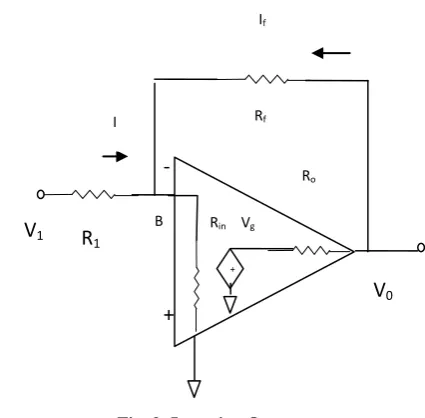
The voltage gain is negative, so it is called as an inverting operational amplifier [18]. It implies that if the input voltage is positive, the output voltage will be negative and vice-versa. The input voltage is applied through the resistor R1 to inverting input terminal as shown in Fig. 3. The Resistor Rf is the feedback resistor which connects from the output to the inverting input.
The voltage gain in the inverting OPAMP is given by
V0=(-Rf/R1)*V1 (1.1)
2.2
Summing Operational Amplifier
The summer circuit actually behaves like the mathematical sum operation [19]. The n-input summer circuit can be shown as Fig. 4. According to the Kirchhoff’s law
I1+I2+...In +If –IB=0
I1+I2+...In +If=IB which can be further written as
(V1 – VB )/R1 +(V2 – VB )/R2+...+(Vn – VB )/Rn+(V0 – VB ) /Rf = VB /Rin
As Vg can be given as Vg= Av(V1Vn), and also V0= -AvVB , so we get
[image:3.595.327.525.76.262.2]V1/R1+ V2/R2+...+ Vn/Rn+ V0/Rf= -V0/AvRp (1.2) where 1/Rp=1/R1+1/R2+...1/Rf+1/Rin
Fig. 3: Inverting Opamp
This operational amplifier has a high voltage gain, so we can consider Av to be infinite. Then the equation (1.2) can be rewritten as
[image:3.595.66.279.443.652.2]V0= -α1V1-α2V2-α3V3-...αnVn (1.3) where αi=Rf/Ri and i = 1, 2, 3,...n.
Fig. 4: Summer Circuit
The example of summation of three voltages is shown in Fig. 5 [20]. In this example three resistances (RI, R2, R3) of 20 kΩ each and Rf = 200kΩ has been used. Thus, α1= α2= α3=10.So the summer implements the equation (1.4) as,
V0 = -10V1-10V2-10V3
3.
THEORETICAL ASPECTS
To simulate the proposed circuit, we can use an analog method by the use of operational amplifiers. An analog method can be applied to find solutions of a number of differential equations, linear equations etc [16].
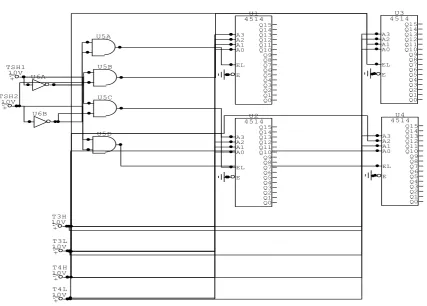
The electronic circuit diagram for the proposed device can be given as in Fig. 5 and Fig. 6. There are six Ideal OPAMPs (U1A, U1B, U2, U3, U4, U5) which have been used for implementation of TSH level interpretation. We have implemented four multimeters so that output of each OPAMP can be watched. The Vs1 represents the TSH level of Human Body. If the output of U3 and U4 are both high (9.984nV) then the TSH level (> 3.0 uIU/mL) is high [21]. If the outputs of both OPAmps are low (4.898V) then the TSH level (<0.3uIU/mL) is low. If the output of U3 is high and U4 is low then the human body is having TSH level in the normal range.
The instance of the circuit shows Vs1 = 0.72V that is the TSH level is between normal range. We are representing the single unit of TSH (1 uIU/mL) by 1V of the voltage supplies used in the Fig. 5). In the given circuit, the ideal OPAMP U5 outputs the negative of input Voltage. Thus, the output represents +TSH.
The ideal OPAMP U1A is a comparator. The comparator compares the linear voltage applied on the negative terminal with the voltage applied on the positive voltage. If the voltage on positive terminal is greater than on the negative terminal, the output is high (9.984 nV), otherwise low( 4.898V). It compares the reference lower limit of TSH that is 0.3 with recorded TSH level. It gives the high output (9.984 nV) because 0.72 > 0.3 as in Fig. 5.
B
1
Ro ut
Rn
V0
Rf
V1
Vn
If
Rin
Vg
R1
I1
In
+
-
-
+
-
Ro ut
Rf
--
+
-
If
Rin
Vg
+
-
-
I
1
B
1
R1
+
-Vs7
3V LM339U1B
+ -Vs6 -5V + -Vs5
+5V IDEALU4
[image:4.595.68.546.78.346.2]DC V 4.898 V + -Vs2 0.3V DC V 9.984nV U3 IDEAL + -Vs4 +5V + -Vs3 -5V U1A LM339 DC V -720.0mV + -Vs1 0.72V U2 IDEAL U5 IDEAL DC V 720.0mV R5 1k R3 1k R2 1k R1 1k R6 1k R4 1k R10 1k R13 1k
Fig. 5: Simulation for comparison of TSH, T3 and T4 using Circuit Maker
+V T4L 10V +V T4H 10V +V T3L 10V +V T3H 10V +V TSH2 10V U6B U6A U5D U5C U5B U5A +V TSH1 10V 4514 A3 A2 A1 A0 EL E Q0 Q1 Q2 Q3 Q4 Q5 Q6 Q7 Q8 Q9 Q10 Q11 Q12 Q13 Q14 Q15 U3 4514 A3 A2 A1 A0 EL E Q0 Q1 Q2 Q3 Q4 Q5 Q6 Q7 Q8 Q9 Q10 Q11 Q12 Q13 Q14 Q15 U4 4514 A3 A2 A1 A0 EL E Q0 Q1 Q2 Q3 Q4 Q5 Q6 Q7 Q8 Q9 Q10 Q11 Q12 Q13 Q14 Q15 U2 4514 A3 A2 A1 A0 EL E Q0 Q1 Q2 Q3 Q4 Q5 Q6 Q7 Q8 Q9 Q10 Q11 Q12 Q13 Q14 Q15 U1
Fig. 6: Circuit for interpretation of type of Thyroidism
Similarly, the ideal OPAMP U1B is a comparator for comparing the higher limit that is 3.0 uIU/mL with the recorded TSH level. In the same way we can construct the circuits for Total T3 and Total T4 [22] and find the possibility
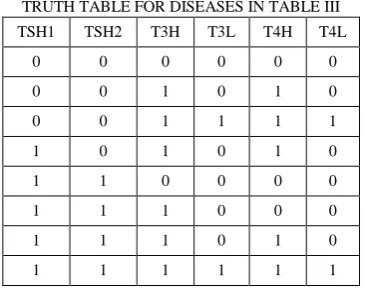
[image:4.595.86.514.375.681.2]TABLE IV
TRUTH TABLE FOR DISEASES IN TABLE III TSH1 TSH2 T3H T3L T4H T4L
0 0 0 0 0 0
0 0 1 0 1 0
0 0 1 1 1 1
1 0 1 0 1 0
1 1 0 0 0 0
1 1 1 0 0 0
1 1 1 0 1 0
1 1 1 1 1 1
4.
CONCLUSION
The possible drawback of any analog computer simulation is so much assumption in deriving the relationships for operational amplifiers [20].It is difficult to get accuracy of measuring a voltage beyond a certain limit. We also have to dedicate an analog computer to one problem. Although there is widespread availability of Digital Computers, analog computers are preferred. The analog representation of a system is often more natural in the sense that it simplifies the implementation of simulation and understanding of the results. The use of analog computers is extended by developments in solid-logic electronic devices [18].
5.
FUTURE WORK
Once the levels of the TSH, T3 and T4 are got and the type of disorder determined. The dosage can be calculated by applying interpolation and curve fitting methods in MATLAB and the corresponding best fitted equations can be implemented in the Circuit-maker [1]. And this is already in progress and being done by the authors.
6. REFERENCES
[1] Xiaobin Tang, ChangranGeng, Feida Chen, Yunpeng Liu, Da Chen Qin Xie, "The Simulation of Effective Dose of Human Body from External Exposure by Monte Carlo Methods,” First International Workshop on Complexity and Data Mining, 2011.
[2] Jose Ramon Alvero, Cruz, Mauro Ronconi, Margarita, Carrillo De Albornoz, Gil, Jeronimo C., Garcia Romero, Daniel Rosado Velazquez, A. Mario De Diego Acosta, Thyroid hormones response in simulated laboratory sprint duathlon, Journal Of Human Sport & Exercise, ISSN 1988-5202, 2011.
[3] Eisenberg M1, Samuels M, DiStefano JJ 3rd., Extensions, validation, and clinical applications of a feedback control system simulator of the hypothalamo-pituitary-thyroid axis, doi: 10.1089/ thy.2007. 0388, 2008.
[4] AACE press release of January 2003.
[5] Walter F., PhD. Boron , Chapter 48, "Synthesis of Thyroid Hormones Medical Physiology: A Cellular And Molecular Approach,” Elsevier/Saunders. p. 1300. ISBN 1-4160-2328-3 2003.
[6] Oylum Şekera, Yaman Barlas and FarukAlagol, “Modeling The Dynamics Of Thyroid Hormones And Related Disorders,” Industrial Engineering Department, Bogaziçi University, and Division of Endocrinology and Metabolism, Department of Internal Medicine, Istanbul Faculty of Medicine, Istanbul University.
[7] I.S. Isa, Z. Saad, S. Omar, M.K. Osman, K.A. Ahmad, H.A. Mat Sakim, "Suitable MLP Network Activation Functions for Breast Cancer and Thyroid Disease Detection," cimsim, pp.39-44, 2010 Second International Conference on Computational Intelligence, Modelling and Simulation, 2010.
[8] A. Mortoglou, H. Candiloros, “The serum triiodo-thyronine to thy- roxine (T3/T4) ratio in various thyroid disorders and after Levoth-yroxine replacement therapy,” Department of Endocrinology, Diabetes and Metabolism, Athens Medical Centre Hospital, Athens, Greece. [9] Leandro Martínez,Milton T. Sonoda,Paul Webb, John D.
Baxter, Munir S. Skaf and Igor Polikarpov,” Molecular Dynamics Simulations Reveal Multiple Pathways of Ligand Dissociation from Thyroid Hormone Receptors,” Biophysical Journal, 2005.
[10] Professor G. Wainer, “Modelling and Simulation of the Human Liver,” Biomedical Applications, Department of Systems and Computer Engineering, Faculty of Engineering, Carleton University.
[11] Georg Hennemann, Roelof Docter, Edith C. H. Friesema, Marion de Jong, Eric P. Krenning and Theo J. Visser, “Plasma Membrane Transport of Thyroid Hormones and Its Role in Thyroid Hormone Metabolism and Bioavailability, Endocrine Reviews”. August 2001, 22(4):451–476.
[12] Modjtaba Rouhani, Kamran Mansouri ,"Comparison of Several ANN Architectures on the Thyroid Diseases Grades,” International Association of Computer Science and Information Technology - Spring Conference, 2009. [13] Jeffrey M. Blaney, Paul K. Weiner, Andrew Dearing,
Peter A. Kollman, Eugene C. Jorgensen, Stuart J. Oatley, Jane M. Burridge, Colin C. F. Blake, Molecular mechanics, Simulation of protein-ligand interactions: binding of thyroid hormone analogs to prealbumin, Journal of the American Chemical Society, 1982. [14] Journal of Clinical Endocrinology and Metabolism,
August 1997.
[15] Granino Arthur Korn and Theresa M. Korn, Electronic Analog and Hybrid Computers, New York: McGraw-Hill Book Company, 1972.
[16] Murray, Francis J., Mathematical Machines, vol.2 Analog Devices, New York: Columbia Press, 1961. [17] Walt Kester, Editor, High Speed Design Techniques,
[18] Robert Paz, Analog Computer Programming
[19] Sergio Franco, Design with Operational Amplifiers and Analog Integrated Circuits, Second Edition, McGrawHill, 1998, pp.17-50
[20] Yash Pal, “An Analog Method to study Average Memory Access time in a compuer system,” Proceedings of the World Congress on Engineering, 2013 Vol II, London, UK, 2013.
[21] Pierre-Frederic Villard, Piers Boshier, Fernando Bello and Derek Gould, “Virtual Reality Simulation of Liver Biopsy with a Respiratory Component.” Imperial College, London, LORIA, Nancy University, Royal Liverpool Hospital, Liverpool.
![TABLE III PERCENTAGE OF BOUND THYROXINE [13]](https://thumb-us.123doks.com/thumbv2/123dok_us/8044555.772318/2.595.48.288.562.681/table-iii-percentage-of-bound-thyroxine.webp)