A Knowledge Discovery Process: Competitive
Intelligence as Dynamic Resource Tool in Defining
Employee Salary
Roland Tumbelaka Palar
Faculty of Information Technology Satya Wacana Christian University Jl. Diponegoro 52 – 60, Salatiga
Danny Manongga
Faculty of Information Technology Satya Wacana Christian University Jl. Diponegoro 52 – 60, Salatiga
Ade Iriani
Faculty of Information Technology Satya Wacana Christian University
Jl. Diponegoro 52 – 60, Salatiga
ABSTRACT
Nowadays, the effort to determine the wages of new employees who are recruits by a company, there are difficulties to make a decision. It is because the influence by many considerations and factors from inside and outside the company. Sometimes the final decision will make one part dissatisfy because the minimum of knowledge and information. Through this research, the uses of competitive intelligence as a tool in knowledge discovery process will be discussed become an alternative solution for helping the company to gain the knowledge and information. Finally, it will help to make a good decision to determine the amount of wages for employees who are recruits.
Keywords
Knowledge Management, Knowledge Discovery, Data Mining, Dynamic Resource Tool.
1.
INTRODUCTION
Employee is one of valuable asset for company to develop products and services [1]. Now, to get the employee or worker is not an easy thing. This is quite reasonable because both of them, is that company and the employee have an interest with each specification. While the interest and specifications which is desire doesn’t have any decision then the agreement between the two sides (employee and company) cannot be achieved. Various measures has implemented by the company. One of the implementation is to lure the employee by giving a good welfare life. However, welfare that gives for the employee doesn’t have clear measurement indicators yet. It has been worth of the view but both of them still have unclear point because the consideration and calculation of the company or high and low level of welfare which is worth is measured by the level of employee satisfaction. As one of the alternatives is that search the knowledge to measure how much wage that will get through the specifications which are owned by the prospective employee for the position and tasks that will accept by them in the future. The level of wages of employees is commonly used as an indicator of welfare. This wage is the remuneration from the company that became a great motivator and also one of the most powerful factors in influencing the level of satisfaction of employees when they work in a company [2]. Therefore, the determination of wages at the beginning is important to be discussed, especially on the part of how companies find the knowledge to set the wage scale.
The knowledge discovery process has many stages in this implementation. Knowledge Discovery Process (KDP) is
called a process of looking for the new knowledge through a variety of processes, there is to identify the truth, identify new things, identify potential things that can be useful or necessary later, and identify patterns in the data [3].
[image:1.595.328.523.449.673.2]In implementation, there are three models of the KDP, such as (1) academic research model, (2) industrial model and (3) hybrid. There are 9 steps on academic research model, is that (1) develop and understand the field of application / application domain, (2) create a target data set, (3) data cleaning and preprocessing, (4) Data reduction and projection, (5) selecting task and data mining, (6) selecting algorithms and data mining, (7) data mining, (8) to interpret patterns of data mining and (9) to consolidate knowledge that was found [4]. In the industrial model, there are six steps which have been defined by the CRISP-DM (Cross Industry Standard Process for Data Mining), such as (1) understand the business, (2) understand the data, (3) preparation of data, (4) modeling, (5) evaluation and (6) development [5].
Fig 1 : KDP for model CRISP-DM (Source: http://www.crisp-dm.org)
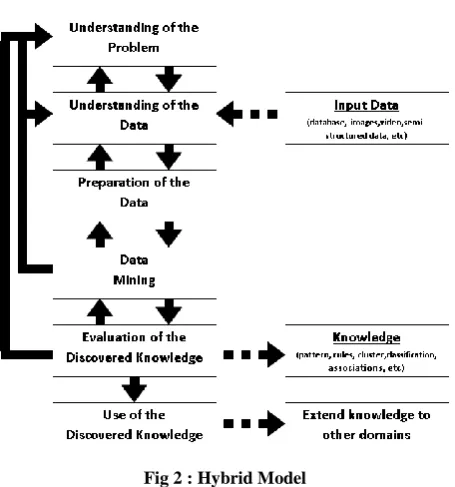
Fig 2 : Hybrid Model
Hybrid model as presented in Fig 2 shows that the differences of the two previous models which lies in (1) the explanation on the general research orientation, (2) data mining more highlighted than the steps of modeling, (3) a feedback mechanism are more detail than CRISP-DM models, and (4) knowledge that is found in certain application areas can be applied to other fields in different applications [6].
Approaching a hybrid model of KDP, found the knowledge of the problem of wage determination for the new employees who are joins in the company has been found a solution. Data mining which is highlighted by the hybrid model provides a variety of data processing techniques to be applied for BI (Business Intelligence) which is part of BI as a source of direct information which is active categories for competitive intelligence that also tools for knowledge discovery process in order to find the knowledge for determine the amount of wages for new employees.
2.
DYNAMIC RESOURCE TOOL
In knowledge discovery, local resources (static resource tool) by the majority realize that is not qualified in produce enough information to get the knowledge. Information can be accessed from anywhere and anytime through the internet and presentation about the content of world wide of web that is dynamic. Web resource becomes part of a dynamic resource tool to generate information that can be processed into knowledge that is useful in achieving a goal. It is also Include the dynamic resource tool, there are: competitive intelligence, virtual representatives and chatter bots, search engine, answer engine and subject tree, case based reasoning (CBR), knowledge bases, knowledge blogs, sales management tool, etc. [7].
3.
COMPETITIVE INTELLIGENCE
Competitive intelligence (CI) is interpret as part of the analysis process that converts all of the information which is scatter about the competitors and consumers becomes information that is relevant, accurate and can be used as strategic knowledge in exploring business opportunities that arise [8].
According Albescu et.al, expressed that the CI is focused on the competitive environment and the use of public resources
to find and develop information about competitors and competition that occur in there. Competitors can be defined as entities that have similar goals and products. In CI, it has to do while monitoring the competitors. There are 4 (four) stages that occur in the monitoring process, is that (1) gathering information (collecting competitor information), (2) convert the information into intelligence, (3) communicate the intelligence, and (4) against actions that harm competitors [ 9].
[image:2.595.316.543.174.309.2]
Fig 3 : The 4C scheme as an approach to Competitive Intelligence (CI)
Refer to fig 3, can be explained bellow.
3.1
Collecting Competitor Information
Gathering the information process must be focused and guided in the corporate business objectives. The purpose is to avoid data collecting that is unbeneficial to achieve the corporate objectives. Information gathering can be done through in variety ways by sources from inside and outside company which has been done by interview, spread the questionnaire until consult with experts and government (see fig 4).
To the environment or area for collecting the information should be diverse and broad so that the information result is more variety and get a lot of comparisons.
[image:2.595.317.542.532.731.2]3.2
Converting Information Into
Intelligence
Data collection process which is not running perfectly will lead output information become less optimal and most likely impact on the result of knowledge, which is not as expected. Therefore, at this stage, the data is arranged in the information catalogs, and then integrated with other information and the last step of this stage, data is analyzed and interpreted. At this final stage, data become intelligence and can lead to ideas, strategies and trends to predict the possibilities that occur in the future.
3.3
Communicating The Intelligence
Intelligence which are obtained in the previous stage, then evaluated and selectively communicated to the parties, which have authorities as decision makers.
3.4
Strategic Analysis of Gathered
Information
At the last stage, which is also the core stage of competitive intelligence, the process of analysis relies on the users’ competence in the use of various analytical models. With precise analytical models selection, the analytical model is able to convert the selected pieces of information into actionable intelligence that are useful and valuable. This stage ends if the products, which are useful and efficient, have been produced for example company profile, industry and market analysis, supplier profiles and so on.
4.
RESEARCH PURPOSE
The purpose of this study was to research the process in finding the knowledge to determine the wages of new employees using competitive intelligence as a part of dynamic resource tool. The finding of this study is expected can be used as input in the design of company’s knowledge management system.
5.
RESEARCH CONTRIBUTION
Contribution made through this research is located on the utilization of competitive intelligence as a dynamic resource tool to support the process of knowledge discovery in finding the knowledge to determine and set the wage of new employees because the conventional way in determining the amount of wages always refer to the standards of government regulations and ability of the company. So, at the end, it always ends with the dissatisfaction among one of the parties. The contribution of this study is expected to minimize the level of dissatisfaction.
6.
RELATED WORK
Here is the overview of several studies related to this research.
Haralampos Karanikas et al describe his research on temporal text mining in Competitive Intelligence to utilize the extraction results in the field of biotechnology and the pharmaceutical industry. In this study, integration done at the level of IE and data mining, in order to obtain the useful pattern contained in the text and then merging the time problems in the process of the text discovery and incorporation of background knowledge through the use of ontologies in the discovery process. Then ontology technique driven is used to find the temporal association in the text. [11].
7.
RESULTS
Fig 5: Knowledge Discovery through competitive intelligence in discovering knowledge in order to determine the amount of the wages of new employees.
The analysis process at this stage is done carefully because the output of the analysis process later will be used as a material consideration in the decision to wage determination in question. Fig 5 shows an illustration of the results obtained in this study.
7.1
Comparisons With Existing
Techniques
Knowledge discovery process using competitive intelligence in defining employee salary has several advantages compare to other existing techniques. Because of the complexity and differences of defining employee salary in countries in the world, we decide to use three existing techniques that most frequently used and compare it one by one.
7.1.1 Salary Survey
We cannot deny that many employees trying to compare his salary to others or compare it with other companies offering and the company also doing the same thing but with a different purpose. There are many salary survey can be found on the Internet. One of this salary surveys is payscale.com. It is an online survey that gathers data from its respondent by asking some questions such as current salary, experience and the workplace. Payscale.com use report from average age of the data points. They are not modified or blend the profile data. About data integrity, all unusual profiles are reviewed by analyst before put it into the database and duplicate entries are deleted [13].
7.1.2 Government Regulation and Companies Culture
Every country has their own regulation about salary and compensation. This policy sometime used as a reference but not all companies have same thought with government suggestion and policy. Companies have culture that can break the entire rule that has been made. They have their salary
range and calculation different from what government proposed. In Indonesia, minimum salary was determined by government using a regulation. [14]
7.1.3 Recruitment System
Salary offering as a part of recruitment system is never apart from tough negotiations. Inadequate data can impact on the difficulty of determining the proper salary which leads to dissatisfaction for either party. Most of recruitment system will ask the candidate to put the information about their last salary, last job position, job location and salary expectation. The data will be store into database. The recruiter or HR will get the report from system.
Fig 6 : Example of online recruitment salary range [15]
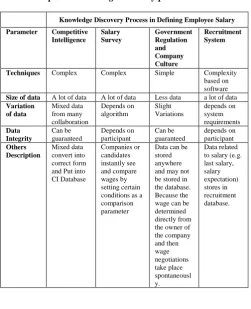
[image:4.595.320.537.548.699.2]Table 1. The comparison between existing techniques as part of knowledge discovery process.
Knowledge Discovery Process in Defining Employee Salary Parameter Competitive
Intelligence Salary Survey Government Regulation and Company Culture Recruitment System
Techniques Complex Complex Simple Complexity
based on software Size of data A lot of data A lot of data Less data a lot of data Variation of data Mixed data from many collaboration Depends on algorithm Slight Variations depends on system requirements Data Integrity Can be guaranteed Depends on participant Can be guaranteed depends on participant Others Description Mixed data convert into correct form and Put into CI Database Companies or candidates instantly see and compare wages by setting certain conditions as a comparison parameter
Data can be stored anywhere and may not be stored in the database. Because the wage can be determined directly from the owner of the company and then wage negotiations take place spontaneousl y. Data related to salary (e.g. last salary, salary expectation) stores in recruitment database.
In Fig 7 below will show the results of the recruitment data integration, data from the government and the magnitude range captured value max, min and average based on the job position, work location, and years now.
Fig 7 : Data result from competitive intelligence
Data conversion and processing results via the concept of competitive intelligence, the next will be discussed by experts, and then analyzed with SWOT analysis technique to find the strength point of knowledge being generated and to look at other impacts that may arise.
8.
CONCLUSIONS
Based on the results of research that has been described above, can be obtained that the knowledge discovery process by utilizing dynamic resource tools with competitive intelligence, generate knowledge from various sources. If the company previously had just received the knowledge derived from the trend of statistical data collected on employee recruitment information systems only, then with competitive intelligence, various data that has been accumulated, will be able to be converted into knowledge with data mining tool and various BI technologies that further communicated expertly
and be analyzed the validity of expert knowledge so that the final output has a great opportunity to have a positive effect in providing the necessary knowledge in determining the wages which is suitable to the expectations of both parties, both the company and employees. But unfortunately, due to the sensitivity of the data generated by this study and in accordance with agreements with some companies that do not want to be identified, the data results cannot be shown to public.
9.
ACKNOWLEDGMENTS
Thanks to Danny Manongga and Ade Iriani and who have helped in guiding and directing me when this study is conducted.
10.
REFERENCES
[1] Crager, B. 2002. Are People Really Our Most Important Asset ?. Energy Houston. Vol 4 No 2, 1-6.
[2] Herzberg, F. 1987. One More Time : How Do You Motivate Employees ?. President and Fellows of Harvard College. Harvard Business Review, 5-16.
[3] Cios, K. J., Pedrycz, W., Swiniarsky, R.W., Kurgan, L. A. 2007. Data Mining A Knowledge Discovery Approach. Springer, XV, 606p.
[4] Fayyad, U., Piatesky-Shapirom G., Smyth, P., and Uthurusamy, R. 1996. Advances In Knowkedge Discovery and Data Mining, AAAI Press, Cambridge [5] Shearer, C. 2000. The CRISP-DM Model : The New
Blueprint for Data Mining. Journal of Data Warehousing, 5(4) : 13-19.
[6] Cios, K., Teresinska, A., Konieczna, S., Potocka, J., dan Sharma, S. 2000. Diagnosing Myocardial Perfusion from SPECT Bull’s-eye Maps – A Knowledge Discovery Approach. IEEE Engineering in Medicine and Biology Magazine, special issue on Medical Data Mining and Knowledge Discovery, 19(4): 17-25.
[7] Zillman, M. 2012. Using The Internet as a Dynamic Resource Tool For Knowledge Discovery.
[8] Albescu, F., Pugna, I., Paraschiv, D. 2007. Business Competitive Intelligence – The Ultimate Use of Information Technologies in Strategic Management, The Bucharest Academy of Economic Studies.
[9] Weiss, A. 2002. A Brief Guide to Competitive Intelligence – Business Information Review, (ISSN 0266-3821) vol 19.
[10]Karim, J. A. 2011. The Value of Competitive Business Intelligence System (CBIS) to Stimulate Competitiveness in Global Market, International Journal of Business and Social Science, Vol 2 No.19.
[11]Karanikas, H., Koundourakis, G., Kopanakis, Ioannis., Mavroudakis, T. A Temporal Text Mining Application In Competitive Intelligence, National & Kapodistrian Univ, of Athens, Knowledge Management Lab, Greece. [12]Sharma, D., Singh, V. 2010. ICT in Universities of the
Western Himalayan Region of India II : A Comparative SWOT Analysis, International Journal of Computer Science, Vol 7, Issue 1 No 3: 62-72.
[13] Payscale.com., Access date 1 March 2013.
[14] Regulation of Indonesian Republic No.13, 2003 about Employment. Issued by Indonesian Goverment [15] Formulatrix online recruitment,
[image:5.595.53.306.451.554.2]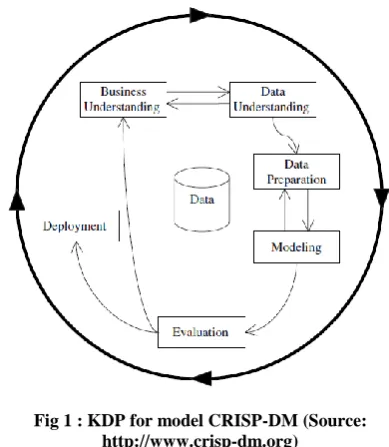
![Fig 6 : Example of online recruitment salary range [15]](https://thumb-us.123doks.com/thumbv2/123dok_us/8082325.782668/4.595.117.497.72.357/fig-example-online-recruitment-salary-range.webp)