Performance Evaluation of Enhanced Interior Gateway
Routing Protocol in IPv6 Network
Kuwar Pratap Singh
Department of Computer Science and Engineering
Jaypee University of Information Technology, Waknaghat, Solan
173 234 INDIA
P. K. Gupta
Department of Computer Science and Engineering
Jaypee University of Information Technology, Waknaghat, Solan
173 234 INDIA
G. Singh
Department of Electronics and Communication Engineering Jaypee University of Information
Technology, Waknaghat, Solan 173 234 INDIA
ABSTRACT
With the explosive growth in communication and network technologies, there is a great demand of IPv6 addressing scheme. However, the modern operating systems has option for this and with the development of IPv6 which removes the limitations imposed by IPv4 and provides the large number of address space. In this paper, authors have considered the Enhanced Interior Gateway Routing Protocol and presented a scenario for its performance evaluation in IPv6 networks and obtained results are highly considerable for the short distance of communication and don’t represent any problem of performance degradation while sending or receiving the data.
Keywords
EIGRP, IPv6, Routing, OSPF, Local Area Network, Wide Area Network.
1.
INTRODUCTION
Recently, a lot of developments have been taken place in computer networks and now it is the necessity that the computer in one geographical location must communicate with another computer located at different geographical location. For doing so, though there are various available alternatives but almost all alternatives require use of Internet Protocol (IP) address to uniquely identify the machine over the network. If the two different computers are in the same location then they can communicate via Local Area Network (LAN), if not, then different available alternatives can be used for connectivity and communication over the networks and Wide Area Network (WAN) is one of them. To communicate over networks, numbers of devices are required and router is one of them and the routing protocol must be configured properly on each router. This routing protocol maintains the routing table which further maintains the shortest path of communication from source to destination. Commonly, this routing protocol is in IPv4 but nowadays IPv4 addresses are depleting so these protocols are now using IPv6 addresses. There are number of dynamic routing protocols (DRP) supported by IPv6 such as RIPng, EIGRP, OSPFv3, IS-IS, and Multiprotocol BGP etc.
In this paper, authors have considered the Enhanced Interior Gateway Routing Protocol (EIGRP) [1, 2, 3] for IPv6 as a routing protocol, which is a Cisco proprietary protocol and uses classless routing schemes based on diffusion update algorithm (DUAL) for calculating a shortest path from source to destination. It also supports unequal path load balancing that is the main reason of its fastest protocol. Its administrative distance is 90 that represent the trustworthiness of protocol. EIGRP selects fastest path based on delay, bandwidth, reliability, and load. For this, smaller size of
packets is transmitted after every 5 seconds to see whether neighbour router is up or not. These packets are sent for various different reasons like:
a) For discovering neighbour,
b) For forming relation with neighbour,
c) For maintaining relation with neighbour.
DUAL algorithm used, includes Successor(S), Feasible Successor (FS), Feasibility Condition (FC), Feasible Distance (FD), and reported distance (RD) [4].
2.
RELATED WORK
according to the network specification, optimal algorithm is selected. Sanjeev et al. [12] presented a comparative analysis of throughput, delay and queue length for the various congestion control algorithms RED, SFQ and REM using NS2 simulator. They also included the comparative analysis of loss rate having different bandwidth for these algorithms. In [13] Nazrul and Ullah designed three network models configured with OSPF, EIGRP to evaluate the OSPF and EIGRP’s performance, and all the three topologies were simulated using the Optimized Network Engineering Tool (OPNET). In this case, the protocols and the combined use of them are also analyzed in terms of convergence time, jitter, end-to-end delay, throughput, and packet loss. The evaluation results show that, in general, the combined implementation of EIGRP and OSPF routing protocols in the network performs better than each one of them alone.
3.
IPv6
IPv6 is a 128 bits or 16 bytes addressing scheme, which is represented by a series of eight 16 bits field separated by colons [14]. The format of IPv6 is x:x:x:x:x:x:x:x ,where x is 16 bits hexadecimal numbers with leading zeros in each x field are optional. Successive x fields with 0 can be represented as :: but only once, for example 2031:0000:0000:013f:0000:0000:0000:0001. Security in IPv6 is inherit, which provides authentication and encryption and has simple header format for higher processing. Here, Table 1 represents the common difference between IPv4 and IPv6.
Table1: Comparison between IPv4 and IPv6
IP Vers ions
Deplo yment year
Add ress Size
Number of addresses available
Format of address
Prefix notatio n
IPv4 1981 32 232=4,294,9 67,296
Dotted decimal notation
192.16 8.0.0/2 4
IPv6 1999 128 2128=approx imately 3.4×1038 addresses
Hexadeci mal notation
2001:a bcd:ab cd::/48
Configuration of IPv6 on router
a) TO enable IPv6 Routing
Router (config) # ipv6 unicast-routing
b) Configure IPv6 address
Router (config-if)# ipv6 address <IPv6 Address>/<prefix>
4.
EIGRP IN IPv6
This is an enhanced distance vector protocol, which relies on the Diffused Update Algorithm (DUAL) to calculate the shortest path to a destination within a network. EIGRP in IPv6 works in the same way as EIGRP in IPv4 but can be configured and managed separately.
4.1
Unchanged Features of EIGRP in IPv6
It’s Cisco proprietary.
Uses Dual algorithm.
Metric composite is same.
Updates are multicast by using multicast address FF02::A.
Authentication
Link bandwidth percentage
Split horizon
Hello interval and hold time configuration.
Address summarization
Stub router
Variance
4.2
Changed Feature of EIGRP in IPv6
The changed features of EIGRP in IPv6 are listed as follows [15]:
Configuration of Interface- Here, interfaces can be configured directly with EIGRP for IPv6, without using the global IPv6 address. There is no network statement in EIGRP for IPv6.
Must no shutdown the routing process- EIGRP for IPv6 has a shutdown feature. The routing process should be in "no shutdown" mode in order to start running.
Router ID- The router ID needs to be configured for an EIGRP IPv6 protocol instance before it can run.
Route filtering- IPv6 EIGRP performs route filtering using only the distribute-list prefix-list command. EIGRP in IPv6 does not support route maps.
No concept of automatic route summarization- EIGRP in IPv4 uses automatic route summarization in classful network but in IPv6 there is no concept of classful networks hence there is no concept of automatic summarization.
5.
Implementation of EIGRP in IPv6
Fig1: Implemented topology for performance evaluation.
5.1 Main configuration command
These are the commands which are used to configure the IPv6 EIGRP protocol on the router 0 and router 1, which can learn the shortest path and deliver the packet between different network through a corresponding shortest path. IPv6 unicast-routing command is used for enabling IPv6 forwarding, which will be the first command as after enabling IPv6 another command can be executed. IPv6 unicast-routing command is configured on the router in its configuration mode and no shut command is mandatory as to start the routing process. The various router configurations are shown as follows:
5.1.1
Router 0 configuration
hostname Router0 !
ipv6 unicast-routing//ipv6 forwarding is enabled// !
interface Fastethernet0/0
ipv6 address 2001:11:11:11::1/64
//configure IPv6 address for interface Fastethernet0/0// no shutdown// Enables no shut mode so the routing process can start running//
ipv6 enable// IPv6 processing on the fastethernet 0/0 interface//
ipv6 eigrp 10// Enables the EIGRP for IPv6 process on the fastethernet 0/0 interface
interface Serial0/0/1
ipv6 address FE80::1 link-local ipv6 address 2010:AB8::1/64
// configure IPv6 address for interface Serial0/0/1//
no shutdown
ipv6 enable// Enables IPv6 processing on the Serial0/0/1 interface//
ipv6 eigrp 10// Enables the EIGRP for IPv6 process on the Serial0/0/1 interface//
clock rate 2000000 !
ipv6 router eigrp 10//eigrp ipv6 routing protocol is enabled//
router-id 2.2.2.2//Router Id is defined//
no shutdown// Enables no shut mode so the routing process can start running//
! end
5.2.2 Router 1 configuration
hostname Router0 !
ipv6 unicast-routing//ipv6 forwarding is enabled// !
interface Fastethernet0/0
ipv6 address 2012:13:13:13::1/64
//configure IPv6 address for interface Fastethernet0/0// no shutdown// Enables no shut mode so the routing process can start running//
ipv6 enable// IPv6 processing on the fastethernet 0/0 interface//
ipv6 eigrp 10// Enables the EIGRP for IPv6 process on the fastethernet 0/0 interface
interface Serial0/0/1
ipv6 address FE80::2 link-local ipv6 address 2010:AB8::2/64
// configure IPv6 address for interface Serial0/0/1//
no shutdown
ipv6 enable// Enables IPv6 processing on the Serial0/0/1 interface//
ipv6 eigrp 10// Enables the EIGRP for IPv6 process on the Serial0/0/1 interface//
clock rate 2000000 !
ipv6 router eigrp 10//eigrp ipv6 routing protocol is enabled//
router-id 1.1.1.1//Router Id is defined//
no shutdown// Enables no shut mode so the routing process can start running//
! end
6.
EXPERIMENTS RESULTS
This section represents the various obtained results for both the router 0 and router 1 in the form of routing table, routing protocol information, IPv6 EIGRP neighbor information, and interface information.
6.1
Routing table
Routing table of router 0 and router 1 as shown in Table 2 and Table 3 maintains the shortest path to other routers. The letter C represents that the routing is directly connected to the router 0. The letter D represents that the routing is local and is done by using EIGRP. The following command shows IPv6-specific EIGRP routes:
Routing table statistics:
IPv6 Routing Table - 6 entries
Codes: C - Connected, L - Local, S - Static, R - RIP, B - BGP
U - Per-user Static route, M - MIPv6
I1 - ISIS L1, I2 - ISIS L2, IA - ISIS interarea, IS - ISIS summary
ON1 - OSPF NSSA ext 1, ON2 - OSPF NSSA ext 2
D - EIGRP, EX - EIGRP external
[image:4.595.54.292.135.290.2]Command: router0#sh ipv6 route
Table 2: IPv6-routing table for router 0.
Codes IP Address LINK
C(Directly connected)
2001:11:11:11::/64 [0/0]
via::, FastEthernet0/0
L(Locally connected)
2001:11:11:11::1/128 [0/0]
via::, FastEthernet0/0
C(Directly connected)
2010:AB8::/64 [0/0] via ::, Serial0/0/1
L(Locally connected)
2010:AB8::1/128 [0/0]
via ::, Serial0/0/1
D(Route learned by EIGRP)
2012:13:13:13::/64 [90/2172416]
via FE80::2, Serial0/0/1
L(Locally connected)
FF00::/8 [0/0]
via ::, Null0
[image:4.595.55.297.333.502.2]Command: router1#sh ipv6 route
Table 3: IPv6-routing table for router 1.
Codes IP Address LINK
D(Route learned by EIGRP)
2001:11:11:11::/64 [90/2172416]
via FE80::1, Serial0/0/0
C(Directly connected)
2010:AB8::/64 [0/0] via ::, Serial0/0/0
L(Locally connected)
2010:AB8::2/128 [0/0]
via ::, Serial0/0/0
C(Directly connected)
2012:13:13:13::/64 [0/0]
via ::, FastEthernet0/0
L(Locally connected)
2012:13:13:13::1/12 8 [0/0]
via ::, FastEthernet0/0
L(Locally connected)
FF00::/8 [0/0] via ::, Null0
6.2
Routing protocol information
The routing protocol information shows that EIGRP IPV6 routing protocol has been established and assigned process ID is 10. EIGRP is enabled on interface fast Ethernet0/0, serial0/0/0 and serial0/0/1.Maximum hop count supported by EIGRP is 100.
Command: router0#sh ipv6 protocol
IPv6 Routing Protocol is "connected" IPv6 Routing Protocol is "static IPv6 Routing Protocol is "eigrp 10 "
EIGRP metric weight K1=1, K2=0, K3=1, K4=0, K5=0
EIGRP maximum hopcount 100 EIGRP maximum metric variance 1 Interfaces:
FastEthernet0/0 Serial0/0/0 Serial0/0/1
Redistributing: eigrp 10 Maximum path: 16
Distance: internal 90 external 170
Command: router1#sh ipv6 protocol
IPv6 Routing Protocol is "connected" IPv6 Routing Protocol is "static IPv6 Routing Protocol is "eigrp 10 "
EIGRP metric weight K1=1, K2=0, K3=1, K4=0, K5=0
EIGRP maximum hopcount 100 EIGRP maximum metric variance 1 Interfaces:
FastEthernet0/0 Serial0/0/0 Serial0/0/1
Redistributing: eigrp 10 Maximum path: 16
Distance: internal 90 external 170
6.3
IPv6 EIGRP neighbor information
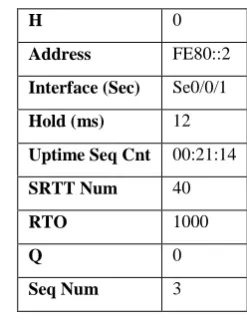
The obtained results also display the neighbors discovered by the EIGRP IPv6. It shows the link for local addresses of router0 and router1. These results are listed in Table 4 and Table 5.
[image:4.595.362.486.386.548.2]Command: router0#sh ipv6 eigrp neighbour
Table 4: IPv6-EIGRP neighbors for process 10(router 0)
H 0
Address FE80::2
Interface (Sec) Se0/0/1
Hold (ms) 12
Uptime Seq Cnt 00:21:14
SRTT Num 40
RTO 1000
Q 0
Seq Num 3
Command: router1#sh ipv6 eigrp neighbour
Table 5: IPv6-EIGRP neighbors for process 10 (router 1)
H 0
Address FE80::1
Interface (Sec) Se0/0/0
Hold (ms) 14
Uptime Seq Cnt 00:22:23
SRTT Num 40
RTO 1000
Q 0
6.4
IPv6 EIGRP Interface information
The EIGRP IPv6 interface information displays information about the interfaces configured for EIGRP in IPv6 for both the routers 0 and 1 and displayed in Table 6 and Table 7.
[image:5.595.314.552.86.315.2]Command: router0#show ipv6 eigrp interfaces
Table 6: IPv6-EIGRP interfaces for process 10 using router 0. Interfa ce Peers Rout es Xmit Queu e Pend ing Un/R eliabl e Mea n SRT T Pacin gTim e Un/R eliabl e Multica st Flow Timer Pe nd in g ro ut es Fa0/0 Se0/0/1 0 1 0/0 0 1236 1236 0/0 0 0/10 0/10 0 0
The output of this command displays information about interfaces configured for EIGRP in IPv6. For router 0 two interfaces Fa0/0 and Se0/0/1 are configured and the command determines which interface of EIGRP is active.
Command: router1#show ipv6 eigrp interfaces
Table 7: IPv6-EIGRP interfaces for process 10 using router 1. Interfa ce Peers Rout es Xmit Queue Pendin g Un/Rel iable Mea n SRT T Pacing Time Un/Rel iable Mult icast Flow Tim er Pend ing rout es Se0/0/0 Fa0/0 1 0 0/0 0/0 1236 1236 0/10 0/10 0 0 0 0
The output of this command Displays information about interfaces configured for EIGRP in IPv6.For Router 1 two interfaces Fa0/0 and Se0/0/0 are configured and the command determines which interface of EIGRP is active.
6.5
EIGRP IPv6 Topology information
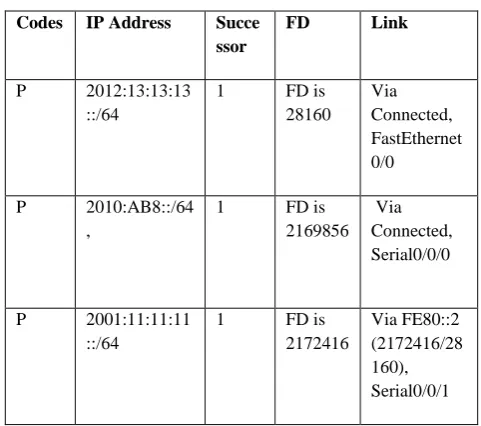
To display output of the EIGRP IPv6 topology table, authors used the EIGRP IPv6 topology command in privileged EXEC mode. The following EIGRP IPv6 topology command can be used to determine diffusion update algorithm (DUAL) states and to debug possible DUAL problems. Here, obtained results are displayed in Table 8 and Table 9.
Codes: P - Passive, A - Active, U - Update, Q - Query, R - Reply, r - Reply status
[image:5.595.313.554.389.602.2]Command: router0#sh ipv6 EIGRP topology
Table 8: IPv6-EIGRP Topology Table for AS 10/ID(2.2.2.2)
Codes IP Address Succe ssor
FD Link
P 2001:11:11:11 ::/64
1 FD is 28160
Via Connected, FastEthernet 0/0
P 2010:AB8::/64 ,
1 FD is 2169856
Via Connected, Serial0/0/1
P 2012:13:13:13 ::/64
1 FD is 2172416
Via FE80::2 (2172416/28 160), Serial0/0/1
Command: router1#sh ipv6 EIGRP topology
Table 9: IPv6-EIGRP Topology Table for AS 10/ID(1.1.1.1)
Codes IP Address Succe ssor
FD Link
P 2012:13:13:13 ::/64
1 FD is 28160
Via Connected, FastEthernet 0/0
P 2010:AB8::/64 ,
1 FD is 2169856
Via Connected, Serial0/0/0
P 2001:11:11:11 ::/64
1 FD is 2172416 Via FE80::2 (2172416/28 160), Serial0/0/1
7.
CONCLUSION
[image:5.595.48.293.397.568.2]8.
REFERENCES
[1] Albrightson, R., Garcia-Luna-Aceves, J. J., and Boyle, J. 1994. EIGRP: A Fast Routing Protocol Based on Distance Vectors. In Proceedings of the Networld/Interop 94. 1-13.
[2] Ivan P. 1999. EIGRP network design solutions. CiscoPress.
[3] Zhengyu X., Sa D., and Garcia-Luna-Aceves, J. J. 1997. A more efficient distance vector routing algorithm. In Proceedings of the MILCOM. 993 – 997.
[4] Chuanqiang Z., Yuanan L., and Kaiming L. 2009. A More Efficient Diffusing Update Algorithm for Loop-Free Routing, In Proceedings of the WiCom '09. 1 – 4. 2
[5] Narisetty, S. K., and Balsu, S. K., “Performance Comparison of EIGRP and ISIS/RIP Protocols,” International Journal of Research and Reviews in Ad Hoc Networks 2011.,vol. 1, no. 2, March 2011, 63-66.
[6] Yehia, M. A., Aziz, M. S., and Elsayed, H. A., “Analysis of IGP Routing Protocols for Real Time Applications: A Comparative Study”, International Journal of Computer Applications, 2011. vol. 26, no.3, 11-17.
[7] Jian, S., and Fang, Y. Y. 2011. Research and Implement of OSPFv3 in IPv6 Network, In Proceedings of the CSQRWC, Conference on Cross Strait Quad-Regional Radio Science and Wireless Technology Conference. 743 – 746.
[8] Wijaya C. 2011. Performance Analysis of Dynamic Routing Protocol EIGRP and OSPF in IPv4 and IPv6 Network. In Proceedings of the ICI, International Conference on Informatics and Computational Intelligence, 355 – 360.
[9] Thorenoor S. G. 2010. Dynamic Routing Protocol implementation decision between EIGRP, OSPF and RIP based on Technical Background Using OPNET Modeler. In Proceedings of the ICCNT, International Conference on Computer and Network Technology. 191 – 195.
[10]Jaafar, Riley, T. M., Reddy, G. F. and Blair, D. 2006. Simulation-Based Routing protocol Performance Analysis - A Case Study. In Proceedings of the WSC’06 Winter Simulation Conference. 2154 – 2161.
[11]Kalyan, G.P.S, and Prasad, D.V.V. 2012. Optimal selection of Dynamic Routing protocol with real time case studies. In Proceedings of the RACSS, International Conference on Recent Advances in Computing and Software Systems. 219 – 223.
[12]Sanjeev P., Gupta P.K., Arjun G.,Prateek M., and Manish C., “Comparative Analysis of Congestion Control Algorithms Using ns-2”, International Journal of Computer Science Issues, 2012. Vol. 8, Issue 5, No 1, 89-94.
[13]Nazrul, M., and Ullah, M. A. 2010. Simulation Based EIGRP over OSPF Performance Analysis, Master Thesis in Electrical Engineering Emphasis on Telecommunication, Blekinge Tekniska Hogskolan. Sweden.
[14]Deering, S., and Hinden, R. 1998. RFC 2460, Internet Protocol, Version 6 (IPv6) Specification. 1-39.