© 2015, IRJET ISO 9001:2008 Certified Journal Page 2459
POWER LOAD MANAGEMENT
Techniques and Methods in Electric Power System
Montaser .Atta . kassem
1, Abdelfatah Ali Elahwil
21
Department of Electrical Engineering ,Higher Institute of Inclusive Professional - ,ben Walid, Libya
2
Department of Electrical Engineering ,Higher Institute of Inclusive Professional - ,ben Walid, Libya
---***---Abstract :
The growth in the demand for electricity in Libya during the last decade witnessed a dramatic growth in the national's annual residential development has played a major role in boosting the demand for electric power. The domestic sector in Libya already accounts for approximately 39 percent of electricity demand. To meet the projected demand for electrical power to cope with, the development plans, increases in the population and the rising in the living standards, government will have to accomplish new power generating units. Comparing with the high budget of constructing new generating power units, load management system it would be attractive resource that should be seriously considered as an important part of national energy program, where demand growth rate exceeds the supply since it is playing an increasing role around the world as a valuable and cost-effective energy resource. Hence, was light projecting on power load management program, for its benefit in reducing the energy demand at peak time.
Key Words:
Load Management, Maximum Demand,
Demand Factor, Tariffs, Peak Demand Valley Filling,
Load Shifting ,Load Reduction.
1.
INTRODUCTION
Electricity is characterized by the fact that its production and consumption act nearly at the same time. Furthermore electricity cannot be stored in large quantities. This means that power generation must match demand alteration, whereas demand is affected by climate, economic growth and customers' consumption patterns. These factors make the demand to fluctuate at different time. Utility must invest in the generation plant and equipment to keep enough net peaking capability
according to the system maximum demand. If the utilities do not impose any system measures, there will be a serious imbalance in power supply and demand. Excessive or insufficient investment will lead to idle asset or create power shortage problems that will be uncomfortable to both suppliers and customers. The system is referred to the “Demand Side Management”.
Demand side management is the effective, efficient and economic use of energy by an organization. It relates to all forms of energy; electricity, gas, solar, diesel, petrol etc. The researcher will concentrate only on electrical energy. Demand side management is a method of containing and reducing the overall cost of energy.
By establishing a demand side management program, an organization should aim to conserve all forms of energy by eliminating waste and encouraging the efficient use of energy. The financial benefits of a successful demand side management can be quite large. Energy is one of the factors of production over which a company has some control and soundly based demand side management program is a means of reducing operating costs, increasing profits and remaining competitive. In non-profit organization such as government utilities, hospital and university, demand side management can be a way to stretch a very limited budget.
Will look through this study at how demand side management applies to raise power operation efficiency, to minimize the cost of electricity and as well as maintaining the comfortable level of working and studying atmosphere, especially based on the following points:
© 2015, IRJET ISO 9001:2008 Certified Journal Page 2460
2. The changes of rate of electricity cost (Peak time operation costs triple of low peaks operation).
2. CONCEPT OF POWER LOAD MANAGEMENT
The load management is a new concept of distribution of electricity aiming at a more efficacious supply network system. Such a control system should satisfy the needs of consumers at the lowest possible peak loading. There is a strong upward tendency in using load management throughout the world. The direct load management systems have passed through the experimental stage and have been now adapted as an everyday practice is a great many of supply network systems. The economic grounds for introduction of these systems have been justified throughout the world and also certain. The load management is a process going along with electricity conservation which decreases total electricity consumption, while the load management is intended for consumption control over a certain period of time .
Load management is defined as sets of objectives designed to control and modifies the patterns of demands of various consumers of a power utility. This control and modification enables the supply system to meet the demand at all times in most economic manner.
3.TERMS DEFINITION FOR POWER SYSTEM
EVALUATION
In order to understand the concept of load management clearly, some basic definitions in electric power systems are discussed .Connected load is the rating (in kW) of the apparatus installed on consumer premises .Maximum demand is the maximum load (in MW), which a consumer uses at any time .Demand factor is the ratio of the connected load to maximum demand .
4. POWER LOAD MANAGEMENT – SUPPLY AND
DEMAND
Load management does not aim to decrease the overall electricity consumption, rather approaches (or replies to) the consumption pattern. It could be applied both on energy demand and on supply sides:
4.1 Supply-Side Load Management
This management is defined as the measure, which is taken at the supply side to meet the demand. The concept has been very popular in the seventies of the twentieth century. If the society demanded more power, the power
companies would simply find a way to supply users even by building more generation facilities. This was the essence of the concept.
4.2 Demand-Side Of Power Load Management
This management describes the planning and implementation of activities designed to influence customers in such a way that the shape of the power load curve of the utility can be modified to produce power in an optimal way. Peak clipping and load shifting from peak to off-peak period’s techniques are used to achieve these purposes. Demand side load management includes not only technical or economic but social measures as well, since it is directly related to the behavioral issues .
5. TECHNIQUES OF POWER LOAD MANAGEMENT
The selection of the load shape objective is determined by the number of the supply side constraints. Some of these constraints may be whether the system is energy constrained, reliability of the system, the need for schedule maintenance and the state of distribution and transmission system. There are three basics types of load shape changes:
5.1 Peak Clipping:
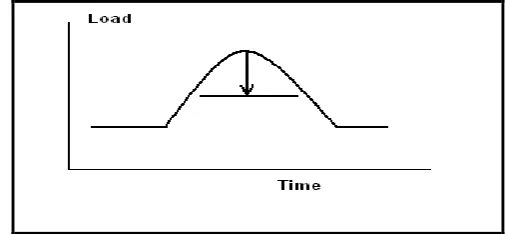
Peak clipping means reduction load during peak period to get the load profile as desired by the utility. This voltage reduction on the part of consumers is directly controlled
by the utility and is usually enforced at peak time’s i.e. When usage of electric appliances by consumers is at its maximum .The shape of load profile through the peak clipping technique is shown in figure (2).
Figure (2): Peak clipping .
[image:2.595.313.566.578.695.2]© 2015, IRJET ISO 9001:2008 Certified Journal Page 2461
utilities that do not possess enough generating capabilities during peak hours .
5.2 Valley Filling
Valley Filling is the second classic form of load profile shape change techniques. It builds loads during the off-peak period. The shape of load profile through valley filling technique is given by figure (3).
Figure (3) : Valley Filling .
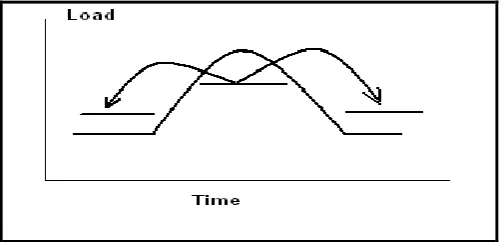
5.3 Load Shifting :
The third technique of load shape change is load shifting which moves peak loads to off peak time periods without necessarily changing overall consumption. Load shifting combines the benefits of peak clipping and valley filling by moving existing loads from on peak hours to off peak hours as in figure (4) .
Figure (4): Load Shifting .
This technique best suits utilities and customers when incremental cost of electricity is less than the average cost of electricity. Adding load at the right price can reduce the average cost of electricity to all consumers and improve system load factors. One of the most promising methods of valley filling is off-peak industrial production, which displaces loads served by fossil fuels with electricity .
6. METHODS OF IMPLEMENTATION OF POWER
MANAGEMENT
The electricity consumption can be controlled in two ways :
1) Direct Control Load Management (DLC).
2) Indirect Control Load Management (IDLC).
6.1 Direct Control Load Management (DLC)
Direct load management is achieved by the utility directly disconnecting, reconnecting, or modifying the operation of the end-use electric devices. LM implementation requires additional equipment installed on the consumer site for controlling demand .
Loads can be interrupted either by the utility, through a remotely activated signals or locally at the consumer premises. Utility remote control produces more predictable results and involves the use of a communication system. Local control involves the voluntary use of time clocks by consumers to alter their equipment usage in response to price signals or incentives .
Weather sensitive loads are the targets of direct load control, of which air-conditioning (A/C) units and Water heaters (W/H's) were selected for cycling strategy. Although W/H's loads are not large they can influence load changes. Water pumping imposes a major influence on the electric supply system, and their loads have a notable effect on increasing system peak load.A survey of a small sample of A/C unit owners, which was done as part of this work, has shown an increase of electricity consumption in the summer months due to A/C load. An average of 8 hours/day of A/C units in service was recorded including peak hours.
6.1.1 A/C units operation:
Air conditioning load is a function of outside temperature. High temperature requires more heat removal, which increases the run-time of the A/C units and thus the average demand in the period considered.
[image:3.595.30.277.229.344.2] [image:3.595.30.282.494.615.2]© 2015, IRJET ISO 9001:2008 Certified Journal Page 2462
A/C load is known, then the natural peak duty cycle of A/C units could be calculated from the equation :
Natural peak duty cycle (%) = ( maximum demand / Connected load) × 100 …………... (1)
Once the natural peak duty cycle is known one can estimate the potential contribution from various cycling strategies by calculating the load relief as function of imposed strategy and natural duty cycle as :
Load Relief (LR)=(1 - (Imposed strategy/ Natural duty) × maximum demand)…...…... (2)
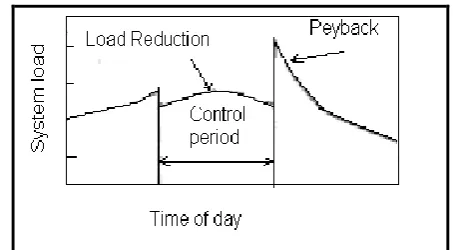
The operation of an imposed duty cycle programme will affect the natural duty cycle of the air conditioner, immediately after the conclusion of the program's operation, as illustrated in Figure (5) .
Figure (5): Air-condition Cycling System Load Impact .
6.1.2.Water heaters operation
Electricity demand for water heating is a function of hot water use. Water heaters have an inherent storage capacity, which means that an interruption of electric service does not necessarily translate into interruption of available hot water. The amount of demand reduction available from a water heater at any time is a function of the electrical demand of the water heater at the time of interruption. Utilities with wide range experience in water heating control report that about four hours of interruption per day can be sustained.
Once control has been exercised, each water heater under control begins to lose temperature, even without any quality of hot water withdrawn, which triggers a thermostat to demand electrical energy for heating. This payback phenomenon can cause serious operating problems if not handled properly. These problems can be
avoided by dividing the controlled units into groups according to the selected cycling strategy, and this was done in this work.
6.1.3 Water Pumping Operation
The water pumping system includes both irrigation and drinking water. Its load is seasonal due to the large demand of water during the hot summer and the fact that winter rainy season offsets irrigation needs. The water-pumping network consists of different water-pumping stations. Each station has a number of pumps of different capacities.
6.2 Indirect Control Load Management (IDLC)
Indirect load control is based on economical measures. Different tariffs and pricing mechanisms are introduced in order to encourage customer to optimize load demand. Indirect Control Load Management (IDLC) allows the customers to control their demand independently according to the price signals sent by the utilities serving the energy services .
Usually, a utility's costs vary by time, e.g. by time of day, time of week or time of year. This variation of costs occurs because of the specific situation of the electricity generation – production always has to meet demand – and there is no cost-effective way to store electricity. Although production costs vary by time, conventional tariffs are flat tariffs based on average costs that mean they do not reflect the "true" costs of generation. During on-peak periods customers pay the same price for their electricity consumed as at off-peak periods although the generation costs are much higher.
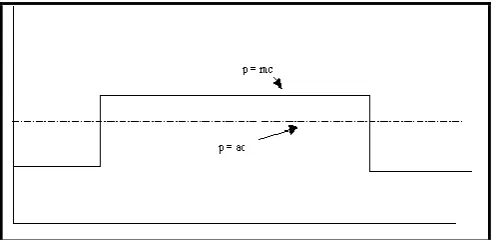
This leads to a cross-subsidization from on-peak periods by off-peak periods. Thus, when electricity prices are based on average costs, customers do not get the correct price signal. This is typically for regulated electricity markets where utilities try to deploy excess capacity. In Figure (6), this problem is sketched: When the electricity price equals the average production costs all types of generation units (base, peak) with corresponding generation costs (Cbase < Cpeak, mc < Cpeak, ac) are needed to
[image:4.595.46.273.343.468.2]© 2015, IRJET ISO 9001:2008 Certified Journal Page 2463
Customers who agree to a time-dependent tariff need an electronic meter instead of the conventional Ferraris meter.. This price reduction made it financially attractive for utilities to offer the consumer such time-dependent programme as well as the metering devices they require .
Figure (6) Peak-load problem and cross-subsidization under a regulated (average cost based (ac)) versus a competitive (marginal cost based (mc)) electricity price .
The idea of time-dependent tariffs, such as Time-of-Use tariffs or Real-Time-Pricing, is based on the marginal cost principle. In the following sections Time-of-Use rates and Real-Time-Pricing are discussed.
6.2.1 Time-Of - Use (TOU) Tariffs
Time-of-Use (TOU) rates can be structured in a variety of ways, depending on the utilities' costs and the type of customers. While small customers (e.g. households) prefer a simpler rate structure, large industrial customers often have an energy manager and, therefore, prefer a more complex tariff structure if the electricity bill can be reduced .
TOU rates have predetermined pricing periods and rates and thus, do not always reflect the marginal costs of generation, but they are a right step in the direction of marginal cost based pricing.
Commonly, TOU rates have on-peak and off-peak periods varying by time of day and time of week (weekday or weekend). Some utilities offer also TOU rates varying by season. TOU rates are predicted over a certain period (e.g. a year), that is the customers know the time and the corresponding prices of on-peak and off-peak periods a year ahead. When designing TOU rates utilities have to determine their costs and convert their costing periods into rating periods.
Nevertheless, rating periods may differ from costing periods, because :
(i)On-peak periods, which are expensive for the customers may be too long to allow them the opportunity to shift their demand or
(ii) There may be too much costing periods for the consumer to remember.
TOU rates have to be designed in a way that both utilities and consumers benefit. Therefore, consumers need an off-peak period that they can shift their electricity demand. The time of these off-peak periods depends on the targeted customer group. While some types of industrial customers can shift parts of their demand . An off-peak period during the night-time does not lead to an advantage for those customers. When implementing TOU rates, a utility may benefit from a decreased on-peak demand and an improved load-curve and as a consequence from lower generation costs. Not only the utility but also the consumers can benefit mainly from a reduced electricity bill if they can shift electricity demand from on-peak to off-peak periods.
6.2.2 Real -Time Pricing (RTP)
RTP goes one step further. Both TOU and RTP are time-dependent tariffs, but the main difference is that TOU rates have predefined on-peak and off-peak periods and rates, whereas in RTP rates there is no defined peak period with a predetermined corresponding price. RTP rates are forecasted near the time (e.g. one day ahead) they go into effect .
Real-time rates are based on the marginal cost of supplying electricity. Therefore they can vary hourly. Thus, real-time rates increase economic efficiency by providing the consumers with the "correct price signal"; i.e. prices that reflect marginal costs.
Many RTP programs use the actual billing history of a customer to develop a baseline, the customer baseline (CBL), of his hourly electricity demand. This customer baseline represents what a consumer would have paid on non-RTP rates for that historical usage. If electricity demand in any hour varies from this baseline, the consumer pays the hourly RTP price for usage above the baseline or he receives a credit for consumption reduction at the hourly RTP price for usage below the baseline. Thus, in principle in time period the customers' bill equals :
Customers' bill = Pmc (t)*[dactual (t) – dCBL (t)]…... (3)
Where:
[image:5.595.30.278.185.305.2]© 2015, IRJET ISO 9001:2008 Certified Journal Page 2464
dactual (t) ... actual electricity consumption in period (t).
dCBL (t) ... customer baseline in period (t).
The monthly electricity bill is the sum over all periods in this month. The consumer benefits from a lower electricity bill when he reduces electricity demand in times when the price is high and shifts this demand into low-pricing periods.
Some utilities combine RTP programmer with interruptible loads. In these programs a customer subscribes a certain level of his electricity demand as an interruptible load, i.e. he has to interrupt this amount of electricity demand when the utility calls it. When an interruption is called he can earn additional benefits from reducing his electricity consumption below the subscribed interruptible level. If such a customer is not able to reduce his electricity demand below the subscribed level he has to pay the marginal price for the difference between the actual and the subscribed demand. Moreover, he often has to pay a penalty. In those periods when an interruption is called (ti) equation (4) must be modified to be:
Customers' bill (ti) = Pmc(ti)*[dactual(ti) – dsi(ti)] ...… (4)
Where:
dsi(ti) ... subscribed interruptible level in period ( ti).
7. POWER LOAD MANAGEMENT BENEFITS
The power load management has many benefits as discussed in the following sections:
7.1 Production Cost savings:
The total production cost saving for A/C units can be calculated from the hourly demand reduction and the hourly levelized production costs.
7.1.1 Calculate The Hourly Demand Reduction
The hourly demand reduction can be calculated from the equation (5) :
( )
( )/1000 22 ) ( 1
1 F T N F T C T
N I
MW
….(5)
Where :
2 1,N
N ……are the number of window and central type A/C
unit respectively.
) ( ),
( 2
1T F T
F ….load consumption, as a function of
temperature, for window, and central type A/C unit respectively, Kw
C(T)……..percentage of A/C units running as function of
temperature.
7.1.2 Calculate The Hourly Levelized Production
Costs:
By using the following equations, the hourly levelized production costs may be calculated by :
U
old
i
old
MWi
C
iold
..
..
……… (6)U
new
i
new
MWi
C
inew
..
..
………..(7)Where:
inew iold
C
C
,
..Are the production cost before and aftercontrol, respectively, $
inew MW iold
MW , ….System loads at hour (i) before and after
control, MW.
inew iold
,
…System incremental cost at hour (i)before and after control.
And the cost levelizing factor can be calculated from the equation (9).
(1 ) 1
) ( ) 1 ( * 1 1 1
nn
r a r r r r a U ……….. (8) Where:
r…discount rate (%).
© 2015, IRJET ISO 9001:2008 Certified Journal Page 2465
n…number of levelizing years .
7.1.3 Calculate The Total Production Cost Saving
Stot ($) For The Total Number Of Control and
Payback Hours (N):
The total production cost saving can be calculated from this equation :
Ni N
i i
tot
S
Ciold
Cinew
S
1 1
)
(
……….….(9)
The total production cost savings for water heaters and water pumping are calculated in the same way as for the A/C units except that as the equations (11) & (12) :
(1) Water heaters:
1000
/
)
(
H H D Si
N
C
F
F
MW
………...(10)Where:
NH….number of water heaters under control.
CH….nominal capacity of water heater (Kw).
FD…time of day factor when control is imposed.
FS….seasonal factor when control is imposed.
(2) Water pumping:
M
j
w pj
i C F
MW
1
* 1000
1
……(11)
Where: Cpj…. nominal capacity of pumping(kW)
M…..number of water pumps under control.
W
F …correction factor to adjust the pump capacity to its
actual average.
7.2 Generation Capacity Cost Savings:
Since lowering the peak load reduces the need for future capacity additions, load control receives a capacity credit for deferring future capacity additions. In order to determine accurately the effects of peak load reduction on a generation system, consideration must be given to maintaining system's reliability. This leads to a factor designated as the Capacity Response Ratio (CRR) which is the ratio of the change in the system capacity to the change in the system load at a constant reliability. Using the hourly loss of load probability for the power system CRR. The capacity cost savings SC ($) are calculated from equation (12) :
CRR
Lcc
MW
S
c
1000
*
(
)
max*
*
……….…(12)
Where :
(MW )max…MW reduction at maximum demand.
Lcc….levelized capacity cost $/kW/year.
7.3 Power System Losses Reduction
The average system losses in Libya are about 30% of the total..generation. The total system losses savings SL ($) is calculated from equation (13):
U Losses
MW
SL
i* *
i*………. (13)
Where:
i ……..system incremental cost at hour (i).7.4 Lost revenue due to lower energy sales
As the load control reduces the delivered energy it leads to less revenue collected from consumers. The lost energy
© 2015, IRJET ISO 9001:2008 Certified Journal Page 2466
Ler
MWh
R
N
i
L
*
1
………. (14)
Where: Ler ……levelized energy rate ($/MWh).
7.5 Load Management Equipment Expenses
Besides the load management LM equipment capital cost, there are the equipment operation and maintenance expenses (EO&M). The primary cause of LM equipment operation and maintenance expenses is the repair of the residential receivers :
Eo&M=Failure rate*Levelized Repair Rate*Number of Units...(15)
7.6 Consumer Incentive Costs
The annual incentive payments (IP) are calculated from :
IP =consumer incentive * number of consumers ……….. (16).
8. Conclusion:
This study investigates the effectiveness of load management techniques & methods in electric power system. It aims to highlight the fact that electric utilities worldwide can provide reliable and efficient service to their consumers in most economical manner by adopting various load management techniques.
Different utilities around the world apply different load management techniques to improve the load profile of their power system.
These techniques are mostly implemented by utilities with the co-operation of the customers.
In today’s modern world energy management is an important issue. The successful management of load yields various benefits. The management of load in electric power system benefits both power utilities and their customers and also saves environment from unnecessary pollution.
REFERENCES
[1] Sarosh Talukdar and Clark W. Gellings, Load Management , IEEE Press, 1984 editorial board .
[2] Abdul H. Samra and Mario. ‘Load management implementation, a method of improving financial performance in power system,’IAS’95 conference record of the 1995 IEEE industry application conference p.2249-54 vol.53.
[3] “Load Management”,M.A. Ekhlat, M.M. El-madhoun. S.S. Ben Nasair and M.A. El-Zaidi, Energy and life Journal No. 7.Sept 1996(in Arabic)
[4] [Sorri and Salo, 1992] V.Sorri and T.Salo. Infl uence of the cost control tariffs on the control of electricity consumption in Finland. In Proceedings of DA/DSM’92,January 1992.
[5] [ Talukdar and Gellings,1987] S. Talukdar and C.w. Gellings. Load Management. IEEE Press. New York, 1987.
[6] [Wafa,1996] A.R.A Wafa. Optimum load management securing minimum revenue loss in industry. In Proceedings of DA/DSM ‘ 96. Pen Well Conferences and Exhibitions, October 1996.
[7] J. Skeer, “Highlights of the International Energy Agency Conference on Advanced
Technologies for Electric Demand-side
Management,” in Proceeding of Advanced
Technologies for Electric Demand-side Management, Sorrento, Italy: International Energy Agency, 1991.
[8] C. W. Gellings, and J. H. Chamberlin, Demand-side Management: Concepts and Methods. Lilburn, Georgia: Fairmont Press, Inc., 1993.
[9] J. Chen, F. N. Lee, A. M. Breipohl, R. Adapa, “Scheduling Direct Load Control to Minimize System Operational Cost,” IEEE Trans. Power Systems, Vol. 10 November 1995.
[10] A. I. Cohen, J. W. Patmore, D. H. Oglevee, R. W. Berman, L. H. Ayers and J. F. Howard, “An Integrated System for Load Control,” IEEE Trans. Power
Systems, Vol. PWRS-2, No. 3, August 1987.