Effects of fluid dynamic forces on vascular cell
adhesion.
K Konstantopoulos, L V McIntire
J Clin Invest.
1996;98(12):2661-2665. https://doi.org/10.1172/JCI119088.
Perspective
Find the latest version:
Perspectives Series:
Cell Adhesion in Vascular Biology
J. Clin. Invest.
© The American Society for Clinical Investigation, Inc. 0021-9738/96/12/2661/05 $2.00
Volume 98, Number 12, December 1996, 2661–2665
Effects of Fluid Dynamic Forces on Vascular Cell Adhesion
Konstantinos Konstantopoulos and Larry V. McIntire
J.W. Cox Laboratory for Biomedical Engineering, Institute of Biosciences and Bioengineering, Rice University, Houston, Texas 77251-1892
Cell adhesion plays a key role in a number of diverse biologi-cal processes, including inflammation and thrombosis. In the cardiovascular system, cells are exposed constantly to hemo-dynamic forces due to the flow of blood. Cell attachment to vessel wall depends on the balance between the dispersive hy-drodynamic forces and the adhesive forces generated by the interaction of membrane-bound receptors and their ligands. Understanding the complex interplay among blood flow, cell adhesion, and vascular biology at the molecular level is crucial for developing specific approaches for altering vessel pathol-ogy. The extravasation of leukocytes from the vasculature to the tissue space is the pivotal event of the immune response and represents a relevant example of this dynamic adhesion process.
The multistep process of leukocyte extravasation: the neutrophil model
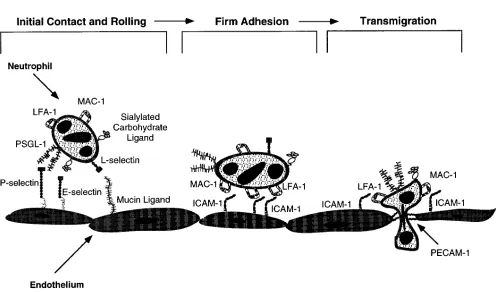
Upon activation the endothelium begins displaying specific ad-hesion molecules that bind free-flowing neutrophils (initial contact), slowing them down and causing them to roll in the di-rection of flow through labile contacts with the vessel wall (rolling). Initial contact and rolling of neutrophils along the endothelium are mediated predominantly by a class of adhe-sion molecules called selectins (Fig. 1). Selectins are trans-membrane, carbohydrate-recognizing glycoproteins that con-stitute a family with three known members: E- and P-selectin expressed on activated endothelium, and L-selectin constitu-tively expressed on all leukocytes except for a subset of mem-ory T cells. All three selectins bind in a calcium-dependent manner to sialylated and fucosylated oligosaccharides such as
sialyl Lewisx and its isomer sialyl Lewisa. A human protein
core ligand has been identified only for P-selectin. P-selectin
glycoprotein ligand-1 (PSGL-1)1 expressed on leukocytes
be-longs to the emerging family of adhesion molecules called sia-lomucins that are serine- and threonine-rich proteins heavily O-glycosylated. PSGL-1 and L-selectin ligands (in the murine system) require sulfation to mediate high-affinity binding to P- and L-selectin, respectively.
As neutrophils roll along the endothelium, they are ex-posed to activating signals, including soluble substances de-rived from the endothelium such as IL-8, agents presented on the endothelial cell surface such as platelet-activating factor, or direct signal transduction via adhesion receptors themselves. Neutrophil activation upregulates the binding affinity of a fam-ily of adhesion molecules called integrins via both conforma-tional changes and altered interaction with the cytoskeleton. Activation-dependent attachment of integrin receptors on neutrophils to endothelial cell adhesion molecules of the im-munoglobulin superfamily (intercellular adhesion molecule-1 [ICAM-1]) converts transient rolling interactions into firm ad-hesion (Fig. 1). Furthermore, upon activation neutrophils flat-ten on the endothelium, resulting in increased contact area for integrin-mediated binding and decreased fluid drag and torque on the cell. Subsequently, neutrophils undergo dramatic changes in shape allowing them to diapedese through the interendothe-lial junctions of the vessel wall (transmigration) (Fig. 1) and migrate to inflammatory sites. Each step of this multistage pro-cess is essential for the proper function of the immune system in humans.
The fact that different families of receptors are capable of mediating distinct types of adhesive events such as rolling or firm adhesion of leukocytes remained unknown until 1987, when Lawrence et al. (1) examined neutrophil adhesion to cy-tokine-stimulated endothelial cells under well-defined post-capillary venular flow conditions in vitro. These studies dem-onstrated that neutrophil primary adhesion (initial contact and
rolling) to endothelium is mediated by b2
integrin–indepen-dent mechanisms, whereas subsequent neutrophil firm
adhe-sion/migration (secondary adhesion) is b2 dependent(2). The
initial flow studies were followed by many further studies, both in vivo using intravital microscopy and in vitro using flow
chambers and videomicroscopy that indicate that (a) L-, E-, or
P-selectins are capable of tethering free-flowing leukocytes;
(b) L- and E- or P-selectins are required for optimal leukocyte
rolling; and (c) b2 integrins cannot initiate leukocyte adhesion
under flow conditions, except possibly at wall shear stresses
, 1.0 dyn/cm2, but can support activation-dependent firm
adhesion and subsequent migration.
Refinements of the four-step neutrophil model
Flowing neutrophils have been shown to tether and roll on the surface of other neutrophils bound to activated endothelium
Address correspondence to Larry V. McIntire, Ph.D., J.W. Cox Lab-oratory for Biomedical Engineering, Institute of Biosciences and Bioengineering, Rice University, Houston, TX 77251-1892. Phone: 713-527-4903; FAX: 713-285-5154.
Received for publication 21 October 1996.
via L-selectin–dependent mechanisms (3). Walcheck et al. (4) extended these observations and demonstrated that free-flow-ing neutrophils can form homotypic tethers with neutrophils rolling on purified P-selectin before attaching to the substrate downstream of the previously rolling cells. These neutrophil– neutrophil interactions are mediated by L-selectin and can dramatically enhance the rate of cell accumulation on P-selec-tin, representing a potential additional pathway in the multi-stage process of neutrophil recruitment to sites of inflamma-tion.
Several studies have been carried out to investigate whether lymphocyte- or monocyte-endothelial cell adhesive interactions under flow follow a multistep pattern analogous to that described for neutrophils. These studies indicate that mononuclear cells may use additional pathways for primary adhesion under flow. Lymphocytes and monocytes differ from
neutrophils in that they express b1 integrin receptors, including
the very late antigen 4 (a4b1). Jones et al. (5) demonstrated
that a4b1 integrins are capable of mediating primary T
lympho-cyte adhesion to vascular cell adhesion molecule-1 (VCAM-1)
transfectants under flow conditions. This finding has been
con-firmed by others (6) who demonstrated that a4 integrin
trans-fectants are capable of tethering and rolling on VCAM-1
ei-ther immobilized on plastic or expressed on TNF-a–stimulated
endothelium. Moreover, a4b7 integrins can support
lympho-cyte attachment to mucosal addressin under shear forces in the
absence of a selectin contribution (7). In contrast, the b2/
ICAM-1 pathway alone has been shown ineffective in initiat-ing mononuclear cell–endothelial cell adhesive interactions at physiologic flow conditions (5–7), as shown earlier for neutro-phils.
Simultaneous blockade of b2 integrins and ICAM-1
signifi-cantly increases the velocity of neutrophils rolling either on
histamine- or IL-1b–activated endothelial cells (8, 9). Recent
[image:3.612.58.556.76.368.2]in vivo studies have shown that leukocyte rolling is absent in P-selectin/ICAM-1 double knockout mice for a much longer time period than in P-selectin–deficient mice, suggesting that ICAM-1 may contribute to the leukocyte rolling contact with the vessel wall (10). Therefore, the steps of the molecular cascade of events seem to be overlapping and not strictly sequential.
Figure 1. The four step model of neutrophil adhesion and transmigration across an endothelial monolayer under dynamic flow conditions at sites of inflammation. (A) Neutrophil tethering and (B) rolling (steps 1 and 2) are mediated by selectin–carbohydrate interactions. However, a4b1 integrins, not expressed by resting neutrophils, are also capable of initiating primary lymphocyte adhesion to endothelial cells through
bind-ing to VCAM-1. (C) Firm adhesion (step 3) follows if neutrophils encounter activating signals while rolling along the endothelium. Activation-dependent attachment of b2 integrins (Mac-1, LFA-1) on neutrophils to endothelial ICAM-1 supports this firm or secondary cell adhesion to the
vessel wall. In addition, monocytes and lymphocytes may use the a4b1/VCAM-1 pathway in this step. (D) Transmigration (step 4) does not
nec-essarily accompany neutrophil adherence to the endothelium unless a favorable chemotactic gradient exists across the monolayer. Antibodies against b2/ICAM-1 pathway that block firm adhesion exert a similar effect on neutrophil transendothelial migration. However,
Properties of the receptors mediating primary versus secondary adhesion
The leukocyte receptors involved in the multistep adhesion process are not randomly scattered on the cell surface, but are rather localized in or excluded from the tips of microvilli.
L-selectin, PSGL-1, and a4 integrins (at least the a4b7) are
con-centrated on microvilli, whereas b2 integrins are mainly
dis-played on the cell body of the leukocytes (Fig. 2). Receptor to-pography appears to regulate the efficiency of a molecule in initiating adhesion under conditions of shear. von Andrian et al. (11) demonstrated that although microvillous versus cell body epitope presentation does not play a role in cell binding under static conditions, it leads to a substantially differential cell capture under flow that is markedly evident at higher
shear stresses (z 3 dyn/cm2). In addition, receptor clustering
on microvilli of leukocytes may facilitate the involvement of these molecules in the earliest step of the adhesion cascade. It
is thought that interaction of endothelial cells with leukocytes through microvillous receptors presumably reduces the area of initial contact and consequently the electrostatic repulsive forces generated by contacts between the glycocalyces of those cells (11). Furthermore, receptor clustering leads to the forma-tion of multiple bonds between the interacting cells that may be required to provide the sufficient adhesive strength to resist shear forces that would lead to detachment.
As described by Bell (12), cell adhesion is mediated by re-versible bonds between cell surface molecules and is depen-dent not only on the density, topographic localization of adhe-sion receptors, and the electrostatic repulsive forces between cells, but also on the kinetics of bond formation/dissociation,
and the length and flexibility of the bonds. Selectins and a4
in-tegrins are capable of mediating the initial leukocyte tethering and rolling along the activated endothelium. To arrest leuko-cytes moving at high hydrodynamic velocity in the
blood-Figure 2. Neutrophil rolling on activated endothelium. Receptors mediating primary adhesion such as PSGL-1 and L-selectin are localized on the tips of microvilli on neutrophils, a position that is particularly advantageous for initial neutrophil-endothelial cell contact. In contrast, b2
inte-grin receptors are displayed on the cell body and are insufficient to initiate adhesion under flow conditions. A rapid rate of bond formation (Kon)
is necessary for neutrophil arrest from the bloodstream to the vessel wall. Furthermore, a fast dissociation rate (Koff) and the ability of the bond
to withstand considerable strain before failing (Koff relatively insensitive to flow-induced stresses) will allow the captured neutrophil to advance
forward in the direction of flow while remaining in contact (due to rapid Kon rates) with the vessel wall. Finally, the length of receptor/ligand
[image:4.612.65.549.63.451.2]stream an extremely rapid rate of bond formation is necessary. Fast association and dissociation rates coupled with the ability of the bond to stretch before breaking under shear stress will allow the captured leukocyte to roll along the cell monolayer in the direction of flow (Fig. 2). The bond between P-selectin
and its counterreceptor has fast association (1.5 3 107 s21) and
dissociation (0.95 s21) rates (13). The modest increase of
disso-ciation rate with shear stress, examined within the
physiologi-cal range of 0.17–1.1 dyn/cm2, demonstrates the high tensile
strength of the selectin bond that is important for the mainte-nance of leukocyte rolling along the vessel wall.
It was demonstrated recently that projection of the ligand-binding domain of P-selectin well above the cell surface is re-quired for optimal neutrophil capture under conditions of hy-drodynamic flow (14). Using Chinese hamster ovary cells ex-pressing P-selectin constructs in which various numbers of consensus repeats (CR) were removed, Patel et al. (14) showed that deletion of three or four CR minimally affected neutrophil adhesion, whereas deletion of five or more CR sig-nificantly impaired or abolished adhesion under flow, but not under static conditions. It is believed that the elongated
molec-ular structure of P-selectin (z 40 nm) facilitates contacts with
its counterreceptor PSGL-1 (z 60 nm long) on flowing
neutro-phils (Fig. 2).
Another important property of L-selectin that clearly
dif-ferentiates it from b2 integrins and makes this selectin
special-ized in initiating adhesion is that L-selectin can form functional bonds under flow without activation of leukocytes. This find-ing makes sense physiologically because circulatfind-ing leukocytes are normally unactivated but can bind to specific endothelial sites when necessary. It is nonetheless possible that later acti-vation can affect selectin adhesion. It has been shown, for stance, that formyl-Met-Leu-Phe stimulation of neutrophils in-duces a brief increase in L-selectin on the cell surface, followed by rapid proteolytic shedding. Furthermore, neutrophil activa-tion by signaling molecules such as platelet-activating factor or IL-8 reduces adhesion to P-selectin. Decreased adhesion ap-pears to be the result of redistribution of PSGL-1 on activated neutrophils mediated by cytoskeletal interactions and is not re-lated to shedding of L-selectin (15). These processes may rep-resent ways for the neutrophil to disengage selectin-mediated binding allowing free migration along the endothelial surface.
Several reports support the notion that selectins play a more complex role than merely catching leukocytes from flow-ing blood, and they have been implicated in signal transduc-tion mechanisms. All three selectins have been shown to
stim-ulate b2 integrin adhesive responses. However, the detailed
signaling mechanisms by which selectins interact with b2
inte-grins remain to be elucidated.
Neutrophil adhesion to immobilized platelets is a sequential multistep process
The heterotypic interaction between neutrophils and platelets is presumably of pathophysiologic significance since it may promote thrombosis and vascular occlusion and prevent re-flow in the microvasculature of ischemic regions. It is believed that platelets are induced to aggregate and to express P-selec-tin on their surfaces at sites of vascular injury, and the ex-pressed P-selectin mediates neutrophil accumulation. It was shown recently that neutrophil attachment to activated plate-let monolayers follows a multistep process of sequential in-volvement of distinct types of receptors analogous to the
neu-trophil–endothelial cell adhesion cascade (16). The initial adhesive interaction is mediated by P-selectin expressed on the surface of activated platelets and results in neutrophil rolling. However, neutrophils from healthy subjects but not leukocyte adhesion deficiency-I patients are arrested on immobilized platelets within 5–30 s after the initial attachment. Neutrophil activation is presumably induced upon platelet contact, but the underlying mechanism of this event remains to be elucidated. Once firmly adherent on activated platelets, neutrophils are able to migrate across the monolayer. Both firm adhesion and transplatelet migration have an absolute requirement for the
b2 integrin receptor Mac-1, but not for lymphocyte associated
antigen-1 (LFA-1).
Platelet interactions with thrombogenic surfaces under flow: analogy to leukocyte adhesion
Platelet adhesion to exposed subendothelium at sites of vascu-lar injury is a critical initiating step of the hemostasis and thrombosis. The specific platelet surface receptors involved in these processes are determined by the local hydrodynamic conditions and the extracellular matrix components. Savage et al. (17) demonstrated that platelet adhesion to immobilized von Willebrand factor (vWF) requires the sequential involve-ment of distinct receptor molecules analogous to the process of leukocyte extravasation in response to inflammatory stimuli.
Platelet GPIba seems to mediate a selectin-like initial
adhe-sive platelet–vWF interaction, manifested as translocation along the wall. These activation-independent bonds presum-ably have fast association and dissociation rates and a high
ten-sile strength, since they appear functional even at 6,000 s21.
Af-ter platelet contact with the wall, aIIbb3 becomes activated and
binds to vWF leading thus to platelet permanent arrest onto the surface and subsequent thrombus formation. Furthermore,
unactivated aIIbb3 receptors are capable of supporting platelet
attachment to immobilized fibrinogen only at low shear rates
(, 1,500 s21), a fact that is attributed to a slow kinetics of bond
formation and low tensile strength.
Concluding remarks
Despite the enormous progress made during the last decade in elucidating the underlying molecular mechanisms of leukocyte interactions with the vessel wall, our understanding of this pro-cess is far from complete. Cell adhesion molecules on both leu-kocytes and activated endothelium remain to be identified. These include the E-selectin ligand on leukocytes and the
L-selectin inducible ligand expressed on IL-1b– or
TNF-a–activated endothelium. It is of note that a ligand for
E-selec-tin, E-selectin ligand-1, has been recently identified and cloned in the murine system. Furthermore, as suggested by Jones et al. (5, 8), a novel adhesion molecule yet to be determined, dis-tinct from the L-selectin–inducible ligand, is expressed on 24-h
IL-1b–activated endothelium and appears to play a key role in
mediating T cell and neutrophil primary adhesion. Another teresting question raised in this work that deserves further
in-vestigation is the absence of leukocyte adhesion to 24-h IL-1b 1
IL-4–costimulated endothelial cells under flow conditions, in contrast to the substantial adhesion observed with either
IL-1b– or IL-4–activated endothelium. One can speculate the
At this point, our knowledge of the nanoscale biomechan-ics of vascular–endothelial cell adhesion is quite limited. Ex-perimental work at the molecular level to determine the life-time, interaction distance, and strain responses of the different families of adhesion receptor–ligand bonds is needed. Such in-formation will provide direct evidence regarding the accuracy of our current models of leukocyte tethering/rolling and firm adhesion/migration. A better understanding of the molecular basis of vascular cell adhesion under flow conditions will pro-vide insights for the development of new therapies for inflam-matory and thrombotic disorders.
References
1. Lawrence, M.B., L.V. McIntire, and S.G. Eskin. 1987. Effect of flow on polymorphonuclear leukocyte/endothelial cell adhesion. Blood. 70:1284–1291.
2. Lawrence, M.B., C.W. Smith, S.G. Eskin, and L.V. McIntire. 1990. Effect of venous shear stress on CD18-mediated neutrophil adhesion to cultured en-dothelium. Blood. 75:227–236.
3. Bargatze, R.F., S. Kurk, E.C. Butcher, and M.A. Jutila. 1994. Neutrophils roll on adherent neutrophils bound to cytokine-induced endothelial cells via L-selectin on the rolling cells. J. Exp. Med. 180:1785–1792.
4. Walcheck, B., K.L. Moore, R.P. McEver, and T.K. Kishimoto. 1996. Neu-trophil-neutrophil interactions under hydrodynamic shear stress involve L-selec-tin and PSGL-1. A mechanism that amplifies initial leukocyte accumulation on P-selectin in vitro. J. Clin. Invest. 98:1081–1087.
5. Jones, D.A., L.V. McIntire, C.W. Smith, and L.J. Picker. 1994. A two-step adhesion cascade for T cell/endothelial cell interactions under flow condi-tions. J. Clin. Invest. 94:2443–2450.
6. Alon, R., P.D. Kassner, M.W. Carr, E.B. Finger, M.E. Helmer, and T.A. Springer. 1995. The integrin-VLA-4 supports tethering and rolling in flow on VCAM-1. J. Cell Biol. 128:1243–1253.
7. Berlin, C., R.F. Bargatze, J.J. Campbell, U.H. von Andrian, M.C. Szabo, S.R. Hasslen, R.D. Nelson, E.L. Berg, S.L. Erlandsen, and E.C. Butcher. 1995.
a4 integrins mediate lymphocyte attachment and rolling under physiologic flow. Cell. 80:413–422.
8. Jones, D.A., C.W. Smith, L.J. Picker, and L.V. McIntire. 1996. Neutro-phil adhesion to 24-hour IL-1-stimulated endothelial cells under flow condi-tions. J. Immunol. 157:858–863.
9. Jones, D., O. Abbassi, L.V. McIntire, R.P. McEver, and C.W. Smith. 1993. P-selectin mediates neutrophil rolling on histamine-stimulated endothe-lial cells. Biophys. J. 65:1560–1569.
10. Kunkel, E.J., U. Jung, D.C. Bullard, K.E. Norman, B.A. Wolitzky, D. Vestweber, A.L. Beaudet, and K. Ley. 1996. Absence of trauma-induced leuko-cyte rolling in mice deficient in both P-selectin and intercellular adhesion mole-cule 1. J. Exp. Med. 183:57–65.
11. von Andrian, U.H., S.R. Hasslen, R.D. Nelson, S.L. Erlandsen, and E.C. Butcher. 1995. A central role for microvillous receptor presentation in leuko-cyte adhesion under flow. Cell. 82:989–999.
12. Bell, G.I. 1978. Models for the specific adhesion of cells to cells. A theo-retical framework for adhesion mediated by reversible bonds between cell sur-face molecules. Science (Wash. DC). 200:618–627.
13. Alon, R., D.A. Hammer, and T.A. Springer. 1995. Lifetime of the P-selec-tin-carbohydrate bond and its response to tensile force in hydrodynamic flow. Nature (Lond.). 374:539–542.
14. Patel, K.D., M.U. Nollert, and R.P. McEver. 1995. P-selectin must ex-tend a sufficient length from the plasma membrane to mediate rolling of neu-trophil. J. Cell Biol. 131:1893–1902.
15. Lorant, D.E., R.P. McEver, T.M. McIntyre, K.L. Moore, S.M. Prescott, and G.A. Zimmerman. 1995. Activation of polymorphonuclear leukocytes re-duces their adhesion to P-selectin and causes redistribution of ligands for P-selec-tin on their surfaces. J. Clin. Invest. 96:171–182.
16. Diacovo, T.G., S.J. Roth, J.M. Buccola, D.F. Bainton, and T.A. Springer. 1996. Neutrophil rolling, arrest, and transmigration across activated, surface-adherent platelets via sequential action of P-selectin and the b 2-inte-grin CD11b/CD18. Blood. 88:146–157.
17. Savage, B., E. Saldivar, and Z.M. Ruggeri. 1996. Initiation of platelet adhesion by arrest onto fibrinogen or translocation on von Willebrand factor. Cell. 84:289–297.
“Cell Adhesion In Vascular Biology”
Series Editors, Mark H. Ginsberg, Zaverio M. Ruggeri, and Ajit P. Varki
October 15, 1996 Adhesion and signaling in vascular cell–cell interactions ...Guy Zimmerman, Tom McIntyre, and ...Stephen Prescott
November 1, 1996 Endothelial adherens junctions: implications in the control of vascular
permeability and angiogenesis ...Elisabetta Dejana
November 15, 1996 Genetic manipulation of vascular adhesion molecules in mice ... Richard O. Hynes and Denisa D. Wagner December 1, 1996 The extracellular matrix as a cell cycle control element in ...
atherosclerosis and restenosis ...Richard K. Assoian and ...Eugene E. Marcantonio
December 15, 1996 Effects of fluid dynamic forces on vascular cell adhesion ...Konstantinos Konstantopoulos and ...Larry V. McIntire
January 1, 1997 The biology of PECAM-1 ...Peter Newman January 15, 1997 Selectin ligands: will the real ones please stand up? ...Ajit Varki
February 1, 1997 Cell adhesion and angiogenesis...Joyce Bischoff and Judah Folkman February 15, 1997 New advances in von Willebrand Factor biology...Zaverio Ruggeri
March 1, 1997 Therapeutic inhibition of carbohydrate-protein interactions in vivo...John Lowe and Peter Ward March 15, 1997 Proteoglycans and proteoglycan-binding proteins in vascular biology ...Robert Rosenberg April 1, 1997 Platelet GPIIb/IIIa antagonists: the first anti-integrin receptor therapeutics...Barry Coller April 15, 1997 Importance of shear stress in endothelial adhesion molecule expression ...Michael Gimbrone May 1, 1997 Integrins and vascular matrix assembly ...Erkki Ruoslahti
May 15, 1997 New insights into integrin-ligand interaction ...Robert Liddington and Joseph Loftus June 1, 1997 Adhesive interactions of Sickle erythrocytes with endothelium ...Robert Hebbel
June 15, 1997 Cell migration in vascular biology ...Stephen Schwartz
July 1, 1997 Integrin signaling in vascular biology...Sanford Shattil and Mark Ginsberg July 15, 1997 Multi-step mechanisms of leukocyte homing...Eugene Butcher