Vascular dysfunction induced by elevated
glucose levels in rats is mediated by vascular
endothelial growth factor.
R G Tilton, … , T A Brock, J R Williamson
J Clin Invest.
1997;
99(9)
:2192-2202.
https://doi.org/10.1172/JCI119392
.
The purpose of these experiments was to investigate a potential role for vascular
endothelial growth factor (VEGF) in mediating vascular dysfunction induced by increased
glucose flux via the sorbitol pathway. Skin chambers were mounted on the backs of
Sprague-Dawley rats and 1 wk later, granulation tissue in the chamber was exposed twice
daily for 7 d to 5 mM glucose, 30 mM glucose, or 1 mM sorbitol in the presence and absence
of neutralizing VEGF antibodies. Albumin permeation and blood flow were increased
two-to three-fold by 30 mM glucose and 1 mM sorbitwo-tol; these increases were prevented by
coadministration of neutralizing VEGF antibodies. Blood flow and albumin permeation were
increased approximately 2.5-fold 1 h after topical application of recombinant human VEGF
and these effects were prevented by nitric oxide synthase (NOS) inhibitors (aminoguanidine
and N(G)-monomethyl L-arginine). Topical application of a superoxide generating system
increased albumin permeation and blood flow and these changes were markedly
attenuated by VEGF antibody and NOS inhibitors. Application of sodium nitroprusside for 7
d or the single application of a calcium ionophore, A23187, mimicked effects of glucose,
sorbitol, and VEGF on vascular dysfunction and the ionophore effect was prevented by
coadministration of aminoguanidine. These observations suggest a potentially important
role for VEGF in mediating vascular dysfunction induced by "hypoxia-like" cytosolic
metabolic imbalances (reductive stress, increased […]
Research Article
Find the latest version:
J. Clin. Invest.
© The American Society for Clinical Investigation, Inc. 0021-9738/97/05/2192/11 $2.00
Volume 99, Number 9, May 1997, 2192–2202
Vascular Dysfunction Induced by Elevated Glucose Levels in Rats Is Mediated by
Vascular Endothelial Growth Factor
Ronald G. Tilton,* Takahiko Kawamura,¶ Katherine C. Chang,i Yasuo Ido,i Robert J. Bjercke,§ Clifford C. Stephan,‡
Tommy A. Brock,‡ and Joseph R. Williamsoni
*Department of Cell Biology, ‡Department of Pharmacology, and §Department of Immunology, Texas Biotechnology Corporation, Houston, Texas 77030; iDepartment of Pathology, Washington University School of Medicine, St. Louis, Missouri 63110; and ¶Department of Internal Medicine, Chubu Rosai Hospital, Nagoya 455, Japan
Abstract
The purpose of these experiments was to investigate a
po-tential role for vascular endothelial growth factor (VEGF)
in mediating vascular dysfunction induced by increased
glucose flux via the sorbitol pathway. Skin chambers were
mounted on the backs of Sprague-Dawley rats and 1 wk
later, granulation tissue in the chamber was exposed twice
daily for 7 d to 5 mM glucose, 30 mM glucose, or 1 mM
sorbitol in the presence and absence of neutralizing VEGF
antibodies. Albumin permeation and blood flow were
in-creased two- to three-fold by 30 mM glucose and 1 mM
sor-bitol; these increases were prevented by coadministration of
neutralizing VEGF antibodies. Blood flow and albumin
per-meation were increased
z
2.5-fold 1 h after topical
applica-tion of recombinant human VEGF and these effects were
prevented by nitric oxide synthase (NOS) inhibitors
(ami-noguanidine and
N
G-monomethyl
L-arginine). Topical
ap-plication of a superoxide generating system increased
albu-min permeation and blood flow and these changes were
markedly attenuated by VEGF antibody and NOS
inhibi-tors. Application of sodium nitroprusside for 7 d or the
sin-gle application of a calcium ionophore, A23187, mimicked
effects of glucose, sorbitol, and VEGF on vascular
dysfunc-tion and the ionophore effect was prevented by
coadminis-tration of aminoguanidine. These observations suggest a
po-tentially important role for VEGF in mediating vascular
dysfunction induced by “hypoxia-like” cytosolic metabolic
imbalances (reductive stress, increased superoxide, and
ni-tric oxide production) linked to increased flux of glucose via
the sorbitol pathway. (
J. Clin. Invest.
1997. 99:2192–2202.)
Key words: polyol pathway
•vascular endothelial growth
factor
•nitric oxide
•blood flow
•albumin permeation
Introduction
A large body of evidence indicates that multiple metabolic im-balances associated with elevated tissue glucose levels contrib-ute to the pathogenesis of diabetic vascular complications
(re-viewed in 1–5). Many of these metabolic perturbations have been linked to increased flux of glucose via the sorbitol path-way, a two-step enzymatic process in which D-glucose is reduced to sorbitol (coupled to oxidation of NADPH to NADP1) by aldose reductase followed by the subsequent oxidation of sor-bitol to fructose (coupled to reduction of NAD1 to NADH) by sorbitol dehydrogenase. Studies utilizing inhibitors of these two enzymes indicate that increased glucose metabolism via this pathway is causally linked to vascular dysfunction (in-creased blood flow and vascular hyperpermeability) in diabetic animals (6–8), and to increased blood flow in nondiabetic ani-mals with acute hyperglycemia induced by intravenous glucose infusion (9). Furthermore, elevation of tissue sorbitol levels at physiological glucose concentration mimics effects of elevated glucose on vascular dysfunction (10), and vascular changes induced by increased glucose or sorbitol levels are prevented by raising tissue pyruvate levels (which drives oxidation of NADH to NAD1coupled to reduction of pyruvate to lactate by lactate dehydrogenase) (10, 11). These findings support the hypothesis that sorbitol pathway-linked vascular dysfunction is mediated largely by an increased cytosolic ratio of free NADH/NAD1coupled to the oxidation of sorbitol to fructose, which results in a “hypoxia-like” cytosolic reductive stress (8, 12). This same redox imbalance develops in hypoxic and is-chemic tissues (in mitochondria as well as in the cytoplasm) due to impaired oxidation of NADH to NAD1 by the mito-chondrial electron transport chain and also is associated with vasodilation, increased blood flow, and vascular hyperperme-ability. The finding that pyruvate attenuates vascular dysfunc-tion induced by hypoxia and ischemia (13, 14), by acute hyper-glycemia in nondiabetic rats, and by diabetes, suggests that an increased cytosolic ratio of NADH/NAD1 may play an impor-tant role in mediating vascular dysfunction in all three condi-tions.
Vascular endothelial growth factor/vascular permeability factor (VEGF)1 is an endothelial cell-specific mitogen (15),
but also displays other biologically relevant activities, such as the ability to increase blood vessel permeability (16) and to in-duce vascular relaxation (17). It is well documented that hy-poxia, both in vitro and in vivo, is a potent inducer of VEGF (18–20), which is one potential mediator of the increases in blood flow and vascular hyperpermeability caused by hypoxia. In view of the similar effects of hypoxia and of elevated tissue glucose levels on cytosolic NADH/NAD1 and on vascular dys-function, the present experiments were performed to investi-gate whether VEGF mediates vascular dysfunction induced by
Address correspondence to Ronald G. Tilton, Department of Cell Bi-ology, Texas Biotechnology Corp., 7000 Fannin, Houston, TX 77030. Phone: 713-796-8822 ext. 112; FAX: 713-796-8232; E-mail: rtilton@ tbc.com
Received for publication 4 November 1996 and accepted in revised form 12 February 1997.
1. Abbreviations used in this paper: AG, aminoguanidine; L-NMMA, NG-monomethyl L-arginine; L/P, lactate/pyruvate ratio; NO, nitric
elevated tissue glucose levels. We report herein that neutraliz-ing VEGF antibodies prevent the increases in blood flow and vascular albumin permeation induced by accelerated sorbitol pathway activity as well as by increased superoxide levels gen-erated by using hypoxanthine/xanthine oxidase. In addition, we demonstrate that blood flow increases and vascular hyper-permeability induced by elevated glucose levels and by super-oxide can be mimicked by nitric super-oxide donors and by a calcium ionophore; the superoxide and calcium ionophore changes can be prevented by inhibitors of nitric oxide synthase (NOS). These data support the likelihood that VEGF plays an impor-tant role in mediating increased blood flow and vascular albu-min permeation in tissue exposed to accelerated glucose flux via the sorbitol pathway, and that these VEGF effects are me-diated via nitric oxide(NO)-dependent mechanisms.
Methods
Animals and materials
Male Sprague-Dawley rats (z 225 grams) were purchased from Sasco
(Indianapolis, IN), female 8-wk-old BALB/c mice were purchased from Harlan Sprague Dawley, Inc. (Indianapolis, IN), and 10-wk-old New Zealand White rabbits were purchased from Myrtle’s Rabbitry (Thompson Station, TN). Housing and anesthesia concurred with the guidelines established by the Institutional Animal Welfare Commit-tee, in accordance with the Public Health Service Guide for the Care and Use of Laboratory Animals, United States Department of Agri-culture regulations, and the American Veterinary Medicine Associa-tion’s Panel on Euthanasia guidelines. Rats were housed individually and fed standard rat chow (rodent chow 5001; Ralston Purina, Rich-mond, IN) and water ad libitum. Rabbits were housed individually and fed 5 oz rabbit chow/day (rabbit chow 7015; Harlan Teklad, Madison, WI) and water ad libitum. All animals were on a 12-h light/dark cycle. The aldose reductase inhibitor, tolrestat, was provided by Wyeth Ay-erst (Princeton, NJ) and the sorbitol dehydrogenase inhibitor, CP-166,572, was provided by Pfizer (Groton, CT). 125I, 131I, and 46Sc-labeled
microspheres were obtained from NEN Research Products (Boston, MA). All other chemicals and reagents, including aminoguanidine (hemisulfate), NG-monomethyl L-arginine (L-NMMA), A23187,
so-dium nitroprusside (SNP), hypoxanthine, xanthine oxidase (grade III), superoxide dismutase, Complete and Incomplete Freund’s adju-vants, and a nonspecific rabbit immunoglobulin were obtained from Sigma Chemical Co. (St. Louis, MO).
Recombinant human VEGF and neutralizing VEGF antibodies
Recombinant human VEGF. The full-length coding region for the 165 amino acid isoform of VEGF (rhVEGF165) was obtained from
human A431 epidermal carcinoma cells by the PCR with the follow-ing oligos: sense, 59-CCGAAACCATGAACTTTCTGC-39 and anti-sense, 59-TCCTTCCTCCTGCCCGGCTCA-39. PCR products were subcloned into the TA-vector (Invitrogen Corp., San Diego, CA). Clones containing rhVEGF 165 were gel purified and isolated from the TA-vector as a Xho1-BamH1 fragment and then ligated into the Xho1/BamH1 site of the pBacPAK8 vector (Clontech; Palo Alto, CA). Transfection into Sf21 cells and the screening for recombinant viruses were performed as described by the manufacturer (Clontech). Sf21 cells (50,000 cells in 10-ml of serum-free medium, Sf 900 II SFM from Gibco BRL, Gaithersburg, MD) were infected with re-combinant virus in suspension for 3 h at 278C. Cells were then plated into 175-cm2 flasks (Falcon, Franklin Lakes, NJ) in a total volume of
25 ml of serum-free medium. After 3 d at 278C, conditioned medium was collected, cellular debris removed by centrifugation (3,000 rpm for 5 min at 48C), then stored at 48C until purification. The rhVEGF165 was partially purified with Hi-Trap heparin-sepharose
columns (Pharmacia Biotech Inc., Alameda, CA) using methods described by Fiebich et al. (21). Partially purified rhVEGF165 was
quantified by ELISA (R&D Systems; Minneapolis, MN) and by competition binding with [125I]VEGF (Biomedical Technologies Inc.,
Stoughton, MA) to human umbilical vein endothelial cells.
Neutralizing polyclonal VEGF antibody. The peptide used for antibody preparation was the NH2 terminal 24 amino acid portion of
rhVEGF which was synthesized (Symphony; Rainin, Woburn, MA), purified with HPLC, then coupled to keyhole limpet hemocyanin (Imject Activated KLH; Pierce, Rockford, IL) via the maleimide-activated carrier protein which crosslinks cysteine to KLH. Poly-clonal rabbit antisera was raised in 10-wk-old New Zealand White rabbits immunized three times at 6-wk intervals by intradermal injec-tion of 200 mg of the KLH-linked peptide. Antisera titer was tested for reactivity to rhVEGF by standard ELISA methods as described previously (22), with the exception that alkaline phosphatase conju-gated mouse anti–rabbit gamma IgG together with p-nitrophenyl phosphate substrate system (Kirkegaard & Perry Laboratories Inc., Gaithersburg, MD) was used for the ELISA. Neutralizing antibody activity was tested by inhibition of 125I-VEGF binding to recombinant
human Flt-1 coated onto microtitre wells (see below). Purified IgG was prepared by Protein A chromatography.
Neutralizing monoclonal VEGF antibody. Five female 8-wk-old BALB/c mice were immunized, then boosted three times, 21 d apart, by intraperitoneal and subcutaneous injections of 50 mg of rhVEGF, which was emulsified with an equal volume of CFA for the primary immunization and Incomplete Freund’s adjuvant for secondary im-munizations. All five mice produced high serum titres to rhVEGF as measured by the ELISA assay described above, except that the sec-ond antibody was alkaline phosphatase conjugated goat anti–mouse g IgG. The mouse with the highest serum level of anti-rhVEGF and neutralizing antibody activity was injected intravenously with an ad-ditional 30 mg of immunogen in PBS, 21 d after the last immunization. 3 d later, spleen cells of the mouse were harvested for production of hybridomas to human recombinant VEGF using previously described techniques (22, 23).
Two hybridoma cell lines with highest antibody titre and neutral-izing antibody activity were cloned three to four times by limiting di-lution in 96-well microtiter plates. Ascites fluid was collected from pristane primed BALB/c mice injected intraperitoneally with each of the cloned hybridomas (107 cells) and purified IgG was prepared by
Protein A chromatography. The isotype and light chain composition of monoclonal antibodies were determined using ELISA, substituting secondary antibody reagents with alkaline phosphatase conjugated rabbit IgG antibodies specific for mouse IgG1, IgG2a, IgG2b, IgG3, IgM, or mouse kappa or lambda light chains.
Characterization of VEGF antibodies. Binding studies were per-formed using a fusion protein composed of the seven loop ecto-domain of Flt-1 fused to the heavy chains of a mouse IgG2a antibody.
The fusion protein was captured onto Immulon 4 strip wells with IgG2a-specific goat anti–mouse antibody. Increasing concentrations
of polyclonal and monoclonal anti-VEGF antibody were incubated separately with 4 ng/ml 125I-VEGF (Biomedical Technologies Inc.,
Stoughton, MA) for 30 min at 378C before adding to the receptor. Nonspecific binding was defined as the binding measured in the pres-ence of a 100-fold molar excess of unlabeled VEGF. Incubations were terminated after 60 min at 228C by washing the wells once with 400 ml of ice-cold PBS, then twice more with 200 ml of ice-cold PBS. Bound VEGF was measured in a Life Technology Inc. g counter (Schaumburg, IL).
A Ca21-sensitive fluorescent dye, Fura-2 (Molecular Probes,
Eu-gene, OR), was used to monitor changes in intracellular Ca21 levels in
flu-orescence was monitored with a Photon Technologies International fluorometer (South Brunswick, NJ) at 340 and 380 nm and calibrated using digitonin (0.25 mM) and EGTA (10 mM, pH 12.0) to obtain maximum and minimum fluorescence signals, respectively. Intracellu-lar Ca21 concentrations were calculated using the formula: [Ca21]
i5
Kd(R2 Rmin)/(Rmax 2 R) 3 (EGTA380/DIG380) as previously
de-scribed (25).
Granulation tissue skin chamber
A modification of the skin chamber model utilized by Lundberg and Gerdin (26) as described in previous studies (9, 11) was used for these studies. Rats were anesthetized with a rodent cocktail (0.6 ml/kg body weight injected intraperitoneally) containing ketamine (100 mg/ml), xylazine (20 mg/ml), and acepromazine (10 mg/ml), hair was shaved from their backs, and 2-cm circles of skin were removed from the up-per back on either side of the midline. The flanged base of the plastic chamber was then sutured to the skin at the wound margins with the skin overlapping the flange to prevent reepithelialization of the gran-ulation tissue inside the chamber. Grangran-ulation tissue containing new vessels formed on the surface of the exposed fascia inside the cham-ber. The chambers were equipped with stainless steel screwcaps which permit repetitive addition of pharmacologic agents to the gran-ulation tissue.
Measurement of vascular albumin permeation and blood flow in granulation tissue
Vascular albumin permeation (expressed as microgram plasma/gram tissue wet weight per min) was quantified using a double isotope-dilu-tion technique based on the injecisotope-dilu-tion of 125I- and 131I-BSA (6, 27). 125
I-BSA was used to quantify vascular albumin permeation after 10 min of tracer circulation, while 131I-BSA served as a plasma volume
marker to correct 125I-BSA tissue activity for tracer contained within
vessels. Blood flow was assessed by injection of 11.3 mm diameter
46Sc-microspheres.
Rats were anesthetized with Inactin (Byk Gulden, Konstanz, Germany) (z 100 mg/kg i.p.), and core body temperature was
main-tained at 3760.58C. The left femoral vein (for tracer injection), left il-iac artery (connected to a 1-ml syringe attached to a withdrawal pump [940; Harvard Apparatus, Inc., South Natick, MA] preset to withdraw at a constant rate of 0.055 ml/min), right subclavian artery (for blood pressure monitoring), and right carotid artery were cannu-lated with polyethylene tubing (0.58 mm i.d.) filled with heparinized saline (400 U heparin/ml). The tip of the carotid artery cannula was placed in the left ventricle of the heart and was used for injection of radiolabeled microspheres. A tracheotomy was performed to facili-tate respiration.
At time 0, 125I-BSA (20 3 106 cpm in 0.3 ml of saline) was injected
i.v. and the withdrawal pump was started simultaneously. 8 min later,
131I-BSA (20 3 106 cpm in 0.3 ml of saline) was injected and 1 min
later, the 46Sc-microspheres (2 3 106 in 0.2 ml saline containing 5%
dialyzed ficoll) were injected slowly over z 30 s. At the 10-min mark,
the heart was excised to stop all blood flow, the withdrawal pump was stopped simultaneously, and the granulation tissue in both chambers was removed. The granulation tissue and arterial plasma sample were weighed, counted in a gamma spectrometer, and corrected for back-ground. 125I-BSA activity in granulation tissue was corrected for
tracer contained within the tissue vasculature by multiplying 125I-BSA
activity in the tissue by the ratio of 125I-BSA/131I-BSA activities in the
arterial plasma sample obtained at the end of the experiment. The vascular-corrected 125I-BSA activity was divided by the time-aver-aged 125I-BSA plasma activity (obtained from a well mixed sample of
plasma taken from the withdrawal syringe) and by the tracer circula-tion time (10 min) and then normalized per gram of tissue wet weight. Blood flow was calculated as previously described (27) using conven-tional techniques; total activity of 46Sc in the granulation tissue was
divided by the activity of 46Sc in the reference blood sample obtained
from the withdrawal pump syringe, multiplied by the pump with-drawal rate, and expressed as milliliter/gram of tissue per min.
Experimental protocols
Some experiments were initiated 7 d after mounting skin chambers with twice daily treatments continuing for 7 d. These included assess-ing effects of: (a) VEGF antibodies on glucose- and sorbitol-induced vascular changes; (b) SOD on glucose-induced changes; (c) topical application of a nitric oxide donor, sodium nitroprusside. The latter two experiments were designed to explore roles for superoxide and nitric oxide in glucose-induced vascular dysfunction. 1.5 ml of 25 mM Hepes buffer (pH 7.4, 137 mM NaCl, 4.2 mM KCl, 3 mM Na2HPO4,
100 mg/ml penicillin G, 10 mg/ml gentamicin, 2% polyvinylpyrroli-done) plus individual reagents being tested for each experiment were added to individual chambers at 9:00 a.m. and 5:00 p.m. for 7 d. Within an hour of the final treatment on day 14, albumin clearance and blood flow were assessed as detailed above.
Additional experiments exploring links between superoxide, ni-tric oxide, and VEGF were initiated 11 d after mounting tissue cham-bers. In these experiments, 1.5 ml of Hepes buffer containing 10 mM hypoxanthine 1 500 mU xanthine oxidase (XO) 61 mM aminoguani-dine (AG), 1 mM L-NMMA, or 30 mg/ml VEGF mAb were added to individual chambers at 9:00 a.m. and 5:00 p.m. for 3 d. Albumin clear-ance and blood flow were assessed on day 14 within an hour of the fi-nal treatment.
Acute experiments evaluating effects of single, topical applica-tions of VEGF or the calcium ionophore, A23187, were initiated 14 d after mounting tissue chambers. Since a well characterized effect of VEGF interaction with its receptor is increased intracellular calcium, the latter experiment was performed to assess: (a) effects of these cal-cium changes on vascular dysfunction, and (b) if these effects were mediated via NOS. 2 ml of Hepes buffer containing 100 pM VEGF or 0.1 mM A23187 were applied topically to the granulation tissue, and albumin clearance and blood flow were assessed 1 h later. In two sep-arate experiments, 2 mM L-NMMA or 1 mM aminoguanidine were added to granulation tissue 2 h before, then coapplied with 100 pM VEGF, and 1 mM aminoguanidine was applied to granulation tissue 1 h before, and again with the A23187; in both experiments, albumin clearance and blood flow were assessed 1 h after adding VEGF or A23187. To control for effects of 2 mM L-NMMA and 1 mM ami-noguanidine on blood flow and vascular permeability in granulation tissue, chambers were separately treated with 5 mM glucose plus the NOS inhibitors twice a day for 7 d.
Glucose-induced changes in granulation tissue lactate, pyruvate, and fructose
Experimental protocols. To document sorbitol pathway–linked re-ductive stress in granulation tissue, in vitro experiments were per-formed on granulation tissue removed from chambers mounted on nondiabetic control rats and exposed to 5 mM glucose daily for 7–10 d as described above. The tissue was quartered with a razor blade and preincubated in Krebs bicarbonate-Hepes buffer (110 mM NaCl, 4.5 mM KCl, 1 mM CaCl2, 0.5 mM MgCl2, 1.5 mM Na2HPO4, 30 mM
Hepes, 15 mM NaHCO3, 5 mM glucose, and 0.5% BSA), pH 7.4,
gassed with 95% oxygen and 5% CO2 for 20 min at 378C. Each tissue
quarter was then transferred to 1 ml fresh buffer containing 5 or 50 mM glucose 670 mM tolrestat (an aldose reductase inhibitor; Wyeth-Ayerst), regassed, and incubated an additional 2 h. At the termina-tion of the incubatermina-tion, granulatermina-tion tissue was snap frozen in Wollen-berger tongs chilled in liquid nitrogen and powdered in a percussion mill kept on dry ice, then extracted as detailed below.
In additional experiments, granulation tissue was removed from the backs of control, diabetic, and diabetic 1 tolrestat (0.2 mmol/kg body weight per d rats mixed in the diet) z 10 d after chamber
Tissue chambers were mounted on rats with diabetes of z 2 wk
dura-tion.
Preparation of tissue extracts and analytical methods for measur-ing metabolites.Tissue extracts for measurement of metabolites were prepared by combining z 200 mg of tissue powder with 0.48 ml of 3 M
perchloric acid at 08C. Extracts were kept on ice for 30 min, then di-luted by addition of 0.5 ml deionized water. Extracts of incubation medium were prepared by adding concentrated perchloric acid to a final concentration of 0.6 M. After centrifugation, supernatants were removed from the precipitate, which was used for protein determina-tion (to which all the metabolic data were normalized), and the pH was adjusted to 3.5 by adding 5 M potassium formate. Buffered ex-tracts were placed on ice, separated from sodium-potassium perchlor-ate, and stored at 48C until assayed. The supernatant was assayed for lactate, pyruvate, and fructose by standard enzymatic methods (28, 29) and the lactate/pyruvate ratio (L/P) was calculated. Before fruc-tose analysis, extracts were treated with glucose oxidase (30) to pre-vent interference with measurement of fructose by high glucose lev-els. The effect of elevated glucose levels on the cytosolic ratio of NADH/NAD1 was not measured directly, but was inferred from
changes in the ratio of granulation tissue lactate/pyruvate; the cytoso-lic ratio of these metabolites is a more reliable parameter of the cyto-solic ratio of free NADH/NAD1 than measurement of the pyridine
nucleotides themselves in tissue extracts (it is not possible to distin-guish between mitochondrial and cytosolic pools, and the reduced and oxidized nucleotides are not extracted with equal efficiency be-cause the reduced form is bound to enzymes more tightly than the ox-idized form) (31).
Statistical analysis
All results are expressed as mean6SD of untransformed data. Over-all differences among experimental groups for each parameter were first assessed by the Van der Waerden test (32, 33), and individual pair-wise group comparisons were evaluated by least square means analysis only if the Van der Waerden test was significant at P , 0.05 for a given parameter. A nonparametric Blom transformation of data was performed before assessment of individual pair-wise group dif-ferences (34).
Results
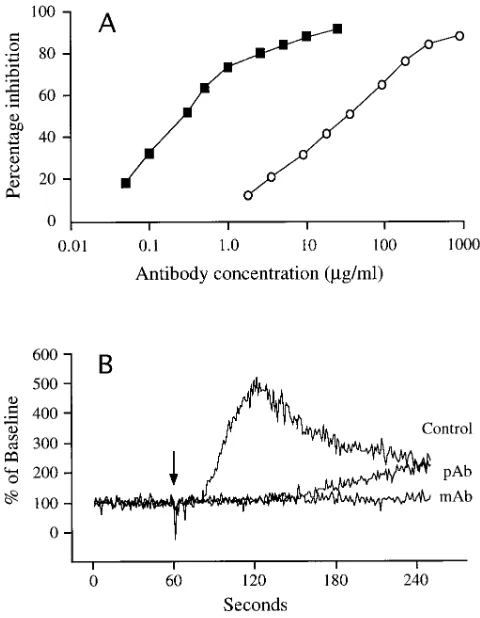
VEGF antibody characterization. Both antibodies dose depen-dently inhibited 125I-VEGF binding to the Flt-1 receptor with
half maximal inhibition at 0.3 mg/ml and 36 mg/ml for the mono-clonal and polymono-clonal antibodies, respectively (Fig. 1 A). In Fig. 1 B, an increase in Fura-2 signal intensity was evident z 15 s
after addition of rhVEGF to human endothelial cells in sus-pension, reaching a fivefold increase by 60 s, then slowly de-caying over the next 2 min to a level two times baseline. The monoclonal antibody completely blocked the VEGF-induced increase in the Fura-2 signal, while the polyclonal antibody sig-nificantly delayed a rise in the signal which reached a level two times baseline 3 min after the addition of VEGF.
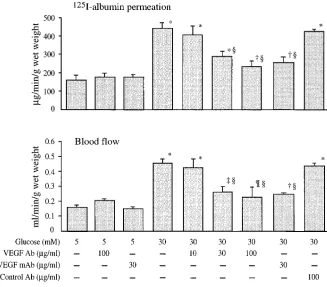
Effect of VEGF antibody on glucose- and sorbitol-induced permeability and blood flow changes.125I-Albumin permeation
and blood flow were increased z 3- and 2.3-fold, respectively,
by 30 mM glucose vs 5 mM glucose controls (P, 0.0001 for both) (Fig. 2). The increased albumin permeation and blood flow caused by glucose were decreased in a dose-dependent manner by coadministration of a neutralizing polyclonal VEGF antibody with 30 mM glucose. Increased albumin per-meation induced by 30 mM glucose was reduced by approxi-mately one-half and the increased blood flow was reduced by two-thirds by coadministration of polyclonal or monoclonal VEGF antibodies at a concentration of 30 mg/ml. Both the
polyclonal and monoclonal VEGF antibodies had no effect on albumin permeation or blood flow when coadministered with 5 mM glucose at concentrations of 100 and 30 mg/ml, respec-tively; nonspecific rabbit antibody (100 mg/ml) had no effect on vascular changes induced by 30 mM glucose. We have pre-viously reported that topical application of 30 mM L-glucose (a nonmetabolizable stereoisomer of D-glucose that penetrates cells much more slowly than D-glucose) and 30 mM 3-0 -meth-ylglucose (a nonmetabolizable analogue of D-glucose that is transported into cells at rates similar to those for D-glucose by the same glucose transporters) did not affect albumin perme-ation or blood flow (9).
[image:5.612.314.554.58.367.2]Albumin permeation was increased 2.4-fold and blood flow 3-fold following application of 1 mM sorbitol for 7 d vs 5 mM glucose (P, 0.0001 for both) (Fig. 3). The sorbitol dehydro-genase inhibitor, CP-166,572, prevented sorbitol-induced per-meability changes and decreased blood flow by 88%. Poly-clonal VEGF antibody (30 mg/ml) coadministered with sorbitol decreased albumin hyperpermeability by 75% and blood flow by 81%.
Figure 1. Inhibition of 125I-VEGF binding to Flt-1 receptor (A) by
Effects of topical VEGF application to granulation tissue.
As shown in Fig. 4, a single topical application of 100 pM VEGF increased 125I-albumin permeation 2.8-fold and blood
flow 2.5-fold (P, 0.0001 for both vs 5 mM glucose controls) after 1 h of treatment. The hyperpermeability effect was de-creased 55% and the blood flow effect was blocked completely
when 100 pM VEGF was combined with 30 mg/ml VEGF
monoclonal antibody for 20 min at 378C before adding to gran-ulation tissue. Two NOS inhibitors, 2 mM L-NMMA and 1 mM aminoguanidine, when administered 2 h before and again during the VEGF application, completely blocked VEGF-induced increases in blood flow; increases in 125I-albumin
permeation were prevented completely by L-NMMA and markedly attenuated (P, 0.005 vs VEGF treated) by amino-guanidine. Twice a day topical application of L-NMMA and aminoguanidine for 7 d did not affect permeability or blood flow in control granulation tissue (data not shown).
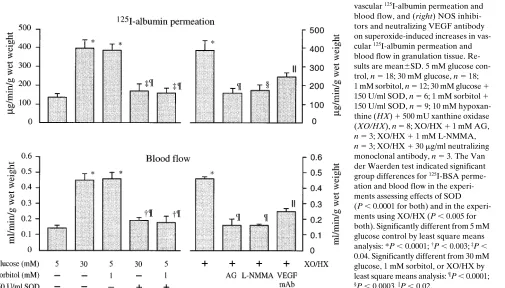
Effects of superoxide on vascular dysfunction. These experi-ments explored potential links between increased sorbitol pathway activity and reactive oxygen intermediate-derived mechanisms involving VEGF and nitric oxide. SOD reduced the 2.9-fold increase in 125I-albumin permeation produced by
30 mM glucose and 1 mM sorbitol by z 90% (P, 0.0001 vs
[image:6.612.60.387.59.346.2]both) and decreased the 3.3-fold increase in blood flow by
Figure 2. Effects of increasing concentra-tion of neutralizing VEGF antibodies on glucose-induced increases in 125I-albumin
permeation and blood flow in granulation tissue. Results are mean6SD. 5 mM glu-cose, n 5 14; 5 mM glucose 1 100 mg/ml polyclonal VEGF Ab, n 5 3; 5 mM glucose 1 30 mg/ml monoclonal VEGF Ab, n 5 3; 30 mM glucose, n 5 14; 30 mM glucose 1 10 mg/ml VEGF Ab, n 5 6; 30 mM glucose 1 30 mg/ml VEGF Ab, n 5 6; 30 mM glu-cose 1 100 mg/ml VEGF Ab, n 5 7; 30 mM glucose 1 30 mg/ml monoclonal VEGF Ab, n 5 3; 30 mM glucose 1 100 mg/ml control Ab, n 5 4. The Van der Waerden test indicated significant group differences for 125I-BSA permeation and blood flow
(P , 0.0001 for both). Significantly differ-ent from 5 mM glucose controls by least square means analysis: *P , 0.0001; †P ,
0.0002; ‡P , 0.001; ¶P , 0.01. Significantly
different from untreated 30 mM glucose by least square means analysis: §P , 0.0001.
Figure 3. Effects of a sorbitol dehydrogenase inhibitor, CP-166,572, and a neutralizing, polyclonal VEGF antibody on sorbitol-induced increases in
125I-albumin permeation and
blood flow in granulation tissue. Results are mean6SD. 5 mM glucose, n 5 8; 1 mM sorbitol, n 5 9; 1 mM sorbitol 1 25 mM sorbitol dehydrogenase inhibitor (SDi), n 5 6; 1 mM sorbitol 1 30 mg/ml polyclonal VEGF anti-body, n 5 6. The Van der Waer-den test indicated significant group differences for
125I-BSA permeation (P , 0.0001)
and blood flow (P , 0.0004). Significantly different from 5 mM glucose controls by least square means analysis: *P , 0.0001; †P , 0.0004. Significantly different from 1 mM
[image:6.612.58.554.535.714.2]z 85% (P, 0.0001 vs both) (Fig. 5). The superoxide
generat-ing system, hypoxanthine plus xanthine oxidase in 5 mM glu-cose, applied topically twice a day for 3 d to granulation tissue, produced similar increases in 125I-albumin permeation and
blood flow observed with elevated glucose and sorbitol levels. The NOS inhibitors aminoguanidine and L-NMMA prevented
these increases, while the neutralizing, monoclonal VEGF an-tibody reduced the superoxide-induced changes in 125
I-albu-min permeation and blood flow by z 60% (P, 0.02 vs
hypo-xanthine 1 xanthine oxidase).
Effects of nitroprusside and A23187.Since VEGF stimulates intracellular calcium mobilization and increasing evidence
in-Figure 4. Effects of topically ap-plied VEGF, VEGF 1 NOS in-hibitors (AG and L-NMMA), and VEGF 1 VEGF mono-clonal antibody on vascular
125I-albumin permeation and
blood flow in granulation tissue. Results are mean6SD. Control, n 5 6; 100 pM VEGF, n 5 7; 100 pM VEGF 1 2 mM L-NMMA, n 5 3; 100 pM VEGF 1 1 mM AG, n 5 5; 100 pM VEGF 1 30 mg/ml VEGF antibody, n 5 3. The Van der Waerden test indicated sig-nificant group differences for
125I-BSA permeation and blood
flow (P , 0.001 and P , 0.004, respectively). Significantly dif-ferent from controls by least square means analysis: *P , 0.0001; †P , 0.005. Significantly
different from untreated VEGF by least square means analysis:
[image:7.612.65.565.100.310.2]‡P , 0.0001; ¶P , 0.005.
Figure 5. Effects of: (left) SOD on glu-cose- and sorbitol-induced increases in vascular 125I-albumin permeation and
blood flow, and (right) NOS inhibi-tors and neutralizing VEGF antibody on superoxide-induced increases in vas-cular 125I-albumin permeation and
blood flow in granulation tissue. Re-sults are mean6SD. 5 mM glucose con-trol, n 5 18; 30 mM glucose, n 5 18; 1 mM sorbitol, n 5 12; 30 mM glucose 1 150 U/ml SOD, n 5 6; 1 mM sorbitol 1 150 U/ml SOD, n 5 9; 10 mM hypoxan-thine (HX) 1 500 mU xanhypoxan-thine oxidase (XO/HX), n 5 8; XO/HX 1 1 mM AG, n 5 3; XO/HX 1 1 mM L-NMMA, n 5 3; XO/HX 1 30 mg/ml neutralizing monoclonal antibody, n 5 3. The Van der Waerden test indicated significant group differences for 125I-BSA
perme-ation and blood flow in the experi-ments assessing effects of SOD (P , 0.0001 for both) and in the experi-ments using XO/HX (P , 0.005 for both). Significantly different from 5 mM glucose control by least square means analysis: *P , 0.0001; †P , 0.003; ‡P ,
[image:7.612.63.568.448.736.2]dicates that vascular effects of VEGF are mediated via nitric oxide (17), these experiments were designed to assess effects of intracellular calcium mobilization and nitric oxide on vascu-lar dysfunction. Topical application of 1 mM sodium nitroprus-side (two times daily for 1 wk) or 0.1 mM A23187 (applied once for 1 h) produced similar increases in 125I-albumin
perme-ation (2.7-fold) and blood flow (2.6-fold) (P, 0.0001 vs con-trols; Fig. 6). These increases were comparable to those in-duced by 30 mM glucose and 1 mM sorbitol. Aminoguanidine (1 mM) decreased the A23187-induced blood flow and perme-ability increases by 80% (P, 0.05 for both vs A23187).
Granulation tissue metabolites. These experiments assessed sorbitol pathway–linked reductive stress in granulation tissue. Incubating granulation tissue in 50 mM glucose increased the L/P ratio 36% (P, 0.0003 vs 5 mM glucose control) and tissue fructose approximately fivefold (P, 0.0008 vs control) (Fig. 7). Tolrestat prevented the increased L/P ratio induced by 50 mM glucose and reduced the L/P ratio by 27% in tissues incu-bated in 5 mM glucose (P, 0.0002). A similar pattern was ob-served for tissue fructose: tolrestat prevented the 50 mM glu-cose-induced increase and decreased tissue fructose levels versus untreated 5 mM glucose controls (P, 0.05). Streptozo-tocin-induced diabetes resulted in a 63% increase in granula-tion tissue L/P ratio versus controls (P, 0.001), which was completely prevented by tolrestat.
Discussion
[image:8.612.55.377.74.628.2]The important observations in this study are that vascular dys-function induced by elevated tissue glucose or sorbitol levels and by increased levels of reactive oxygen intermediates is sig-nificantly attenuated by neutralizing antibodies to VEGF, and that acute VEGF-, superoxide-, and calcium ionophore–linked vascular changes are blocked by NOS inhibitors. These find-ings: (a) indicate that metabolic imbalances linked to increased
Figure 6. Effects of sodium nitroprusside (SNP) and the calcium ionophore A2318761 mM aminoguanidine on
125I-albumin permeation and blood flow in
granulation tissue. Results are mean6SD. 5 mM glucose control, n 5 9; SNP, n 5 6; A23187, n 5 6; A23187 1 1 mM AG, n 5 3. The Van der Waerden test indi-cated significant group differences for
125I-BSA permeation and blood flow
(P , 0.0005 and P , 0.001, respectively). Significantly different from 5 mM glucose controls by least square means analysis: *P , 0.0001; †P , 0.05. Significantly
dif-ferent from untreated A23187 by least square means analysis: ‡P , 0.05.
Figure 7. Lactate/pyruvate (L/P) ratio and tissue fructose in granula-tion tissue (from control rats and from rats fed 0.2 mmol tolrestat/kg body weight added to the diet for 6 d) after 2-h incubation in 5 or 50 mM glucose. Granulation tissue fructose is expressed as nanomoles/ gram of tissue protein, and data are shown as the mean61 SD (n 5 6 per experimental group). Also shown is L/P ratio in granulation tis-sue sampled from control (n = 13), untreated diabetic (n 5 13), and diabetic rats treated with tolrestat (n 5 12). The Van der Waerden test indicated significant group differences for lactate/pyruvate (P , 0.004) and tissue fructose (P , 0.002) obtained from granulation
tis-sue incubated in vitro with 50 mM glucose, and for L/P ratio of granu-lation tissue obtained from control and diabetic rats (P , 0.0002). Significantly different from controls by least square means analysis: *P , 0.0005; †P , 0.001; ‡P , 0.05. Significantly different from
sorbitol pathway activity increase either the expression, activ-ity, or sensitivity of this growth factor (in the absence of true hypoxia) sufficiently to cause vascular dysfunction, (b) impli-cate VEGF in mediating vascular dysfunction induced by ele-vated glucose levels via reactive oxygen intermediate-derived mechanisms and via nitric oxide produced by increased NOS activity, and (c) suggest that VEGF may play an important role in the pathogenesis of early diabetic vascular dysfunction (i.e., hemodynamic changes and loss of endothelial barrier functional integrity) before development of vascular structural changes.
Mechanism(s) of glucose-induced increased VEGF produc-tion. The findings that VEGF expression is increased in is-chemic areas surrounding regions of tumor necrosis (reviewed in reference 16) as well as in hypoxic tissues (35–38), together with numerous observations that limiting oxygen concentra-tion provokes a number of cell types to overexpress VEGF mRNA (19, 20, 39) indicate that local tissue hypoxia is a major regulator of VEGF production. However, the molecular mechanisms responsible for hypoxia-induced increased VEGF mRNA expression have not been fully elucidated. Despite in-direct evidence suggesting that the hypoxia sensing elements for VEGF and other hypoxia-inducible genes occur through a heme-containing protein such as the superoxide-generating flavoprotein NADPH oxidase (40), the identity of the hypoxia sensor for VEGF remains unknown.
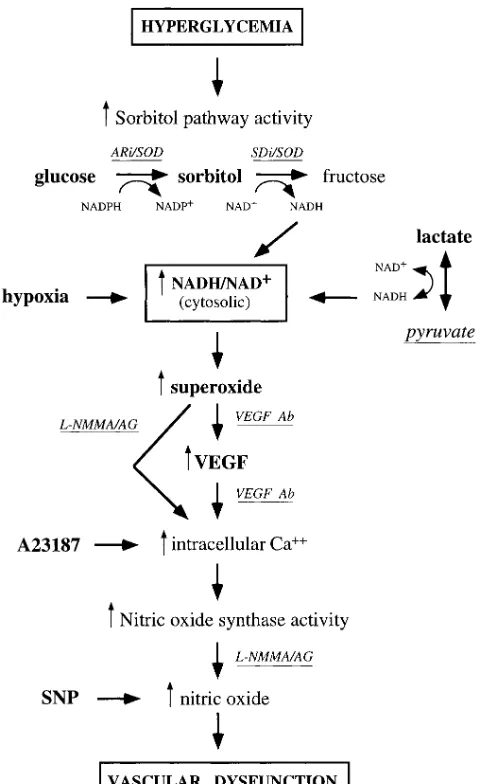
Since hypoxia is a potent stimulus for increased VEGF ex-pression, and since the redox imbalance (an increased ratio of NADH/NAD1) resulting from impaired oxidation of NADH to NAD1 by the electron transport chain is a very early conse-quence of hypoxia, a plausible explanation for increased VEGF production by tissues exposed to elevated glucose lev-els is the “hypoxia-like” redox imbalance resulting from in-creased flux of glucose via the sorbitol pathway (see Fig. 8). To the extent that an increased cytosolic ratio of free NADH/ NAD1 may be involved in mediating hypoxia-induced VEGF expression, then excess reducing equivalents generated by any metabolic imbalance might be predicted to increase VEGF mRNA expression. While many metabolic imbalances associ-ated with the diabetic milieu may generate excess reducing equivalents (12), the best characterized example is increased oxidation of sorbitol to fructose coupled to reduction of NAD1 to NADH by sorbitol dehydrogenase in the second step of the sorbitol pathway. This redox imbalance has been demonstrated in retina, kidney, and nerve (as well as in granu-lation tissue in this report) exposed to elevated glucose levels in vivo and in vitro, and has been linked to increased flux of glucose via the sorbitol pathway in each tissue (41–43). Fur-thermore, vascular dysfunction in each of these tissues in dia-betic as well as in nondiadia-betic rats with acute hyperglycemia of 5 h duration (induced by i.v. glucose infusion) is attenuated by inhibitors of the sorbitol pathway. It is noteworthy that inter-ventions which prevent sorbitol pathway–linked vascular dys-function either prevent cytosolic reductive stress (i.e., inhibi-tors of aldose reductase and sorbitol dehydrogenase prevent reduction of NAD1 to NADH while pyruvate increases the rate of oxidation of NADH to NAD1 by lactate dehydroge-nase), or they inhibit some step in the cascade of biochemical imbalances that result from cytosolic reductive stress as de-picted in Fig. 8. A number of other diabetes-induced metabolic imbalances implicated in the pathogenesis of diabetic compli-cations also are potential consequences of the effects of
re-ductive stress on other dehydrogenase enzymes. Increased NADH/NAD1: (a) favors inhibition of glyceraldehyde 3-phate dehydrogenase, causing accumulation of triose phos-phates (12) which are among the most potent intracellular nonenzymatic glycation agents known; (b) promotes reduction of dihydroxyacetone phosphate to sn-glycerol 3-phosphate, the first step in one pathway for de novo synthesis of diacyl-glycerol, an activator of protein kinase C; and (c) inhibits xan-thine dehydrogenase which favors oxidation of xanxan-thine and hypoxanthine by xanthine oxidase resulting in production of superoxide.
Evidence that hypoxia, ischemia/reperfusion injury, and di-abetes/hyperglycemia sequentially induce reductive stress and oxidative stress raises the possibility that reductive
[image:9.612.315.556.57.449.2]induced increased production of reactive oxygen intermedi-ates may mediate the increased VEGF in these conditions. The plausibility of this scenario is supported by several lines of evidence: (a) reductive stress increases superoxide production by several mechanisms (12) including inhibition of xanthine dehydrogenase as discussed above; (b) reactive oxygen inter-mediates increase VEGF mRNA expression (44); (c) superox-ide dismutase and VEGF antibodies prevent vascular dysfunc-tion induced by elevated glucose and sorbitol levels in the skin chamber granulation tissue (Figs. 2, 3, and 5); and (d) neutral-izing VEGF antibody prevents vascular dysfunction induced by reactive oxygen intermediates (Fig. 5).
An alternative putative mechanism of sorbitol pathway– linked oxidative stress has been proposed to result from com-petition between aldose reductase, glutathione reductase, and nitric oxide synthase for the cofactor NADPH (45). However, there is little evidence that NADPH levels are limiting for glu-tathione reductase or nitric oxide synthase activity in the two tissues in which it has been measured; in lenses of diabetic rats NADPH levels have been reported to be slightly decreased (46), and in peripheral nerve NADPH levels and NADPH/ NADP1 ratios have been reported to be normal (43). While it remains unclear at this time if accelerated sorbitol pathway ac-tivity decreases cytosolic NADPH sufficiently to impact on the activities of GSH reductase and NO synthase in vascular cells, the relatively low Km’s of aldose reductase (z 4 mM),
glu-tathione reductase (z 10 mM), and nitric oxide synthase (z 0.3
mM) for the cofactor NADPH, suggests that the modest reduc-tion in NADPH observed in diabetic tissues would not limit the activities of these enzymes.
Mechanisms of VEGF-mediated vascular dysfunction in-duced by elevated glucose levels. The mechanism(s) by which VEGF exerts its mitogenic, hemodynamic, and vascular per-meability effects on vascular endothelium remain poorly un-derstood, although increasing evidence suggests that these ef-fects of VEGF are mediated, at least in part, via nitric oxide. It has been shown that both recombinant and native VEGF in-duce a slowly developing relaxation in isolated canine coro-nary arteries that is dependent on intact endothelium, and this can be blocked by NOS inhibitors as well as by a neutralizing VEGF antibody (17). VEGF induces relaxation in canine cor-onary arteries by stimulating nitric oxide release, most likely via increases in intracellular calcium, events that are initiated by VEGF receptor-induced tyrosine phosphorylation of phos-pholipase C-g1. These observations are consistent with reports that: (a) VEGF-stimulated proliferation of coronary venular endothelium is mediated by the formation of nitric oxide and cGMP, and that the VEGF proliferative effect could be blocked with NOS inhibitors (47); (b) human monocyte-induced angiogenesis requires an L-arginine/NOS-dependent mecha-nism (48); (c) agonist-induced activation of NOS as well as ni-tric oxide donors promote endothelial cell proliferation, whereas NOS inhibitors suppress the response (49); and (d) systemic administration of VEGF in rats decreased blood pressure, cardiac output, and stroke volume without affecting myocardial contractility and these changes were attenuated with NOS inhibitors (50).
The findings that neutralizing VEGF antibodies decreased albumin permeation and blood flow induced by elevated glu-cose and sorbitol levels as well as by increased superoxide lev-els support the conclusion that these vascular changes are me-diated, at least in part, by increased VEGF production. The
likelihood that these vascular changes are mediated by VEGF-induced stimulation of NOS as depicted in Fig. 8 is supported by several lines of evidence. First, vascular dysfunction in-duced by elevated glucose levels was prevented by two differ-ent neutralizing antibodies to VEGF (Fig. 2) and, as previously reported, by two different NOS inhibitors (51). Vascular dys-function induced by VEGF also was prevented by these same NOS inhibitors, i.e., aminoguanidine and L-NMMA (Fig. 4). In addition, the nitric oxide releasing agent sodium nitroprus-side and the calcium ionophore A23187 caused the same vas-cular dysfunction induced by glucose, sorbitol, and VEGF, and the effects of A23187 were prevented by aminoguanidine (Fig. 6). These observations support the conclusion that elevated glucose levels can increase VEGF production sufficiently to cause vascular dysfunction in the absence of hypoxia. This in-terpretation is consistent with recent evidence that elevated glucose increases VEGF in retinal pigment epithelial cells (52) and increases platelet-derived growth factor-b mRNA in hu-man monocytes, capillary endothelial cells, and rat mesangial cells (53). Shweiki et al. (54) published evidence of a signifi-cant glucose induction of VEGF mRNA under normoxic con-ditions in a cell line derived from a rat glial tumor (Fig. 3 in ref-erence 54), but did not comment on the significance of this finding.
The effects of increased sorbitol pathway metabolism on nitric oxide production are controversial and are due, at least in part, to differences in models used (tissue culture, isolated vascular rings, whole animal, and human studies) and to the in vivo use of nonselective inhibitors of NOS at doses which in-duce hypertension (45). Our finding that VEGF-inin-duced vas-cular dysfunction is prevented by NOS inhibitors is consistent with evidence that a relative or absolute increase in nitric ox-ide mediates vascular dysfunction in diabetic rats and in retina and nerve of nondiabetic rats with acute hyperglycemia (27, 55). Our hypothesis that vascular dysfunction induced by early diabetes is mediated by increased nitric oxide production as a consequence of “hypoxia-like” cytosolic reductive stress is supported by evidence that true hypoxia increases endothelial NOS mRNA, NOS enzyme activity, and increased NO pro-duction (56, 57) and that blood flow increases immediately in response to mild hypoxia.
While aminoguanidine blocked glucose-, VEGF-, superox-ide- and A23187-induced increases in albumin hyperperme-ability and blood flow, this effect was not mediated by block-ing VEGF bindblock-ing to its receptor, nor did aminoguanidine interfere with VEGF-induced changes in intracellular calcium and release of van Willebrand factor (unpublished observa-tions). These results suggest that the beneficial effect of ami-noguanidine is through inhibition of constitutive NOS, whose activity is increased by changes in intracellular calcium after stimulation with VEGF, superoxide, or the calcium ionophore A23187. The observation that L-NMMA also blocked VEGF-induced vascular changes provides further support for this in-terpretation. Although aminoguanidine is a selective inhibitor of the inducible isoform of NOS, this selectivity depends on the absence of Ca21. In the presence of Ca21, aminoguanidine competes with L-arginine for cNOS (58), and at the doses used in the present studies, aminoguanidine also effectively inhibits constitutive NOS.
involv-ing increased superoxide and nitric oxide production. This finding supports the hypothesis that hypoxia-like reductive stress induced by hyperglycemia, linked to increased sorbitol pathway activity, increases VEGF production enough to cause vascular dysfunction manifested by increased blood flow and impaired vascular barrier functional integrity.
Acknowledgments
We thank Nemani Rateri and Antoinette Faller for expert assistance with mounting and treating granulation tissue skin chambers, and Wanda Allison for technical assistance with the animal surgery.
This research was supported in part by National Institutes of Health grant EY-06600 (J.R. Williamson) and by the Kilo Diabetes and Vascular Research Foundation.
References
1. Greene, D.A., S. Lattimer, J. Ulbrecht, and P. Carroll. 1985. Glucose-induced alterations in nerve metabolism: current perspective on the
pathogene-sis of diabetic neuropathy and future directions for research and therapy.
Dia-betes Care. 8:290–299.
2. Winegrad, A.E. 1987. Does a common mechanism induce the diverse
complications of diabetes? Diabetes. 36:396–406.
3. Kinoshita, J.H., and C. Nishimura. 1988. The involvement of aldose
re-ductase in diabetic complications. Diabetes Metab. Rev. 4:323–337.
4. Pugliese, G., R.G. Tilton, and J.R. Williamson. 1991. Glucose-induced
metabolic imbalances in the pathogenesis of diabetic vascular disease. Diabetes
Metab. Rev. 7:35–59.
5. Ruderman, N.B., J.R. Williamson, and M. Brownlee. 1992. Glucose and
diabetic vascular disease. FASEB J. 6:2905–2914.
6. Tilton, R.G., K. Chang, G. Pugliese, D.M. Eades, M.A. Province, W.R. Sherman, C. Kilo, and J.R. Williamson. 1989. Prevention of hemodynamic and vascular albumin filtration changes in diabetic rats by aldose reductase
inhibi-tors. Diabetes. 38:1258–1270.
7. Pugliese, G., R.G. Tilton, A. Speedy, K. Chang, M.A. Province, C. Kilo, and J.R. Williamson. 1990. Vascular filtration function in galactose-fed versus
diabetic rats: the role of polyol pathway activity. Metab. Clin. Exp. 39:690–697.
8. Tilton, R.G., K. Chang, J.R. Nyengaard, M. Van den Enden, Y. Ido, and J.R. Williamson. 1995. Inhibition of sorbitol dehydrogenase: effects on vascular
and neural dysfunction in streptozocin-induced diabetic rats. Diabetes. 44:234–
242.
9. Williamson, J.R., E. Ostrow, D.M. Eades, K. Chang, W. Allison, C. Kilo, and W.R. Sherman. 1990. Glucose-induced microvascular functional changes in nondiabetic rats are stereospecific and are prevented by an aldose reductase
in-hibitor. J. Clin. Invest. 85:1167–1172.
10. Williamson, J.R., K. Chang, E. Ostrow, W. Allison, J. Harlow, and C. Kilo. 1989. Sorbitol-induced increases in vascular albumin clearance are
pre-vented by pyruvate but not myo-inositol. Diabetes. 38:94a. (Abstr.)
11. Wolf, B.A., J.R. Williamson, R.A. Easom, K. Chang, W.R. Sherman, and J. Turk. 1990. Diacylglycerol accumulation and microvascular
abnormali-ties induced by elevated glucose levels. J. Clin. Invest. 87:31–38.
12. Williamson, J.R., K. Chang, M. Frangos, K.S. Hasan, Y. Ido, T. Kawa-mura, J.R. Nyengaard, M. Van den Enden, C. Kilo and R.G. Tilton. 1993.
Hy-perglycemic pseudohypoxia and diabetic complications. Diabetes. 42:801–813.
13. Bunger, R., R.T. Mallet, and D.A. Hartman. 1989. Pyruvate-enhanced phosphorylation potential and inotropism in normoxic and postischemic iso-lated working heart: near-complete prevention of reperfusion contractile
fail-ure. Eur. J. Biochem. 180:221–233.
14. Cavallini, L., M. Valente, and M.P. Rigobello. 1990. The protective ac-tion of pyruvate on recovery of ischemic rat heart: comparison with other
oxi-dizable substrates. J. Mol. Cell. Cardiol. 22:143–154.
15. Ferrara, N. 1993. Vascular endothelial growth factor. Trends
Cardio-vasc. Med. 3:244–250.
16. Dvorak, H.F., L.F. Brown, M. Detmar, and A.M. Dvorak. 1995. Vascu-lar permeability factor/vascuVascu-lar endothelial growth factor, microvascuVascu-lar
hyper-permeability, and angiogenesis. Am. J. Pathol. 146:1029–1039.
17. Ku, D.D., J.K. Zaleski, S. Liu, and T.A. Brock. 1993. Vascular endothe-lial growth factor induces EDRF-dependent relaxation in coronary arteries.
Am. J. Physiol. 265:H586–H592.
18. Minchenko, A., T. Bauer, S. Salceda, and J. Caro. 1994. Hypoxic
stimu-lation of vascular endothelial growth factor expression in vitro and in vivo. Lab.
Invest. 71:374–379.
19. Namiki, A., E. Brogi, M. Kearney, E.A. Kim, T. Wu, T. Couffinhal, L. Varticovski, and J.M. Isner. 1995. Hypoxia induces vascular endothelial growth
factor in cultured human endothelial cells. J. Biol. Chem. 270:31189–31195.
20. Aiello, L.P., J.M. Northrup, B.A. Keyt, H. Takagi, and M.A. Iwamoto. 1995. Hypoxic regulation of vascular endothelial growth factor in retinal cells.
Arch. Ophthalmol. 113:1538–1544.
21. Fiebich, B.L., B. Jäger, C. Schöllmann, K. Weindel, J. Wilting, G. Kochs, D. Marmé, H. Hug, and H.A. Weich. 1993. Synthesis and assembly of functionally active human vascular endothelial growth factor homodimers in
in-sect cells. Eur. J. Biochem. 211:19–26.
22. Bjercke, R.J., G. Cook, N. Rychlik, H.B. Gjika, H.V. Vunakis, and J.J. Langone. 1986. Stereospecific monoclonal antibodies to nicotine and cotinine
and their use in enzyme-linked immunosorbent assays. J. Immunol. Methods.
90:203–213.
23. Koehler, G., and C. Milstein. 1976. Derivation of specific
antibody-pro-ducing tissue culture and tumor lines by cell fusion. Eur. J. Immunol. 6:511–519.
24. Brock, T.A., and E. L. Capasso. 1988. Thrombin and histamine activate phospholipase C in human endothelial cells via a phorbol ester-sensitive
path-way. J. Cell. Physiol. 136:54–62.
25. Brock, T.A., H. F. Dvorak, and D. R. Senger. 1991. Tumor-secreted
vas-cular permeability factor increases cytosolic Ca21 and von Willebrand factor
re-lease in human endothelial cells. Am. J. Pathol. 138:213–221.
26. Lundberg, C., and B. Gerdin. 1984. The inflammatory reaction in an ex-perimental model of open wounds in the rat. The effect of arachidonic acid
me-tabolites. Eur. J. Pharmacol. 97:229–238.
27. Tilton, R.G., K. Chang, K.S. Hasan, J.M. Petrash, T.P. Misko, W.M. Moore, M.G. Currie, J.A. Corbett, M.L. McDaniel, and J.R. Williamson. 1993. Prevention of diabetic vascular dysfunction by guanidines: inhibition of nitric
oxide synthase versus advanced glycation end product formation. Diabetes. 42:
221–232.
28. Lowry, O.H., and J.V. Passoneau. 1972. A Flexible System of Enzymatic Analysis. Academic Press, Inc., Orlando, FL. 174.
29. Passonneau, J.V., and O.H. Lowry. 1993. Enzymatic Analysis. A Practi-cal Guide. The Humana Press, Totowa, NJ.
30. Chi, M.M.-Y., M.E. Pusateri, J.G. Carter, B.J. Norris, D.B. McDougal, Jr., and O.H. Lowry. 1987. Enzymatic assays for 2-deoxyglucose and
2-deoxy-glucose 6-phosphate. Anal. Biochem. 161:508–513.
31. Williamson, D.H., P. Lund, and H.A. Krebs. 1967. The redox state of free nicotinamide-adenine dinucleotide in the cytoplasm and mitochondria of
rat liver. Biochem. J. 103:514–527.
32. Lehman, E.L. 1975. Nonparametrics: Statistical Methods Based on Ranks. Holden-Day, San Francisco.
33. Anderson, T.W. 1958. An Introduction to Multivariate Statistical Anal-ysis. John Wiley & Sons, Inc., New York.
34. Blom, G. 1958. Statistical Estimates and Transformed Beta Variables. John Wiley & Sons, Inc., New York.
35. Phillips, H.S., M. Armanini, D. Stavrou, N. Ferrara, and M. Westphal. 1993. Intense focal expression of vascular endothelial growth factor mRNA in
human intracranial neoplasms: association with regions of necrosis. Int. J.
On-col. 2:913–919.
36. Shweiki, D., A. Itin, D. Soffer, and E. Keshet. 1992. Vascular endothe-lial growth factor induced by hypoxia may mediate hypoxia-initiated
angiogen-esis. Nature (Lond.). 359:843–845.
37. Ladoux, A., and C. Frelin. 1993. Hypoxia is a strong inducer of vascular
endothelial growth factor mRNA expression in the heart. Biochem. Biophys.
Res. Commun. 195:1005–1010.
38. Plate, K.H., G. Breier, H.A. Weich, and W. Risau. 1992. Vascular
en-dothelial growth factor is a potential tumour angiogenesis factor in vivo. Nature
(Lond.). 359:845–847.
39. Koos, R.D., and C.E. Olson. 1991. Hypoxia stimulates expression of the gene for vascular endothelial growth factor (VEGF), a putative angiogenic
fac-tor, by granulosa cells of the ovarian follicle, a site of angiogenesis. J. Cell Biol.
115:421a. (Abstr.)
40. Goldberg, M., and T. Schneider. 1994. Similarities between the oxygen sensing mechanisms regulating the expression of vascular endothelial growth
factor and erythropoietin. J. Biol. Chem. 269:4355–4359.
41. Tilton, R.G., L.M. Baier, J.E. Harlow, S.R. Smith, E. Ostrow, and J.R. Williamson. 1992. Diabetes-induced glomerular dysfunction: links to a more
re-duced cytosolic redox state. Kidney Int. 41:778–788.
42. Van den Enden, M.K., J.R. Nyengaard, E. Ostrow, J.H. Burgan, and J.R. Williamson. 1995. Elevated glucose levels increase retinal glycolysis and
sorbitol pathway metabolism. Invest. Ophthalmol. & Visual Sci. 36:1675–1685.
43. Obrosova, I., J. Marvel, A.M. Faller, and J.R. Williamson. 1995. Reduc-tive stress is a very early metabolic imbalance in sciatic nerve in diabetic and
ga-lactose-fed rats. Diabetologia. 38:8a. (Abstr.)
44. Kuroki, M., E.E. Voest, S. Amano, L.V. Beerepoot, S. Takashima, M. Tolentino, R.Y. Kim, R.M. Rohan, K.A. Colby, K.-T. Yeo, and A.P. Adamis. 1996. Reactive oxygen intermediates increase vascular endothelial growth
fac-tor expression in vitro and in vivo. J. Clin. Invest. 98:1167–1175.
45. Stevens, M.J., J. Dananberg, E.L. Feldman, S.A. Lattimer, M. Kamijo, T.P. Thomas, H. Shindo, A.A.F. Sima, and D.A. Greene. 1994. The linked roles
of nitric oxide, aldose reductase, and (Na1,K1)-ATPase in the slowing of nerve
conduction in the streptozotocin diabetic rat. J. Clin. Invest. 94:853–859.
46. Lou, M.F., J.R. Dickerson, Jr., R. Garadi, and B.M. York, Jr. 1988.
46:517–530.
47. Morbidelli, L., C.-H. Chang, J.G. Douglas, H.J. Granger, F. Ledda, and M. Ziche. 1996. Nitric oxide mediates mitogenic effect of VEGF on coronary
venular endothelium. Am. J. Physiol. 270:H411–H415.
48. Leibovich, S.J., P.J. Polverini, T.W. Fong, L.A. Harlow, and A.E. Koch. 1994. Production of angiogenic activity by human monocytes requires an
L-argi-nine/nitric oxide-synthase-dependent effector mechanism. Proc. Natl. Acad.
Sci. USA. 91:4190–4194.
49. Ziche, M., L. Morbidelli, E. Masini, S. Amerini, H.J. Granger, C.A. Maggi, P. Geppetti, and F. Ledda. 1994. Nitric oxide mediates angiogenesis in vivo and endothelial cell growth and migration in vitro promoted by substance P. J. Clin. Invest. 94:2036–2044.
50. Yang, R., G.R. Thomas, S. Bunting, A. Ko, N. Ferrara, B. Keyt, J. Ross, and H. Jin. 1996. Effects of vascular endothelial growth factor on
hemodynam-ics and cardiac performance. J. Cardiovasc. Pharmacol. 27:838–844.
51. Hasan, K.S., K. Chang, W. Allison, A. Faller, J.V. Santiago, R.G. Tilton, and J.R. Williamson. 1993. Glucose-induced increases in regional blood flow are prevented by aminoguanidine and L-NMMA, inhibitors of nitric oxide
syn-thase. FASEB J. 7:105a. (Abstr.)
52. Sone, S., Y. Kawakami, Y. Okuda, S. Kondo, M. Hanatani, H. Suzuki, and K. Yamashita. 1996. Vascular endothelial growth factor is induced by long-term high glucose concentration and up-regulated by acute glucose deprivation
in cultured bovine retinal pigmented epithelial cells. Biochem. Biophys. Res.
Commun. 221:193–198.
53. Inabe,T., S. Ishibashi, T. Gotoda, M. Kawamura, N. Morino, Y. Nojima, M. Kawakami, Y. Yazaki, and N. Yamada. 1996. Enhanced expression of
plate-let-derived growth factor-b receptor by high glucose. Involvement of
platelet-derived growth factor in diabetic angiopathy. Diabetes. 45:507–512.
54. Shweiki, D., M. Neeman, A. Itin, and E. Keshet. 1995. Induction of vas-cular endothelial growth factor expression by hypoxia and by glucose deficiency
in multicell spheroids: implications for tumor angiogenesis. Proc. Natl. Acad.
Sci. USA. 92:768–772.
55. Corbett, J.A., R.G. Tilton, K. Chang, K.S. Hasan, Y. Ido, J.L. Wang, M.A. Sweetland, J.R. Lancaster, J.R. Williamson, and M.L. McDaniel. 1992. Aminoguanidine, a novel inhibitor of nitric oxide formation, prevents diabetic
vascular dysfunction. Diabetes. 41:552–556.
56. Xu, X.-P., J.S. Pollock, M.A. Tanner, and P.R. Myers. 1995. Hypoxia ac-tivates nitric oxide synthase and stimulates nitric oxide production in porcine
coronary resistance arteriolar endothelial cells. Cardiovasc. Res. 30:841–847.
57. Arnet, U.A., A. McMillan, J.L. Dinerman, B. Ballermann, and C.J. Lo-wenstein. 1996. Regulation of endothelial nitric-oxide synthase during hypoxia.
J. Biol. Chem. 271:15069–15073.
58. Wolff, D.J., and A. Lubeskie. 1995. Aminoguanidine is an
isoform-selective, mechanism-based inactivator of nitric oxide synthase. Arch. Biochem.