Volume: 03 Issue: 09 | Sep-2016 www.irjet.net p-ISSN: 2395-0072
ESTIMATION OF DEFLECTION OF A CHASIS FRAME UNDER MOVING
CONDITIONS BY USING ABAQUS SOFTWARE
Md. Abdul Fazal
1, B.T. Naik
2, Doneti Gopi Krishna
3, A. Sai Kumar
41
M.Tech student, Department of Mechanical Engineering, AHTC Hyderabad
2Associate Professor,(HOD) Department of Mechanical Engineering, AHTC, Hyderabad
3
Assistant Professor, Department of Mechanical Engineering, AHTC, Hyderabad
4Assistant Professor, Department of Mechanical Engineering, AHTC, Hyderabad
---***---Abstract -
A Vehicle is a Structural Assembly which consistsof many components coupled together to make it run on different initial conditions as well as under various load conditions. Vehicles are basically designed to carry a wide variety of loads. The chassis plays a vital role in the design of any truck. This paper presents the estimation of deflection of chassis for various loading cases while moving such as Breaking, Turnings and crossing over the speed brakers is done by using ABAQUS and also by Theoretical analysis which include the Von-Mises stress distribution and displacement. Finally concluded that the both analyses i.e., Theoretical and ABAQUS results are approximately same.
Key Words: Deflection, Chassis, Abaqus, Pro – E, Hyper
Mesh,structural performance, IGS file
1.1 Truck Definition And Classification
Generally, trucks are heavy motor vehicles designed for carrying or pulling loads. Other definition of the truck is an automotive vehicle suitable for hauling. Some other definition are varied depending on the type of truck, such as Dump Truck, is a truck whose contents can be emptied without handling; the frontend of the platform can be pneumatically raised, so that the load is discharged by gravity. There are two classifications most applicable to Recreational Vehicle tow trucks. The first one is the weight classes, as defined by the US government, ranging from Class 1 to Class 8, as listed in Table 1.1 and Table1.2. The second is classified into a broader category:
1. Medium Light Duty Truck 2. Duty Truck
3.
Heavy Duty Truck1. INTRODUCTION
Different types of vehicles with wide variety of applications are present in the market the capacity of which varies from 1Tonne to 40Tonnes and more. There are different types of vehicles such as trucks, buses, cars etc. The present scenario in automotive industry has an increase in demand of trucks not only on the cost and weight aspects but also on improved complete vehicle features and overall work performance. . Vehicle chassis is an important part which supports the major load of the vehicle assembly. As vehicle chassis plays a pivotal role, its design has to be subjected to structural analysis to validate against all the possible cases of load applications and failures to strengthen the design. A chassis frame acts as a structural backbone for a vehicle. The intrinsic function of the truck chassis frame is to support the components and payload placed upon it. When the truck travels along the road, the chassis is subjected to vibration induced by road roughness and excitation by vibrating components mounted on it.
1.2 Theories of Failures
When the material starts exhibiting inelastic behavior, failure starts to occur. Generally there are two types of material namely Brittle and Ductile material. These ductile material and brittle material have different failure modes depending upon the loads. The ductile materials exhibits yielding in elastic region and plastic deformation occurs before material’s failure. In brittle material there is no yielding and thus sudden failure takes place. Some of the important theories of failures are discussed here as follows:
1. Maximum Principal stress theory (Rankine Theory)
2. Maximum Principal strain theory (StVenants Theory)
3. Maximum Strain energy (Beltrami Theory) 4. Maximum Distortion energy (Von Mises Theory) 5. Max. Shear stress theory (Tresca’s Theory)
1.2.
1 Maximum Principal Stress Theory
This theory holds good for brittle materials. According to this theory failure occurs when the maximum principal stress
induced in a material under complex load condition exceeds the maximum ultimate strength in a simple
tension test. So the failure condition can be expressed as,
octWhere,
= Octahedral Shear Stress.
1
ultimate 1.2.5 Max. Shear Stress TheoryWhere,
1 = Maximum Principal Stress, and
ultimate = Ultimate Stress.
1.2.
2 Maximum Principal Strain Theory
According to theory it states that, “Failure occurs at a point in a body when the maximum strain at that point exceeds the value of the maximum strain in a uniaxial test of the material at yield point.”
The maximum normal strain in actual case is given by,
1
1
[
(
)]
E
1 2 3
Where,
1= Maximum Principal Strain.E = Young’s Modulus
1,
2,
3 =Maximum Principal Stresses.And
=Poisson’sRatio.
This theory is also called Tresca’s theory. According to theory it states that, “Yielding begins when the maximum shear stress at a point equals the maximum shear stress at yield in a uniaxial tension”, which is expressed as,
max
y
Where,
max = Maximum Shear Stress, and
y = Maximum Shear Stress at Yield.Assuming
1
2
3 then, the maximum shear stress is given by,
1
3max
2
Also under simple tension,
ymax
2
1.2.3 Maximum Strain Energy
According to theory it states that, “Failure at any point in a body subjected to a state of stress begins only when the energy density absorbed at that point is equal to the energy density absorbed by the material when subjected to elastic limit in a uniaxial stress state”. Total strain energy (U) of deformation is given by,
U
1 [
2
2
2
2
(
)]
2E
1 2 3 1 2 2 3 3 1And in simple tension the strain energy is given by,
U
2y
2
E
Where, y= Yield Stress.
1.2.4 Maximum Distortion Energy:
This theory is also called as Shear Energy Theory or Von Mises-Hencky Theory. This theory states that, “Failure will occur when distortion energy per unit volume in a part reaches the distortion per unit volume at yield point in tensile testing”. At the plastic limit, the elastic energy of distortion reaches a constant value which is expressed as,
oct
2
y3
Hence the condition of yielding according to this theory becomes,
1 3y
1.3 ABAQUS
Volume: 03 Issue: 09 | Sep-2016 www.irjet.net p-ISSN: 2395-0072
2. EXPERIMENTAL PROCEDURE AND
RESULTS
The load on the chassis frame is recorded with electronic weighing machine for the following cases.
2.1 Theoretical Analysis
Equation of Beam,
M
E
I
y
R
M = Bending Moment.
I = Moment of Inertia of the section of the beam.
= Bending Stress in a fiber which is at a distance y from neutral axis.E = Young’s Modulus. R = Radius of Curvature. So from we get,
M
y
andI
Deflection of Beam is given by the equation,
3
y
max
PL
P = load3EI
1. Cross sectional area of beam (A) = 10 X 10 mm2 2. Length of beam (L) = 100 mm
3. Young’s Modulus (E) = 2x10⁵ N/mm2
Case 1: At Rest Condition. 500N Load Has Been Recorded.
Bending Moment (M) =
P L
= 500×100=5×10⁴N/mm2Moment of Inertia (I) =
b
4
10
4
833.33 mm
4.12
12
Distance y from the neutral axis =
h
10
5 mm.
2
2
Substituting the values in Eq (13) we get,
= = 300 N/mm2
= =1.00 mm
Case 2: Inertia Load Or Load Due To Jerks While Shifting Or Lifting The Chassis From One Place To Other, 600N Load Has Been Recorded.
Bending Moment(M) =
P
L
=600
100
6
10
4 N/mm2.b
410
4Moment of Inertia (I) =
833.33 mm4.
12
12
Distance y from the neutral axis =
h
10
5
mm.2
2
Substituting the values in Eq we get,
6
10
4
5
360 N/mm
2.833.33
Deflection of Beam is given by the equation,
= = 1.200 mm
Case 3: When Brakes Are Applied, Here 650N Load Is Has Been Recorded
.
Bending Moment (M) =
4
N/mm2.
P L
=600
100
6
10
b
410
4Moment of Inertia (I) =
833.33 mm4.
12
12
Distance y from the neutral axis =
h
10
5 mm.
2
2
Substituting the values in Eq we get,
=
= 390.00 N/mm2. = = 1.300 mm
Case 4: When The Vehicle Goes Over A Speed Breaker Or On A Ditch, Here 750n Load Has Been Recorded.
Bending Moment (M) =
P
L
=600
100
6
10
4 N/mm2.b
410
4Moment of Inertia (I) =
833.33
mm
4.
12
12
Distance y from the neutral axis =
h
10
5
mm.
2
2
Substituting the values in Eq we get,
=
= 450 N/mm
2=
= 1.500 mm
Case 5: Vehicle Cornering, Here 700N Load Has Been Recorded.
Bending Moment (M) =
P
L
=600
100
6
10
4 N/mm2.Moment of Inertia (I) =
b
4
10
4
833.33
mm
4.
12
12
Distance y from the neutral axis =
h
2
10
2
5
mm. Substituting the values in Eq we get,= 420 N/mm2.
[image:4.595.32.560.49.698.2]= =1.400 mm
Fig-4 Von-Misses stress plots of Case 2.
2.2 ABAQUS ANALYSIS
Case 1: At Rest Condition. 500N Load Has Been
Recorded.
Fig -1 Von-Mises stress plots of Case 1.
[image:4.595.314.550.64.434.2]Fig – 5 Zoomed view of Stress Region where it occurs.
Fig - 6 DEFLECTION for Case 2.
[image:4.595.41.283.292.634.2]Case 3: When Brakes Are Applied, Here 650N Load Is Has Been Recorded.
Fig - 2 Zoomed view of Stress Region where it occurs
Fig- 3 DEFLECTION for Case 1.
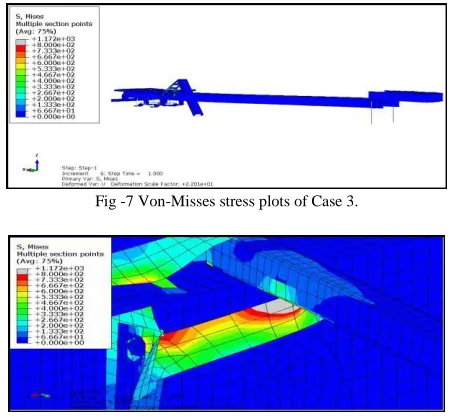
Fig -7 Von-Misses stress plots of Case 3.
Case 2: Inertia Load Or Load Due To Jerks While Shifting Or Lifting The Chassis From One Place To Other, 600N Load Has Been Recorded.
[image:4.595.321.546.497.706.2]Volume: 03 Issue: 09 | Sep-2016 www.irjet.net p-ISSN: 2395-0072
Fig – 13 Von-Misses stress plots of Case 5
Fig - 9 DEFLECTION for Case 3.
Case 4: When The Vehicle Goes Over A Speed Breaker Or .
Fig – 14 Zoomed view of Stress Region where it occurs. On A Ditch, Here 750N Load Has Been Recorded.
[image:5.595.315.553.96.438.2]
Fig - 15 DEFLECTION for Case 5.
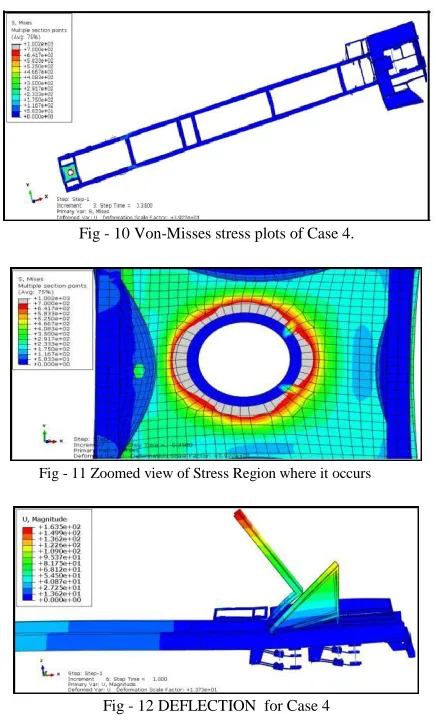
[image:5.595.54.272.265.626.2]Fig - 10 Von-Misses stress plots of Case 4.
Fig - 11 Zoomed view of Stress Region where it occurs
Fig - 12 DEFLECTION for Case 4
3. RESULT ANAYSIS & COMPARISION
Table – 1: Comparison of Theoretical and Analytical results of stress
The above table gives the stress values which have been developed during the load developed on the chassis frame for five cases by both theoretical and Abaqus results. The abaqus results have been taken from the figures as shown above. It is clearly understood that the error from the table gives evidence that both analyses gives approximately same results. The below table gives the deflection values for loading cases as mentioned in top by both the analyses. From error column it is clearly understood that Abaqus software gives approximately same values as theoretical.
Case 5: Vehicle Cornering, Here 700N Load Has Been Recorded.
Table – 2 Comparisons of Theoretical and Analytical Results of Deflections
[image:5.595.313.568.403.511.2]CONCLUSIONS
The work presented herein is an attempt to study and analyze the Heavy Vehicle Chassis Frame to get better structural performance. From this study following conclusions are observed, all the objectives are met and results obtained are satisfactory. Theoretical and analytical results are approximately same. The structure is safe under given loading condition with the appropriate factor of safety. Induced stresses are within the permissible limit for all cases, thus giving a better structural performance. The ABAQUS results from the tables give the evidence, that the software is valid for finding the deflection under various loading conditions.
Engineering and Technology eISSN: 2319-1163 | pISSN: 2321-7308
[8] Hemant B.Patil , Sharad D.Kachave , Eknath R.Deore ‘Stress Analysis of Automotive Chassis with Various Thicknesses’ IOSR Journal of Mechanical and Civil Engineering (IOSR-JMCE) e-ISSN: 2278-1684 Volume 6, Issue 1 (Mar. - Apr. 2013), PP 44-49
[9] Swami K.I. , Prof. Tuljapure S.B.’ ‘Analysis of Ladder Chassis of Eicher 20.16 Using FEM’ IOSR Journal of Applied Geology and Geophysics (IOSR-JAGG) e-ISSN: 2321–0990, p-ISSN: 2321–0982.Volume 2, Issue 1 Ver. I. (Jan. 2014), PP 06-13
REFERENCES
[1] Hirak Patel, Panchal and Chetan, Structural Analysis of Truck Chassis Frame and Design Optimization for Weight Reduction, International Journal of Engineering and Advanced Technology (IJEAT), ISSN: 2249 – 8958, Volume-2, Issue-4.
[2] Iqubal1,S.M.Oak,R.S.Kharatmal, Analytical Optimization of Chassis Frame for 40ft D Axle Flatbed Trailer Design, IOSR Journal of Mechanical (IOSR-JMCE), e-ISSN: 2278-1684
[3] Paul, Sarange, and Chaudhari, STRUCTURAL ANALYSIS OFTRUCKCHASSISUSINGFINITEELEMENTMETHOD,Inte rnationalJ.ofMultidispl.Research&Advcs.InEngg.(IJMRAE ), ISSN 0975-7074, Vol. 4, No. I
[4] Patil, Kachave, and Deore, Stress Analysis of Automotive Chassis with Various Thicknesses, IOSR Journal of Mechanical and Civil Engineering (IOSR-JMCE), e-ISSN: 2278-1684 Volume 6, Issue 1
[5] Vinayak R. Tayade*, Avinash V. Patil ‘Structural Analysis Of Truck Chassis Using Finite Element Method’,
International Journal Of Engineering Sciences & Research Technology. ISSN: 2277-9655 (I2OR), Publication
[6] Kallappa Khannukar, Vinayak Kallannavar, Dr. B. S. Manjunath ‘Dynamic Analysis Of Automotive Chassis Using Fea’ International Research Journal Of
Engineering And Technology (IRJET) E-ISSN: 2395 - 0056 Volume: 02 Issue: 09 | Dec-2015 Www.Irjet.Net P-ISSN: 2395-0072