In this report:
OSI Standards Progress ... 6 OSI Management ... 8 OSI and the Future •....••....•.. 9 Note: This report ex-plains the OSI Seven-Layer Reference Model at all layers; compares OSI to other architectures; rationalizes the need for standards testing and veri-fication; examines the case for OSI; profiles major testing organiza-tions; and outlines OSI Management standards and status.
DATA PRO
Data Networking 2783Standards
1
ISO Reference Model
for Open Systems
Interconnection (OSI)
Datapro Summary
The goal of Open Systems Interconnection (OS!) was designed to enable dissimilar com-puters in multivendor environments to share information transparently. The OSI structure calls for cooperation among systems of different manufacture and design. There are seven layers of the OSI model that communicate between one end system and another. The layers cover nearly all aspects of information flow, from applications-related services provided at the Application Layer to the physical connection of devices to the communications medium at the Physical Layer. All seven layers have long since been defmed and ISO protocols ratified for each layer, though extensions have been made occasionally. Although the model has changed the way we look at networking, the dream of complete OSI-compliance has not come to fruition. The causes are varied, but this is essentially because OSI protocols are too expensive and too complex compared with other protocols that have become de facto stan-dards in their own right. Even so, it is important to understand the model because, although the complete stack of protocols is not much used today, the model has formed the way we think of the structure of networks, and the model itself is always referred to in intemetwork-ing matters.
Analysis
The proliferation of computerized data process-ing systems in the late 1960s produced a need for compatible data communications networks in the 1970s. Several proprietary network architec-tures were developed for mainframe-to-tenninal communications, including ffiM's SNAin 1974. Although many of these proprietary architec-tures were based on a layered model, none was compatible with any other. The CClTI's X.25 host interface to the packet networks standard was ratified in 1976 but this is not a complete network architecture. In 1977 the International Organization for Standardization (ISO) formed ISO Technical Committee 97 (TC97), Subcom-mittee 16 (SC16), to embark on a worldwide
-By Marina Smith Senior Analyst
email: [email protected]
standardization effort and confront the issue of incompatibility head-on. The purpose of TC97! SC 16 was to develop a model and define the protocols and interfaces required to support an open system. The goal of OS! was, and still is, to enable dissimilar computers in multivendor environments to share information transparently. With this capability, it was thought that global digital networks could become a reality. As we shall see, however, much of the OSI goal has in fact come about through widespread use of de facto protocols such as TCPIIP and from
multi-vendor initiatives formed to ensure interoper-ability such as the ATM Forum, a standards-set-ting body in its own right.
The Open System
The ISO defines a system as a set of one or more computers and associated software, peripherals, tenninals, human operators, physical processes, information transfer means, etc., which form an autonomous whole capable of performing infor-mation processing and/or inforinfor-mation transfer. An open system is one that obeys OSI standards in its communication with other systems.
@ August 1997 The McGraw-HUI Companies, Inc. Reproduction Prohibited. Dalapro Information Services Group. Dellan NJ 08075 USA
2 2783 Standards
An application process is an element within a system that performs information processing for a particular application. The application process can be manual (a person operating a banking terminal), computerized (a program executing in a computer cen-ter and accessing a remote database), or physical (a process con-trol program executing in a dedicated cQIllPuter attachedto indus-trial equipment and linked to a plant control system).
The OSI structure calls for cooperation among systems of dif-ferent manufacture and design. This includes coordinating activi-ties such as the following:
• Interprocess communications-the synchronization between OSI application processes and the exchange of information • Data representation-the creation and maintenance of data
descriptions and transformations for reformatting data ex-changed between systems
• Data storage-storage media, file systems, and database sys-tems for providing access to and management of stored data • Process and resource management-how application processes
are declared, initiated, controlled, and acquired
• Integrity and security-information processing constraints that must be ensured during open systems operations
• Program support-the definition, compilation, testing, linking, storage, and transfer of and access to programs executed by the application processes
The OSI model is concerned only with the exchange of informa-tion between open systems.
The Layering Concept
Layering is a basic structuring technique used in the OSI model. Each layer is composed of an ordered set of subsystems, with logically related functions grouped together. The OSI model breaks down internetworking activities between systems into two
The Seven Layers of 051
Layer Name
7 Application
6 Presentation
5 Session
4 Transport
3 Network
2 Data Unk
Physical
On the Intemet htIp:llwww.datapro.com
ISO Reference Model for Open Systems· Interconnection (OSI)
Data Networking
distinct groups. Communications-oriented functions are sepa-. rated from user-oriented functions; features which move
informa-~on across a network are distinct from features which handle and format information.
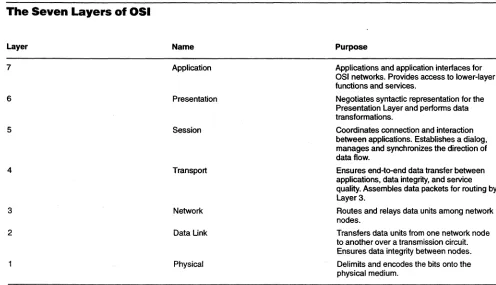
[image:2.612.66.562.451.736.2]There are seven layers of the OSI model that communicate between one end system and another end system. The layers cover nearly all aspects of information flow, from applications-related services provided at the Application Layer to the connec-tioJ;l of devices to the communications medium at the Physical Layer. Below the Physical Layer, the media itself corresponding to '1..ayer 0" -such as wire, cable, or through-the-air communi-cation-is not addressed by the model. Application, Presentation, Session, Transport, Network, Data Link, and Physical Layers have been defined (see Table "The Seven Layers of OSI"). The table describes the OS.! model's seven layers and their purposes. In the model, information flows down from Layer 7 to Layer 1, and then out over a physical transmission medium. At the receiv-ing end, the information flows into another end system and up from Layer I to Layer 7, until it is received by a user.
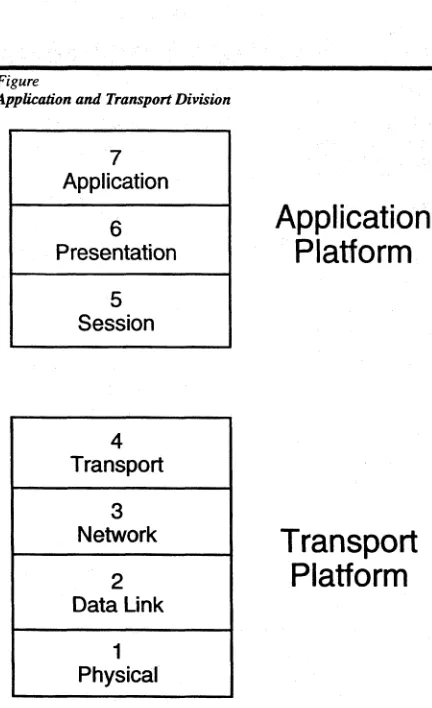
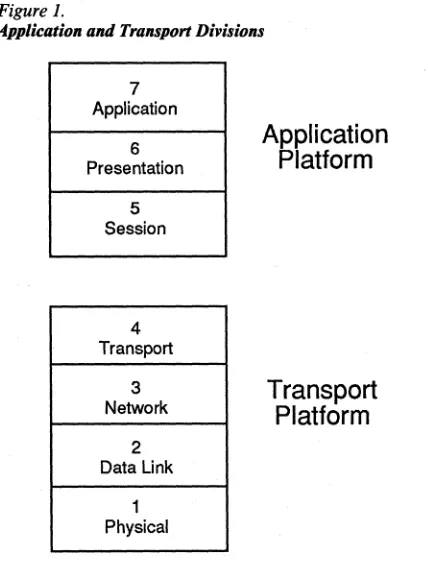
The seven layers can be divided into two functional groups: the Transport Platform (Layers I to 4) and the Application Plat-form (Layers 5 to 7). The Transport PlatPlat-form's function is to get data from one system to another without errors. The Application Platform's function is to interpret the data stream and present it to the user in a usable form (see Figure "Application and Transport Division").
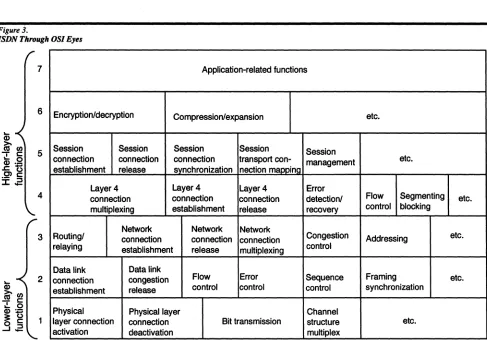
Each layer contributes functions to the communications task. For example, the Link Layer enables communications across a single physical connection, while the Network Layer provides end-to-end routing and data relay. Services at the upper-layer in-terface--providing communications to the next~higher layer-are provided by each layer, usually described by a service speci-fication for the layer. Services at each layer are provided by a layer entity. Each layer entity communicates with its peer at the same layer on another system, providing services specified in the service specification.
Purpose
Applications and application interfaces for OSI networks. Provides access to lower-layer functions and services.
Negotiates syntactic representation for the Presentation Layer and performs data transformations.
Coordinates connection and interaction between applications. Establishes a dialog, manages and synchronizes the direction of data flow.
Ensures end-to-end data transfer between applications, data integrity, and service quality. Assembles data packets for routing by Layer 3.
Routes and relays data units among network nodes.
Transfers data units from one network node to another over a transmission circuit. Ensures data integrity between nodes. Delimits and encodes the bits onto the physical medium.
Data Networking ISO Reference Model for Open Systems Interconnection (051)
Standards Organizations
Several standards testing and verification bodies have been organized by vendor consor-tiums, govemment agencies, and independent organiza-tions. They have found that developing conformance specifications, producing test-ing suites, and conducttest-ing comprehensive testing are complicated, expensive, and time consuming. Regional dif-ferences can stymie attempts at verification. The trend for these organizations, therefore, is to cooperate with each other, sharing resources and expertise. A primary objective is demonstrating interopera-bility among different vendors; i.e., proving that standards really work and fostering end-user interest. Many agencies have tried vainly to involve more end users but are backed primarily by the vendors.
ANSI (American National Standards Institute)
ANSI
11 W.42nd Street
New York NY 10036, U.S.A. Tel:+12126424900 Fax: +12123980023 http://www.ansi.org
ATMForum World Headquarters
2570 West EI Camino Real Suite 304
Mountain View, CA 94040-1313, U.S.A.
Phone: +1 4159496700 Fax: +14159496705 http://www.atmforum.com
European Office
Boulevard Saint-Michel 78 1040 Brussels, BELGIUM Phone: +32 2 732 8505 Fax: +32 2 732 8485
Asia-Pacific Office
Hamamatsucho Suzuki Bldg.3F
1-2-11 Hamamatsucho, Minato-ku
Tokyo 105, JAPAN Phone: +8133438 3694 Fax: +81 3 3438 3698
IEEE (The Institute Of Electrical And Electronics Engineers)
The Institute Of Electrical And Electronics Engineers, Inc. 1828 l Street NW, Suite 1202 Washington DC 20036-5104, U.S.A.
Tel: +1 908 981 0060 Fax: +19089810027 http://www.ieee.org
IBM's SNA is also a layered architecture, following rules of layering similar to OSI and other layered architectures. There are good reasons for layering: layering simplifies change; compo-nents inside a layer can be changed without affecting any other layers in that node. Layers are like structured programming-but for teleprocessing systems. Because there are rigid interfaces be-tween levels, fewer people need to react to changes, allowing them to be implemented faster. There is no better way of achiev-ing complex functions. Layerachiev-ing allows each network function to be made "transparent," unaware and independent of other func-tions at other layers, thus enabling any layer to be modified with-out changing the entire monolithic architecture.
Each layer may support one of several different protocols designed for specific network applications; the choice of a spe-cific protocol is optional, allowing users to tailor networks to their own design. Each layer defines functions crucial to the com-munications process at that layer, independent of the other layers. However, a layer may perform functions hinging on functions performed in the layers immediately above or below. A layer can only communicate with another device or network node at its peer layer. Messages exchanged between peer layers are "enveloped"
@ 1997 The McGraw·Hill Companies, Inc. Reproduction Prohibited. Datapro Information Services Group. Delran NJ 08075 USA
IEEE Corporate Office 345 E. 47th Street
New York, NY, 10017, U.S.A. Tel: +1 2127057900 IEEE Operations Center 445 Hoes Lane
Piscataway, NJ, 08855-1331, U.S.A.
Tel: +1 908981 0060 IEEE European Operations Center (Brussels)
Tel: +32 2 770 2242 Fax: 32 2 770 8505 E-mail: [email protected]
ISO (International Organization for Standardization)
ISO Central Secretariat 1, rue de Varembe Case Postale 56 CH-1211 Geneva 20 Switzerland
Tel: + 4122 749 0111 Fax: + 4122 733 34 30
E-mail:
INTERNET: [email protected] X.4OO: c=ch; a=4oonet; p=iso; e=isocs; s=central
http://www.iso.ch
Please note: Copies of ISO standards can be ordered from local standards offices.
2783 Standards
3
ITU (International
Telecommunications Union)
Place des Nations CH - 1211 Geneva 20 Switzerland
Tel: +412273051 11 Fax (Group 3): +41 22 733 7256
Fax: (Group 4): +41 22 730 6500
http://www.itu.ch
European Computer Manufacturers Association (ECMA)
Rue du Rhone 114
CH-1204 Geneva, Switzerland Tel: +41 22 849 6000 Fax: +41 22 849 6001 Telex: 413237 ECMA CH http://www.ecma.ch
Electronic Industries Association (EIA)
Electronic Industries Association
2500 Wilson Boulevard Arlington, VA 22201-3834 Tel: +1 703 907 7500 Fax: +1 703 907 7501 http://www.eia.org
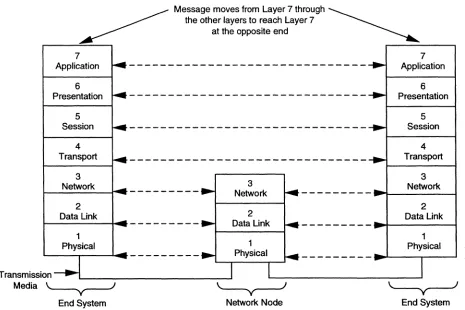
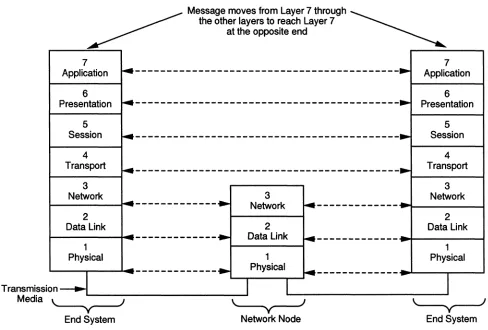
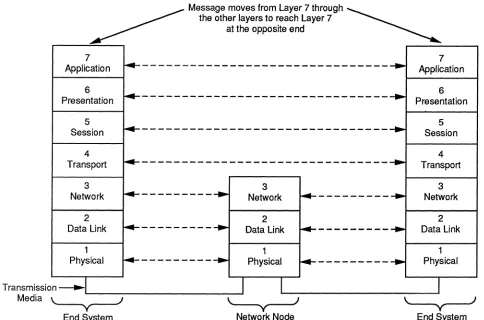
with messages from other layers and passed through these other layers on the way to their destination, picking up and then shed-ding these other protocol layers along the way. For example, if layer seven at one end system must send a message to layer seven at another, it must travel down through six layers at its own end and then up through six layers at the other, until it reaches layer seven at its opposite (peer) layer.
Each network node (a network user, computer, terminal) is equipped with this layer mechanism. However, not all intermedi-ate nodes need all seven layers. Network nodes, in particular, must only route and transmit data packets-functions at the bot-tom three layers of the OS! model. Layer 4 through 7 functions are not required and, therefore, not included in network node soft-ware. Data packets processed in these nodes reach only Layer 3 and are then routed elsewhere (see Figure "Message Movement Among OS] l.o.yerS'). A node communicates with its peer in an-other node sending or receiving data. Data transfer is routed from Layer 7 down to Layer 1 at the transmitting node, then along the network to Layer 1 at the receiving node, and finally from Layer I up to Layer 7. Peer layers communicate by the same method.
4
Figure
2783
Standards
Application and Transport Division
7
Application
6
Presentation
5
Session
4
Transport
3
Network
2
Data Unk
1
Physical
Application
Platform
Transport
Platform
The seven layers are divided into two functional groups.
The message initiated at the Application Layer is passed from layer to layer, through the various OSI layers, encapsulating con-trol information in the process. A fully encapsulated message enters the cable at Layer 1. The procedure is reversed at the re-ceiving end. Each item of control information is processed at its appropriate layer, and the message itself passes up to Layer 7. Data transfer essentially is a packaging process at the transmitting node and an unpackaging process at the receiving node. The Layers
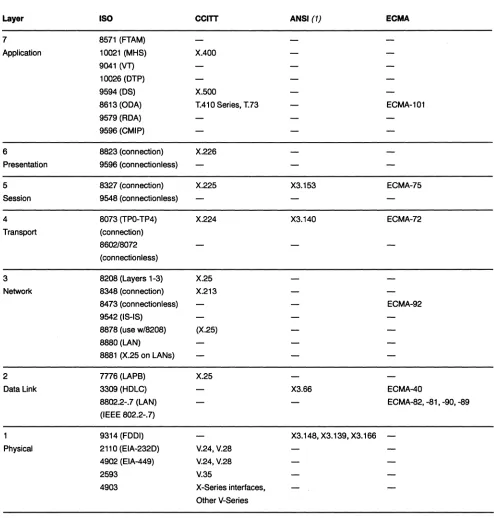
A number of objectives were considered by the reference model's designers: to limit the number of layers to make the system engi-neering task of describing and integrating the layers as simple as possible; to create boundaries between layers at points where the description of services can be small and the number of interac-tions across each boundary is minimized; and to collect similar functions in the same layer. Table "The Seven Layers of OSf' summarizes the OSI Reference Model's layers; more detailed descriptions follow for each layer.
The App6cation Layer
The Application Layer (Layer 7) is the highest layer, providing the means for the application process to access the OSI environ-ment. Its function is to serve as the passageway between applica-tion processes using Open Systems Interconnecapplica-tion to exchange information; consequently, all application process parameters are made known to the OSI environment through this layer.
All services directly usable by the application process (i.e., systems and applications management functions) are provided by the Application Layer. It differs from the other layers in that it
On the Intemet http://www.datapro.com
ISO Reference .Model for Open Systems Interconnection (051)
Data Networking
does not provide services to a layer above it. Some of the services provided by this layer, other than information transfer, are the following:
• Identifying intended communications partners
• Determining current availability of the intended partners • Establishing the authority to communicate
• Agreeing on responsibility for error recovery • Agreeing on procedures for controlling data integrity The Presentation Layer
The Presentation Layer (Layer 6) allows an application to inter-pret the meaning of information exchanged, Information is for-matted and translated at this layer. Aspects of Layer 6 include data syntax, which is the data to be transferred between layers, and the presentation image syntax, which is the data structure thatappli-cation entities refer to in their dialog, or the set of actions that may be performed on the data structure.
Services provided to the Presentation Layer include the following:
• Transforming data syntax, primarily code and character set conversion
• Transforming and selecting the presentation syntax, the adap-tation and modification of the presenadap-tation data (the OSI view) Functions within the Presentation Layer include session estab-lishment request; data transfer; negotiation and renegotiation of data syntax and presentation image syntax; and session
termina-tion request. The Session Layer
The Session Layer (Layer 5) allows cooperating presentation entities to organize and synchronize their dialog and to manage data exchange. It provides the following services:
• Session-connection establishment-creation of an exchange between presentation entities
• Session-connection release • Normal data exchange • Expedited data exchange
• Interaction management-allowing presentation entities to take turns exercising control functions
• Session-connection synchronization
• Exception reporting-permitting the presentation entities to be notified of exceptional situations
• Activity management The Transport Layer
The Transport Layer (Layer 4) provides transparent data flow between session entities, freeing the Session Layer from respon-sibility for cost-effective and reliable data transfer. Layer 4 pro-vides information interchange according to a user-specified reli-ability level and end-to-end control. Transport protocols transfer information from one end of a physical connection to another and ensure that it is delivered correctly_ Layer 4 protocols are used after a route has been established through the network by the network-layer protocol.
The services provided by this layer include the following: • Transport-connection establishment to complete a connection
between session entities
Data Networking
Figure
ISO Reference Model for Open Systems Interconnection (OSI)
Message Movement Among OSI Layers
2783 Standards
5
Message moves from Layer 7 through ~
the other layers to reach Layer 7 at the opposite end
7 Application
6 Presentation
5 Session
4 Transport
3 Network
I-...;..=.;.;:.;..:.:.----I-~ -2
Data Link
I---+~- -1
Physical
L . - -_ _ r---L~
-Transmission
3 Network
2 Data Link
,....---,
7 Application6 Presentation
5 Session
4 Transport
3 Network
---~~---_4
2 Data Link
---~~---_4
1 Physical
---~~--~--~
Media
'--v---'
'--v---'
'--v---'
End System Network Node End System
Intermediate nodes in an OSI network require only bottom-layer functions of the OSI modeL Note how peer layers communicate only with their peers; i.e., Layer I talks to other Layer Is but not to Layer 2s.
• Data transfer, in accordance with the agreed quality of service • Transport-connection release
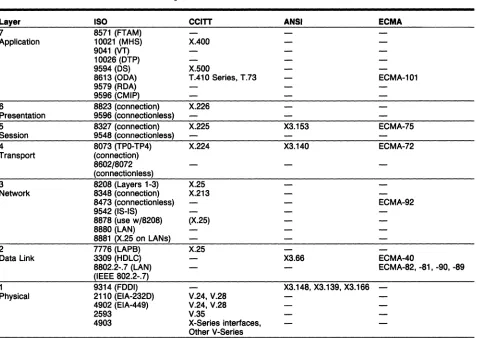
The European Computer Manufacturers Assn. (ECMA) has defined this layer in its Transport Protocol standard, ECMA-72.
In the early 199Os, as the popularity of the OSI protocols be-gan to wane and TCPIIP bebe-gan to take over, a number of hybrid stacks were developed whereby data streams could "cross over" from one type of stack to another, in either direction. The cross-over point was at the Transport Layer in all cases. This allowed applications to reach their intended destinations whichever sys-tem they were using, and encouraged interoperability. Although this was in keeping with the aims of the ISO, it made possible migration to the newly-popular TCPIIP stack, and aided the even-tual near-demise of the OSI stack as a complete set of protocols. The Network Layer
The Network Layer (Layer 3) provides the means to establish, maintain, and terminate connections between systems. Its basic service is providing transparent data transfer between transport entities.
The services provided by this layer encompass the following: • Establishing network connections for transporting data
be-tween transport entities through network addresses • Identifying connection endpoints
• Transferring network service data units
@ 1997 The McGraw-HRI Companies, Inc. ReproduCtion Prohibited. Oatapro Information Services Group. Delran NJ 08075 USA
• Noting errors for reporting unrecoverable errors to the trans-port layer
• Sequencing network control data units • Row control
• Releasing the network connection
The Network Layer is where routers and, nowadays, some LAN switches operate. They are indifferent to the type of network and can therefore be used to pass data from one type of network to another, for example from Ethernet to Token-Ring. Although many routers have OSI protocol support, in fact it is little used, IP being by far the preferred protocol for this layer. Given the impor-tance of the Internet, which today runs almost entirely on IP, this can only increase. However, the remarks made earlier as to how the model has formed the way we think about networks holds particularly true for this layer and Layer 2-nobody can talk co-herently about networking without mentioning these layers. The Data Link Layer
Data Link Layer 2 provides the procedural and functional means to establish, maintain, and release data link connections between two network nodes or network entities and to transfer data frames (or packets). This layer also detects and may correct errors that occur in the Physical Layer.
Services provided by the Data Link Layer to the Network Layer include data link connection, sequencing, error notifica-tion, flow control, and data unit transfer.
6 2783
Staodards
Layers
are
sometimes divided into sublayers, for several rea-sons. Layer functions are often divided into separate modules to handle the service interface of the layer beneath it. This avoids "rewriting" the entire layer. The Data Link Layer of the IEEE 802Local Area Network (LAN) standards is divided into a Logical Link Control (LLC) sublayer and a Media Access Control (MAC) sublayer. The MAC sublayer depends on characteristics of the underlying" Physical Layer. Any layer may originate a message to fulfill its responsibilities. The message may not bypass any layer en route to its destination. If a message leaves the node, it will end up in another node at the same layer that originated the message. It is at Layer 2 that bridges and most LAN switches reside. All such devices have a MAC address table for all the end stations (which all have MAC addresses).
The Physical Layer
The lowest of the OSI layers is Physical Layer I. It provides the electrical, mechanical, functional, and procedural characteristics for activation, maintenance, and deactivation of a physical con-nection. Physical Layer standards specify physical interfaces (connectors) connected by a physical medium.
Services provided by this layer include the following: • Activating and deactivating physical connections • Data circuit identification
• Sequencing
• Transmitting physical service data units either synchronously or asynchronously
• Fault condition notification
Abstract Syntax Notation One (ASN.1)
ASN.I is a specification language adopted for the OSI Reference Model, giving standards developers a common method for defin-ing syntax. ASN.I is somewhat analogous to grammatical rules defining the English language, with the exception that it is not procedural. Just as English grammar specifies notation (punctua-tion symbols) and word classifica(punctua-tions (such as nouns and verbs), ASN.I specifies the rules that help standards developers define complex data types in terms of simple building blocks.
ASN.I was first formally described and published in 1984, in the ITU-T X.409 standard entitled "Message Handling Systems: Presentation Syntax and Notation." It is now described (in less readable fashion) in two later documents: ITU-T X.208 (ISO 8824), entitled "Specification of Abstract Syntax Notation One (ASN.l)," and X.2OO (ISO 8825), "Basic Encoding Rules for Abstract Syntax Notation One (ASN.l)."
According to ASN.I, each fragment of information must pos-sess a type and a value. For example:
.• Device-Status could be a type (in this case, it is a Boolean
tyj,e)
• Zero or One are the possible valuesThis is specified in ASN.I notation as such: Device-Status ::= Boolean Boolean ::= I (or 0)
This is a very simple example; ASN.I is a powerful grammar, capable of specifying very complex data types. Hence, it will continue to be the grammar of choice for specifying open systems standards and protocols.
On \he Intemet htIp:llwww.datapro.com
ISO Reference Model for OpenSyatems Interconnection (OSI)
Data NetworKing
OSI Standards Progress
There are four stages in the developmerit cycle: working paper; committee draft (CD), previously known as a draft proposal; draft international standard (DIS); and international standard (IS). A working paper is developed in the first stage. When it matures and contains well-developed technical concepts, it is registered as a CD. Passage advances the CD to the DIS level, and the document is considered sufficiently stable to serve as the basis of initial implementations. At the DIS level, the document is distributed for a 180-day ballot. The DIS may require multiple ballots. A suc-cessful ballot elevates the DIS to the level of IS and completes ISO's process.
The entire process usually takes between four and eight years. Here we can see one of the reasons for the lack of popularity for the protocols involved. The ITU-T was formerly the CCITT, under whose aegis these standards were set. The CCITT has now been devolved into the International Telecommunications Union (ITU). Telecommunications standards can be set over a long period of time as the voice and WAN world needs to ensure high quality and complete interoperability between systems. Data net-working, on the other hand, in many cases exists in isolated LANs, and though these are almost always today connected to the outside world in some manner, a gateway of some sort, often IP, gives enough connectivity. For Wide Area Networks (WANs) the same needs may apply as for voice but there is a lot of crossover between the types of device used and the WAN manufacturers have adopted the same standards as are used in LANs in many cases. With the new standard, Asynchronous Transfer Mode (ATM), the standard was set for WANs, but became developed by the LAN vendors far more quickly. Given the fast-moving nature of LAN developments, with low-cost high-volume products appearing in ever greater numbers and new high-specification models ensuring replacements in ever-shorter times, it is easy to see that a standards process that takes up to eight years to com-plete is not workable. LAN standards today are proposed one year and a first version out the next. Again, the ISO process that demands a complete standard before the first release is ignored. as soon as a halfway working standard can be given out, it is, with a further release the year after. A case in point is the new LAN standard for virtual LANs, being developed by the IEEE 802.lq working group-the first release, planned for mid- to late 1997, has only the facilities for port-switching LANs, whereas the idea of completely separating the logical from the physical LAN (which is what a virtual LAN can do) needs far more than that to be efficient.
A list of standards organizations, together with contact details, associated with the OSI Reference Model and other standards mentioned here is given at the end of this report.
OSI Applications Standards
In the early 1990s, applications at Layer 7 were considered the driving force of OSI acceptance. In particular, the ISO electronic mail standard for message handling systems (MHSs)-or X.400-was becoming popular in commercial implementations. Two versions, one in 1984, and another in 1988, were unratified
draft international standards. The standard was given a big boost in 1989, when the Aerospace Industry Assn. (AlA) adopted X.400 to interconnect its diverse electronic mail networks. Gateways to proprietary E-Mail systems were also developed that year, and dozens of vendors rolled out X.400-based products. In addition, the ISO adapted XAOO as the message medium for electronic data interchange (EDI). In this context, X.400 was to be used as the communications method to· store and forward trade documents and business forms conforming to ANSI X 12, the European EDI-FACT, and de facto EDI standards. Alas, MHSIX.400 proved
Data Networking ISO Reference Model for Open Systems Interconnection (051)
costly and complicated to implement, and was overtaken by other, simpler, electronic mail standards, particularly, since the mid-199Os, Internet mail based on IP.
One component of successful E-Mail internetworking is direc-tory services (OS), with the ISO version known as X.500. Again, this seems to be unworkable and, while no international standard has taken over, Novell's NOS and Banyan's StreetTalk provide most of the directory functionality in use today. Microsoft is also in the process of developing a similar function. In today's open networking environment, reliance on proprietary software is un-usual (unless as pre-standard releases) and it can only be con-cluded that X.500 proved more or less unworkable, although Banyan declared its StreetTalk to be based very much upon X.500 and obviously drew upon it for a lot of the ideas.
X.500 specifies an on-line directory for message communica-tions, ultimately allowing network providers to map a common, interconnected directory of worldwide users. X.500 dictates nam-ing conventions, how users access directory information, and what services are available.
The OSI protocol pair for office automation, Office Document Architecture (aDA) and Office Document Interchange Format (ODIF), has been an international standard since 1988 (ISO 8613). It was also specified in the various governments' GOSIP procurement standards until the demise of GOSIP worldwide in the early 199Os. aDA and ODIF facilitate the exchange of office documents-such as letters, memoranda, and business reports-among dissimilar systems. Moreover, the standard specifies the formatting and exchange of compound documents-those con-taining combinations of text, images, and graphics. Several ISO working groups are attempting to strengthen and extend the stan-dard in such areas as the inclusion of audio, spreadsheet data, color graphics, document security, and various layout and presen-tation styles.
The OSI standard for sending and sharing data files-File Transfer, Access, and Management (FTAM)-is also a finalized international standard. It is a Layer 7 component of the Manufac-turing Automation Protocol (MAP), which was developed from networking efforts in the manufacturing industry. It spread quickly in Europe and made significant progress in domestic business applications, but the file protocol used with Transmis-sion Control Protocol/lnternet Protocol (TCPIIP)-File Transfer Protocol (FfP)-was also well established in the U.S., however, and generally more popular than FTAM. FTPhas since taken over from FTAM for most file transfer and is the established way of downloading large files from Internet sites. It was thought that FfAM would become the standard for EDI transfers but, again, it became apparent that it was too cumbersome, and that was when X.400 became popular for that. The difference in use between X.400 (or any messaging system) and FTAM (or any other file transfer protocol such as FfP), is that file transfer is real time while X.400 is store and forward. With any store-and-forward system, there can be long delays while the information gets through the network-with FfAM and FTP any delays during transmission are usually brief, but are variable depending upon bottlenecks on a large system such as the Internet.
The Layer 7 protocol for network management, Common Management Information Protocol (CMIP), is now an Interna-tional Standard. CMIP is a communications protocol between the agent process, and management agents at each managed OSI node. The real work of managing network processes is located within each node's managed objects at individual OSI layers. In other words, each layer must have its own network management system, which OSI does not specify. CMIP allows a centralized management process to either modify the value of an attribute, or request its value (read its status) at each of the layers. While CMIP has been more or less superseded by the Simple Network
@ 1997 The McGraw-HiA Companies, Inc. Reproduction Prohibited. Delapro Infonnation Services Group. Delran NJ 08075 USA
2783 Standards
7
Management Protocol (SNMP) in the LAN, CMIP is still popular for WAN management, showing once again how different the two worlds can be. SNMP has taken up the structure for management that OSI set up with CMIP and now does the job of managing networks perfectly well. (For more information, see the OSI Management section featured later in this report.)
Other Layer 7 protocols include distributed Transaction Pro-cessing (TP), designed to interconnect different transaction com-puting systems across OSI networks; Remote Database Access (RDA), a protocol for integrating database management systems; and Manufacturing Message Specification (MMS), ISO 9506, a manufacturing protocol that requires extensions for specific manufacturing device types.
Connection Methods
Every layer of the OSI Reference Model, except the Physical Layer, supports both connection and connectionless mode (this is one of the reasons the protocols are so complex and expensive to implement-{)ther technologies are one or the other). Connec-tion-oriented service requires a connection establishment phase, a data transfer phase, and a connection termination phase; a logical connection is set up between end systems prior to data exchange. These phases define the necessary sequence of events for suc-cessful data transmission. Connection-oriented service capa-bilities include data sequencing, flow control, and transparent error handling.
In a connectionless service, such as Switched Multi-megabit Data Service (SMDS), each Protocol Data Unit (PDU) isjnde-pendently routed to the destination; no connection establishment activities are required, since each data unit is independent of the previous or subsequent one. Connectionless-mode service trans-fers data units without regard to establishing or maintaining con-nections. In connectionless mode, transmission delivery is uncer-tain due to the possibility of errors. This appears contrary to the goal of network design--users want to ensure that messages reach their destination. In reality, connectionless-mode communi-cation simply shifts responsibility for message integrity to a higher layer, which checks integrity only once, rather than requir-ing checks at each lower layer. Alternatively, each data unit might contain the error recovery mechanism.
In connection-oriented networking, such as ATM, a connec-tion is established for the whole data stream just once, and all packets or cells follow that path. There is now also what might be thought of as a hybrid never dreamed of in OSI-IP switching, where the first packet is examined but the rest follow the path of the first through the switch, despite the connectionless nature of the protocols involved. This depends on having a switched net-work. Multiprotocol Over ATM (MPOA) will perform the same function when standardized late in 1997.
Lower-Layer Protocols
Lower-layer OSI protocols for Layers 1 through 3 are well-defined veterans and in many cases borrowed from existing EIA, IEEE, or ITU-T standards_ Connectionless communications at the lower layers of the OSI model is well established and is found, for example, in LANs and metropolitan area networks (MANs). While the original OSI model-described in ISO 7498-was connection oriented, the ISO foresaw the need for connection-less service and issued an addendum to that protocol (ISO 74981
ADI). The ISO standard for Network Layer service, ISO 8348, contains connectionless service (in ADl) in addition to the con-nection mode.
OSI Security
By definition, an open system is one that encourages communi-cations between different applicommuni-cations or users. Unfortunately, an
8 2783
Standards
open system can also encourage illegal eavesdropping and infor-mation theft or destruction. Notorious examples of white-<:ollar crime, corporate espionage, and network intrusions by computer worms and viruses have alarmed information processing profes-sionals, and raised a general awareness of computer security is-sues. The concepts of information security and open systems are antithetical; nevertheless, the ISO has taken steps to provide a secure environment within the OSI Reference Model.
International Standard 7498, Part 2 addresses a security architecture within the general OSI model. It describes security measures that can be provided by specific layers in the model. Specific security standards are not yet defined, however, but are under study by working group JTC1, Subcommittee 27 for Information Technology Security Standards, plus other sub-committees.
SC2l, concerned with maintaining and defining the upper three layers of the OSI Reference Model, stabilized several net-work management and security standards in 1991. The Security model is composed of six frameworks that work together across all seven layers of the OSI Reference Model: authentication, access control, security audit, nonrepudiation, confidentiality, and integrity.
OSI and MAP/TOP
The Manufacturing Automation Protocol and Technical Office Protocol (TOP) were originally developed by General Motors and Boeing Computer Services, respectively; to automate manufac-turing functions on the factory floor and in the "back office." Both are based on the OSI Reference Model, using formal standards for each layer where possible. MAP, in particular, is probably the best-known example of a formal multilevel OSI implementation and is achieving substantial industry acceptance.
Version 3.0 added a Presentation Layer to the profile and implemented a version of the Manufacturing Message Specifica-tion (MMS), the protocol for transferring factory and robotics information, ISO 9506. Other Layer 7 protocols specified are FfAM, Network Management, and Directory Service. Middle layers implement ISO connection-oriented protocols, although these must be bypassed for time-critical applications. At the lower transport layers, MAP specifies the IEEE 802.4 token bus system employing a Type F coaxial connection to a 75-ohm cable. Al-though MAP was taken up widely in some countries, notably Japan, it has not been further pursued generally. LANs have moved on and few new LANs use token bus or coaxial cable now (except that in the new field of home LANs, coaxial cable is often employed for its ease of use, but standard Ethernet is universally installed here).
OSI and TCP/IP
Transmission Control ProtocollInternet Protocol was developed by the U.S. government's Defense Advanced Research Projects Agency (DARPA) for its research network, ARPANET. By 1986, TCPIIP had gained a following of commercial users seeking a protocol that could be used as a common denominator for multi-vendor computer networks. TCP and IP are actually two separate protocols, occupying middle layers number Four (Transport) and number Three (Network), respectively, of the OSI Reference Model.
TCPIIP has been implemented on almost every type of com-puter and is especially successful in commercial Ethernet LAN environments. The reason TCPIIP is so popular is because it is free and its development was paid for by the U.S. government. It avoids the connection-orientedlconnectionless dilemma by essen-tially avoiding it. OSI provides a richer set of network options, but these may not be compatible in different networks. Users
On the Internet htlpitwww.datapro.com
ISO Reference Model for Open Systems Interconnection (OSil
Data Networking
cannot communicate across different networks if they implement different options at these layers.
Despite OSI's early promise, a majority ·of networks no:w use TCPIIP for LAN interconnectivity. The Internet, the. tool and plaything "Of the 1990s that is ARPANET's grandchild, runs almost exclusively on IP, though ATM is hidden now in the infra-structure, and we can expect this to increase as ever more band-width is needed. TCPIIP is also used for Ethernet LANs, and Novell has recently withdrawn its proprietary IPX from new Net-Ware installations, preferring instead to migrate customers to pure IP.
OSI Management
Since the first draft of the seven-layer ISO model was produced in 1978, extensions to the basic model have been developed to more adequately represent all of the functions required by large-scale, multivendor networking environments. OSI Management is an extension to the original reference model that specifies transfer of network management information in the Application Layer and support for network management functions at Layers 4, 5, and 6.
Advantages and Disadvantages to OSI·Based Network Management
In addition to solving the problem of managing heterogeneous environments, OSI-based network management played a part in bringing about a new phenomenon-the unbundling of network management from network products. In a proprietary enVlron- . ment, a given vendor's products are primarily manageable only by products developed by that vendor. The promise of OS I helped to split that one-to-one relationship, making it possible for any OSI-based network management system (NMS) to manage any OSI Management-conformant device. Despite being widely sup-ported, CMIP has in the end lost out to SNMP in the LAN envi-ronment, but the initiative encouraged the widespread publication of private Management Information Bases (MIBs) so that hetero-geneous networks could be managed under SNMP. In the WAN, CMIP is both widespread and popular. Here, there is not such an open environment due to lack of customer demand for it, and such interoperability as there is must be reliable. WAN management is vital--LAN management is still often, wrongly, treated as a lUXUry.
The market (both vendors and users)widely criticized ISO for moving too slowly in its efforts to ratify OSI Management stan-dards. Vendors are wisely unwilling to develop products based on standards that are not yet final. In an effort to open the door to new OSI~based network management system products, SC21 WG4 defined groups of network management functions that were to be covered within OSI-based network management: fault, con-figuration, performance, accounting, and security management specifications. These principles, if not the actual protocols, have been established as the expected field to be covered by any net-work management system (NMS), and this is one of the areas that OSI has changed networking profoundly.
Another disadvantage of standards-based network manage-ment is that OSI standards merely provide a menu of options. There are numerouS gaps and ambiguities in OSI Management standards that could be interpreted differently, leading to incom-patible implementations.
Standards Documents
OSI Management standards can be broadly categorized into four
areas:
1. Functions--what network management is, according to OSI
2. Services--how network management functions are accom-plished
If"
(
Data Networking ISO Reference Model for Open Systems Interconnection (OSI)
3. Information Structure-terms and categories describing what is managed (e.g., "management information") 4. Protocols-describe means of transporting network
manage-ment information
Taken together, these four areas describe a generic package for network management systems, and how these products relate to the network devices they manage (called managed objects in OSI terminology).
A blueprint document, Management Framework OMNIPoint, places the OSI Management environment in perspective by describing terms and the scope of OSI network management.
OSI Management Functions
OSI Management functions are described in the Systems Man-agement standards (IS 10040, IS 10164-1 through 10164-7, and N 10164-8 through 10164-12). Management using three models:
1. The Organizational Model---describes ways OSI Manage-ment can be distributed administratively
2. The Information Model-provides guidelines for defining managed objects and their interrelationships, classes, and names
3. The Functional Model-describes network management functions
The Functional Model outlines how ISO has partitioned network management into five functional areas: fault management, con-figuration and name management, performance management, accounting management, and security management. ISO origi-nally described each of these areas in its own standard. Further studies revealed that functions overlapped; therefore, ISO reorga-nized the documents in December 1988 into their present Sys-tems Management form.
Fault management provides the detection, isolation, and cor-rection of abnormalities in network operation. Configuration and name management facilities permit network managers to control the configuration of the system, network, or layer entities. Changed configurations may isolate faults, alleviate congestion, or meet changing user needs. Performance management enables the network manager to monitor and evaluate the performance of the system, network, and layer entities. Data from performance management may be used to initiate configuration changes and diagnostic testing to allow a satisfactory level of performance. Accounting management facilities help determine and allocate costs for the use of a network manager's communications re-sources. Security management facilities permit the management of those services providing access protection of communications resources.
Services
Services are described, in part, in the Common Management In-formation Protocol (CMIP) standard, IS 9596. Services use primitives, or command types, to accomplish network manage-ment functions. Examples of CMIP commands include GET, SET, GET REPORT, CREATE, and DELETE. While service primitives are somewhat abstract, they are important building blocks for composite commands used by network management applications to obtain vital data on the status and activity of net-work devices.
Common Management Infonnation Services (CMIS) include a detailed abstract model of open systems management services. These fall into three categories--event notification, information transfer, and control. Event notification allows one system to no-tify another that some event of importance has occurred.
@ 1997 The McGraw-Hili Companies. Inc. Reproduction Prohibited. Datapro Infonnation Services Group. Delran NJ 08075 USA
2783 9
Standards
Information Structure
The most important standards in this category are Structure of Management Information (SMI), Parts I, 2, and 4 (CD 1Ol6?-I, -2, and -4). (Part 3 is not missing; rather, ISO merged Part 3 mto Part 4.) Included in these standards is an explanation of the object-oriented paradigm, used to model a network in terms of object classes and attributes. In object-oriented environments, a variable (for example, a variable called Bridge) is defined both in terms of the operations that can be performed on it and the values of attributes it can possess. For example, Bridge can have an attribute such as Status, which may have a value of Busy; a net-work management system may obtain this value via a Get opera-tion, or alter it via a Set operation.
Objects (including their attributes and operations) are stored in a MIB, sometimes called an Object Library. The SMI docu-ments just listed provide syntax and semantics for information in the MIB; however, no single ISO standard defines exactly what the OSI MIB will contain, nor how vendors and users can register objects in the standard MIB.
In the TCPIIP world, an Internet Standard MIB exists for objects managed using SNMP. This MIB functions in an analo-gous role to the proposed OSI MIB, although the administration and rules governing the two are sure to differ.
MIB includes all information needed to make management decisions. MIB is a conceptual repository of all OSI management data in an OSI environment. The MIB concept does not imply any form of physical or logical storage for management infonnation, however, and its implementation is outside the scope of OSI stan-dards. Rather, the SMI defines the abstract syntax and the seman-tics of information, so that it can be represented in OSI protocol exchanges.
Protocols
Common Management Information Protocol, IS 9596, is the
pri-mary OSI Management protocol. CMIP specifies procedures for the exchange of basic management information between open systems interconnected by OSI protocols.
X.500.-The Directory
The Directory is a related standard designed to manage name-related infonnation concerning protocol layers and network nodes. These services connect the actual names used in the net-work with names and addresses understood by human users. The Directory is defined in CD 9594.
OSI and the Future
The world needs a network of computers, similar to standards for international telephony, to link users across oceans and conti-nents. A few years ago, most industry analysts perceived OSI as the answer. Although endorsed by such prominent vendors as IBM, DIGITAL, and Hewlett-Packard, OSI's once-bright future as the premier means of interconnecting multivendor computer networks is now dimmed. Where OSI was too complex, slow, and expensive, TCPIIP stepped in to fill the gaps. The OSI Reference Model also had some technical glitches and holes that prevented it from being widely implemented. These will probably never now be repaired. As an internetworking protocol, TCPIIP has proved its worth and is a popular and commercially succ~ssful
method of linking users across diverse networks. OSI IDlddle-layer protocols 3 through 5, the altematives to TCPIIP, are not as simple to implement in the real world. SNMP, the network man-agement protocol for TCPIIP networks, is also a proven, comm
7
r-cially successful solution. As long as vendors and users requIre practical networking products, they will continue using TCPIIP-based protocols-standard or not.10 2783
Standards
In reality, OSI and other layered architectures .do not serve every application and are not a panacea. Proprietary architectures , will continue to thrive alongside both de j(lCto and de jure
stan-dards-based networks, especially for closed user groups (where internetworking is not a requirement) or in time-sensitive appli-cations intolerant of layered protocols' high overhead,
All others who desire internetworking must realize that the associated protocols are still evolving-nothing is truly cast in iron. In market-based economies, products that do .not satisfy market needs will not gain widespread favor. Therefore, prospec-tive users must evaluate OSI protocols and their adoption with an
On the lniemet: http://www.datapro.com
ISO Reference Model for Open Systems Interconnection (OSI)
Data Networking
. eye toward future standards developments. As it stands now, OSI will not be the interconnection standard of the future .. Significant portions of it, however, have most certainly contributed to the evolution of international standards. The OSI 7-Layer model it-self, however, has proved itself over and over. This view of data communication has become universally accepted, with even SNA-which is layered differently-often explained in the OSI model's terms. While the standards and protocols may not develop, the structure has added greatly to a common understanding of networkunderstanding and has now also stood the test of time.
(
In this report:
051 Standards Progress ... 6
051 Management ..•..•...• 9
051 and the Future ...••... 11
Note: This report updates the OSI's status at all seven layers; compares OSI to other architectures; rationalizes the need for standards testing and veri-fication; profiles major testing organizations; and outlines OSI Management standards and status.
DATA PRO
Data Networking 2783 Standards1
ISO Reference Model for
Open Systems
Interconnection (OSI)
Datapro Summary
The goal of Open Systems Interconnection (OSI) is to enable dissimilar computers in mul-tivendor environments to share information transparently. The OSI structure calls for coop-eration among systems of different manufacture and design. With this capability, global digital networks can become a reality. There are seven layers of the OSI model that commu-nicate between one end system and another. The layers cover nearly all aspects of informa-tion flow, from applicainforma-tions-related services provided at the Applicainforma-tion Layer to the phys-ical connection of devices to the communications medium at the Physphys-ical Layer. Although all seven layers have long since been defined and ISO protocols ratified for each layer, the ISO committees must keep refining and extending specific sections of the model by rewrit-ing existrewrit-ing definitions and addrewrit-ing new protocols.
Analysis
The proliferation of computerized data process-ing systems in the late 1960s produced a need for compatible data communications networks in the 1970s. Several proprietary network architec-tures were developed for mainframe-to-tenninal communications, including IBM's SNA in 1974. Although many of these proprietary architec-tures were based on a layered model, none were compatible with any other. The CClTf's X.25 host interface to the packet networks standard was ratified in 1976 but is not a complete net-work architecture. In 1977 the International
Or-ganization for Standardization (ISO) formed ISO Technical Committee 97 (TC97), Subcem-mittee 16 (SC16), to embark on a worldwide standardization effort and confront the issue of incompatibility head-on. The pUIpOse of TC97/ SC 16 was to develop a model and define the pro-tocols and interfaces required to support an open system. The goal of OSI was, and still is, to en-able dissimilar computers in multivendor envi-ronments to share infonnation transparently. With this capability, global digital networks can become a reality.
The Open System
The ISO defines a system as a set of one or more computers and associated software, peripherals, terminals, human operators, physical processes, infonnation transfer means, etc., which fonn an autonomous whole capable of perfonning infor-mation processing and/or infonnation transfer. An open system is one that obeys OSI standards in its communication with other systems.
An application process is an element within a system that performs infonnation processing for a particular application. The application process can be manual (a person operating a banking ter-minal), computerized (a program executing in a computer center and accessing a remote data-base), or physical (a process control program ex-ecuting in a dedicated computer attached to in-dustrial equipment and linked to a plant control system).
The OSI structure calls for cooperation among systems of different manufacture and de-sign. This includes coordinating activities such as the following:
• Intetprocess communications-the synchro-nization between OSI application processes and the exchange of infonnation
• Data representation-the creation and mainte-nance of data descriptions and transfonna-tions for refonnatting data exchanged be-tween systems
@ 1993 McGraw-Hili, Incorporated. Reproduction ProhibRed. Datapro Information Services Group. Delran NJ 08075 USA
2 2783
Standards
• Data storage---storage media, file systems, and database sys-tems for providing access to and management of stored data • Process and resource management-how application processes
are declared, initiated, controlled, and acquired
• Integrity and security-information processing constraints that must be ensured during open systems operations
• Program support-the definition, compilation, testing, linking, storage, and transfer of and access to programs executed by the application processes
The OSI model is concerned only with the exchange of informa-tion between open systems.
The Layering Concept
Layering is a basic structuring technique used in the OSI model. Each layer is composed of an ordered set of subsystems, with logically related functions grouped together. The OSI model breaks down internetworking activities between systems into two distinct groups. Communications-oriented functions are sepa-rated from user-oriented functions; features which move informa-tion across a network are distinct from features which handle and format information.
There are seven layers of the OSI model that communicate between one end system and another end system. The layers cover nearly all aspects of information flow, from applications-related services provided at the Application Layer to the connec-tion of devices to the communicaconnec-tions medium at the Physical Layer. Below the Physical Layer, the media itself corresponding to "Layer 0" -such as wire, cable, or through-the-air communi-cation-is currently not addressed by the model. Application, Presentation, Session, Transport, Network, Data Link, and Phys-ical Layers have been dermed (see Table 1). The model described in Table 1 is OSI's seven layers with their purposes. In Table I, information flows down from Layer 7 to Layer I, and then out over a physical transmission medium. At the receiving end, the information flows into another end system and up from Layer 1 to Layer 7, until it is received by a user.
Table 1. The Seven Layers of OSI
Layer Name
7 Application
6 Presentation
5 Session
4 Transport
3 Network
2 Data Link
Physical
JUNE 1993
ISO ~nc. Model tor
Open Systems Interconnection (OSI)
Data Networking
The seven layers can be divided into two functional groups: the Transport Platform (Layers 1 to 4) and the Application Plat-form (Layers 5 to 7). The Transport PlatPlat-form's function is to get data from one system to another without errors. The Application Platform's function is to interpret the data stream and present it to the user in a usable form (see Figure 1).
Each layer contributes functions to the communications task. For example, the Link Layer enables communications across a single physical connection, while the Network Layer provides end-to-end routing and data relay. Services at the upper-layer in-terface-providing communications to the next-higher layer-are provided by each layer, usually described by a service speci-fication for the layer. Services at each layer are provided by a layer entity. Each layer entity communicates with its peer at the same layer on another system, providing services specified in the service specification.
Layers are sometimes divided into sublayers, for several rea-sons. Layer functions are often divided into separate modules to handle the service interface of the layer beneath it. This avoids "rewriting" the entire layer. For example, the Link Layer of the IEEE 802 Local Area Network (LAN) standards is divided into a Logical Link Control (LLC) sublayer and a Media Access Con-trol (MAC) sublayer. The MAC sublayer depends on characteris-tics of the underlying Physical Layer. Any layer may originate a message to fulfill its responsibilities. The message may not by-pass any layer en route to its destination. If a message leaves the node, it will end up in another node at the same layer that origi-nated the message.
IBM's SNA is also a layered architecture, following rules of layering similar to OSI and other layered architectures. There are good reasons for layering: layering simplifies change; compo-nents inside a layer can be changed without affecting any other layers in that node. Layers are like structured programming-but for teleprocessing systems. Because there are rigid interfaces be-tween levels, fewer people need to react to changes, allowing them to be implemented faster. There is no better way of achiev-ing complex functions. Layerachiev-ing allows each network function to
. Purpose
Applications and application interfaces for OSI networks. Provides access to lower-layer functions and services.
Negotiates syntactic representation for the Presentation Layer and performs data transformations.
Coordinates connection and interaction between applications. Establishes a dialog, manages and synchronizes the direction of dataflow.
Ensures end-ta-end data transfer between applications, data integrity, and service quality. Assembles data packets for routing by Layer 3.
Routes and relays data units among network nodes.
Transfers data units from one network node to another over a transmission circuit. Ensures data integrity between nodes. Delimits and encodes the bits onto the physical medium.
@ 1993 McGraw-HiII.lncorporated. Reproduction Prohibited. Oatapro Infomlation ServIces Group. Delran NJ 08075 USA
"'-'--(
Data Networking ISO Reference Model for
Open Syatem. Interconnection (OSI)
Standards Organizations and
Testing Agencies
Although standards are indis- expertise. A primary objective pensable for computer inter- is demonstrating interoperabil-networking, they are useless ity among different vendors; unless vendor claims of com- i.e., proving that standards patibility can be tested and really work and fostering end-users can be ensured of 00- user interest. Many agencies quiring products that comply have tried vainly to involve fully with the standards. In more end users but are general, vendor claims of backed primarily by the ven-standards compatibility are dors.
suspect unless verified by an
impartial testing agency. Addi- In the U.S., primary testing and certification agencies in-tionally, compatibility claims
clude the Corporation for can mean different things to
Open Systems (COS), the different people. For users, it
National Institute of Science is a good idea to probe vendor
and Technology (NIST), and claims of standards
compati-bility to determine what is Bell Communications Re-compatible with what, and at search (Bellcore). Several what levels. smaller organizations and
cer-tain vendors, however, also Several standards testing and offer testing services. Europe verification bodies have been is represented by the Stan-organized both here and dards Promotion & Application abroad by vendor consor- Group (SPAG); Japan by the tiums, government agencies, Promoting Conference for OSI and independent organiza- (POSI). Standards organiza-tions. They have found that tions are listed below: developing conformance
specifications, producing test- American National Stan-ing suites, and conductStan-ing dards Institute (ANSI) comprehensive testing are 1430 Broadway complicated, expensive, and New York, NY 10018 time consuming. Regional dif- (212) 642-4900 ferences can stymie attempts ANSI X3 Secretariat at verification. The trend for Computer and Business these organizations, therefore, Equipment Manufacturers is to cooperate with each Assn. (CBEMA)
other, sharing resources and
be made "transparent," unaware and independent of other func-tions at other layers, thus enabling any layer to be modified with-out changing the entire monolithic architecture.
Each layer may support one of several different protocols de-signed for specific network applications; the choice of a specific protocol is optional, allowing users to tailor networks to their own design. Each layer defines functions crucial to the communica-tions process at that layer, independent of the other layers. How-ever, a layer may perform functions hinging on functions per-formed in the layers immediately above or below. A layer can only communicate with another device or network node at its peer layer. Messages exchanged between peer layers are "enveloped" with messages from other layers and passed through these other layers on the way to their destination, picking up and then shed-ding these other protocol layers along the way. For example, if layer seven at one end system must send a message to layer seven at another, it must travel down through six layers at its own end
Ie 1993 McGraw-Hili, Incorporated. Reproduction prohibned. Qatapro Information Services Group. Oelran NJ 08075 USA
Suite SOO, 311 First Street, NW
Washington, DC 20001-2178 (202) 737-8888
Be" Communications Re-search (Be"core) 60 New England Avenue Piscataway, NJ 08854-4196 (908) 699-2000
Customer Service Hot Line: (800) 521-CORE
Corporation for Open Sys-tems(COS)
Suite 400, 1750 Old Meadow Road
McLean, VA 221 02-4306 (703) 883-2700
Telex: WU16503157578 MCI UW
European Computer Manu-facturers Assn. (ECMA) Rue du Rhone 114
CH-1204 Geneva, Switzerland (+41) 22 735 36 34
Telex: 413237 ECMA CH
Electronic Industries Assn. (EIA)
1722 Eye Street NW, Suite 300
Washington, DC 20006 (202) 457-4900
International Organization for Standardization (ISO) 1, Rue de Varembe Case Postale 56
C8-1211 Geneva 20, Switzer-land
(+41) 22 33 34 30
International Telegraph and Telephone Consultative Committee (CCITT) General Secretariat International Telecommunica-tions Union (ITU)
2783
Standards
Place des Nations
3
CH-1211 Geneva 20, Switzer-land
(+41) 22 99 51 11 Fax: (+41) 22 33 72 56 Telex: 421 000 UIT CH
Institute of Electrical and Electronics Engineers (IEEE)
Headquarters 345 E. 47th Street New York, NY 10017 (212) 70~7900
Fax (publications): (212) 70~
7682
IEEE Service Center (published standards): 445 Hoes Lane, P.O. Box 1331
Piscataway, NJ 0885~1331
(908) 981-1393 Fax: (908) 981-9667 Telex: 833-233
OSINET
Mr. Jerry Mulvenna, Chairman OSINET Steering Committee NIST Building 225, Room B217
Clopper Road
Gaithersburg, MD 20899
Standards Promotion & Ap-plication Group SA (SPAG) Avenue Louise 149, Box 7 10SO Brussels, Belgium (+32) 2 535 08 11 Telex: 20307 SPAG B
National Institute of Stan-dards and Technology (NIST)
U.S. Department of Com-merce
Gaithersburg, MD 20899 (301) 97~2000
and then up through six layers at the other, until it reaches layer seven at its opposite (peer) layer.
Each network node (a network user, computer, terminal) is equipped with this layer mechanism. However, not all intermedi-ate nodes need all seven layers. Network nodes, in particular, must only route and transmit data packets-functions at the bot-tom three layers of the OSI model. Layer 4 through 7 functions are not required and, therefore, not included in network node soft-ware. Data packets processed in these nodes reach only Layer 3 and are then routed elsewhere (see Figure 2). A node communi-cates with its peer in another node sending or receiving data. Data transfer is routed from Layer 7 down to Layer 1 at the transmit-ting node, then along the network to Layer 1 at the receiving node, and finally from Layer 1 up to Layer 7. Peer layers
commu-nicate by the same method. .