Scholarly Research Journal for Interdisciplinary Studies, Online ISSN 2278-8808, SJIF 2016 = 6.17, www.srjis.com UGC Approved Sr. No.49366, NOV-DEC 2017, VOL- 4/37 https://doi.org/10.21922/srjis.v4i37.10788
Copyright © 2017, Scholarly Research Journal for Interdisciplinary Studies
IMPACT OF GLOBALIZATION ON SOCIAL SCIENCES EDUCATION IN
SECONDARY SCHOOLS
Poosapati Durgaiah, Ph. D.
Principal, Einstein College of Education, Rangareddy, Telangana state, India.
E-mail:[email protected]
Education is fundamental issue for development. It is an integrated part of modernization process. Modern knowledge is articulated with the idea of global education. Globalization has definitely influenced on education system in different countries. It is also a key instrument of development. To achieve the target of Millennium Development Goals (MDGs) it is obviously important that right to education should be ensured from the secondary level of every country .The globalization process has greatly influenced on the educational system, which is largely considered as an outcome of modernization process. The study investigated globalization and its influence on social sciences education in secondary schools in Rangareddy district in Telangana state. The study determined how globalization influences social sciences contents, teaching methods and instructional materials/resources. The research questions were to what extent does globalization influences social sciences contents, teaching methods and instructional materials/resources. Descriptive survey design was employed in which five secondary schools were chosen and ten students were randomly selected from each of the schools making a total of fifty students. A 21-item studied questionnaire comprising of the following sub-sections: social sciences contents, social sciences teaching methods and social sciences instructional materials/resources were used to collect the needed data for the study. The collected data were analysed using chi-square analysis.
Keywords: Globalisation, Social Sciences Education, Social Sciences Contents, Teaching Methods, and Instructional materials\resources.
Introduction:
Globalization is a recent phenomenon with its root in trade and commerce. Globalization is a
process of free exchange of goods and capitals across globe. The advancement of science and
technology, revolution leading to the INTERNET, fastest means of transportation etc. have
made the whole world a “global village” and globalization a new impetus. This means that
globalization is a process wherein geographic distance becomes a factor of diminishing
importance in the establishment and maintenance of cross border economic, political and
socio-cultural relations. There is a emergence of global mass culture or a single world
Dr. Poosapati Durgaiah
(Pg. 8675-8684) 8676
Copyright © 2017, Scholarly Research Journal for Interdisciplinary Studies
community to a “virtual” community. UNESCO - Commission on the development of
education (1972) rightly, observes in its memorable report, learning to be “Rigid distinction
between different types of teaching, general, scientific, technical and professional must be
dropped and education as from primary and secondary levels must become theoretical,
technological, practical etc. the same time”. In this sense education is not narrowly conceived
particularly which relates to nation, now a days it needs to conductive globally because of
impact of globalization. Globalisation processes have linked education to technological and
economic development. The culture of globalization has equally engendered the Millennium
Development Goals strategies (MDGs), which seek to address issues of poverty, education,
equality, wealth and environment and the Education For All Goals to be achieved by year
2015 (Obomanu & Adaramola, 2011). In view of these, globalization has deeply affected
social sciences education in schools since social sciences are regarded as the peak for
decision making and development of social competencies. With the discovery of computer
and internet which make globalization possible, the nature of teaching and learning is
changing from traditional learning to electronic learning method. The change from
teacher-centered to learner-teacher-centered has created a close connection between knowledge construction
and reflective action among students and the need to embrace information technologies.
Education and training need to keep up with the emergence of new technologies and
techniques.
Odili (2006) opines that the education of any nation is given impetus by the quality of
educational programmes that are available and the zeal with which they are implemented.
Through the internet, globalization allows the access to ideas on new things and best
practices in all areas of human endeavour. Globalization is a force reorganizing the world’s
economy and help to increase the body of knowledge and quality of life. Knowledge is
fundamental to globalization and globalization in turn has influence on the transfer of
knowledge. Therefore the concept of social sciences learning and knowledge delivery needs
to be changed. As the world is advancing, the use of traditional learning materials and
learning style has changed to the use of technology/electro-mechanical devices for societies
to acquire the right information skills, attitudes and techniques for sustainable growth and
development. In this case, learning is easily linked across countries thereby maintaining
Dr. Poosapati Durgaiah
(Pg. 8675-8684) 8677
Copyright © 2017, Scholarly Research Journal for Interdisciplinary Studies
Wokocha (2011), the globalised world was made possible by the discovery of the computer
and internet which has made the world virtual by transmitting information across the globe in
a matter of micro-seconds.
In Rangareddy district, social sciences does not appear to be in tune with the developments
across the state because its pedagogical approach has not changed substantially. Schools do
not integrate new technologies into teaching and learning. Students do not learn how to use
and integrate the new technologies in order to fit in wherever they find themselves.
Communication infrastructure is inadequate for our students. Most learners in remote rural
cannot have access to computers or get connected when they want to learn after school hours.
It has been observed that learners do not appear to use their computers for learning, and the
use of computer and internet is not embraced in a higher rate for learning of social sciences.
Since the need for knowledge and technology-based personnel in the area of social sciences is
very necessary in this era of globalization, it therefore becomes imperative and expedient to
find out if there is any influence of globalization on teaching and learning of social sciences
in secondary schools. This paper in general terms seeks to determine the influence of
globalization on social sciences education in secondary schools. Therefore, the purpose of
this study is to determine how globalization influences social sciences contents, teaching
method and instructional resources. In the same vein, the following research questions were
developed to direct the study. To what extent does globalization influence social sciences
contents, teaching method and instructional materials/resources? The hypotheses adopted for
this study is there is no significant influence of globalization on social sciences contents,
teaching methods and instructional materials/resources?
Globalization and Social Sciences Contents
Globalization in the 21st century is reaching almost all countries. Few places can elude
contemporary trends and innovative practices are seen to spread even faster due to modern
technology. Social sciences has played important role in the school curriculum in every
aspect. It acts as a means of access to other courses thereby helping to develop many
professionals. The inexorable transformation of consciousness brought on by globalization
alters the content and contours of education, as schools take on an increasingly important role
in the process. (Wokocha 2011), and Rutkowski & Rutkowski, (2008) argue that it is
Dr. Poosapati Durgaiah
(Pg. 8675-8684) 8678
Copyright © 2017, Scholarly Research Journal for Interdisciplinary Studies
for which an increase in similarity across countries may be expected. Therefore it is wise for
us to promote the international curriculum standards that might positively influence social
sciences learning. Rutkwoski et al asserted that, as the role and impact of technology continue
to increase in society and in the workplace, the concepts, processes and skills of science and
social sciences are likely to become even more highly valued and the importance of these
subjects in school curricula to become even greater. There is a necessity of addressing the
need to shift the culture of social sciences learning to suit the features of globalization. In this
case more specific contents should covers cognitive processes in hypermedia and multimedia
learning, social issues in computer-supported collaborative learning, motivation and emotion
in blended learning and e-learning. Therefore social sciences academic bodies should try to
make changes in the area of contents design, instructional resources and teaching method
which should be well incorporated for the training of youths.
Globalization and Social Sciences Teaching Methods
National curriculum frame work 2005 has asserted that the classical way to deliver lectures
needs to be changed, minimizing the use of old textbooks and offering a very lively guiding
programme based upon various information sources, with revised teaching notes and opening
new windows to appreciate the context of students and their creativity as individuals and as a
group. The way knowledge is delivered in the classroom is an important aspect of knowledge
production and the classroom seems largely untouched and equity pedagogy creates an
environment in which students can acquire, integrate and produce knowledge and envision
new possibilities for the use of knowledge for societal change. It challenges the idea of
instruction as transmission of knowledge where the teacher is the source of knowledge and
wisdom and the students are passive recipients.
Globalisation and Social Sciences Instructional materials/resources
National curriculum frame work 2005 asserted that education is very gradual in its adoption
of changes despite the presence of technology within their reach. They are rarely used. Social
sciences teachers perceive computers as a positive tool that can enhance the teaching and
learning process but putting such perception into practice tells a different story. In view of
these, the new technologies should be highly embraced by social sciences learners such as
making use of computer in learning, the use of computer, internet, hypermedia and
Dr. Poosapati Durgaiah
(Pg. 8675-8684) 8679
Copyright © 2017, Scholarly Research Journal for Interdisciplinary Studies
access to information on the internet such as communicating with colleagues on social
sciences topics over the internet, sharing information on social sciences through e-mail,
downloading of information into Compact Disk&Digital Video Disk (CD&DVD) to
distribute to schools which help students without computer to use television and study which
make them active in learning. The increasing capacity of information and communication
technologies, there is a rise in new learning opportunities beyond the traditional book teacher
model. These factors cannot be denied because it is the main factor in increasing the level of
collaboration as globalization comes to stay. A substantive progress in implementation of
information and communications for that matter progress in quality of life and development
cannot be achieved without preparing people for a knowledge society. Learning takes place
through communication. Globalization has many important implications for the learning of
mathematics in schools.Based on these facts, it of interest to examine the influence of
globalization on social sciences education in schools.
Methodology
For this study is descriptive survey method is adopted, its helps the researcher in obtaining
the vital facts and opinions from students. The population of the study consists of all
secondary school students in Rangareddy district. To obtain the sample five students were
randomly chosen from each of the ten schools selected for the study. Therefore, a total of
fifty students in formed the sample for the study. A questionnaire was designed, validated and
their reliability determined before they were used. The above instrument was used to collect
the data used for the study. The administration and collection of all the necessary information
were done during the normal class hours. Chi-square test (χ2) was used to see if there exist
any significant influence in the globalization of social sciences contents, teaching methods
and instructional resources in students learning.
Dr. Poosapati Durgaiah
(Pg. 8675-8684) 8680
[image:6.595.67.534.145.405.2]Copyright © 2017, Scholarly Research Journal for Interdisciplinary Studies
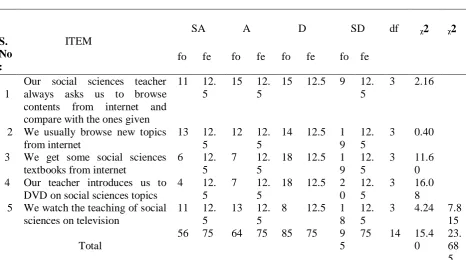
Table 1: Result of Chi-Square Analysis of the Influence of Globalization on Social
Sciences Contents
S. No :
ITEM
SA A D SD df ᵪ2 ᵪ2
fo fe fo fe fo fe fo fe
1
Our social sciences teacher always asks us to browse contents from internet and compare with the ones given
11 12.
5
15 12.
5
15 12.5 9 12.
5
3 2.16
2 We usually browse new topics from internet
13 12.
5
12 12.
5
14 12.5 1
9 12. 5
3 0.40
3 We get some social sciences
textbooks from internet
6 12.
5
7 12.
5
18 12.5 1
9 12. 5
3 11.6
0
4 Our teacher introduces us to
DVD on social sciences topics
4 12.
5
7 12.
5
18 12.5 2
0 12. 5
3 16.0
8 5 We watch the teaching of social
sciences on television
11 12.
5
13 12.
5
8 12.5 1
8 12. 5
3 4.24 7.8
15
Total
56 75 64 75 85 75 9
5
75 14 15.4
0
23. 68 5
Table 1 reveals that the calculated χ2 value of 15.40 is less than the critical χ2 value of
23.685 with 14 degree of freedom at 0.05 level of significance. The result is not significant.
Therefore, the hypothesis that there is no significant influence of globalization on social
sciences contents is retained. The table also shows that none of the items on influence of
globalization on social sciences contents is significant when the calculated χ2 values of 2.16,
0.40, 11.60, 16.08, and 4.24 are compared with the critical χ2 value of 7.815 at 0.05 level of
significance. This result means that globalization has no significant influence on the contents
Dr. Poosapati Durgaiah
(Pg. 8675-8684) 8681
[image:7.595.98.505.146.570.2]Copyright © 2017, Scholarly Research Journal for Interdisciplinary Studies
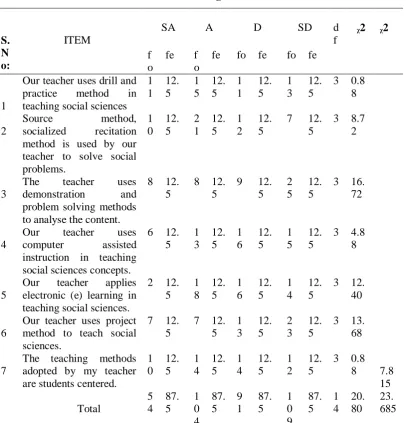
Table 2: Result of Chi-Square Analysis of the Influence of Globalization on Social
Sciences Teaching Methods
S. N o:
ITEM
SA A D SD d
f
ᵪ2 ᵪ2
f o
fe f
o
fe fo fe fo fe
1
Our teacher uses drill and
practice method in
teaching social sciences 1 1 12. 5 1 5 12. 5 1 1 12. 5 1 3 12. 5
3 0.8 8
2
Source method,
socialized recitation
method is used by our teacher to solve social problems. 1 0 12. 5 2 1 12. 5 1 2 12. 5
7 12.
5
3 8.7 2
3
The teacher uses
demonstration and
problem solving methods to analyse the content.
8 12. 5
8 12. 5
9 12.
5 2 5
12. 5
3 16. 72
4
Our teacher uses
computer assisted
instruction in teaching social sciences concepts.
6 12. 5 1 3 12. 5 1 6 12. 5 1 5 12. 5
3 4.8 8
5
Our teacher applies
electronic (e) learning in teaching social sciences.
2 12. 5 1 8 12. 5 1 6 12. 5 1 4 12. 5
3 12. 40
6
Our teacher uses project method to teach social sciences.
7 12. 5
7 12. 5 1 3 12. 5 2 3 12. 5
3 13. 68
7
The teaching methods adopted by my teacher are students centered.
1 0 12. 5 1 4 12. 5 1 4 12. 5 1 2 12. 5
3 0.8
8 7.8
15 Total 5 4 87. 5 1 0 4 87. 5 9 1 87. 5 1 0 9 87. 5 1 4 20. 80 23. 685
Table 2 reveals that the calculated value of 20.80 is less than the critical χ2 value of 23.685
with 14 degree of freedom at 0.05 level of significance. The result is not significant.
Therefore, the hypothesis that there is no significant influence of globalization on social
sciences teaching methods is retained. The table also shows that none of the items on
influence globalization on social sciences teaching methods is significant when the calculated
χ2 values of 0.88, 8.72, 16.72, 4.88, 12.40, 13.68, and 0.88 are compared with the critical χ2
value of 7.815 at 0.05 level of significance. This result means that globalization has no
Dr. Poosapati Durgaiah
(Pg. 8675-8684) 8682
Copyright © 2017, Scholarly Research Journal for Interdisciplinary Studies
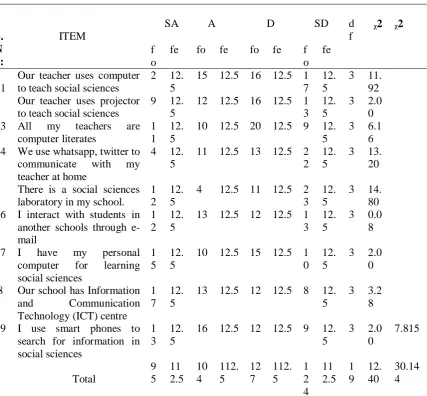
Table 3: Result of Chi-Square Analysis of the Influence of Globalization on Social
Sciences Instructional materials/resources
S. N o:
ITEM
SA A D SD d
f
ᵪ2 ᵪ2
f o
fe fo fe fo fe f
o fe
1
Our teacher uses computer to teach social sciences
2 12.
5
15 12.5 16 12.5 1 7
12. 5
3 11.
92
2
Our teacher uses projector to teach social sciences
9 12.
5
12 12.5 16 12.5 1 3
12. 5
3 2.0
0
3 All my teachers are
computer literates
1 1
12. 5
10 12.5 20 12.5 9 12.
5
3 6.1
6 4 We use whatsapp, twitter to
communicate with my
teacher at home
4 12.
5
11 12.5 13 12.5 2 2
12. 5
3 13.
20
5
There is a social sciences laboratory in my school.
1 2
12. 5
4 12.5 11 12.5 2
3 12. 5
3 14.
80 6 I interact with students in
another schools through e-mail
1 2
12. 5
13 12.5 12 12.5 1 3
12. 5
3 0.0
8
7 I have my personal
computer for learning
social sciences
1 5
12. 5
10 12.5 15 12.5 1 0
12. 5
3 2.0
0
8 Our school has Information
and Communication
Technology (ICT) centre 1 7
12. 5
13 12.5 12 12.5 8 12.
5
3 3.2
8
9 I use smart phones to search for information in social sciences
1 3
12. 5
16 12.5 12 12.5 9 12.
5
3 2.0
0 7.815 Total 9 5 11 2.5 10 4 112. 5 12 7 112. 5 1 2 4 11 2.5 1 9 12. 40 30.14 4
Table 3 reveals that the calculated χ2 value of 12.40 is less than the critical χ2 value of
30.144 with 19 degree of freedom at 0.05 level of significance. The result is not significant.
Therefore, the hypothesis that there is no significant influence of globalization on social
sciences instructional materials/resources is retained. The table also shows that none of the
items on globalization influence on social sciences instructional resources is significant when
the calculated χ2 values of 11.92, 2.00, 6.16, 13.20, 14.80, 0.80, 2.00, 3.28, and 2.00 are compared with the critical χ2 value of 7.815 at 0.05 significance level. This result means that
globalization has no significant influence on the social sciences instructional
[image:8.595.89.517.150.546.2]Dr. Poosapati Durgaiah
(Pg. 8675-8684) 8683
Copyright © 2017, Scholarly Research Journal for Interdisciplinary Studies Discussion
The finding on Hypothesis 1 reveals that there is no significant influence of globalization on
social sciences contents in which policy and curriculum may be impacted more by regional
forces than global forces, which mean that students are yet to feel the impact of globalization
on social sciences contents. The test of Hypothesis 2 reveals that there is no significant
influence of globalization on social sciences teaching methods. Based on the results it can be
concluded that there is no significant influence on the social sciences teaching methods in the
secondary school system. The test of Hypothesis 3 reveals that there is no significant
influence of globalization on social sciences instructional resources/materials. Based on the
results it can be concluded that there is no influence of globalization on social sciences
instructional resources/materials
Findings and Conclusions
From the findings, it implies that with globalization which enhances the adoption of good
modern techniques of instructional delivery through the use of social sciences hypermedia
and multimedia and demonstration procedure, students can become versatile in their approach
to understand the concepts clearly. It also implies that with the use of internet, computer,
mobile and information technology in learning social sciences students’ potentials of
understanding the concepts of social sciences will increase. It also reveals that with the
adoption of globalization in social sciences teaching and learning, students are likely to
develop interest in the subject. The study took a careful look at globalization and its influence
on social sciences education of students in secondary schools. It has been realized that there
is no significant influence of globalization on social sciences contents, teaching methods and
instructional materials/resources. This is as a result of low level use of computers technology
in teaching. And it has reduced students’ knowledge and skill compared to what and how it
should be achieved. Hence, appropriate methods of teaching and the use of Technology based
Instruction be embraced as these would help reduce the rate of globalization influence on
social sciences education. Also the framework for what students need to know to meet their
Dr. Poosapati Durgaiah
(Pg. 8675-8684) 8684
Copyright © 2017, Scholarly Research Journal for Interdisciplinary Studies References:
Atweh,B. & Clarkson, P. (2005).More perspectives on the impact of globalization on mathematics education in higher education. Retrieved on 14th November, 2011
Barakat. A., Political Economy of Madrasah Education in Bangladesh. The book was published as a book on October 1, 2011 at CIRDAP auditorium organized by Nijera Kori and ALRD, Dhaka. In Shikhkat o karmakartader biranabbai satanksa rajnitite jukta. The Daily Kaler Kantho, October 2, 2011. p. 1. Dhaka. Retrieved from
Held, D., McGrew, A., Goldblatt, D. &Perraton, J. (1999). P.16. Global Transformations: Politics, Economics and Culture. In Globalization, Policy and Comparative Research: Discourses of Globalization. (2009). P.78. Melbourne: Springer.
NCF Document 2005 Prepared by NCERT
National Education Policy 2010, Ministry of Primary and Mass Education, The People’s RepublicofBangladesh,UNESCODhaka).Retrievedfromhttp://www.unescodhaka.org/images/a ttachments/article/138/National%20Education%20Policy%202010_Eng%20PDF%20final.pd f
Odili, G. (2006). Mathematics in Nigeria secondary schools: A teaching perspective. (Rev.ed.). Nigeria: Rex Charles & Patrick Limited.