On Black-Box Complexity of Universally Composable Security
in the CRS model
∗Carmit Hazay† Muthuramakrishnan Venkitasubramaniam‡
Abstract
In this work, we study the intrinsic complexity ofblack-box Universally Composable (UC) secure computationbased ongeneral assumptions. We present a thorough study in various corruption mod-elings while focusing on achieving security in the common reference string (CRS) model. Our results involve the following:
• Static UC secure computation. Designingthe first static UC oblivious transfer protocol based on public-key encryption and stand-alone semi-honest oblivious transfer. As a corollary we obtain the first black-box constructions of UC secure computation assuming only two-round semi-honest oblivious transfer.
• One-sided UC secure computation. Designing adaptive UC two-party computation with single corruptions assuming public-key encryption with oblivious ciphertext generation.
• Adaptive UC secure computation.Designing adaptively secure UC commitment scheme assum-ing only public-key encryption with oblivious ciphertext generation. As a corollary we obtain the first black-box constructions of adaptive UC secure computation assuming only (trapdoor) simu-latable public-key encryption (as well as a variety of concrete assumptions).
We remark that such a result was not known even under non-black-box constructions.
Keywords:UC Secure Computation, Black-Box Constructions, Oblivious Transfer, UC Commitments
∗
An extended abstract of this paper appeared in the proceedings of ASIACRYPT 2015. †
Faculty of Engineering, Bar-Ilan University, Israel. Email:[email protected] partially supported by a grant from the Israel Ministry of Science and Technology (grant No. 3-10883).
‡
1
Introduction
Secure multi-party computation enables a set parties to mutually run a protocol that computes some function
f on their private inputs, while preserving a number of security properties. Two of the most important properties are privacy and correctness. The former implies data confidentiality, namely, nothing leaks by the protocol execution but the computed output. The later requirement implies that no corrupted party or parties can cause the output to deviate from the specified function. It is by now well known how to securely compute any efficient functionality [Yao86,GMW87,MR91,Bea91,Can01] in various models and under the stringent simulation-based definitions (following the ideal/real paradigm). Security is typically proven with respect to two adversarial models: the semi-honest model (where the adversary follows the instructions of the protocol but tries to learn more than it should from the protocol transcript), and the malicious model (where the adversary follows an arbitrary polynomial-time strategy), and feasibility results are known in the presence of both types of attacks. The initial model considered for secure computation was of a static adversary where the adversary controls a fixed subset of the parties (who are called corrupted) before the protocol begins. In a stronger corruption model the adversary is allowed to choose which parties to corrupt throughout the protocol execution, and as a function of its view; such an adversary is called adaptive.
These feasibility results apply in most cases on stand-alone security, where a single set of parties run a single execution of the protocol. Moreover, the security of most cryptographic protocols proven in the stand-alone setting does not remain intact if many instances of the protocol are executed concur-rently [Lin03]. The strongest (but also the most realistic) setting for concurrent security is known by
Universally Composable (UC) [Can01]. This setting considers the execution of an unbounded number of concurrent protocols in an arbitrary and adversarially controlled network environment. Unfortunately, stand-alone secure protocols typically fail to remain secure in the UC setting. In fact, without assum-ing sometrusted setup, UC is impossible to achieve for most tasks [CF01,CKL06,Lin03]. Consequently, UC protocols have been constructed under various trusted setup assumptions in a long series of works; see [CLOS02,BCNP04,CDPW07,KLP07,CPS07,LPV09,DMRV13] for few examples.
In this work, we are interested in understanding the intrinsic complexity of UC secure computation. Identifying the general assumptions required for a particular cryptographic task provides an abstraction of the functionality and the specific hardness that is exploited to obtain a secure realization of the task. The expressive nature of general assumptions allows the use of a large number of concrete assumptions of our choice, even one that may not have been considered at the time of designing the protocols. Constructions that are based on general assumptions are proven in two flavors:
Black-box usage: A construction is black-box if it refers only to the input/output behavior of the underlying primitives.
Non-black-box usage: A construction is non-black box if it uses the code computing the functionality of the underlying primitives.
efficiency of the protocol as an undesirable effect of non-black-box constructions is that they are typically inefficient and unlikely to be implemented in practice.
Fortunately, in a line of works [IKLP06,Hai08,PW09,GLOV12] the gap between what is achievable via non-black-box and black-box constructions under minimal assumptions has narrowed. More relevant to our context, the work of Ishai, Prabhakaran and Sahai [IPS08] that provided the first black-box constructions of UC protocols in the static and adaptive settings assuming only one-way functions, in a model where all par-ties have access to an ideal oblivious transfer (OT) functionality. Whereas in the adaptive setting, the work of Choi et al. [CDMW09b] provided a transformation from adaptively secure semi-honest oblivious transfer to one that is securein the stronger UC settingagainst malicious adaptive adversaries while assuming that all parties have access to an ideal commitment functionality. These works make progress towards identify-ing the necessary minimal general computational assumptions in both the static and adaptive UC settidentify-ings. In particular, it follows that, to answer the motivating question of identifying these minimal assumptions, it suffices to identify the minimal assumptions to realize the ideal oblivious transfer in the static setting as specified in [IPS08] and the ideal commitment in the adaptive setting as specified in [CDMW09b].
Static setting. In the stand-alone (i.e. not UC) static setting, assuming only the existence of semi-honest oblivious transfer it has been shown in [IKLP06,Hai08,HIK+11] how to construct secure multi-party com-putation protocols while relying on the underlying primitives in a black-box manner. In the UC setting, Canetti, Lindell, Ostrovsky and Sahai [CLOS02] presented the firstnon-black-box constructions of static UC protocols assuming enhanced trapdoor permutations. In a later work, Choi et al. [CDMW09b] (cf. Proposition 1) provided black-box constructions that are secure against static adversaries, where all parties have access to an ideal commitment functionality. This construction achieves a stronger security notion of straight-line simulation, however falls short of achieving static UC security (see more details in Section3).
UC OT was studied in the influential paper by Peikert et al. [PVW08], who presented a black-box framework in the local1common reference string (CRS) model for an oblivious transfer, based on dual-mode
public-key encryption (PKE) schemes. Such PKE schemes can be concretely instantiated under the Discrete Diffie-Hellman (DDH), quadratic residuosity (QR) and Learning with Errors (LWE) hardness assumptions. In a followup work Choi et al. [CKWZ13] present UC OT constructions in the global CRS model assuming DDH,N-residuosity and the Decision Linear Assumption (DLIN).
It is worth noting that while the works of Peikert et al. [PVW08] and Choi et al. [CKWZ13] provide abstractions of their assumptions, the assumptions themselves are not general enough to help understand the minimal assumptions required to achieve static UC security.
Adaptive Setting. The only work that considered a single general assumption that implies adaptive UC security using non-black-box techniques is the result due to Dachman-Soled et al. [DMRV13], that shows how to obtain adaptive UC commitments assuming simulatable PKE in the global CRS model.2 Moreover, the best known general assumptions required to achieve black-box UC security are adaptive semi-honest oblivious transfer and UC commitments [DN02,CDMW09b]. Known minimal general assumptions that are required to construct these primitives are (trapdoor) simulatable PKE for adaptive semi-honest oblivious transfer [CDMW09a] and mixed commitments for UC commitments [DN02] in the local CRS model. Fi-nally, we remark that the commitment scheme of Damgard and Groth [DG03] based on Strong RSA is, in fact, an adaptive UC commitment in the global CRS model.
As such prior works leave the following important question open:
What are the minimal (general) assumptions required to construct UC protocols, given only
black-boxaccess to the underlying primitives?
1
Namely, a distinct common reference string (CRS) per party.
2Where simulatable PKE is a public key encryption scheme with additional properties that allow oblivious sampling of public
We note that this question is already well understood in the static setting when relaxing the black-box requirement. Namely, in [DNO10] Damg˚ard, Nielsen and Orlandi showed how to construct UC commit-ments assuming only semi-honest oblivious transfer in the global CRS model, while additionally assuming a pre-processing phase where the parties participate in a round-robin manner.3 More recently, Lin, Pass and Venkitasubramaniam [LPV12] improved this result by removing any restricted pre-processing phase. In the same work the authors showed how to achieve UC security in the global CRS model assuming only the existence of semi-honest oblivious transfer. In particular, this construction shows that static UC security can be achieved without assuming UC commitments when relying on non-black-box techniques.
1.1 Our Results
In this paper we present a thorough study of black-box UC secure computation in the CRS model for different attack models; details follow. We note that our first and third results hold for the multi-party case, while the second result is for the two-party setting.
1.1.1 Static UC Secure Computation
Our first result is given in the static setting, where we demonstrate the feasibility of UC secure computation based on semi-honest oblivious transfer and extractable commitments. More concretely, we prove how to transform any statically semi-honest secure oblivious transfer into one that is secure in the presence of malicious adversaries, giving only black-box access to the underlying semi-honest oblivious transfer protocol. Our approach is inspired by the protocols from [HIK+11] and [LP12], where we observe that it is not required to use the full power of static UC commitments. Instead, we employ a weaker primitive that only requires straight-line input extractability. This weaker notion of security, denoted by extractable commitments [MPR10], can be realized based on any CPA secure PKE. More precisely, we prove the following theorem.
Theorem 1.1. (Informal) Assuming the existence of PKE and semi-honest oblivious transfer, then any func-tionality can be realized in the CRS model with static UC security, where the underlying primitives are accessed in a black-box manner.
We remark here that this theorem makes a significant progress towards reducing the general assumptions required to construct UC protocols. Previously, the only general assumptions based on which we knew how to construct UC protocols were mixed-commitments [DN00] and dual-mode PKE [PVW08] both of which were tailor-made for the particular application. Towards understanding the required minimal assumptions, we recall the work Damg˚ard and Groth in [DG03] who showed that the existence of UC commitments in the CRS model implies a stand-alone key agreement protocol. Moreover, under black-box constructions, the seminal work of Impagliazzo and Rudich [IR88] implies that key agreement cannot be based on one-way functions. Thus, there is reasonable evidence to believe that some public-key primitive is required for UC commitments. In that sense, our assumption regarding PKE is close to being optimal. Nevertheless, it is unknown whether plain model (i.e. without setup) semi-honest oblivious transfer assumption is required.
Our result is shown in two phases. At first we compile the semi-honest oblivious transfer protocol into a new protocol with intermediate security properties in the presence of malicious adversaries. This transfor-mation is an extension of the transfortransfor-mation from [HIK+11] that is only proven for bit oblivious transfer, whereas our proof works for string oblivious transfer. Next, we use the transformed oblivious transfer pro-tocol in order to construct a fully secure (malicious) oblivious transfer. By combining our oblivious transfer protocol with the protocol from [IPS08] we obtain a statically generic UC secure computation.
3
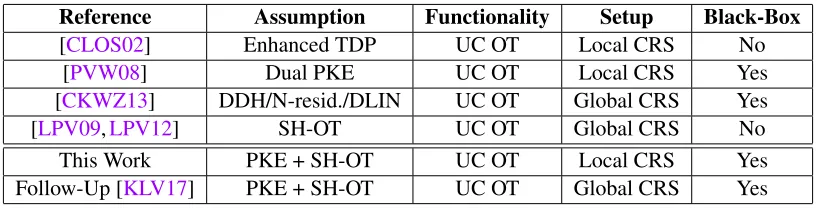
Reference Assumption Functionality Setup Black-Box
[CLOS02] Enhanced TDP UC OT Local CRS No
[PVW08] Dual PKE UC OT Local CRS Yes
[CKWZ13] DDH/N-resid./DLIN UC OT Global CRS Yes
[LPV09,LPV12] SH-OT UC OT Global CRS No
This Work PKE + SH-OT UC OT Local CRS Yes Follow-Up [KLV17] PKE + SH-OT UC OT Global CRS Yes
Table 1: Comparison with prior work on UC oblivious transfer in the CRS model against static corruptions.
An important corollary is deduced from the work by Gertner et al. [GKM+00], who provided a black-box construction of PKE based on any two-round semi-honest oblivious transfer protocol. Specifically, the combination of their result with ours implies the following corollary, which demonstrates that two-round semi-honest oblivious transfer is sufficient in the CRS model to achieve black-box constructions of UC protocols. Namely,
Corollary 1.2. (Informal) Assuming the existence of two-round semi-honest oblivious transfer, then any functionality can be UC realized in the CRS model, where the oblivious transfer is accessed in a black-box manner.
The work of [CDMW09b] shows how starting from a semi-honest oblivious transfer it is possible to obtain a black-box construction of an OT protocol that is secure against stand-alone static adversaries in theFCOM-hybrid model. Moreover,FCOMcan be directly realized in theFEXTCOM-hybrid using the notion of extractable trapdoor commitments [PW09,DS13].4 We do not pursue this approach and instead directly realize OT in theFEXTCOM-hybrid because the main goal in this work is to identify the minimal assumptions required to construct UC OT. We remark that although the main result in [CDMW09b] demonstrates UC security against adaptive corruptions, the same analysis fails to extend to the static setting. More concretely, while their protocol might be secure in the static setting (if we replace the underlying primitives with their analogues in the static setting), its security analysis is not sufficient. This is because Choi et al. modularly compose a weaker building block (adaptive semi-honest OT) to construct a UC OT. Furthermore, in the simulation of the final protocol, the simulator invokes theadaptivesimulator of the weaker primitive on-the-fly. Such a simulation cannot be used in the static setting when the building blocks are instantiated with their analogues in the static setting.5 We finally remark that the previous works of [CDMW09b] and [HIK+11] require a three-step transformation, whereas, our transformation is simpler with a single step transformation.
Implications.In what follows, we make a sequence of interesting observations that are implied by our result in the static UC setting which are summarized in Table1.
• The important result by Canetti et al. [CLOS02], that assumes enhanced trapdoor permutations, can be extended assuming only PKE with oblivious ciphertext generation (which is PKE with the special property that a ciphertext can be obliviously sampled without the knowledge of the plaintext, and can be further realized using enhanced trapdoor permutation). In that sense, our result, assuming PKE with oblivious ciphertext generation, can be viewed as an improvement of Canetti et al. [CLOS02] when relying on this primitive in ablack-boxmanner.
4Where the starting point of the latter work is a statistically-hiding and statistically-binding straight-line extractable commitment
scheme which requires a physical assumption, and is therefore not applicable in the CRS model.
5
• The pair of works by Damgard, Nielsen and Orlandi [DNO10] and Lin, Pass and Venkitasubramaniam [LPV12] demonstrate thatnon-black-boxconstructions of UC commitments, and more generally static UC secure computation, can be achieved in the CRS model assuming only semi-honest oblivious transfer. In comparison, our result shows that two-round semi-honest oblivious transfer protocols are sufficient for obtainingblack-box UC secure computation in the CRS model. We note here that many semi-honest oblivious transfer protocols indeed involve only two-round of communication, e.g., [EGL85,HK12].
• In [LPV09,LPV12], Lin, Pass and Venkitasubramaniam provided a unified framework for construct-ing UC protocols in any “trusted-setup” model. Their result is achieved by capturconstruct-ing the minimal requirement that implies UC secure computation in the setup model. More precisely, they introduced the notion of a UC puzzle and showed that any setup model that admits a UC puzzle can be used to securely realize any functionality in the UC setting, while additionally assuming the existence of semi-honest oblivious transfer. Moreover, they showed how to easily construct such puzzles in most models. We remark that our approach can be viewed as providing a framework to construct black-box UC protocols in other UC models. More precisely, we show that any setup model that admits the extractable commitment functionality can be used to securely realize any functionality assuming the existence of semi-honest oblivious transfer. In fact, our result easily extends to the chosen key reg-istration authority (KRA) model [BCNP04], where it is assumed the existence of a trusted authority that samples public key, secret key pairs for each party, and broadcasts the public key to all parties. We leave it for future work to instantiate our framework in other setup models.
• The fact that our construction only requires PKE and semi-honest oblivious transfer allows an easy translation of static UC security to various efficient implementations under a wide range of concrete assumptions. Specifically, both PKE and (two-round) semi-honest oblivious transfer can be realized under RSA, factoring Blum integers, LWE, DDH,N-residuosity,p-subgroup and coding assumptions. This is compared to prior results that could be based on the later five assumptions [PVW08,CKWZ13, DDN14,DNM12].
• Recently, Maji, Prabhakaran, and Rosulek [MPR10] initiated the study of the cryptographic com-plexity of secure computation tasks, while characterizing the relative comcom-plexity of a task in the UC setting. Specifically, they established a zero-one law that states that any task is either trivial (i.e., it can be reduced to any other task), or complete (i.e., to which any task can be reduced to), where a functionalityF is said to reduceto another functionality G, if there is a UC protocol forF using ideal access toG. More precisely, they showed that assuming the existence of semi-honest oblivious transfer, every finite two-party functionality is either trivial or complete. While their main theorem relies on the minimal assumption of semi-honest oblivious transfer, their use of the assumption is non-black-box and they leave it as an open problem to achieve the same while relying on oblivious transfer in a black-box manner. Our result makes progress towards establishing this.
In more details, their high-level approach is to identify complete functionalities using four categories, namely, (1)FXOR that abstracts a XOR-type functionality, (2) FCCthat abstracts a simple cut-and-choose functionality, (3)FOTthe oblivious transfer functionality, and (4)FCOMthe commitment func-tionality. They then show that each category can be used to securely realize any computational task.6 Among these reductions, functionalitiesFXORandFCCrely on oblivious transfer in a non-black-box way. In this work we improve the reduction of functionalityFCC. That is, we obtain this improvement by showing that the extractable commitment functionalityFEXTCOMand semi-honest oblivious trans-fer can be used in a black-box way to realize functionalityFOT, and combine this with a reduction
6
presented in [MPR10] that reducesFCCto theFEXTCOMfunctionality in a black-box way.
1.1.2 One-Sided UC Secure Computation
In this stronger attack model, where at most one of the parties is adaptively corrupted [KO04,HP14], we prove that one-sided adaptive UC security is implied by PKE with oblivious ciphertext generation, which implies semi-honest OT. Here we combine two observations: (1) In our malicious static oblivious transfer from the previous result, the actions of the parties depend on their real inputs only in the last phase of the protocol, and (2) we do not need a full fledge NCE, rather only need one-sided non-committing encryption (NCE), which we know can be designed based on PKE with oblivious ciphertext generation [CFGN96, DN00]. In particular, NCE allows secure communication in the presence of adaptive attacks, which implies that the communication can be equivocated once the real message is handed to the simulator. Then, by encrypting part of our statically secure protocol using NCE, we obtain a generic protocol for any two-party functionality under the assumption specified above.7 Namely,
Theorem 1.3. (Informal) Assuming the existence of PKE with oblivious ciphertext generation, then any two-party functionality can be realized in the CRS model with one-sided adaptive UC security and black-box access to the PKE.
1.1.3 Adaptive UC Secure Computation
Our last result is in the strongest corruption setting, where any number of parties can be adaptively cor-rupted. Here we design a new adaptively secure UC commitment scheme under the assumption of PKE with oblivious ciphertext generation, which is the first construction that achieves the stronger notion of adaptive security based on this hardness assumption. Our construction makes a novel usage of such a PKE together with Reed-Solomon codes, where the polynomial shares are encrypted using the PKE with oblivious ci-phertext generation. Plugging-in our UC commitment protocol into the transformation of [CDMW09b] that generates adaptive malicious oblivious transfer given adaptive semi-honest oblivious transfer and UC com-mitments, implies an adaptively UC oblivious transfer protocol with malicious security based on semi-honest adaptive oblivious transfer and PKE with oblivious ciphertext generation, using only black-box access to the semi-honest oblivious transfer and the PKE. That is,
Theorem 1.4. (Informal) Assuming the existence of PKE with oblivious ciphertext generation and adaptive semi-honest oblivious transfer, then any functionality can be realized in the CRS model with adaptive UC security, where the underlying primitives are accessed in a black-box manner.
We further recall the work of Choi et al. [CDMW09a] that shows that the weakest general known as-sumption that is required to construct adaptively secure semi-honest oblivious transfer is trapdoor simulat-able PKE.8 Now, since such an encryption scheme admits PKE with oblivious ciphertext generation, we obtain the following corollary that unifies the two assumptions required to achieve adaptive UC security.
Corollary 1.5. Assuming the existence of (trapdoor) simulatable PKE, then any functionality can be realized in the CRS model with adaptive UC security and black-box access to the PKE.
An additional interesting observation that is implied by our work is that our UC commitment scheme implies a construction that is secure in the adaptive setting when erasures are allowed, and under the weaker
7We note that while in the plain model any statically secure protocol can be compiled into one-sided secure protocol by
encrypt-ing its entire communication usencrypt-ing one-sided NCE, such a transformation cannot be applied generically in the UC settencrypt-ing as the trusted setup (eg, CRS) might depend on the identity of the corrupted party.
8
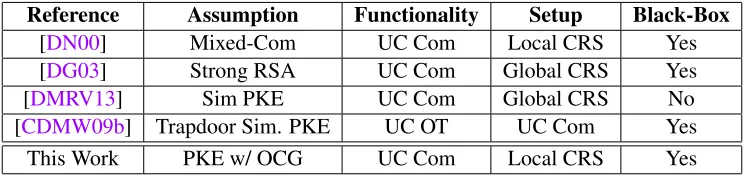
Reference Assumption Functionality Setup Black-Box [DN00] Mixed-Com UC Com Local CRS Yes [DG03] Strong RSA UC Com Global CRS Yes
[DMRV13] Sim PKE UC Com Global CRS No
[CDMW09b] Trapdoor Sim. PKE UC OT UC Com Yes
This Work PKE w/ OCG UC Com Local CRS Yes
Table 2: Comparison with prior work on UC commitments and UC oblivious transfer in the CRS model against adaptive corruptions.
assumption of PKE. Specifically, instead of obliviously sampling ciphertexts in the commitment phase, the committer encrypts arbitrary plaintexts and then erases the plaintexts and randomness used for these com-putations. Our proof follows easily for this case as well. Combining our UC commitment scheme together with the semi-honest with erasures OT from [Lin09] and the transformation of Choi et al. [CDMW09b], we obtain the following result
Theorem 1.6. (Informal) Assuming the existence of PKE and semi-honest oblivious transfer secure against an adaptive adversary assuming erasures, then any functionality can be realized in the CRS model with adaptive UC security assuming erasures, where the underlying primitives are accessed in a black-box man-ner.
Noting that OT secure against adaptive adversaries assuming erasures can be realized under assump-tions sufficient for achieving the same with respect to the weaker static adversaries, this theorem shows that achieving UC security against adaptive adversaries in the presence of erasures does not require any additional assumption beyond what is required to secure against static adversaries.
Implications. Next, we specify a sequence of interesting observations that are implied by our result in the adaptive UC setting which are summarized in Table2.
• Previously, Dachman-Soled et al. [DMRV13], showed that adaptively secure UC protocols can be constructed in the CRS model assuming the existence of simulatable PKE. Our result improves this result in terms of complexity assumptions by showing that simulatable PKE is sufficient, and provides new constructions based on concrete assumptions that were not known before. Nevertheless, we should point out that while the work of Dachman-Soled et al. is constructed in the global CRS model using a non-black-box construction, our result provides a black-box construction in a CRS model where the length of the reference string is linear in the number of parties.
• Analogous to our result on static UC security, it is possible to extend this result to the chosen key-registration authority (KRA) model, where we assume the existence of a trusted-party that samples public keys and secret keys for each party, and broadcasts the public key to all parties.
• Regarding concrete assumptions, previously, adaptive UC commitments without erasures were con-structed based onN-residuosity andp-subgroup hardness assumptions [DN02] and Strong RSA [DG03]. On the other hand, our result demonstrates the feasibility of this primitive under DDH, LWE, factoring Blum integers and RSA assumptions. When considering adaptive corruption with erasures, the work of Blazy, et al. [BCPV13], extending the work of Lindell [Lin11], shows how to construct highly efficient UC commitments based on the DDH assumption. On the other hand, assuming erasures, we are able to construct an adaptive UC commitment scheme based on any CPA-secure PKE.
1.2 Subsequent Work
In subsequent work, Kiyoshima et al. [KLV17] improve the results in the work for the static setting in the CRS model where they show that assuming PKE and semi-honest OT, UC is feasible in the global CRS model where there is a single CRS string chosen for all sessions.
2
Preliminaries
Basic notations. We denote the security parameter byn. We say that a functionµ :N → Nisnegligible
if for every positive polynomialp(·)and all sufficiently largenit holds thatµ(n) < p(1n). We use the ab-breviation PPT to denote probabilistic polynomial-time. We further denote bya←Athe random sampling ofa from a distributionA, and by [n]the set of elements {1, . . . , n}. We specify next the definition of computationally indistinguishable.
Definition 2.1. LetX = {X(a, n)}a∈{0,1}∗,n∈
N andY = {Y(a, n)}a∈{0,1}∗,n∈Nbe two distribution
en-sembles. We say thatX andY arecomputationally indistinguishable, denoted X ≈c Y, if for every PPT
machineD, everya∈ {0,1}∗, every positive polynomialp(·)and all sufficiently largen:
Pr [D(X(a, n),1n) = 1]−Pr [D(Y(a, n),1n) = 1] <
1
p(n).
2.1 Public-Key Encryption Schemes
We specify the definitions of public-key encryption, IND-CPA and public-key encryption with oblivious ciphertext generation.
Definition 2.2(PKE). We say thatΠ = (Gen,Enc,Dec)is apublic-key encryption schemeifGen,Enc,Dec are polynomial-time algorithms specified as follows:
• Gen, given a security parametern(in unary), outputs keys(PK,SK), wherePKis a public-key and
SKis a secret key. We denote this by(PK,SK)←Gen(1n).
• Enc, given the public-key PKand a plaintext message m, outputs a ciphertextc encryptingm. We denote this by c ← EncPK(m); and when emphasizing the randomness r used for encryption, we
denote this byc←EncPK(m;r).
• Dec, given the public-keyPK, secret keySK and a ciphertextc, outputs a plaintext messagem s.t. there exists randomnessr for whichc = EncPK(m;r)(or⊥if no such message exists). We denote
For a public-key encryption schemeΠ = (Gen,Enc,Dec)and a non-uniform adversaryA= (A1,A2), we consider the followingindistinguishability game:
(PK,SK)←Gen(1n).
(m0, m1, history)← A1(PK), s.t.|m0|=|m1|.
c←EncPK(mb), whereb←R{0,1}.
b0 ← A2(c, history). Awins ifb0 =b.
Denote by ADVΠ,A(n)the probability thatAwins the IND-CPA game.
Definition 2.3(IND-CPA). A public-key encryption scheme Π = (Gen,Enc,Dec) isIND-CPA secure, if for every non-uniform adversary A = (A1,A2) there exists a negligible functionµ(·) such that for all
sufficiently largen’s,ADVΠ,A(n)≤ 12 +µ(n).
A public-key encryption with the property of oblivious ciphertext generation implies additional two algorithms: (1) oblivious ciphertext generator Encg and (2) a corresponding ciphertext faking algorithm
g
Enc−1. Intuitively, the ciphertext faking algorithm is used to explain a legitimately generated ciphertext as an obliviously generated one. Formally,
Definition 2.4(PKE with oblivious ciphertext generation [DN00]). A PKEΠwith oblivious sampling gen-eration is defined by the tuple(Gen,Enc,Dec,Encg,Encg
−1
)and has the following additional property,
• Indistinguishability of oblivious and real ciphertexts. For any message m in the appropriate domain, consider the experiment (PK,SK) ← Gen(1n), c1 ← EncgPK(r1), c2 ← EncPK(m;r2),
r20 ←Encg
−1
PK(c2). Then,(PK, r1, c1, m) c
≈(PK, r20, c2, m).
To this end, we only employ encryption schemes with perfect decryption. This merely simplifies the analysis and can be relaxed by using PKE with a negligible decryption error instead.
2.2 Secret-Sharing
A secret-sharing scheme allows distribution of a secret among a group of nplayers, each of whom in a
sharing phasereceive a share (or piece) of the secret. In its simplest form, the goal of secret-sharing is to allow only subsets of players of size at leastt+ 1to reconstruct the secret. More formally at+ 1-out-of-n
secret sharing scheme comes with a sharing algorithm that on input a secretsoutputsnsharess1, . . . , sn
and a reconstruction algorithm that takes as input(si)i∈S, Swhere|S|> tand outputs either a secrets0or
⊥. In this work, we will use the Shamir’s secret sharing scheme [Sha79] with secrets inF =GF(2n). We
present the sharing and reconstruction algorithms below:
Sharing algorithm: For any inputs∈F, pick a random polynomialf(·)of degreetin the polynomial-field F[x]with the condition thatf(0) =sand outputf(1), . . . , f(n).
Reconstruction algorithm: For any input (s0i)i∈S where none of the s0i are ⊥ and |S| > t, compute a
polynomialg(x) such thatg(i) = s0ifor everyi∈ S. This is possible using Lagrange interpolation wheregis given by
g(x) =X i∈S
s0i Y
j∈S/{i}
x−j i−j .
FunctionalityFOT
FunctionalityFOTcommunicates with with senderSenand receiverRec, and adversaryS.
1. Upon receiving input(sender, sid, v0, v1)fromSenwherev0, v1∈ {0,1}t, record(sid, v0, v1).
2. Upon receiving(receiver, sid, u)fromRec, where a tuple(sid, v0, v1)is recorded andu∈ {0,1},
send(sid, vu)toRecandsidtoS. Otherwise, abort.
Figure 1: The oblivious transfer functionality.
Reed-Solomon code: For integerst, nand field F, satisfying0 < t ≤ n < |F|, and a set ofn distinct
elementsI ={x1, . . . , xn} ⊂F, theReed-Solomon codeWn,tis defined by
q(x1), . . . , q(xn)|q(·)is a degreetpolynomial inF[x] .
The Reed-Solomon code has minimum distance relative distance1−nt where a corrupted codeword with up todn−t
2 eerrors can be corrected using the Berlekamp-Welch algorithm. It follows easily that Shamir’s secret sharing onFas described above results in a sequence of shares in the Reed-Solomon codeWn,t.
2.3 Oblivious Transfer
1-out-of-2oblivious transfer (OT) is an important functionality in the context of secure computation that is engaged between a senderSenand a receiverRec; see Figure1for the description of functionalityFOT. In this paper we are interested in reducing the hardness assumptions for general UC secure computation when using only black-box access to the underlying cryptographic primitives, such as the semi-honest OT. We use semi-honest OT as a building block for designing UC protocols in both static and adaptive settings. In the static setting, we refer to the two-round protocol of [EGL85] that is based on PKE with oblivious ciphertext generation (or enhanced trapdoor permutation). In the adaptive setting, we refer to the two-round protocol of [CLOS02] that is based on augmented non-committing encryption scheme.
We briefly recall that any two-round semi-honest OT implies PKE. This is demonstrated in two phases, starting with the claim that semi-honest OT implies a key agreement (KA) protocol. This statement has been proven in [GKM+00] in the static setting, and holds for any number of rounds as well as in the presence of adaptive adversaries. Next, a well established fact shows that in the static setting a two-round key agreement implies PKE (in fact, these primitives are equivalent).
2.3.1 Receiver Private Oblivious Transfer
Receiver privacy is a weaker notion than malicious security and only requires that the receiver’s input be hidden even against a malicious sender. It is weaker than malicious security in that it does not require a simulation of the malicious sender that extracts the sender’s inputs. In particular, we will only require that a malicious sender cannot distinguish the cases where the receiver’s input is0or1. Formally stated,
Definition 2.5(Receiver private OT). Letπbe a two-party protocol that is engaged between a senderSen
and a receiverRec. We say thatπis areceiver privateoblivious transfer protocol, if for everyPPTadversary
Athat corruptsSen, the following ensembles are computationally indistinguishable:
whereViewA,π[A(1n),Rec(1n, b)]denotesA’s view withinπwhenever the receiverRecinputs the bitb.
We point out that receiver privacy protects the receiver against a malicious sender and should be read as privacy against a malicious sender.
2.3.2 Defensibly Private Oblivious Transfer
The notion ofdefensible privacywas introduced by Haitner in [Hai08,HIK+11]. A defense in a two-party protocolπ = (P1, P2)execution is an input and random tape provided by the adversary after the execution concludes. A defense for a party controlled by the adversary is said to be good if, whenever this party participated honestly in the protocol using this input and random tape, then it would have resulted in the exact same messages that were sent by the adversary. In essence, this defense serves as aproof of honest behavior. Defensible privacy ensures that a protocol is private in the presence of defensible adversaries if the adversary learns nothing more than its prescribed output when it provides a good defense.
We begin with informally describing the notion ofgood defensefor a protocolπ; we refer to [HIK+11] for the formal definition. Lettrans = (q1, a1, . . . , q`, a`) be the transcript of an execution of a protocol
π that is engaged between P1 andP2 and let Adenote an adversary that controls P1, whereqi is the ith
message from P1 andai is the ith message from P2 (that is, ai is the response forqi). Then we say that (x, r) constitutes a good defenseof Arelative to trans if the transcript generated by running the honest algorithm forP1 with inputxand random taperagainstP2’s messagesa1, . . . , a`results exactly intrans.
At a high-level, an OT protocol is defensibly private with respect to a corrupted sender if no adversary interacting with an honest receiver with inputbshould be able to learnb, if at the end of the execution the adversary produces any good defense. Similarly, an OT protocol that is defensibly private with respect to a corrupted receiver requires that any adversary interacting with an honest sender with input(s0, s1)should not be able to learns1−b, if at the end of the execution the adversary produces a good defense with input
b. Below we present a variant of the definition presented in [HIK+11]. We stress that while the [HIK+11] definition only considers bit OT (i.e. sender’s inputs are bits) we considerstring OT.
Definition 2.6(Defensible-private string OT). Let π be a two-party protocol that is engaged between a senderSen and a receiverRec. We say thatπ is adefensibly-privatestring oblivious transfer protocol, if for everyPPTadversaryAthe following holds,
1. {Γ(ViewA[A(1n),Rec(1n, U)], U)} ≈ {c Γ(ViewA[A(1n),Rec(1n, U)], U0)}whereΓ(v,∗) is set to
(v,∗) if following the execution A outputs a good defense for π, and ⊥otherwise, and U andU0
are independent random variables uniformly distributed over{0,1}. This property is referred to as defensibly private with respect to a corrupted sender.
2. {Γ(ViewA[Sen(1n,(Un
0, U1n)),A(1n)], U1n−b)}
c
≈ {Γ(ViewA[Sen(1n,(Un
0, U1n)),A(1n)],U¯n)}where
Γ(v,∗)is set to(v,∗)if following the executionAoutputs a good defense forπ, and⊥otherwise,b
is theRec’s input in this defense and U0n, U1n,U¯nare independent random variables uniformly dis-tributed over{0,1}n. This property is referred to as defensibly private with respect to a corrupted receiver.
In our construction from Section3, we will rely on an OT protocol that is receiver private and defensibly private with respect to a corrupted receiver. In [HIK+11], Haitner et al. showed how to transform any semi-honest bit OT to one that is defensibly private with respect to a corrupted receiver and malicious secure with respect to a corrupted sender. More formally, the following Lemma is implicit in the work of [HIK+11].
with respect to the receiver and receiver private that relies on the underlying primitive in a black-box manner.
Now, since receiver privacy is implied by malicious security with respect to a corrupted sender, this transformation yields a bit OT protocol with the required security guarantees. Nevertheless, our protocol crucially relies on the fact that the underlying OT is a string OT protocol. We therefore show in AppendixA how to transform any bit OT to a string OT protocol while preserving both defensible private with respect to a maliciously corrupted receiver and receiver privacy.
2.4 Commitment Schemes
Commitment schemes are used to enable a party, known as thesender, to commit itself to a value while keeping it secret from thereceiver(this property is calledhiding). Furthermore, in a later stage when the commitment is opened, it is guaranteed that the “opening” can yield only a single value determined in the committing phase (this property is calledbinding). In this work, we consider commitment schemes that
are statistically-binding, namely while the hiding property only holds against computationally bounded
(non-uniform) adversaries, the binding property is required to hold against unbounded adversaries. More precisely, a pair of PPT machinesComis said to be a commitment scheme if the following two properties hold.
Computational hiding: For every (expected) PPT machineR∗, it holds that, the following ensembles are computationally indistinguishable overn∈N.
• {viewRCom∗ (v1, z)}n∈N,v1,v2∈{0,1}n,z∈{0,1}∗ • {viewRCom∗ (v2, z)}n∈N,v1,v2∈{0,1}n,z∈{0,1}∗
whereviewRCom∗ (v, z)denotes the random variable describing the output ofR∗after receiving a com-mitment tovusingCom.
Statistical binding: Informally, the statistical-binding property asserts that, with overwhelming probability over the coin-tosses of the receiver R, the transcript of the interaction fully determines the value committed to by the sender.
We say that a commitment is validif there exists a unique committed value that a (potentially malicious) committer can open to successfully. We refer the reader to [Gol01] for more details.
2.5 UC Commitment Schemes
The notion of UC commitments was introduced by Canetti and Fischlin in [CF01]. The formal description of functionalityFCOMis depicted in Figure2.
2.6 Extractable Commitments
FunctionalityFCOM
FunctionalityFCOMcommunicates with with senderSenand receiverRec, and adversaryS.
1. Upon receiving input(commit, sid, m)fromSen wherem ∈ {0,1}t, internally record(sid, m)
and send message(sid,Sen,Rec)to the adversary. Upon receiving approve from the adversary sendsid,toRec. Ignore subsequent(commit, ., ., .)messages.
2. Upon receiving (reveal, sid) fromSen, where a tuple (sid, m) is recorded, send messagem to adversarySandRec. Otherwise, ignore.
Figure 2: The string commitment functionality.
Definition 2.7. A protocol is asyntactic commitment protocolif:
• It is a two phase protocol between a sender and a receiver (using only plain communication channels).
• At the end of the first phase (commitment phase), the sender and the receiver output a transcripttrans. Furthermore, the sender receives an output (which will be used for opening the commitment).
• In the decommitment phase the sender sends a messageγto the receiver, who extracts an output value opening(trans, γ)∈ {0,1}n∪ {⊥}.
Definition 2.8. Two syntactic commitment protocols (ωL, ωR) form a pair of complementary statistically binding commitment protocols if the following hold:
• ωRis a statistically binding commitment scheme (with stand-alone security).
• InωL, at the end of the commitment phase the receiver outputs a stringz∈ {0,1}n. If the receiver is honest, it is only with negligible probability that there existsγ such thatopening(trans, γ) 6=⊥and opening(trans, γ)6=z.
As noted in [MPR10],ωLby itself is not an interesting cryptographic goal, as the sender can simply send
the committed string in the clear during the commitment phase. Nevertheless, in definingFEXTCOMbelow, there exists a single protocol that satisfies both the security guarantees. We are now ready to introduce the notion of extractable commitments in Figure3that is parameterized by(ωL, ωR). We additionally include
a functionppthat will be used as an initialization phase to set up the public-parameters forωLandωR.
In Appendix2.6.1we show how to realizeFEXTCOMbased on IND-CPA secure PKE.
2.6.1 Extractable Commitments from PKE in the CRS model
FunctionalityFEXTCOMparameterized by(pp, ωL, ωR)
FEXTCOM is running with parties P1, . . . , Pn and an adversary S: Upon receiving a
message (init−commit, sid, ssid, Pi, Pj) from Pi, it first checks if there is a tuple (public−params, sid, Pi,(pp, sp)). If yes, it sends (init−commit, sid, ssid, Pi, Pj) to Pj. If
not, it runs (pp, sp) ← pp(1n) and sends (init−commit, sid, Pi, pp) to Pi, Pj and S. It stores (public−params, sid, Pi,(pp, sp)). We denotePiby the sender andPj by the receiver in this interaction.
Next, the functionality behaves as follows, depending on which party is corrupted.
• Pi IS HONEST ANDPj IS HONEST.
Commit Phase: Upon receiving(commit, sid, ssid, Pi, Pj, m)fromPi, it internally simulates a
ses-sion ofωR(simulating both the sender and receiver inωR), with the sender’s input fixed tom.
It gives(transcript, sid, ssid,trans, γ)toPiand(receipt, sid, ssid, Pi, Pj,trans)toPj andS.
Reveal Phase: Upon receiving (decommit, sid, ssid,·) from the sender, it sends (decommit, sid, ssid, Pi, Pj, z)toPjandS.
• Pi IS CORRUPTED ANDPj IS HONEST.
Commit Phase: It runs the commitmentωL with the sender, playing the part of the receiver inωL,
to obtain(sid, ssid,trans, z). It sends(receipt, sid, ssid, Pi, Pj,trans)toPj andS.
Reveal Phase: Upon receiving(decommit, sid, ssid, γ)from the sender, ifopening(trans, γ) = z, it sends(decommit, sid, ssid, Pi, Pj, z)toPj andS. Otherwise ignore.
• Pi IS HONEST ANDPj IS CORRUPT.
Commit Phase: Upon receiving (commit, sid, ssid, Pi, Pj, m) from Pi, it runs the commitment
phase ofωR with Pj, playing the sender’s role inωR with m as input. It obtains the output (trans, γ)at the end of this phase, and sends(transcript, sid, ssid,trans, γ)toPi.
Reveal Phase: Upon receiving (decommit, sid, ssid) from the sender it sends (decommit, sid, ssid, Pi, Pj,(γ, z))toPj andS.
The functionality does not do anything when both the sender and the receiver are corrupted.
Figure 3: Extractable commitment functionality.
3
Static UC Secure Computation
semi-honest OT. An important weakening in our commitment scheme compared to CCA-secure commit-ments from [LP12] is that we allow invalid commitments to be made by the adversary. Our construction obtains a statically UC protocol for any well-formed functionality (see definition in [CLOS02]). Namely,
Theorem 3.1. Assume the existence of static semi-honest oblivious transfer. Then for any multi-party well-formed functionality F, there exists a protocol that UC realizes F in the presence of static, malicious adversaries in theFEXTCOM-hybrid model using black-box access to the oblivious transfer protocol.
The proof of Theorem3.1 follows from combining our UC OT protocol with the [IPS08] protocol. It seems possible to generalize our theorem to multi-session functionalities. Analogous to [CF01], this will allow us to extend our corollaries to the Global CRS model by additionally assuming CCA encryption scheme; we leave this as future work.
3.1 Static UC Oblivious Transfer
In the following, we discuss a secure implementation of the oblivious transfer functionality (see Figure1) with static, malicious security in theFEXTCOM-hybrid model (whereFEXTCOMis stated formally in Figure3). Our goal in this section is to show that the security of malicious UC OT can be based on UC semi-honest OT, denoted byπSH
OT, and extractable commitments. Our result is shown in two phases. At first we com-pile the semi-honest OT protocolπSH
OT into a new protocol with the security properties that are specified in Section2.3.2, extending the [HIK+11] transformation into string OT; denote the compiled OT protocol by
b
πOT. This transformation in specified AppendixA. In what follows, we usebπOTin order to construct a new
protocolπML
OT that is secure in the presence of malicious adversaries.
Our protocol is a variant of first step of the compilation in [CDMW09b] which in turn is based on the work of [HIK+11]. On a high-level, the compilation in [CDMW09b,HIK+11] shows how to amplify the security of an oblivious transfer protocol against receiver corruption from semi-honest to malicious. In comparison, our protocol amplifies the security of an OT protocol that is defensibly private against the sender and receiver to full security.
Loosely speaking, the parties first run a coin tossing protocol in order to generate the input and ran-domness for both the receiver and the sender. Using cut-and-choose, which requires to repeat this process multiple times, we are able to extract these values in the simulation. The parties then run a sequence of random oblivious transfers using the values generated in the coin tossing phase. Finally, the sender applies a combiner on the remaining random OT inputs (namely, for the positions that were not opened during the cut-and-choose opening phase), in order to transfer its real inputs. Details follow,
Protocol 1(ProtocolπML
OT with static security).
Input:The senderSenhas input(v0, v1)wherev0, v1∈ {0,1}nand the receiverRechas inputu∈ {0,1}.
The protocol: 1. Coin tossing:
• Receiver’s random tape generation:The parties use a coin tossing protocol in order to generate the inputs and random tapes for the receiver.
– The receiver commits to20nstrings of appropriate length, denoted bya1
Rec, . . . , a20Recn, by sending FEXTCOMthe message(commit, sid,ssid]i, aiRec)for alli∈[n].
– The sender responds with20nrandom strings of appropriate lengthb1
Rec, . . . , b 20n
Rec.
– The receiver computesri
Rec=aiRec⊕biRecand then interpretsrReci =ci||τReci wherecidetermines
the receiver’s input for theith OT protocol, whereasτi
Rec determines the receiver’s random tape
• Sender’s random tape generation:The parties use a coin tossing protocol in order to generate the inputs and random tapes for the sender.
– The sender commits to20nstrings of appropriate length, denoted by a1Sen, . . . , a20Senn, by sending
FEXTCOMthe message(commit, sid,ssid]0i, a i
Sen)for alli∈[n].
– The receiver responds with20nrandom strings of appropriate lengthb1
Sen, . . . , b 20n
Sen.
– The sender computesri
Sen = aiSen⊕bSeni and then interpretsriSen = s0i||s1i||τSeni where(s0i, s1i)
determine the sender’s input for theithOT protocol, whereasτi
Sendetermines the sender’s random
tape used for this execution.
2. Oblivious transfer:
• The parties participate in 20nexecutions of the OT protocol bπOT with the corresponding inputs and
random tapes obtained from Stage2. Let the output of the receiver in theithexecution bes˜i.
3. Cut-and-choose:
• Senchooses a random subsetqSen = (qSen1 , . . . , qnSen)∈ {1, . . . ,20}nand sends it toRec. The string qSenis used to define a set of indicesΓSen⊂ {1, . . . ,20n}of sizenby grouping the indices into blocks
of 20 and choosing elementqi
Senindex in theithblock. More formally,ΓSen={20i−qSeni }i∈[n]. The
receiver then opens the commitments from Stage1that correspond to the indices withinΓSen, namely, the
receiver decommitsai
Recfor alli∈ΓSen.Senchecks that the decommitted values are consistent with the
inputs and randomness used for the OTs in Stage2by the receiver, and aborts in case of a mismatch.
• Recchooses a random subsetqRec = (qRec1 , . . . , q
n
Rec) ∈ {1, . . . ,20}
nand sends it toSen. The string
qRec is used to define a set of indices ΓRec ⊂ {1, . . . ,20n} of size nin the following way: ΓRec = {20i−qi
Rec}i∈[n]. The sender then opens the commitments from Stage1that correspond to the indices
withinΓRec, namely, the sender decommitsaiSenfor alli∈ΓRec.Recchecks that the decommitted values
are consistent with the inputs and randomness used for the OTs in Stage2by the sender, and aborts in case of a mismatch.
• Reccommits to another subsetΓ ⊂ [20n]denoted by(Γ1, . . . ,Γn), by sendingFEXTCOM the message
(commit, sid, ssid0i,Γi)for alli∈[n]. (The sender will reveal its inputs and randomness that are used in Stage2that correspond to the indices inΓlater in Stage5.)
4. Combiner:
• Let∆ = [20n]−ΓRec−ΓSen. Then for everyi∈∆, the receiver computesαi =u⊕ciand sends it to
the sender.
• The sender computes a10n-out-of-18nsecret sharing ofv0, denote the shares by{ρ0i}i∈∆. Analogously,
it computes a10n-out-of-18nsecret sharing ofv1, denote the shares by{ρ1i}i∈∆. The sender computes βib=ρbi⊕sb⊕αi
i for allb∈ {0,1}andi∈∆, and sends the outcome to the receiver.
• The receiver computesρ˜i=βiu⊕s˜ifor alli∈∆. Denote byρthese concatenated bits.
5. Final cut-and-choose:
• The receiver decommitsΓ and the sender sends the inputs and randomness it used in Stage2 for the coordinates that correspond to∆∩Γ. (Note that the sender needs only reveal the indices that were not decommitted in Stage3). Rec checks that the sender’s values are consistent with the inputs and randomness used for the OTs in Stage2and the combiner computation in Stage4made by the sender, and aborts in case of a mismatch.
• The receiver checks whether( ˜ρi)i∈∆agrees with some codewordw∈ W18n,10non17nlocations (where
the codeW18n,10nis induced by the secret sharing construction that we use in Stage4; see Definition2.2
for more details). Recall that the minimum distance of the codeW18n,10nis at least18n−10n > 8n,
which implies that there will be at most one such codewordw. Furthermore, since we can correct up to
18n−10n
2 = 4nerrors, any code that is17nclose to a codeword can be efficiently recovered using the
We next prove the following theorem.
Theorem 3.2. Assume that that the compiledπbOTis defensible-private (cf. Definition2.6). Then Protocol1
UC realizesFOTin the presence of static malicious adversaries in theFEXTCOM-hybrid model using
black-box access to the oblivious transfer protocol.
We recall Lemma 2.1 and Appendix A that demonstrate the transformation from semi-honest OT to defensible private string OT. Specifically, our protocol relies on the existence of semi-honest OT and ex-tractable commitments, where the later can be constructed based on any two-round semi-honest OT, e.g., [EGL85], which implies PKE (see Sections2.3and2.6for more details). Therefore, an immediate corollary from Theorem3.2implies that,
Corollary 3.3. Assume the existence of two-round static semi-honest oblivious transfer. Then there exists a protocol that securely realizesFOT in the presence of static malicious adversaries in the CRS model using
black-box access to the oblivious transfer protocol.
A high level proof. We first provide an overview of the security proof; the complete proof is found in Section3.2. Loosely speaking, in case the receiver is corrupted the simulator plays the role of the honest sender in Stages1-3and extracts the receiver’s inputu. Specifically, the simulator extracts all the committed values of the receiver within Stage1(relying on the fact that the commitment scheme is extractable), and then uses these values in order to obtain the inputs for the OT executions in Stage 2. Upon completing Stage2, the simulator records the coordinates for which the receiver deviates from the prescribed input and random tape chosen in the coin tossing phase. Denoting these set of coordinates by Φ, we recall that a malicious receiver may obtain both of the sender’s inputs with respect to the OT executions that correspond to the coordinates withinΦandΓ. On the other hand, it obtains only one of the two inputs with respect to the rest of the OT executions that correspond to the coordinates within∆−Φ−Γ. Consequently, the simulator checks how many shares ofv0 andv1 are obtained by the receiver and completes Stage4accordingly. In more details,
• If the receiver obtains more than10nshares of both inputs then the simulator halts and outputsfail
(we prove in Section3.2that this event only occurs with negligible probability).
• If the receiver obtains less than10nshares of both inputs then the simulator picks two random values forv0 andv1 of the appropriate length and completes the interaction, playing the role of the honest sender on these values. Note that in this case the simulator does not need to call the ideal functionality.
• Finally, if the receiver obtains more than10nshares for only one inputu∈ {0,1}, then the simulator sendsuto the ideal functionalityFOTand obtainsvu. The simulator then setsv1−uas a random string
of the appropriate length and completes the interaction by playing the role of the honest sender on these values.
first extracts the sender’s input for the OT executions in Stage1 (relying on the fact that the commitment scheme is extractable). Next, the simulator extracts the shares {ρ0
i}i∈∆ and {ρ1i}i∈∆ that correspond to inputsv0andv1. To obtain the actual values the simulator checks if these shares agree with some codeword relative to16nlocations. That is,
• Letw0 andw1 denote the corresponding codewords (if there are no such codewords that agree with withv0andv1 on16nlocations then the simulator uses a default codeword instead). Next, the simu-lator checksw0andw1against the final cut-and-choose. If any of the shares fromwbare inconsistent
with the opened shares that are opened by the sender in the final cut-and-choose, thenvb is set to a
default value, otherwisevbis the value corresponding to the shared secret.
Finally, the simulator sends(v0, v1)to the ideal functionality forFOT. Security in this case is reduced to the privacy of the OT receiver. In addition, the difference between the simulation’s strategy and the honest receiver’s strategy is that the simulator extracts the sender’s both inputs in alli ∈ ∆−Φ and then finds codewords that are16n-close to the extracted values, whereas the honest receiver finds a codeword that is 17n-close based on the inputs it received in the Stages2and5, and returns it. We thus prove that the value
uextracted by the simulator is identical the to the reconstructed output of the honest receiver relying on the properties of the secret sharing scheme.
3.2 Proof of Theorem3.2
LetAbe a malicious probabilistic polynomial-time real adversary running protocol1in theFEXTCOM-hybrid model. We construct an ideal model adversaryS with access toFOT which simulates a real execution of protocolπML
OT withAsuch that no environmentZcan distinguish the ideal process withSandFOTfrom a real execution ofπML
OTwithA.Sstarts by invoking a copy ofAand running a simulated interaction ofAwith environmentZ, emulating the honest party. We separately describe the actions ofS for every corruption case.
Simulating the communication withZ: Every message that S receives fromZ it internally feeds toA and every output written byAis relayed back toZ.
Simulating the corrupted receiver:In this caseS proceeds as follows:
1. Semulates functionalityFEXTCOMin Stage1and invokes20ntimes the commitment schemeωLwith
A(that plays the role of the committer), obtaining((trans^1, a1Rec), . . . ,(trans^20n, a20Recn)). It internally
recordsa1Rec, . . . , a20Recnand further picks 20nrandom stringsb1Rec, . . . , b20Recn, forwarding them to the adversary. The simulator also computesrReci = aiRec⊕biRecand then views riRec = ci||τReci where
ci is the input an honest receiver must use in theithOT protocol execution in Stage2, together with
randomnessτReci .
Next, the simulator picks 20n random strings a1Sen, . . . , a20Senn and emulates the ideal functionality FEXTCOM by invoking 20ntimes the commitment phase of ωR with inputsa1Sen, . . . , a20Senn, against A that plays the role of receiver for the commitment scheme. At the end of this phase S obtains
the output((trans^0
1, γ1), . . . ,(trans^200 n, γ20n)) and receives from the adversary20n random strings
b1
Sen, . . . , b20Senn.
3. In Stage3the simulator picksnrandom numbers(q1Sen, . . . , qSenn )from{1, . . . ,20}nand sends them
to the receiver. Upon receiving the decommitments from the receiver, the simulator verifies the de-commitments as would the honest sender do with respect toΓSen and halts in case of a mismatch, outputting the simulated transcript thus far. Next, it receives (qRec1 , . . . , qRecn ) from the receiver and decommits the subset of values that corresponds to the coordinates in ΓRec as determined by
(q1Rec, . . . , qnRec), playing the role of the sender. Finally, it emulates functionality FEXTCOM and in-vokes the commitment schemeωL withA(that plays the role of the committer)ntimes, obtaining ((trans01,Γ1), . . . ,(trans020n,Γ20n)). Let∆ = [20n]−ΓRec−ΓSen.
4. In Stage4the simulator proceeds as follows. Observe first thatΦandΓSenare disjoint, since otherwise the simulator would have halted in the previous stage. We consider three cases here:
(a) Φ≥n: In this case the simulator halts and outputsfail.
(b) Φ< n: This implies that∆−Φ−Γ>16nwhere by definition, the malicious receiver proceeds according to the honest OT receiver’s strategy with respect to every coordinate in∆−Φ−Γ. Note that in this case the adversary learns at most∆ + 2Φ + 2Γ<20ndistinct shares of both the sender’s inputs and the simulator knows precisely which share is learned for every coordinate relative to the set∆−Φ−Γ. We consider two subcases:
i. There exists a bitu∈ {0,1}for which the adversary learns10nshares ofvu. We recall that
the adversary might learn both shares for the OT executions that correspond to the coordi-nates within the setΦ∪Γ, and exactly one share for every OT execution that corresponds to the coordinates within∆−Φ−Γ. Now, since the simulator knows which share is learned for every coordinate within∆−Φ−Γ, it can also compute an upper bound on the number of
vushares that are obtained by the receiver. In this case the simulator forwardsuto the ideal
functionalityFOTand receives backvu. The simulator then setsv1−uas a random string of
the appropriate length and completes the interaction by playing the role of the honest sender on these inputs.
ii. There does not exist a bitu ∈ {0,1}for which the adversary learns10nshares of vu. In
this case the simulator picks two random values forv0andv1of the appropriate length and completes the interaction, playing the role of the honest sender on these values. Note that in this case the simulator does not call the ideal functionalityFOT.
5. The simulator completes the simulation in Stage5similarly to Stage3.
Note that the only difference between the simulation and the real execution is in the way the messages in Stage4are generated. In the simulation, a valueuis extracted from the malicious receiver and then fed to theFOTfunctionality, where the simulation is completed based on the output returned from the functionality. Furthermore, we recall that in Stage5the receiver learns both of the sender’s inputs in all sessionsi∈ Γ, then it holds that the receiver learns one such input for every session it behaved honestly and two inputs for all sessions it deviates or included inΓ. Proving that the adversary deviates in more thannOT executions only happens with negligible probability, implies that it learns less than20nshares in total. Therefore, at least one of the shared secrets is completely hidden due to the10n-out-of-18nsecret sharing scheme. To complete the simulation, the simulator identifies which of the two valuesv0andv1is learnt by the receiver (by identifying how many shares are obtained by that party) and fixes that to be the receiver’s input. Finally, indistinguishability follows from the defensible privacy with respect to the receiver of the OT protocol.
Claim 3.1. The probabilitySreturnfailis negligible.
Proof: Note first that the only place where the simulator fails is in Step4a, whenφ≥n. We now show that this event occurs with negligible probability. In other words, we need to show that the probability that the corrupted receiver deviates from the honest receiver’s strategy in at leastn-out-of-18nOT executions while not getting caught by the sender is negligible. Formally, letBaddenote the event for which the corrupted receiver deviates in at leastncoordinates. Note first that the simulator can easily identify when eventBad occurs since it knows the random tapes and the inputs the receiver must use in all executions, and can therefore identify the coordinates for which the receiver deviates. Next, we show that conditioned on event Badoccurring, the probability thatΓSen does not contain one of thendeviated coordinates is negligible. This implies that the probability thatSreturnsfailis negligible.
Denote byΦthe set ofncoordinates in which the receiver deviates and define the binsAj ={20(j−1)+ 1, . . . ,20j}for allj∈[n]. By the pigeon-hole principle it holds that at leastbn/20cbins intersect withΦ. In addition, we recall thatΓSenis chosen by the simulator by picking one element from each bin independently ofΦand uniformly at random. Then the probability thatΓSen∩Φ = ∅is at most(19/20)bn/20cwhich is negligible inn. This concludes the proof of the Claim.
Next, we prove that the receiver’s view for both executions is computationally indistinguishable assum-ing that the simulator did not abort the execution. More formally, denotassum-ing the simulated execution by
πIDEAL, then we prove the following statement,
Claim 3.2. The following two distribution ensembles are computationally indistinguishable,
ViewFEXTCOMπML OT,A,Z
(n) n∈
N
c ≈
ViewFOTπ
IDEAL,S,Z(n) n∈N.
Proof: The security argument proceeds in a sequence of hybrids games starting from the simulated execu-tion towards the real execuexecu-tion. We denote byπHYBRIDithe receiver’s view in thei
thhybrid game.
Hybrid 1: In this game we define a simulator S1 that is identical to S except for the way the sender’s message is generated in Stage4. More precisely, the simulator modifies the wayβi1⊕u is computed for alli∈∆−Γ−Φ. Recall first thatSsets
βi1⊕u =ρi1⊕u⊕s(1⊕u)⊕αi
i =ρ
1⊕u i ⊕s
1⊕ci i .
Instead, S1 will chooseβ1i⊕u at random, which can be viewed as using a masking element that is
independent ofs1⊕ci
i . Intuitively, we claim that the simulated view and the view generated in hybrid 1are computationally indistinguishable because for everyi∈∆−Γ−Φthe receiver generates the OT messages in sessioniof Stage2honestly (i.e. using the inputciand random tapeτReci ), where by the defensible privacy of the receiver it cannot distinguish the inputs1⊕ci
i from a random input.
Proof Intuition. THe goal in this hybrid is the remove the real input from the receiver. The idea is that in all parallel OT executions where the sender does not cheat, by the defensible privacy, the sender should not be able to identify the receiver’s input. The specific executions can be identified by the set ∆−Γ−Φ. In order to carry of the security reduction we need to reduce a cheating sender to a sender that violates the defensible privacy of the underlying OT protocol. In the main sequence of hybrids
H11, H12, . . .we change the inputs of the receiver in the executions corresponding to∆−Γ−Φone at a time. To argue indistinguishability between theithandi+ 1sthybrids, we need to do two things. First need to decouple the receiver’s actions in these execution (that are simulated) from the coin-tossing stage. We can rely on the hiding of the commitment for this, however, to carry out this reduction we need to guess which is theithindex in∆−Γ−Φ. Towards this we consider a variant of the hybrid
¯
Next, we consider a nested hybrid H˜1i andH˜1i+1 where we rely on the hiding of the commitment scheme by setting the receivers commitments to 0 in the coin tossing stage. Formally, we prove this in the following claim.
Claim 3.3. The following two distribution ensembles are computationally indistinguishable,
ViewFOT
πIDEAL,S,Z(n) n∈N≡
ViewFOT
πHYBRID1,S1,Z(n) n∈N.
Proof: Towards proving this claim, we introduce a sequence of intermediate hybrid experimentsH1e
fore= 0, . . . ,18n, where in hybridH1ewe consider a simulatorSe
1that proceeds identically toSwith the exception that it followsS1’s strategy for the firsteindices in∆−Γ−Φregarding the generation ofβi1⊕u(i.e. for the firstesessions where the receiver proceeded honestly). By definition we have that experimentH10 proceeds identically to the ideal simulation andH118nproceeds identically to hybrid 1. Denote the view output in hybridH1ebyhybe(n)and assume by contradiction that there exist an adversaryA(controlled byZ), a distinguisherD, a polynomialp(·)and infinitely manyn’s such that,
Pr[D(View
FOT
πIDEAL,S,Z(n)) = 1]−Pr[D(View FOT
πHYBRID1,S,Z(n)) = 1]
≥
1
p(n) .
Using a standard hybrid argument it follows that there exists ane∈[18n]such that,
Pr[D(hybe(n)) = 1]−Pr[D(hybe−1(n)) = 1]
≥
1 18np(n) .
Next, we plan to exploit the above observation in order to construct a defensible adversaryA0 that violates the receiver’s defensible privacy relative tobπOTin the sense of Definition2.6. At a high-level
A0 picks a randomj ∈ [20n]and externally forwardsA’s messages within thejthexecution of the OT protocol, wherejserves as the guess for theethexecution in∆−Γ−Φ. A0 then emulates the rest of the OT executions, playing the role of the sender. In order to simplify the analysis and allow A0carry out the reduction properly (where the generated randomness within the coin-tossing phase is disassociated from the OT executions) we consider the following additional hybrid executions.
First, we consider a slight variation ofHie−1 (resp.,Hie) denoted byHe−1(resp.,He), and a random
variable J that denotes a randomly chosen index from [20n] which is picked at the onset of the hybrid execution. Moreover, the experiment is aborted if chosen index does not correspond to theeth
execution in∆−Γ−Φ. We say that indexJ isBadif the experiment aborts. Note that experiments
He−1 andHe proceed identically toHe−1 andHe, respectively, conditioned onJ not beingBad.
This is due to the fact thatJ is chosen independently of the experiments. Moreover, relying on the fact that theethexecution can take at most20nvalues we have that,
Pr[Jis notBad] = 1 20n.
Therefore, ifhybe−1(n)andhybe(n)respectively correspond toA’s views inHe−1andHe, then
Pr[D(hybe(n)) = 1] = Pr[D(hybe(n)) = 1∧ J notBad] + Pr[D(hybe(n)) = 1∧ JisBad]
=
1 20n
Pr[D(hybe(n)) = 1|J notBad] +
1− 1 20n
Pr[D(hybe(n)) = 1|JisBad]
=
1 20n
Pr[D(hybe(n)) = 1] +
1− 1 20n