ISSN: 1992-8645 www.jatit.org E-ISSN: 1817-3195
157
A SULE’S METHOD INITIATED GENETIC ALGORITHM
FOR SOLVING QAP FORMULATION IN FACILITY LAYOUT
DESIGN: A REAL WORLD APPLICATION
1
FABRICIO NIEBLES ATENCIO, 2DIONICIO NEIRA RODADO
1
Asstt Prof., Department of Industrial Engineering, Universidad de la Costa (CUC), Barranquilla,
COLOMBIA 2
Asstt. Prof., Department of Industrial Engineering, Universidad de la Costa (CUC), Barranquilla,
COLOMBIA
E-mail: [email protected], [email protected]
ABSTRACT
This paper considers the Quadratic Assignment Problem (QAP) as one of the most important issues in optimization. This NP-hard problem has been largely studied in the scientific literature, and exact and approximate (heuristic and meta-heuristic) approaches have been used mainly to optimize one or more objectives. However, most of these studies do not consider or are not tested in real applications. Hence, in this work, we propose the use of Sule’s Method and genetic algorithms, for a QAP (stated as a facility Layout Problem) in a real industry application in Colombia so that the total cost to move the required material between the facilities is minimized. As far as we know, this is the first work in which Sule’s Method and genetic algorithms are used simultaneously for this combinatorial optimization problem. Additionally the proposed approach was tested using well-known datasets from the literature in order to assure its efficiency.
Keywords: Facilty Layout Design; QAP; Genetic Algorithm; Sule’s Method
1. INTRODUCTION
In order to improve competitiveness,
manufacturing and service companies require to constantly implement formal procedures to optimize their processes. In this regard, Quadratic Assignment Problem (QAP) formulation is very important because it helps the decision maker to represent real life situations. The QAP tackles the problem of assigning N facilities to N locations; each of these assignments implies a certain cost. QAP formulation is useful to address problems such as airport terminal location, keyboard design, facility layout problems, among others. Particularly the Facility Layout Problem (FLP) is considered one of the most critical problems in the conformation of a new industry. Basically, it tackles the allocation of several resources in different settings [2], and is a problem in which numerous components have to be considered; for instance, distance and costs between the resources and the flow of materials. As these two are determining factors, it is essential to
generate the mathematical formulation of the problem based on them. [5]
According to this, one of the conventional methods to determine a facility layout conformation was proposed by Dileep Sule. According to a basic goal: to obtain a neat and practical set –up of work stations, in order to reduce the movement of materials and people to a minimum level, which at the same time gives the possibility to have enough work in process.
ISSN: 1992-8645 www.jatit.org E-ISSN: 1817-3195
158 short time, even more if these decision have to be made daily. Meta-heuristics are within these approaches, and consist of formal procedures that are developed in order to overcome this difficulty encountered with traditional methods. Meta-heuristics solve instances of problems that are believed to be hard in general, by exploring the usually large solution search space of these instances. These algorithms achieve this by reducing the effective size of the space and by exploring that space efficiently. The most common meta-heuristic procedures to solve combinatorial problems are: genetic algorithms, tabu search, ant colony and simulated annealing, among others.
[image:2.612.89.293.421.615.2]Genetic Algorithms (GA) are included in the group of metaheuristics, which are characterized by using one, although random, structured search approximation. Its exploration process is based on the mechanism of natural evolution in which individuals who are more adapted to the environment, survive and prosper. The algorithm opens a space to the evolution of a new solution through mutation (creation of a new solution through the combination of two solutions in the population) by maintaining and using a series of solutions available.
Figure 1: General Ga Scheme
As shown in figure 1, Genetic Algorithms operate in the following way: an initial population of solutions is generated; then, in order to obtain the value of the objective function, an evaluation of each individual is done. The objective of this evaluation is to make a selection for the better
duplication criteria of individuals (the most suitable solutions). Subsequently, a crossing is done; through this procedure with the individuals selected or parents, two new individuals or sons are created; the new individuals suffer random mutation to generate a new individual (a single parent generates a new son). Finally, the new population suffers process iteration, from its evaluation to a new mutation. It becomes necessary then, to specify the GA variables: crossing probability and mutation probability, number of generations.
One of the greatest advantages of GA´s by which it is considered superior when compared to other meta-heuristics, especially in facility layout problem [7], is that its search pattern focuses in a random and parallel way. It has been demonstrated that this search pattern gives a better performance when it has been compared to other serial approaches [7]. On the other hand, Genetic Algorithms can handle several parameters in a parallel way. This make them work properly when solving problems in which the space for solutions is very large.
In this paper is considered a real life application, analyzing the problem of locating facilities in the configuration of a new manufacture facility that is going to make diverse products for electrical, telecommunications and building infrastructures. The company of this case study is planning to build a new facility and has estimated the allocation of the different assets and areas using basic tools as the spaghetti diagram. Nevertheless they considered that it is necessary to optimize this initial solution. The decision making process of allocating these assets and areas is known as the Facility Layout Problem (FLP), which can be formulated as a Quadratic Assignment Problem (QAP). This NP-hard problem has been largely studied in the scientific literature, and exact and approximate (heuristic and meta-heuristic) approaches have been used mainly to optimize one or more objectives. However, the most of these studies do not consider real applications. Hence, in this work, we propose the use of Sule’s Method and genetic algorithms, for facility layout in this real industry so that the total cost to move the required material between the
facilities is minimized. This paper shows
preliminary and final results from the execution of this real case application.
ISSN: 1992-8645 www.jatit.org E-ISSN: 1817-3195
159 generate an initial solution (or subpopulation) for the genetic algorithm, improve its performance obtaining better solutions in a shorter computational time. The proposed approach was useful for the analyzed company, but in order to prove the efficiency of the proposed model, computational experiments are carried out using well- known datasets from the literature. Results show the efficiency of our approach, and allow us to estimate the deviation against the optimum in this problem.
The rest of this paper is organized as follows: Section 2 is devoted to present the review of literature related to the solution of some particular facilities layout problems. Section 3 shows the formulation and mathematical model of the problem under study. Section 4 presents in detail the proposed hybrid approach, while Section 5 is devoted to computational experiments and the analysis of results. This paper ends in Section 7 by
presenting some concluding remarks and
suggestions for further research.
2. LITERATURE REVIEW
Many researchers in multiple disciplines have analyzed the optimization of the Facility layout Problem over the last decades; among them: [9], [2], [10] and [11], in which they present different surveys that expose various examples of methods to solve the Facility Layout Problem. In addition, [12] reviewed the state-of-the-art papers on facility layout problem with quadratic assignment model and mixed integer-programming models. More exhaustive surveys of the heuristic algorithms for the QAP can be found in [13], [14] and [15]. However, due to the intrinsic complexity in Facility Layout Problem, which are of the NPhard type -like we previously said- the attention of the researchers is focused on the development of heuristics and metaheuristics for solving this problem with the less computational effort. These procedures can produce good answers within reasonable time constraints. There are following categories of heuristics for the QAP: construction
methods, limited enumeration methods,
improvement methods, and metaheuristics.
Construction methods create suboptimal
permutations by starting with a partial permutation which is initially empty. The permutation is expanded by repetitive assignments based on set selection criterion until the permutation is complete. The CRAFT (Computerized Relative Allocation of Facilities Technique), used for the layout of facilities was first introduced by [16]. Limited enumeration methods are motivated when
one expects that an acceptable suboptimal solution can be found early during a brute force enumeration examination. Thus, due to the hardness of the QAP for heuristic methods [17], in recent times, this problem is a suitable testing platform for innovative intelligent optimization techniques or improvement methods like metaheuristics [18]. These methods work by starting with an initial basic feasible solution and then attempting to improve it. Therefore, approaches like: ant colony optimization [19], [20], [21] and [22]; evolution strategies [23], genetic algorithms [24], [25], [26], [27], [28] and
[29]; greedy randomized adaptive search
procedures [30]; hybrid heuristics [31], [32] and [33]; iterated local search [34]; simulated annealing [35], [36]; tabu search and very large-scale neighbourhood search [37], [38]. Thus, the design of the enhanced heuristic approaches for the QAP -which is also stimulated by numerous practical applications-, remains an active area of research.
3. PROBLEM FORMULATION
Considering that QAP formulation is useful to model the problem of allocating n facilities to n locations with the goal of optimizing one or more objectives, the objective of the FLP application considered in this study was to minimize the cost associated with the distance and flow between the facilities. Each of these assignments implied a certain cost. The determining factors for cost assignment are: distance and the flow of materials between facilities. As these two are determining factors, it is essential to generate the mathematical formulation of the problem based on them, in the following way:
∙
With:
= 1, 2, 3,…, n
= 1, 2, 3,…, n
And:
If 0 →
If 0 → ∙
Where:
ISSN: 1992-8645 www.jatit.org E-ISSN: 1817-3195
160 rk station
: amount of pt and facilities : flow of materials from pt i to pt j
: distance between facility i and facility j
: proximity relation between pt i and ptj
Variables:
{
! " #$ → 1&#'" ( " → 0
1
1
∈ *0,1,
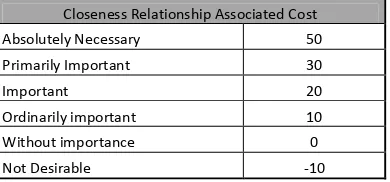
To define it is necessary to take into account that it can take negative values (because the non-desirable relation is quantified as a negative value. For this reason, two alternatives for the calculation of costs are given based on the proximity relation or
, the formula , is done, since a negative
value which is calculated ∙ , would
generate an inconsistency in the result of the target function, even if this is represented as an absolute value :
Hence, a non-desirable relation should be weighed as a raise in the total cost which generates lower impact in the desirable relations. If the designer considers it appropriate, a non-desirable relation could also be quantified as a higher value in any desirable relation and in the formulation of
only ∙ would be considered.
The variable ensures that, firstly, all the working stations are used and, secondly, all the facilities have a assigned working station
On the other hand, distance is calculated through the rectilinear norm: the distance between two points is not determined by the straight line that joins them, but, by the number of streets (making an analogy of the distance crossed by a car in a city) or positions (making reference to the generation of any initial solution to the problem) that should be crossed. It is formulated in the following way:
- . - / . /
Where:
-: Coordinate in X from point i
-: Coordinate in X from point j
/: Coordinate in Y from point i
/: Coordinate in Y from point j
4. PROPOSED APPROACH
4.1 Sule´s Conventional Method
In order to generate a preliminary facility distribution, [3] suggests the completion of a series of steps: (the tables and figures shown at this point are the results obtained from the practical exercise).
4.1.1. Establish the necessary content for each workstation, determining its area. The sum of these areas will determine the total required area. For this study, it is needed to make sure that the total required area does not exceed the total available area.
4.1.2. Determine the amount of material to be
moved between workstations or by using a
single unit of measurement in order to handle raw materials in a generic way, as well as product in process and finished goods. For the case of study of this paper, the unit Kg/Hour is used.
4.1.3. Closeness can be determined by the flow of materials, personal needs in multiple workstations, communication requirements, security restrictions and any other aspect to be considered.
4.1.4. Then a graphic display of the relationships table is generated. To do this, it is necessary to illustrate an initial arrangement of workstations by using a nodal diagram. Later, a grid or net representation in which the initial arrangement can be seen in the form of blocks is generated.
The representation of the solutions is shown in a matrix, as follows:
08 5 36 1 2
ISSN: 1992-8645 www.jatit.org E-ISSN: 1817-3195
161
Table 1: Material Flow Rates.
The location of each working station can be represented through the matrix position. For instance, working station 8 is located in position 1,1
[image:5.612.89.522.89.362.2]at the matrix and working station 7 is located in position 3,3.
Table 2: Available Area Vs Required Area.
AREA REQUIREMENT
Facility Length (m) Width (m) Area (m2)
1 20,0 8,0 160
2 20,0 8,0 160
3 38,0 4,0 152
4 16,0 4,0 64
5 16,0 16,0 256
6 15,0 3,0 45
7 7,0 1,4 9,8
8 8,4 1,4 11,76
9 13,0 1,0 13
10 18,0 9,0 162
11 5,0 5,0 25
12 3,0 3,0 9
13 3,0 3,0 9
14 5,0 5,0 25
15 2,0 2,0 4
16 20,0 2,0 40
17 4,0 6,0 24
18 11,0 5,0 55
19 7,0 1,4 9,8
20 5,0 2,0 10
21 12,0 4,0 48
22 12,0 4,0 48
Total required área 1340,36
Total available area (Parte 1482
[image:5.612.330.528.416.513.2]Complete available area 2613
[image:5.612.111.285.450.722.2]Table 3A: Relationship Nomenclature (from Sule D. 2001)
Table 3B: Associated Cost MATERIAL FLOW RATE (Kg/hr)
Facility 1 2 3 4 5 6 7 8 9 10 11 12 13 14 15 16 17 18 19 20 21 22
1 --- 2007 0 0 0 0 425 182 0 0 0 0 0 0 0 1400 0 0 6 0 0 0
2 2007 --- 2007 0 0 0 0 0 0 0 0 0 0 0 0 0 0 0 0 0 0 0
3 0 2007 --- 607 0 0 0 0 0 0 0 0 0 0 0 88 0 0 0 0 0 0
4 0 0 607 --- 513 0 0 0 0 0 0 0 0 93 0 0 0 0 0 0 0 0
5 0 0 0 513 --- 513 0 0 2,7 0 0 0 0 0 0 0 0 0 0 0 0 0
6 0 0 0 0 513 --- 432 197 0 0 0 0 0 0 0 0 0 0 7 0 22 2
7 425 0 0 0 0 432 --- 0 0 8 0 0 0 0 0 0 0 0 0 0 0 0
8 182 0 0 0 0 197 0 --- 0 15 0 0 0 0 0 0 0 0 0 0 0 0
9 0 0 0 0 2,7 0 0 0 --- 0 0 0 0 0 0 0 0 0 0 0 0 0
10 0 0 0 0 0 0 8 15 0 --- 0 0,2 0 0 0 0 0 0 0,8 56 22 2
11 0 0 0 0 0 0 0 0 0 0 --- 0 0 0 0 0 0 0 0 0 0 0
12 0 0 0 0 0 0 0 0 0 0,2 0 --- 0 0 0 0 0 0 0 0 0 0
13 0 0 0 0 0 0 0 0 0 0 0 0 --- 0 0 0 0 0 0 0 0 0
14 0 0 0 93 0 0 0 0 0 0 0 0 0 --- 0 0 0 0 0 0 0 0
15 0 0 0 0 0 0 0 0 0 0 0 0 0 0 --- 0 0 0 0 0 0 0
16 1400 0 88 0 0 0 0 0 0 0 0 0 0 0 0 --- 0 0 0 0 0 0
17 0 0 0 0 0 0 0 0 0 0 0 0 0 0 0 0 --- 0 0 0 0 0
18 0 0 0 0 0 0 0 0 0 0 0 0 0 0 0 0 0 --- 0 0 0 0
19 6 0 0 0 0 7 0 0 0 0,8 0 0 0 0 0 0 0 0 --- 0 0 0
20 0 0 0 0 0 0 0 0 0 56 0 0 0 0 0 0 0 0 0 --- 0 0
21 0 0 0 0 0 22 0 0 0 22 0 0 0 0 0 0 0 0 0 0 --- 0
22 0 0 0 0 0 2 0 0 0 2 0 0 0 0 0 0 0 0 0 0 0 ---
Closeness Relationship Associated Cost
Absolutely Necessary 50
Primarily Important 30
Important 20
Ordinarily important 10
Without importance 0
Not Desirable -10
Closeness Relationship Associated Cost
Absolutely Necessary 50
Primarily Important 30
Important 20
Ordinarily important 10
Without importance 0
Not Desirable -10
1 1 1 1 1 1 1 1 1 1 2 2 2 2 2 2 2 2 2 2 2 2 2 2 2 2 2 2 2 2 11 11 11
1 1 1 1 1 1 1 1 1 1 2 2 2 2 2 2 2 2 2 2 2 2 2 2 2 2 2 2 2 2 11 11 11
1 1 1 1 1 1 1 1 1 1 3 3 3 3 3 3 3 3 3 3 3 3 3 3 3 3 3 3 3 18 18 18 12 13
1 1 1 1 1 1 1 1 1 1 3 3 3 3 3 3 3 3 3 3 3 3 3 3 3 3 3 3 3 18 18 18 12 13
8 8 10 10 10 10 10 10 10 10 10 10 21 21 21 21 21 21 20 20 20 18 18 18 12 13
8 8 10 10 10 10 10 10 10 10 10 10 21 21 21 21 21 21 20 20 20 4 4 4 4 4 4 4 4 18 18 18 12 13
8 8 10 10 10 10 10 10 10 10 10 10 22 22 22 22 22 22 4 4 4 4 4 4 4 4 18 18 18 17 17
19 19 10 10 10 10 10 10 10 10 10 10 22 22 22 22 22 22 16 16 16 16 16 16 16 16 16 16 16 16 16 16 17 17
19 19 7 7 5 5 5 5 5 5 5 5 5 5 5 5 5 5 5 5 5 5 5 6 6 6 9 9 14 14 17 17
19 19 7 7 5 5 5 5 5 5 5 5 5 5 5 5 5 5 5 5 5 5 5 6 6 6 9 9 14 14
19 19 7 7 5 5 5 5 5 5 5 5 5 5 5 5 5 5 5 5 5 5 5 6 6 6 9 9 14 14
5 5 5 5 5 5 5 5 5 5 5 5 5 5 5 5 5 5 5 6 6 6 15 15
[image:5.612.333.528.569.660.2]ISSN: 1992-8645 www.jatit.org E-ISSN: 1817-3195
162
4.2 Genetic algorithm (GA)
A Genetic Algorithm is a problem solving technique that uses the concepts of evolution and hereditary to produce good solutions to complex problems that typically have enormous search spaces and are therefore difficult to solve. Figure 2 illustrates the general phases of a GA. The biggest difference with other meta-heuristics is that GA maintains a population of solutions rather than a unique current solution. Solutions are coded as finite-length strings called chromosomes and a measure of their adaptation (the fitness) is computed by an engine. Starting from an existing population representing the initial solution of the problem, a set of iterations generate new chromosomes (solutions) by applying crossover and mutation operators, according to a probability, to two chosen parents. The main advantage of GA is its intrinsic parallelism, which allows the exploration of a larger solution space.
4.2.1 Solution Representation and Initial Population:
In a broad way, the genetic algorithm presented here is an optimization procedure that seeks to minimize the total cost of facility layout design proposed. Once the values of decision variables are found, the total cost is computed by the procedure shown in figure 2.
The structure of each individual in the solution is a chain of chromosomes, each one giving the values of decisions variables (see problem formulation
section) for a specific layout conditions. That is we
have a total of v chromosomes, each with m × z
genes representing the location of each working station obtained by sule’s method.
4.2.2 Selection, Crossover and Mutation:
The selection procedure selects the best individuals to be considered for the next generation. In our procedure, the number of selected individuals is limited by the size of population and by the constraints of the problem (i.e., capacity constraints). The individuals with best values of the fitness function are selected.
TABLE 5:CLOSENESS RELATIONSHIP QUANTIFICATION
Facility 1 2 3 4 5 6 7 8 9 10 11 12 13 14 15 16 17 18 19 20 21 22 1 - 4 0 0 0 0 4 4 0 0 0 0 -1 0 0 3 0 0 4 0 0 0 2 - 4 0 0 0 0 0 0 0 0 0 -1 0 0 0 0 0 0 0 0 0 3 - 4 0 0 0 0 0 0 0 0 -1 0 0 0 0 0 0 0 0 0
4 - 4 0 0 0 3 0 0 0 -1 1 1 2 0 0 3 0 0 0
5 - 4 0 0 3 0 0 0 -1 0 0 0 0 0 0 0 0 0
6 - 2 2 0 0 0 0 -1 0 0 0 0 0 2 0 3 3
7 - 0 0 4 0 0 0 0 0 0 0 0 0 0 0 0
8 - 0 4 0 0 0 0 0 0 0 0 0 0 0 0
9 - 0 0 0 -1 0 0 0 0 0 0 0 0 0
10 - 0 0 -1 1 1 0 0 0 4 4 4 4
11 - 0 0 0 0 0 0 3 0 0 0 0
12 - 0 0 0 0 0 0 0 0 0 0
13 - -1 -1 0 3 0 0 0 0 0
14 - 4 0 -1 0 0 0 0 0
15 - 0 -1 0 0 0 0 0
16 - 0 0 0 0 0 0
17 - 0 0 0 0 0
18 - 0 0 0 0
19 - 0 0 0
20 - 0 0
21 - 0
22
ISSN: 1992-8645 www.jatit.org E-ISSN: 1817-3195
163 Partial Mapped Crossover (PMX) is done over all individuals of the population and elitism procedure is carried out, registering all information in order to compare with the next generation. Four individuals are generated as follows: Son 1 is composed of genetic material from the first half of chromosome Father 1 with second half of chromosome Father 2, Son 2 is composed of genetic material from the first half of chromosome Father 2 with second half of chromosome Father 1, Son 3 is composed of genetic material from the first half of chromosome Father 1 with first half of chromosome Father 2, and finally Son 4 is composed of genetic material from the second half of chromosome Father 1 with second half of chromosome Father 2. This procedure is carried out for each matrix giving all the decision variables of the problem. After crossover, it is necessary to verify that the resulting individuals correspond with a feasible solution.
Mutation operator is defined as an interchange operation. This means that two positions of the chromosome are interchanged as follows: the first position with the third one, the third position with the last one, etc. (see Figure 3). Chromosomes to be mutated are those with the lowest value of the total cost (objective function) after the selection process.
At the same way of crossover, after mutation, it is necessary to verify that the resulting individuals corresponds with a feasible solution.
4.2.3 Fitness Function
The fitness function allows the algorithm to compare the quality of the individuals in the population (i.e., to evaluate the quality of the different solutions). Let f(x1),…, f(xn) be the values
[image:7.612.89.527.65.361.2]of the objective function for each individual. Since the objective is to minimize the total cost, chromosomes with the lowest probability are selected. That is, the lower the value of f(xh). The higher the probability ph of being selected. Hence, individual xh will be selected for reproduction.
Figure 3: Example of Mutation Operation
STOP CRITERIOM
YES
START GENERATE INITIAL SOLUTION (POPULATION)
EVALUATE OBJECTIVE FUNCTION
BEST INDIVIDUAL (SOLUTION)
:
;CROSSOVER WITH PROBABILITY
:
<MUTATION WITH PROBABILITY
SELECTION
END
[image:7.612.325.522.629.672.2]NEW GENERATION
ISSN: 1992-8645 www.jatit.org E-ISSN: 1817-3195
164
5. COMPUTATIONAL EXPERIMENTS
AND RESULTS
The main objective of design of experiments (DOE) is to study the effect of various factors on the response variables and select, for these factors, the best option among multiple levels. The kind of design is a 33 factorial and the response variable is the cost result in the objective function.
A group of initial solutions is generated by using the Sule’s method and those solutions that will make part of the initial population of genetic algorithm (those that conceived a better result of efficacy) are chosen. The initial population is used as a basis for the experiment design pilot-test. The genetic algorithm was coded in Visual Basic®. Computational experiments were carried out on a PC under Windows 7 Home Premium (32 bits) operating system and with processor Intel® Core TM 2 Duo CPU T7100 1.8GHz and RAM 2.00 GB RAM.
5.1 Evaluation Of The Amount of Generations
Initially, the amount of ideal generations to be studied is evaluated. Five runs in which the results for 5, 10, 15 and 20 generations are done, then; the cost percentage decrease is quantified from the results obtained in the initial population.
For the group of solutions conceived by the crossing, the solutions with the best result in the target function emerged from the first 5 generations.
In the group of solutions conceived by mutation, better solutions are obtained in 5, 10 and 20 generations. One of the best solutions was found in the group of the 20 generations; which leads to considering the group in the evaluation; especially because of its high decrease percentage with respect to the solution generated in the initial population (21.0%)
For most of the runs (except the third one), the best solutions obtained through mutation are better than those obtained through crossover; which shows the effectiveness of the mutation operation in the algorithm. It is established that the amount of generations to be evaluated are 5, 10 and 20 generations.
5.2 Crossover Probability And Mutation Probability
As Genetic Algorithms behaves in a probabilistic manner, the analysis of computational experiments
were carried out following a proper statistical methodology. A formal planned experimentation was used following the principles of statistical experimental design (or Design of Experiments, DOE), in which a set of factors that may affect a response variable defined in advance are evaluated [38]. Our first experiment consisted on a 33 full factorial design which means that three factors and three levels were defined (see Table 6). The response variable was the total cost. A pilot sample was analyzed first by running four replications for all nine levels of the three factors, giving a total of 108 runs. The analysis of results was done using SPSS® statistical software. The aim of this pilot test was to verify the assumptions of experimental design. Based on the results obtained, the basic assumptions of the design of experiments (independence of observations, normal distribution of the residuals and homogeneity of variances) were all verified [38].
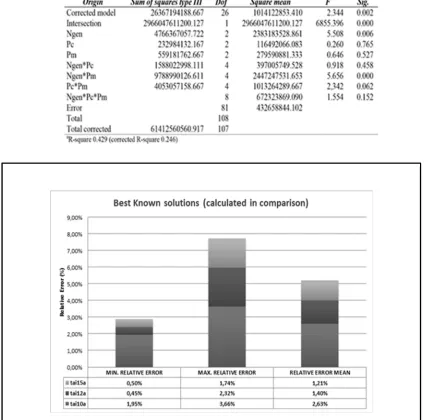
This first test allowed us also to have some insights about the possible interactions between factors. Results of the ANOVA (analysis of variance) test are presented in Table 7.
We see that at least one factor (population size) causes an effect on the response variable, while crossover and mutation probabilities do not affect the total cost. However, the interaction between the number of generations and mutation probability, with their respective levels, does influence the value of the total cost.
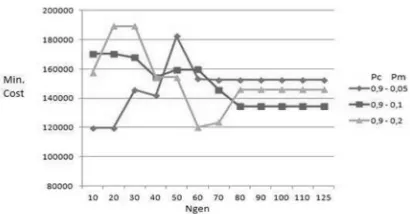
From the insights given by these results, we next analyzed the behavior of the proposed genetic algorithm in terms of the objective function (total cost) in order to evaluate its convergence over the number of generations (see Figure 4 to 6). As shown in Figure 4, there is not a clear convergence of the algorithm when the probability of crossover is 0.7; the value of the objective function tends to improve when mutation probability is 0.2, and the initial solution is not improved at all in the case of mutation probability of 0.1. The value of the total cost moves within the range between USD 132467
and USD 177456, Pc=0.7 with Pm=0.05 and
Pc=0.7 with Pm=0.1, respectively.
ISSN: 1992-8645 www.jatit.org E-ISSN: 1817-3195
165
TABLE 6:FACTORS AND LEVELS FOR THE EXPERIMENTAL DESIGN
Factors Notation Values
Number of
generations Ngen 50 100 125
Crossover
probability Pc 0.7 0.8 0.9
Mutation
probability Pm 0.05 0.1 0.2
opposite phenomenon occurs with Pc=0.8 and
Pm=0.2. The value of the minimum cost moves
between USD 131389 and USD 166099 for Pc=0.8
with Pm=0.05 and Pc=0.8 with Pm=0.1,
respectively.
Finally, Figure 6 presents the evolution of the minimum cost over the number of iterations with crossover probability of 0.9. We observe that the value of the objective function trends to converge from the 80th iteration. For the case of Pc=0.9 with
Pm= 0.1, the solution value improves over the number of generations, while the opposite phenomenon occurs with Pc=0.9 and Pm=0.05. The value of the minimum cost moves between 134500 and 152435 for Pc=0.9 with Pm=0.1 and Pc=0.9 with Pm=0.05, respectively.
5.3. Comparison of the proposed model
A comparison with some instances proposed in QAPLIB (Burkard, Çela, Karisch, & Rendl, 2011) is done. These have been the subject of multiple comparisons through the years.
Specifically, the instances proposed by [36] and in Comparison of iterative searches for the quadratic assignment problem are selected, to then carry out 10 runs with the proposed method for each instance.
Additionally, in order to maintain certain coherence in the experimental analysis, a relative deviation index, in percentage, was employed, as shown in the following equation, where =>? corresponds to the averages values of the objective function (i.e., total cost) obtained using the
proposed genetic algorithm (GA). Also,
=@?Acorresponds to the best values of the objective function based on mentioned Taillard instances. These values are
shown in Table 5. It is necessary to clarify that the instances that were chosen are the most comparable with the problem under study. Not all the instances accomplished with this.
% "C
=>?.
=@?A=@?A
D 100%
[image:9.612.96.298.127.262.2]Figure 4: Evolution of the Total Cost with Crossover Probability of 0.7
Figure 5: Evolution of the Total Cost with Crossover Probability of 0.8
[image:9.612.316.525.158.331.2] [image:9.612.316.521.541.648.2]ISSN: 1992-8645 www.jatit.org E-ISSN: 1817-3195
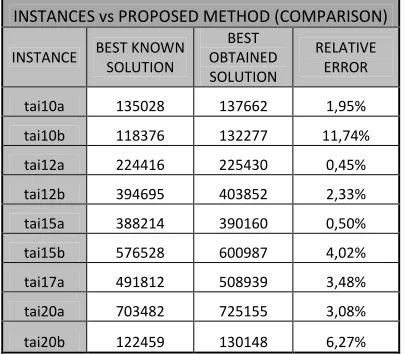
166 As it was evidenced in the table above, solutions with low relative error are found when compared to the best solutions found for each of the instances.
The solution with the lowest relative error was founded for tai12a (0.45%) followed by those generated by tai15a (0.5%) and tai10a. The instance which the method evidenced its best behavior was tai15a, whose average and relative error range among the 10 solutions found, where the lowest (1.21% and 1.2% respectly). Hence, the results
shown in Table 5 shows that the proposed algorithm has very good performance with respect to the best value known for this problem.
On the other hand, the solutions with the lowest relative error belong to the comparisons made with Tai-a instances, these last instances mentioned were generated randomly, unlike tai-b instances, which belong to real problems.
Finally, as we previously stated in section I, the company initially made an estimation of the new
[image:10.612.88.518.133.553.2]TABLE 7:ANOVA FOR THE PILOT TEST (DEPENDENT VARIABLE: TOTAL COST)
ISSN: 1992-8645 www.jatit.org E-ISSN: 1817-3195
[image:11.612.89.291.117.294.2]167
Table 7: Results And Qaplib Instances Comparission
INSTANCES vs PROPOSED METHOD (COMPARISON)
INSTANCE BEST KNOWN
SOLUTION
BEST OBTAINED SOLUTION
RELATIVE ERROR
tai10a 135028 137662 1,95%
tai10b 118376 132277 11,74%
tai12a 224416 225430 0,45%
tai12b 394695 403852 2,33%
tai15a 388214 390160 0,50%
tai15b 576528 600987 4,02%
tai17a 491812 508939 3,48%
tai20a 703482 725155 3,08%
tai20b 122459 130148 6,27%
Facility layout using basic tools such as the spaghetti diagram. However, this method is not efficient in terms of total time of production process, total amount and time spent in movements. Thus, with the proposed approach, the company obtained a reduction the total time of flow materials in a 15% [41]. In addition, the total cost for the proposed layout was reduced in a 20% comparing it with the initial estimation of the company [41] (See Table 8)
TABLE 8:Savings
Initial estimated total layout cost
(USD)
Total layout cost after
optimization (USD) Saving (USD)
156178 130148 26030
CONCLUSIONS
The integration of the proximity measure in the proposed model turns out to be highly important: it forces the inclusion of important factors in the total cost. Besides flow and distance, it is also important to consider the need for distance between working stations due to risks in the security of the facility´s operative personnel; or, closeness issues, due to the fact that a group of people are required to distribute their daily activities between several working stations.
The proposed algorithm generated solution that compared with instances from other methods, provides a sign that the proposed method can behave satisfactorily both with problems conceived randomly and with real-life problems. Additionally,
it is important to point that such behavior can be even more evidenced in problems with less than 15 working stations.
As for the practical exercise, the combination of QAP together with the additional variable proposed by Sule permitted the consideration of the manufacture system´s stochastic nature, while optimal close solutions were derived.
For further research, several lines are still open. For example, many other issues of the problem under study could be included in the analysis in order to keep the problem much more realistic: probabilistic constraints, i.e. stochastic capacities in production plant. The procedure can be improved by implementing: different procedures to generate the initial population, other types of crossover or mutation strategies, or even other fitness function, etc. Other heuristic procedures could be employed to hybridize the genetic algorithm. Finally, because of the NP-completeness of the problem under study, researchers could be interested in analyzing the behavior of various meta-heuristic algorithms such as GRASP (Greedy Randomized Adaptive Search Procedure), Tabu Search, etc.
Additionally, it is important to use this kind of formulation for other applications such as police station allocation, hospital areas allocation, among others in order to test the applicability of the QAP formulation and the proposed solution method.
REFERENCES:
[1] Niebles-Atencio, F., Solano-Charris, E.L.,
Montoya-Torres J.R.. “Ant Colony
Optimization Algorithm to Minimize Makespan and Number of Tardy Jobs in Flexible Flowshop Systems. Proceedings 2012 XXXVIII
Conferencia Latinoamericana en Informática
(CLEI 2012), Medellin, Colombia, 1-5 Oct.
2012, pp. 1-10. DOI:
10.1109/CLEI.2012.6427154.
[2] Eldrandaly K. A., G.M. Nawara, M.A. Shouman, and A. H. Reyad. 2001. Facility Layout problem and intelligent techniques: A
Survey, 7th International Conference on
Production Engineering, Design and Control,
PEDAC, 2001, Alex Egypt. Pp.:409-422
[3] Logistics of facility location and allocation. Dileep Sule. 2001.
[image:11.612.88.305.449.504.2]ISSN: 1992-8645 www.jatit.org E-ISSN: 1817-3195
168 [5] Sahni S, Gonzalez T (1976) P-complete
approximation problems. J ACM 23:555–565. [6] Meller R. D, Gau K. Y, The facility layout
problem: recent and emerging trends and
perspectives, Journal of Manufacturing
Systems, 15 (1996) 351-366.
[7] Azadivar, F., & Wang, J. (2000). Facility layout optimization using simulation and genetic algorithms. International Journal of Production
Research, 38(17), 4369–4383.).
[8] Coello, C.A.C., Lamont, G.B., van Veldhuizen, D.A.: Evolutionary Algorithms for Solving Multi-Objective Problems, 2nd edn.. 2007. Pp 145–156.
[9] Kratica J., Tošić D., Filipović V., Dugošija Đ.A. New genetic representation for quadratic assignment problem. 2011. Yugoslav Journal of
Operations Research. 21 (2011), Number 2,
225-238. DOI: 10.2298/YJOR1102225K
[10] S. P. Singh, R. R. K. Sharma. A review of different approaches to the facility layout
problems. The International Journal of
Advanced Manufacturing Technology.
September 2006, Volume 30, Issue 5-6, pp 425-433
[11] Drira A, Pierreval H, Hajri-Gabouj S (2007)
Facility layout problems: a survey. Annual
Reviews in Control, 31(2), 255—267.
[12] Burkard RE, Çela E, Pardalos PM, Pitsoulis L (1998) The quadratic assignment problem. In:
Du DZ, Pardalos PM (eds) Handbook of
Combinatorial Optimization, vol 3. Kluwer,
Dordrecht, pp 241–337
[13] Loiola EM, de Abreu NMM, Boaventura-Netto PO, Hahn P, Querido T (2007) A survey for the quadratic assignment problem. Eur J Oper Res
176:657–690
[14] Voß S (2000) Heuristics for nonlinear assignment problems. In: Pardalos PM, Pitsoulis
L (eds) Nonlinear Assignment Problems.
Kluwer, Boston, pp 175–215 Armour and Buffa
[15] Angel E, Zissimopoulos V (2002). On the hard ness of the quadratic assignment problem with metaheuristics. J Heurist 8:399–414
[16] Gambardella LM, Taillard ED, Dorigo M (1999) Ant colonies for the quadratic assignment problems. J Oper Res Soc 50:167–176
[17] Maniezzo V, Dorigo M, Colorini A. The ant system applied to the quadratic assignment
problem. Technical report IRIDIA/94-28.
Belgium: Universite Libre de Bruxelles; 1994.
[18] Dorigo M, Maniezzo V, Colorni A. The ant system: optimization by a colony of cooperating agents. IEEE Trans Syst Man Cybern—Part B 1996;26:29–41.
[19] Stutzle T, Dorigo M. ACO algorithms for the quadratic assignment problem. In: Corne D, Dorigo M, Glover F, editors. New ideas in optimization. Maidenhead, UK: McGraw-Hill Ltd; 1999.
[20] Nissen V (1994) Solving the quadratic assignment problem with clues from nature.
IEEE Trans Neural Netw 5:66–72 (Drezner
2003
[21] Merz P, Freisleben B (2000) Fitness landscape analysis and memetic algorithms for the
quadratic assignment problem. IEEE Trans
Evolut Comput 4:337–352
[22] Misevicius A (2004) An improved hybrid genetic algorithm: new results for the quadratic assignment problem. Knowl Based Syst 17:65– 73
[23] Fleurent C, Ferland J. Genetic hybrids for the
quadratic assignment problem. DIMACS Ser
Math Theor Comput Sci 1994;16:190–206.
[23] Tate DM, Smith AE. A genetic approach to the
quadratic assignment problem. Comput Oper
Res 1995;22(1):78–83.
[24] Ahuja KR, Orlin JB, Tiwari A. A greedy algorithm for the quadratic assignment problem.
Comput Oper Res 2000;27:917–34.
[25] Li Y, Pardalos PM, Resende MGC. A greedy randomized adaptive search procedure for the
quadratic assignment problem. Quadratic
assignment and related problems. In: Pardalos PM, Wolkowicz H, editors. DIMACS series in discrete mathematics and theoretical computer
science. American Mathematical Society; 1994.
p. 237–61
[26] McLoughlin JF III, Cedeño W (2005) The enhanced evolutionary tabu search and its
application to the quadratic assignment
problem. In: Beyer H-G, O’Reilly U-M (eds)
Proceedings of the genetic and evolutionary
computation conference—GECCO 2005. ACM
Press, New York, pp 975–982
[27] Tseng L, Liang S (2005) A hybrid metaheuristic for the quadratic assignment problem. Comput
Optim Appl 34:85–113
conference-ISSN: 1992-8645 www.jatit.org E-ISSN: 1817-3195
169
GECCO 2006, vol 1. ACM Press, New York,
pp 599–605.
[29] StützleT (2006) Iterated local search for the
quadratic assignment problem.
EurJOperRes174:1519–1539.
[30] Bölte A, Thonemann UW (1996) Optimizing simulated annealing schedules with genetic programming. Eur J Oper Res 92:402–416 [31] Wilhelm MR, Ward TL. Solving quadratic
assignment problems by simulated annealing.
IIE Trans 1987; 19:107–19.
[32] Battiti R, Tecchiolli G (1994) The reactive tabu search. ORSA J Comput 6:126–140
[33] Drezner Z (2005). The extended concentric tabu for the quadratic assignment problem. Eur J
Oper Res 160:416–422
[34] JamesT, Rego C, Glover F (2009) A cooperative parallel tabu search algorithm for the quadratic assignment problem. Eur J Oper Res 195:810– 826
[35] Misevicius A (2005) A tabu search algorithm for
the quadratic assignment problem. Comput
Optim Appl 30:95–111
[36] Taillard ED (1991) Robust taboo search for the QAP. Parallel Comput 17:443–455
[37] Voß S (1995) Solving quadratic assignment problems using the reverse elimination method. In: Nash SG, Sofer A (eds) The Impact of Emerging Technologies on Computer Science and Operations Research. Kluwer, Dordrecht, pp 281–296
[38] Skorin-Kapov J. Tabu search applied to the quadratic assignment problem. ORSA J Computing 1990; 2:33–45.
[39] Ahuja RK, Jha KC, Orlin JB, Sharma D (2007) Very large-scale neighborhood search for the
quadratic assignment problem. INFORMS J
Comput 19:646–657