ISSN: 1992-8645 www.jatit.org E-ISSN: 1817-3195
74
HYBRID MULTI USER DETECTION FOR DS-OPTICAL
CDMA
1
ADIL EL KABLI, 2MY AHMED FAQIHI, 3AHMED HAMMOUCH
1
PhD student, Department of Telecommunication and Networks Engineering, University of Mohamed V 2
Assoc. Prof., Associate member of LRIT, Telecom Engineering and Networks, University of Mohamed V 3
Assoc. Prof., ENSET, University of Mohamed V
E-mail: [email protected], [email protected], [email protected]
ABSTRACT
OCDMA multiplexing technique has gained increasing interest from researchers and has made great progress due to its easy access and flexible network structure.
DS-OCDMA systems suffer however from many noises, the most serious is multiple access interferences (MAI), in order to mitigate the effect of MAI, codes offering high performances in term of auto-correlation and cross-correlation like Optical Orthogonal Codes (OOC) or Prime Codes (PC) have been proposed but as the entire burden of performances could not be placed on code design only, numerous detection strategies have been developed to help increase the system performances.
In this paper, we present a statistical based method that uses both conventional detection and non linear detection in an efficient way. The results show that we can reduce by 24\% up to 60\% the detection complexity while keeping the BER at the same level.
Keywords: Optical Orthogonal Code (OOC), Optical CDMA (OCDMA), Multiple Access Interferences (MAI), Direct Sequence OCDMA (DS-OCDMA), Single User Detection.
1. INTRODUCTION
End-user demand for broadband services is unstoppable, resulting in high pressure on operators to upgrade their access networks. Most operators agree that fibre is the end-game and fibre deployments are already happening all over the world. In this context optical CDMA can help bring solution to the increasing demand for broadband access.
CDMA technique has proven its success and strength in radio frequencies domain, this success has encouraged engineers and researchers to design CDMA based optical systems [1].
The performances of optical CDMA systems are like other CDMA systems, limited by the MAI [1]-[3]. MAI gives rise of irreducible errors even in absence of thermal noise. The use of orthogonal codes improves notably the performances but the delay between users destroys the orthogonality, moreover, the system capacity is limited by the theoretical limit of the number of codes given a defined spreading factor [1],[5]. In order to overcome these shortcomings an appropriate detection strategy should be applied.
We found generally two detections families: Single-user detection and Multi-user detection. [10], [11].
The single user detector treats the signals of all the other users as noise and tries to suppress it. Thus, conventional decoding requires that the interference from other users should be minimal. However, the interferences suppression capability of such system deteriorates as the number of users grows in the system.
A better detection strategy is to jointly detect multiple users, where the additional structure of the MAI is exploited rather than considered as noise. Multi-user Detection deals with the demodulation of the digitally modulated signals in the presence of MAI [10], [11]
The use of conventional detection is not sufficient to reach high performances, for this reason a statistical based technique that combines conventional and non-linear detections is described and analyzed.
ISSN: 1992-8645 www.jatit.org E-ISSN: 1817-3195
75 Section III introduces the newly proposed method whereas the obtained results are evaluated in section IV. The conclusion and the recommendations are discussed in section V.
2. SINGLE-USER DETECTION
In single-user detection strategy, each user is detected independently from the others through the use of a bank of correlators (matched filters)
2.1 System Model
In the DS-OCDMA system involved in this paper the following assumptions are considered:
• For the sake of simplified analysis, the effects of quantum noise and thermal noise in the system are neglected and consequently, the performance degradation is caused only by the presence of other users interferences.
• The used multiple-access channel is an asynchronous incoherent additive channel.
• OCDMA system in this paper uses Optical orthogonal codes
The output from one encoder under the assumptions listed above could be expressed as [1]
(1)
Where A , c , d are the amplitude, signature code waveform and modulation of the k user respectively.
The codeword could be expressed as [1]
∑ , 0 (2)
Where , ∈ 0,1 is the #$ chip of the %#$ address codeword, is the width of one chip, is the time bit and is a rectangular pulse of duration .
The modulation of the %#$ user data bit using on-off keying (OOK) could be expressed as :
∑ , & (3)
Where , ∈ 0,1 is #$ bit of the k user, is the time bit and & is a rectangular pulse of duration .
The resulted signal ' from ( users in the system is expressed as the sum of ( superimposing signals [1]:
' ∑* )
+ ∑* +
) ) (4)
Where ) is the delay for user %. ) is uniformly distributed over ,0
2.2 Conventional detection
The conventional detection for the received signal expressed by equation (1) is done through a bank of .collerators as shown in Figure 2, the received signal is correlated with each branch code sequence using a matched filter. The output from each correlator is then sampled during the interval
/0a decision is finally made based on a threshold
/1. Figure 1 shows a receiver block diagram. [10],[11].
2.3 Performance analysis of DS CDMA using OOCs
This section evaluates DS-OCDMA system based on Binary Error Rate (BER), indeed multiple access interferences is the main component impacting the BER. The system BER should be less than 2345.
The probability of error in case of chip synchronous case is given by [3]:
6788 +9∑=4+>:; 1<:?
@
9A< :1 ?@ 9A<
=4+4 (5)
Where B is the code weight, C is the code length,
D is the number of subscribers and /1 is the decision threshold. It is important to choose /1that permits the minimal number of errors, hence choosing /1 too high will lead to some 1s taken for 0s whereas a too low value of /1causes some 0s to be taken for 1s.
One approach to decrease the number of errors is to place an optical hard limiter before the correlator of the receiver. An ideal Optical Hard Limiter (OHL) is a device that has an output E F as bellow:[1],[3],[10]
E F G2, F H 23, F I 2 (6)
The usage of an optical hard limiter mitigates the multi user interferences; the probability of errors is reduced in this case. Figure 3 shows the gain if an OHL is used.
The probability of error if an OHL is used could be expressed by [1],[3],[10]:
ISSN: 1992-8645 www.jatit.org E-ISSN: 1817-3195
76 The binary error rate increases with the number of simultaneous users as it can be seen in Figure 3, the performance degradation of the system is due mainly to the effect of multiple access interferences. For this reason codes with good cross-correlation and anto-correlation values should be used to mitigate the effect of multiple access interferences (MAI).
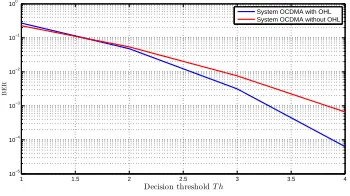
Figure 4 shows that the lowest BER is obtained for threshold value equal to w, and in Figure 5 we can see that the BER decreases with the code weight, and in all cases the system performs better with an OHL.
The biggest limitation of one dimensional incoherent OCDMA codes is that the code cardinality is proportional to the length of frequency spreading (the length of the code). Due to the limitation of current technology it is difficult to make the width of chip optical pulses narrower than the order of magnitude of ps (pico second) from the practical point of view in optical communication systems. Furthermore, even if it is possible to make an optical pulse narrower, it is difficult for it to be transmitted a long distance because of existing limitations in the fiber-optic, such as non-linearity, dispersion, etc [10].
It is obvious that the entire burden of performance of OCDMA systems could not be placed on optical codes performances only, indeed detection and interferences cancellation methods contribute greatly to improve OCDMA performances as well.
3. SMART DETECTION METHOD
In this section we describe how it is possible to apply an interferences cancellation technique like parallel interference cancellation (PIC) with high efficiency.
3.1 Description of PIC
PIC detector subtracts out interferences from undesired users in the same time using conventional detection scheme
.
The initial bit estimates are done using conventional detection, these bits are then spread using codes, and a summer finally sums up all signals except the one that will be cleaned hence the summed signal represents the MAI from all interfering users. The MAI is finally subtracted for the user % as bellow [11],[12]:
' ' ∑ S=+UT
V (8)
Where SUT is the estimated bit for the user obtained by the conventional detector, ; is the number of simultaneous users.
It is possible to repeat this process a certain number of times (stages) till obtaining a satisfying level of performances.
Figure 6 shows an example of PIC detector for 5 users and one stage. The input of the desired user detector is a cleaned signal if the previous conventional detections are successful. [3]
3.2 Auxiliary Threshold Decision Variable
Let W be the variables defined as:
W X Y+ &'
&
Where is the time bit, is the #$ bit and ' is the received signal from all users.
W is a random variables that represent the sum of data and MAI from all users received by the user % during .
Let Z the variable defined as:
Z *+∑ W*[ + [
Where ( is the number of active users during the interval (( ; and is the #$ bit transmitted by the \#$ user.
For the sake of simplicity, and without lost of generality we consider the first bit transmitted
1 and we note Z*+ as Z*.
Z* is also a random variable that represents the mean amount of data and interferences received by the ( active users during . Based on the Theorem of Central Limit (TCL) we can assume that the variable Z]]]* follows a normal distribution; Figure 8 shows a comparison of the distribution of variable
Z*
]]] obtained by simulation and calculated using the normal distribution, the graph shows that the normal approximation is valid.
3.3 Learning phase and PIC processing decision
The learning phase consist of constructing
the values of
Z
]]] in the context of a
*ISSN: 1992-8645 www.jatit.org E-ISSN: 1817-3195
77
At the received end, we first calculate the
value of
Z
]]] and then estimate the number
*of bits ”1”.
if the estimated value of the number of bits
”1” is equal to the number of detected bits
”1” obtained by conventional detection
then we assume that there is no need to use
a nonlinear detection method like PIC. On
the other hand, if the comparison results in
a mismatch between the estimated number
of bits ”1” and the number of ”1” really
obtained by conventional detection, then
we conclude that there is likely an error in
this case a non linear detection method
should be applied.
4. RESULTS
In this paragraph we present the results
of different simulations done using
MATLAB program.
We consider only the case where
6 (
15
because when
( `
or all users are
active no errors occurred. We repeat the
experience of K users sending with equal
probability bit ”1” or bit ”0” and we note
the number of errors, Based on the
approximation of the variable
Z
]]] we can
*consider only the values of
Z
]]] that fall in
*the interval
ab
* cde
b
*f
cd
e
g
The figure 9 shows that by lowering the
value of
h
the number of unnecessary
interferences cancellations (a method of
interferences
cancellation
is
applied
whereas it is not needed) decreases which
is a an improvement of the system
efficiency, the number of detected errors
improves significantly for
h H 1
but the
number of estimation errors (i.e decision to
perform only a conventional detection
whereas
a
method
of
interferences
cancellation is needed) remains high for
h 1
.
We can see that for
h 2
we have a good
trade-off between system efficiency and
Binary Error Rate (BER)
5. CONCLUSION
In this paper I tried to propose an
enhancement to the DS-OCDMA system
by reducing the number of expensive
interferences cancellation operations given
the fact that the most serious limitation of
DS OCDMA is the multi user interferences
which prevent this system from being
deployed in larger networks. This system
simplification will keep DS-OCDMA on
the course among other all optical
technologies given its simple configuration
and lower cost. I suggest for future work to
improve the decision model in order to
perform interferences cancellation only
when it is needed meaning that for a
system with
;
users using OOC of weight
`
the rate of interferences cancellation is
approximately:
' 12 :M$< j 1 O=4+4P
>4+
P Q
REFRENCES:
[1] Dr. Hongxi Yin, Prof. David J. Richardson, Optical Code Division Multiple Access Communication Networks Theory and Applications, ISBN 978-3-540-68445-9 Springer Berlin Heidelberg New York
[2] Fan Chung, Salehi, J.A.; Wei, V.K.Optical orthogonal codes: design,analysis and applications.
[3] Saad, N Contribution à l’Etude de l'application de la technique CDMA aux systmes de transmission optique. PhD thesis, Universit de Limoges, (Mai 2005).
ISSN: 1992-8645 www.jatit.org E-ISSN: 1817-3195
78 [5] Prucnal, P.R. : Optical Code Division Multiple
Access : Fundamentals and Applications. Har/Cdr edition, ISBN : 084933683X (2006) [6] Salehi, J.A., Brackett, C.A. Code division
multiple-access techniques in optical fiber networks-part I : Fundamental principles IEEE Transactions on Communications, Aug. 1989, 8(37) :824 833
[7] Sangwook Han, Optical CDMA with Optical Orthogonal Code MULTIUSER WIRELESS COMMUNICATION (EE381K) CLASS PROJECT, FALL 2002
[8] Mrs. Anita Borude, Prof. Shobha Krishnan Simulation of Optical CDMA using OOC Code. International Journal of Scientific and Research Publications,Volume 2, Issue 5, May 2012 ISSN 2250-3153
[9] P. Saghari, R. Gholizadeh, P. Kamath, R. Omrani, A. E. Willnar, J.A. Bannister, J. D. Touch, P.V. Kumar Analytical model of variable quality of service to increase the number of users in an OCDMA network ECOC2005, Paper Th1.4.7
[10] R. T. S. Z. Xie and C. K. Rushforth, A family of suboptimum detectors for coherent multiuser communications IEEE J. Select. Areas Commun., p. 683690, May 1990.
[11] Shimon Moshavi, Multi-user detection for DS-CDMA communications IEEE Communications Magazine October 1996.
ISSN: 1992-8645 www.jatit.org E-ISSN: 1817-3195
79
Fig. 1 OCDMA system receiver block diagram
Fig. 2 User Data S , Code Waveform , And
OCDMA Encoder Output
Fig. 3 Bit Error Rate Performance For The Two Cases With And Without An Ideal Optical Hard-Limiter Versus
The Number Of Simultaneous Users ; When k 97 And
[image:6.612.90.532.64.502.2]n M 4
Fig. 4 Bit Error Rate Performance For The Two Cases With And Without An Ideal Optical Hard-Limiter Versus
The Decision Threshold n When k 97 And ; 8
Fig. 5 Bit Error Rate Performance For The Two Cases With And Without An Ideal Optical Hard-Limiter Versus
The Decision Threshold n And The Code Weight M
When k 97 And ; 10
Fig. 6 Parallel Interference Cancellation Detector
h1(t)
1/Tc
Tc
r(t)
Optical decoder Photo detector Sample at time t=Tb
Z
Threshold decision Output data
5 10 15 20 25 30
10−6
10−5
10−4
10−3
10−2
10−1
100
Number of simultanuous usersN
B
E
R
System OCDMA with OHL System OCDMA without OHL
1 1.5 2 2.5 3 3.5 4
10−5
10−4
10−3
10−2
10−1
100
Decision thresholdT h
B
E
R
System OCDMA with OHL System OCDMA without OHL
1 2 3 4 5 6 7 8 9
10−7
10−6
10−5
10−4
10−3
10−2
10−1
100
101
Number of simultaneous users
BER
Without OHL
With OHL
w=8 w=6
w=4 w=5
Conventional Detector #2
Conventional Detector #3
Conventional Detector #4
Conventional Detector #5 r(t)
+
- Conventional
Detector #1 ^b 2
^ b 3
^ b 4
^b 5 C2(t)
C3(t)
C4(t)
C (t)5 ^ b 2
^ b 4 ^ b 3
^ b 5
C2(t)
C (t)3
C (t)4
C (t)5
[image:6.612.108.283.483.581.2]ISSN: 1992-8645 www.jatit.org E-ISSN: 1817-3195
[image:7.612.83.560.66.695.2]80
Fig. 7 Schematic Diagram Of The Proposed Enhancement Algorithm For User Detection
Fig. 8 Distribution Of The Variable Z* For ( 12 And
[image:7.612.109.285.461.532.2]; 16
Fig. 9 Comparison Between The Binary Error Rate, Incorrect Decisions, Detected Errors And Unnecessary
Operations Rates Versus h For DS-OCDMA With 16
Users And Using OOC (217,4,1,1)
22 24 26 28 30 32 34 36
0 0.05 0.1 0.15 0.2 0.25
SK
Probability
Distribution obtained by simulation for K=12 Thoretical distribution of SK for K=12
0.5 1 1.5 2 2.5 3
10−5
10−4
10−3
10−2
10−1
100
Γ
Rate
[image:7.612.107.284.586.681.2]