ROUTING IN MOBILE ADHOC NETWORKS (MANETS)
USING FUZZY AIDED ANT COLONY OPTIMIZATION
(ACO) TECHNIQUE
1B.NANCHARAIAH, 2B.CHANDRA MOHAN 1
Research Scholar, Department of ECE,JNT University, Hyderabad, Andhrapradesh, India.
2Professor & Head, Department of ECE,.Bapatla Engineering College,
Bapatla-522101, Andhrapradesh, India.
Email: [email protected] , [email protected]
ABSTRACT
In this work, a routing algorithm suitable for Mobile Adhoc Networks is proposed. MANETS are unstable nature when network mobility increases. Path selection process is a critical task in routing algorithms. The proposed work addresses this problem by employing Ant Colony Optimization and Fuzzy logic technques while developing the routing algorithm. The path information by ants will be given to FIS(Fuzzy Interference system ) in order to compute the available path’s score values, based on this score value from the FIS system the optimal paths will be selected. Hence, the routing problem can be solved more effectively by achieving high successful path delivery rate rather than the conventional routing algorithms. This technique is implemented and the results are compared to the existing algorithms. The performance of the proposed algorithm is assessed using distance, power consumption etc..,
Keywords: Ant Colony Optimization, Fuzzy Rules, Routing, MANET
1. INTRODUCTION
Now-a-days, there is major problem in the routing protocols in adhoc networks of wireless hosts. There are numerous different routing protocols presently proposed for adhoc networks [1]. An adhoc network is a collection of nodes that are dynamically and arbitrarily located in such a manner that the inter connections between nodes are capable of changing on a continual basis [2]. Adhoc networks, which are also called ‘mesh networks’, are defined by the manner in which network nodes are organized to provide pathways for data to be routed from the user to and from the desired destination [3]. Wireless networking provides a prospect to facilitate new uses for networks while also increasing the number of users who can access broadband services [4]. In adhoc networks each node forwards data to other nodes willingly. Each node communicates with other nodes within its transmission range [3] [5]. Inorder to send a packet to a destination, a node forwards the packet to its neighbour which in turn forwards it to its neighbour and so on, until the packet reaches the destination [5] [6]. All these mean that a wireless ad-hoc network will not have a clear line of defence, and every node must be prepared for
encounters with an adversary directly or indirectly [6] [7].
There are two scenarios of ad-hoc networking, they are very different from each other in many ways: In the first scenario the mobile devices need to work only in a safe and friendly environment where the networking conditions are predictable [8] [9]. Thus no special security requirements are needed. On the other hand, in the second and rather extreme scenario the devices operate in an extremely hostile and demanding environment, in which the protection of the communication and the mere availability and operation of the network both very vulnerable without strong protection [7] [9].
Adhoc networks maximize total network throughput by using all available nodes for routing and forwarding. Therefore, the more nodes that participate is in packet routing, the greater the aggregate bandwidth, the shorter the possible routing paths, and the smaller the possibility of a network partition [10]. The main advantages of an adhoc network are:
ii) Self-configuring, nodes are also routers iii) Self-healing through continuous
re-configuration
iv) Scalable-accommodates the addition of more nodes
v) Flexible-similar to being able to access the Internet from much different location [11].
Routing is the act of moving information across an inter-network from a source to a destination. Along the way, at least one intermediate node typically is encountered [12]. Routing protocols use metrics to evaluate what path will be the best for a packet to travel. The process of path selection and directing packets from a network source node to the destination node is routing and is an active area of research in adhoc networks [13]. A metric is a standard of measurement; such as path bandwidth, reliability, delay, current load on that path etc.; is used by routing algorithms to determine the optimal path to a destination [14]. Routing algorithms fill routing tables with a variety of information. Mainly Destination/Next hop associations tell the router that a particular destination can be reached optimally by sending the packet to a particular node that represents the "next hop" on the way to the final destination [15] [16]. When a router receives an incoming packet, it checks the destination address and attempts to associate this address with a next hop [17]. These networks include a combination of fixed wireless services and mobile networking [17] [18]. There are number of challenges presented by community networks absent in hierarchically-organized networks [19]. Our research group is addressing several of those challenges. If a route is found, the sender uses this route to transmit the packet. If no route is found, the sender may attempt to discover one using the route discovery protocol [20].
2. RECENT RELATED RESEARCHES: A REVIEW
EhsanKhosrowshahi et al. [21] have proposed ant colony based routing algorithms in mobile adhoc networks (MANETs) and presents SAMP-DSR, an algorithm to address the shortcomings of both ant colonies based as well as the traditional DSR algorithms. Owing to the unhinged nature of Manet’s memory based search algorithms such as ant based methods become inefficient and impractical as the network mobility increases. In simulations shown ant based routing algorithms suffer from lack of accuracy while incurring extensive memory usage as well as valuable processing power and bandwidth costs in highly
dynamic environments. The proposed ANT based routing algorithm exploits a dual-mode approached. The network topology changes were constantly monitored. When the rate of topology changed got too high for ants to converge efficiently, a node switched to local mode to rely less on the information learnt through ants. The experimented approach were significantly improved the performance of the network by quickly adapting to the dynamics of the environment.
Zulfiqar Ali et al. [22] have proposed a method for the routing protocols in adhoc and sensor wireless networks with genetic programming (GP), Neural Network, Evolutionary programming (EP), Particle Swarm Optimization (PSO) and Ant Colony Optimization (ACO). There were restraints involved in those protocols due to the mobility and non-infrastructure nature of an Adhoc and sensor networks. In that paper had to a probabilistic performance evaluation frameworks and Swarm Intelligence approaches (PSO, ACO) for routing protocols. The performance evaluation metrics employed for wireless and adhoc routing algorithms were, (a) routing overhead, (b) route optimality, and (c) energy consumption. This proposed method given critical analysis of PSO and ACO based algorithms with other approaches applied for the optimization of an adhoc and wireless sensor network routing protocols.
Kaushik R. Chowdhuryet al. [23] have proposed Cognitive radio (CR) technology for improving the spectrum utilization. The CR operation must not interfere with the transmissions of the licensed or primary users (PUs), and generally achieved by incur-ring a trade-off in the CR network performance. In that paper, to evaluate this trade-off, a distributed CR routing protocol for adhoc networks (CRP) was proposed that makes the following contributions: (i) explicit protection for PU receivers that were generally not detected during spectrum sensing, (ii) allowing multiple classes of routes based on service differentiation in CR networks, and (iii) scalable, joint route-spectrum selection. The proposed method was mapping to spectrum selection metrics and local PU interference observations to a packet forwarding delay over the control channel. The results reveal the importance of formulating the routing problem from the view point of safe guarding the PU communication, which was a unique feature in CR networks.
infrastructure and limited in temporal and spatial exten,t where each node communicate with each other over a wireless channel and is willing to forward data for other nodes is called as Wireless adhoc network. In that paper, they proposed a routing strategy based on gossip based routing approach that followed the proactive routing with some treatment for wireless adhoc network. The experimental and logical verification of proposed method has shown it was an approach based on gossip routing.
ToqeerMahmoodet al. [25] have evaluated the method of MANETs. In that paper, they had to introduce a new adaptive and dynamic routing algorithm for MANETs based on the Ant Colony Optimization (ACO) algorithms with network delay analysis. Ant colony optimization algorithm helps in finding, if not the shortest, at least a very good path connecting the colony’s nest with a source of food. This experimental evaluation of MANETs was based on the estimation of the mean End-to-End delay to send a packet from source to destination node through a MANET. The most important performance evaluation metrics in computer networks was evaluated as mean End-to-End delay. They had proved that algorithm offers good results under certain conditions such as, increasing the pause time and decreasing node density.
3. ANT COLONY OPTIMIZATION (ACO)
ACO, a famous swarm intelligence approach, has taken the inspiration from the social behaviours of real world ants. In this algorithm best path for the routing is found out from the pheromone deposited by the ants. Upon finding food, they return back to their nests and simultaneously deposit pheromone along the paths. Therefore, they likely move through these paths and strengthen (update) the existent pheromone. Over time, the pheromone starts to evaporate and strength is reduced. At regular intervals several ants are launched toward the destination node to discover the feasible low cost path to that node from the source. Each ant in ACO considers two parameters to select its next hop. The first one is the amount of pheromone deposited on the path to the next node, and the other is the queue length associated with the link.
An example for multi path routing based on ACO is discussed using Figure. 1
From source to destination routing here it includes four paths where best path can be found out. The different paths are XABY, XCBY, XCY, and XEFY. X and Y are said to be source and destination respectively. The probabilities of the paths are found using Eq. (1)
tion to destina ll routes
count of a Pheromone
oute Count of R Pheromone
of Route obability
∑ =
Pr (1)
Using the probability values cost of the paths can be found out.
4. ROUTING FOR MANET
Routing is the process of selecting paths in a network along which to send network traffic. The routing process usually directs forwarding on the basis of routing tables which maintain the record of routes to various network destinations. Thus, constructing routing tables, which are held in the router's memory, is very important for efficient routing. Most routing algorithms use only one network path at a time, but multipath routing techniques enable the use of multiple alternative paths.
The important parameters for the optimization in the routing algorithm are distance, delay, capacity and power consumption. The evaluation method for the distance parameter is given in Eq.(2)
2 / 1 2 1 2 2 1 2 ] ) ( ) [( (AB) nodes o between tw Distance B B A A − + − =
(2) (2)
1 2
,
A
A
whereas
are latitudes andB
1,
B
2are longitudes in real life measurements and X and Y co-ordinates in simulation. The delay formula is given in the Eq. (3)∑
∑
− = connection nodes of number time forwarded packet time arrival packet Delay ) ( (3)Capacity can be found using the summation of capacity of each node; and Power consumption is the random value of the nodes.
The two main functions of the routing algorithm are selection of routes and delivering of packets. The focus will be on the first function and how it affects the network performance. Routing tables contain information used by switching software to select the best route.All the following metrics that have been used in the routing algorithm to determine the best route is discussed below:
Path length is the sum of the costs associated with each link traversed. Other routing protocols define hop count, a metric that specifies the number of passes through internetworking products, such as routers, that a packet moves from a source to a destination.
Reliability: The ability of a network to maintain or restore an acceptable level of performance during network failures by applying various restoration techniques, and mitigation or prevention
of service outages from network failures by applying preventive techniques.
Routing delay refers to the length of time required to move a packet from source to destination through the internet work. Delay depends on many factors, including the bandwidth of intermediate network links, the port queues at each router along the way, network congestion on all intermediate network links, and the physical distance to be travelled.
Bandwidth refers to the available traffic capacity of a link. Although bandwidth is a rating of the maximum attainable throughput on a link, routes through links with greater bandwidth do not necessarily provide better routes than routes through slower links.
Load refers to the degree to which a network resource, such as a router, is busy. Load can be calculated in a variety of ways, including CPU utilization and packets processed per second. Monitoring these parameters on a continual basis can be resource-intensive itself.
Communication cost is another important metric, especially because some companies may not care about performance as much as they care about operating expenditures. Even though line delay may be longer, they will send packets over their own lines rather than through the public lines that cost money for usage time.
5. FUZZY INTEGRATED ANT COLONY OPTIMIZATION FOR SOLVING ROUTING In MANET
Many routing methods are used in several cases and found to be inefficient using FL rules generated in [26]. So we proposed the method with Fuzzy Interference System (FIS) using Fuzzy Logic (FL) in a hybrid to select shortest path for ants in ant colony optimization. Using this method shortest best path can be found out with low power consumption. To accomplish this, probability of the forward path is calculated using Eq. (4)
The probability of moving from ‘
x
’ to ‘y
’ is)
)(
(
)
)(
(
β
α
β
α
α
η
η
xy xy xy xy xyT
T
P
Σ
=
(4)→
α
xy
→
β
η
xy The desirability of the transition ‘x
y
’Let N be the number of nodes, ‘
x
’ be the source point and ‘y
’ be the destination point. The limit for x and y isx
N
− −
<
<
1
andy
N
− −
<
<
1
,
1
0to
=
α
= 0 to1, andβ
=
0
to
1
. By using the Eq. (4) above the probability for each path between source and destination can be calculated. The substantial step of the fuzzy integrated ACO is to generate hybrid fuzzy rules tofeed fuzzy intelligence to the ants. In the FIS,Quadruplet membership function is used as the membership grade to train the FL Distance value (D), delay (I), Capacity (W) and power consumption (P) are given as input to the FL and fuzzy weight matrix is obtained as the output. The inputs to the FL are fuzzified into two sets; they are high and low. Similarly the output is fuzzified into three sets; they are high, low and medium. By considering these input and output variables the hybrid fuzzy rules are generated and tabulated in Table.1.
Table1. Fuzzy Rules Using AND Logic
S.No. INPUTS OUTPUT Parameter D I W P F
1 High Low Low High Medium 2 High Low High High High 3 High Low High Low Medium 4 High Low Low Low Low 5 High High Low Low Medium 6 High High High Low High 7 High High Low High High 8 High High High High High 9 Low Low Low Low Low 10 Low Low Low High Low 11 Low Low High High Medium 12 Low Low High Low Low 13 Low High High High High 14 Low High Low High Medium 15 Low High High Low Medium 16 Low High Low Low Low
The shortest path between the source and destination is obtained using the fuzzy weight values in ACO. The pheromone deposition of the ant and pheromone updating are included for the succession. The pheromone deposited by the ant moving from one node to another has to be updated during all successful iterations.
The amount of pheromone to be deposited is calculated using the Eq. (5)
= ∇
otherelse
tour its in xy curve uses
ant any if L
Q K
K Txy
0 /
(5)
→
K
L
Cost of thek
th ants’ tour and Q is constantPheromone update is calculated using the formula given below in Eq. (6) and is mainly depends on the pheromone evaporation coefficient and the amount of pheromone deposited.
K xy
xy T
T ←(1−ρ) +Σ ∇TxyK
(6)
ρ
→ Pheromone evaporation coefficient By updating the pheromone, the above process is repeated and from the result obtained byidentified. The cost function for the path is calculated based on the: hop count (θ), delay (
φ
), packet forwarding capacity (φ) and power consumption (α) is given in Eq. (7) and ‘n’ be the number of iterations.
+
+
+
=
∑
∑
= =
n
i i n
i
i i
1 1
)
(
1
25
.
0
ϕ
α
θ
φ
ϕ
ξ
(7)
Here
α
=
α
1+
α
2+
...
+
α
n,
1 1
ϕ
λ
α
=
α
2=
ϕ
2λ
+
ϕ
1τ
,
...
,
2 3
3
ϕ
λ
ϕ
τ
α
=
+
τ
ϕ
α
1,
n=
n−This fuzzy integrated ant colony optimization using hybrid fuzzy rules obtains the shortest path quickly with low power consumption. Also the shortest path obtained here is accurate because of the weight matrix obtained by considering the hop count (distance), delay, capacity and power consumption.
6. RESULTS AND DISCUSSION
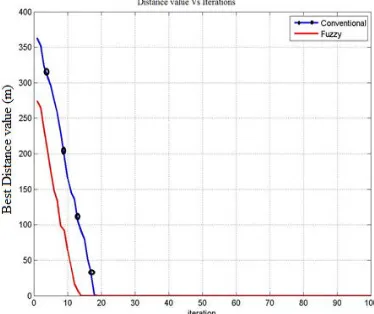
[image:6.612.325.536.82.276.2]The optimization parameters such as distance, delay, capacity, power consumption and cost value for different iterations is represented in a graphical manner in Figure. 2 to Figure.7
Figure.2 Distance Between The Nodes In The Network Using Conventional And Fuzzy Algorithm
[image:6.612.323.543.317.476.2]For Iterations 100
[image:6.612.320.538.521.688.2]Figure. 3 Capacity Of The Routing Network Using Conventional And Fuzzy Algorithm For Iterations 100
Figure. 4 Delay Value Using Conventional And Fuzzy Algorithm For Iterations 100
Figure. 5 Power Consumption Of The Network Using Conventional And Fuzzy Algorithm For
[image:6.612.103.290.546.703.2]Figure. 6 Cost Of The Network Using Conventional And Fuzzy Algorithm For Iterations 100
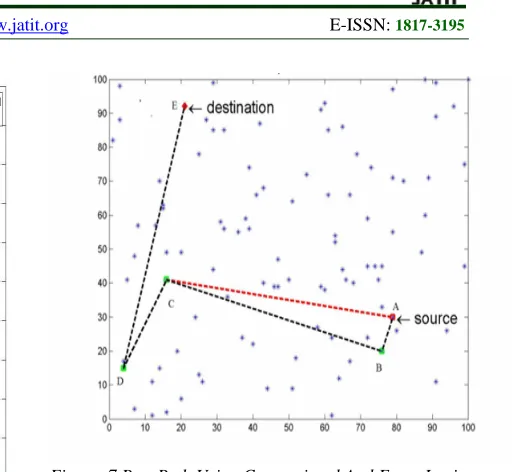
Figure. 7 Best Path Using Conventional And Fuzzy Logic For Different Node Values
Note: Best routing path using conventional ACO is ABCDE and Fuzzy logic is ACDE. Since the red line is over by the black dotted, red dotted up to the source to destination path routing is not displayed.
DISCUSSION
In this proposed method performance of the Fuzzy aided Ant colony optimization is compared with the conventional algorithm and the best path is found out. The proposed method is found to be the better in most important parameters such as delay, power consumption, distance and cost. From the Figure. 2, ACO using fuzzy has better performance with less distance value up to the iteration 20 while compared to the conventional algorithm. But in case of capacity of the paths conventional goes better than the fuzzy aided Ant colony optimization as shown in Figure. 3. Even in this case conventional feels better; it is negligible while considering other cases. In Figure. 4, Figure. 5 and Figure.6 Fuzzy performs better in delay, power consumption and cost value respectively. Optimal path for the MANET is shown in the Figure. 7 for conventional and Fuzzy ACO. There dark dotted path is conventional ACO and red is for proposed method. It is finally concluded that conventional algorithm takes several iterations to find the optimal path, but Fuzzy algorithm finds the optimal path in an effective manner.
7. CONCLUSION
In this paper, the proposed technique (Fuzzy ACO) is implemented and is tested by identifying
different shortest paths by sending different number of ants. The most important parameters for the optimization in the proposed method are distance, capacity, delay, power consumption and cost; and the values of the proposed method are compared with conventional ACO. The proposed Fuzzy ACO method is better in most cases such as distance, delay, power consumption, and cost except capacity of the path. From the above results it is clear that shortest path can be identified using FIS in an effective manner than the conventional algorithm.
8. ACKNOWLEDGMENTS
First author would like to extend his sincere thanks to the Principal and the Management of NRI Institute of Technology, Guntur for the support extended in the completion of the work.
REFERENCES
[1] Kun Tan, Qian Zhang and Wenwu Zhu, “Shortest path routing in partially connected Adhoc networks”, IEEEGlobal Telecommunications Conference, Vol. 2, pp. 1038- 1042, 2003
[image:7.612.94.312.75.322.2]Special Issue of International Journal of Computer Applications, Vol.4, pp. 24-27, Dec 2011
[3] Gary Breed, “Wireless Adhoc Networks:Basic Concepts”, High Frequency Electronics, pp. 44-46, 2007
[4] Matthias Grossglauser and David N. C. Tse, “Mobility Increases the Capacity of AdhocWireless Networks”, IEEE/ACM Transactions on Networking, Vol. 10, No. 4, pp. 477-486, 2002
[5] RajuBaskar and GulfishanAhmed, “Different Approaches on Cooperation in Wireless Adhoc Networks”, International Journal of Computer Applications, Vol. 28, No.3, pp. 36-41, August 2011
[6] David B.Johnson, David A. Maltz and Josh Broch, “DSR: the dynamic source routing protocol for multihop wireless Adhoc networks”, In Adhoc networking, pp. 139-172, December 2000
[7] HaiyunLuo ,Zerfos , Jiejun Kong , Songwu Lu and Lixia Zhang, “Self-securing Adhoc Wireless Networks”, In Seventh IEEE Symposium on Computers and Communications, pp. 1-17, 2002
[8] Martin Haenggi and Daniele Puccinelli, “Routing in Adhoc Networks: A Case for Long Hops”, IEEE Communications Magazine, pp. 93-101, 2005
[9] Vesa Karpijoki, “Security in Adhoc Networks”,
Seminar on Network Security, pp. 1-16, 2000 [10] Sergio Marti, T.J. Giuli, Kevin Lai and Mary
Baker, “Mitigating Routing Misbehaviour in Mobile Adhoc Networks”, In Proceedings of the 6th annual international conference on Mobile computing and networking, pp. 255-265, 2000
[11] Tanu Preet Singh, “Adhoc Networks: An Analytical Overview”, International Journal of Computing and Corporate Research, Vol. 2, No. 1, 2012
[12] “Routing Basics”, http://docwiki.cisco.com/wiki/Routing_Basics.
[13] Sunil Taneja and Ashwini Kush, “A Survey of Routing Protocols in Mobile Adhoc Networks”, International Journal of Innovation, Management and Technology, Vol. 1, No. 3, August 2010
[14] AneliseMunaretto and Mauro Fonseca, “Routing and quality of service supportfor mobile Adhoc networks”, Computer Networks, Vol. 51, No. 11, pp. 3142-3156, 2007
[15] Chunsheng Richard Lin and Jain-Shing Liu, “QoS Routing in Adhoc Wireless Networks”,
IEEE Journal on Selected Areas in Communications, Vol. 17, No. 8, pp. 1426-1438, 1999
[16] Seoung-Bum Lee, Gahng-Seop Ahn, Xiaowei Zhang and Andrew T. Campbell, “INSIGNIA: An IP-Based Quality of ServiceFramework for Mobile Adhoc Networks”, Journal of Parallel and Distributed Computing, Vol. 60, pp. 374-406, 2000
[17] Stephen Deering, Deborah L. Estrin, Dino Farinacci, Van Jacobson, Ching-Gung Liu and Liming Wei, “The PIM architecture for wide-area multicast routing”, IEEE/ACM Transactions on Networking (TON), Vol. 4, No. 2, pp. 153 – 162, April 1996
[18] Tomasz Imielinski and Badrinath, “Mobilewireless computing: challenges in data management”, MagazineCommunications of the ACM, Vol. 37, No. 10, pp. 18-28, Oct. 1994
[19] UpkarVarshney and Ron Vetter, “Emerging mobile and wireless networks”,
MagazineCommunications of the ACM, Vol. 43, No. 6, pp. 73 – 81, June 2000
[20] Yih-Chun Hu and David B. Johnson, “Exploiting Congestion Information in Network and Higher LayerProtocols in Multi-hop Wireless Adhoc Networks”, In proceedings of the 24th International Conference on Distributed Computing Systems (ICDCS’04), pp. 301-310, 2004
[21] Ehsan Khosrowshahi-Asl, Majid Noorhosseini and AtiehSaberiPirouz “A Dynamic Ant Colony Based Routing Algorithm for Mobile Ad-hoc Networks”, Journal of Information Science and Engineering, Vol. 27, pp. 1581-1596, 2011
[22] Zulfiqar Ali and Wasim Shahzad, “Critical Analysis of Swarm Intelligence based Routing Protocols in Ad-hoc and Sensor Wireless Networks”, International Conference on Computer Networks and Information Technology (ICCNIT), pp. 287- 292, 2011 [23] Kaushik R. Chowdhuryand Ian F. Akyildiz,
“CRP: A Routing Protocol for Cognitive RadioAdhoc Networks”, IEEE Journal on Selected Areas in Communications, Vol. 29, No. 4, April 2011
International Journal of Computer Science Issues, Vol. 9, No. 3, No 2, pp. 444-448, May 2012
[25] ToqeerMahmood, Tabassam Nawaz, Rehan Ashrafand Syed M. Adnan Shah,“Gossip Based Routing Protocol Design for Adhoc Networks”, IJCSI International Journal of Computer Science Issues, Vol. 9, No 1, pp. 177-181, January 2012
[26] Aloysius George and B. R. Raja Kumar, "Fuzzy Aided Ant Colony Optimization Algorithm to Solve Optimization Problem",