Journal of Chemical and Pharmaceutical Research, 2018, 10(6): 152-157
Mini Review
CODEN(USA) : JCPRC5
ISSN : 0975-7384
152
P/M Processed Fe-Sn Alloys
Deepika Sharma
*Department of Physics, Swami Premanand Mahavidyalaya, Panjab University, Mukerian, Punjab, India
_____________________________________________________________________________
ABSTRACT
The present review predominantly deals with the literature on Fe-Sn magnetic materials (having Phosphorous as one of the alloying elements) produced from powders, using compacting and sintering. Influence of the alloy chemistry and processing parameters on the physical, electrical, magnetic and mechanical properties are also highlighted. Structure sensitive properties are sensitive to the metallurgical conditions and the microstructure of the material; in turn these properties are governed by the processing parameters such as use of the binder and or lubricant, compacting pressure, sintering temperature, sintering time and sintering atmosphere, and these are therefore dependent upon processing techniques.
Keywords: Fe-Sn Alloys; Permeability; Processing
_____________________________________________________________________________
INTRODUCTION
Permanent magnetic materials are important for energy applications such as wind turbines and motors for hybrid and electric vehicles. The increasing importance of permanent magnets in modern society has resulted in renewed interest in the design and discovery of new permanent magnet materials [1]. For a good permanent magnet a ferromagnetic compound should have a Curie temperature, Tc, above 400 K, a saturation moment, Ms, in the range of 1 MA/m, anisotropy energy, K1, of about 4 MJ/m3, and additionally a uniaxial magnetic anisotropy [2-4].
LITERATURE REVIEW
Fe-Sn system has many of the desirable properties for a new permanent magnet phase with a Curie temperature of 725 K, a saturation moment of 1.18 MA/m. and anisotropy energy, K1 of 1.8 MJ/m3. The phase diagram of Fe-Sn system [5] is shown in Figure 1. Five compounds appear in this system, all of which have hexagonal crystal structures. These are FeSn2, FeSn, Fe3Sn2, Fe5Sn3 and Fe3Sn [6]. The loop closes at about 2%Sn. Maximum
153
Figure 1: Phase diagram of Iron-Tin alloys [5]
Apparently FeSn2 is magnetic, for the alloy containing 97% tin is weakly ferromagnetic [7]. Curie points and atomic
moments of alloys containing 12% and less of tin have been measured. In this range the Curie point drops only to 5°C, and the saturation at room temperature decreases about 8%. Reduction in hysteresis by adding 2% of tin to iron has been reported and a reduction in total losses in sheet, which contained less than this amount of tin, was also observed. In experiments at Bell Laboratories a permeability of 34000 and a coercive force of 0.15 Oersted have been attained by heat treating the Fe-3%Sn alloy in pure hydrogen at 1100°C.
Tin is a ferrite stabilizer, its addition to iron effectively increases the resistivity and at room temperature a solid solution of Sn in α-iron possessing good soft magnetic characteristics exists up to about 8%Sn whose curie temperature is as high as that of pure iron. Further, the addition phosphorous to Fe-Sn system is expected to activate the sintering and enhances both resistivity and magnetic properties. Therefore, it is thought to develop Fe-Sn-P alloys up to 8% of tin for soft magnetic applications and the results are encouraging [8,9]. Further, as per United States Patent [10], it is claimed that the soft magnetic properties of iron based P/M alloys are improved by using powders prepared by mixing SnP powder, or Sn and Fe3P powders, with iron powder [9,10]. However, due to the
154
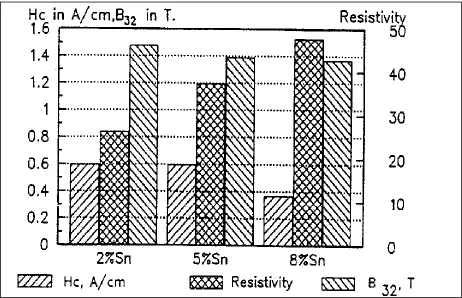
Figure 2: Effect of tin content in Fe-Sn-0.45%P alloys, samples compacted at 589 MPa, sintered for 30 minutes at 1250°C in H2 atm
The structural sensitive properties are most affected by an increase in phosphorous content (Figure 3). The decrease in coercive force and increase in maximum permeability is approximately one third by an increase in phosphorous content from 0.45% to 0.8%. Induction and resistivity are increased by increase in phosphorous however; the increase in induction is marginal.
[image:3.612.114.476.503.689.2]155
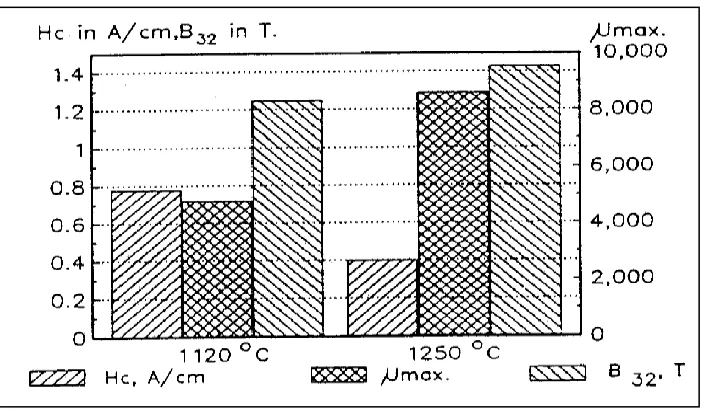
[image:4.612.116.467.172.379.2]In contrast to other high resistivity alloys, this material is not confined to high temperature sintering i.e. about 1200°C. Sintering at 1120°C resulted in high resistivity and better soft magnetic properties (Figure 4). Increasing the sintering temperature is however amply rewarded, as coercive force is halved and maximum permeability almost doubled.
Figure 4: Effect of sintering temperature on Fe-5%Sn-0.8%P alloy, samples compacted at 589 MPa, sintered for 30 minutes at 1250°C in H2 atm
[image:4.612.114.499.517.710.2]Table 1 indicates the magnetic characteristics of well-established Fe-3%Si and Fe-50%Ni alloys along with these characteristics for Fe-5%Sn-0.45%P and Fe-8%Sn-0.45%P alloys and alternate materials for established alloys from the point of view of overall economy.
Table 1: Comparison of Fe-5%Sn-0.45%P alloy characteristics with established Fe-3%Si alloy and Fe-8%Sn-45%P alloy characteristics with Fe-50%Ni alloy
Material and Processing Parameters Sintered Density (g/cm3) Induction at 32 A/cm, B32
at 15 A/cm, B15
(T) Br (T) Hc (A/cm) µmax
Resistivity
(µ-ohm-cm) Remarks
Fe-3%Si alloy, compacted at 589 MPa and sintered
at 1250°C
for 30 min. in hydrogen (dimensional change-1.25%)
7.2 1.3 [B32] 1 0.8 4300 47
Fe-5%Sn-0.45%P
alloy with
slightly lower resistivity
can be
accepted as
it has
156
Fe-5%Sn-0.45%P alloy, compacted at 589 MPa and sintered
at 1120°C
for 30 min. in hydrogen (dimensional change 0.21%)
7.2 1.4 [B32] 1.1 0.8 4800 40
reducing dimensional change and sintering temperature.
Fe-50%Ni alloy, compacted at 589 MPa and sintered
at 1250°C
for 30 min. in hydrogen
7.4 1.1 [B15] 0.8 0.25 13000 50
Fe-50%Ni
alloy has
excellent magnetic properties, owing to its
high cost
may be
substituted by Fe-8%Sn-0.45%P alloy, compacted at 589 MPa and sintered
at 1250°C
for 30 min. in hydrogen
7.4 1.3 [B15] 1 0.37 9700 48
Fe-8% Sn-0.45%P
alloy for
more extensive use.
CONCLUSION
The review summarizes the material’s choice on the basis of selection criteria for some of the components made through P/M route for magnetic applications. The selection of a material for a particular application will depend up on its ability to meet the required performance, and also its availability and cost.
ACKNOWLEDGEMENT
Authors thanks to the Directorate of Higher Education Indonesia (DIKTI) on the graduate program BPPS scholarship. Authors also thanks to LIPI in Serpong, Indonesia that has helped an elusidation of the structure of the synthesized compound.
REFERENCES
[1] D Sharma. J Chem Pharm Res. 2017, 9, 225-229. [2] KHJ Buschow. Rep Prog Phys. 1991, 54, 1123-1213. [3] JF Herbst. Rev Mod Phys. 1991, 63, 819-898. [4] JMD Coey. IEEE Trans. Magn.2011, 47, 4671-4681.
[5] PM Hansen. Constitution of Binary Alloys, McGraw-Hill Book Company, New York, USA, 1958, 711-720.
157
[8] P Jansson. Alloys Specifically Developed For Sintered Soft Magnetic Applications, Proceedings of Conference on Powder Metallurgy Materials Featuring Specific Physical Properties, Paris, France, 1992, 1-6.
[9] P Jansson. Powder Metall. 1992, 35, 63-66.
[10]P Jansson; SE Viken. Powder Metallurgical Composition Having Good Soft Magnetic Properties, 1996,
![Figure 1: Phase diagram of Iron-Tin alloys [5]](https://thumb-us.123doks.com/thumbv2/123dok_us/8734734.888124/2.612.147.521.82.305/figure-phase-diagram-iron-tin-alloys.webp)