A JOINT DESIGN OF ROUTING AND RESOURCE
ALLOCATION USING QOS MONITORING AGENT IN
MOBILE AD-HOC NETWORKS
1P. SENTHILNATHAN, 2 C. KALAIARASAN
1
Assistant Professor, School of Computing Science and Engineering, VIT University, Vellore
2Principal, Tamilnadu College of Engineering, Coimbatore
E-mail: [email protected], [email protected]
ABSTRACT
In MANETs, mobile nodes can join and leave or change their position inside the network, so its topology can change anytime in unpredictable ways. So maintaining the QoS for the resource allocation is crucial for MANETs. In this paper, we propose a joint design of routing and resource allocation using QoS monitoring agent in MANETs. In this joint design, depending on the bandwidth request, a QoS monitoring agent checks the available bandwidth and allocates the resources temporarily for the real-time flows. In case of QoS changes or route breakages, the monitoring agent sent a feedback to the source, which contains the estimated amount of resources to be reserved or the route failure information. The sender adaptively adjusts the reservations or data rate when there is a QoS change or selects another efficient route when there is a route or link failure. By simulation, we show that our proposed joint design framework improves the throughput and bandwidth utilization.
Keywords:Mobile ad-hoc networks (MANETs), Quality of Service (QoS)
1. INTRODUCTION
1.1. Mobile Ad hoc Networks (MANET)
Mobile ad-hoc networks (MANETs) are infrastructure-less network consisting of numbers of mobile hosts communicating with one another via relaying messages among mobile hosts through multihop wireless links. These MANETs denotes wireless networks that can form spontaneously as soon as multiple wireless nodes are in transmission range. Mobile nodes can join and leave or change their position inside the network, so its topology can change anytime in unpredictable ways. Another fundamental property is the absence of a centralized control to manage and assign resources. In addition, routing protocols in wireless networks have to cope with problems like the exposed and hidden terminal problem or the usage of a shared medium, which can lead to frame collisions. Examples for mobile ad-hoc networks are ZigBee and Bluetooth networks [1][2].
1.2. Routing in MANETs
Routing is one of the core problems for data exchange between nodes in networks. In recent years, both the areas of providing quality-of-service and routing in mobile ad-hoc networks have
massively increased in importance. Many routing protocols for wireless networks, e.g. AODV or DSR, use best-effort (normal traffic) routing, where all nodes within range compete for the shared medium. No guarantees or predictions can be given here on when a node is allowed to send. For quality-of-service (QoS) routing, it is not sufficient to only find a route from a source to one or multiple destinations. This route also has to satisfy one or more QoS constraints, mostly, but not limited to, bandwidth or delay. To guarantee these constraints after a route was found, resource reservations on the participating nodes are made. [3][4]
1.3. QoS in MANETs
Providing QoS in mobile ad-hoc networks is much more difficult than in most other types of network. First of all, because of the nature of radio links, reservations on links can influence each other in a 2-hop range and thus complicate the computation and management of bandwidth and delay restrictions. Additionally, even with reservations, resource availability cannot always be guaranteed due to the dynamic aspect of the network. In this is denoted as Soft QoS. Protocols for QoS routing in MANETs have to take care of these problems. [1][5]
1.4 Problem Identification and Proposed Solution
QoS in routing has severe disadvantages in MANETs with high dynamics, because of the increased communication overhead to exchange information about net state, even when no routes need to be discovered. The most commonly used metrics in QoS networks is either delay or bandwidth. For example, the delay constraint used in TBP could be replaced by energy or jitter constraints, if the necessary net state information is also available at all nodes. Here, delay constraints are used to initialize timers to change a node's state for a certain period of time. This principle would not work with, e.g., energy constraints, which also belong to the group of additive metrics.
In the paper [12], a QoS reservation mechanism for Multirate AWNs that allows bandwidth allocation on a per flow basis has been proposed. Basically in this approach the QoS-aware applications are able to request the appropriate bandwidth when establishing a connection between the nodes. These nodes know the capacity of the wireless links that are available for QoS flows during the transmission. Also a pure Carrier Sensing Medium Access (CSMA) protocol is used, so that whenever a node is transmitting, all its neighbors will remain silent in the network. When the nodes have to reach all their neighbors in the network the nodes reach them through broadcasting packets.
But the drawback of this approach is that there is no method described here to decrease the dropping rate during the transmission of the data packets in the network. Due to these reasons the energy consumption of the network increases.
2. RELATED WORK
Vishnu Kumar Sharma et al. [6] have proposed an agent based bandwidth reservation technique for MANET. In this approach the mobile agent from
the source starts forwarding the data packets through the path which has minimum cost, congestion and bandwidth. The status of every node is collected which includes the bottleneck bandwidth field and the intermediate node computes the available bandwidth on the link. At the destination, after updating the new bottleneck bandwidth field, the data packet is feedback to the source. In resource reservation technique, if the available bandwidth is greater than bottleneck bandwidth, then bandwidth reservation for the flow is done. Using rate monitoring and adjustment methodologies, rate control is performed for the congested flows. The advantage of this approach is that it reduces the losses and improves the network performance.
Wenjing YANG et al. [7] have proposed a Bandwidth aware Multi-path Routing (BMR) protocol. Here in this protocol, the analysis of the number of parallel paths of a source-destination pair is presented firstly, including limitations caused by hidden terminal and carrier sensing. Based on these analyses, BMR constructs two bandwidth aware paths for a source-destination pair. BMR adopts a cross-layer method to obtain the available bandwidth from the MAC layer. The advantage of this proposed protocol is that it improves end-to-end throughput by constructing parallel paths, and thus meets the requirement of the high traffic communications in MANETs.
Shinsuke Kajioka et al. [8] have proposed a new routing mechanism to support real-time multimedia communication by efficiently utilize the limited wireless network capacity. This approach considers a wireless ad-hoc network composed of nodes equipped with multiple network interfaces to each of which a different wireless channel can be assigned. By embedding information about channel usage in control messages of OLSRv2, each node obtains a view of topology and bandwidth information of the whole network. Based on the obtained information, a source node determines a logical path with the maximum available bandwidth to satisfy application QoS requirements. The advantage of this approach is that it effectively routes multimedia packets over a logical path avoiding congested links and also the load on a network will be distributed and the network can accommodate more sessions than QOLSR.
system response to the observed grade of mobility in the environment. The advantage of this approach is that it guarantees a soft-QoS provision thanks to a flexible resource management adapted to different scenarios.
Atef Abdrabou et al. [10] have proposed a model-based quality-of-service (QoS) routing scheme for IEEE 802.11 ad hoc networks. This approach via a cross-layer design approach selects the routes based on a geographical on-demand ad hoc routing protocol and checks the availability of network resources by using traffic source and link-layer channel modeling. Also this approach extends the well developed effective bandwidth theory and its dual effective capacity concept to multihop IEEE 802.11 ad hoc networks. The advantage of this proposed scheme is it provides stochastic end-to-end delay guarantees, instead of average delay guarantees, to delay-sensitive busty traffic sources.
Kumar Manoj et al. [11] have proposed bandwidth control management (BWCM) model. The proposed algorithm includes a set of mechanisms: control management that calculates the BW, co-ordination that provides allocation of the bandwidth, temporary resource reservation process that released the connection link or bandwidth after complete the communication. Also an algorithm for end-to-end bandwidth calculation and allocation has been proposed in the paper. The advantage of this proposed model is it improves the QoS performance by minimized end-to-end delay.
Rafael Guimarães et al. [12] have proposed a QoS reservation mechanism for Multirate AWNs that allows bandwidth allocation on a per flow basis. By multirate it refers to those networks where wireless nodes are able to dynamically switch among several link rates. This allows nodes to select the highest possible transmission rate for exchanging data, independently for each neighbor. The advantage of this approach is that it guarantees certain QoS levels, but also naturally distributes the traffic more evenly among network nodes (i.e. load balancing). It works completely on the network layer, so that no modifications on lower layers are required, although some information about the network congestion state could also be taken into account if provided by the MAC (medium access control) layer.
3. JOINT DESIGN OF ROUTING AND RESOURCE ALLOCATION
3.1 Overview
We propose a joint framework for routing and multimedia resource management in wireless adhoc networks with the following objectives:
o To improve QoS of all active flows by increasing the average allocated bandwidth.
o To reduce dropping rate
o To optimize the data rate for network communication
The usual performance metrics of a network are average throughput and delay. The interaction between routing and flow control affects how well these metrics are jointly optimized. Good routing generally results in a more favorable delay throughput curve. These curves serve as the standard metric for comparison of routing algorithm performance.
In our proposed joint framework, depending on the bandwidth request, a QoS monitoring agent checks the available bandwidth and allocates the resource temporarily for the real-time flows.
The monitoring agent sends a setup message along with the traffic flows, to obtain the QoS information. In case of QoS changes or route breakages, a feedback is sent to the source, which contains the estimated amount of resources to be reserved or the route failure information. The sender adaptively adjusts the reservations or data rate when there is a QoS change or selects another efficient route when there is a route or link failure.
3.2 QoS Monitoring Agent
QoS monitoring agent initially starts forwarding the probe packets from the source node through the
path with minimum cost and bandwidth
availability. These probe packets which are sent by the source node reach every intermediate node in the path and update its list with the node information such as its id, flag, power level, node activating counter, information about the neighbor node. It also monitors the QoS level of each intermediate node along the path. If the QoS constraint is violated, then the monitoring agent sends a notification to the source so that the source can perform rate control or choose another suitable route satisfying the QoS constraint.
Fig 1: QoS Monitoring Agent
3.3 Allocation of Resources
During the allocation of the resources, initially the monitoring agent sends a probe packet from the source to the destination that contains the IP address of both the nodes. During this transmitting of the data packet, the intermediate node determines the available bandwidth AB on its outgoing link. The total required bandwidth is TB. In case if AB is greater than the TB value, then the node forwards the packet to the next node on the path. If AB is less than TB, then the node replaces the TB field with the value of AB and forwards the packet to next node. This process will be continued till the probe packet reaches the destination node.
Data packet ID Source ID Destination ID Available Bandwidth Total required Bandwidth
Fig 2: Probe Packet Format
Finally when the probe packet reaches the destination, the destination node copies the TB value to the new probe packet and sent back to the source node using the same path. Again the intermediate node upon receiving the probe packet updates its routing table with the new TB and then forwards the packet to the next node in the path. When the probe packet reaches the source node, the source node establishes the real-time flow based on the value of the TB field. If the source node containing AB is greater than or equal to the TB value then reservation of bandwidth for the flow can be proceeded. Otherwise, the TB is overwritten
with the AB and then TB. The rate control technique concentrates on rate monitoring and adjustment methodologies whereas the cumulative assigned rate for incoming and outgoing flow helps in rate adjustment.
3.4 Bandwidth Estimation
Every node is in charge for estimating the available bandwidth on its link. For a given node, the link capacity is measured defined by
Li = CAR ij + ABi (1) Where AB = Available Bandwidth.
Li = link capacity associated with one-hop neighbor i.
CAR be the cumulative assigned rates for all incoming and outgoing flows.
Hence the sum of the assigned incoming and outgoing flow rates and available bandwidth on the link should be equal to the capacity of the link i. The available bandwidth can be expressed as
{
0, C}
)max j ARij
Bj L
A ∆ −
, (2)
3.5 QoS Monitoring
In this section we address the complexity of the node that faces during the QoS. The QoS had to be provided since the QoS plays an important role while transmitting the data packets from the node to node. The QoS provided to the data packets will be satisfied only it satisfies the eq 5.
The QoS requirement is captured by delay bound (DBmax) and probability P of total delay. Here we will calculate the probability (p) by using the following equation
[
]
max1
max
DB EB e DB
TD pr
P
− ≈ ≥
=
(3) In the equation (3), TD is total delay (queuing delay + service time) of the packet,
DBmax is the delay bound and
EB is the effective bandwidth of the traffic source.
We will calculate the EB by using the following equation. Where EB is the exact bandwidth required by the data packets to reach the destination node.
[
]
, 0log 1 1
lim () ∀ >
= →∞ Ee y
y t
EB t yAPt
(4) In equation (4), AP(t) is the arrival process of the source and t is the interval time i.e., [0,t]. The arrival process is the number of packets arrived in the interval [0,t]. The path must satisfy the a stochastic end-to-end delay guarantee
[image:4.612.105.284.488.552.2]the probability of total delay and the packet delay of all nodes. If this condition does not satisfy, then a new QoS will be provided for the data packets.
Q ≤ P (5) In equation (5), P is probability of total delay and Q is the probability of packet delay of all nodes. Q is calculated by using the following equation
>
=
∑
=
n i
i DB
TD pr Q
1
max
(6) In equation (6), TDi is the packets delay of the link i and n is the number of hops in the route. The sum of packets delay of the link i of all hops in the route and is greater than the delay bound (DBmax).
3.6 Providing QoS and Routing Path
When the QoS is not maintained which is required to transmit the data packets on the selected route i.e. the measured bandwidth is not enough to cover the required route by the data packet or the QoS condition is not satisfied, a feedback is sent by the monitoring agent to the source in order to generate the discovery of a new route. This new route should be capable of satisfying the demanded bandwidth by the data packets.
A NQoS (QoS Not satisfied) packet is maintained to avoid dropping packets by the source in excess due to the failure QoS. It is sent after the unsuccessful updates in order to find a new QoS route to the data packets. The source on receiving this packet, checks the failure of QoS to satisfy the routing constraints. So at the end, a new QoS route is provided in order to satisfy the routing constraints.
At the initial time of the approach the network is monitored by the QoS monitoring agents. These agents monitor the network’s QoS between the nodes. Through this way the monitoring agents allocate the available bandwidth according to the routing constraints for the data packets to transmit towards the destination node. Then the approach checks the provided QoS for the data packets, if this QoS does not satisfy the routing constraints. Then again new QoS is provided for the data packets. Finally the data packets are transmitted towards the destination node through the routing path which is satisfied by the provided QoS.
4. SIMULATION RESULTS
4.1 Simulation Model and Parameters
We use NS2 [13] to simulate our proposed Joint Design of Routing and Resource Allocation Using QoS Monitoring (JDRRA). In our simulation, the channel capacity of mobile hosts is set to the same value: 2 Mbps. We use the distributed coordination
function (DCF) of IEEE 802.11 for wireless LANs as the MAC layer protocol. It has the functionality to notify the network layer about link breakage.
In our simulation, the mobile nodes move in a 1000 meter x 1000 meter region for 20 seconds simulation time. All nodes have the same transmission range of 250 meters. In our simulation, the node speed is varies from 2m/s to 10m/s. For high priority class 1 traffic we use CBR and video flows and for best effort class2 traffic, TCP is used.
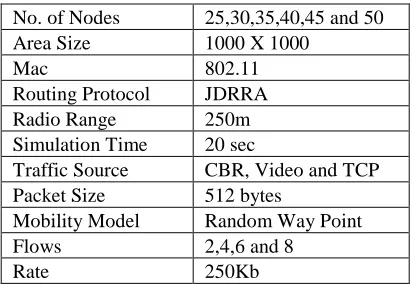
[image:5.612.315.521.280.424.2]Our simulation settings and parameters are summarized in table 1.
Table 1. Simulation Parameters
No. of Nodes 25,30,35,40,45 and 50
Area Size 1000 X 1000
Mac 802.11
Routing Protocol JDRRA
Radio Range 250m
Simulation Time 20 sec
Traffic Source CBR, Video and TCP
Packet Size 512 bytes
Mobility Model Random Way Point
Flows 2,4,6 and 8
Rate 250Kb
4.2. Performance Metrics
We evaluate mainly the performance according to the following metrics.
Average Packet Delivery Ratio: It is the ratio of
the number .of packets received successfully and the total number of packets transmitted.
Delay: It is the time taken by the packet to reach
the receiver.
Throughput: It is the average throughput received
by each receiver and measured in Mbits/sec.
Fairness: It is the fraction of bandwidth utilized for
each flows.
We compare our JDRRA with the bandwidth reservation over ad hoc wireless networks (BRAWN) [12] scheme. The simulation results are presented in the next section
A. Based on Nodes
Throughput of Class-1 Traffic
0 0.5 1 1.5
25 30 35 40 45 50
Nodes
Mb
/s BRAWN
[image:6.612.90.527.70.210.2]JDRRA
Fig 3: Nodes Vs Throughput (class-1)
Throughput of Class-2 Traffic
0 0.5 1 1.5
25 30 35 40 45 50
Nodes
Mb
/s BRAWN
[image:6.612.95.294.245.360.2]JDRRA
Fig 4: Nodes Vs Throughput (class-2)
The throughput obtained for both class-1 and class-2 traffic are depicted in Fig 3 and 4, respectively. It shows that increase in number of nodes decreases the throughput, since the number of hops increases. The figures clearly show that JDRRA obtains higher throughput than BRAWN.
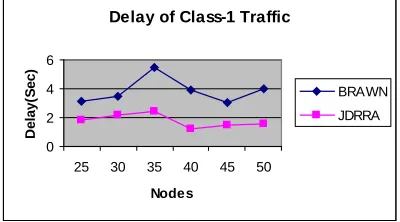
Delay of Class-1 Traffic
0 2 4 6
25 30 35 40 45 50
Nodes
D
el
ay(
S
ec)
[image:6.612.318.517.308.420.2]BRAWN JDRRA
Fig 5: Nodes Vs Delay (class-1)
Delay of Class-2 Traffic
0 2 4 6 8
25 30 35 40 45 50
Nodes
D
el
ay(
s) BRAWN
JDRRA
Fig 6: Nodes Vs Delay (class-2)
The end-to-end delay obtained for both class-1 and class-2 traffic shown in Fig 5 and 6, respectively. It shows that increase in number of nodes increases the delay, since the number of hops increases. The figures clearly show that JDRRA obtains lesser delay than BRAWN.
Fairness of Class-1 Traffic
0 0.1 0.2 0.3 0.4 0.5
25 30 35 40 45 50
Nodes
Mb
/s BRAWN
JDRRA
Fig 7: Nodes Vs Fairness (class-1)
Fairness of Class-2 Traffic
0 0.1 0.2 0.3 0.4
25 30 35 40 45 50
Nodes
Mb
/s BRAWN
JDRRA
Fig 8: Nodes Vs Fairness (class-2)
[image:6.612.318.517.457.566.2] [image:6.612.94.294.484.595.2]Packet Delivery Ratio of Both Traffic
0 0.2 0.4 0.6 0.8
25 30 35 40 45 50
Nodes
D
el
iver
yR
at
io
[image:7.612.91.519.75.207.2]BRAWN JDRRA
Fig 9: Nodes Vs Delivery Ratio
B. Based on Flows
In our second experiment we vary the flows as 2, 4, 6 and 8.
Throughput for Class-1 Traffic
0 0.1 0.2 0.3 0.4
2 4 6 8
Num ber of Flow s
Mb
/s BRAWN
JDRRA
Fig 10: Flows Vs Throughput (class-1)
Throughput of Class-2 Traffic
0 1 2 3 4 5
2 4 6 8
Num ber of Flow s
Mb
/s BRAWN
[image:7.612.318.517.238.348.2]JDRRA
Fig 11: Flows Vs Throughput (class-2)
The throughput obtained for both class-1 and class-2 traffic are depicted in Fig 10 and 11, respectively, for the increased traffic flow scenario. It shows that increase in number of flows increases the throughput, since more number of resources will be allocated. The figures clearly show that JDRRA obtains higher throughput than BRAWN.
Delay of Class-1 Traffic
0 1 2 3 4 5
2 4 6 8
Num ber of Flow s
D
el
ay(
S
ec) BRAWN
JDRRA
Fig 12: Flows Vs Delay (class-1)
Delay of Class-2 Traffic
0 1 2 3 4 5
2 4 6 8
Num ber of Flow s
D
el
ay(
s)
BRAWN JDRRA
Fig 13: Flows Vs Delay (class-2)
The end-to-end delay obtained for both class-1 and class-2 traffic shown in Fig 12 and 13, respectively. It shows that increase in number of traffic increases the delay, due to collision. The figures clearly show that JDRRA obtains lesser delay than BRAWN.
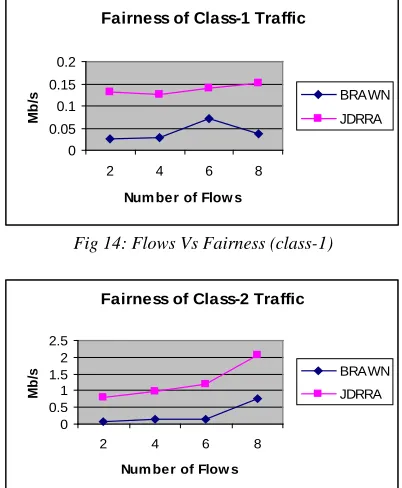
Fairness of Class-1 Traffic
0 0.05 0.1 0.15 0.2
2 4 6 8
Num ber of Flow s
Mb
/s BRAWN
[image:7.612.93.296.275.535.2]JDRRA
Fig 14: Flows Vs Fairness (class-1)
Fairness of Class-2 Traffic
0 0.5 1 1.5 2 2.5
2 4 6 8
Num ber of Flow s
Mb
/s BRAWN
JDRRA
[image:7.612.316.517.454.698.2]The fairness obtained for both class-1 and class-2 traffic are depicted in Fig 14 and 15, respectively. It shows that increase in number of flows, increases the fairness, since more resources are allocated. The figures clearly show that JDRRA obtains fairness higher than BRAWN.
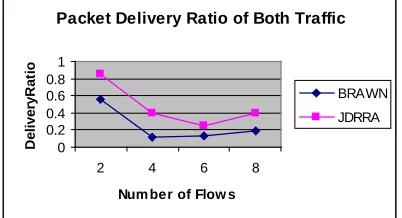
Packet Delivery Ratio of Both Traffic
0 0.2 0.4 0.6 0.8 1
2 4 6 8
Num ber of Flow s
D
el
iver
yR
at
io
[image:8.612.94.295.184.293.2]BRAWN JDRRA
Fig 16: Flows Vs Delivery Ratio
5. CONCLUSION
To achieve maximum QoS for the data packets during the routing between the nodes, in this paper we are proposing a Joint Design of Routing and Resource Allocation Using QoS Monitoring for the MANETs. In this approach the monitoring agents monitors the resources required by the nodes in the network. During the transmission of the data packets if any link breaks or loss data packets occurs the QoS monitoring agent assigns a path for the nodes in the network. by providing required QoS to the data packets with help of the monitoring agents present we can reduce the breakage of links, loss of data packets and we can get the route information.
REFERENCES:
[1] Philipp Becker, ”QoS Routing Protocols for Mobile Ad-hoc Networks – A Survey”, Fraunhofer IESE and TU Kaiserslautern, 2007 [2] Rajeshkumar RAMRAJ, “Bandwidth Allocation
and Routing Information for Wireless Mobile Ad-hoc Networks”, International Conference on Fuzzy Systems and Knowledge Discovery, 2010
[3] Shakeel Ahmed and A. K. Ramani, “Alternate Route for Improving Quality of Service in
Mobile Ad hoc Networks”, IJCSNS
International Journal of Computer Science and Network Security, VOL.11 No.2, February 2011 [4] Wang Xiangli, Li Layuan, Gong Bencan and
Wang Wenbo, “A Distributed Bandwidth
Reservation Protocol for QoS Routing in Mobile Ad Hoc Networks”, IEEE, 2007.
[5] M.Pushpavalli and Dr.A.M.Natarajan, “Quality of Service in Mobile Adhoc Networks using
Two Bandwidth Estimation Method in
Optimized Link State Routing protocol”, IJCSNS International Journal of Computer Science and Network Security, VOL.12 No.1, January 2012
[6] Vishnu Kumar Sharma and Dr. Sarita Singh Bhadauria, “Agent based Bandwidth Reservation Routing Technique in Mobile Ad Hoc Networks”, International Journal of Advanced Computer Science and Applications, Vol. 2, No. 12, 2011
[7] Wenjing YANG1, Xinyu YANG, Guozheng LIU, Chiyong DONG, “A Bandwidth Aware Multi-path Routing Protocol in Mobile Ad Hoc
Networks”, Journal of Computational
Information Systems 7:3, 685-696, 2011
[8] Shinsuke Kajioka, Naoki Wakamiya, Hiroki Satoh, Kazuya Monden Masato Hayashi , Susumu Matsui and Masayuki Murata, “A QoS-aware routing mechanism for multi-channel multi-interface ad-hoc networks”, Ad Hoc Networks, Elsevier, 2010
[9] Marı´a Canales, Jose´ Ramo´n Ga´llego, Angela Herna´ndez-Solana and Antonio Valdovinos, “QoS provision in mobile ad hoc networks with an adaptive cross-layer architecture”, Wireless Networking, 15:1165–1187, 2011
[10] Atef Abdrabou and Weihua Zhuang, “Statistical QoS Routing for IEEE 802.11 Multihop Ad Hoc Networks”, IEEE TRANSACTIONS ON WIRELESS COMMUNICATIONS, VOL. 8, NO. 3 MARCH 2009.
[11] Kumar Manoj, S. C. Sharma and S.P. Singh, “Dynamic Behavior of Bandwidth Control Management in Mobile Ad-Hoc Network”, Proceedings of the World Congress on Engineering and Computer Science, Vol I, October 20-22, 2009.
[12] Rafael Guimarães, Llorenc Cerdà, José M. Barceló, Jorge García, Michael Voorhaen and Chris Blondia, “Quality of service through bandwidth reservation on multirate ad hoc wireless networks”, Elsevier, Ad Hoc Networks, vol 7, 388–400, 2009