Open Access
Research article
Validity and responsiveness of the Clubfoot Assessment Protocol
(CAP). A methodological study
Hanneke Andriesse*
1, Ewa M Roos
1, Gunnar Hägglund
1and
Gun-Britt Jarnlo
2Address: 1Department of Orthopedics, Clinical Sciences, Lund University and Lund University Hospital, SE-221 85 Lund, Sweden and 2Departments of Health Sciences, Division of Physical Therapy, Lund University, Lasarettsgatan 7, SE 221 85, Sweden
Email: Hanneke Andriesse* - [email protected]; Ewa M Roos - [email protected]; Gunnar Hägglund - [email protected]; Gun-Britt Jarnlo - [email protected] * Corresponding author
Abstract
Background: The Clubfoot Assessment Protocol (CAP) is a multi dimensional instrument designed for longitudinal follow up of the clubfoot deformity during growth. Item reliability has shown to be sufficient. In this article the CAP's validity and responsiveness is studied using the Dimeglio classification scoring as a gold standard.
Methods: Thirty-two children with 45 congenital clubfeet were assessed prospectively and consecutively at ages of new-born, one, two, four months and two years of age.
For convergent/divergent construct validity the Spearman's correlation coefficients were calculated. Discriminate validity was evaluated by studying the scores in bilateral clubfeet. The floor-ceiling effects at baseline (untreated clubfeet) and at two years of age (treated clubfeet) were evaluated. Responsiveness was evaluated by using effect sizes (ES) and by calculating if significant changes (Wilcoxons signed test) had occurred between the different measurement occasions.
Results: High to moderate significant correlation were found between CAP mobility I and morphology and the Dimeglio scores (rs = 0.77 and 0.44 respectively). Low correlation was found between CAP muscle function, mobility II and motion quality and the Dimeglio scoring system (rs = 0.20, 0.09 and 0.06
respectively). Of 13 children with bilateral clubfeet, 11 showed different CAP mobility I scores between right and left foot at baseline (untreated) compared with 5 with the Dimeglio score. At the other assessment occasions the CAP mobility I continued to show higher discrimination ability than the Dimeglio. No floor effects and low ceiling effects were found in the untreated clubfeet for both instruments. High ceiling effects were found in the CAP for the treated children and low for the Dimeglio.
Responsiveness was good. ES from untreated to treated ranged from 0.80 to 4.35 for the CAP subgroups and was 4.68 for the Dimeglio. The first four treatment months, the CAP mobility I had generally higher ES compared with the Dimeglio.
Conclusion: The Clubfoot Assessment Protocol shows in this study good validity and responsiveness. The CAP is more responsive when severity ranges between mild – moderate to severe, while the Dimeglio focuses more on the extremes. The ability to discriminate between different mobility status of the right and left foot in bilaterally affected children in this population was higher compared with the Dimeglio score implicating a better sensitivity for the CAP.
Published: 15 March 2006
BMC Musculoskeletal Disorders2006, 7:28 doi:10.1186/1471-2474-7-28
Received: 04 January 2006 Accepted: 15 March 2006
This article is available from: http://www.biomedcentral.com/1471-2474/7/28
© 2006Andriesse et al; licensee BioMed Central Ltd.
Background
Studies on children with clubfoot are mainly based on classification and cross-sectional group studies with often a wide range in age. Consequently most instruments used in clubfoot assessment are primarily for classification or cross sectional long-term outcome. There is a lack of knowledge on the nature of clubfoot progression. There-fore the development of an instrument for longitudinal multilevel follow-up is of importance.
As a part of the ongoing study of the Clubfoot Assessment Protocol [1] psychometric properties, the purpose of this
study was to investigate validity and responsiveness of the CAP in comparison with the Dimeglio scoring system [2].
Research questions were: i. How does the CAP subgroups
associate with the Dimeglio instrument? ii. How are the
ceiling -and floor effects in these two instruments and how is the sensitivity for levels of different severity? iii. Do these instruments show change over time?
Methods
Subjects and treatment program
Thirty-two consecutive children diagnosed with congeni-tal clubfoot (19 unilateral, 13 bilateral = 45 clubfeet) were assessed prospectively as new-borns (at the time of pres-entation to the orthopaedist), at 1 and 2 months (preop-erative), at 4 months (postop(preop-erative), and at 2 years of age with the CAP [1] and the Dimeglio classification system [2]. The assessments were done in the clinic in conjunc-tion with patient's treatment and did not involve extra inconvenience for the child or the parents. All assessments were done by an experienced physiotherapist (HA). The Ethics Committee at Lund University Hospital approved the study. All Subjects gave their informed consent to par-ticipate.
Treatment was started within 8 days after birth in all cases. The patient group received one of two treatment regimes during the first 4 months. Sixteen children were treated according to a modified Copenhagen method [3] and 16 children were treated using only the first part of the Pon-seti method [4] namely the casting technique regime but not the Foot Abduction Orthosis (FAO).
In both treatment regimes operation was done at the age of two months. Operation criteria for surgery was the same in both groups; A remaining isolated equinus posi-tion of less than 5° dorsiflexion was treated with percuta-neous achilles tendon lengthening, if necessary in combination with posterior capsulotomy. The varus – adductus (inversion) component being less than 15° mobile into valgus-abduktion (eversion) was treated with tibialis posterior lengthening and capsulotomy of the talo-navicular joint. Remaining toe-flexion was treated with lengthening of flexor hallucis and/or flexor digito-rum tendon. Treatment goal was a foot with at least 15° dorsiflexion and more than 15° of eversion. In this popu-lation 16 feet (35%) required an achilles tenotomy alone, 20 feet (44 %) had achilles tenotomy and a posteriome-dial release, one foot had achilles tenotomy and elonga-tion of flexor hallucis longus and 8 feet (18%) in five children had no operative intervention. Postoperatively, or directly at two month of age if no operation was needed, the children continued their treatment with an individual made dynamic Knee Ankle Foot Orthosis (KAFO, Figure 1). The foot part was positioned in outward
[image:2.612.58.290.258.605.2]Dynamic Knee Ankle Foot Orthosis (with permission from Scandinavian Orthopaedic technical Laboratory)
Figure 1
Dynamic Knee Ankle Foot Orthosis (with permission from
rotation, related to the obtained eversion of the foot (var-ying between 15°–35°). The dynamic construction (hinged ankle joint and elastic band) of the KAFO makes it possible to keep the achilles tendon lightly stretched during the night. The elastic band was kept lose during daytime enabling the foot to move freely in plantar – and dorsal flexion. This orthosis was used according to a standardised schedule during the first 2 months (at least 18 hours a day; whole night and maximal 2 hours free morning time, afternoon and before bedtime). During free time muscle function in foot and knee movement was stimulated by play-full activities stimulating especially the peroneus longus muscles. Gradually the orthose usage during daytime was cut down. At the age of eight month all children only use the orthose(s) night time (12 hours)
and during midday nap. Once the child started to walk independently the KAFO was changed to a dynamic Ankle Foot Orthosis (AFO). Foot outward rotation was main-tained around 10 to 15°. Compliance was set to a mini-mal 10 hours a night. This is continued until the age of four years. Generally no orthopaedic shoes were pre-scribed.
The Clubfoot Assessment Protocol (CAP)
[image:3.612.59.545.99.496.2]In a previous study we have described the Clubfoot Assessment Protocol (CAP) and its item reliability which was found to be moderate to very good [1]. The same study showed that the instrument was able to show varia-tion on impairment and activity level in different phases of the treatment.
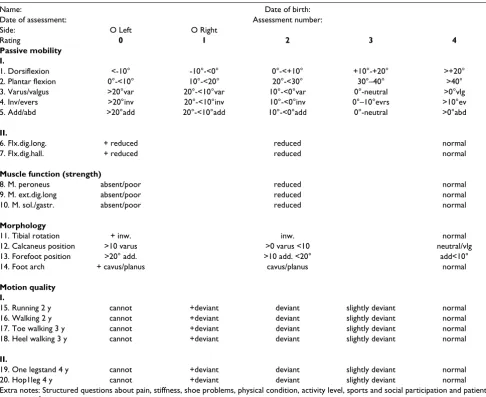
Table 1: The Clubfoot Assessment Protocol (CAP version 1.1).
Name: Date of birth: Date of assessment: Assessment number: Side: O Left O Right
Rating 0 1 2 3 4
Passive mobility I.
1. Dorsiflexion <-10° -10°-<0° 0°-<+10° +10°-+20° >+20° 2. Plantar flexion 0°-<10° 10°-<20° 20°-<30° 30°–40° >40° 3. Varus/valgus >20°var 20°-<10°var 10°-<0°var 0°-neutral >0°vlg 4. Inv/evers >20°inv 20°-<10°inv 10°-<0°inv 0°–10°evrs >10°ev 5. Add/abd >20°add 20°-<10°add 10°-<0°add 0°-neutral >0°abd
II.
6. Flx.dig.long. + reduced reduced normal 7. Flx.dig.hall. + reduced reduced normal
Muscle function (strength)
8. M. peroneus absent/poor reduced normal 9. M. ext.dig.long absent/poor reduced normal 10. M. sol./gastr. absent/poor reduced normal
Morphology
11. Tibial rotation + inw. inw. normal 12. Calcaneus position >10 varus >0 varus <10 neutral/vlg 13. Forefoot position >20° add. >10 add. <20° add<10° 14. Foot arch + cavus/planus cavus/planus normal
Motion quality I.
15. Running 2 y cannot +deviant deviant slightly deviant normal 16. Walking 2 y cannot +deviant deviant slightly deviant normal 17. Toe walking 3 y cannot +deviant deviant slightly deviant normal 18. Heel walking 3 y cannot +deviant deviant slightly deviant normal
II.
19. One legstand 4 y cannot +deviant deviant slightly deviant normal 20. Hop1leg 4 y cannot +deviant deviant slightly deviant normal Extra notes: Structured questions about pain, stiffness, shoe problems, physical condition, activity level, sports and social participation and patient/ parent satisfaction.
+ = Pronounced/very, var = varus, vlg = valgus, inv = inversion, evers = eversion, add = adduction, abd = abduction., inw = inward rotation, flx.dig.long. = length of M. flexor digiti longus, flx.dig.hall. = length of M. flexor digiti hallucis, y = years.
After this study we have slightly revised the protocol. Multi-correlation analyses have shown (unpublished data) that it was possible to exclude two items, tightness and squatting, without decreasing information on the clubfoot child's clinical function. The scale construct for domain motion quality was revised from 4 to 5 levels. Feedback from other clinical users on this part of the instruments showed the need for specifying an extra response item between "cannot "and "deviant" (Table 1).
The concept behind the construct of the CAP was that within orthopaedics firstly the mobility is of major inter-est (i.e. correction of the deformity), secondly, the muscle function for control over the foot which influences its development, thirdly, the exterior of the foot plays an important roll for patient satisfaction and finally, activity which is a combination of mobility, muscle function and neuro-motoric development and of importance for patient satisfaction and participation. Twenty items divided between Body structure (CAP subgroups; mobil-ity I and II, muscle function and morphology) and Activ-ity (CAP subgroup; motion qualActiv-ity) levels according to the International Classification of Function, Disability and Health (ICF) [5] form the CAP. The CAP is intended to be used in clinical practice and research, in short- and long term follow-up during the child's growth. Focus is on item and subgroup level and no total scores are used. Scoring intervals for each item are determined by their expected impact (importance) on activity and clinical decision making and normal variation. Item scoring range from 0–4 (worst to best).
Dimeglio classification scoring system
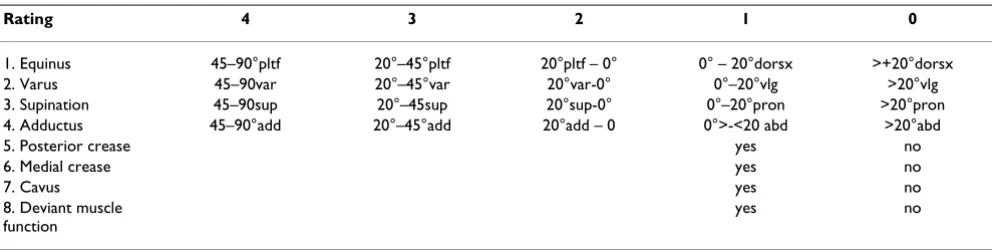
We chose the Dimeglio classification system for compari-son [2] (Table 2) as it is one of the most cited instruments and is used both for classification and in follow-up studies [6-12].
This instrument assesses primarily the mobility of the clubfoot deformity and is comparable with the first 5 items in the subgroup mobility of the CAP. One item con-cerns muscle function.
The Dimeglio classification consists of 8 items. Scorings for 4 items range from 0–4 (best to worst). Four items only score zero or one. Total score ranges between 20-0 (very severe: 16–20, severe 11–15, moderate 6–10, and postural 0–5). Focus is on total score and classification. Good reliability has been shown [2,6,13].
To simplify comparison between these two instruments the raw scores of both instruments were transformed into percentage scores (0–100, worst to best possible score).
The differences between these two instruments are prima-rily that the Dimeglio scoring focuses mostly on mobility. Secondly the width of the scoring ranges is different with the CAP focusing its scoring more to the centre and less to the extremes.
An example of the item derotation/inversion-eversion is given in figure 2.
Validity
Convergent/divergent construct validity
This was determined by assessing the relationship between the CAP and the Dimeglio score in the new-born phase and at 2 years of age. We expected a high correlation (convergent validity) between the CAP mobility I and the Dimeglio score as they mainly measure the same con-struct i.e. mobility. A moderate correlation was expected with the CAP morphology, as we assume that morphol-ogy is influenced by the mobility. Also moderate
correla-tion was expected between CAP motion quality and the
Dimeglio score as mobility is a prerequisite for functional ability. Low correlation was expected with the CAP
mobil-Table 2: Dimeglio classification scoring system
Rating 4 3 2 1 0
1. Equinus 45–90°pltf 20°–45°pltf 20°pltf – 0° 0° – 20°dorsx >+20°dorsx 2. Varus 45–90var 20°–45°var 20°var-0° 0°–20°vlg >20°vlg 3. Supination 45–90sup 20°–45sup 20°sup-0° 0°–20°pron >20°pron 4. Adductus 45–90°add 20°–45°add 20°add – 0 0°>-<20 abd >20°abd 5. Posterior crease yes no 6. Medial crease yes no
7. Cavus yes no
8. Deviant muscle function
yes no
[image:4.612.57.553.99.225.2]ity II and CAP muscle function as muscle testing (length and strength) is a different construct than mobility (diver-gent construct validity).
The Spearman correlation coefficient (rs) for non-para-metric data was used. P < 0.05.
The floor and ceiling effects for the CAP and the Dimeglio score were assessed at two occasions; at baseline/new-born (untreated) and at the age of 2 years (treated).
Discriminant validity
The ability to show variation (that is being sensitive for difference) is one of the aims of the CAP. Score intervals
were chosen less broad in the middle of the CAP mobility
I compared with the Dimeglio scoring system. These two
instruments ability for showing variation was assessed by comparing their ability to differ in severity between the right and left foot in the 13 bilateral clubfeet. The right and left foot were compared at new-born, preoperatively and at two years of age.
Responsiveness (= longitudinal construct validity)
The CAP and the Dimeglio assessments were applied at age new-born (the pre-treatment phase), 1 month, 2 (pre-operative), 4 months (post-operative) and at 2 years of age.
Responsiveness was calculated for both instruments by use of effect size (ES) [14]. Effect size was defined as the mean change scores divided by the standard deviation of the baseline score, which in this case is the score in new-born. Effect sizes of 0.2 are defined as small, 0.5 as medium and 0.8 as large [15].
Finally we assessed if changes had occurred across the whole follow up period with Friedman's tests for change. Thereafter change between a measurement and its preced-ing assessment was assessed by uspreced-ing Wilcoxon's signed rank test and the Friedman's test for change across the whole follow up period. P < 0.05 was considered signifi-cant.
The SPSS 12.00 was used for statistical analyses.
Results
Missing data
Item "M. soleus-gastrocnemius." in CAP muscle function
could be tested properly in less than 40 % of the children. Therefore this item was distracted from this subgroup and omitted from further analysis.
There were 14 CAP subgroup scores missing from a total of 945 assessments (= 1.5 %) at five time points. At one month two scores for morphology were missing. Preoper-atively, two scores were missing for mobility II, four for
morphology and six for muscle function. None were missing for the Dimeglio score (Table 3).
Validity
Convergent/divergent construct validity
The highest correlation was found between the CAP
mobility I and the Dimeglio score (rs = 0.77) (Table 4).
Moderate correlation was seen with the CAP
morphol-ogy. No correlation was found with the CAP motion. (rs =
0.06), the CAP muscle function nor the CAP mobility II
(rs = 0.2 respectively 0.09).
Ceiling and floor effect
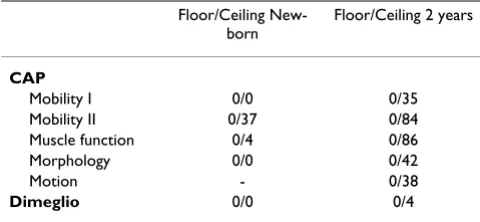
No floor effects were seen for the CAP or for the Dimeglio scoring at the two assessment occasions (Table 5). At
new-Proportion in scoring distribution between the Dimeglio scoring system and the CAP for the item "derotation/eversion" Figure 2
Proportion in scoring distribution between the Dimeglio scoring system and the CAP for the item "derotation/eversion".
CAP
Dimeglio 100%
75 50 25 0 %
0 % 25 50 75 100%
0°°°°
born (untreated clubfeet) 37% ceiling scores were found
for subgroup CAP mobility II and 4 % for CAP muscle
function indicating muscle length and strength within normal variation. At two years of age (treated clubfeet) all CAP subgroups had highly increased ceiling effects rang-ing from 36 to 87%. Subgroup CAPmotion showed at age 2 years a ceiling effect of 38 % indicating that 15 out of 45 feet had walking and running patterns within normal var-iation. The Dimeglios scores showed nearly no ceiling effects at all (4 %).
Discriminant validity
Of the 13 children with bilateral clubfeet, 11 showed dif-ferent scores between the right and left foot when the CAP
mobility I was used, compared to 5/13 when the Dimeg-lios scoring was used. In the preoperative assessment 10/ 13 showed variation for the CAP and 4/13 for the Dimeg-lio. At two years of age this was 4/13 for CAP and 0/13 for the Dimeglio.
Responsiveness
All children except two out of 32 were compliant with the orthosis treatment. All CAP subgroups showed effect sizes varying from medium to high (range 0.60 to 4.35, Table
6). The CAP mobility I and the Dimeglio score showed
generally the highest effects sizes with a slight tendency to higher efficiency of the CAP mobility I which in the later treatment phase is passed by the Dimeglio.
Highest effects sizes were found during the first month of treatment (Table 6). The CAP subgroups showed effect sizes from 0.60 to 2.70. The Dimeglio scoring showed 2.42. Increase of the effect sizes slowed down between one to two months of treatment, increasing strikingly for
the CAP mobility I and Dimeglio score from pre-to
post-operative. Thereafter the feet continued to improve in mobility and muscle function with a clearly higher effect size for the Dimeglio score (4.68) compared with the CAP
mobility I (4.35) at the age of two years. The CAP mobil-ity II and morphology showed lower ES at the age of two
years (0.80 and 1.66 respectively) compared with the age of four month (1.00 and 2.01 respectively) implying dete-rioration.
Both instruments showed significant changes between the scoring occasions except between the pre-and
postopera-tive measurement for the CAP mobility II, muscle
func-tion and morphology and between postoperative to 2 years of age for the CAP mobility I and mobility II (Table 3). From baseline (= newborn) to the age of two years all the CAP subgroups scores and the Dimeglio scoring showed significant (Friedman's test, p < 0.0001) improve-ment.
Discussion
Within the field of clubfoot assessment a countless amount of instruments are available. A search on data-bases (Medline, Libris and Elin) on methodological aspects in clubfoot measurements revealed seven instru-ments on clubfoot with documented reliability studies [16-21]. All of them were developed primarily for classifi-cation except for Roye et al. [20] which is used as a patient based outcome instrument. Content/face validity was based on expert groups deciding a gold standard. No validity studies were found, except for Roye et al. One study, comparing three clubfoot measurements, regarded responsiveness [7] by utilising the Wilcoxon signed rank test.
Furthermore, within paediatric orthopaedics, different measurements on activity and participation levels and methodological sound are now available depending on diagnose and aim of the study [22-24]. For studies on clubfoot these instruments might not be sensitive enough as these children are normally high functioning [19].
[image:6.612.53.560.100.212.2]The results of this study on methodological aspects of a clubfoot assessments instrument shows that the associa-tions between the CAP and the Dimeglio scoring were generally in accordance to the presumptions. Both CAP
Table 3: Mean (SD) in percentage score for the CAP and Dimeglio scores. 0–100 worst to best possible score.
New-born 1 month 2 months, preoperative
4 months, postoperative
Age 2 years
CAP
Mobility I 43.20 (11.83) 75.00 (13.65)** 80.10 (11.30)** 93.44 (4.80)** 94.67 (5.05) Mobility II 73.90 (23.20) 87.80 (17.37)** 93.60 (15.50)* 97.78 (7.20) 92.22 (20.52) Musclefunction 52.80 (20.80) 79.40 (18.70)* 90.38 (18.68)* 91.70 (16.01) 96.70 (8.60)* Morphology 62.40 (16.60) 87.50 (13.40)** 94.81 (6.80)** 95.80 (9.20) 90.00 (10.20)**
Motion 82.80 (18.13)
and the Dimeglio score showed god ability to detect change over time though the CAP showed higher sensitiv-ity for discriminating differences than the Dimeglio score. The distributions of the scores were in accordance with the instruments aim and scale construct. The CAP adds other clinical dimensions on impairment and activity level compared with the Dimeglio score which mainly assesses mobility.
Validity
Convergent and divergent construct validity
The high to moderate correlation between the CAP
sub-groups mobility I and morphology and the Dimeglio
indicates a clear association between these domains. The
correlations seen between the CAP subgroups mobility II
and muscle function were low and indicate that different entities are assessed. The low correlation found between
the CAP motion quality and the Dimeglio was not
expected. As the CAP mobility I correlated so well with
the Dimeglio score we checked the correlation of the Dimeglio score with the CAP domain motion quality and found a highly significant moderate correlation (0.41, p = 0.01). It seems that the scale construct of the CAP mobil-ity I give assessments that correlates better with the activ-ity levels of the clubfoot child than the Dimeglio score.
Ceiling and floor-effect
Normally, the high ceiling effects seen in the treated group with the CAP would be found to be a negative factor in measurements as these effects make it impossible to meas-ure improvement. The scoring construct of the CAP though concentrates on smaller intervals in the middle of the scale, where changes are of most clinical importance. The CAP is not intended to measure changes above nor-mal or below extreme abnornor-mal.
In the untreated group of clubfeet children both instru-ments showed no floor effects in this population. Moder-ate ceiling effects where found for CAP mobility II (37%) which indicates that about 60% of the children have prob-lems with this item, which is of clinical importance. In the follow-up, at two years of age most of the children should
have reached a functional level within normal variation. As the CAP has its anchor points within normal variation and the Dimeglio score has its anchors on more extreme levels (e.g. forefoot abduction > 20° or valgus >20°), the CAP will sooner reach its ceiling levels. Furthermore with usage of only three scoring levels such as in domain CAP
muscle function, there is less room for discrimination which gives higher ceiling- or floor effects.
We conclude that both the CAP and the Dimeglio floor and ceiling effects are in accordance with the concept and construct of the instruments.
Disciminant validity
As a result of different scaling intervals and distribution of scores, the use of different instruments can result in differ-ent conclusions. This can be seen in the differdiffer-ent abilities of these two instruments sensitivity when both instru-ments assess the same patient group. Our clinical experi-ence is that children with bilateral clubfeet most often have a difference in severity between left-right. The results of this study shows that if we used the Dimeglio score we would have concluded that most children with bilateral clubfeet had similar severity. The CAP mobility I though showed that out of 13 children with bilateral clubfeet 11 showed different scores between left-right. In this case one can conclude that the commonly seen differences in sever-ity in bilateral clubfeet can be assessed and both feet can thus be included in clubfeet studies.
Responsiveness
The result on responsiveness showed for both instruments large effects sizes. The effect sizes of the CAP domains should not be compared with each other as they assess dif-ferent entities.
The CAP mobility I shows higher effect size compared
with the Dimeglio when the feet are still clinically in a worse state. This is maintained until the postoperative phase where the Dimeglio effect size increases between 4
[image:7.612.55.294.111.203.2]month and age 2 years compared with the CAP mobility
Table 5: Ceiling and floor effects in percentage of patients assessed with the CAP and the Dimeglio instrument at two treatment phases, untreated and treated clubfeet. N = 45
Floor/Ceiling New-born
Floor/Ceiling 2 years
CAP
Mobility I 0/0 0/35 Mobility II 0/37 0/84 Muscle function 0/4 0/86 Morphology 0/0 0/42 Motion - 0/38
[image:7.612.313.553.120.231.2]Dimeglio 0/0 0/4
Table 4: Convergent and Divergent Construct Validity. The Spearman's correlation coefficient (rs) was used. N = 45.
I (with1.10 to 4.68 and 0.26 to 4.35, respectively). This is caused by the fact that the best possible score is reached
earlier with the CAP mobility I than the Dimeglio.
Fur-thermore both instruments contain slight different items such as plantar flexion for the CAP mobility I and integra-tion of muscle funcintegra-tion in the Dimeglio score, increasing or decreasing the subgroup score.
We tried to compare our study with Lehman et al. [7] which showed to be problematic as baseline groups differ in both severity and age and treatment programs were not totally comparable.
The effect sizes for the CAP subgroups mobility II, muscle function and morphology ranged from medium (0.60) to very large (2.1), increasing with time during treatment the first 4 months. In phase two of treatment (maintain-ing correction) muscle function continues to develop though the length of the toe flexors and morphology seem to decrease.
It is interesting that these CAP subgroups show changes over time providing new information from different dimensions. This will enable us to gain more specific information and make outcome evaluation on different levels possible. For example we can, by looking at the development of the subgroup muscle function, conclude that once the feet have increased mobility, muscle func-tion slowly improves. Subgroup morphology shows a decrease at the age of two years. We analysed the results on item level which showed that decreased scoring of the item tibia rotation was the main cause. This is an example of the effects of aggregating information into a single total score. We notice a decrease, but cannot distinguish the cause, as the other items in this subgroup regard other problems which are not associated with tibia rotation even though they belong to this subgroup. This could be an effect of low item-internal consistency for this domain (calculated by Crohnbachs alfa and normally used in test-ing reliability in patient based questionnaires [25]). That is why it is also important to observe how the individual
items develop. The same accounts for studies on group or individual level.
Even though the instruments show good responsiveness on group level through statistically detectable change it is more and more emphasised to study responsiveness in relation to the patient/parents perceived clinical impor-tant change [26,27]. Future studies will therefore be needed.
Methodological issues
In this material none of the children's clubfeet were assessed as extremely severe which would probably have resulted in a higher differentiating ability with the Dimeg-lio score.
Item "M. soleus-gastrocnemius" seems to be difficult to assess properly in this young age group as co-operation and understanding the meaning of the test is low. We sug-gest that this item should not be expected to be assessed before the age of four years.
We had problems to find a methodological soundly developed clubfoot instrument to compare our newly developed Clubfoot Assessment Protocol (CAP) with. The Dimeglio scoring system seemed to be the best alternative. When we started this study the Outcome Evaluation in Clubfoot [28] generated by Bensahel et al. and the Inter-national Clubfoot Study Group (ICSG) and now advo-cated as one of the instruments to be used for outcome measures was not available. The construct of the ICSG-instrument has some similarities with the CAP and in future it will be interesting to see more studies on these instruments validity, sensitivity and responsiveness.
Conclusion
The Clubfoot Assessment Protocol with its different sub-groups shows in this study good validity and responsive-ness. The CAP is more responsive regarding severity in the moderate to severe range, while the Dimeglio focuses more on the extremes. The ability to discriminate between different mobility status of the right and left foot in
bilat-Table 6: Effect Size from baseline to 1 month, 2 month, 4 month and 2 years of treatment for all clubfeet (n = 45), starting treatment within 8 days after birth.
Effect Size 1 month Effect Size 2 months, preoperative
Effect Size 4 month, postoperative
Effect Size, 2 years
CAP
Mobility I 2.70 3.2 4.21 4.35 Mobility II 0.60 0.80 1.00 0.80 Musclefunction 1.28 1.60 1.87 2.1 Morphology 1.55 1.84 2.01 1.66
[image:8.612.56.556.110.220.2]Publish with BioMed Central and every scientist can read your work free of charge
"BioMed Central will be the most significant development for disseminating the results of biomedical researc h in our lifetime."
Sir Paul Nurse, Cancer Research UK
Your research papers will be:
available free of charge to the entire biomedical community
peer reviewed and published immediately upon acceptance
cited in PubMed and archived on PubMed Central
yours — you keep the copyright
Submit your manuscript here:
http://www.biomedcentral.com/info/publishing_adv.asp
BioMedcentral
erally affected children in this population was higher compared to the Dimeglio score. The CAP provides infor-mation on the development of different functional domains within clubfoot diagnosis. As validation and development of an instrument is a complicated procedure more studies will be needed to fully establish the use of the Clubfoot Assessment Protocol.
Competing interests
The author(s) declare that they have no competing inter-ests.
Authors' contributions
HA and GH designed and collected the data. HA and EMR analysed, interpreted and revised the data and manu-script. HA drafted the manumanu-script. GH and G-BJ revised the manuscript.
Acknowledgements
This study was supported by Lunds University Hospital, Skåne Region in the county of Skåne, Sweden.
Special thanks to Per-Erik Isberg at the Department of Statistics, Lund Uni-versity, for statistical advice.
References
1. Andriesse H, Hägglund G, Jarnlo GB: The Clubfoot Assessment Protocol (CAP) ; description and reliability of a structured multi-level instrument for follow-up. BMC Musculoskeletal Disor-ders 2005, 6:40.
2. Dimeglio A, Bensahel H, Souchet P, Mazeau P, Bonnet F: Classifica-tion of clubfoot. J Pediatr Orthop 1995, 4:129-36.
3. Reimann I: Congenital Idiopathic Clubfoot Copenhagen: University of Copenhagen; 1962.
4. Ponseti IV: Congenital clubfoot Oxford University Press; 1996. 5. World Health Organization: Classification, Assessment, Surveys
and Terminology Team. ICIDH. Geneva Switserland. Prefinal draft
2000. Fullversion
6. Dobbs MB, Rudzki JR, Purcell DB, Walton T, Porter KR, Gurnett CA:
Factors predictive of outcome after use of the Ponseti method for the treatment of idiopattic clubfeet. J Bone Joint Surg Am 2004, 86-A(1):22-7.
7. Lehman WB, Mohaideen A, Madan S, Scher DM, Van Bosse HJ, Ianna-cone M, Bazzi JS, Feldman DS: A method for the early evaluation of the Ponseti (Iowa) technique for the treatment of idio-pathic clubfoot. J Pediatr Orthop B 2003, 12(2):133-40.
8. Macnicol MF, Nadeem RD, Forness M: Functional results of surgi-cal treatment in congenital talipes equinovarus (clubfoot): a comparison of outcome measurements. J Pediatri Orthop B
2000, 9(4):285-92.
9. Scher DM, Feldman DS, Van Bosse HJ, Sala DA, Lehman WB: Pre-dicting the need for tenotomy in the Ponseti method for cor-rection of clubfeet. J Pediatr Orthop 2004, 24(4):349-52. 10. Souchet P, Bensahel H, Theman-Noel C, Pennecot G, Gsukonyi Z:
Functional treatment of clubfoot: a new series of 350 idio-pathic clubfeet with longterm follow-up. J Pediatric Orthop B
2004, 13(3):189-96.
11. Thacker MM, Scher DM, Sala DA, Van Bosse HJ, Feldman DS, Lehman WB: Use of the foot abduction orthosis following Ponseti casts: is it essential? J Pediatr Orthop 2005, 25(2):225-8. 12. Van Mulken JM, Bulstra SK, Hoefnagels NH: Evaluation of the
treatment of clubfeet with the Dimeglio score. J Pediatr Orthop
2001, 21(5):642-7.
13. Flynn JM, Donoho M, Mackenzie WG: An independent assess-ment of two clubfoot-classification systems. J Pediatr Orthop
1998, 18:323-27.
14. Kazis LE, Anderson JJ: Effects sizes for interpreting changes in health status. Med Care 1989, 27(3):178-89.
15. Cohen J: Statistical power analysis for the behavioral sciences 2nd edition. Hillsdale, NJ: Lawrence Earlbaum Associates; 1988.
16. Roye BD, Vitale MG, Gelijns AC, Roye DP Jr: Patient- based out-comes after clubfoot surgery. J Pediatric Orthop 2001, 21:42-49. 17. Flynn JM, Donohoe M, Mackenzie WG: An independent
assess-ment of two clubfoot – classification systems. J Pediatr Ortop
1998, 18:323-27.
18. Wainwright AM, Auld T, Benson MK, Theologis TN: The classifica-tion of congenital talipes equinovarus. J Bone Joint Surg (Br) 2002,
84-B:1020-4.
19. Pirani S, Outerbridge H, Moran M, Sawatsky BJ: A method of eval-uating the virgin clubfoot with substantial inter-observer reliability. In POSNAVolume 71. Miami, Florida; 1995:99. 20. Roye BD, Vitale MG, Gelijns AC, Roye DP Jr: Patient- based
out-comes after clubfoot surgery. J Pediatric Orthop 2001, 21:42-49. 21. Celebi L, Muratli HH, Aksahin E, Yagmurlu MF, Bicimoglu A:
Bensa-hel et al. and International Clubfoot Study Group evaluation of treated clubfoot: assessment of interobserver and intraobserver reliability. J Pediatr Orthop B 2006, 15:34-36. 22. Daltroy LH, Liang MH, Fossel AH, Goldberg MJ: The POSNA
pedi-atric musculoskeletal functional health questionnaire: report on reliability, validity and sensitivity to change. J Pedi-atr Orthop 1998, 18:561-571.
23. Plint AC, Caboury I, Owen J, Young NL: Activities Scale for Kids, an analysis of normals. J Pediatr Orthop 2003, 23:788-790. 24. Young NL, Williams JI, Yoshida KK, Wright JG: Measurement
properties of the Activities Scale for Kids. J Clin Epidemiol 2000,
53:125-137.
25. Crohnbach L: Coefficient alpha and the internal structure of tests. Psychometrica 1951, 16:297-334.
26. Schmitt SS, Di Fabio RP: Reliable change and minimum impor-tant difference (MID) proportions facilitated group respon-siveness comparisons using individual threshold criteria. J Clin Epidemiol 2004, 57:1008-18.
27. Liang MH: Longitudinal Construct Validity. Establishment of clinical meaning in patient evaluative instruments. Med Care
2000, 38(9, suppl II):84-90.
28. Bensahel H, Kuo K, Duhaime M: The international Clubfoot Study Group. Outcome evaluation of the treatment of club-foot: the international language of clubfoot. J Pediatr Orthop B
2003, 12:269-271.
Pre-publication history
The pre-publication history for this paper can be accessed here: