R E S E A R C H
Open Access
Proofs to two inequality conjectures for a
point on the plane of a triangle
Fangjian Huang
**Correspondence:
[email protected] School of Energy Science and Engineering, University of Electronic Science and Technology of China, No. 2006 Xiyuan Ave., Chengdu, P.R. China
Abstract
We prove two conjectures for a point on the plane of a triangle presented in (Liu in J. Math. Inequal. 8(3):597-611, 2014, doi:10.1007/s11590-013-0708-4) by using the successive difference substitution algorithm NEWTSDS. Compared with the original proof, the new one is simpler and more easily understood. Similar problems can be treated with the same procedure.
MSC: 51M16; 12-04
Keywords: geometry inequality; successive difference substitution; automated reasoning
1 Introduction
Liu [] put forward four conjectures for a point on the plane of a triangle. For Conjectures and in its last part, we conclude that they are correct. We prove them with the help of a successive difference substitution algorithm called NEWTSDS [].
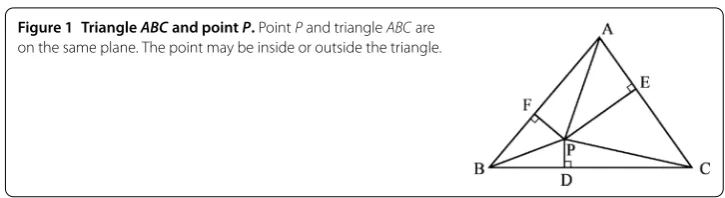
As showed in Figure ,Pis a point on the plane of a triangleABC, which means thatP
is not limited only inside the triangle. Let (x,y,z) be the barycentric coordinates ofPwith respect to the triangleABC. LetD,E,Fbe the foots of the perpendicular to the three sides
BC,CA,ABofABCfromP, respectively. As in [], leta,b,c,R,R,R,r,r,rindicate the lengths ofBC,CA,AB,PA,PB,PC,PD,PE,PF, respectively.
Conjectures and in [] state that
R
–r–r (b+c) +
R
–r–r (c+a) +
R
–r–r (a+b) ≥
()
and
R
+R–r–r (b+c) +
R
+R–r–r (c+a) +
R
+R–r–r (a+b) ≥
. ()
These two inequalities can be considered as some kind of promotion of the famous Erdös-Mordell inequality [], which states some relationship between a point and a tri-angle on the same plane. Mathematicians have presented different proofs, such as [–], to the original Erdös-Mordell inequality and some generalizations [, ].
The rest of this paper is arranged as follows. In Section , a well-known equivalent con-dition of the nonnegativity of quadratics is recalled, and a computer aided reasoning tool,
Figure 1 TriangleABCand pointP.PointPand triangleABCare on the same plane. The point may be inside or outside the triangle.
the algorithm called NEWTSDS based on the successive difference substitution method, is introduced. The proofs to the two conjectures are discoursed in Section . The proofs also show that the algorithm NEWTSDS saves us a lot of effort to avoid tedious calculation, so that we can concentrate on the mainline of the process.
2 Proving tools
In this section, the symbols are not specified, which means that they do not denote any-thing as in the first section. For any quadraticf(x) =ax+bx+cwitha,b,c,x∈R(real field), we have
∀x∈R, f(x)≥ ⇔ a≥∧c≥∧ac–b≥. ()
Based on the original successive difference substitution method [] and its sequels [], in [] the algorithm called NEWTSDS is presented, which uses the barycentric matrices obtained by performing elementary row interchanges on the matrix
Tn= ⎡ ⎢ ⎢ ⎢ ⎢ ⎢ ⎣
· · · n
. .. ... ..
. . .. ... n · · · n
⎤ ⎥ ⎥ ⎥ ⎥ ⎥ ⎦
n×n
as the substitution matrices. It is a complete tool for the decision of the nonnegativity of polynomials. We use it during the proving process. This is a practical and most efficient method we can perform till now.
3 Main result: proofs to the two conjectures
In this section, all the symbols have the same meanings as in Section . Since the barycen-tric coordinates are a form of homogeneous coordinates, without loss of generality, we can restrict (x,y,z) with the condition
x+y+z= . ()
There are some other needed substitution equations, which are well known and just listed here without proofs:
R= bz+cy
–ayz–bxz–cxy, ()
R= az+cx
R= ya+xb
–ayz–bxz–cxy, ()
r=
axS, r=
ySb , r=
zSc , ()
S=s(s–a)(s–b)(s–c), ()
a=u+v, b=v+w, c=w+u. ()
In (),Sandsdenote the area and the half of the perimeter ofABC, respectively. In (),
u,v,ware general nonnegative real numbers.
Letfandfdenote the differences between the left and right sides of () and (), respec-tively:
f= R
–r–r (b+c) +
R
–r–r (c+a) +
R
–r–r (a+b) –
, ()
f=
R+R–r–r
(b+c) +
R+R–r–r
(c+a) +
R+R–r–r
(a+b) –
. ()
Obviously, the correctness of () and () is equivalent to the positive semi-definiteness of () and (), respectively.
Substituting ()-() into () and () and removing the nonnegative denominator, we get the equivalent polynomialsfnandfnofu,v,w,x,y:
fn=gx+gx+g, fn=hx+hx+h,
whereg,h are polynomials ofu,v,w, andgi,hi(i= , ) are polynomials ofu,v,w,y.
This means the positive semi-definiteness offandfis equivalent to the positive semi-definiteness offnandfn, respectively, whenu,v,w≥. For better performance, we write
all the long equations in Section .
Remark The barycentric coordinate system is a widely used tool, which transforms ge-ometric problems to algebraic ones for which lots of computer-aided solvers are available. As shown in the following steps, we can focus ourselves on the main line of proofs and employ some automated reasoning package to deal with the less important branches.
According to condition (), whenx,y∈Randu,v,w≥,fn,fnare both nonnegative if
and only ifg,h,g,h,= gg–gand= hh–hare all nonnegative.
From the expressions it is easy to find thatg=h and they are both nonnegative. In the following two subsections, we discourse the nonnegativity ofg,h,, andwhen
y∈R,u,v,w≥.
3.1 Nonnegativity ofg3andh3
Sincegandhare both quadratics ofy, we can rewrite them as follows:
g= (u+v) gy+gy+g
, ()
h= (u+v) hy+hy+h
From the expressions we find thath=g,g, andhare all nonnegative. Denote
δg= gg–g = (w+u)(v+w)(v+ u+w)(u+w+ v)δg,
δh= hh–h= (w+u)(v+w)δh.
Following the NEWTSDS algorithm, we can get the positive semi-definiteness ofδgand δhby iterating four loops and five loops, respectively. Hence, we get the nonnegativity of
gandhaccording to ().
Remark We can perform the substitution procedure based on the successive difference substitution method by computer. For ternary forms, in every loop, the number of sub-stitutions is at most ! = to the power of the ordinal of the current loop, which means at most nsubstitution steps are needed for thenth loop. Actually, many examples show
that fewer substitutions are needed. Bounds on the number of steps of substitutions for algorithms based on the successive difference substitution method are presented in [, ]. The TSDS package for the Maple platform developed by L Yang and Y Yao is avail-able at http://staff.uestc.edu.cn/huangfangjian/?page_id=. We can use it to check the nonnegativity of polynomials or get a counterpoint when it does not hold.
3.2 Nonnegativity of
1and
2
Sinceandare quadratics ofytoo, we can perform similar operations as before. First, factor and rewriteandas follows:
= (v+u)(w+u)(v+w) ϕy+ϕy+ϕ
,
= (v+u)(w+u)(v+w) ψy+ψy+ψ
.
Then by simple calculation we have
ϕ= uvw(w+v+u)ϕ,
ϕ= wvu(v+w)(v+w+u)(v+u+ w)(u+w+ v)ϕ,
ϕ= (v+w)(v+u+ w)(u+w+ v)ϕ,
ψ=ϕ,
ψ= wvu(v+w)(v+w+u)ψ,
ψ= (v+w)ψ.
From the expression ofϕwe find that all the coefficients are positive. Then we have the nonnegativity of ϕ and ψ. Using NEWTSDS, we can obtain the positive semi-definiteness ofϕ andψ by iterating four and five loops, respectively. Following this, we acquire the nonnegativity ofϕandψ. Denote
δϕ= ϕϕ–ϕ,
Computation shows that
δϕ=δψ
= vuw(v+w)(u+w+ v)(u+v+w)
·(u+v+ w)(u+w+v)δϕδϕ.
Only one loop of NEWTSDS is needed forδϕ to check its nonnegativity. From the ex-pression it is easy to find thatδϕis positive semi-definite because all the coefficients of δϕwith respect touare positive semi-definite. So we have the nonnegativity ofδϕandδψ.
According to condition (),andare both nonnegative becauseϕ,ϕ,δϕ,ψ,ψ,δψ
are all nonnegative.
So, the nonnegativity of allg,g,h,h,, andis achieved. This, we obtain the pos-itive semi-definiteness offnandfnbased on the equivalence (). Equivalently, we acquire
the nonnegativity offandf. Furthermore, we finish the proofs of conjectures () and ().
4 Conclusions
In this paper, two interesting conjectures are proved. These two inequalities are about a point and a triangle on the same plane. They describe some relationships between the lengths of three sides of the triangle, the distances from the point to the three vertices and to the three sides of the triangle. The whole procedure is achieved by using the traditional analytical method and some computer-aided tool. First, we transform these two geometric problems into algebraic ones by using the barycentric coordinate system. After analyzing
fnandfnas general polynomials ofx, we find their equivalent problems, the nonnegativity
ofg,g,h,h,, and. Actually, this is a process of reducing indeterminate. Repeating this process to eliminatey, we get some polynomials of three variablesu,v,w. After that, NEWTSDS is employed to check their positive semi-definiteness, and then we finish the proofs of the conjectures. We can solve some other problems in a similar way just using an analytical method to control the main line and leave branches to the computer. It is easy to read and easy to reproduce.
5 Summarization of long expressions
We summarize all the explicit expressions that are too long to be listed in the main body:
g= (v+w)
v+ w+ (v–w)u+ v+ vw+ vw
+ wu+ v+ vw+ vw+ vw+ wu
+ vw+ v+ vw+ vw+ w+ vwu
+ v+ vw+ vw+ ,vw+ ,vw+ vw
+ wu+ v+ vw+ vw+ ,vw+ ,vw
+ vw+ vw+ wu+ v+ vw+ vw+ ,vw
+ ,vw+ ,vw+ vw+ vw+ wu+ vw+ vw
+ vw+ vw+ vw+ vw+ vw+ vwu+ vw
g= (v+w)(v+u)
(v– w)u+ v– w+ vwu+ v
+ vw– w– vwu+ wv+ wv– w– wv
+ vu+ vw– w– vw+ vw+ vw+ vu
+ wv– w+ v+ wv+ vw– vw+ wvu
+ vw– w+ vw+ vw+ vw+ vw+ vwu
+ vw+ vw+ vw+ vw+ vw+ vwy– uvw
–uw+ uw– uw–uw+uw+ vw+w+ uwv+ uwv
+ uwv+ wv+ wv+ uv+ uv+ uv+ wv+ uwv
+vu+ uwv+ uwv+ uwv+ uwv(u+w+ v), ()
g= (v+u) gy+gy+g
, ()
g= u+v
+ (u–v)w+ (u+v) u+v+ (u–v)w
+ ,u+ ,vu+ ,vu+ ,vu+ ,vw
+ (u+v) u+ vu+ vu+ vu+ vw+ ,u
+ ,vu+ ,vu+ ,vu+ ,vu+ ,vu+ ,vw
+ (u+v) u+ vu+ vu+ vu+ vu+ vu
+ vw+ u+ ,vu+ ,vu+ ,vu+ ,vu
+ ,vu+ vu+ vu+ vw
+ vu(u+v) u+ vu+ vu+ vu+ vu+ vu+vw
+ vu v+ vu+ vu+ vu+ u(u+v), ()
g= –(v+w)(u+w+ v)
w+ uv+ (w+u)w+ uv
+ uw+ w+ u+ uw+ uwv+ (w+u) w+ uw
+ uw+ uw+ uv+u(u–w) u+uw+w(w+u), ()
g= (v+w)(u+w+ v)
w+ u+ (u–w)v+ w
+u+ (u–w)(w+u)v+ w+ u+ uw+ uw
+ uwv+ (w+u) w+ uw+ uw+ uw+ uv
+ u+ uw+ uw+ uw+ w(w+u), ()
h=g,
h= (v+w)(u+v)
(v– w)u+ –w+ v+ wvu
+ –vw– w+ vw+ vu+ vw+ vw
– vw+ v– wu+ vw+ vw– vw+ v
– w+ vwu+ vw+ vw– w– vw+ vw
+ v+ vwu+ vw+ vw+ vw+ vw+ vw
+ vwy+ (w–v)u+ w– v– wvu+ w– vw
– v– vwu+ –vw+ w– vw– vw– vu
– vw+ vw+ v+ vw+ vw+ wu
+ vw– v– vw– vw– vw– w– vwu
+w(w+v)–w– vw– vw– vw– vw+ vu
–w(w+ v) w+ vw+ vw+ v(w+v), ()
h= (u+v) hy+hy+h
, ()
h=g,
h= –(v+w)
u+ w– uwv+ (w+u)w– uw
+ uv+ w+ u+ uw+ uw+ uwv
+ w+ uw+ uw+ uw+ u(w+u)v+ u
+ uw+ uw+ uw+ w(w+u)v+ u+ uw
+ uw+ uw– uw+ w(w+u)v+u(–w+u) w
+ uw+ uw+ uw+ u(w+u), ()
h= (v+w)( w+u
+ (u–w)v
+ (w+u) w+u+ (u–w)v
+ w+u+ u–w+ uw u+wv
+ (w+u) w+u+ u–w+ uw u+wv
+ u+ uw+ uw+ uw+ w(w+u)v
+ u+ uw+ uw+ uw+ w(w+u)v+ u+ uw
+ uw+ uw+ uw+ uw+ w(w+u)), ()
δg= w+ v– vw
u+ v+ w+ wv– vwu
+ v+ w– vw– vw+ vwu+ v
+ w– vw+ ,vw+ ,vw– vwu
+ v+ w+ ,vw– ,vw+ ,vw+ ,vw
– ,vwu+ v+ w+ ,vw+ ,vw
+ ,vw+ ,vw– ,vw– ,vwu+ v
+ w+ ,vw– ,vw+ ,vw
+ ,vw– vw+ ,vw+ ,vwu+ w
+ ,vw+ ,vw– vw+ v+ ,vw+ ,vw
+ ,vw– vw+ ,vwu+ w+ v+ wv
+ ,vw+ ,vwu– vw(w+v)(w+v) –w– vw
– vw– vw– vw– vw– vw+ vu
+vw w+ vw+ vw+ vw+ v(w+v)(w+v), ()
δh= w+ u– wu
v+ ,w+ ,u– ,wu– ,wuv
+ ,w+ ,u– ,wu– ,wu+ ,wuv+ ,w
+ ,u– ,wu+ ,wu+ ,wu– ,wuv
+ ,w+ ,u+ ,wu– ,wu+ ,wu
+ ,wu– ,wuv+ ,u+ ,w– ,wu
– ,wu+ ,wu– ,wu+ ,wu+ ,wuv
+ ,u+ ,w+ ,wu– ,wu– ,wu
+ ,wu+ ,wu– ,wu+ ,wuv+ ,u
+ ,w+ ,wu– ,wu+ ,wu– ,,wu
+ ,wu+ ,,wu– ,,wu+ ,,wuv
+ ,u+ ,w+ ,wu+ ,,wu– ,wu
+ ,wu– ,,wu+ ,,wu– ,,wu
+ ,,wu+ ,wuv+ (w+u) ,w+ ,wu
+ ,wu+ ,wu+ ,wu+ ,wu– ,wu
– ,wu– ,wu+ ,wu+ ,uv
+ (w+u)v ,u– ,wu– ,wu– ,wu
– ,wu+ ,wu+ ,,wu+ ,,wu
+ ,wu+ ,wu+ ,w+ (w+u)v ,u– ,wu
– ,wu– ,wu+ ,wu+ ,wu+ ,wu
+ ,wu+ ,wu+ ,wu+ ,wu+ ,w
+ w+ u+ ,wu+ ,wu+ ,wu
– ,wu+ ,wu+ ,wu+ ,wu+ ,wu
– ,wu– ,wu+ ,wu(w+u)v
– wuv(w+u) u+ wu– ,wu– ,wu– ,wu
– ,wu– ,wu– ,wu– ,wu
– ,wu– w+wu u+ ,wu+ ,wu+ ,wu
+ ,wu+ ,wu+ ,wu+ ,wu+ w(w+u), ()
ϕ= v+ (w+ u)v+ ,uw+ ,w+ ,u
v
+ (u+w) ,u+ ,uw+ ,wv+ ,uw+ ,uw
+ ,uw+ ,uw+ ,wv+ ,w+ ,u+ ,uw
+ ,uw+ ,uw+ ,uw+ ,uwv
+ (u+w) ,u+ ,uw+ ,uw+ ,uw+ ,uw
+ ,uw+ ,wv+ ,uw+ ,uw+ ,uw
+ ,uw+ ,uw+ ,uw+ ,uw+ ,u
+ ,wv+ (u+w) u+ ,uw+ ,uw+ ,uw
+ ,uw+ ,uw+ ,uw+ ,uw+ wv
+ w+ uw+ ,uw+ ,uw+ ,uw
+ ,uw+ ,uw+ uw+ u(u+w), ()
ϕ= (w–u)v+ w– u– uw
v+ w– u– uw– uwv
+ w– u– uw– uw– uwv+ –u– uw
– uw– uw– uw+ wv+ w– u– uw
– uw– uw– uw– uwv+ w– u– uw
– uw– uw– uw– uw– uwv
–u(w+u)w+ uw+ uw+ uw+u(w+ u), ()
ϕ= u– uw+ w
v+ uw– uw+ w+ uv
+ uw– uw+ u+ w– uwv+ –uw+ ,uw
+ ,uw– uw+ w+ uv+ ,uw– ,uw
– ,uw+ ,uw+ ,uw+ w+ uv
+ ,uw+ ,uw+ ,uw+ ,uw– ,uw
– ,uw+ w+ uv+ ,uw+ ,uw
+ ,uw+ ,uw– ,uw– uw
+ ,uw+ u+ wv+ w+ ,uw+ ,uw
+ ,uw+ ,uw+ ,uw– uw+ ,uw
– uw+ uv+ w+ ,uw+ ,uw+ ,uw
+ ,uw+ ,uw+ uw+ ,uw– uw
+ u– wuv+ uw(w+ u)(w+u)–w+ uw+ uw
+ uw+ uw+ uw+ uw+ uv
+uw w+ uw+ uw+ uw+ u(w+u)(w+ u), ()
ψ= (w– u)v+ –u+ w+ uw
v+ ,w– ,u
– ,uw+ ,uwv+ ,uw– ,u+ ,w– ,uw
– ,uwv+ ,w+ ,uw– ,uw– ,uw
– ,uw– ,uw– ,uw+ ,uwv
+ ,w– ,u+ ,uw– ,uw
– ,uw– ,uw– ,uw+ ,uwv
+ –,u+ ,w– ,uw+ ,uw
– ,uw– ,uw– ,uw
– ,uw+ ,uwv– (w+u)–,w– ,uw– ,uw
+ ,uw+ ,uw+ ,uw+ ,uw
+ ,uw+ ,uv– ,u+ ,uw+ ,uw
+ ,uw+ ,uw+ ,uw+ ,uw
– ,uw– w(w+u)v– u+ ,uw+ ,uw
+ ,uw+ ,uw+ ,uw+ ,uw
+ ,uw+ uw– w(w+u)v–u w+uw+u w+ uw
+ uw+ ,uw+ uw+ uw+ u(w+u), ()
ψ= –wu+ w+ u
v+ ,w+ ,u– ,wu
– ,wuv+ ,w– ,wu+ ,u– ,wu
+ ,wuv+ ,w+ ,wu– ,wu– ,wu
+ ,wu+ ,uv+ ,w+ ,wu– ,wu
– ,wu+ ,wu+ ,wu+ ,uv
+ ,u+ ,w– ,wu+ ,wu
– ,wu+ ,wu– ,wu+ ,wuv+ ,u
– ,wu+ ,wu+ ,wu+ ,wu– ,wu
– ,wu+ ,w+ ,wuv+ ,u
+ ,wu+ ,wu– ,wu+ ,,wu
– ,,wu– ,,wu+ ,w+ ,,wu
+ ,wuv+ ,,wu– ,,wu+ ,,wu
– ,,wu+ ,wu+ ,wu+ ,u+ ,w
– ,wu+ ,,wu+ ,wuv
+ (w+u),w+ ,wu– ,wu– ,wu
– ,wu+ ,wu+ ,wu+ ,wu
+ ,wu+ ,wu+ ,uv+ ,u+ ,wu
+ ,wu+ ,,wu+ ,,wu+ ,wu
– ,wu– ,wu– ,wu– ,wu
+ ,wu+ ,wu+ ,wu+ ,wu
+ ,wu– ,wu– ,wu– ,wu+ ,w(w+u)v
+ ,wu+ w+ u– ,wu+ ,wu+ ,wu
– ,wu+ ,wu+ ,wu– ,wu
+ ,wu+ ,wu+ ,wu(w+u)v
+ (w+u)vwu u+ ,wu+ ,wu+ ,wu+ ,wu
+ ,wu+ ,wu+ ,wu+ ,wu– wu– w
+wu u+ ,wu+ ,wu+ ,wu+ ,wu+ ,wu
+ ,wu+ ,wu+ w(w+u), ()
δϕ= w+ (u+ v)w+ u+ v– vu
w
+ (u+v) u– vu+ vw+ u– vu– vu
– vu+ vw+ (u+v) u– vu+ vu– vu+ vw
+ u+ vu+ vu+ vu– vu– vu+ vw
+ (u+v) u– vu+ vu– vu+ vu– vu+ vw
+ –vu+ vu+ vu– vu+ vu– vu
– vu+ u+ vw+ (u+v)u– vu– vu– vu
+ vu– vu– vu– vu+ vw+ v+ vu+ vu+ vu
+ vu+ vu+ vu+ vu+ u(u+v), ()
δϕ= v+w
+ (w–v)u+ (w+v) v+w+ (w–v)u
+ w+ v+ vw+ vw+ vwu
+ (w+v) w+ vw+ vw+ vw+ vu
+ w+ v+ ,vw+ ,vw+ ,vw+ vw+ vwu
+ (w+v) w+ vw+ vw+ vw+ vw+ vw+ vu
+ v+ w+ vw+ vw+ ,vw+ ,vw+ ,vw
+ vw+ vwu+ vw(w+v) w+ vw+ vw+ vw
+ vw+ vw+vu+vw v+ vw+ vw
+ vw+ w(w+v). ()
Competing interests
The author declares that he does not have any commercial or associative interest that represents a conflict of interests in connection with the work submitted.
Acknowledgements
The research is partially supported by the National Science Foundation of China, China (Grant No. 61374001) and the Fundamental Research Funds for the Central Universities, University of Electronic Science and Technology of China (Grant No. ZYGX2013J116).
References
1. Liu, J: A new inequality for a point in the plane of a triangle. J. Math. Inequal.8(3), 597-611 (2014). doi:10.7153/jmi-08-44
2. Yao, Y: Infinite product convergence of column stochastic mean matrix and machine decision for positive semi-definite forms. Sci. Sin., Math.53(3), 251-264 (2010) (in Chinese), also see arXiv:0904.4030v3 for English version 3. Erdös, P: Problem 3740. Am. Math. Mon.42(6), 396 (1935). doi:10.2307/2301373
4. Mordell, LJ: Solution to problem 3740. Am. Math. Mon.44(4), 252-254 (1937). doi:10.2307/2300713 5. Kazarinoff, DK: A simple proof of the Erdös-Mordell inequality for triangles. Mich. Math. J.4(2), 97-98 (1957).
doi:10.1307/mmj/1028988998
6. Dergiades, N: Signed distances and the Erdös-Mordell inequality. Forum Geom.4, 67-68 (2004)
7. Pambuccian, V: The Erdös-Mordell inequality is equivalent to non-positive curvature. J. Geom.88(1), 134-139 (2008). doi:10.1007/s00022-007-1961-4
8. Liu, J: Some new inequalities for an interior point of a triangle. J. Math. Inequal.6(2), 195-204 (2012). doi:10.7153/jmi-06-20
9. Yang, L: Solving harder problems with lesser mathematics. In: The 10th Asian Technology Conference in Mathematics, Blacksburg, pp. 37-46 (2005)
10. Yang, L, Yao, Y: Difference substitution matrices and decision on nonnegativity of polynomials. J. Syst. Sci. Math. Sci.
29(9), 1169-1177 (2009) (in Chinese)
11. Hou, X, Shao, J: Bounds on the number of steps of WDS required for checking the positivity of integral forms. Appl. Math. Comput.217(24), 9978-9984 (2011). doi:10.1016/j.amc.2011.04.067