4612
THE INFLUENCE OF ENTREPRENEURIAL COMPETENCIES
OF PROJECT LEADER ON INNOVATIVE IDEA GENERATION
IN THE ICT FIRMS
1MOTAHAREH ZAREFARD, 2DAE-YUL JEONG
1First Author, Department of MIS, Gyeongsang National University, 52828, Korea
2Corresponding Author, Department of MIS, Gyeongsang National University, 52828, Korea
E-mail: 1[email protected], 2[email protected]
ABSTRACT
To be more adaptive, innovative, and remain competitive in challenging business environment, entrepreneurship and intrapreneurship are becoming increasingly important for high-technology firms as well as ICT and software firms to renew strategic innovation. This study examines the impact of entrepreneurial competencies of project leaders on the innovative behavior of IT experts and software developers during the new ICT and software development processes. We especially focused on the mediating role of team intrapreneurial climate and self-efficacy of team members between the independent variable and the performance variable. Structural equation model was constructed from the theoretical hypotheses, and the model was proved based on responses from the survey of knowledge workers who have experience in the ICT and software development projects. The conclusions would give some implications for the ICT and software companies who intend to form and develop successful intrapreneurial climate for project teams and to increase self-efficacy for innovative work behavior of their employees. Keywords: Entrepreneurial Competencies, Intrapreneurial Behavior, Team Climate, Self-efficacy, ICT
Project Teams.
1. INTRODUCTION
To remain innovative and encourage the team members in fast-paced competitive and challenging environments, intrapreneurship is one important solution for achieving business objectives in ICT (Information and Communications Technology) firms. In these firms, project teams are composed of knowledge workers such as software developers and IT experts who exchange information, experience, and insight cooperatively to meet the project targets. Software developers and IT experts as the team members intend to explore their talents and evaluate their creative ideas through entrepreneurship.
Appropriate competencies for project teams’ leader and manager are required to response competitive and challenging environments; however, there are a few empirical studies of the theoretical relationships among the key components that make up such change strategy, including leadership, entrepreneurial competencies, team climate, employees’ intrapreneurial self-efficacy
and intrapreneurial behaviors in ICT and software development sectors.
The entrepreneurial leaders are interested in exploring innovative business opportunities, suggesting unique ideas and applying them during new ICT and software development process. In this way, they can expand their entrepreneurial competences and career paths. On the other hand, ICT and software firms need competent leaders and professional entrepreneurs to create an intrapreneurial climate in teams and increase intrapreneurial intention and self-efficacy among team members.
4613 variables in the specific ICT development contexts. The research results will contribute to give some implications and insight to the project management of ICT and software firms.
2. LITERATURE REVIEW AND
HYPOTHESES
2.1 Intrapreneurship and Intrapreneurial Behavior
Innovation and intrapreneurship are key drivers underlying the competitive advantage of organizations. For organizations to successfully adapt and proactively act upon environmental opportunities, executives and scholars have recognized the importance of the entrepreneurial activities of individual employees. Consequently, the concept of intrapreneurship, has received increased attention as it centers on the activities of employees to expand and rejuvenate the organization to adequately adapt to external and internal developments.
In organizational environments, Intrapreneurial
Behavior (IB) is defined as voluntary employee behavior aimed at the perception of opportunities, generation of ideas, creation of new products, as well as the development of new business lines.
Despite much researches conducted on factors affecting intrapreneurial behavior such as organizational characteristics [1, 2, 3], external environment [4], organizational culture [5], entrepreneurial leadership competencies [6, 7, 8], managerial competencies and experience [2, 9], there is still no consensus on a definite set of factors driving intrapreneurial behavior successfully, specifically in the ICT sectors. Researchers believe that employees’ intrapreneurial behaviors among internal organizational factors are the most essential to the success of innovation process in businesses [10].
Intrapreneurship and innovative work behavior are closely related concepts. Innovative work behavior and intrapreneurship overlap in so far as both may refer to innovative initiatives and involving the overcoming of barriers and the acceptance of some risk. Innovative work behavior differs from intrapreneurship when the innovation is restricted to improving one's own work, or when no barriers or risks are involved. In these cases, innovative work behavior is usually more of a managerial than of an entrepreneurial nature.
Intrapreneurial behavior of knowledge workers in ICTs is an employee’s voluntary work behavior encompassing behaviors such as perception of
innovation opportunities, generation of new ideas, searching for solutions to improve the current software products and IT services [11, 12, 13]. It is considered as a type of challenging extra-role behavior, which is not assigned in the task description [14]. Therefore, recognition of entrepreneur employees or intrapreneurs and establishing of IB in innovative organizations are both very critical tasks of managers.
2.2 Innovative Idea Generation (IIG)
Innovative idea generation is the first and most important place in the innovation process [12, 15].
Idea generation as a behavioral aspect of creativity is thus present in all studies of employee innovative behavior [13]. Rather than generating ideas, innovative activity may also be triggered by individuals searching for new ideas in their environment. The idea search perspective is consistent with findings that entrepreneurial and innovative activities may be based on searches of existing knowledge sources. However, it is largely under researched even though both idea generation and searches are considered as valid paths into entrepreneurship [12, 15].
In entrepreneurial contexts, an idea is defined as an essential condition for innovation as it precedes the opportunity exploitation. Opportunity discovery to the SW developers includes behaviors such as searching for new ways to improve current products’ quality or design, as well as looking for alternative ways to improve services, products, processes and new markets.
One important source of innovative ideas for organizations is the ideas generated by creative employees. These ideas “which are like the raw materials for innovation”, can be obtained through competitors, suppliers, customers and other employees. They can have significant influence on the failure or success of innovation in the organizations [15].
Accordingly, attempts are on how to increase the effectiveness of employees’ ideas and how to develop the process to exploit these ideas and benefit them in innovative practices [12]. It is believed that entrepreneur leaders have imperative roles in entrepreneurial practices from the creation of an initial intention to business development and success.
2.3 Entrepreneurial Competencies (EC)
4614 their roles. Leadership is an important determining factor of success in the marketplace. It permeates all aspects of the organization and reinforces the strengths in other facets of the organization. Entrepreneurial leadership can be defined as the fusion of entrepreneurship, entrepreneurial orientation, entrepreneurial management, and leadership concepts, innovative start-ups [6, 9]. It could be defined as the process of influencing organizations through leading and direct involvement in creating value for stakeholders by bringing together a unique innovation and package of resources to respond to a recognized opportunity. Entrepreneurial leadership is about influencing others toward a goal through effective communication to recognize opportunity and share a vision about future possibilities that organization could exploit to sustain competitiveness [15]. Project leaders’ characteristics are very crucial to all projects in innovative organizations including ICTs. Researchers believe that project leaders need to possess special behavioral competencies to stimulate entrepreneurship among employees that have enduring effects on performing innovative tasks. Knowledge workers in ICT sectors of all sizes and types, compared to other sectors, are facing increasing pressure to improve the process actively and deliver high quality innovative product and services in highly competitive global markets. In this regard, reviewing literature of leadership theory and leadership styles particularly in team projects showed that transformational leadership style with entrepreneurial orientation [16] is more appropriate for intrapreneurship development in ICTs rather than other styles as it can contribute to more innovative businesses.
Since competencies are detectable through individuals’ observable behaviors and can be promoted by education [17, 9], we applied a competence-based approach to create the concept of “entrepreneurial competencies for project leaders” and selected those entrepreneurs’ competencies such as proactiveness, innovativeness, risk-taking, network building, communication, and leadership which are vital for leading innovation teams successfully [8, 7, 11].
Considering technical and relational skills, in addition, managerial role of project leaders [18], the competencies theory and competence-based framework contributes to develop the following hypothesis:
H1: Project leader’s entrepreneurial competencies positively affect innovative idea generation of SW developers.
2.4 Team’s Intrapreneurial Climate (TIC)
Managers of both small and large-sized enterprises should make creating an appropriate climate for intrapreneurship a top priority. Although climate is influenced by individuals’ attributes, it is manifested at the organizational or team level. Generally, climate encompasses the work environment, acting as a continuous factor that influences team composition and team performance and innovative behaviors. When individuals in the workplace create a positive climate, job satisfaction and intrapreneurship are formed. Team climate also plays an important role in understanding team members’ attitude which is viewed as a strong predictor of behavioral intention.
Intrapreneurship in project teams occurs at the edge of interactions between the environment and the organization. Studies show that the more a firm faces dynamic environment with cooperative climate, the more the firm emphasis on intrapreneurship [4]. Software developers work in teams as a basic work unit in ICT companies where team leadership is the key determinant of team’s intrapreneurial behavior. Software development involves lots of communication and interactions between team members during the development process [19]. In ICT project teams, innovativeness is a key demanding element for team performance. In this development process, leaders are a powerful source of influence on making a positive cooperative climate for innovativeness [20, 15]. Therefore, we propose:
H1a: Project leader’s entrepreneurial competencies positively affect team’s intrapreneurial climate at the ICT development project.
In SW development teams, a supportive and motivational climate can help members to share and exchange new ideas, knowledge, experience and participate actively in strategic plans of project [21]. Intrapreneurial climate with respect to a project-based team, such as software development team, helps by creating an agile platform for project leaders to make it more flexible and enable them to foster competent members for innovation in their firms.
4615 innovativeness in teams by teaching them the way of thinking creatively, communicating with members effectively, leading project management meetings and managing the conflicts [15, 20]. As a motivational mediator, team climate may influence the relationship between entrepreneurial competencies of project leader and innovative idea
generation of employees. Therefore, we
hypothesized that:
H1b: Intrapreneurial climate of software development team positively effects innovative idea generation of SW developers.
2.5 Intrapreneurial Self-Efficacy (ISE)
Intrapreneurial self-efficacy is defined as the positive judgment of perceived capabilities of individuals to execute specific behavior, including entrepreneurship. There are three fundamental components of capabilities which with their various constituents interact together to produce professional competencies. They are cognitive ability which is the possession of appropriate work-related knowledge, as well as functional ability that is the ability to perform the tasks effectively to produce specific outcomes, and behavioral competence which is the ability to adopt appropriate and observable behaviors in work-related situations [22].
In ICT firms, intrapreneurial self-efficacy is characterized by software engineers and IT experts’ capabilities to identify significant entrepreneurship opportunity in the company, solving problems by creative solutions, developing their both technical and non-technical skills, suggesting new ideas for product design or quality improvement and saving time. Self-efficacy refers to the self-appraisal of what people believe they can accomplish [6, 23].
Based on above explanation we think
entrepreneurial leaders can transfer the professional competences to employees and increase their intrapreneurial self-efficacy. So, we hypothesize:
H2a: Project leader’s entrepreneurial competencies positively affects SW developer’s intrapreneurial self-efficacy.
Generating innovation ideas is a function of ability, efficacy and motivation. New idea generation is the first step and the main gate of innovation process. Hence, ideas generated by knowledge workers can be the main sources of the flow of innovativeness. Confident and self-efficient
software developers, system analyst, and IT experts can have a strong influence on the innovative performance. Since they are highly motivated and confident in suggesting creative solutions, displaying outstanding analytical and technical skills, being able to communicate well in teams’ interactions and very adaptive to face any changes of project strategy [12, 24], Above reviews naturally drive following hypothesis.
H2b: SW developer’s intrapreneurial self-efficacy positively affects innovative idea generation of them.
2.6 Relationship between Team’s
Intrapreneurial Climate and Intrapreneurial Self-Efficacy
Intrapreneurial climate created by leaders in teams may affect employee’s extra role and organizational citizenship behavior. A well-structured team climate encourages continuous contribution in decision making, learning innovativeness, and practices. We propose that entrepreneurial competencies of leaders can foster employees’ professional skills and attitudes by creating a climate in which the followers are confident enough to overcome difficulties and they engage in opportunity seeking to realize visions of strategic importance for the projects [25, 26, 27]. Accordingly, we suggest final hypothesis:
H3: Intrapreneurial climate of team positively affects intrapreneurial self-efficacy of employees.
3. RESEARCH METHODS
To examine the effect of entrepreneurial competencies of project leader on employees’ innovative work behavior, an empirical survey was conducted. To test the hypothesized relationships, a structural equation model was developed with operationalized constructs.
3.1 Sample and Data Collection
4616 standard 1), Goodcolist, Clooblist, and Iran’s top ICT companies’ databases which report “The most innovative Firms in ICT industry in Iran”.
The survey questionnaires contained the construct measures, accompanied by a cover letter, and were mailed to the pre-selected more than 800 respondents across the 32 companies. In order to increase the potential response of participants, the questionnaire was also provided in a link through Telegram application and Linked-in website sent to each respondent. Lastly, respondents answered brief demographic questions. The response rate varied significantly by firms, ranging from 50% to 90%.
3.2 Measurements
The measures used to operationalize the constructs were mainly adapted from previous studies with minor modifications to tailor them to
the targeted context. The definitions of each construct were properly defined for the empirical
research. Error! Reference source not
found.represents a summary of operational definitions and measurement items that is utilized to measure each construct.
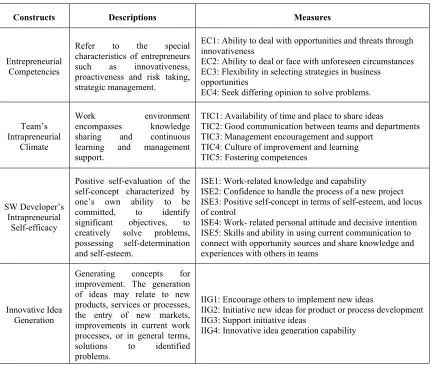
The survey included 18 items using 7 Likert-type scales (ranging from 1=strongly disagree to 7=strongly agree) to measure the core independent factor related to “entrepreneurial competencies”, dependent variable “innovative idea generation”, ten items for the positive effect on team intrapreneurial climate and intrapreneurial self-efficacy of software developers as mediating factors.
[image:5.612.86.520.112.486.2]In the process of developing the questionnaire, innovative ideas generation was measured by four items based on empirical studies and adapted from Unsworth et al. [27] and Hansen [28]. To measure entrepreneurial competencies, we benefited from
Table 1: Operational Definitions and Measures
Constructs Descriptions Measures
Entrepreneurial Competencies
Refer to the special
characteristics of entrepreneurs
such as innovativeness,
proactiveness and risk taking, strategic management.
EC1: Ability to deal with opportunities and threats through innovativeness
EC2: Ability to deal or face with unforeseen circumstances EC3: Flexibility in selecting strategies in business opportunities
EC4: Seek differing opinion to solve problems.
Team’s Intrapreneurial
Climate
Work environment
encompasses knowledge
sharing and continuous
learning and management
support.
TIC1: Availability of time and place to share ideas
TIC2: Good communication between teams and departments TIC3: Management encouragement and support
TIC4: Culture of improvement and learning TIC5: Fostering competences
SW Developer’s Intrapreneurial
Self-efficacy
Positive self-evaluation of the self-concept characterized by one’s own ability to be
committed, to identify
significant objectives, to
creatively solve problems,
possessing self-determination and self-esteem.
ISE1: Work-related knowledge and capability
ISE2: Confidence to handle the process of a new project ISE3: Positive self-concept in terms of self-esteem, and locus of control
ISE4: Work- related personal attitude and decisive intention ISE5: Skills and ability in using current communication to connect with opportunity sources and share knowledge and experiences with others in teams
Innovative Idea Generation
Generating concepts for
improvement. The generation of ideas may relate to new products, services or processes, the entry of new markets, improvements in current work processes, or in general terms,
solutions to identified
problems.
IIG1: Encourage others to implement new ideas
IIG2: Initiative new ideas for product or process development IIG3: Support initiative ideas
4617 the questionnaires developed by Zarefard and Cho [6] and Afsar et al. [29].
The scale for team intrapreneurial climate was developed based on Bulut and Alpkan [21] and Afsar et al. [29]. To evaluate employee’s intrapreneurial self-efficacy we modified some items slightly from entrepreneurial self-efficacy Zarefard and Cho [6] and adapted the scale proposed by Afsar et al. [29]. All items were translated and double-checked translation during the pretesting process.
3.3 Characteristics of Sample
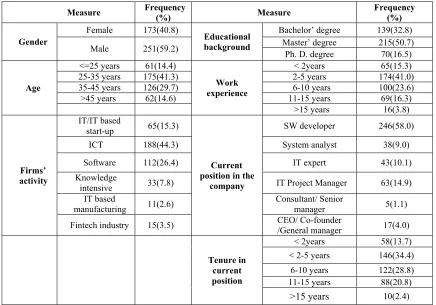
Descriptive statistics are used to describe the sample characteristics. Total 424 valid responses were used for statistical analysis. The demographic characteristics of respondents are as follows: Sex—251 male (59.2%) and 173 females (40.8%); Educational level—285 employees with a post graduate degree (67%) ; Age—less than or equal to twenty-five years old (14.4%), 175 between twenty-five and thirty-five years old (41.3%), 126 between thirty-five and forty-five years old (29.7%) and 62 above 45 (14.6%).
Most respondents fall between the “25-45” age-range (73.3%), majority of software developers in
the sample worked in ICT and software companies (70.7%); approximately 26.4 % worked in software companies and 7.7 % in knowledge intensive organizations.
Detailed characteristics of respondents are presented in Table 2.Demographics
3.4 Validity and Reliability
Exploratory factor analysis (EFA) and confirmatory factor analysis (CFA) was executed simultaneously to inspect validity of the measurement items compare with the variables offered in the theoretical framework. The results were very satisfactory enough. We could use all the measured variables to analysis the research model.
[image:6.612.88.524.135.440.2]Construct level reliability was examined by using Cronbach’s alpha and by composite reliability (CR). Internal consistency of scales is also calculated by Cronbach’s Alpha value, and composite reliability measured that how well constructs were measured by its assigned items [30].
Table 2. Demographics
Measure Frequency (%) Measure Frequency (%)
Gender
Female 173(40.8)
Educational background
Bachelor’ degree 139(32.8)
Male 251(59.2) Master’ degreePh. D. degree 215(50.7) 70(16.5)
Age
<=25 years 61(14.4)
Work experience
< 2years 65(15.3)
25-35 years 175(41.3) 2-5 years 174(41.0)
35-45 years 126(29.7) 6-10 years 100(23.6)
>45 years 62(14.6) 11-15 years 69(16.3)
>15 years 16(3.8)
Firms’ activity
IT/IT based
start-up 65(15.3)
Current position in the
company
SW developer 246(58.0)
ICT 188(44.3) System analyst 38(9.0)
Software 112(26.4) IT expert 43(10.1)
Knowledge
intensive 33(7.8) IT Project Manager 63(14.9)
IT based
manufacturing 11(2.6)
Consultant/ Senior
manager 5(1.1)
Fintech industry 15(3.5) CEO/ Co-founder /General manager 17(4.0)
Tenure in current position
< 2years 58(13.7)
< 2-5 years 146(34.4)
6-10 years 122(28.8)
11-15 years 88(20.8)
4618 Table 3 shows that the Cronbach’s alpha is higher than the required value of 0.6, and composite reliability is higher than the recommended 0.7 value [31]. The values in the Table 3 support the appropriateness of data for the statistical analysis procedure.
Table 3: Statistics of Reliability and Validity
Constructs EC TIC ISE IIG
Cor rela tion
EC 0.887
TIC 0.383 0.880
ISE 0.317 0.498 0.877
IIG 0.372 0.368 0.403 0.853
Mean 5.153 5.138 5.192 5.528
SD 0.977 1.032 0.983 0.946
CR 0.937 0.945 0.943 0.914
Cronhach’s
Alpha 0.910 0.927 0.925 0.875
Note1: The diagonals figures in bold indicate the average variances
extracted (AVE)
Note2: EC=Entrepreneurial Competencies, TIC=Team Intrapreneurial
Climate, ISE=Intrapreneurial Self-Efficacy, IIG= Innovative Idea Generation
4. ANALYSIS AND RESULTS
The model was analyzed using the two-step structural equation model using AMOS 24.0 program. First, a confirmatory factor analysis was performed to evaluate construct validity in the measurement model and then, hypothesized relationships test was conducted.
4.1 Measurement Model
To evaluate convergent validity, each item’s loading on its underlying construct should be over 0.70 [32]. In addition, the Average Variance Extracted (AVE) for each construct should be higher than the minimum recommended value 0.50 [33]. The observed values for the reliability estimates including the coefficient alphas, values of the AVE for each construct, and composite reliability in Table 1 are above the threshold level suggested by Nunnally [31], indicating a satisfactory result for model fit. Table 1 shows also the validity of constructs. The square root value of correlation between variables is less then AVE of corresponding variables. Thus, Table 3 shows that all the constructs are adequate, valid, and discriminant.
4.2 Structural Model
The result of fit indices of the structural model support a good overall model fit (Chi- Square=151.448, df =125, (χ2/df=1.221), competitive fit index (CFI) =0.995, Trucker-Lewis Index (TLI) =0.957, Goodness of Fit Index (GFI) =0.963, and Root Mean Square Error of approximation (RMSEA) = 0.023. The structural model involves estimating the path coefficient, which represents the strength of the relationship between the independent and dependent variables and R-squared, indicating the variance explained by the exogenous variables [32].
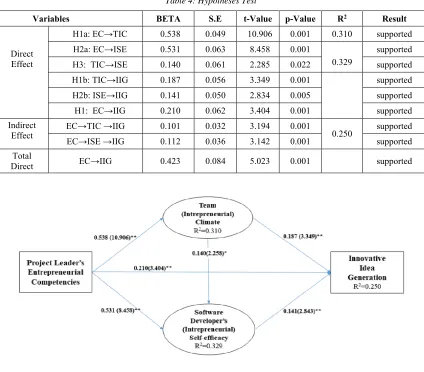
The results from testing the hypotheses, path coefficients and their related t-values are displayed in Table 4. The results demonstrated that there was a significant and positive relationship between entrepreneurial competencies of project leaders (EC) and project team’s intrapreneurial climate (B1a=0.538, p<0.01), also between entrepreneurial competencies and intrapreneurial self-efficacy (B2a=0.531, p<0.01). The independent variable strongly effects on the two mediating variables (TIC and ISE). The path coefficients from entrepreneurial competencies of project leaders to TIC and ISE demonstrating that the growth in EC are associated with the increase in TIC and ISE and had a very strong effect on both mediating variables.
Similarly, the path coefficients from project team’s intrapreneurial climate (TIC) to intrapreneurial self-efficacy (ISE) is 0.140 (p<0.01), showing a positive interaction between two variables. Hence, hypotheses H1a, H2a, H1b, and H2b were confirmed on each mediating variable to test whether the suggested mediators had effect on the innovative idea generation (IIG).
Results in Table 4 also revealed that entrepreneurial competencies of project leaders (EC) had a significant direct effect on the innovative idea generation (B1=0.21, p<0.01) as well as strong indirect effects (0.423, p<0.01).
4619 the end, approximately, 25% variance of innovative idea generation (IIG) (R2 = 0.250) is explained by all the precedent variables, EC, TIC, and ISE.
5. DISCUSSION AND CONCLUSIONS
This study identified the process of innovative behavior formation among employees by focusing on the effect of entrepreneurial competencies of project leaders on innovative idea generation. Idea generation is the first phase in the innovation process and is the entry gate to the whole process. Ideas generated by the SW developers of any organization are considered one of the main sources of the inflow of innovation ideas.
Research results highlighted leadership competencies as significant factors affecting the opportunity exploration and idea generation of
employees. Entrepreneurial leadership
competencies should cover all the management
layers of the organization, especially, middle managers like project leaders who have direct contacts with software developers. They get motivated when they can see that their manager or project leader is evaluating their ideas, monitoring the progress, showing interest even if it is just an idea.
[image:8.612.89.513.98.470.2]In many Iranian software organizations, CEOs attend innovation events and follow up on innovation ideas. They participate in forums and platforms discussing the progress of different ideas. They also support the piloting of different projects and mentor the innovators giving them guidance and sharing their experience and commercial background. However, the involvement and support of middle management remains as crucial as that of top management. Middle management must have more interaction with employees to listen to their ideas, challenge them, monitor, coach and motivate them.
Table 4: Hypotheses Test
Variables BETA S.E t-Value p-Value R2 Result
Direct Effect
H1a: EC→TIC 0.538 0.049 10.906 0.001 0.310 supported
H2a: EC→ISE 0.531 0.063 8.458 0.001
0.329
supported
H3: TIC→ISE 0.140 0.061 2.285 0.022 supported
H1b: TIC→IIG 0.187 0.056 3.349 0.001 supported
H2b: ISE→IIG 0.141 0.050 2.834 0.005 supported
H1: EC→IIG 0.210 0.062 3.404 0.001 supported
Indirect
Effect EC→TIC →IIG EC→ISE →IIG 0.101 0.112 0.032 0.036 3.194 3.142 0.001 0.001 0.250 supported supported
Total
4620 We also focused on the mediating role of intrapreneurial climate of project team and self-efficacy of team members. The results support the hypothesis of the influence of entrepreneurial competencies on innovative idea generation behavior as well as the two mediating variables’ role.
The effect of project team’s intrapreneurial climate on intrapreneurial self-efficacy was statically significant since, competencies of leaders provide both intrinsic and extrinsic motivation [19, 30] to generate ideas. The findings supported the previous evidences indicated that employees having higher degree of self-efficacy are more motivated to generate new ideas [22, 24] and would affect their motivation and confidence to overcome difficulties [26].
This research contributes to provide meaningful insights to the entrepreneurial competency and intrapreneurship literatures as well as theory building in the innovative behavior. From practical perspective, findings of our study provide clear guidelines to practitioners on paths to success in promoting intrapreneurship and creating innovative ideas among employees in ICTs. It increases the insights for fostering competencies of project leaders during the progressing from a junior level to senior level. From theoretical perspective, it offers a case model of intrapreneurial behavior in the field of ICTs, applying competency approach for leadership in team projects by promoting team climate and self-efficacy. It guides IT experts and managers for forming and developing successful innovative climate in teams and entrepreneurial competences of employees for effective innovative performance.
Finally, we introduced a new concept of intrapreneurial self-efficacy that is rarely considered in intrapreneurship studies. Team climate may serve adverse effects and can cause failure in some projects. However, our study addresses positive effects and emphasizes that entrepreneurial competencies of project leaders are necessary to create specific vision and motivation to lead individual to the level of maturity in innovativeness. Entrepreneurial competencies of project leaders should be taken into accounts when assigning them to ICT projects to stimulate intrapreneurial intention and behavior among followers. Concludingly, in project leaders’ development program, focusing on entrepreneurial competencies is more necessary than on only technical and managerial skills.
In the leadership theory, there is an implicit assumption that leaders can create valuable and
positive change in their followers. In the framework of this study, we assumed that entrepreneurial competencies as an attribute of leaders of innovative organizations are applicable for all subordinates.
Nevertheless, this study has several limitations. First, it used a non-random sample because of characteristics of social survey studies. The study was carried out on IT dominated sample in Iran. Thus, generalizations may not be appropriate to the entire industry and country. Before generalization of our findings more conclusively, additional research is required to be conducted in other countries, diverse firms, sectors, industries and cultural settings. It can be compared with different expertise contexts as well for the reliability of the findings.
The second is the focus on the employees’ perspective on the variables of the model. Multiple source methods to measure intrapreneurial behavior and other potential determinants of the behavior are recommended for future studies.
It would be beneficial to analyze the influence of other factors on intrapreneurial behavior, apart from the ones we have discussed relative to entrepreneurial leadership competencies, among employees. Although the results provided important outcomes of the effect of entrepreneurial leadership competencies on team entrepreneurial climate and self-efficacy, other factors influencing these variables can be included. Particularly, intrapreneurial self-efficacy that a few studies focused on its important effects on intrapreneurial activities.
Another potential limitation is concerned with data gathering method. Since this research is based on a self-reported questionnaire, a preferred method would be to base analysis on actual behavior in launching to achieve more accurate results. To develop our research more, we will continue to develop more extended research model and apply more diverse research methods.
REFERENCES:
[1] H. Schollhammer, “Internal Corporate
Entrepreneurship,” Encyclopedia of
Entrepreneurship, No.209, 1982, p. 223.
[2] B. Antoncic, and R. D. Hisrich, “Clarifying the Intrapreneurship Concept,” Journal of Small
Business and Enterprise Development, Vol.
10, No.1, 2003, pp. 7-24.
4621
Human Capital to Enhance Innovative
Performance,” Management Decision, Vol.
48, No. 5, 2010, pp. 732-755.
[4] S. A. Zahra, “A Conceptual Model of
Entrepreneurship as Firm Behavior: A
Critique and Extension,” Entrepreneurship
Theory and Practice, Vol. 17, No. 4, 1993,
pp. 5-21.
[5] J. Heinonen, and K. Korvela, “How about
Measuring Intrapreneurship,” Small Business
Institute, Turku School of Economics and Business Administration, 2003.
[6] M. Zarefard, and S. E. Cho, “Entrepreneurs' Managerial Competencies and Innovative Start-up Intentions in University Students: Focus on Mediating Factors,” International
Journal of Entrepreneurship, Vol. 22, No. 2,
2003.
[7] L. Geoghegan, and V. Dulewicz, “Do Project
Managers’ Leadership Competencies
Contribute to Project Success?,” Project
Management Journal, Vol. 39, No. 4, 2008,
pp. 58-67.
[8] R. H. Messinger, “Leadership Competencies for
Effective Global Innovation Teams,” Ph.D. Dissertation, University of Phoenix, Arizona: 2008.
[9] M. Zarefard, and S. E. Cho, “Relationship
between Entrepreneur’s Managerial
Competencies and Innovative Start-up Intentions in University Students: An Iranian
Case,” International Journal of
Entrepreneurship, Vol. 21, No. 3, 2017.
[10] J. S. Hornsby,D. F. Kuratko, and S. A. Zahra, “Middle Managers' Perception of the Internal Environment for Corporate Entrepreneurship: Assessing a Measurement Scale,” Journal of Business Venturing, Vol. 17, No. 3, 2002, pp.
253-273.
[11] C. Okuonzi, “Exposition of Competencies that Matter: An Owner-manager Perspective of Climacteric Leadership Competencies in Ugandan SMEs,” International Journal of
Technology and Management, Vol. 2, No. 1,
2017, pp. 1-18.
[12] H. H. Abdel Aziz, and A. Rizkallah, “Effect of Organizational Factors on Employees’ Generation of Innovative Ideas: Empirical Study on the Egyptian Software Development Industry,”Euro Med Journal of Business, Vol. 10, No. 2, 2015, pp.134-146.
[13] J. De Jong, S. K. Parker, S. Wennekers, and C. Wu, “Corporate Entrepreneurship at the
Individual Level: Measurement and
Determinants,” EIM Research Reports.
Zoetermeer: EIM, Vol. 11, No. 13, 2011.
[14] J. P. C. Rigtering, and U. Weitzel, “Work
Context and Employee Behavior as
Antecedents for Intrapreneurship,”
International Entrepreneurship and
Management Journal, Vol. 9, No. 3, 2013, pp.
337-360.
[15] A. Fontana, and S. Musa, S., “The Impact of Entrepreneurial Leadership on Innovation
Management and Its Measurement
Validation,” International Journal of
Innovation Science, Vol. 9, No. 1, 2017, pp.
2-19.
[16] R. D. Ireland, and J. G. Covin, and D. F.
Kuratko, “Conceptualizing Corporate
Entrepreneurship Strategy,” Entrepreneurship
Theory and Practice, Vol. 33, No. 1, 2009,
pp. 19-46.
[17] E. Kyndt, and H. Baert, “Entrepreneurial Competencies: Assessment and Predictive Value for Entrepreneurship,” Journal of
Vocational Behavior, Vol. 90, 2015, pp.
13-25.
[18] T. Vargas-Halabí, R. Mora-Esquivel, and B. Siles, “Intrapreneurial Competencies:
Development and Validation of a
Measurement Scale,” European Journal of
Management and Business Economics, Vol.
26, No. 1, 2017, pp. 86-111.
[19] C. Ebert, and P. De Neve, “Surviving Global
Software Development,” IEEE software, Vol.
18, No. 2, 2001, pp. 62-69.
[20] M. Basadur, “Leading Others to Think Innovatively Together: Creative Leadership,”
The Leadership Quarterly, Vol. 15, No. 1,
2004, pp. 103-121.
[21] C. Bulut, and L. Alpkan, “Behavioral Consequences of an Entrepreneurial Climate within Large Organizations: An Integrative
Proposed Model,” The South East European
Journal of Economics & Business, Vol. 1, No.
2, 2006, pp. 64-70.
[22] J. C. Hayton, and D. J. Kelley, “A Competency‐based Framework for Promoting
Corporate Entrepreneurship,” Human
Resource Management, Vol. 45, No. 3, 2006,
pp. 407-427.
[23] D. M. Hechavarria, M. Renko, and C. H. Matthews, “The Nascent Entrepreneurship Hub: Goals, Entrepreneurial Self-efficacy and
Start-up Outcomes,” Small Business
Economics, Vol. 39, No. 3, 2012, pp.
4622 [24] P. Skarzynski, and R. Gibson, Innovation to
the Core, Harvard Business School Press,
Boston: 2008.
[25] V. Gupta, I. C. MacMillan, and G. Surie, “Entrepreneurial Leadership: Developing and Measuring a Cross-cultural Construct,”
Journal of Business Venturing, Vol. 19, No. 2,
2004, pp. 241-260.
[26] M. Renko, A. E. Tarabishy, A. L. Carsrud, and
M. Brännback, “Understanding and
Measuring Entrepreneurial Leadership Style,”
Journal of Small Business Management, Vol.
53, No.1, 2015, pp 54-74.
[27] K. L. Unsworth, H. Brown, and L. McGuire, “Employee Innovation: The Roles of Idea Generation and Idea Implementation,” In Proceedings of the Annual Conference of the Society for Industrial and Organizational
Psychology, New Orleans, 2000.
[28] M. T. Hansen, and J. Birkinshaw, “The Innovation Value Chain,” Harvard Business
Review, Vol. 85. No. 6, 2007, p. 121.
[29] B. Afsar, B., Y. F. Badir, B. Saeed, and S. Hafeez, “Transformational and Transactional Leadership and Employee’s Entrepreneurial Behavior in Knowledge–intensive Industries,”
The International Journal of Human Resource
Management, Vol. 28, No. 2, 2017, pp.
307-332.
[30] O. Götz, K. Liehr-Gobbers, and M. Krafft, “Evaluation of Structural Equation Models Using the Partial Least Squares (PLS)
approach,” Handbook of Partial Least
Squares, Springer, 2010, pp. 691-711.
[31] J. Nunnally, Psychometric Methods, New York: McGraw-Hill, 1978.
[32] W. W. Chin, and J. Dibbern, J, “How to Write
up and Report PLS Analyses,” Handbook of
Partial Least Squares, Springer, 2010, pp.
655-690.
[33] R. P. Bagozzi, and Y. Yi, Y, “On the Evaluation of Structural Equation Models,”
Journal of the Academy of Marketing Science,